It was a warm, humid 62F when we left Los Templarios at 6:35 this morning. Our first rest/breakfast stop was a little more than 2 miles down the path, in Moratinos.
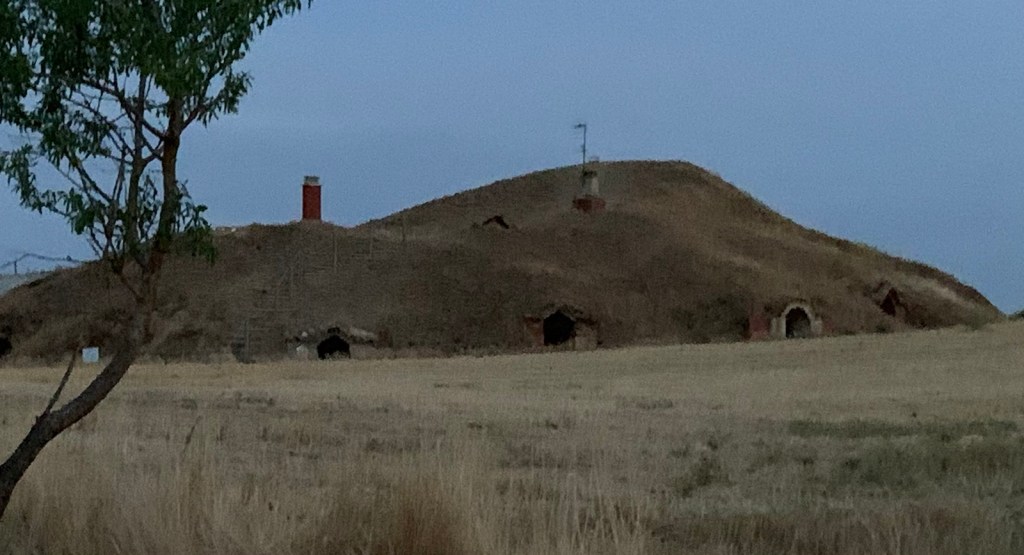
our first breakfast stopan above-ground “wine cellar” in the field across from the bar.
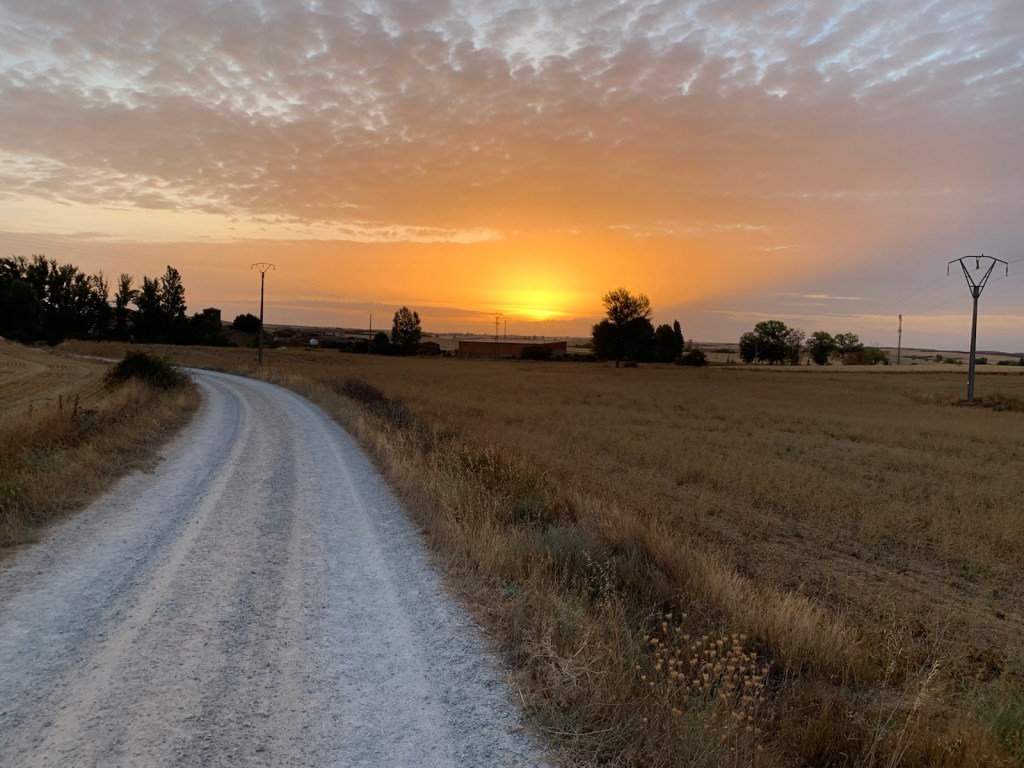
Shortly after, while walking to the next hamlet, we looked over our shoulder and saw a nice sunrise.
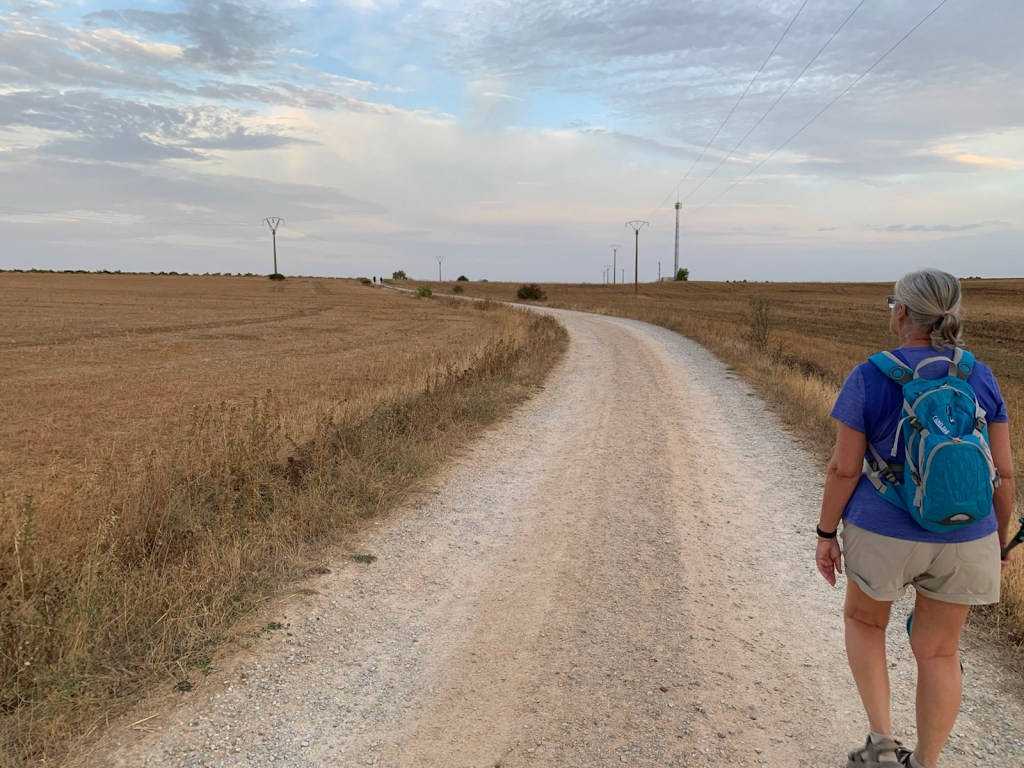
familiar looking scenery, still on the meseta.
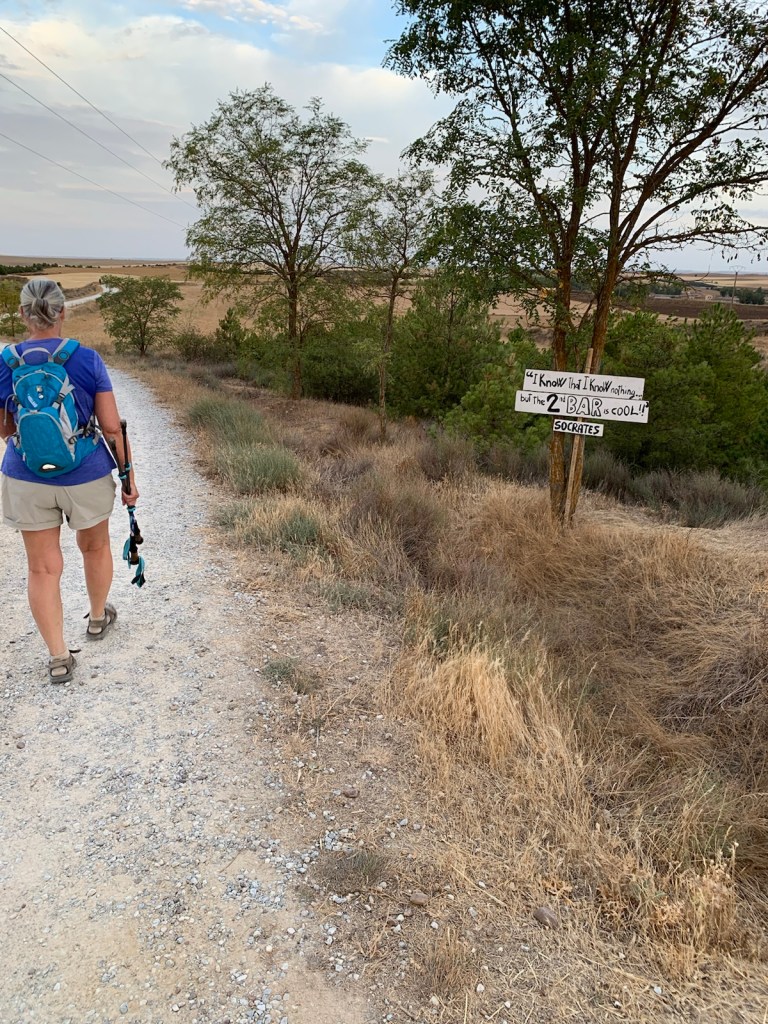
Another two miles later, we made our second rest/breakfast stop. Before arriving in San Nicolas del Real Camino, we passed a sign regarding one of the two bars/ albergues in the hamlet.
Advertising on the Camino
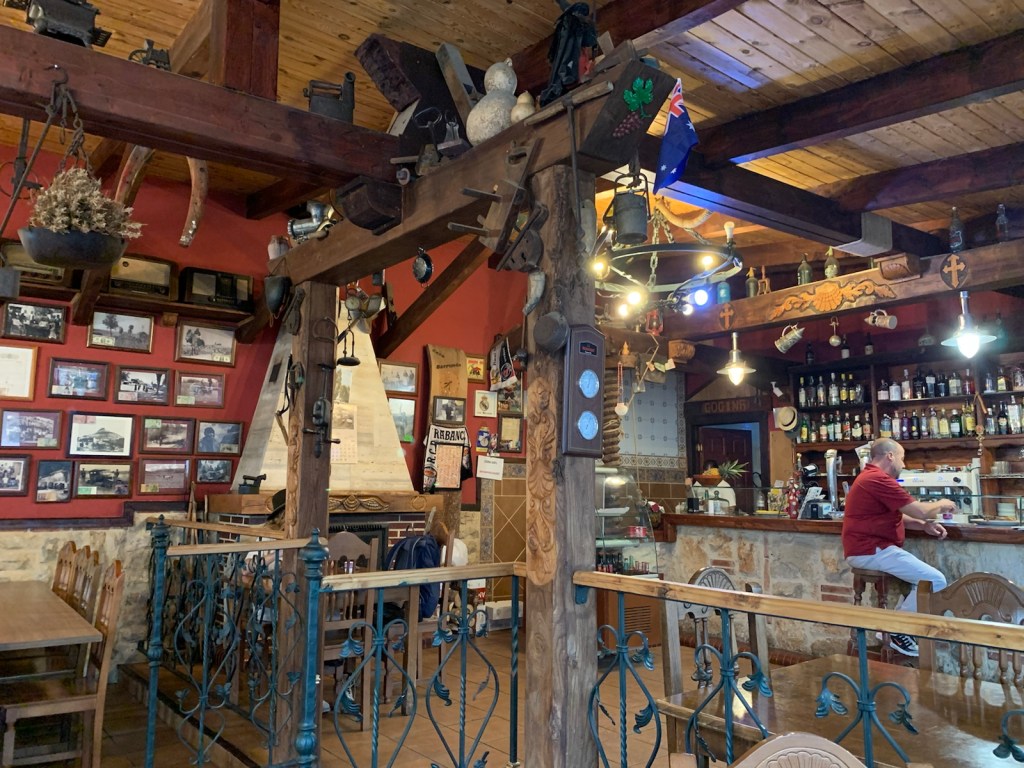
We stopped at the first bar, a favorite, from prior Caminos. We have stayed in the albergue (2014) of bar number 2 and eaten there also Both bars have good food, based on our experience.
this is the first bar, not referred to in the sign attribution to Socrates.
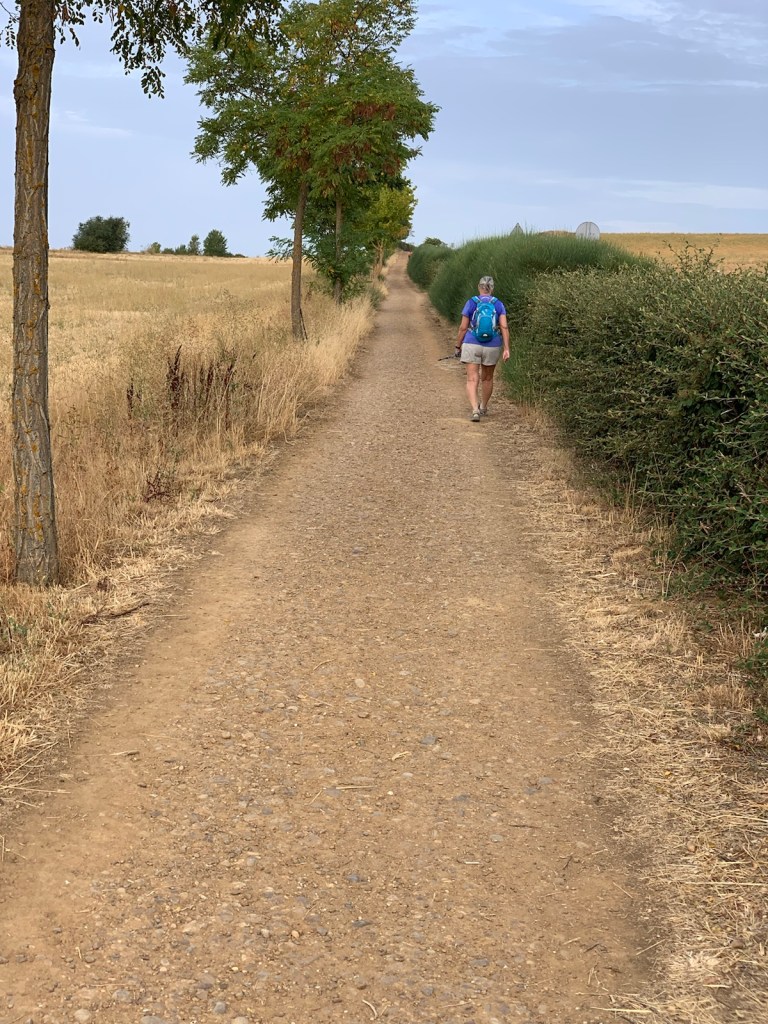
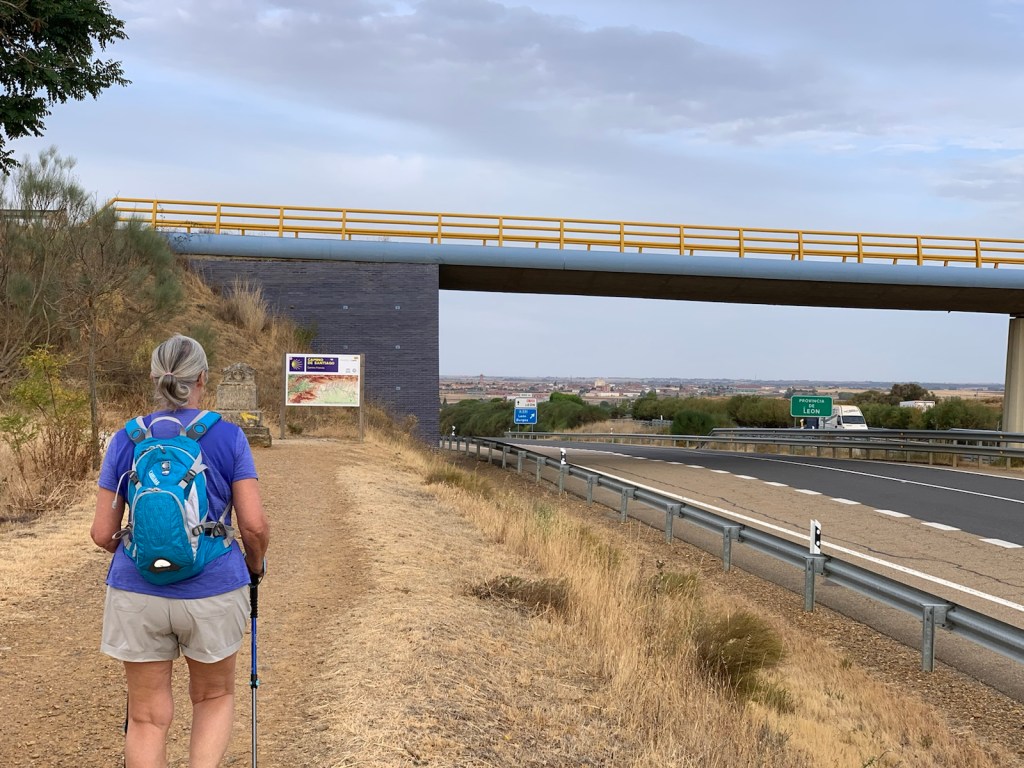
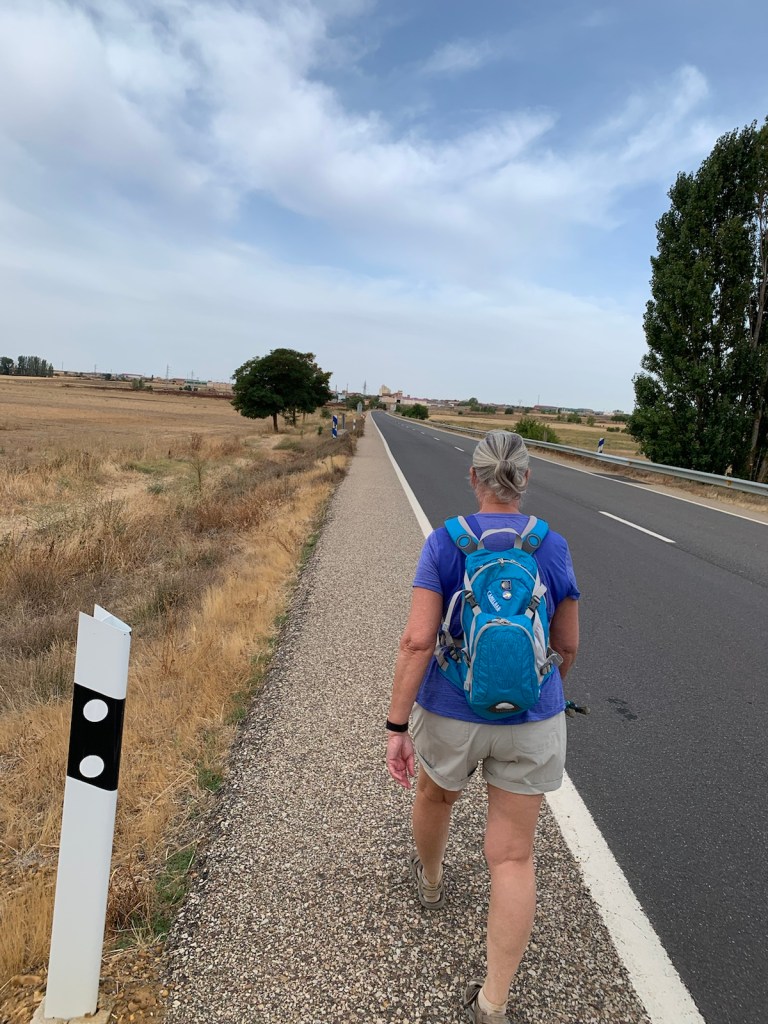
Just outside of San Nicolas…., the Camino pulled alongside of N-120, going into Sahagún. We then walked the next 4 miles, arriving at our hotel at 10:40 and check-in.
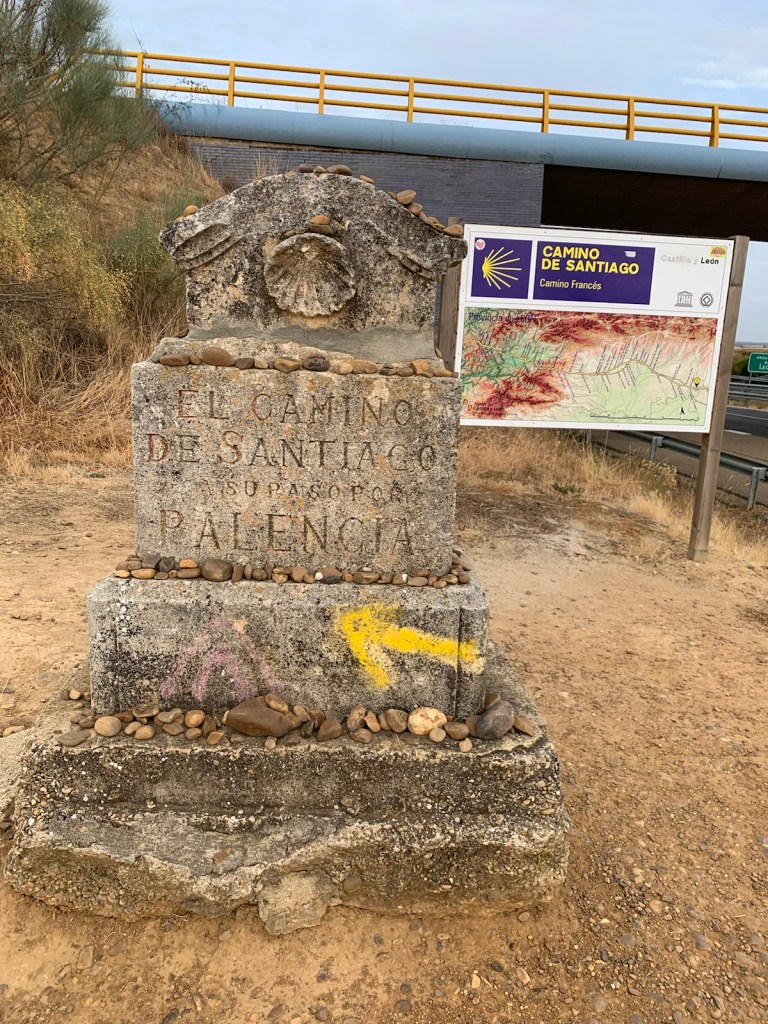
Camino becoming a path along N-120decent walking surface, gradual inclineApproaching Sahagún (in the background, 2 miles away)milepost marking leaving province of Palencia and entering Castile and Leon.final mile stretch on shoulder of N-120
Our room was still being cleaned, so we waited on the hotel terrace until 12:00, when we accessed our room and began unloading and organizing our stuff for the afternoon and evening.
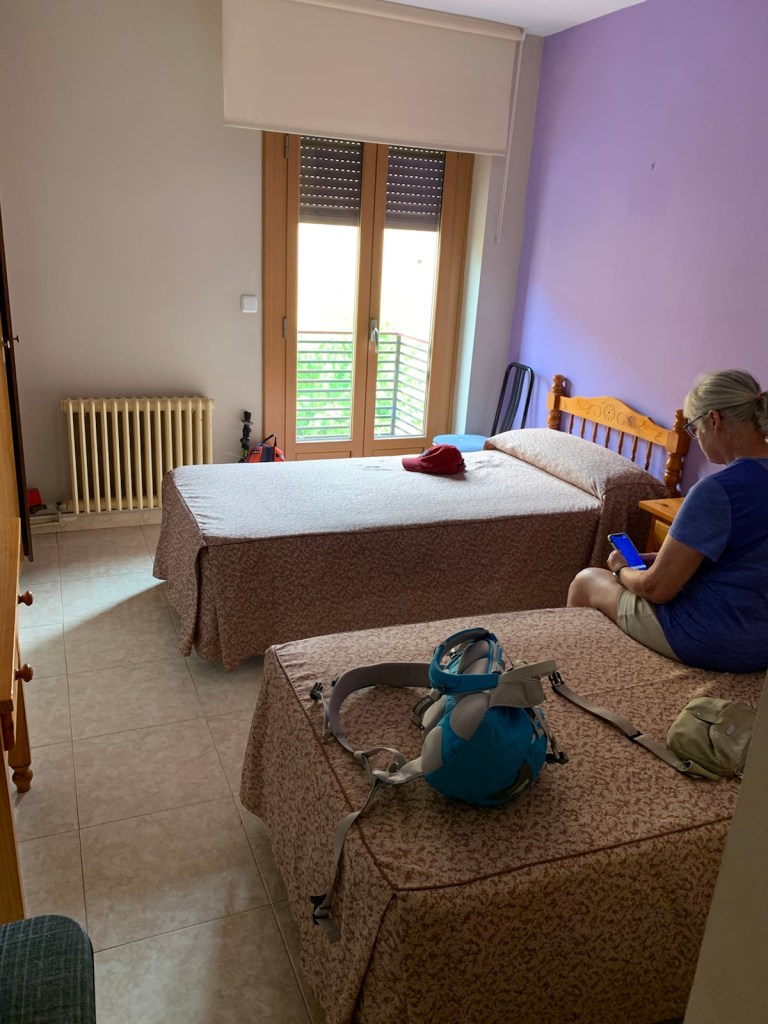
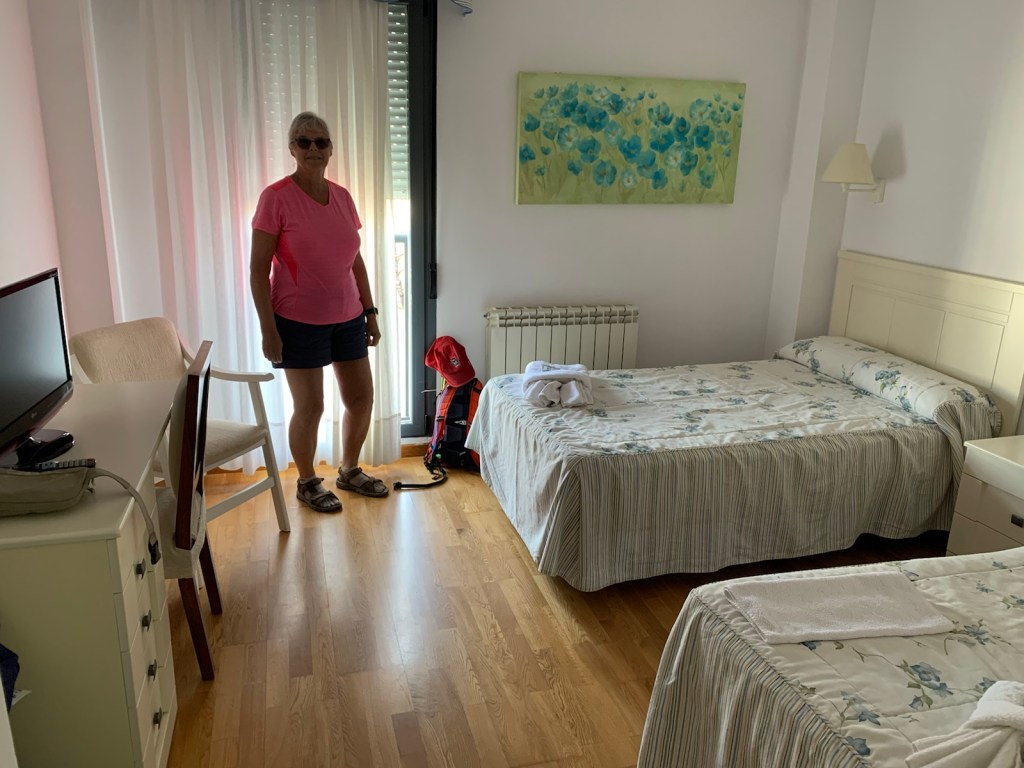
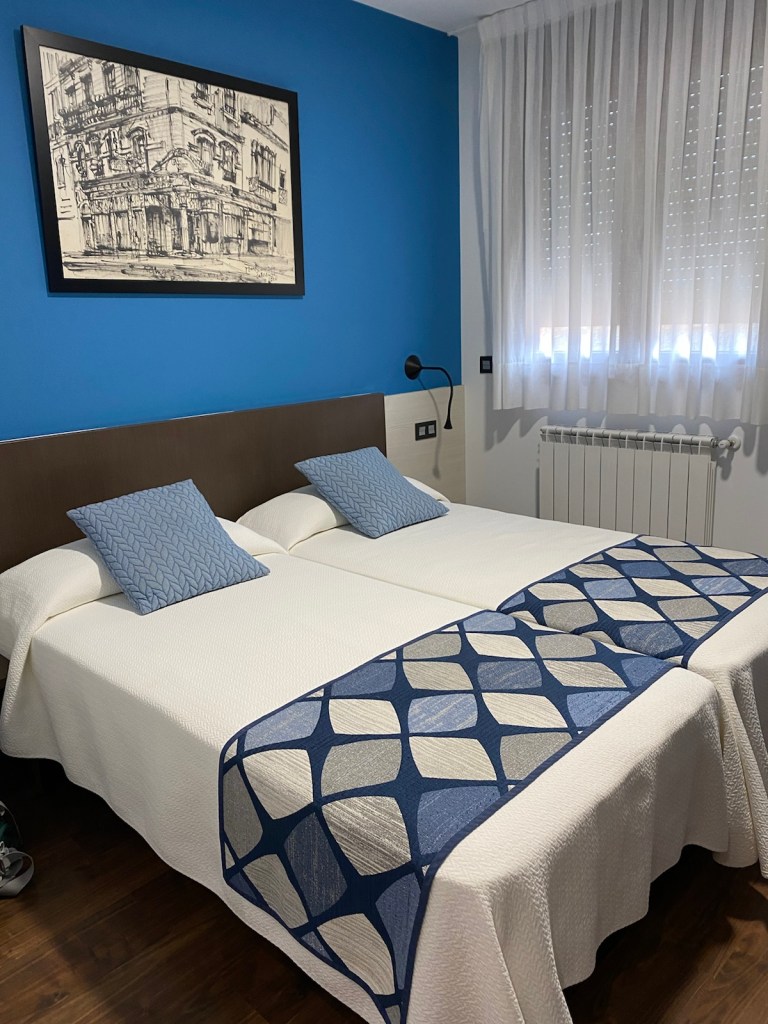
Our room meets our basic needs: twin beds, ensuite bathroom, clean, on or close to the Camino.
We decided to walk 7 minutes to a supermarket to gather some snacks for the next several days. By then, it was 1:30, so we took a seat in the hotel dining room for our main meal of the day.
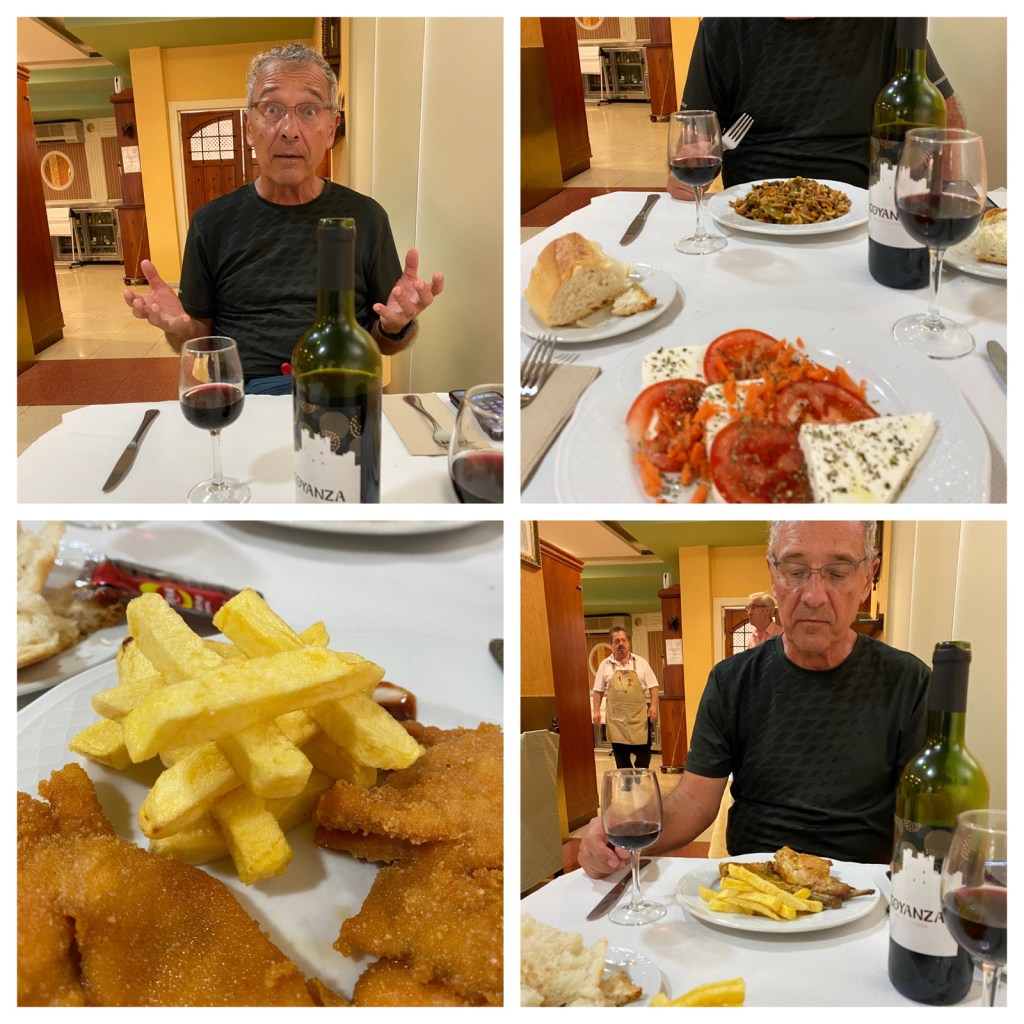
The owner/ waiter brought us a menu in the form of scribblings on a small piece of paper, and proceeded to go down the list quickly in Spanish (did we mention that people around here are all fluent in Spanish, for some reason, and mostly assume everyone else is too?) making it clear by demonstrating on our first question, that all responses were going to be in even faster Spanish. Jim, whose stomach growl could be heard by Linda, chose something with included the word pasta for his 1st course, and after asking about the last item on the list and understanding nothing.,. said he’d take that one. Linda followed a similar approach picking an item with tomato in the description and the word pollo (chicken).
1-Jim has no clue after ordering, 2-success on first course: delicious multi-veggie pasta with brown sauce for Jim, sliced tomatoes with basil & olive oil on fresh cheese for Linda 3-second course:fried chicken & “Lincoln log”? fries for L., baked wing and breast of something that flies. and fries for J.
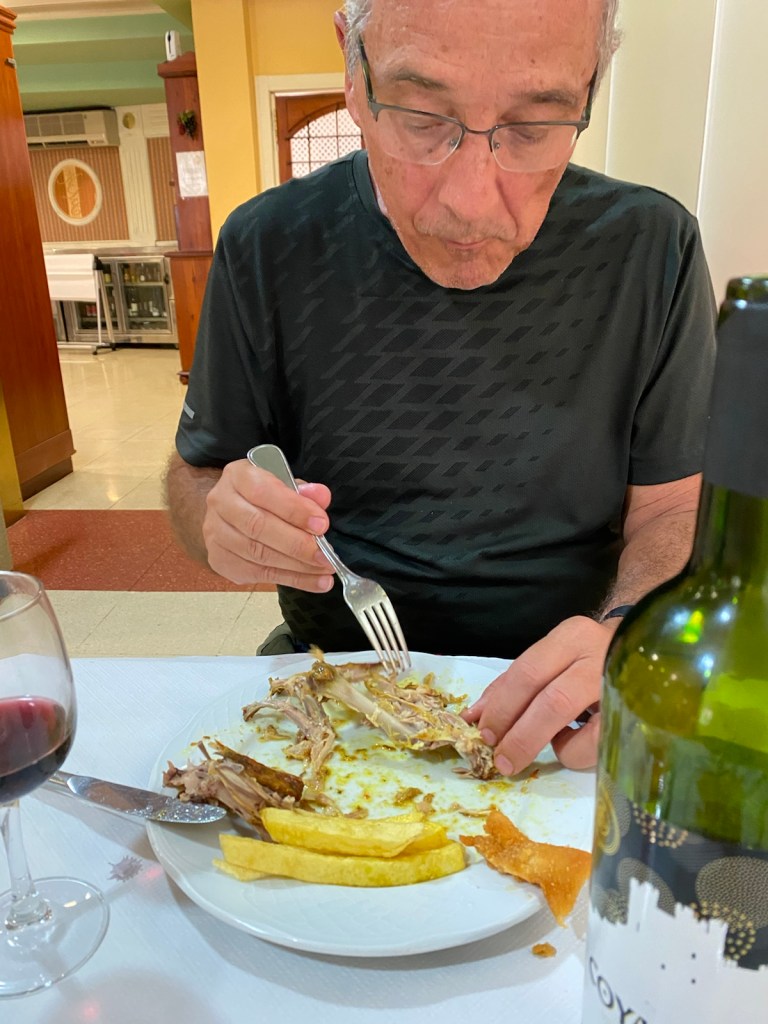
So, what was the verdict on Jim’s mystery selection for course 2?
cleaned to the bone, literally… yum!
What do you think?
The rest of the day was spent napping, blogging, etc. Long walk, feeling strong, having fun on the Camino Frances.
After walking in the dark for nearly a half-hour, the scenery around us was still the same as yesterday.
“campos“ all around us
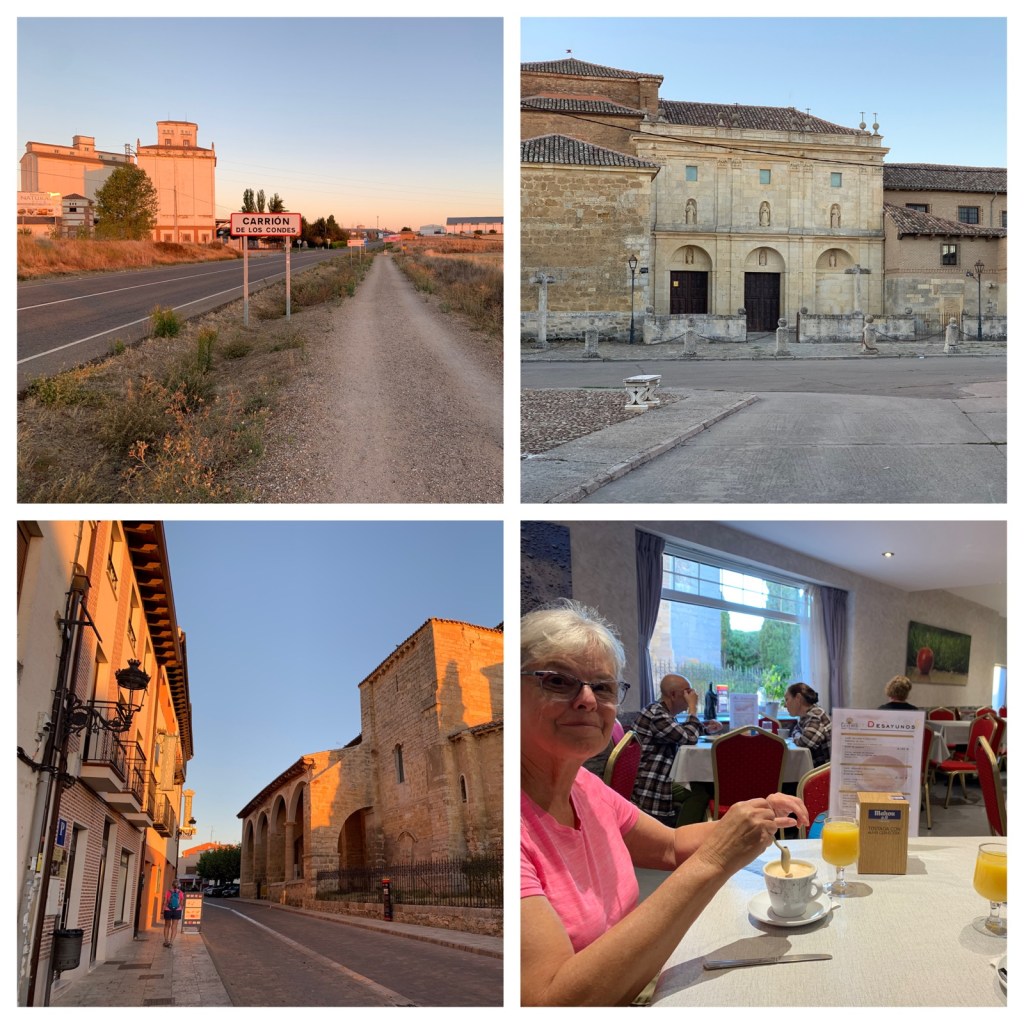
We reached Carrion de los Condes after 3.5 miles and stopped for breakfast at La Corte, a very nice restaurant/albergue.
Entering Carrion de los Condes (upper left), Santa Clara Monastery, La Corte, our place for breakfast… across the street from Iglesia de Santa María and desayuno ( breakfast) at La Corte.
We’ve had two dinners and now, two breakfasts here. As soon as we finished eating, we asked the waiter to please call us a taxi, which arrived at 8:30.
The driver took us to Calzadilla de la Cueza, which is located at the end of the walk from Carrion, which offers 11 miles with no shade and no services… one of the longest stretches without a town on the Camino Frances.
just after leaving Calzadilla de la Cueza
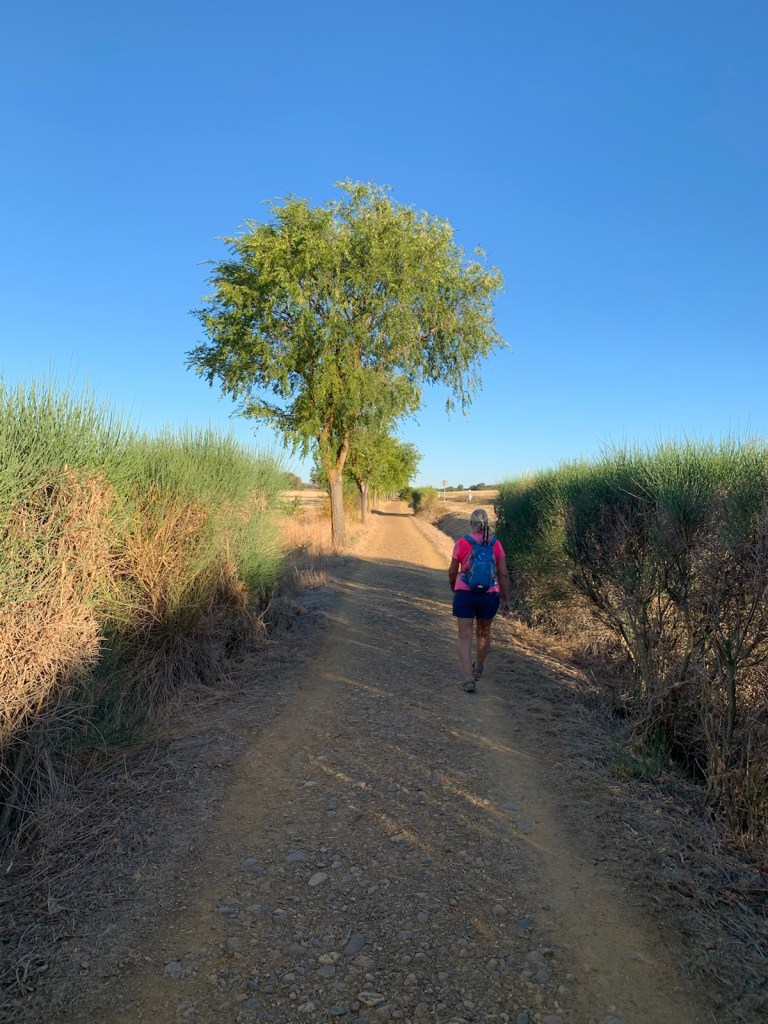
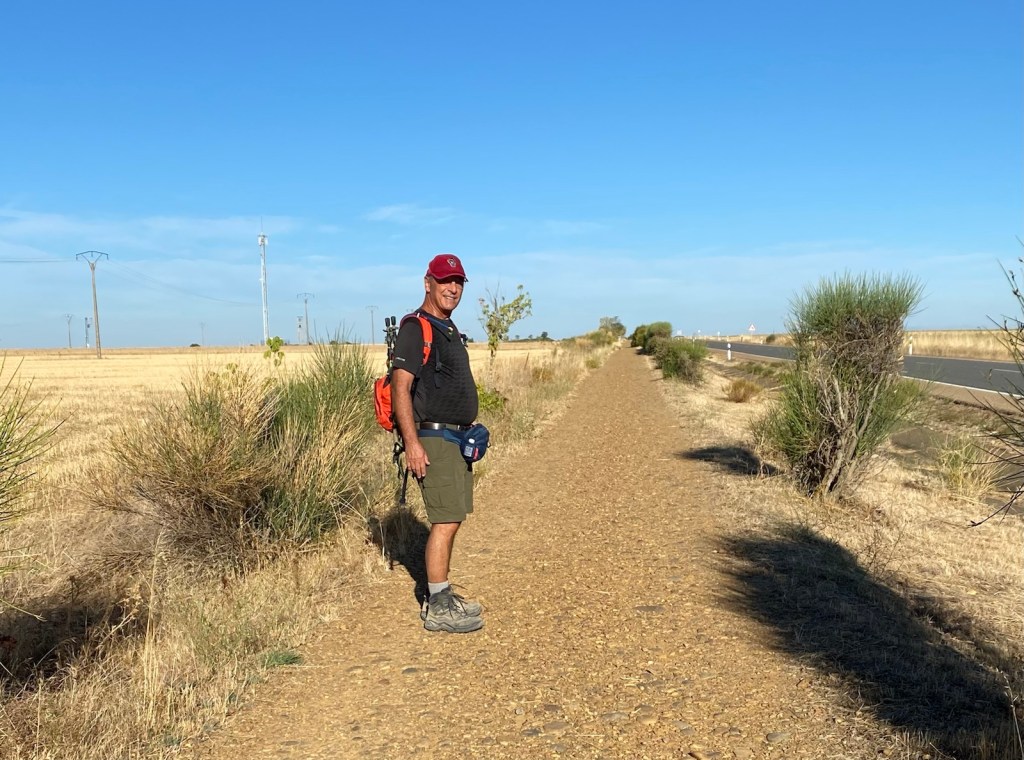
The next 3 plus miles were quite pleasant. Even though we walked along a two lane, lightly traveled road the entire way, the natural shrubs and trees mostly blocked our view of the road and provided ample shade to mitigate the ever increasing heat from the sun.
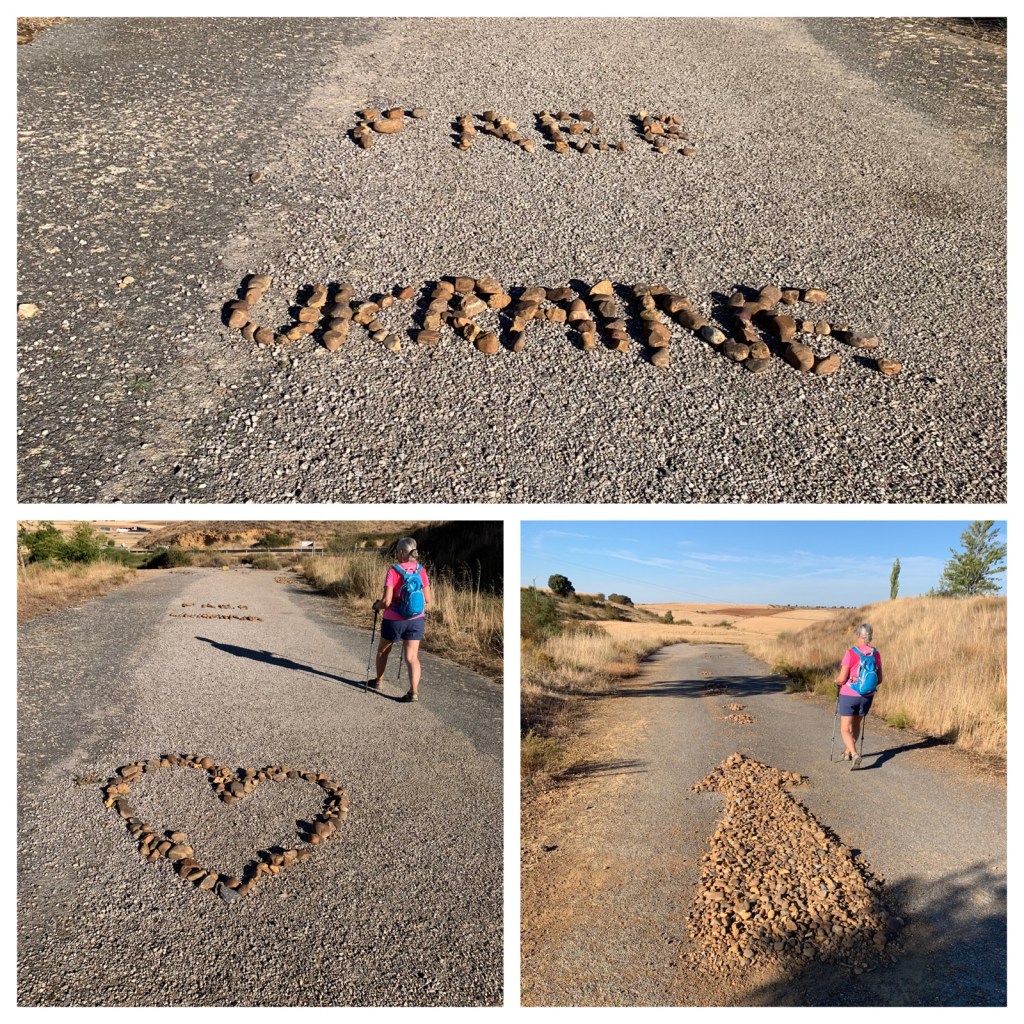
Just after leaving the dirt path before entering Ledigos, we encountered some nice pilgrim art, created from nearby stones.
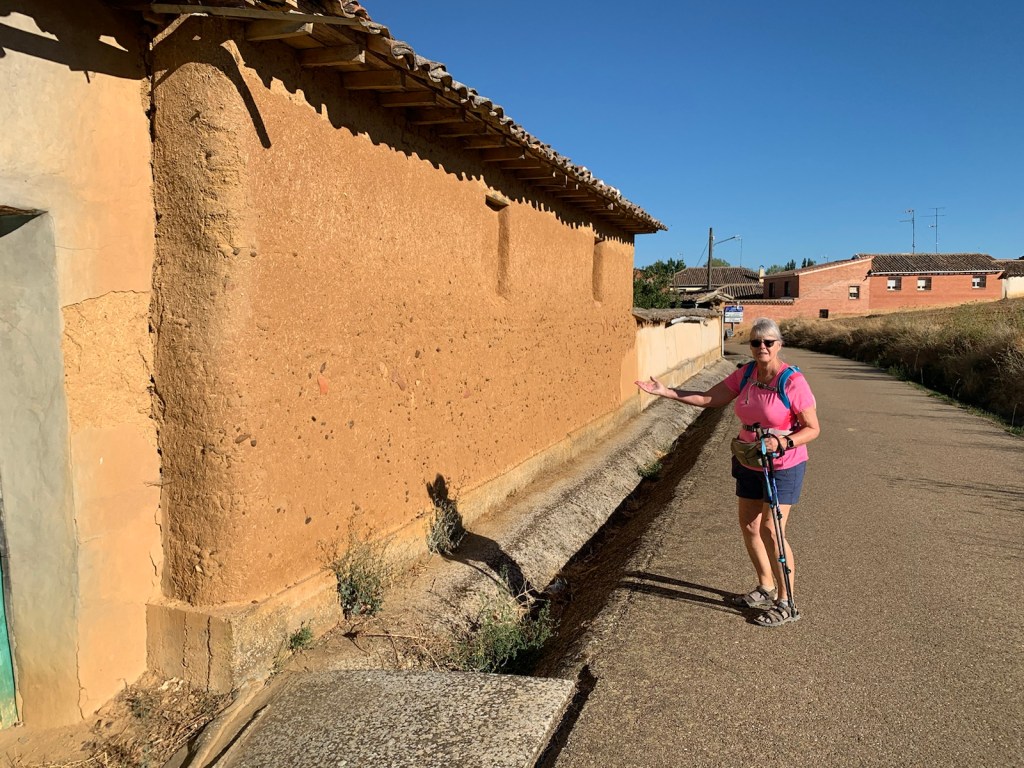
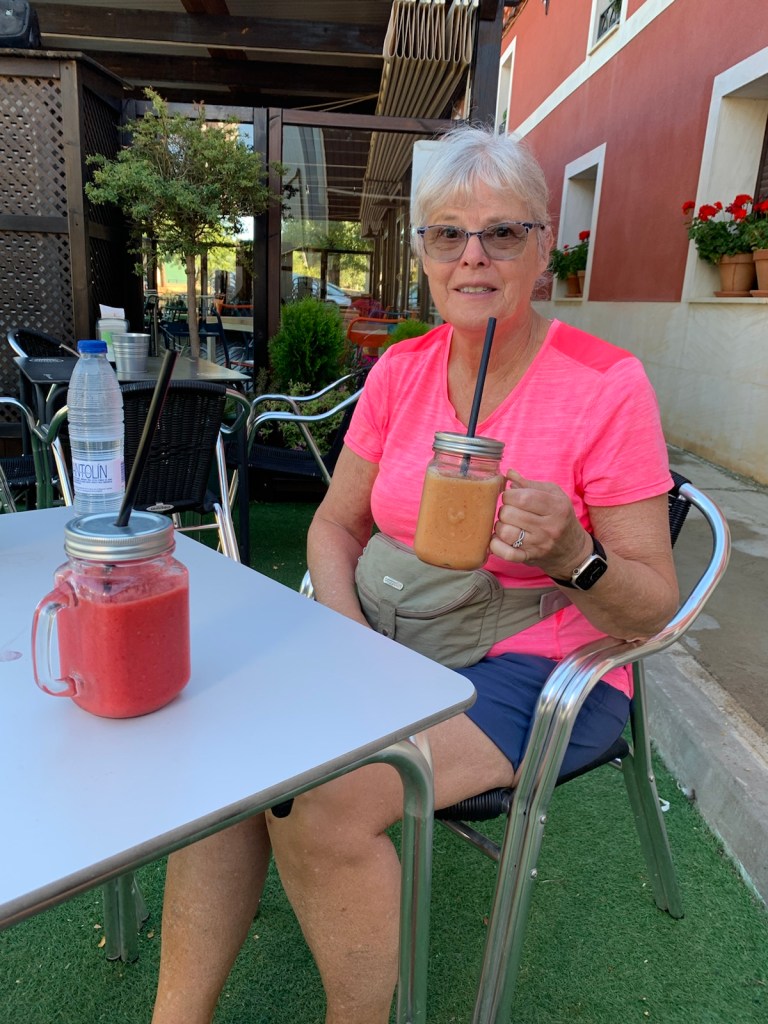
Ledigos is a very small village with brick and adobe buildings. Nevertheless, it has two nice albergues. It was nearly 11:00 so we stopped at the newest one and had “smoothies”!
Smoothies, to give us an extra boost for the final stretch.
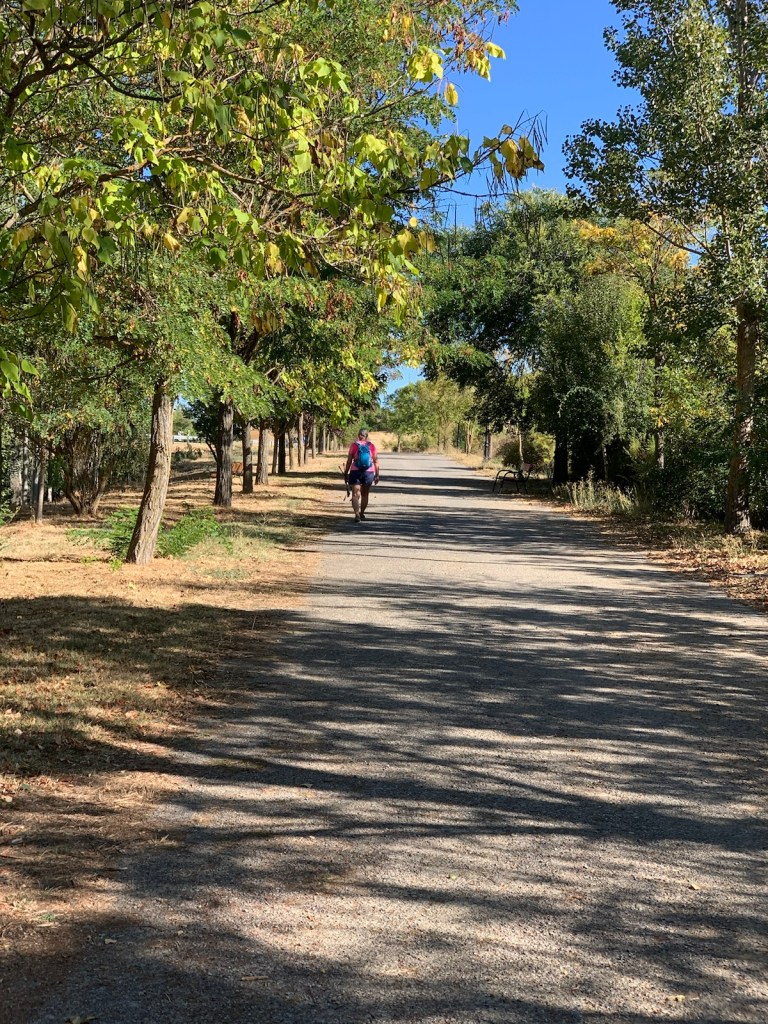
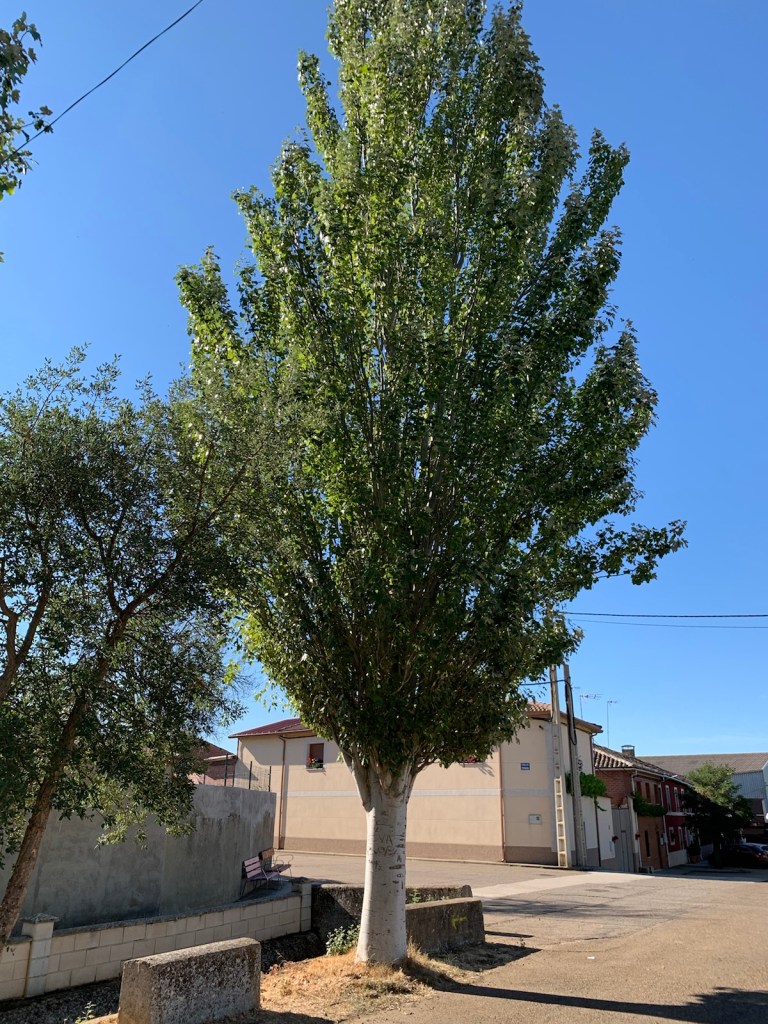
The walk out of Ledigos was beautiful. A huge birch tree also captured our attention on the way out.
… walking out of Ledigoson our way to Terradillos de los Templarios
Albergue Los Templarios was not open until noon, so we made ourselves at home on the front porch (in the shade) and discovered the wifi was strong and the password was the same as 2019 (both our phones remembered).
At 11:50, the owner opened the front door, welcomed us inside and we were soon in our room.
our room ( 42€ )
We took advantage of the laundry service to wash our clothes (4€) and we hung them out to dry ourselves.
Front of the albergue and rear where we hung clothes to dry (took about 2 hours)lunch (7.50€)
We had ensalada mixta’s for lunch. The afternoon was spent enjoying the property. We had nice chats with two guys, both retired, from Stuttgart, Germany and a British couple currently working in Madrid. They were both nurses, walking their first Camino. We talked about our recent Camino experiences and their experiences working in medical facilities during the pandemic.
We had a dinner in the albergue dining room and retired to our room at 8:30.
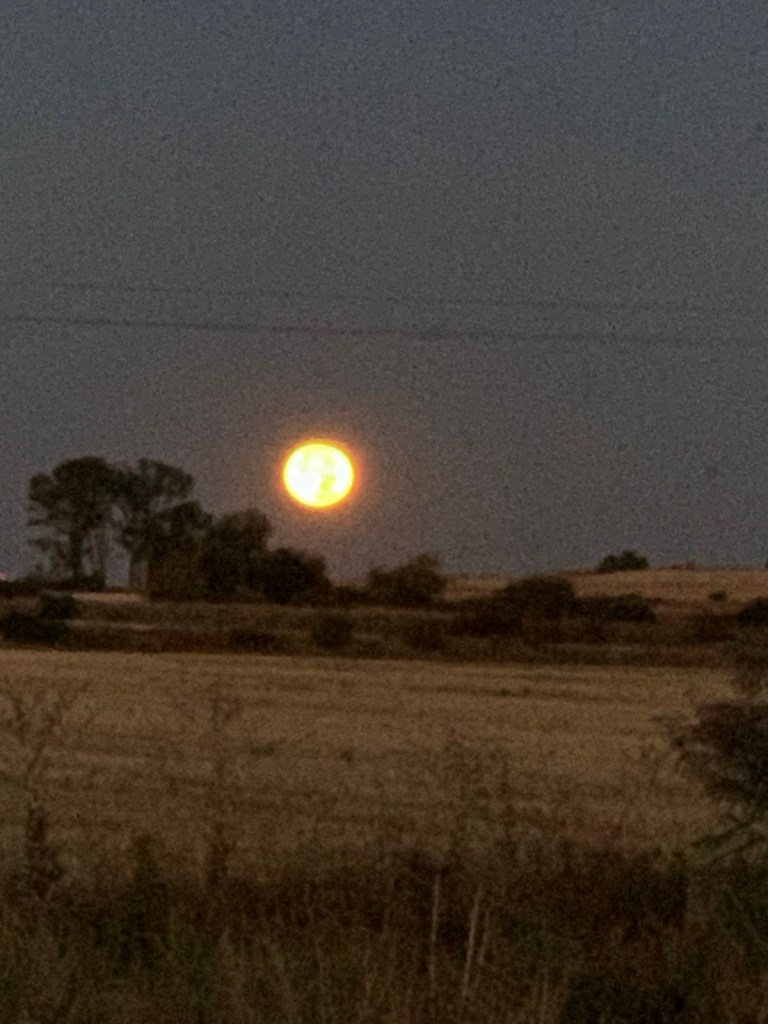
We began the day with a “moon set”… and a sunrise a half-hour later… not photo worthy.😉.
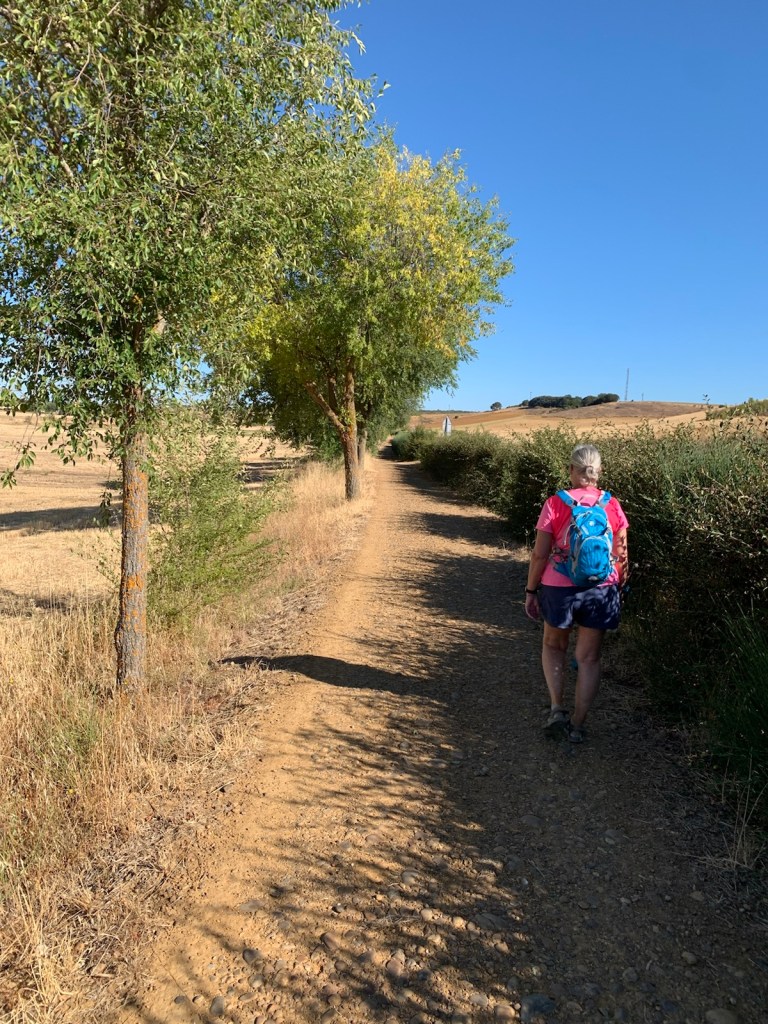
Most of the villages we’ve encountered yesterday and today end with Compos, “fields” in Spanish. After walking along a two lane paved road with light vehicle traffic but relatively heavy pilgrim traffic for couple of miles we passed quickly through Revenga en Campos, then back along the road. (Note: cyclist pilgrim pulling good size cart behind)
Aporoaching Revenga
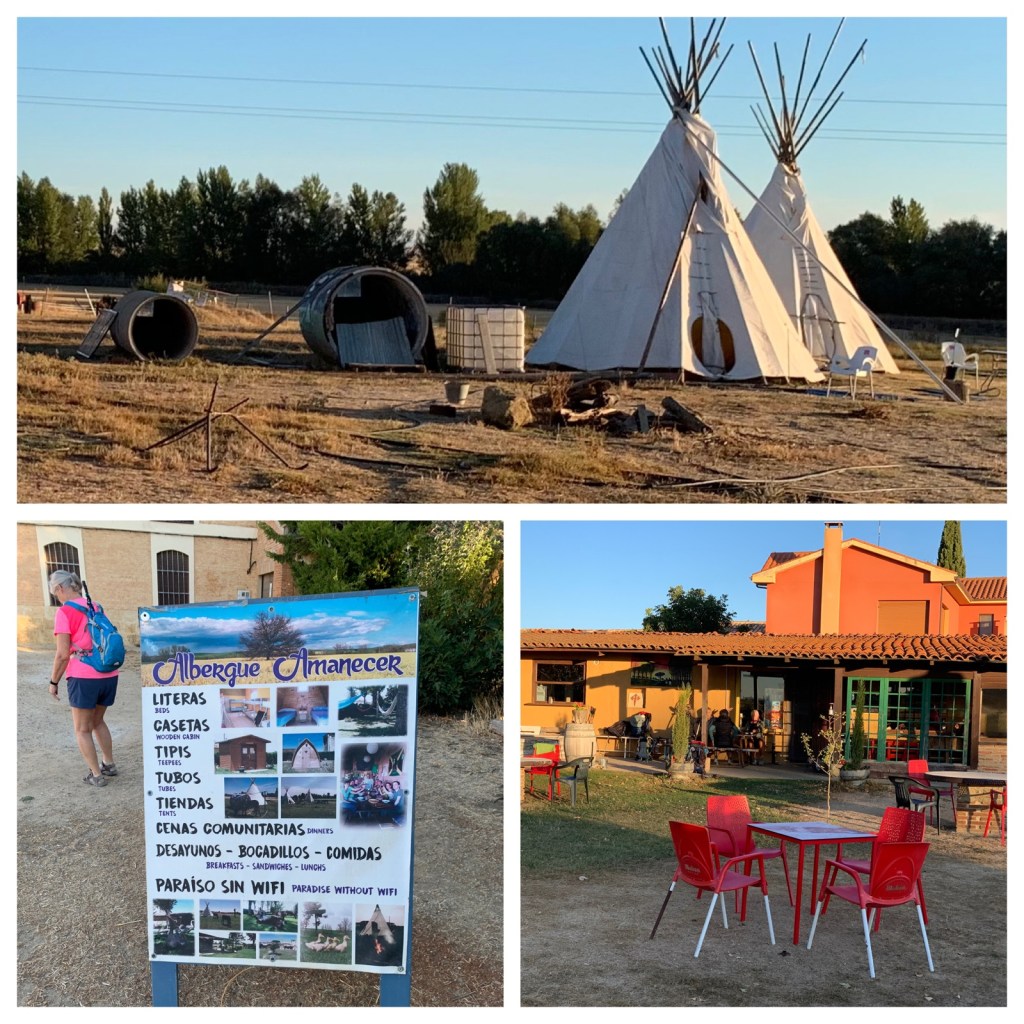
Next, we approached Villarmentero de Campos. It being about breakfast time, we saw an intriguing sign and decided to make a stop.
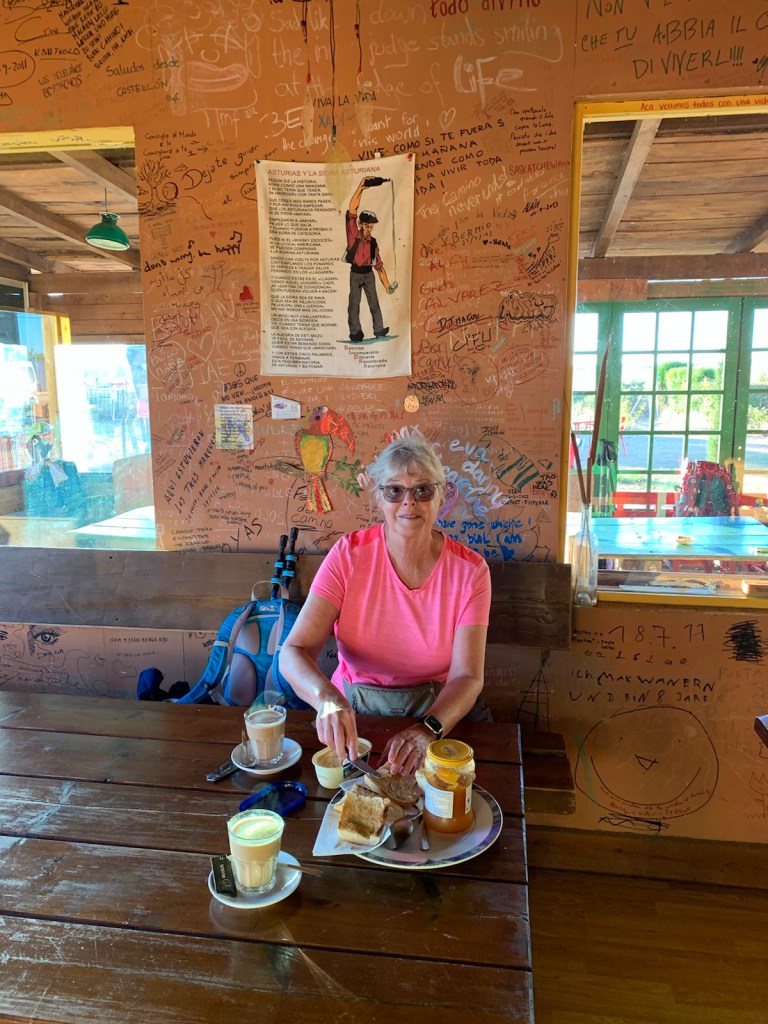
approaching Villarmentero de CamposOur breakfast stop in Albergue Amenecer Our standard breakfast in an anything but standard albergue.
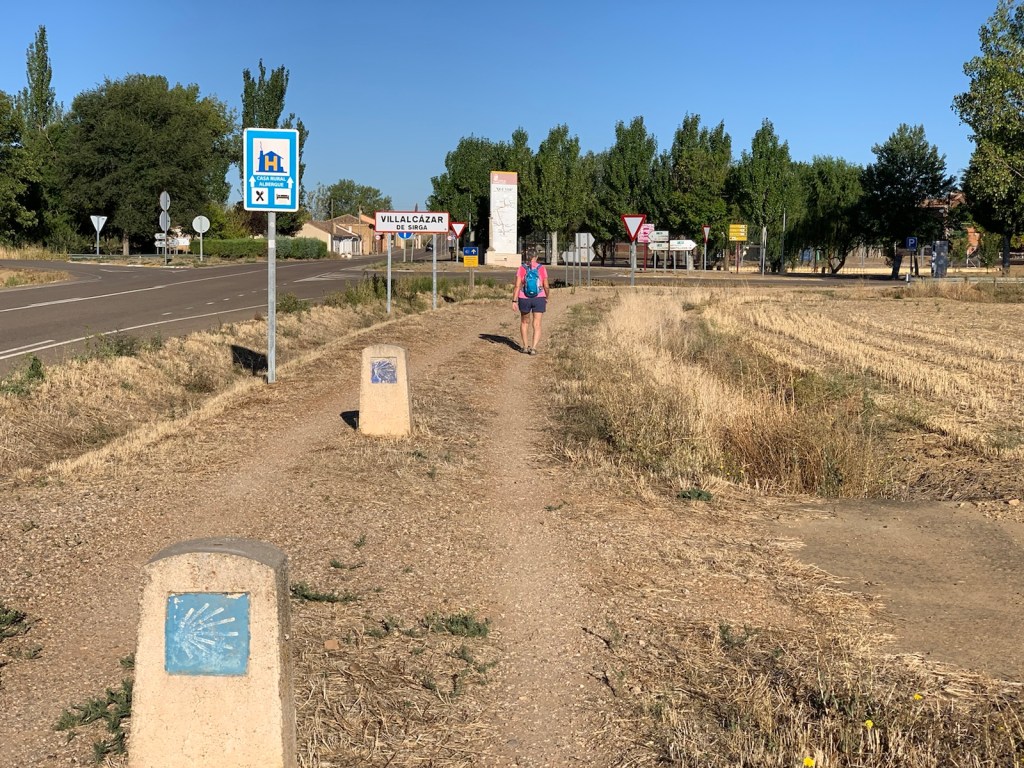
We returned to the road and “campos” and walked another 3 miles to Villalcazar de Sirga.
approaching Villalacazar de Sirga
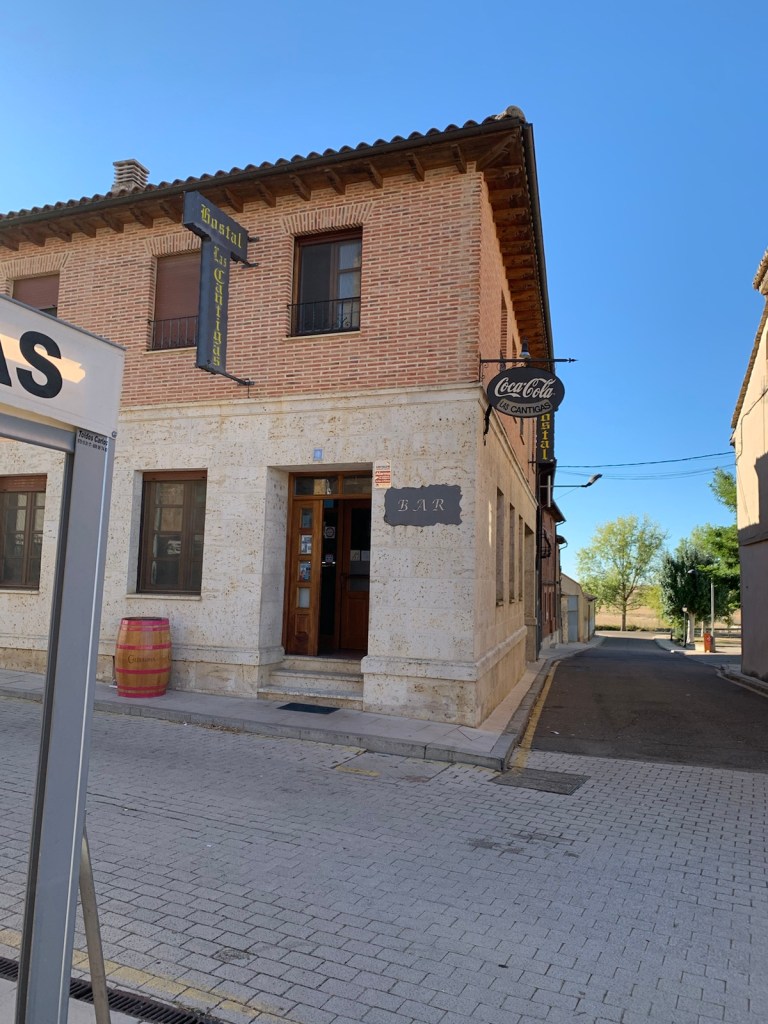
We waited comfortably in the La Cantigas Bar terrace until our room was ready.
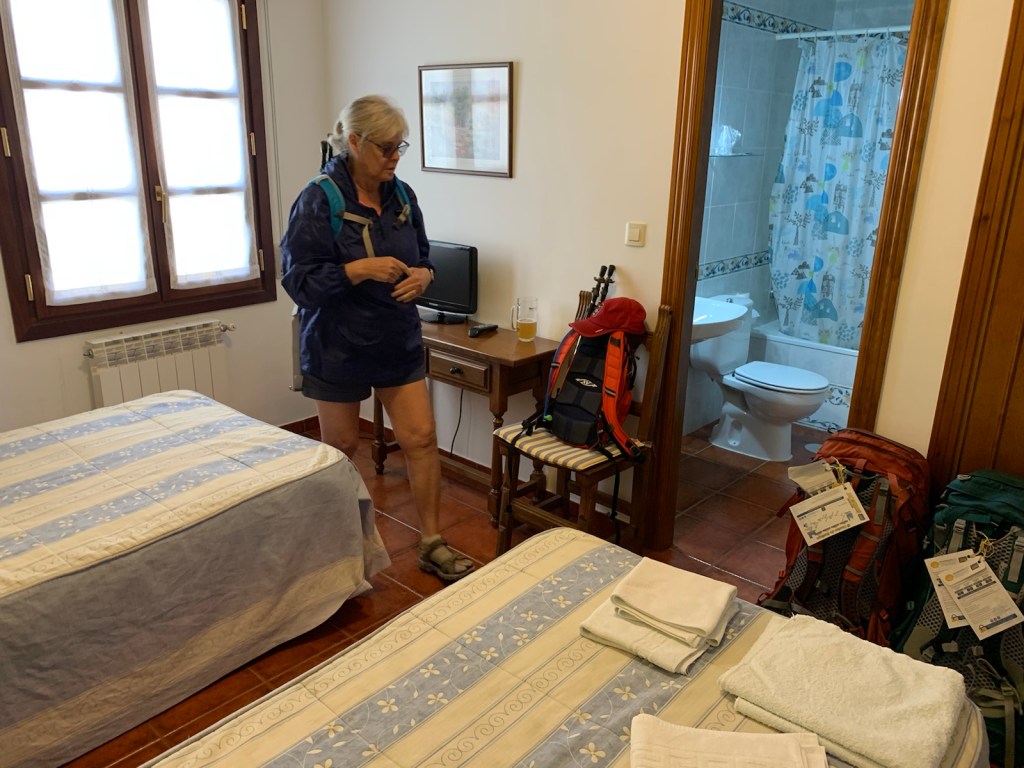
Our hotel for the night, Las Cantigasnice room
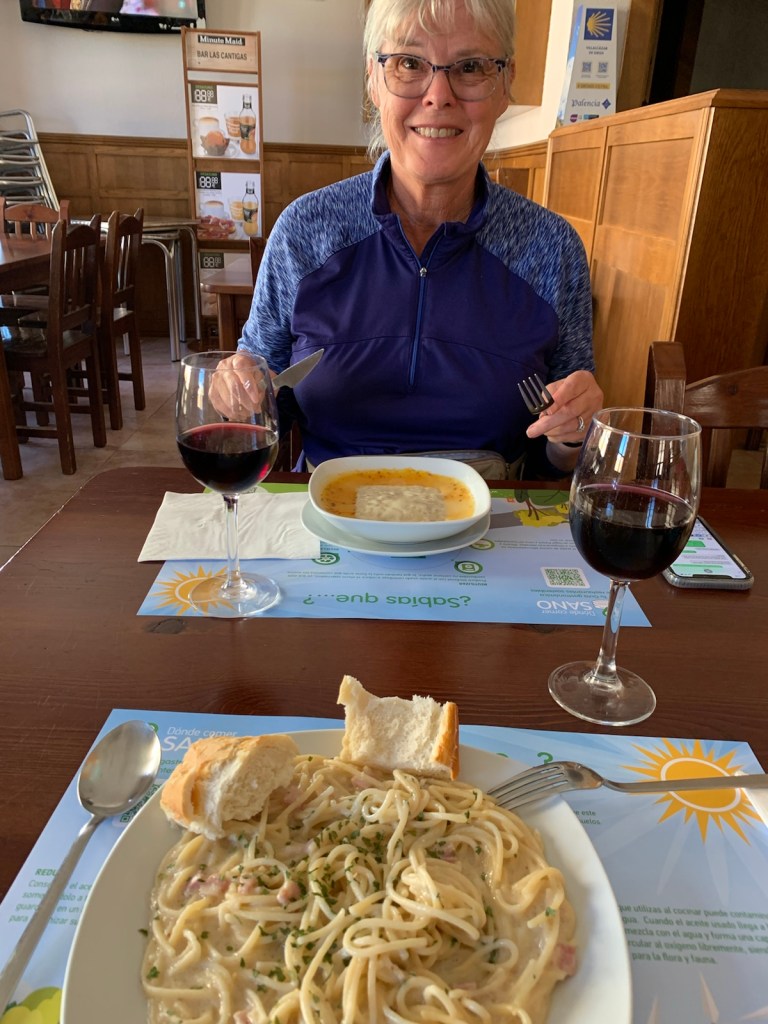
After attending to some chores, we had a three course lunch in the Las Cantigas Bar, then walked to a nearby “supermarket”, about the size of our living room back home, to get some snacks for next several days and returned to our room.
First Course (Primero Plato): lasagna for Linda, Spaghetti Carbonara for Jim
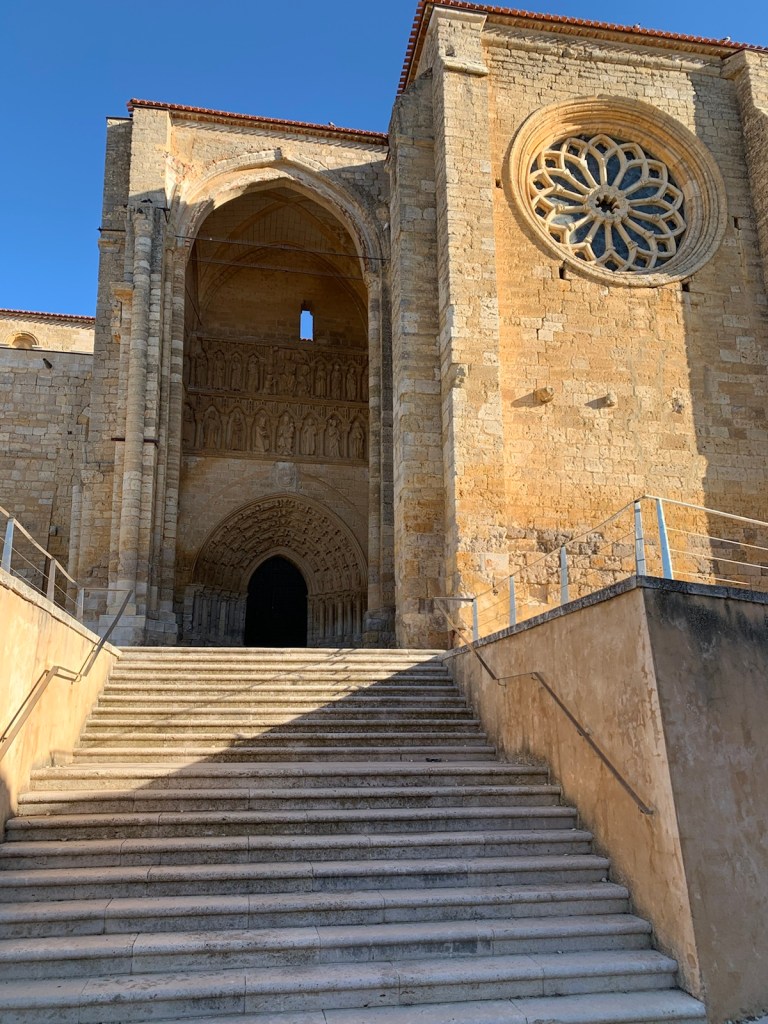
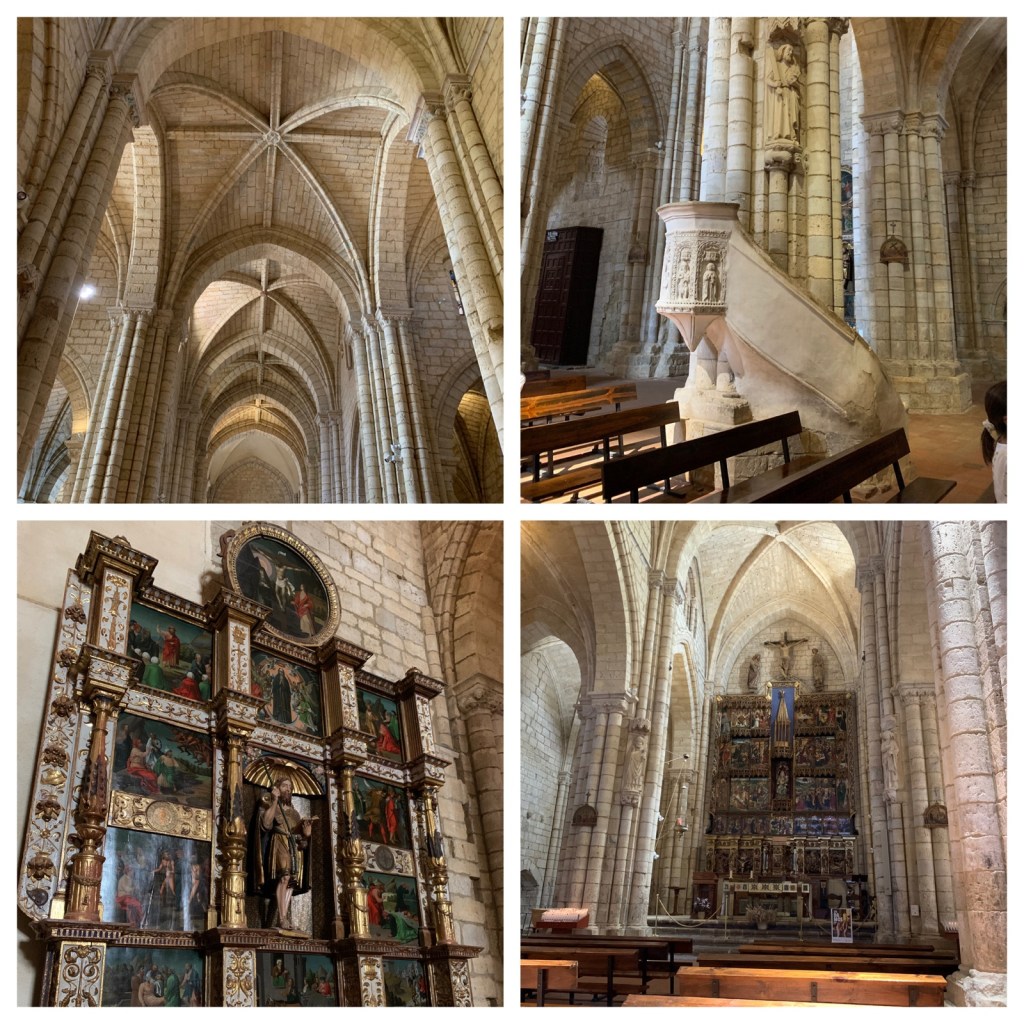
Later, we ventured out to the huge church dwarfing our hostal and did the self-guided tour and got a stamp for our credential for the day.
directly across from Las Cantigas, Santa María La Blanca…inside Iglesia Santía Maria la Blanca, built by the Knights Templar as a temple-fortress in the 12th century as protection for pilgrims bound for the Holy Land.
Back in our room, we were more than adequately sated from our lunch, so we decided again to skip dinner and finish out the day blogging and reading.
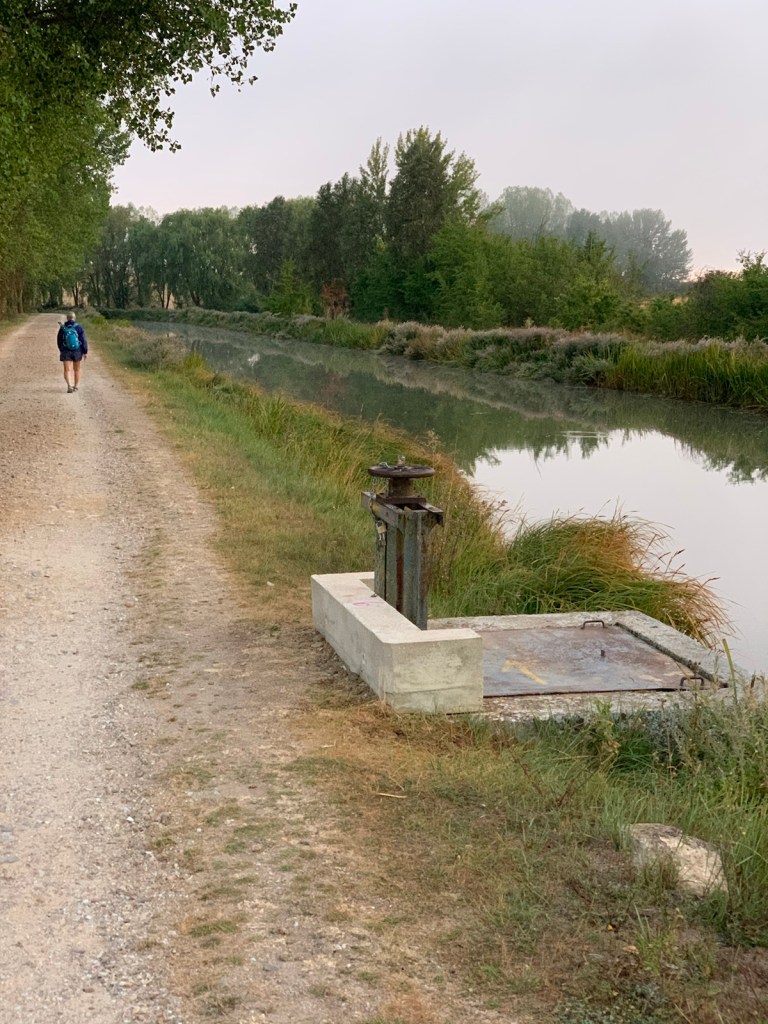
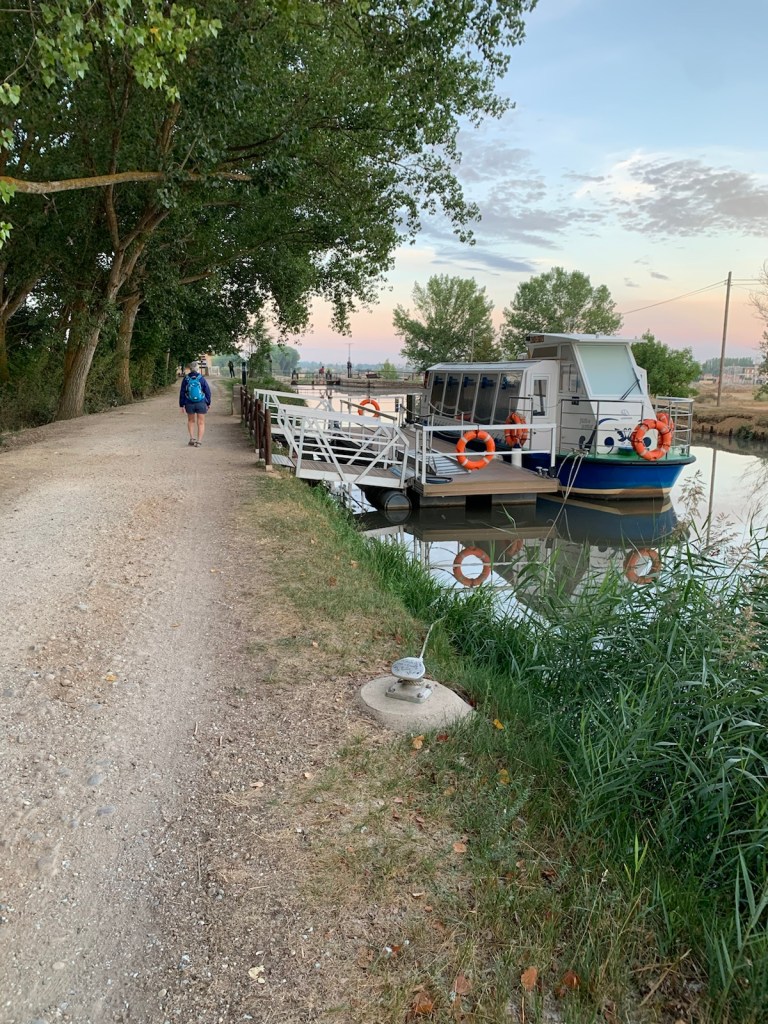
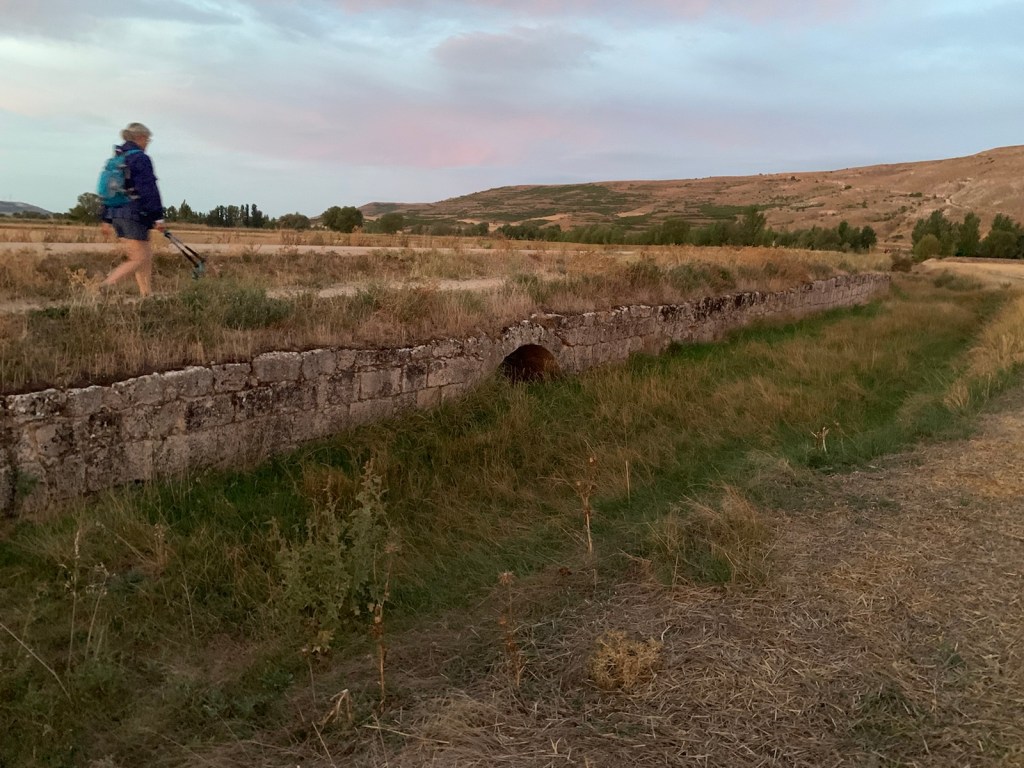
We were on our way at 6:40, before first light. Linda captured this shot as we began walking along the Canal de Castile.
The Canal de Castile was intended to transport grain from Castile to the northern port of Santander on the bay of Biscay and to other markets from there; vice versa the canal was also intended to facilitate moving products from the Spanish colonies to Castile. Construction was started in 1753 and continued until 1849 with only 207 of the planned 400 km completed when work was halted as railroads began to be built to serve northern Spain. The canal ultimately evolved into a major part of an irrigation system still in use today.
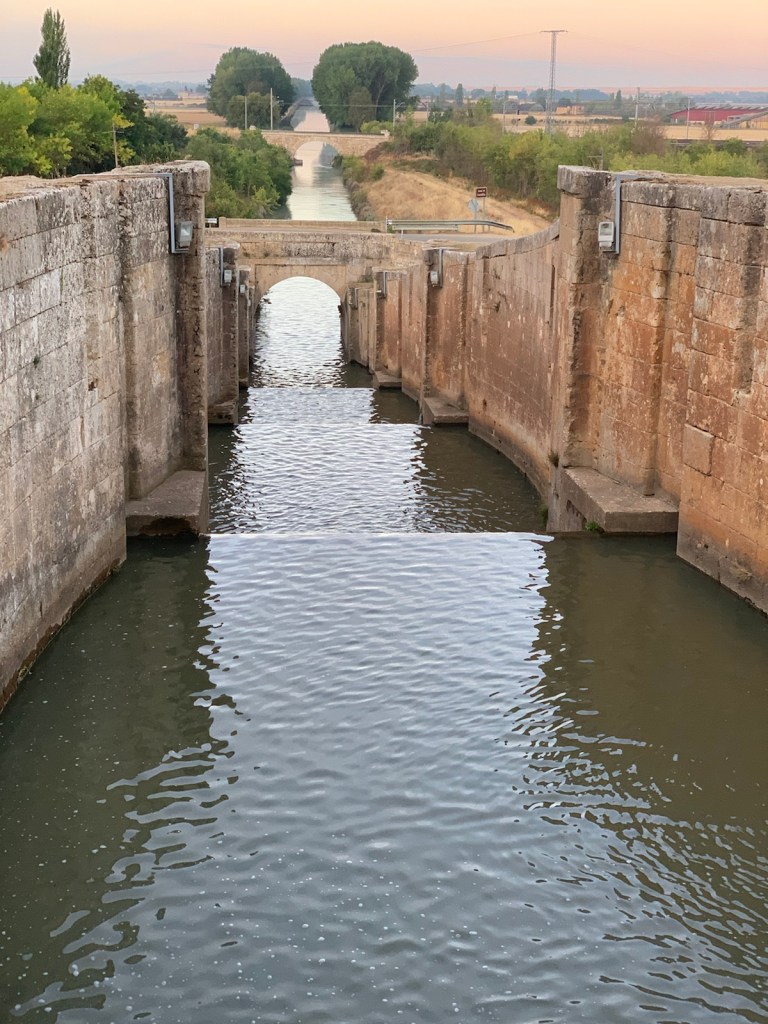
Reflection of the silhouetted trees reveals the Canal de Castile locationThe Canal de Castile just before the locks located on the outskirts of Formista. The valves are located along the canal to release water into a system of aqueducts that irrigate the crops located below and off to the left of the Camino.This ferry boat provides rides up and down the canal on special occasions and holidays, according to Mario. We passed another boarding dock about 2 miles earlier, soon after starting to walk along the canal in the dark.the canal locks at Formista which were decommissioned in the 20th century.
We stopped for breakfast in Formista, then continued on to Población de Campos, to complete today’s planned walk.
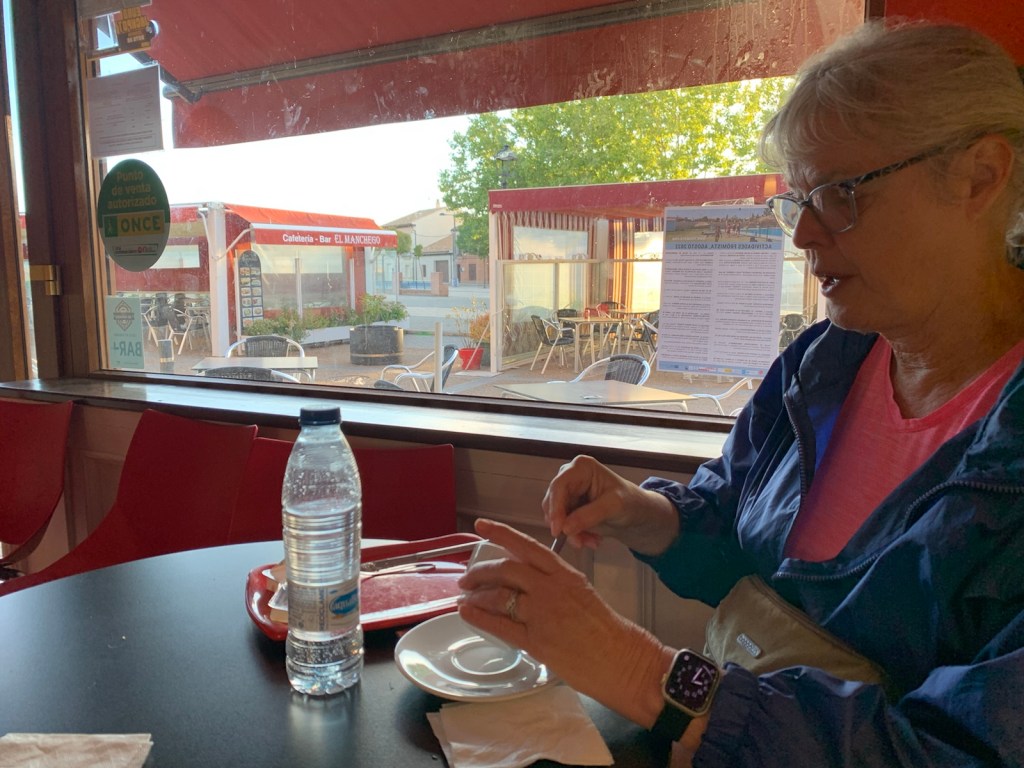
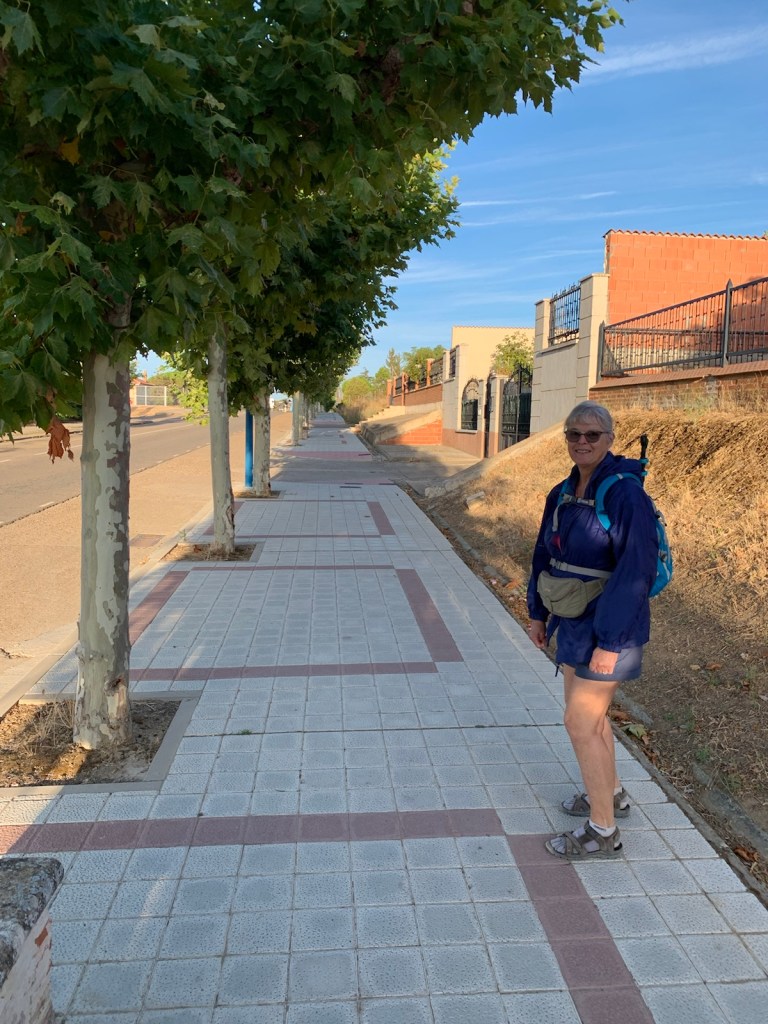
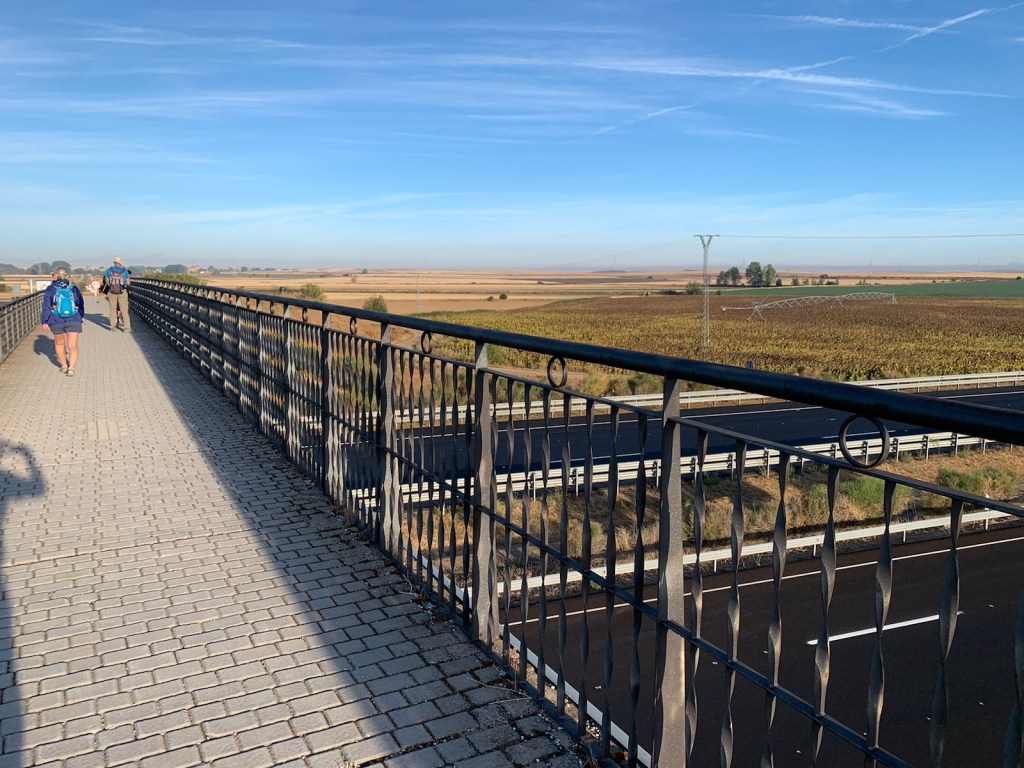
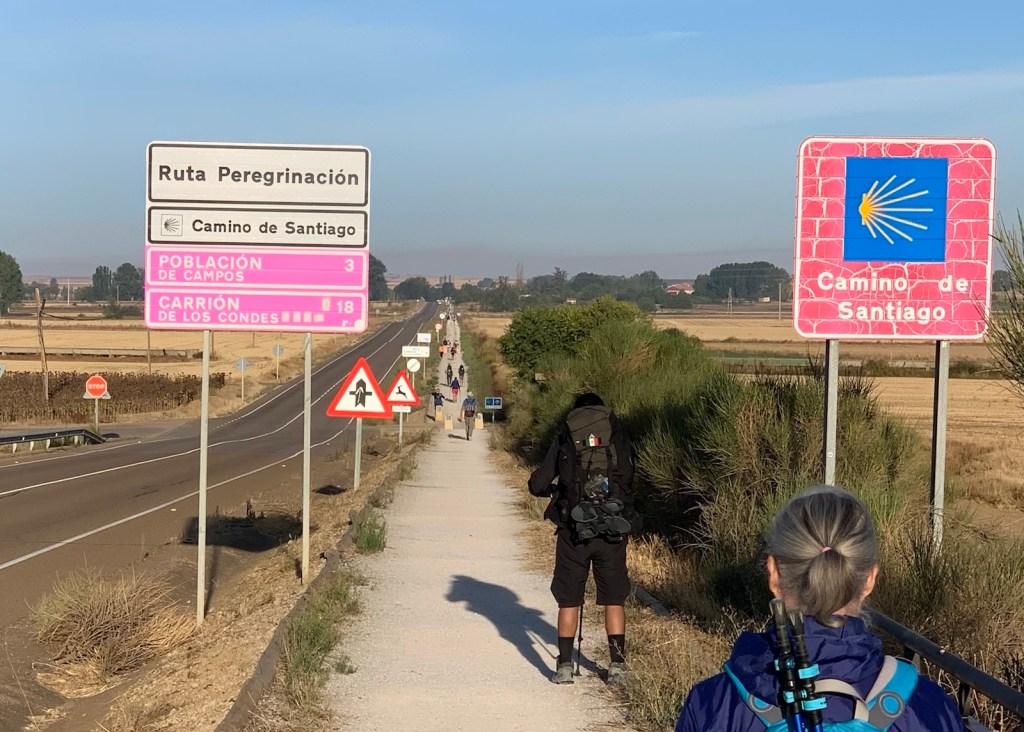
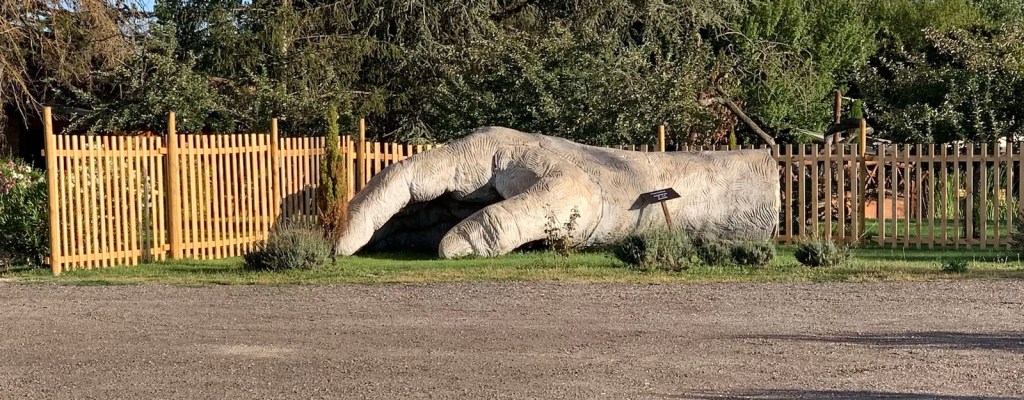
After several days without, cafe con leche y dos tostadas for breakfast in FormistaAttractive Camino path exiting Formista.the Camino crossing over an autopista, then back down to walk along a secondary national 2-lane highway … many pilgrims walking along the highway between Formista and Población de Campos.Some really strange artwork outside an albergue, just before Población de Campos. We would have taken a close-up shot, but Jim was afraid to get any closer!
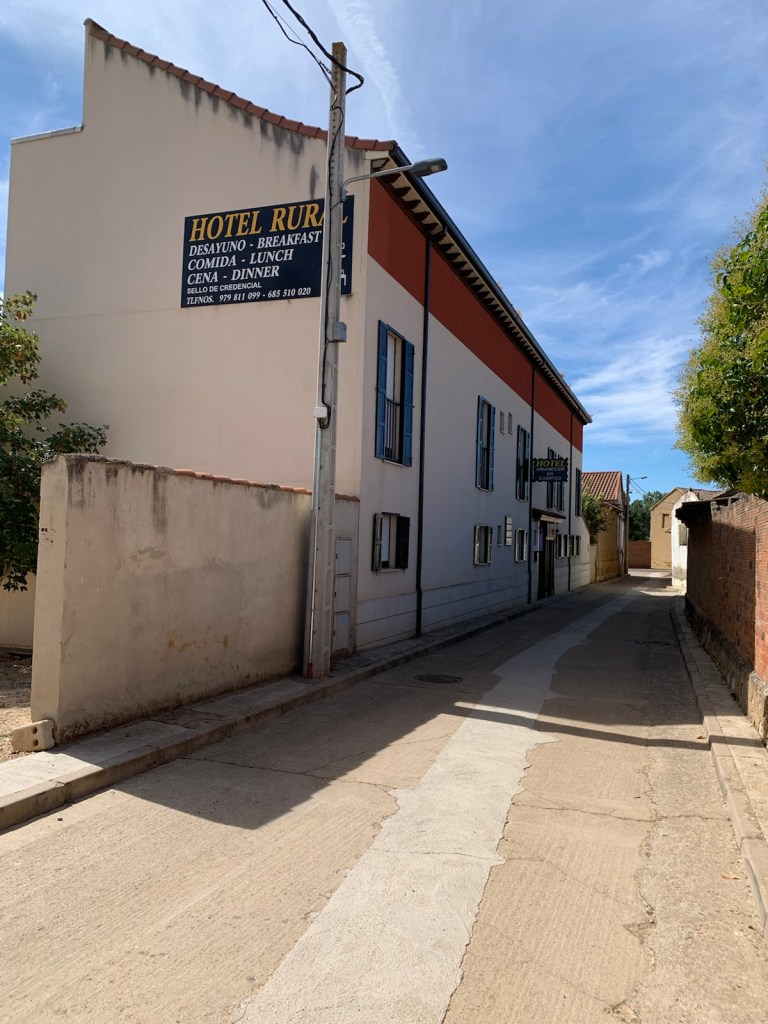
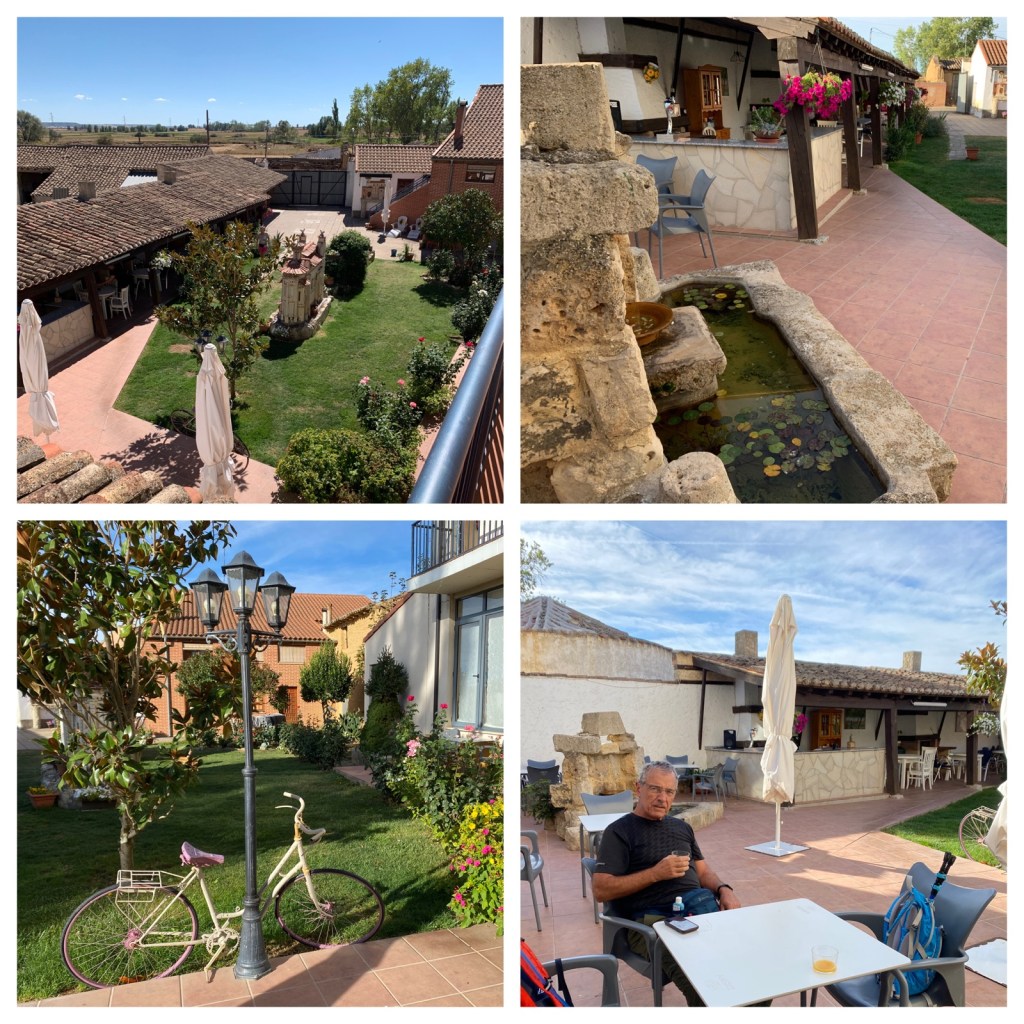
We arrived at a very early 9:45, but the front door was open and when we identified ourselves, Carmen told us that our room was not ready, but we were welcome to come in and use the rest room and sit in the jardin behind the building until our room was ready. A few minutes after we were settled she brought us each a glass of fresh squeezed orange juice and recognized us from our previous visits! We love this place, having stayed here in 2014 and 2017 and have been excited about returning since booking it several days ago for Camino 2022.
Casa Rural Amanecer en Campos…. amanecer means “dawn” or “daybreak”.The “jardin” behind the buildingour room
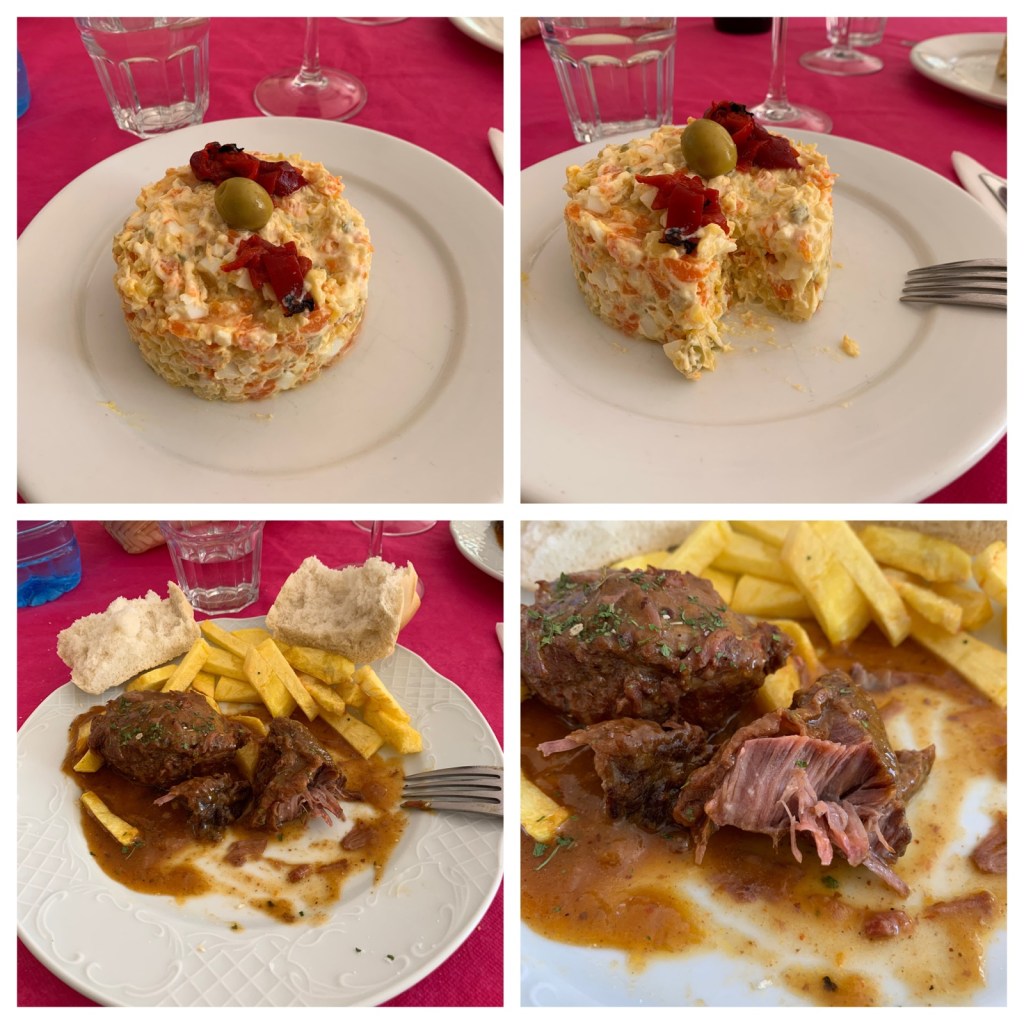
We got into our room about 10:15, did our chores, had a delicious lunch in the casa dining room ….
Our delicious lunch: Ensalada Rusa (potato salad) and la Carrillera de ternera ( veal cheeks), fresh bread, vino tinto (red wine) and for postra (dessert) flan (Jim) and melón (Linda)
…..hung out in our room or the jardin: napping blogging and reading until lights out at 9:00 p.m.
We turned off the alarms for this morning and slept only an extra 45 minutes! With the shortage of bathroom space, we figured we’d have an easier time getting ready if we let most of the more than 30 other pilgrims go first. Our plan worked… we had the bathroom all to ourselves and left at 7:30.
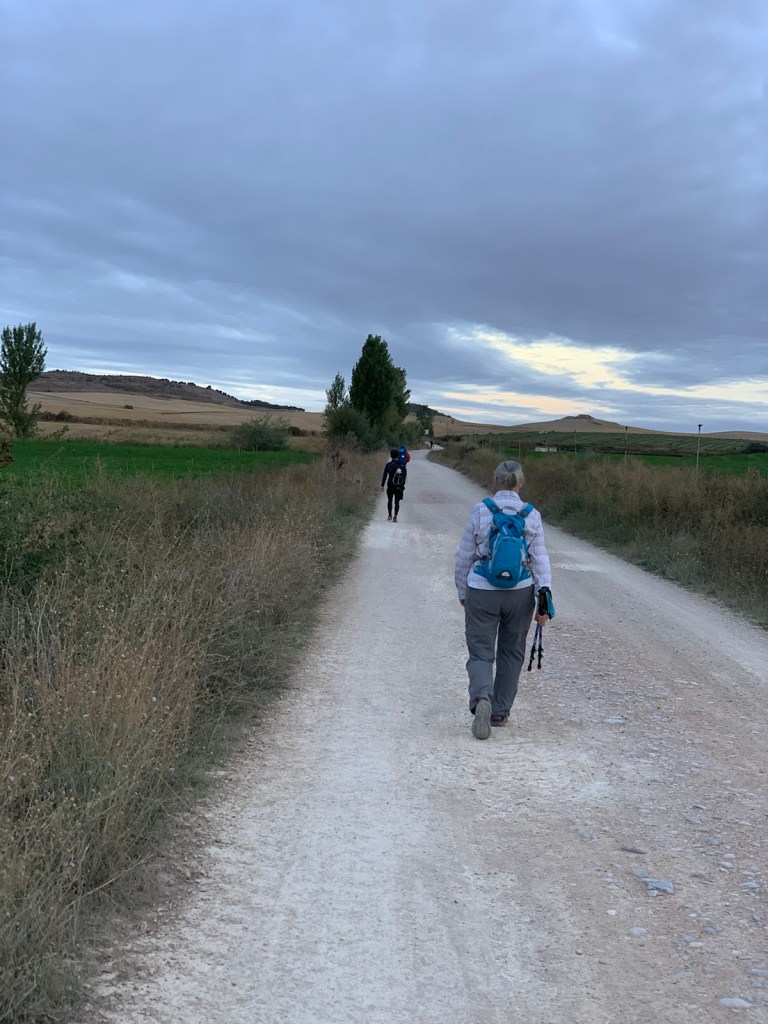
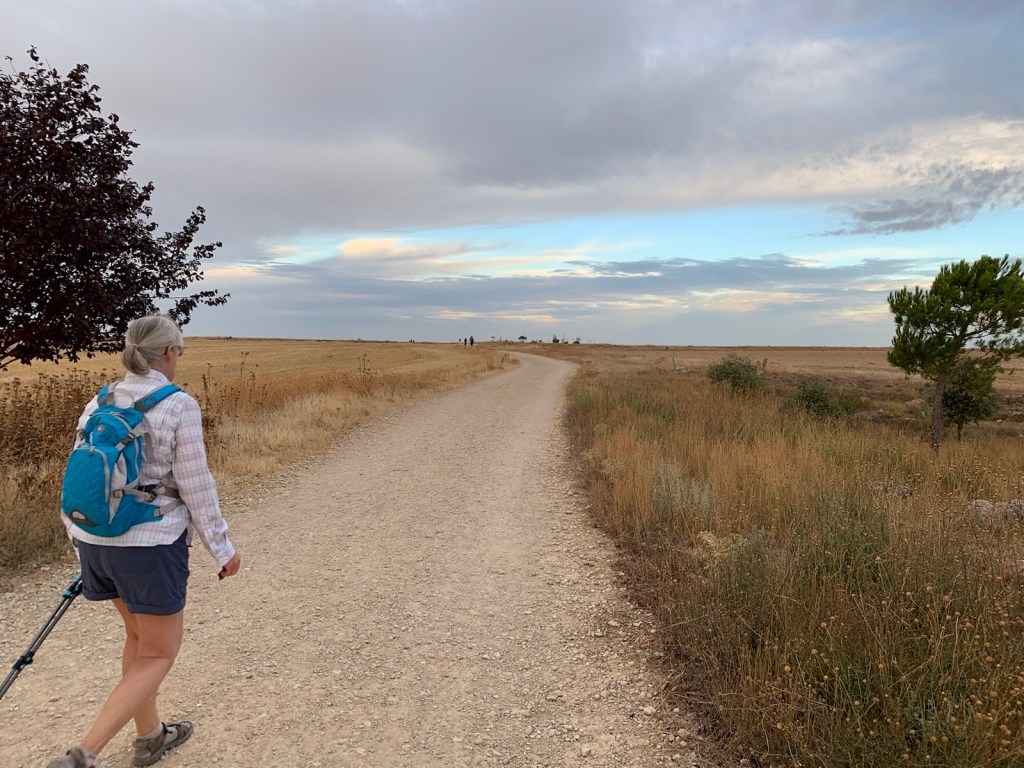
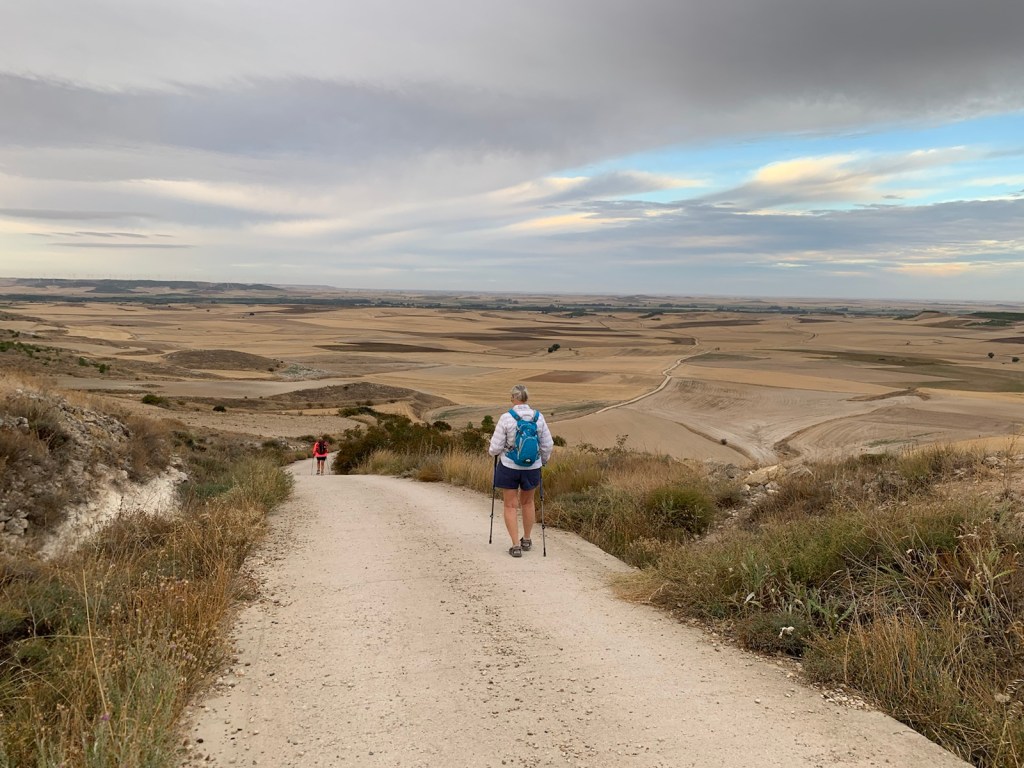
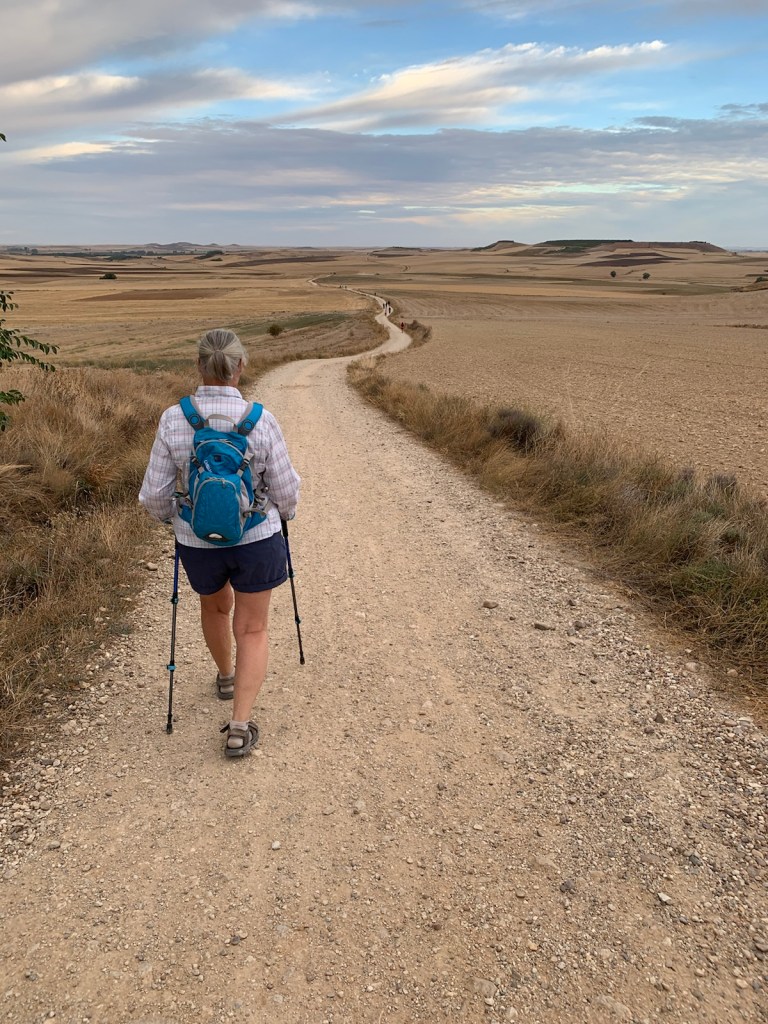
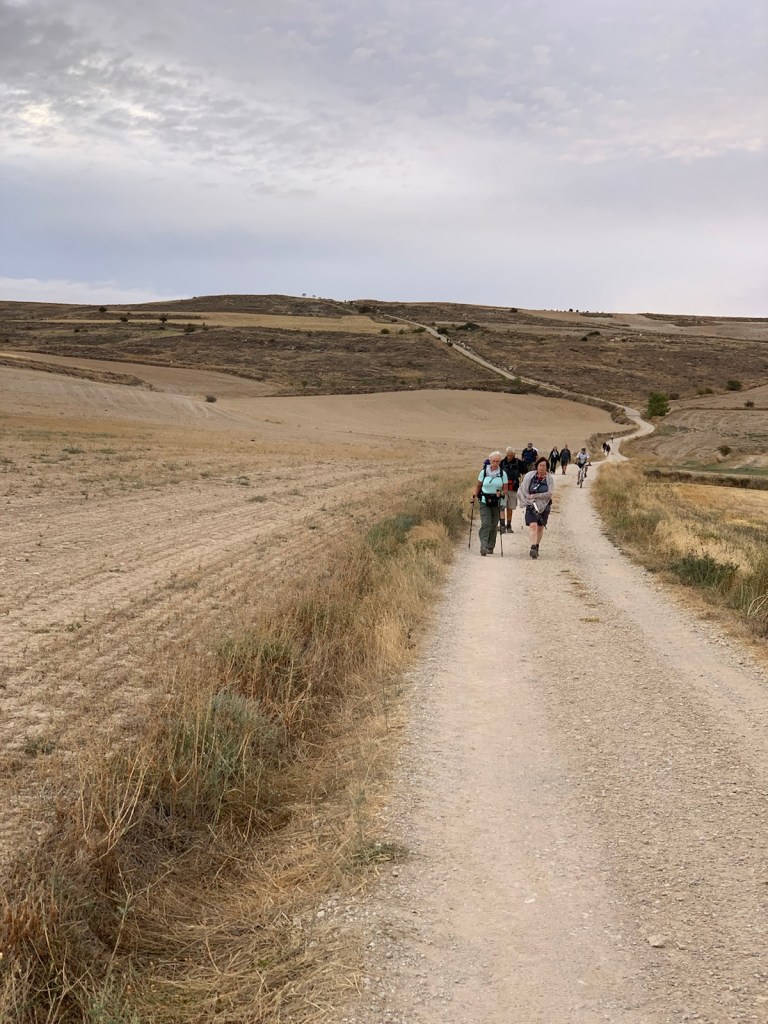
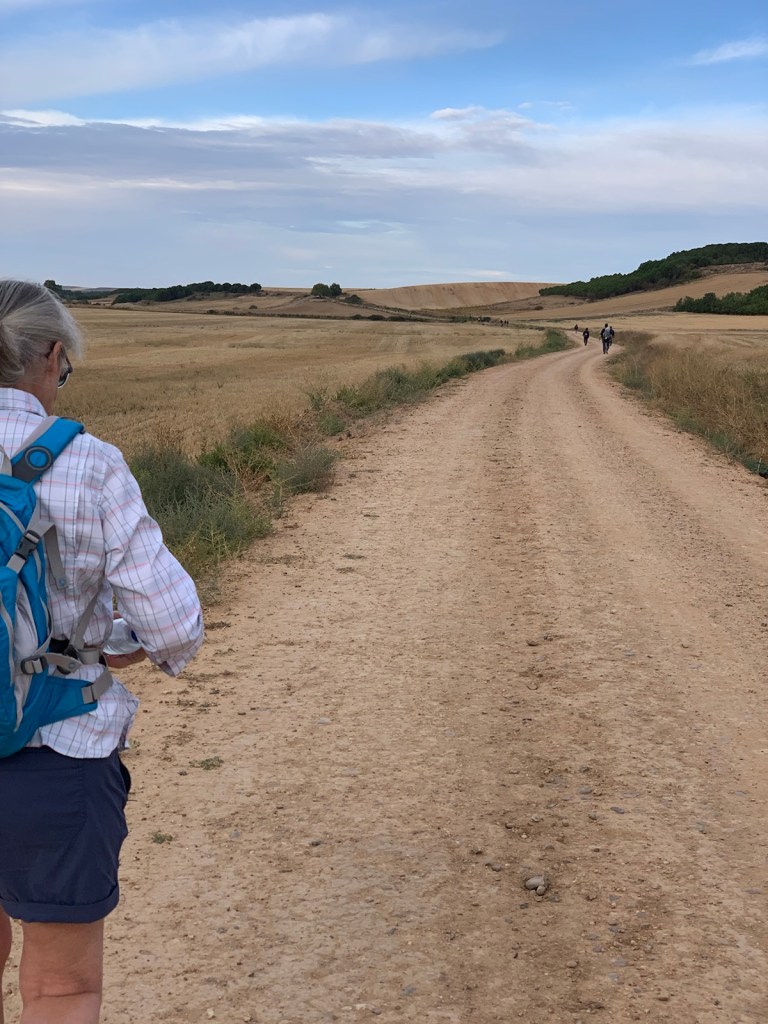
We walked just over 5 miles, dictated by our reservations made two days ago. The Camino is still busy and we’re glad we made some more bookings in advance. The walk was less interesting than most.
Linda adjusting her poles a mile or so out of Itero de la Vega.
We remember this section of the Camino, because about half way there is rise in the mostly flat terrain and at the crest, we could see the steeple of the church in Boadillo del Camino. But regardless of how much we actually advanced toward it, visually we didn’t appear to be making any progress. This has happened now for all 4 Camino’s and we can’t explain it.
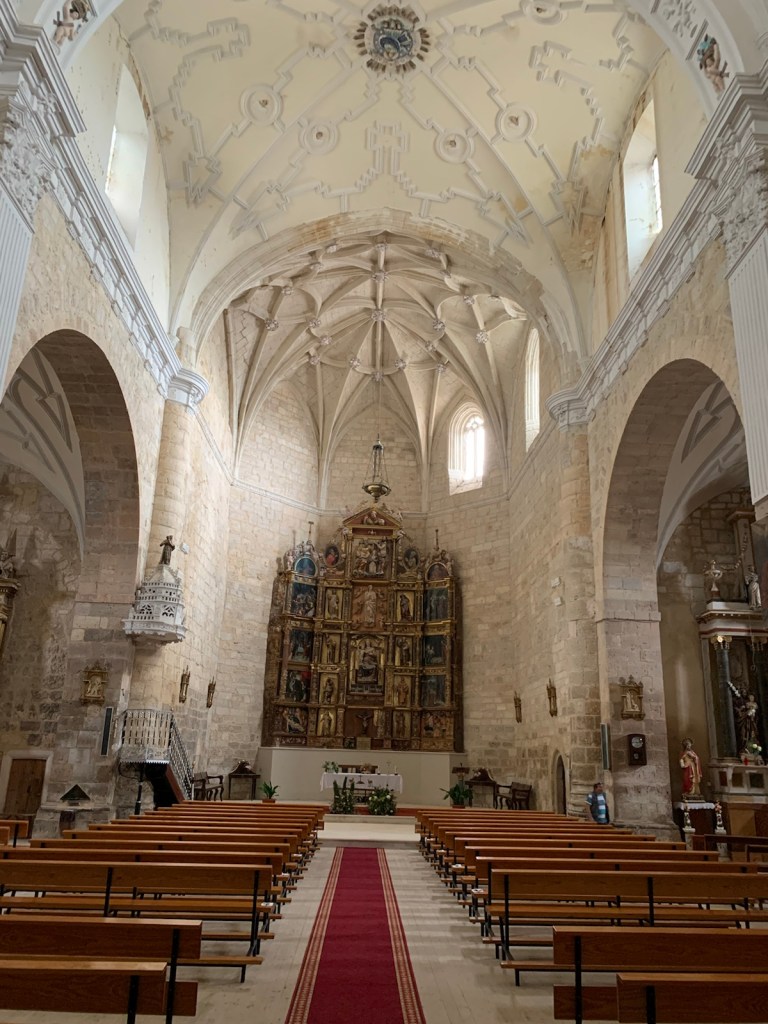
at the halfway point looking at where we’ve been… at the halfway point, looking ahead, Iglesia Santa Maria de la Asunción steeple visible in the distance.nearing Boadillo del Camino… flat fields all around … with occasional hills/moundsSo, this is Iglesia Santa Maria de la Asunción (outside)… the “ when are we gonna get to” church steeple.…. and inside. Beautiful ceilings!!
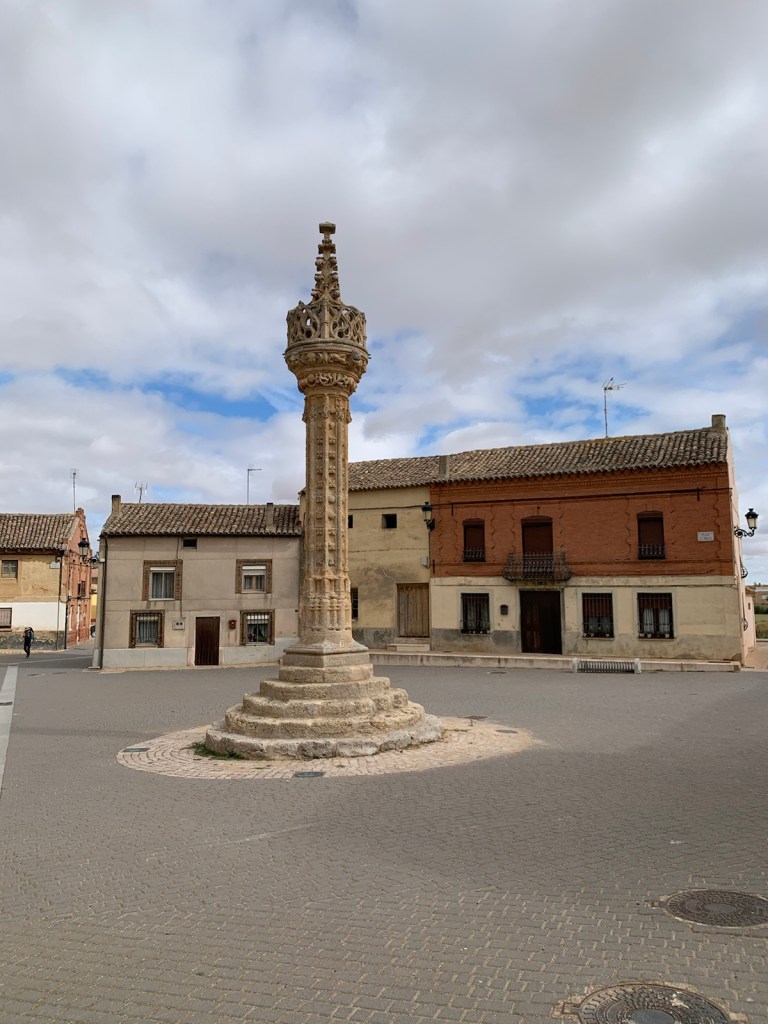
The first records of Boadillo del Camino’s existence occur in AD905! The church and Rollo were built in the 15-16th centuries when the town became more affluent.
The Rollo de Justicia, where the accused were manacled to until their fate was determined. Built in 15th century.
This is our first time to stay in Boadillo del Camino (pop. 70). We usually passed through early in the morning, in a hurry to make it to Formista or Población de Campos before it got too hot …and the only thing open was the bar at another albergue, where we would have breakfast and moved on.
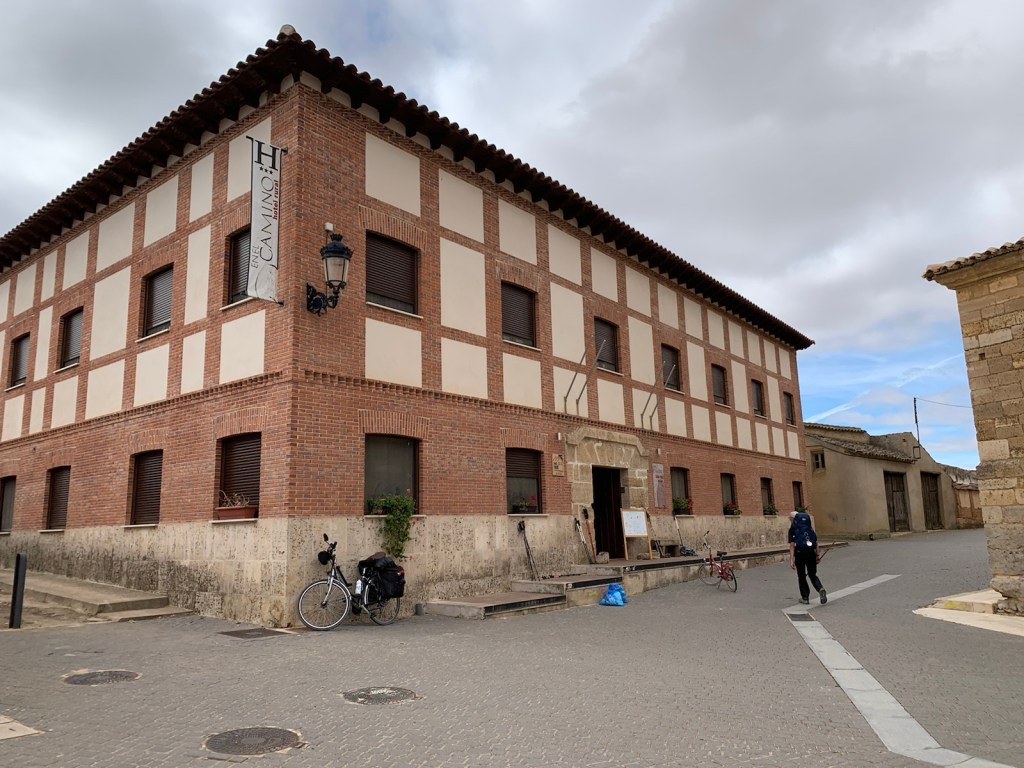
Casa Rural Boadillo en el Camino
Today we checked-in early, at 10:45, got showers, paid 7.50€ for laundry service, and ventured out while waiting for lunchtime at our Casa Rural Boadillo en el Camino.
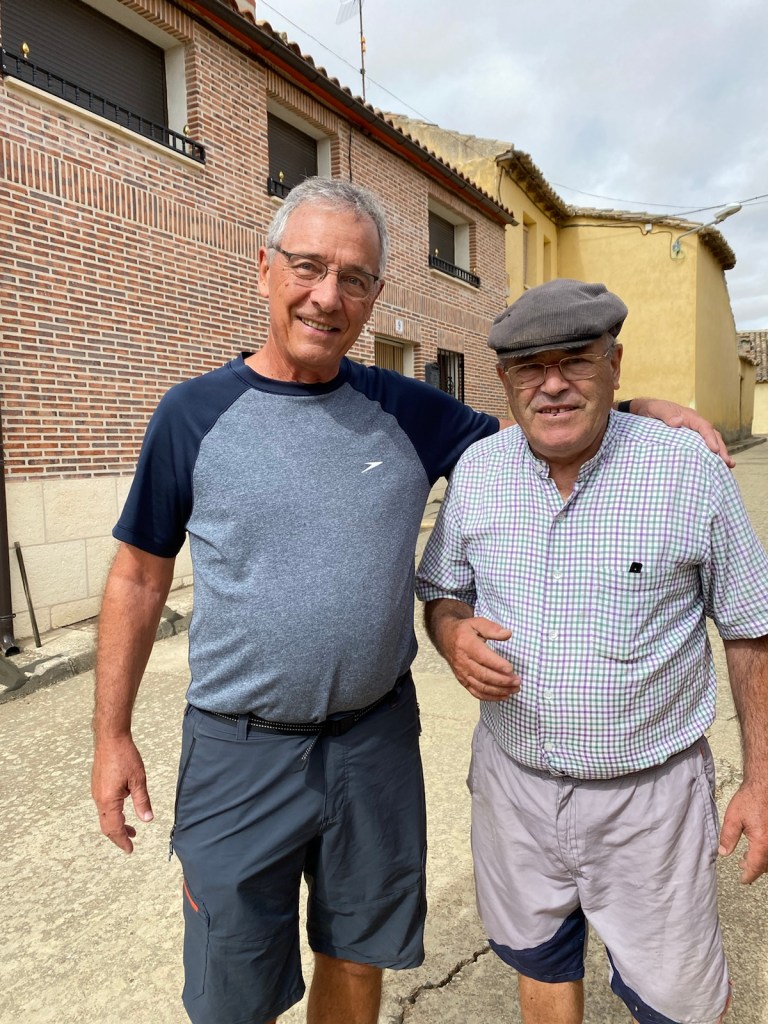
We had one of our great Camino moments today. While wandering aimlessly around Boadillo, looking for a market, we were approached by a resident who asked if we spoke Spanish. He was clearly disappointed with our response, but motioned for another young man to come over who could speak English.
Mario Mediavilla, a young 80-year-old, said he had completed three Camino’s, the first in 1992 on a horse! He also said he knew English because he has a “rich” uncle who owns several liquor stores in NYC. He also pointed up the street to his new house.
Jim with Mario’s new house in the background.
After chatting for a few minutes longer, Mario asked if we would like to see his “museum”. We both responded simultaneously with “Si!” and we followed him up to the end of his street and to what appeared to be a garage door, with a chain, but no lock.
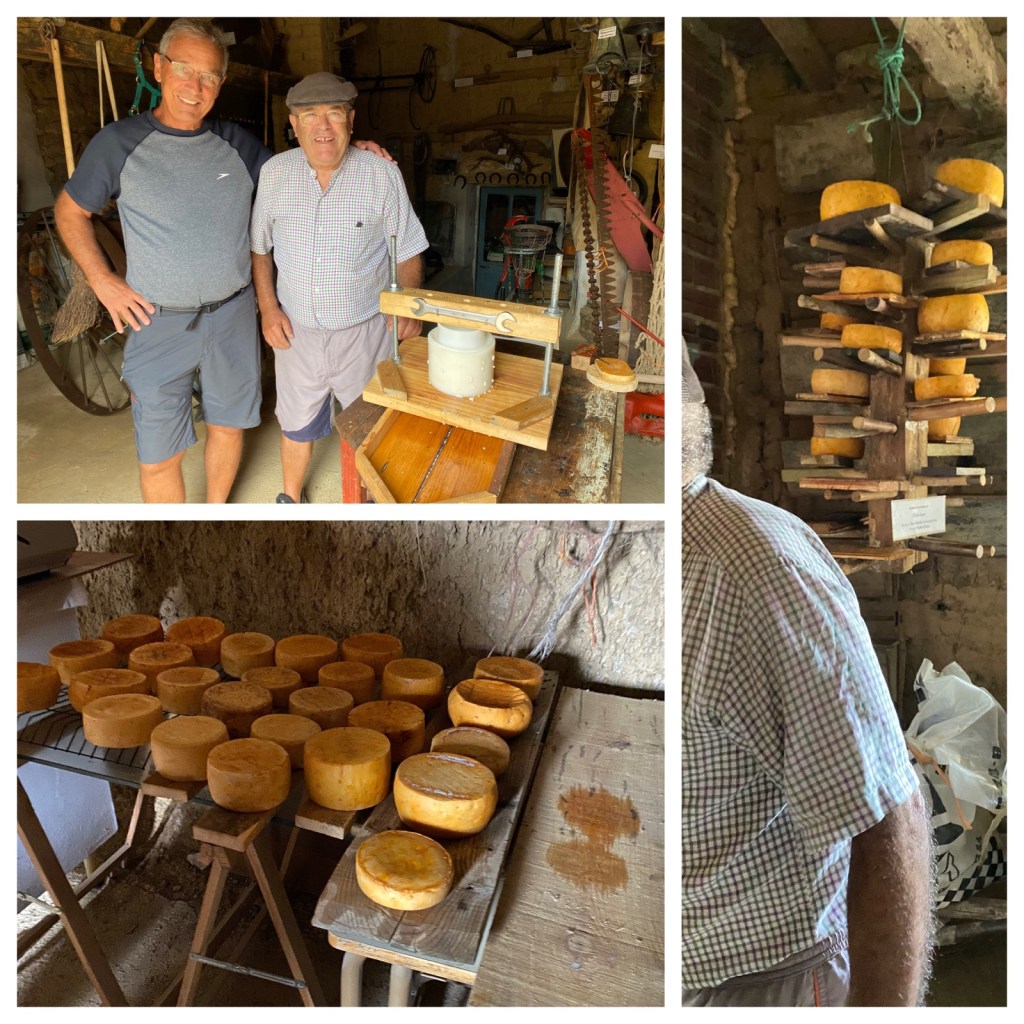
Mario opened the door and the first thing we saw was a cheese press, which he explained he used to make goat cheese. But all around us were relics, mostly farm implements, many over 100 years and older. Many were labeled like in an antique store.
Cheese press and aging goat cheese wheels
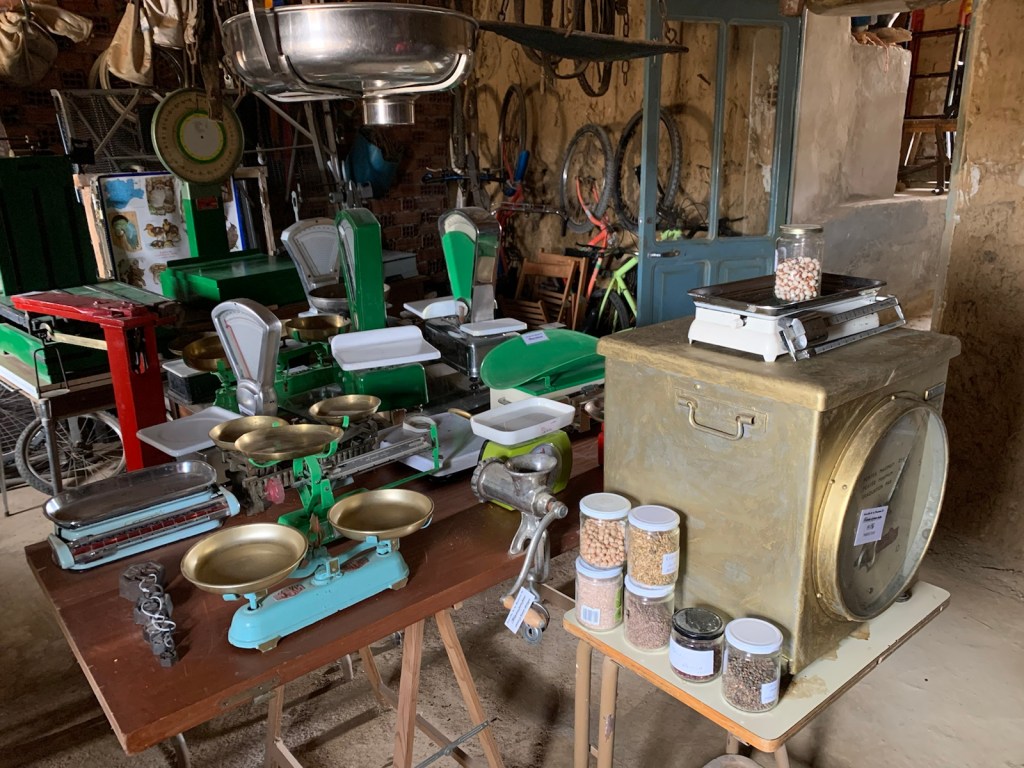
He opened another door down to another lower level filled with all kinds of weighing scales, again many well over a hundred years old…also in one corner were a couple dozen aging cheese wheels… 90 days to maturity.
Weighing scales of all kinds and ages
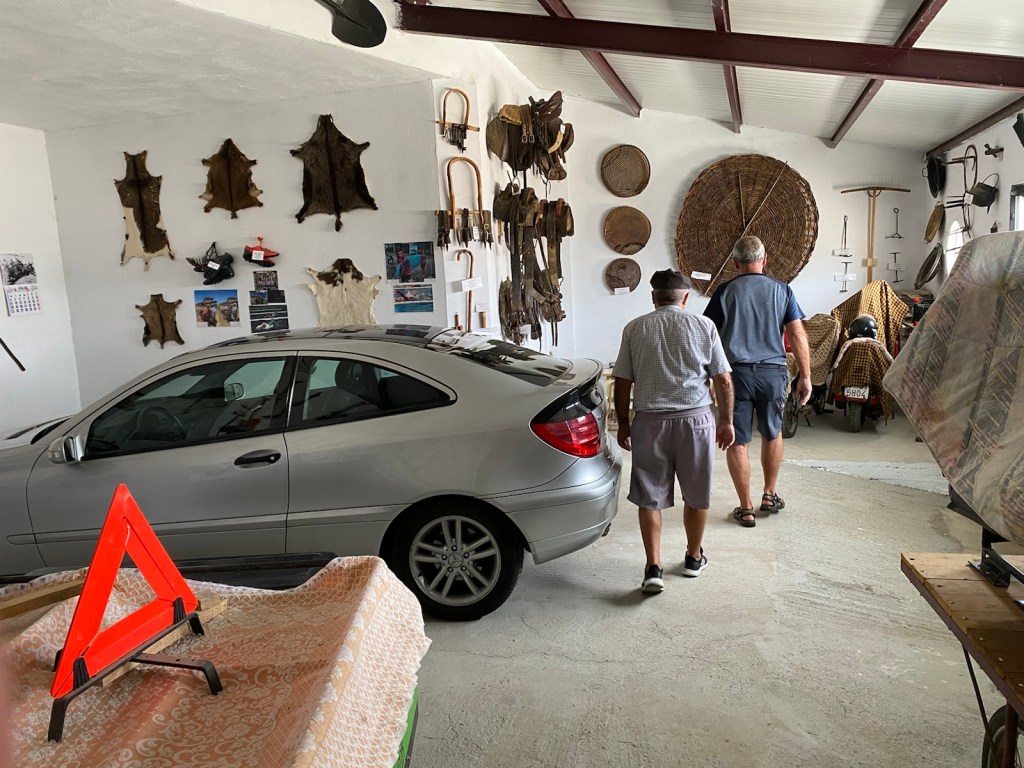
We continued into another room which was a garage occupied by a Mercedes Kompressor. The garage walls were neatly filled with displays of farm implements, skis, children’s antique toys, horse tack, etc. Jim asked Mario which saddle he rode in his first Camino and he proudly pointed to it.
The real garage and end of museum tour.1992 Camino saddle in top left corner
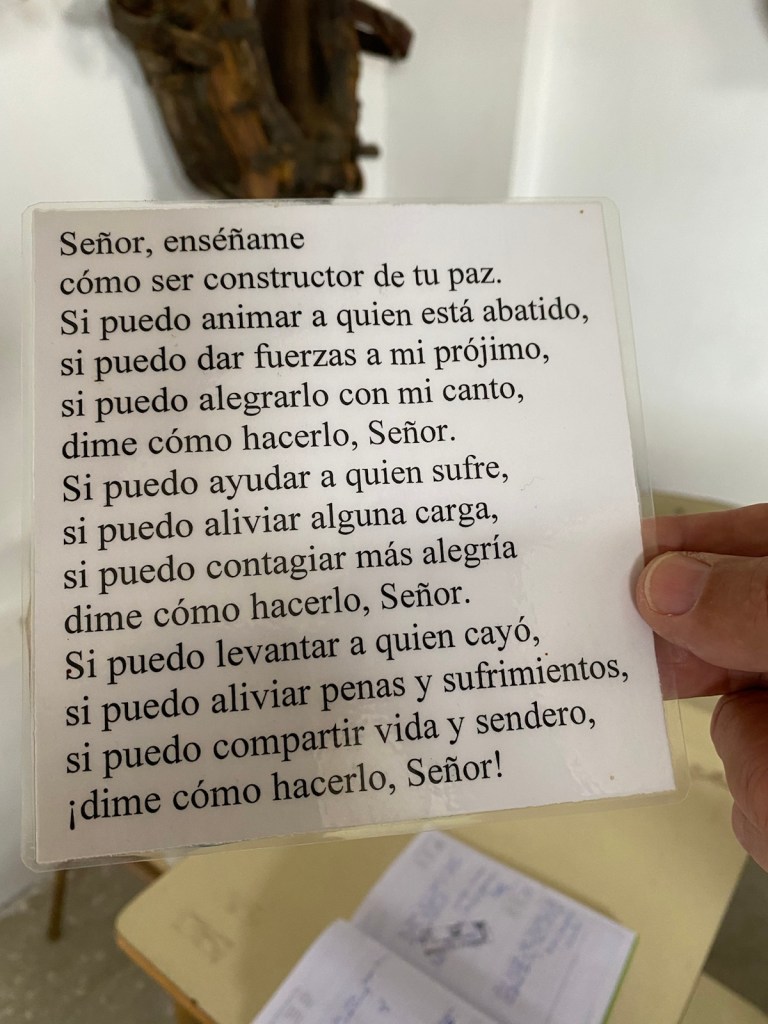
At the end of our tour, Mario asked us to sign his guestbook. He said he so far had over 1000 entries! He also showed us and read to us, what appeared to be a prayer which we copied.
The apparent prayer read to us, by Mario, when we finished his museum tour.
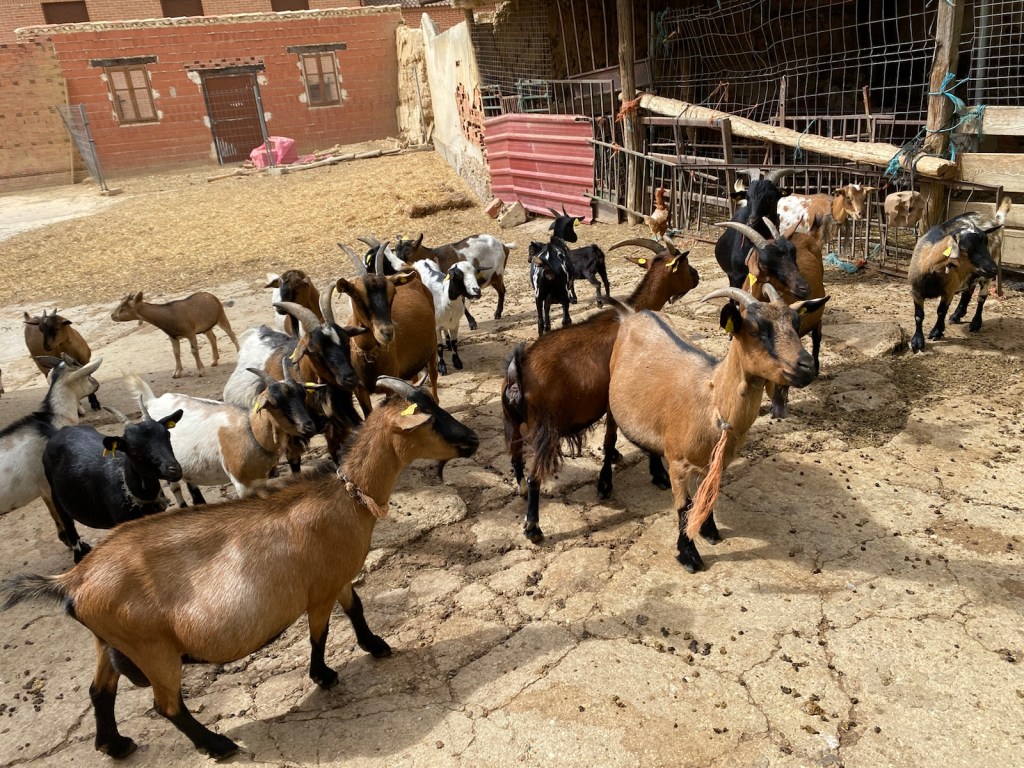
We then thanked Mario for sharing his wonderful “museum” and worked our way out of the building. As we walked down the street, Mario ushered us into a large barn (tractor engine running outside) and called out to his brother, who we’re sure felt left out from the English tour. His brother then guided us through the barn through a door in the rear, an we went outside to a large pen or corral for 15-20 goats… several who were close to delivery.
Mario pointed out one goat that was the unusual “brother” of four that were born to a dam this past season. We thanked Mario’s brother (name never revealed) and walked away in amazement at what we had just experienced.
PRAYER TRANSLATION:
Lord, teach me how to be a builder of your peace.
If I can encourage those who are dejected, if I can give strength to my neighbor, if I can cheer him up with my song, tell me how to do it, Lord.
If I can help those who suffer, if I can relieve any burden, if I can spread more joy, tell me how to do it, Lord.
If I can lift those who fell, if I can relieve sorrows and sufferings, if I can share life and path,
Tell me how to do it, Lord!
We returned to our casa and had a large lunch, probably enough for supper, too. We settled into our nice room, a palace, compared to yesterday and read, napped and blogged for the remaining afternoon.
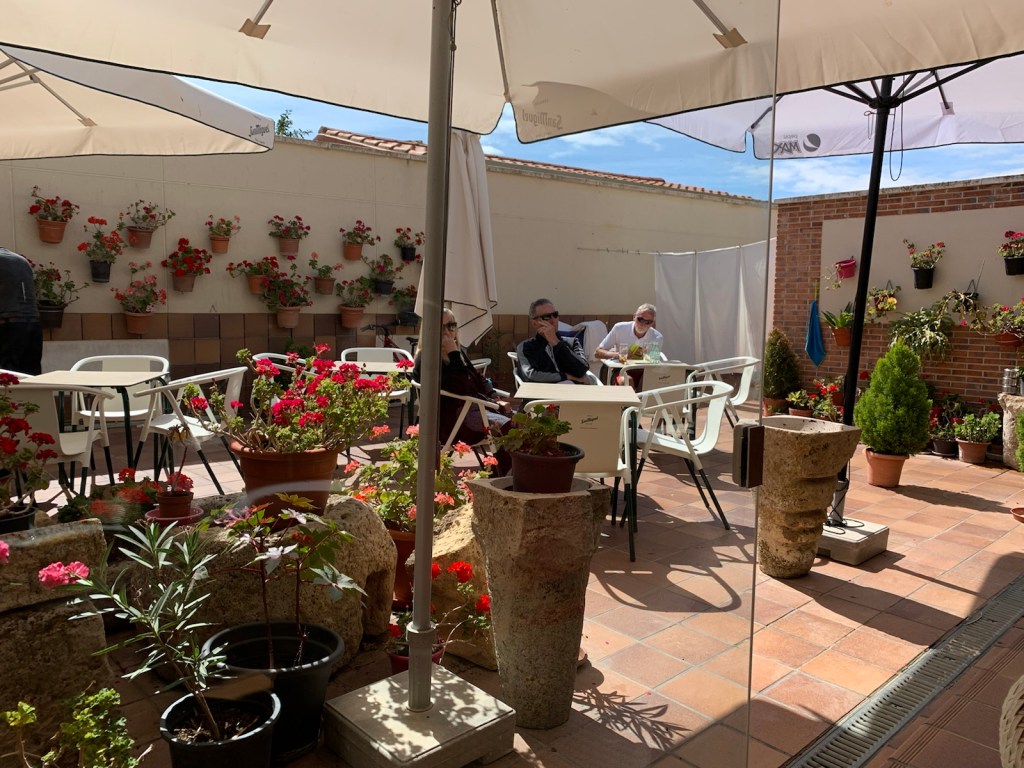
our palace for todayNice outdoor eating area of our lodging for today
After our full lunch, we decided to not have another meal and instead had a snack dessert and retired for the evening after a memorable day on the Camino Frances.
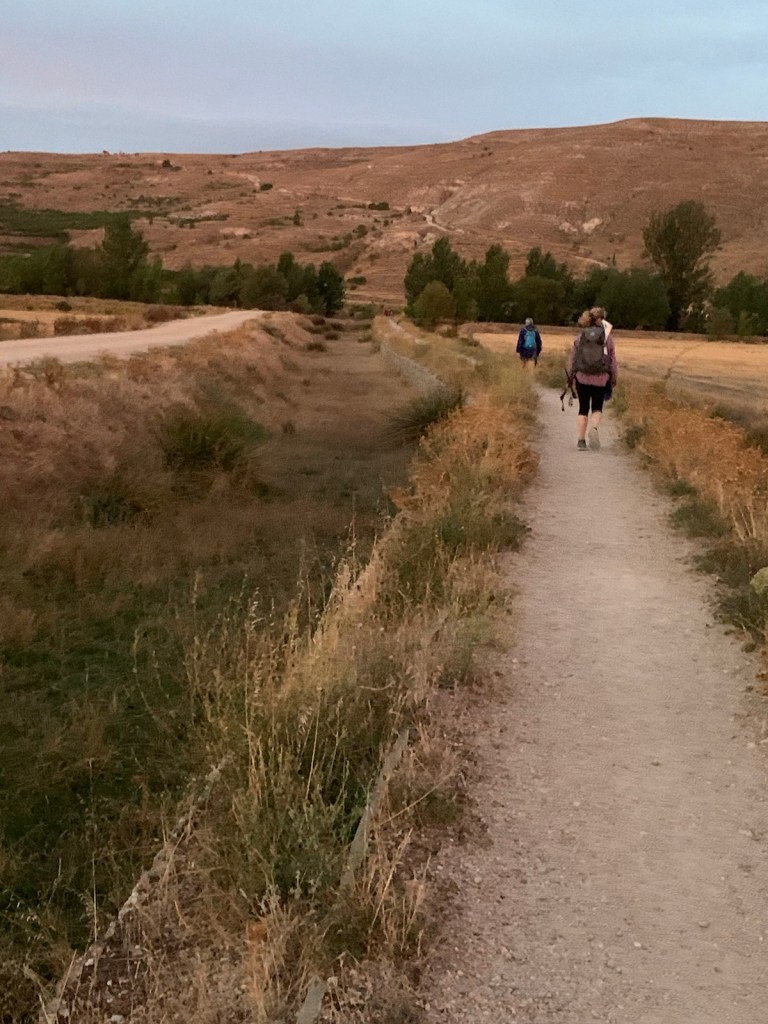
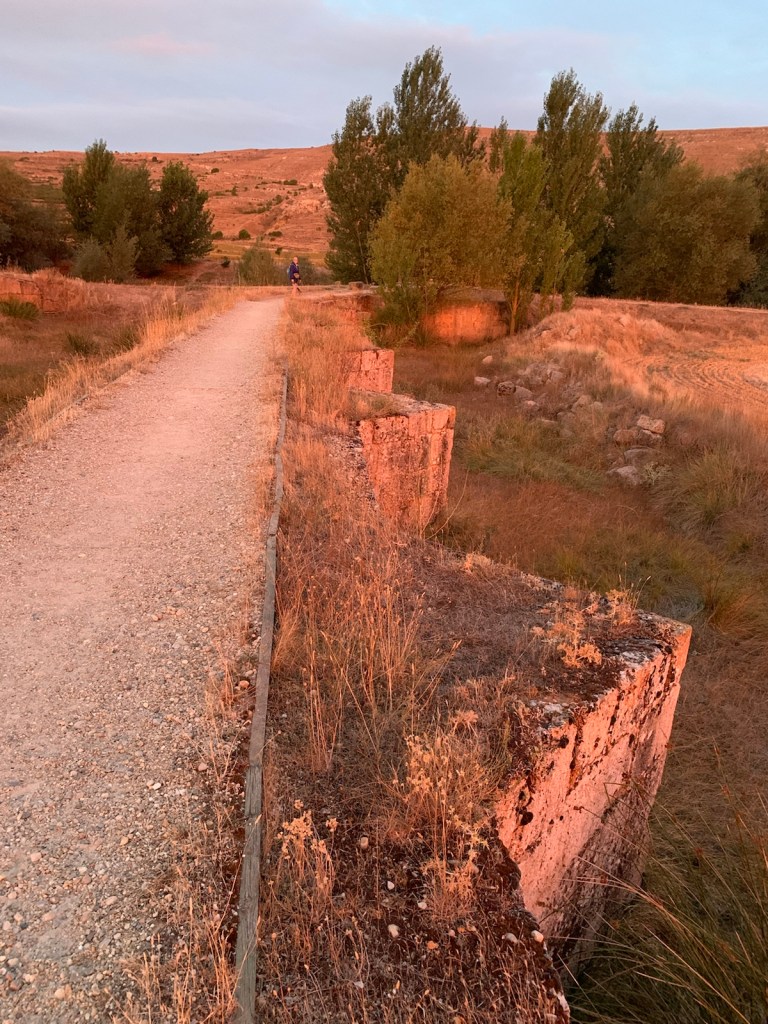
lobby of Hotel Iocabus as we left this morningJust a few hundred yards outside of Castrojeris, we began walking over a Roman causeway! … then the remains of a connecting Roman bridge!!…the Roman bridge ruins, with red highlights from spectacular sunrise rise behind us.Another progressively spectacular sunrise as we walked toward the mountain
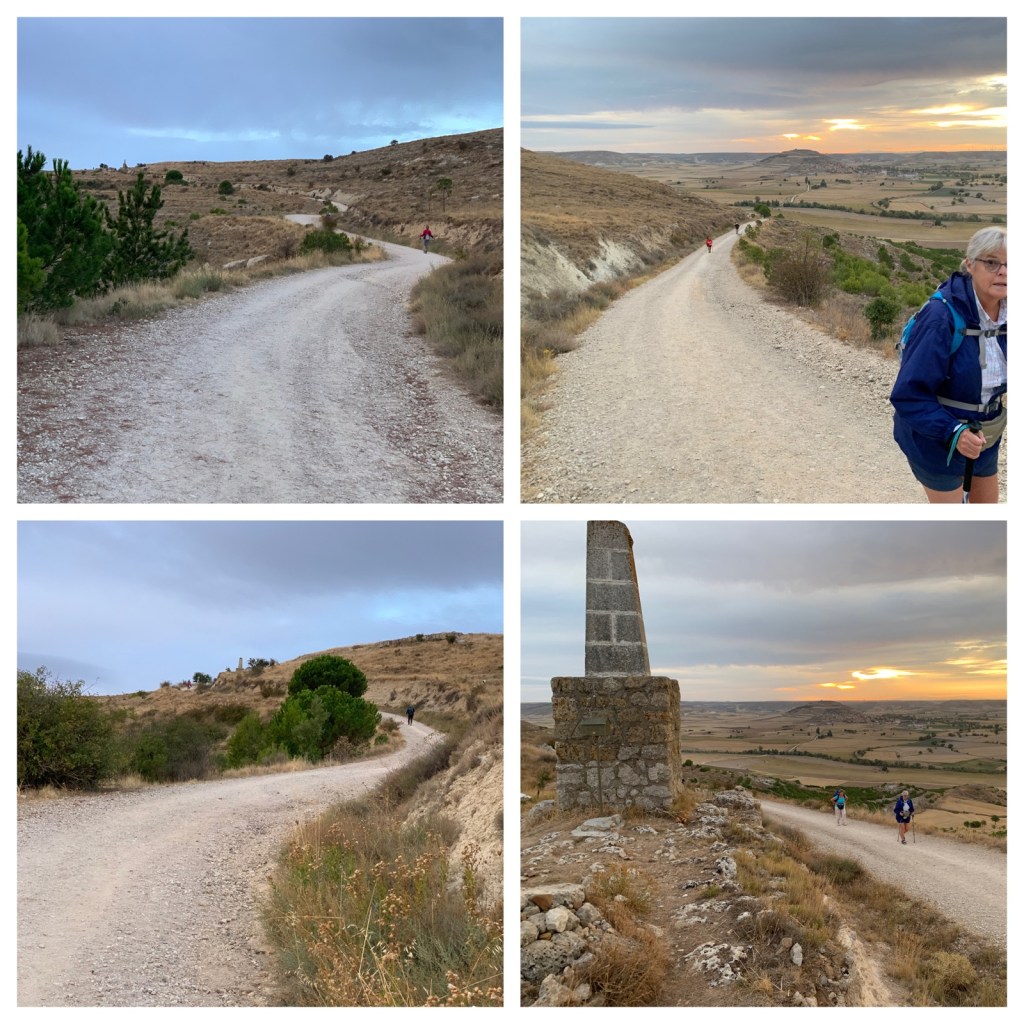
We thought we’d let you walk up the mountain with Linda this morning. Follow the photos below in left-to-right order… her perspective looking ahead and looking back on her way up.
Linda working her way upYeah!!! Linda!!!…moving on, after catching our breath and a snack…back on topwhat goes up, must come downverrryyy steeeeepmade it!!looking back … lots of pilgrims “ chasing” uschange of scenery not far aheadWe’re walking on pavement for first time today with huge fields of sunflowers around us, nearing harvest time.“hermitage” and bridge ahead
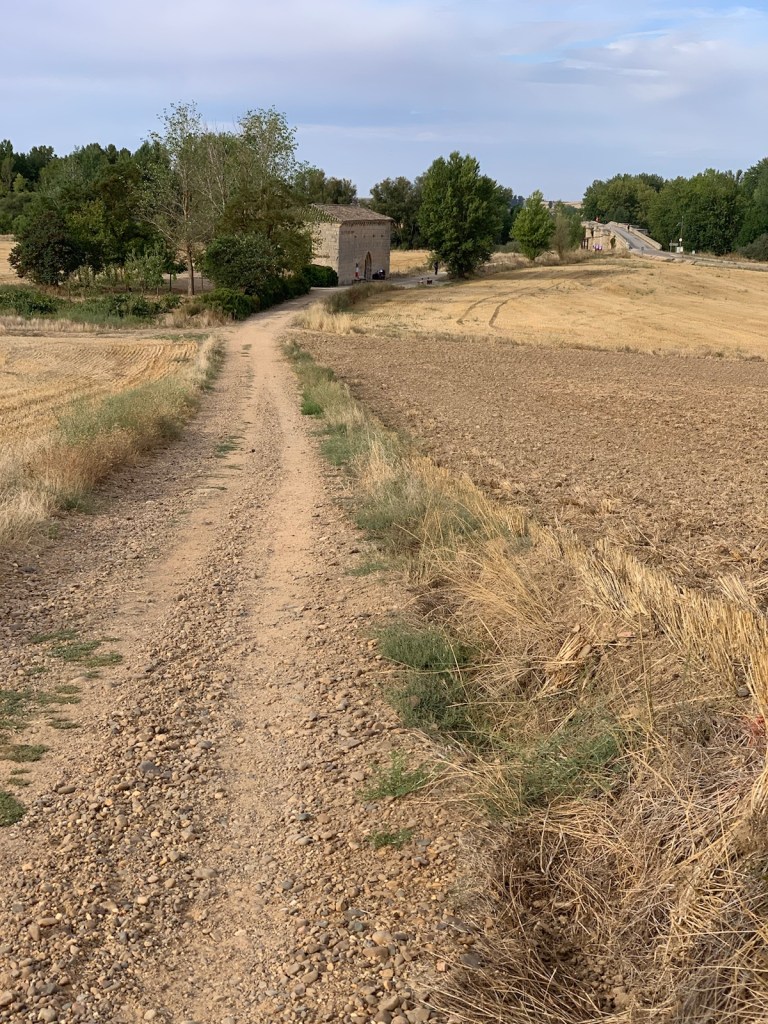
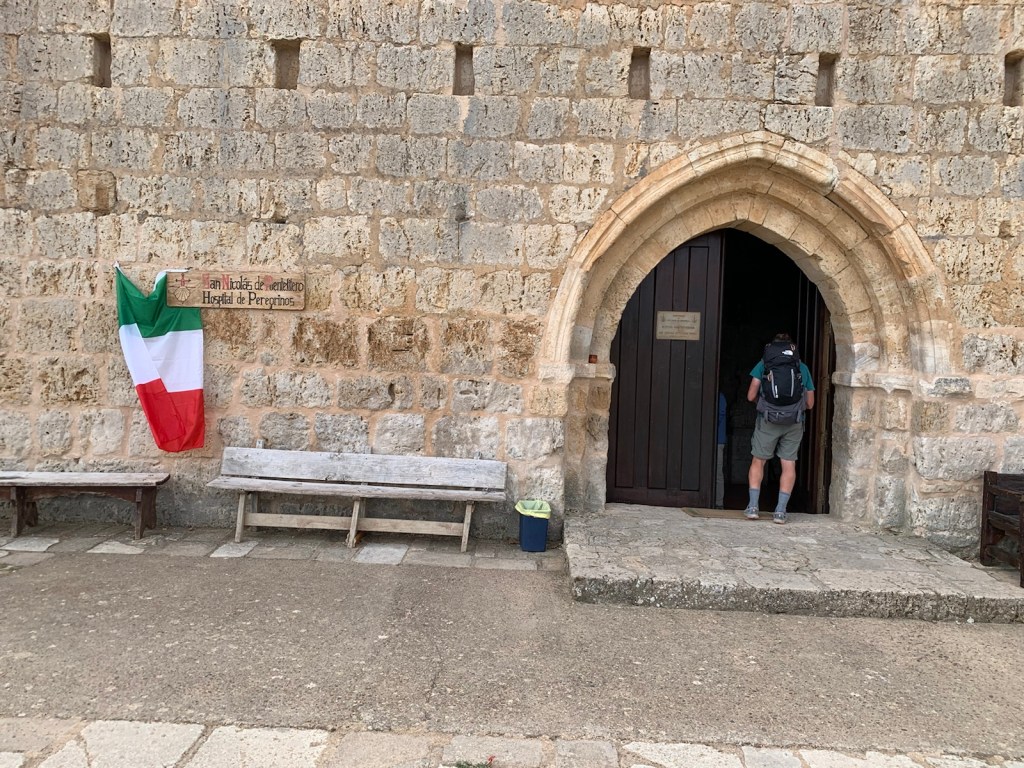
The hermitage of San Nicholas de Puentefitero dates back to the 12th and 13th centuries. Its membership in the Order of the Knights of San Juan, later known as the Order of Malta, is documented and linked to the presence of the nearby Fitero Bridge over the Pisuerga River, an infrastructure of great importance that linked the kingdoms of Castilla y León and, today, to the provinces of Burgos and Palencia. The Knights of San Juan would have taken care to keep the bridge in good condition, facilitating the passage of pilgrims and also offering them their hospitality.
San Nicholas de Puentefitero
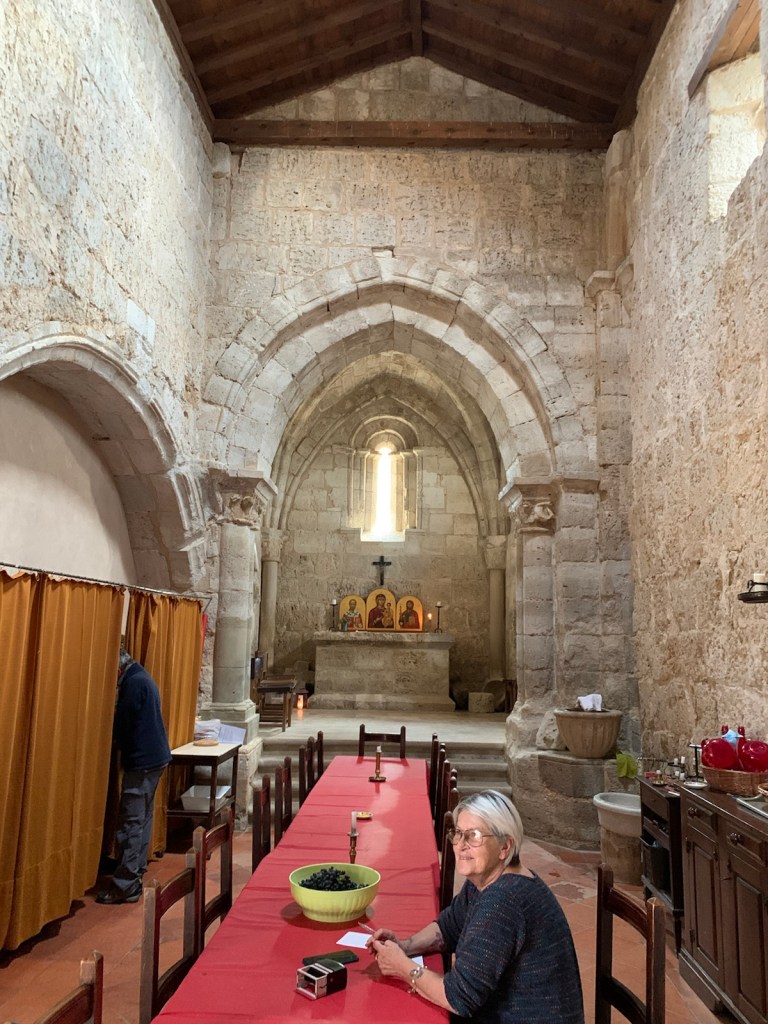
A famous traditional pilgrim shelter, it was restored by and is supported by the Italian Pilgrims Association.
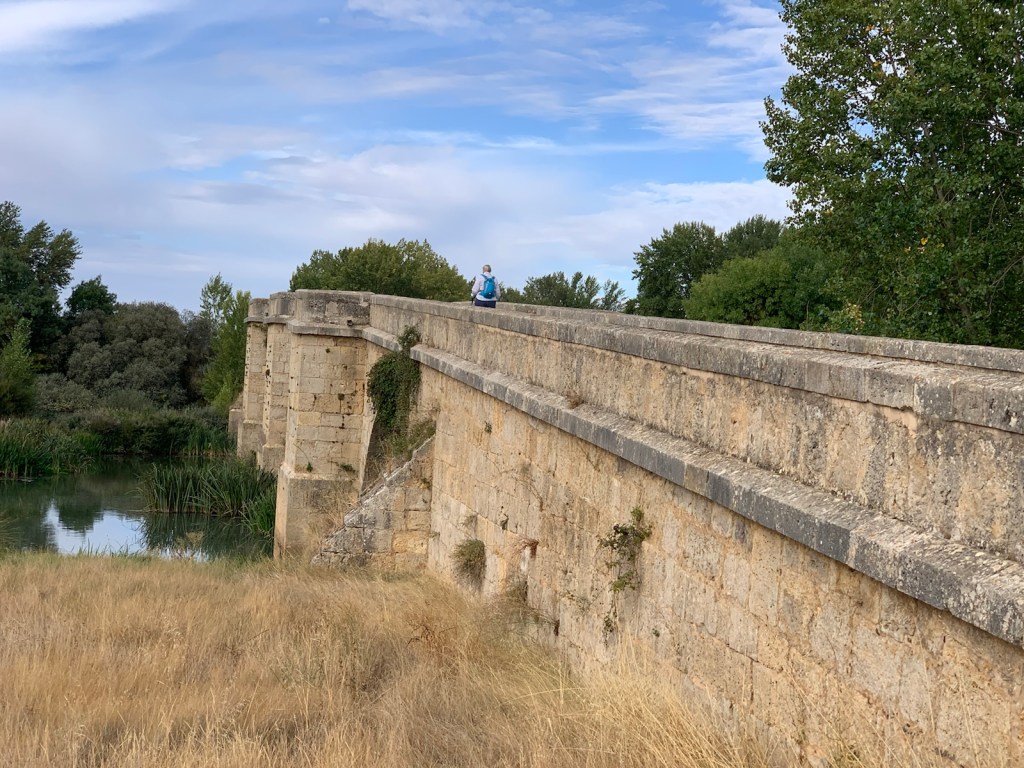
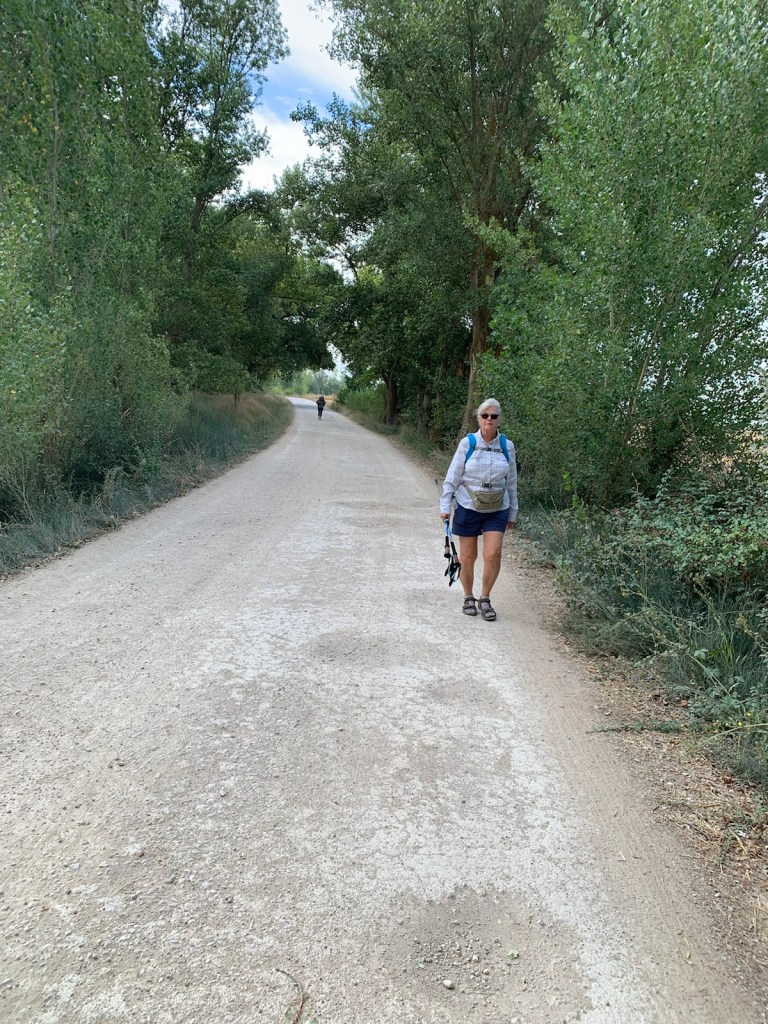
Puente de Fitero (11th century) one of the most beautiful and longest bridges on the Camino Frances.walking along the Pisuerga Rio and along the edge of a (poplar?) tree farm.Puente de Fitero alberge… now permanently closed.. was our initial choice to stay tonight
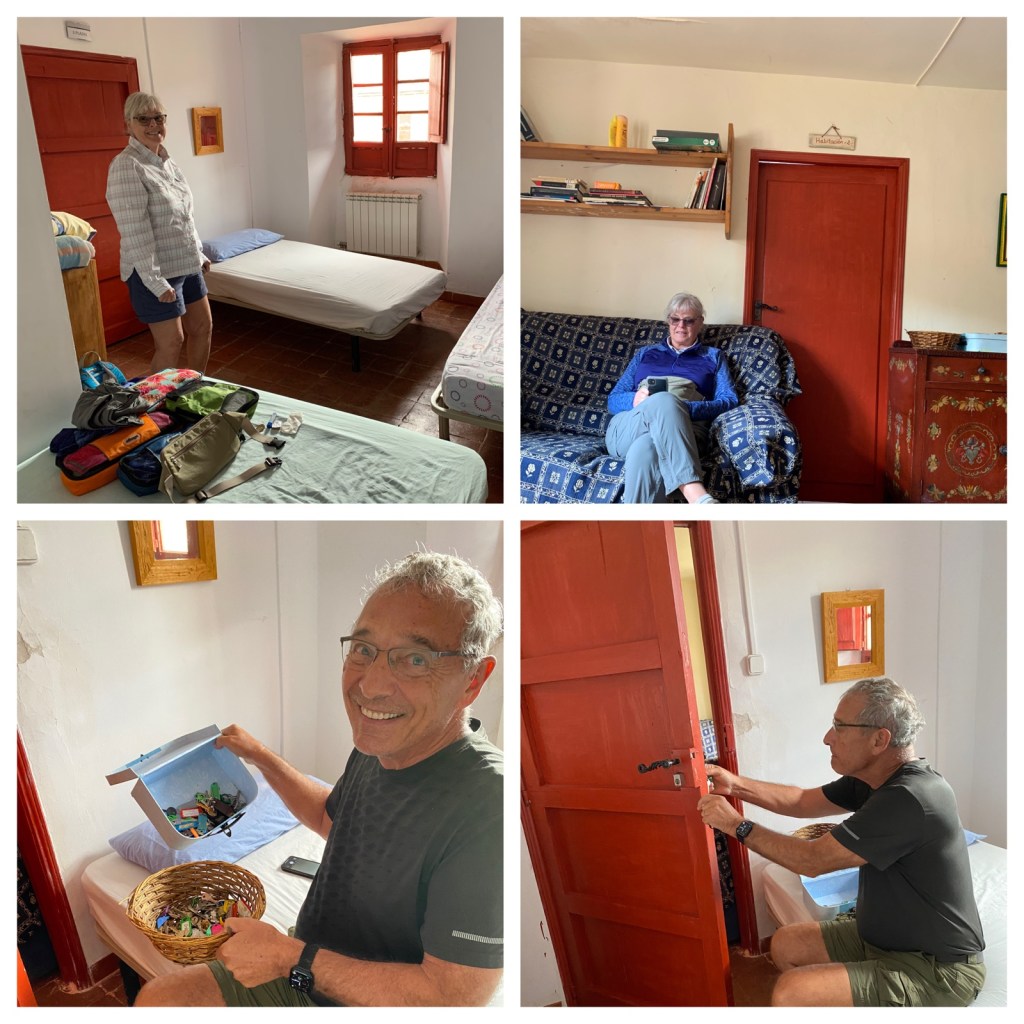
We checked in to La Mochilla albergue soon after arriving in Itero de la Vega at 10:45. The albergue is a very old, make-shift collection of rooms with possibly 30 beds ( dormitory style) and two private rooms (w/o bathroom) of which we have one. There are two bathrooms with sinks, 1 working shower and ourdoor patio for socializing and meals, a basic kitchen for doing your own meal and a kitchen for albergue prepared breakfast, lunch and dinner. Soon after occupying our room we had no key so Jim asked the owner for one and he came back with two containers of keys to try to find one that fit our door. He said (we think) that a prior occupant of our room apparently took the key with him as the owner began trying keys in the two boxes. Jim offered to look for him so he could get back to processing the line of other pilgrims waiting to rent beds for the night.
Our room, the shared sitting area for us and a 8 bunkbead dormitory like room. Jim busily at work looking for the “ key” for “ habitacion #2”.
After trying all the keys in our door without a fit, we abandoned the effort and accepted that our room tonight is not “technically” private. (Jim considered asking for a discount but decided against it). This may not be the most primitive albergue we’ve stayed in, but it’s close… at 35€.
our new pilgrim friends from New Zealand
We met two delightful sisters from New Zealand who checked-in shortly before us. We had chats with them during breakfast and later for lunch in a nearby bar in Itero de la Vega.
Dinner tonight was with 8 other pilgrims. We had interesting conversations, mostly in English, even though 5 were from Spain. The other pilgrims were from Norway, Switzerland and Philadelphia. It was enjoyable and lasted until our new, normal bedtime, 8:45 p.m.


















 Jimandi