Day 24- Villafranca to Atapuerca

  • Distance today:                       11.4mi
  • Distance Camino 2017:      173.5 mi


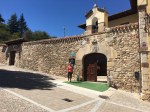
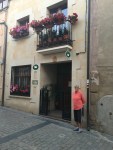
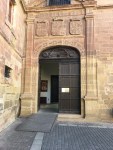
We had a rough start this morning. It was still dark when we dropped our key at the front desk at 6:15 and walked into the courtyard to exit through the medieval, 4 inch thick, 1 ton wooden door which was locked. We fiddled with all the old and new locking mechanisms. None of this would have occurred, had we left at 7:00, when the hotel staff was awake and there to serve us.
Finally, Jim found a heavy metal steel rod and forced open one of the latches and the door miraculously opened just as an awakened staff member was apparently coming to our aid. Jim returned the steel beam to its place and we left, hurriedly, to avoid potential retribution, waving to the staff member, and saying “gracias”!
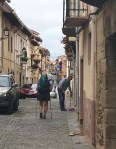
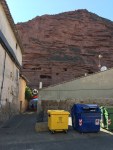
No more than 5 paces outside the door we rejoined the Camino and with headlamps beaming, did our best to navigate a very steep, rocky, narrow path straight up the side of an Oca Mountain. This continued for about 3/4 mile until we merged with a slightly wider path with better footing and proceeded the climb to the top of the mountain … another mile. 
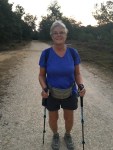
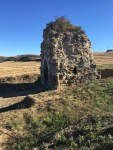
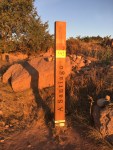
A further test of our resolve occurred after 2 miles. It was a really big dip that began at a monument for 30 or so Franco supporters that were assassinated during the 1936-39 Spanish revolution that brought Franco into power.
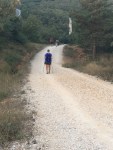
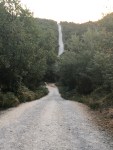
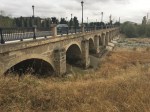
The path went straight down abruptly for at least 200 feet to a small bridge over an insect infested creek and then immediately climbed straight up 200 feet. This spot of the Camino definitely warrants a long, level bridge!!

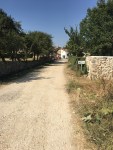
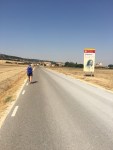
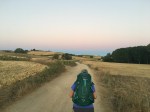
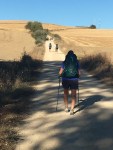
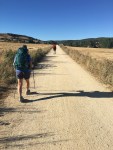
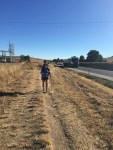
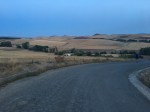
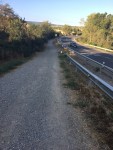
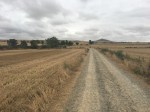
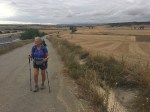
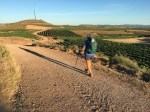
When we thankfully leveled off, we left the small path and joined a wide almost level 30-40 ft wide logging road that continued for at least another 5 miles.
The logging road was boring except for the constant buzzing of flies and other annoying insects. To make matters worse, there were no places for a rest stop or any other types of services.

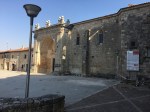
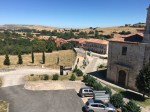
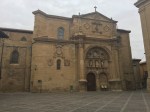
After 7.4 miles and no break, we finally arrived at San Juan de Ortega, named for the disciple of Santo Domingo.
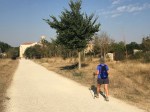
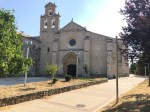
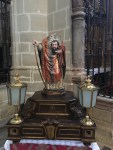
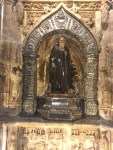
Juan Velásquez, was a young priest and disciple of Santo Domingo who was born near Burgos. San Juan helped Santo Domingo in the construction of bridges in Logroño, Santo Domingo and Nájera. After Domingo’s death, Juan went on pilgrimage to Jerusalem. On the journey, he was caught up in a shipwreck and prayed to San Nicolás de Bari to save him. When he survived, he returned to the Burgos area determined to serve pilgrims in the notoriously dangerous and difficult Oca mountains. He is attributed with developing the road from Villafranca to Burgos (from which he took his name de Ortega, “of the nettles”) as well as a hospice and monastery in the wilderness. Along with being considered the patron saint of innkeepers, San Juan also became known as the saint of fertility. Legend says that when his tomb was opened, the air was fragrant and a swarm of white bees flew out. Queen Isabel la Católica was perhaps the most famous barren woman to pray at his tomb. She visited twice and conceived two children, named Juan and Juana.

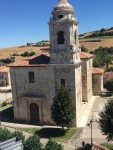
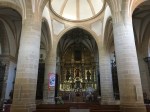
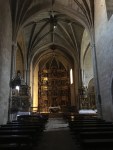
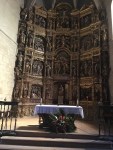
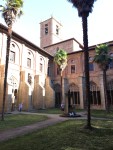
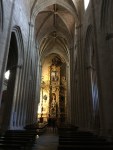
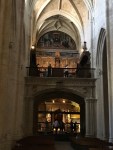
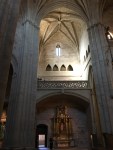
Continuing our fun morning, we had cafe con leche at the only bar in San Juan de Ortega, but there was no tostada available and no zuma naranja. We still rested our feet and after a brief visit to the Iglesia de San Juan De Ortega continued another 2.5 miles to Ages where we stopped for a zuma naranja, ummmm!
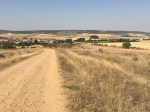
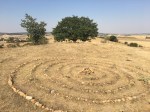
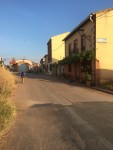
The sun was beginning to bare down so we finished our OJ and walked the final 1.2 miles to Atapuerca.

Just outside the village of Atapuerca is a still ongoing excavation campaign, rich in fossil deposits and stone tool assemblages discovered in the complex of local caves that are attributed to the earliest known hominin residents in Western Europe. The nearby Atapuerca Mountains, served as the preferred occupation site of Homo erectus, Homo antecessor (or Homo erectus antecessor) and Homo heidelbergensis communities. The earliest specimen yet unearthed and reliably dated confirm an age between 1.2 Million and 600,000 years.
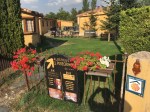
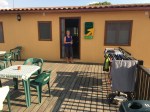
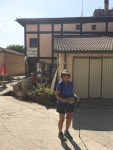
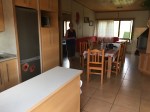
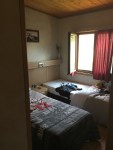
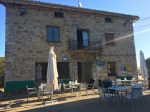
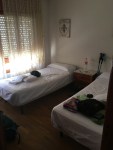
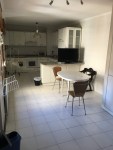
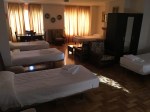
We really like our place for tonight, Casa El Peregrino (35€). It appears to be relatively new and has given us a much needed haven to relax and recover from today’s walk.

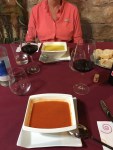
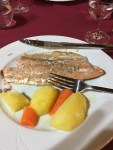
Tonight we had a nice dinner at an nearby albergue, El Palomar.
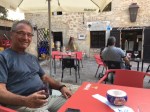
After dinner Jim sat on the deck just outside our room trying to upload photos to the blog. Strangely, the only place we could get wifi was outside our unit, not inside. Several young Spanish pilgrims were using a karaoke app (words and notes only) on one of their cellphones and were accompanied by one pilgrim with a guitar as they all apparently were singing traditional songs.  Jim gave up eventually on uploading but still enjoyed the nice “concert”.

 

Day 23- Belorado to Villafranca Montes de Oca

  • Distance today:                         7.8 mi
  • Distance Camino 2017:       162.1 mi

We left Belorado in the dark, as the high today is supposed to be 101 by 3:00 p.m. It was only 55 when we left at 6:15.

The terrain was similar to yesterday. There seemed to be more pilgrims out this morning, probably because Belorado is the end of a traditional stage of the Camino, meaning that more people stop and spend the night in Belorado, than in the towns/villages in between stages.

We try to avoid the end of stages for that very reason, which reduces the competition for places to stay plus it gives us a chance to visit the less visited places and contribute to their local economy by staying in their accommodations and buying food and drink in their markets and bars.

We stopped at the first village Villambistia (pop.47) with an open bar (Casa de Los Deseos) and had breakfast. When Jim paid the bill he guessed it was 5€ and the bar tender agreed and Jim responded with voila when giving her the 5 euros in coins, to which she responded merci, thinking we were French (tee hee).

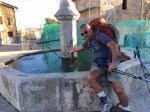
Villambistia has a tradition that says if you immerse your head in the village fountain it will cure you of tiredness . So as we walked up to the fountain (which incidentally had a warning about potability), Jim almost fell into the fountain trying to immerse his full head with backpack, etc. So he opted instead for a self baptism with the fountain water. He followed that with a second baptism while Linda snapped a photo. Incredibly, Jim’s pack got lighter almost immediately and he got noticeably stronger all the way to Villafranca… no kidding!

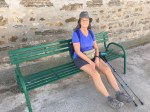
We walked on for another mile and needed an excuse for another rest (we’re a little tired, still, from our walk yesterday) so we stopped in the village of Espinosa del Camino (pop.36) at La Cantina and shared a banana and zuma naranja while occupying a bench outside in the cool shade… and then moved on.

The last few miles into Villafranca included a long grade up and a short grade down and then a flat section that almost merged but then the paralleled the road into town busied with cars, vans and big trucks… adding new meaning to the concept of “share the road”!

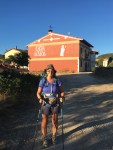
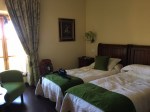
We’re staying in Villafranca Montes de Oca (pop. 147), at the Hotel San Antón Abad(59€), a former hospital for pilgrims, built in 1377. It’s an upscale hotel, beautifully decorated with period antique furniture, paintings and pieces and with spacious modern rooms, restaurant and bar and an attached more primitive albergue facilities at 12€ per bed.

Jim chatted with John from Raleigh on the terrace after a late lunch. John is staying at the albergue and is trying to walk to Santiago in 4 more weeks so he can fly back home in time to his granddaughter’s wedding.

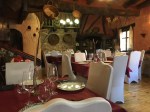
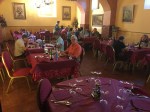
Our pilgrim’s dinner was in the hotel dining room with approximately 19 pilgrims in attendance.

Day 22- Grañon to Belorado

  • Distance today:                       10.5mi
  • Distance Camino 2017:      154.3 mi

After leaving Grañon this morning

we passed through three nearly equally spaced villages: Redecilla (pop.137), where we stopped for breakfast, Viloria de la Rioja (pop.50),
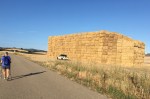
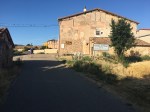
the village where Santo Domingo de la Calzada was born and Villamayor del Rio (pop.53), known as “the place of three lies”.

Instead of being as it’s name implies, the large town on a river, it is actually a small hamlet on a creek!

Grañon to Belorado is a little more than 10 miles via the Camino.

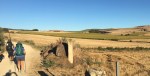
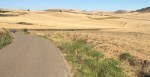
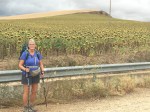
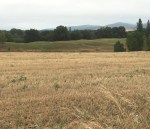
It’s mostly a dirt path along long straight stretches of a two lane highway and pavement into and out of the towns and villages. We walked on rolling hills and were surrounded by recently mowed wheat fields and occasional fields of not-yet-harvested sunflowers.

Today, shortly before entering the village of Redecilla, we left the region of Rioja and entered Castillo & Leon, the largest region in Spain and it encompasses the next 400 km (250 miles) of the Camino.
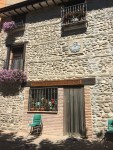
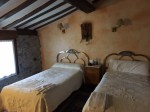
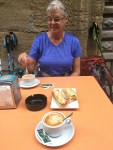
We made another stop, just after entering the Belorado town limits for some refreshment and to let our feet cool.

We’ve had a nice relaxing afternoon, recovering from our longer walk today. Other than doing our routine chores, our only activity was to walk about 20 steps to take a look at church with 4 huge stork nests in its belfry.

At about 6:00, we walked a few blocks from our hotel to the town square and after some serious searching, found a restaurant that served something beside pintxos before 8:00.

Our tummies full we returned to our hotel for the evening.

Belorado’s fiesta is not for another week or so, consequently  things have been quiet, for a welcomed change of pace.

Day 21- Cirueña to Grañon

  • Distance today:                        8.4mi
  • Distance Camino 2017:     143.8 mi

We walked through farmland for a while after leaving Cirueña this morning at daybreak.

A mile or two later, we saw half a dozen vehicles parked just off the narrow dirt road. Doubting it was a ride/share program as traffic was minuscule in Cirueña yesterday, we were about to speculate on the occasion, when we heard several gun shots. A closer look revealed bird hunters, probably grouse or quail or dove, and their canine hunt mates. Everyone, hunters and dogs, seemed to be enjoying themselves on a cool Saturday morning.
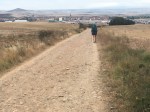
Shortly after, we sighted the next town, Santo Domingo de la Calzada, which has always been linked to The Pilgrimage of St. James. 

Its founder, Domingo García, was born in Viloria de Rioja (Burgos) in 1019. He decided to devote his life to God and tried to enter the monasteries of San Millán and Valvanera but was not accepted.

Around the year 1040 he became a hermit in the forests which occupied the site on which this city now stands. From his home he was able to see how difficult the pilgrimage was for those undertaking it and he began to work to help them by building a bridge to cross the Oja River, a hospital where pilgrims could seek refuge, roads connecting Nájera and Redecilla del Camino (Burgos) and a little church.

Domingo received approval from King Alfonso VI de Castilla who provided the piece of land where Domingo built the first church completed in 1106, but which sadly no longer exists.

When Domingo died, on 12th May 1109, he was buried in a sepulcher he had designed and prepared for himself in the middle of the road he himself had built for the pilgrims.

When the Cathedral was begun in 1158, it was built around Santo Domingo’s tomb, becoming part of the south transept of the Cathedral. His followers maintained the little village which later took his name and they continued his work, creating a confraternity, that even today works to keep his memories, traditions and beliefs alive by working with pilgrims in the Hostel.

Santo Domingo performed 12 miracles during his life that led to his beatification.

Two of his best known miracles involves the Camino. Legend tells of a German Pilgrim called Hugonell who was walking to Santiago with his parents, when they decided to rest at an inn in Santo Domingo de la Calzada. The owner of the inn´s daughter immediately fell in love with him; however her feelings were not reciprocated, so the girl, angered, placed a silver cup into his luggage and accused the boy of theft. Thieves at that time were punished by hanging, and this was the fate of Hugonell. His parents, saddened by his death continued the pilgrimage, and upon arriving in Santiago de Compostela, began their return journey to visit the grave of their dead son. When they arrived in Santo Domingo however, they found their son still hanging in the gallows but, miraculously alive. Hugonell, excited, said to them: “Santo Domingo brought me to back life, please go to the Mayor´s house and ask him to take me down”. Quickly, the parents arrived at the Mayor´s house and told him of the miracle. The incredulous Mayor, who was preparing to have dinner with friends, responded: “That boy is as alive as these two roast chickens we are about to eat,” and suddenly, the chickens came to life, sprouted feathers and beaks and began to crow.

We had breakfast in a small bar adjacent to the Catherdral of Santo Domingo de la Calzada and then as pilgrims gained entrance to the Cathedral for 3€ each.

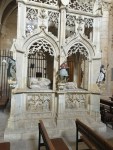
In front of the Mausoleum of Santo Domingo was a stone, polychrome and gothic Henhouse, which was built in the middle of the 15th century to keep alive a hen and a rooster in memory of the most famous of Santo Domingo´s miracles. There are documents from Pope Clemente VI dated 1350 allowing these live animals inside the cathedral. Below the cage is a representation of the pilgrim being hanged painted by Alonso Gallego. Above the cage there is a piece of wood from the gallows.

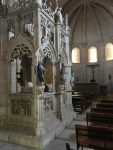
We were also impressed with the beauty of the tomb and statue of Santo Domingo and the simplicity of the altar and absence of an ornate retablo, positioned instead in the left transept of the Cathedral.

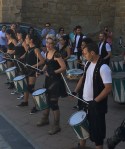
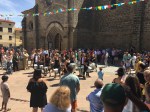
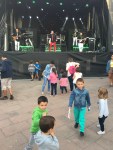
Four miles later we entered the village of Grañon (pop. 306) that was having, you guessed it, a fiesta. Shortly after we arrived, checked in and shopped for some groceries, it seemed the the entire population turned out to be entertained by an all drum band, free chorizo, bread and drinks.

We entered the church in Grañon which was empty as all the folks had already attended a noon service and were now engaged in the fiesta.

It’s a really special place, nice retablo as most Iglesia we have visited but this one has wooden floors, much like you would find in an old log cabin, which created a very warm and inviting feeling… a true sanctuary.

Other events followed, but as soon as the crowd cleared enough for us to make it to our room, which was once again, by chance, in the center of the festivities, we got back into our pilgrim afternoon routine.

We’re staying in the small casa rural called, “Mirabel”(50€), a habitacion doble con bano with access to a full kitchen and living area.

We took advantage of the facilities and prepared both lunch and dinner from items procured from two small grocery stores nearby.

Just before calling it day, we walked back to the town square and couldn’t believe the magnitude of the celebration of this village of just over 300 people.

Fiesta us a very big deal in Spain.

Day 20 – Nájera to Cirueña

  • Distance today:                      9.6 mi
  • Distance Camino 2017:    135.4 mi

We encountered a steep climb up the mountain behind Nájera at the beginning of our walk and a gradual, steep incline carrying us from the valley up into Cirueña, but otherwise the terrain was not an issue for our longest walk since we began nearly 3 weeks ago.

Shortly after our breakfast stop in Asofra,

Jim chatted for a few minutes with Gary from England who was walking 25-30 km per day for only a week, as he has done the last few years. With him were his daughter, a college student, and his two cousins.

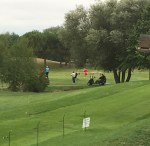
We stopped for a second cafe con leche and zuma  naranja at a golf course for an unusual 19th hole Camino experience to conclude our walk.

Today was much of what we enjoy about the Camino. The rolling farmland of Rioja, extending out in all directions from a winding seemingly endless Camino soothed the senses. The dark green rows of fruit filled grape vines randomly patched among already harvested fields of grain and occasional, occurring lighter green olive orchards formed a comforting quilt. The sounds of rustling water in the open irrigation trenches, the gentle rhythm of crunching footsteps and an occasional dog bark punctuated the soundless void that was relaxing and meditative and sustaining.

The cloudy sky with showers off in the distance and a gusty wind threatened rain most of the morning, but provided only a minor threat and instead made us thankful and satisfied as we completed today’s not hard, not easy but satisfying daily journey.

We arrived in Cirueña (pop. 127) at 11:45 and we able to check-in to Casa Victoria (42€), a home that rents out 3-4 nice rooms for guests. After completing our chores we had a sandwich for lunch at the “only bar in town”, literally, then had a nice relaxing afternoon.

For dinner we joined a group at the Albergue Victoria which is owned by the same family that owns ours. Our fellow pilgrims all spoke a little English.

One lady, originally from Peru was with her American husband and they live in Connecticut. The others were from Brazil, Italy and Ireland.

Day 19 – Ventosa to Nájera

  • Distance today:                      6.6 mi
  • Distance Camino 2017:    125.8 mi

Between Ventosa and Nájera is the village of Alesón where the legendary knight, Roland had camped in July 778 with his knights on his way to Santiago with Charlemagne and the French army. Early the next morning they marched to the Poyo Roldan (Roland’s Hill),

… and marched to Poyo Roldan (hill with tall thin tower), the watchtower for Nájera castle.

which was a large mound serving as a watchtower over the castle of Nájera. The Moors occupied Nájera and had sent the giant, Ferragut, of Syrian origin and 20,000 soldiers from Turkey to fight Charlemagne’s army, who was marching to Santiago and driving the Moors from northern Spain. Ferragut was reportedly a descendent of Goliath (of David and Goliath fame), was 9 feet tall and weighed over 400 pounds. (He was ugly, too!)

Ferragut came out from Nájera into the open field between Poyo Roldan and Nájera, challenging any of the opposition to fight him one-on-one. Many tried and failed. Finally, Roland insisted on having his turn and fought with the giant for three days. In between spurts of fighting the two conversed about their respective faiths, and Ferragut revealed that his one weak place (his Achille’s heel if you will) was his belly button. A final duel ensued, having both agreed that the winner would be the one espousing the true faith. Ferragut tried to fall on Roland to crush him to death, but Roland stabbed him in the belly and won.

The duel lost, the Moors vacated Nájera and moved south, clearing the way for Charlemagne’s army to continue on their way toward Santiago. And Roland became the greatest knight in Christianity.

We must be getting stronger. Maybe not strong enough to take on Ferragut, but today’s walk seemed actually easy. We were pleasantly surprised when we stopped just outside of Nájera (pop. 8144) for our standard breakfast and weren’t really tired from our nearly 7 mile trek.


Waiting at a bar in old Nájera until we can check in to Pencion Calle Mayor.

Pencion Calle Mayor (30€) didn’t open until noon so we explored Nájera a little and hung around a bar with wifi (most every place has wifi, especially bars) and made like efficient pilgrims waiting for their room.

Our twin bed room is small and shares 2 bathrooms with 5 other private rooms and a communal bedroom with 6 twin beds (not bunks).

There is a communal kitchen which is large enough to include a washing machine and racks to dry clothes near several windows. Being the first pilgrims to arrive, we had the bathrooms to ourselves for showers and washing socks and underwear, so we didn’t actually share.

Late afternoon (4:30-5:30) we walked around Nájera and discovered as we often do in Spain, that a meal like dinner, is not offered by restaurants before 8:00 p.m. We finally found a bar and ordered pasta.

Before calling it a day we walked to the Monasterio de Santa María la Real.

According to legend, in 1044 Navarran King Don Garcia III was hunting partridge with a falcon. The two birds entered a cave and the king followed them in and deep inside he found a statue of the Virgin Mary, with a vase of fresh lilies and a burning oil lamp.

He saw this as a blessing on the Reconquista and used some of the money he had plundered from the Moors to build a church around the cave leaving the statue in place. At one point the statue wore a crown of jewels, which were later stolen and divided. The Black Prince Ruby made its way to England’s coronation crown.

The church is also a burial place for Navarran royalty and also contains the remains of monarchs going back to 918 AD.