Preparations

We originally planned for Camino2026 to begin on May 1. However, on November 6, 2025, our grandson, Mac, shared that he and Anna had become engaged and asked that we save May 22 for their planned wedding.

So, we tentatively set May 24 as our departure date for Camino2026 and decided to start our walk in Pamplona as we did in 2025.

And, because of the ever increasing popularity of the Camino Frances, we decided to reserve each night’s lodging before leaving for Spain. Subsequently, we began the tedious process on November 18, 2025 with our first contact being via email with a hard-to-get albergue in the small village of Cirauqui.

Once we successfully secured this first reservation, we plugged it into our tentative itinerary (a spreadsheet based on Camino2025) and proceeded to fill-in other accommodations, giving priority to the hard-to-book ones. We completed the last of the 49 total bookings on April 18. We used (1)Booking.com, (2) email, (3) Whatapp and (4) available property websites to secure the reservations.

In parallel with our booking process, we began gathering the items we would each need for our 7-week trek and displayed them on our guest bedroom bed. We added to and subtracted from our respective collections until we were satisfied we were each left with only “essentials”.

Jim’s stuff on the left side and Linda’s on the right.

On May 11, we packed our respective backpacks and flight carryons/ daypacks to verify that there was room for everything and that it was comfortably transportable.

Backpacks, daypacks and fanny packs ready for trekking.

Last year, we used Correos, the Spanish postal service, to transport our backpacks to and from each daily destinations. The service was very reliable and much less expensive than the other transport services we used on previous caminos. However, once in Spain, it was difficult to pay at their website, requiring a visit to a major office in Pamplona, delaying our walk to our next destination. We also struggled finding someone to print our itinerary from the Correos website for the bag tags and then looking for materials for securely attaching the tags to our backpacks.

So, with the Camino 2026 itinerary completed and each night’s lodging reserved, we were able to do all the “front end” prep work for backpack (mochila) transport from the comfort of our home, benefiting from a superior internet signal, color printer and “golf bag name tags”, easily purchased from Amazon.

Our ” professionally made” backpack transport tags up close. It contains our ID in text and scan code, along with the dates for pick-up and delivery at each municipality & property for our entire itinerary.
Tag with itinerary for Correos attached to Jim’s backpack (mochila).

Finally, since we need to take trekking poles, scissors and a pocket swiss-army knife with us, carrying them in our fanny pack or carryon pack is not an option given TSA regulations for our flights. Thus, we put these items into our backpacks, which we check. To keep our checked backpacks dry and safe from handling and/or mishandling by airline and airport handlers and automated equipment… we found a lightweight (11oz), inexpensive ($5.00) plastic, zippered duffle bag at IKEA. It’s called FRAKTA.

The folded FRAKTA shown with Jim’s backpack before and after preparing for checking on our flights.

We expected the FRAKTA to be disposable, but it has held up now for 3 caminos going to and from Spain. It appears to be able to make the journey for Camino2026 too. Once we arrive in Spain, we fold it and stuff it in the section between the back support and hydration bladder and accept the added weight. But with its low cost it could be discarded once in Spain to save the extra 11oz weight to carry. By using the transport service, weight is no longer an issue for us.

Larry, our generous friend, neighbor and ardent follower of our blog, has offered to give us a ride to GSP on Sunday morning, so unless we’ve forgotten something, we’re ready to embark on Camino 2026.

Camino 2026 – An octogenarian approach to the Camino Frances

Our Caminos to date:

YearStartEndMiles/Days Walked
2012SJPDPRoncesvalles15 /2
2013RoncesvallesPamplona32/2
2014PamplonaLeon270/27
2015LeonSantiago180/21
2017SJPDPSantiago494/68
2019SJPDPSantiago414/59
2022SJPDPSantiago348/52
2023SJPDPSantiago316/51
2024RoncesvallesSantiago296/47
2025PamplonaSantiago275/46

Camino 2026 will be, logistically, similar to Camino 2025. We’ll begin again in Pamplona and end in Santiago 46 days later. And, it will be our second opportunity to walk across Northern Spain in late spring/early summer.

While the route will be the same, we will be staying at 10 properties for the first time. (For 3 properties, it will be our 8th return visit.) Our mental and physical challenges will be different, as will our encounters with new pilgrims and service providers. And we look forward to the renewal of acquaintances and friendships developed during prior caminos.

Because of the ever-increasing popularity of the Camino Frances (over 500,000 pilgrims in 2025), to reduce a potential stressor, we recently completed bookings for each night’s stay to eliminate the risk of arriving at our planned destination and finding all suitable accommodations “completo”.

Our preparations for Camino 2026 are nearing completion as we approach our departure for Spain on May 24th.

Home again, after Camino2025.

The Camino Frances begins in St Jean Pied de Port in France and extends across Spain to Santiago for a total of 799 km (487 miles).  Our Camino2025 began in Pamplona and ended in Santiago, reducing our total potential to 712km (434 miles).

When we both struggled with bad colds, we skipped walking and used public transportation for 40 km (24 miles).  We also skipped segments of the Camino that totaled 220 km (135 miles) that we have walked two or more times before and chose not to walk this time due to one of the following reasons: (1) required us to walk more than 10 miles in a given day,(2) contained difficult terrain that we didn’t care to repeat for safety reasons or (3) included walking through densely urban or industrial areas not characteristic of the typical Camino, especially the Camino experienced by Medieval Pilgrims. Consequently, Camino 2025 amounted to walking only 275 miles in 43 days for an average of 6.4 miles/day.  Our longest walk was 9.0 miles and shortest was 4.1 miles. 

We are frequently asked “What does it cost to do the Camino”. Because of our unique approach to walking the Camino Frances, our expenses would likely be considered on the high side of pilgrims walking the Camino in a more traditional fashion.  So, an analysis of our costs follows, to give you a frame of reference should you be planning your Camino:

Total cost for Camino2025 (Total days=56, walking=43) was $12,750.   Air travel to Pamplona was $3615 ($3239: GSP to MAD, $376: MAD to PNA).  The train returning from Santiago to Madrid cost $113. Our average cost per day for lodging was 70.24€ ($81.50) and 55.24€ ($64.07) for meals and snacks.  Transporting our backpacks cost $428 and taxi/bus fares were 487€ ($565).  In retrospect, it was an extraordinary adventure vacation experience for less than $230/day for 2 adults.

Camino2025, our 7th Camino, in several ways was our best. Walking in the spring vs summer/fall eliminated our need to begin each day walking in the dark and reduced significantly the time waiting to checkin at our next destination.  It was nice to see more greens vs browns in the scenery around us, more flowers of different colors and less dried up streams/rivers. Conversely, we missed seeing, walking through and sampling the fruit filled vineyards and orchards.

Dealing with a bad cold for over a week was a bummer, but manageable and on hindsight, confirmed the healing environment of the Camino.  We lost several days of walking when sick, but we still made progress via taxi or bus.  In the end, after 43 days of walking over 6 miles per, carrying a daypack, we felt healthier and stronger, confirming that our advanced chronological age is still not a deterrent.

Interesting pilgrims, local citizens and hostelers enriched our experiences along the way and previous relationships were renewed, appreciated and strengthened. The cuisine and culture of Northern Spain reminded us of the value of simplicity in our lives and reinforced practices and lifestyles to be continued upon our return home. The simplicity of the Camino became even more apparent as we rejoined the complexity and stress of the world on our way back home.

Walking and living on the Camino Frances has had a profound impact on our lives and who we are.  Our physical, mental and spiritual condition has been influenced and strengthened by it. It has positively influenced our relationship and our appreciation of each other as we have shared the challenges and satisfactions associated with experiencing the Camino Frances together. 

The perennial question is “will we do it again” and the answer, as before, is “we’ll see”.

Madrid

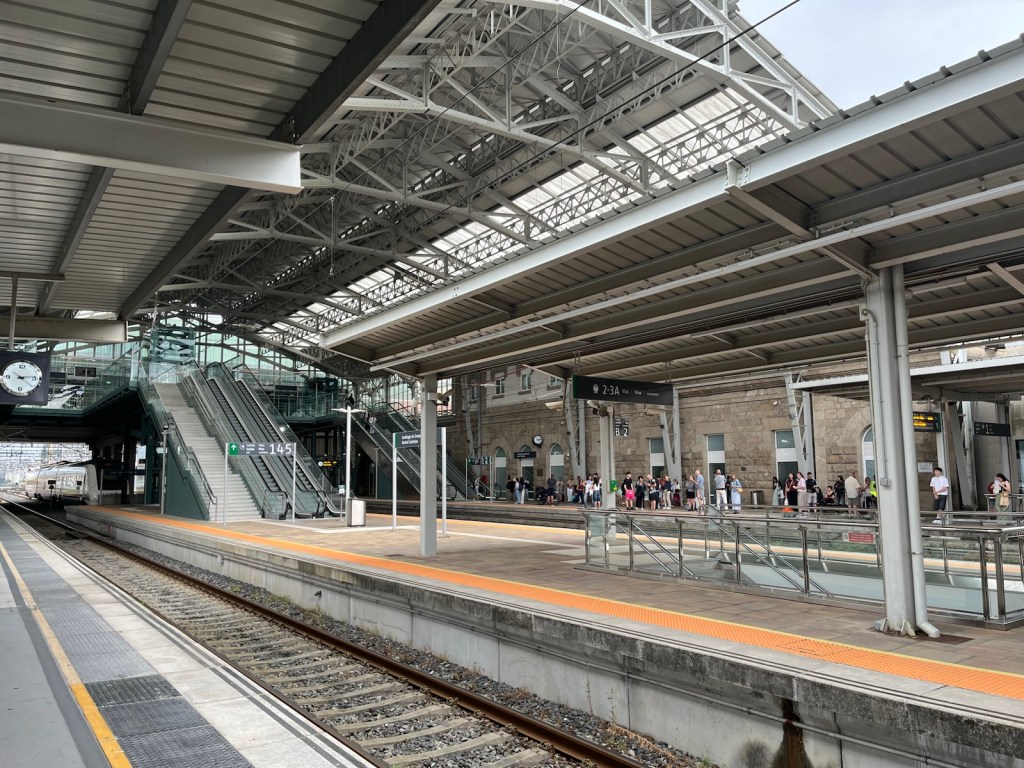
We walked to the newly updated Santiago train station just before daybreak. The new station has been under construction for as long as we can remember, but the final result is impressive.

Sorry about the closeups of Jim’s finger. Linda is here negotiating the steps, carrying her backpack and daypack.
Made it!
Much larger new restaurant.
Nice large train arrivals/ departures status board, much more efficient checkin cue and baggage scanning/security area.
We collected our bags and a few steps later took the escalator down to our “via” (boarding platform).
A 20 minute wait for our train to arrive.
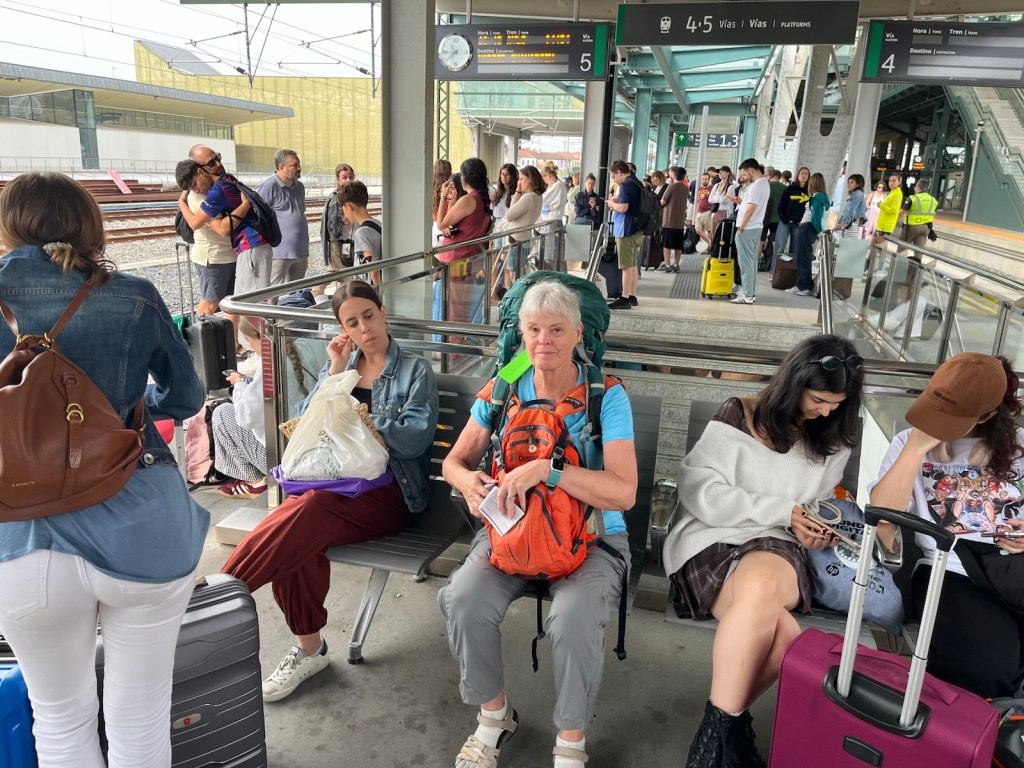
Sitting snd waiting the final 10 minutes with some Santiago residential housing behind us.
“Here comes da train”.
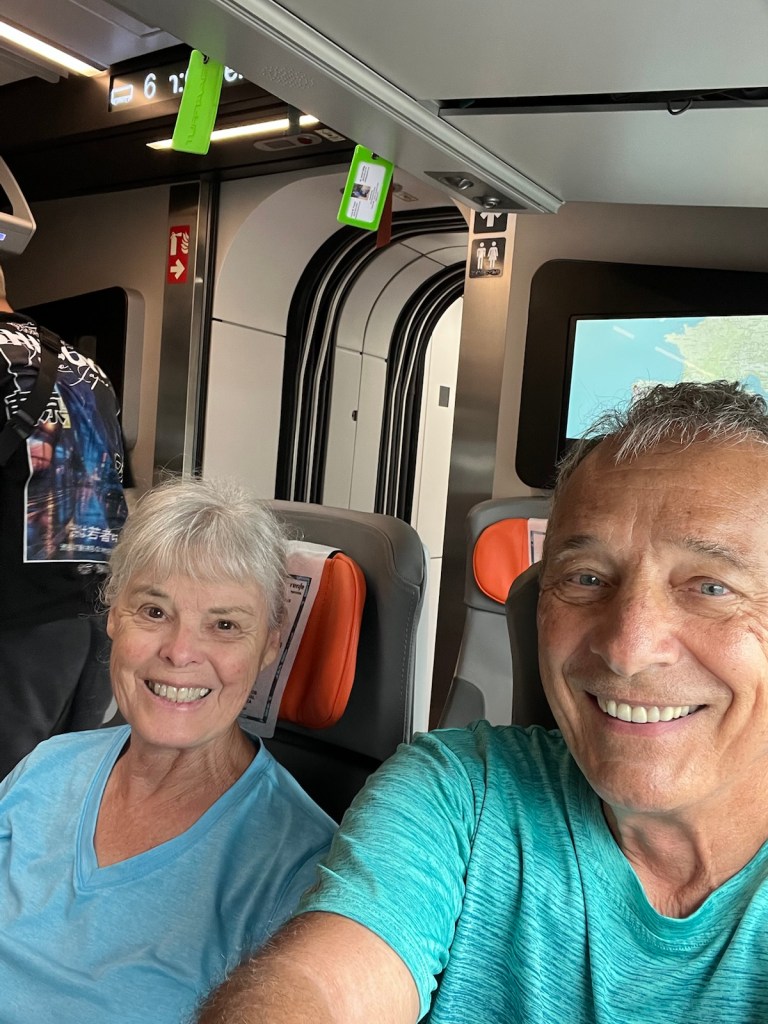
All aboard in very comfortable “comfort” seating. Fare for the three hour Santiago to Madrid trip was 48€.
A look around behind us.

The following is a brief journal of our train ride from Santiago to Madrid. Photos are a challenge when the sun is rising on your side of the train and seats on “better lighting” side are occupied. Also, interior train lights and other light sources create reflections that are picked up in photos taken through the windows. Further, the photo subjects outside are appearing and disappearing at 180 mph most of the way. So, please forgive the photo quality chronicling our ride down to Madrid.

Just after leaving Santiago, shooting toward sunrise, high speed.
This screen gave us the train speed continuously. 301 km/hr is about 180 mph!
Ourense, at around 8:50, an hour into our journey.
Ourense, at slow speed, prior to our first stop.
At the halfway point of our trip.
A fellow passenger sleeping soundly at 180 mph.
Nearing Zamora
Still clicking along.
As we got closer to Zamora, the colors were more brown than green, the green aided by visible irrigation systems. And mountains were less prominent.
A lake near Zamora
Typical countryside approaching Madrid.
Getting closer to Madrid.
Still going full speed a half hour out of Madrid.
Some Madrid skyscrapers a few minutes from the Charmatin train station.
Walking to a very well organized taxi area with a zillion taxis… no waiting for us.
All our stuff using today’s backpack transport service!
And ditto for Jim.
Our room at the Madrid Airport Hilton.
Upscale bathroom
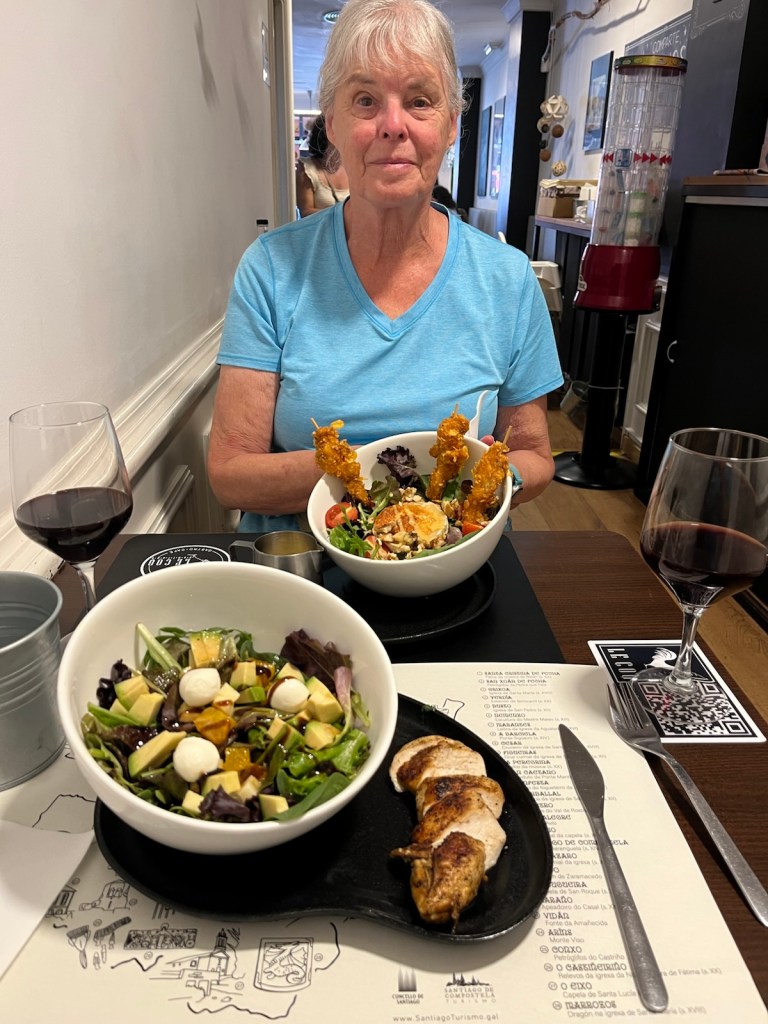
Lunch at nearby eatery. Gazpacho for Jim, chickpea salad for Linda.
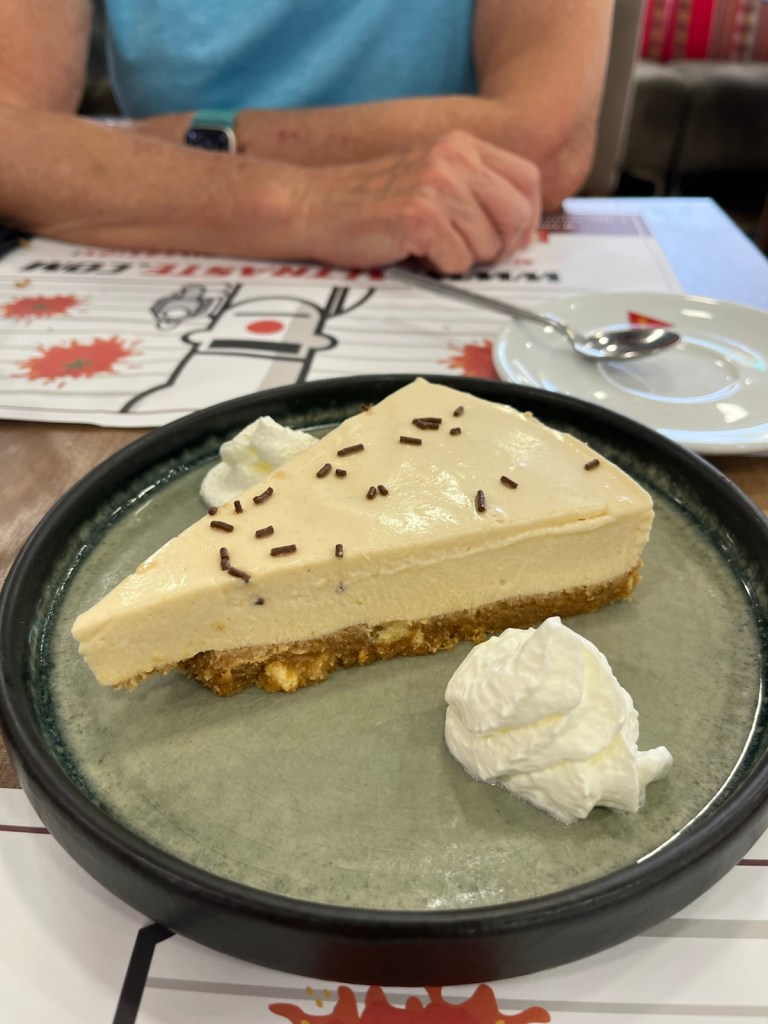
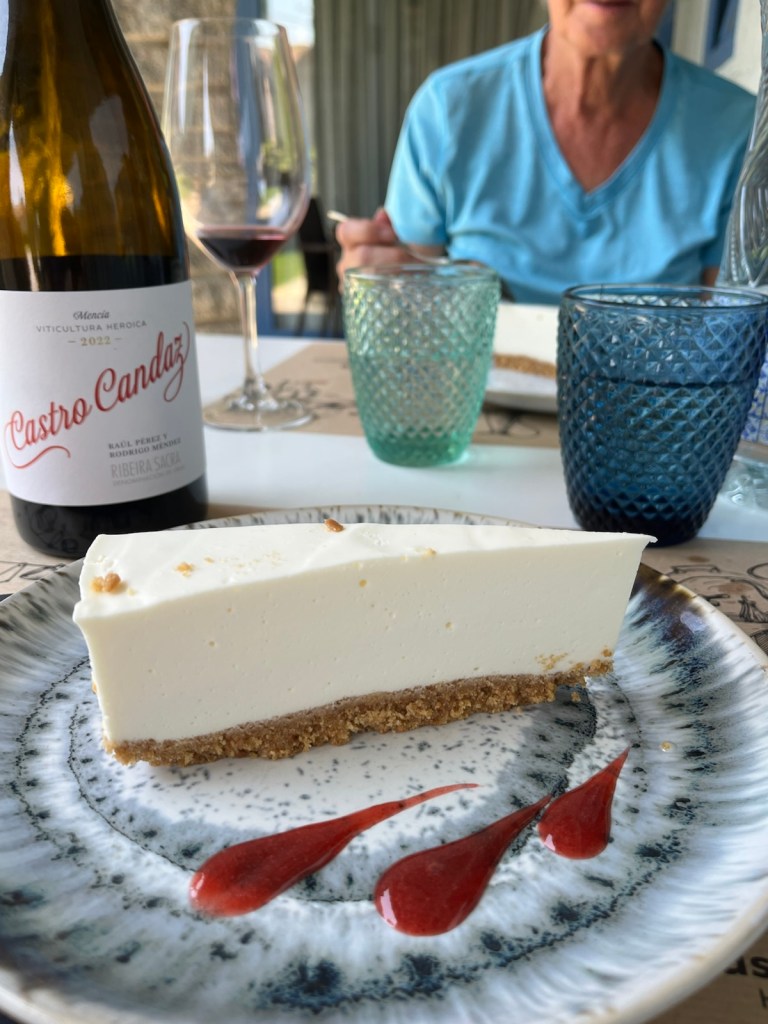
Cheesecake on slate.

After lunch we chilled a bit in our comfortable room and re-organized our packs again. (backpack and carry-on).

The temperature in Madrid got to 101F by mid-afternoon, so we were glad to not be walking. Looking back, the temperature in Santiago this afternoon was 87F.

So, we walked across Spain, took a train to Madrid and tomorrow it’s a jet to Charlotte/Greenville.

We’ll do a wrap-up on Camino2025 when we get back home.

Buen Camino!

Santiago

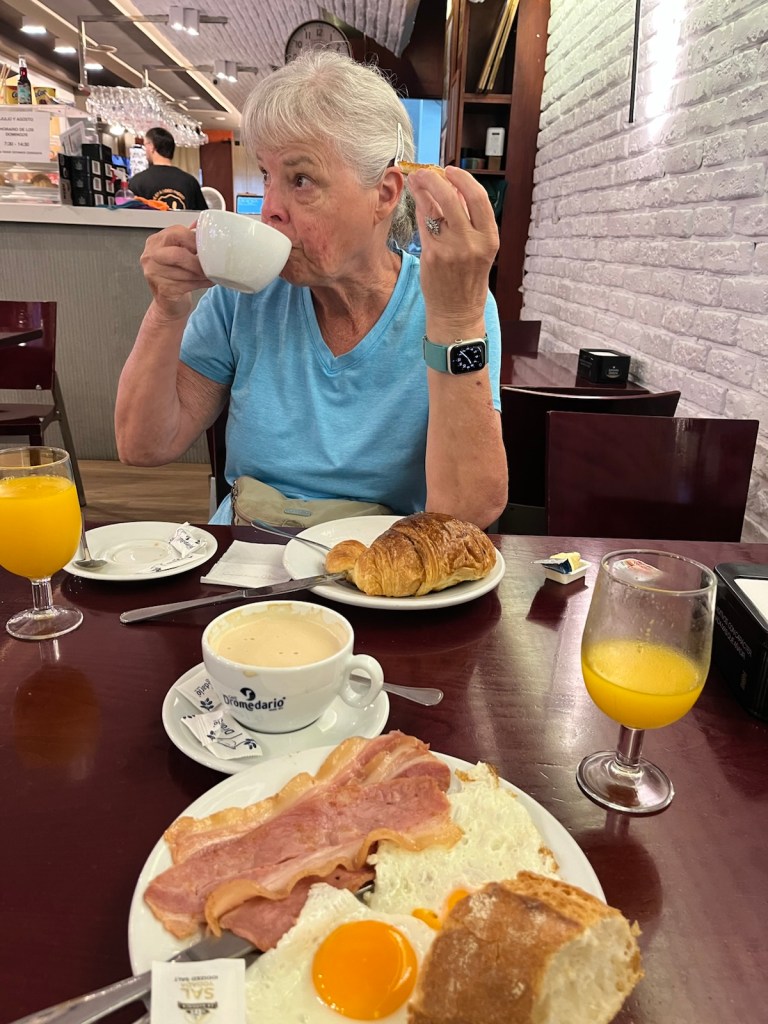
After setting an alarm everyday for 2 months on the Camino, we slept in this morning until around 8, then walked next door from our hotel and had a breakfast of cafe con leche and Croissants!

When we finished, Linda returned to the room to begin reorganizing her stuff for the train trip tomorrow. So, Jim returned the 1.25 mile walk to old Santiago de Compostela to take some photos and checkout the inside of the Catedral.

A few pilgrims and tourists beginning to congregate in Obradoiro Plaza at 9:00 a.m.
A view of the Catedral looking directly at the Pórtico de la Gloria (gated door on center, ground level). The Pórtico of Gloria was like a porch where pilgrims entered the 24/7 over 1000 years ago. It was closed this morning so will have to check it out next trip!
A closer look at the west entrance (which is normally closed except for the Pórtico de la Gloria museum/display).
A closer look above the Pórtico at the architecture and sculptures.
Jim walked around to the south side of the Catedral where most visitors enter. No line this morning, but yesterday, a line containing hundreds of people snaked into and filled the courtyard on the east side of the Catedral and then continued down a street leading into the courtyard.

When Jim entered the Catedral there was a 9:30 pilgrims mass beginning and no photos were allowed in respect for the parishioners.

So Jim took a seat and joined the 30 minute service. It was obviously in Spanish and Jim’s not catholic, thus being unfamiliar with the service routine. So, when not reflecting on the spirituality of the moment, he observed the artwork and sculpture and symbolism displayed all around him.

Here are some of his visual observations during the service and then after the service.

Jim’s view as he sat in the nave, in a pew about half way back. The organ pipes and decor located at near mid-sanctuary were awesome.
Approaching the altar… Botafumeiro suspended at right center.
The Botafumeiro was hanging in the Catedral but not swinging during today’s pilgrimage mass at 9:30.

The ‘Botafumeiro’ is the famous giant thurible or censer in the Santiago de Compostela cathedral. It has been used since the Middle Ages, to clean the air when crowds of pilgrims, having completed the Camino de Santiago, arrived in Santiago de Compostela after their long journey.

The Codex Calixtinus, the first Camino de Santiago ‘guide-book’, refers to the ‘Botafumeiro’ as Turibulum Magnum, which means this ritual has been taking place at least since the 12th century.

The current ‘Botafumeiro’ dates back to 1851, and it’s made of silver-plated brass, is 160 cm high and weighs 62kg when empty plus up to another 10 kgs more when filled with smoking coal and incense. Eight men, called ‘Tiraboleiros’, are required to operate the ‘Botafumeiro’.

The Santiago de Compostela Botafumeiro is the largest ‘Censer” in the world.

Moving forward, with the transepts to your left and right, you can focus more on the Altar Major which features St. James.

The Altar Major with three depictions of St. James (Santiago).
Santiago “the knight”
Santiago “the pilgrim” or “martyr”
Santiago “the Apostle”
A closer look at Santiago, the Apostle. This depiction of St. James is the main focus of the Altar Major and is positioned just above the crypt that holds the remains of St James and two of his followers. Pilgrims can climb the steps behind him and embrace him, by placing their arms around his shoulders.
This is the crypt holding the remains of Santiago, St. James, Apostle of Jesus Christ.
This was one of only a few stain glass windows seen in the Catedral. It was located behind the Altar Major.

After his brief visit today to the old city and the Catedral, Jim hurried back to our hotel to get to work organizing his stuff for our return home,

The rest of the day was routine/uneventful. We got to bed early as our train departs for Madrid at 7:48 a.m. tomorrow morning.

Day 46 – Lavacolla to Santiago

Walked: 6.6 mi. Camino2025: 275 mi.

Today’s forecast called for temperatures in the high 90’s, so we decided to start walking at daybreak. We stamped our credential with the first sello for the day at Pención Xacobeo as we went out the door.

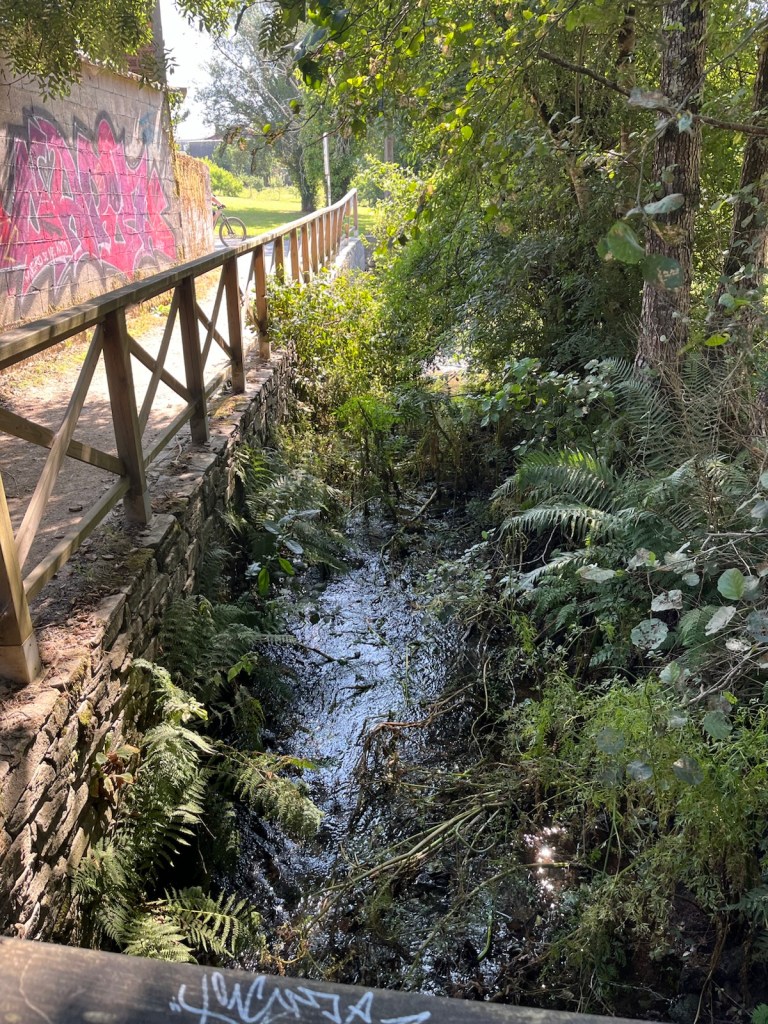
Linda walking past the stream that pilgrims of the middle ages used to clean themselves before walking the final miles to Santiago. Lavacolla comes from the Latin “lavamentula” which literally means, “wash private parts”. We both had our showers indoors last night so we skipped a dousing in the creek this morning.
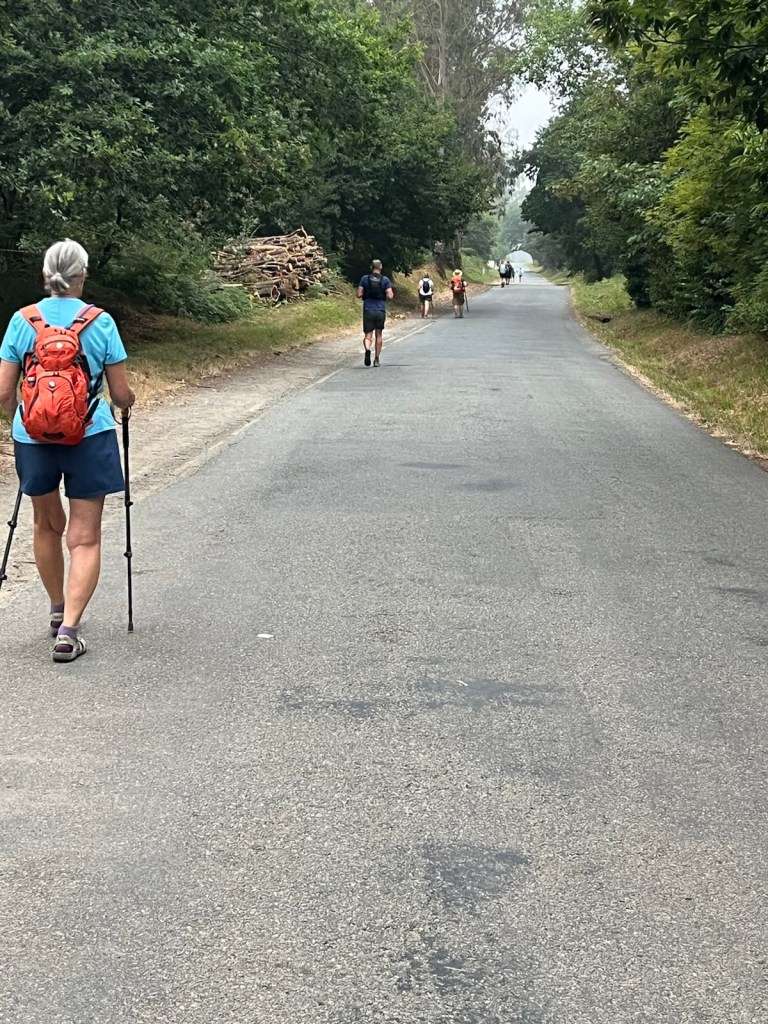
The Camino was all on paved surfaces today, beginning with the initial climb from Lavacolla to the hamlet of Vilamaior.
We walked along large farmhouses nestled in the forest, with serious walls and fences forming barriers from passing vehicles and curious pilgrims.
We followed markers, passing a major radio/television network complex on our right, then turned left to walk by a large camping area then right a few hundred yards later with a steeplechase field on our left and corn fields on the right.

Our road formed a T, so we made a right then after a few more steps, made a left into the village of San Marcos.

It seemed like a good time for breakfast so we stopped at a modern restaurant in San Marcos and got our second sello for today, meeting our requirements for receiving a Compostela.

We walked through San Marcos and then down the steep hill past the huge sports complex that dominates Monte de Gozo.

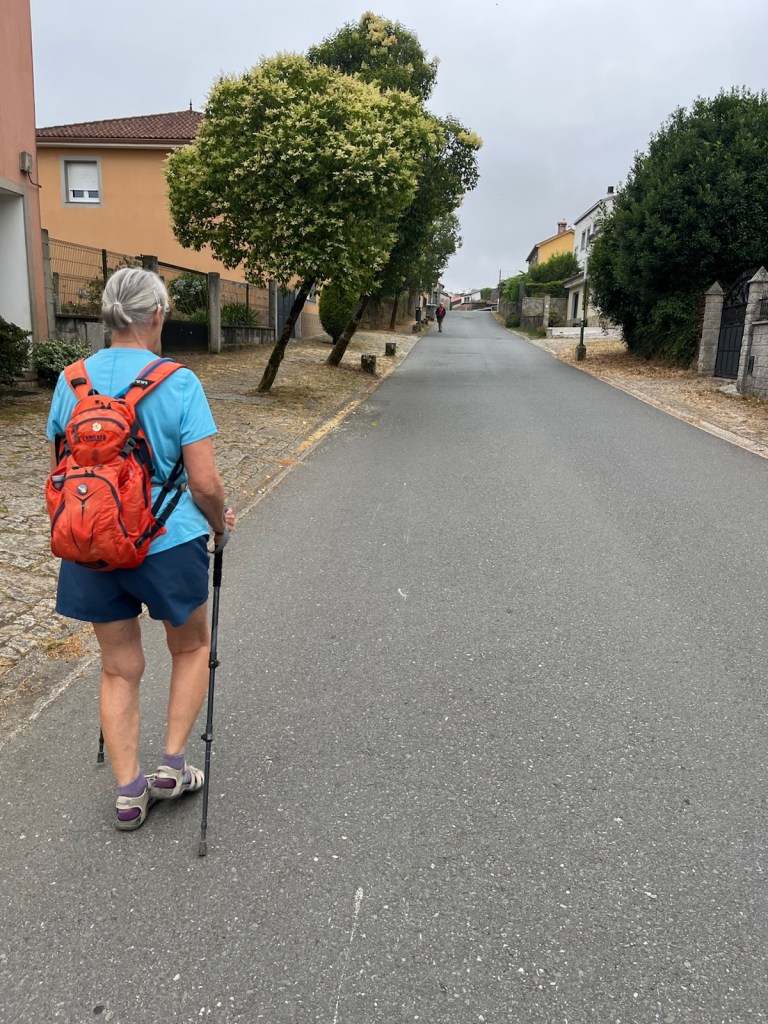
As we left Monte de Gozo, we began the final 3 miles through suburbs of Santiago on the way to the old city and the Catedral.

The following sequence of photos shows the changing looks of our way to the Catedral:

Walkway to allow pilgrims to safely cross expressway around Santiago.
It’s Sunday morning and typically a light day for pilgrims to finish the Camino. When we arrived at the pilgrims office to receive our Compostela, Jim was the 91st recipient for today. Some 2451 pilgrims ultimately received their Compostela today.
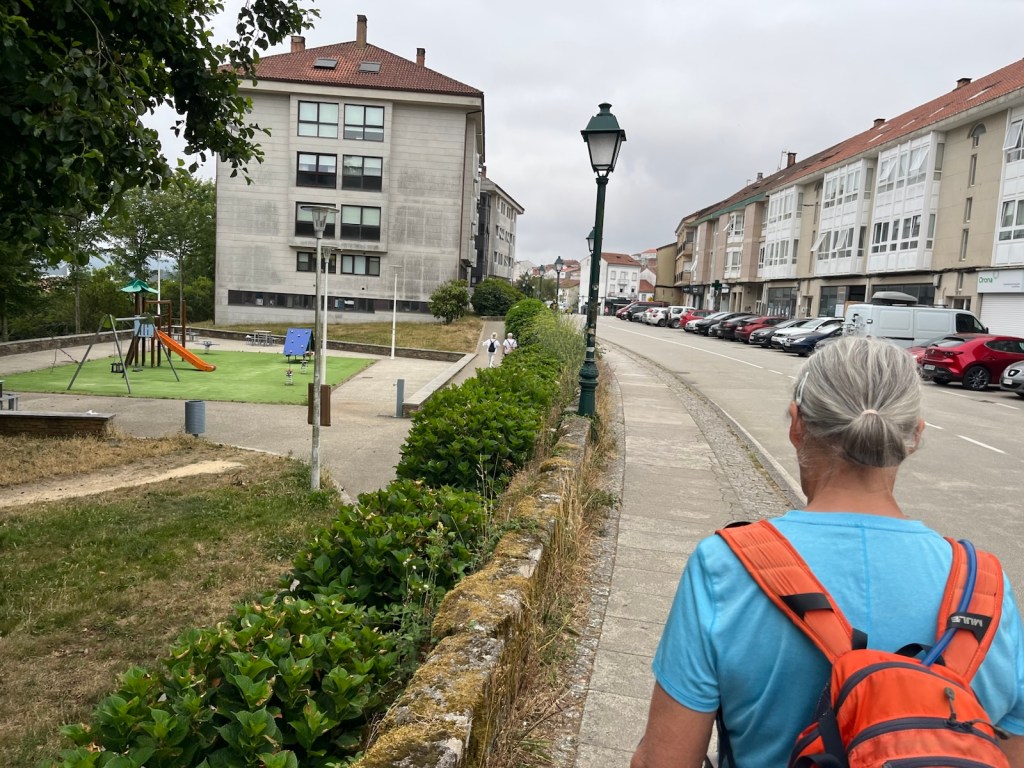
Walking along mostly modern storefronts and eateries.
sidewalk changed a bit
Bizarre/hazardous sidewalks.
more residential
dense residential
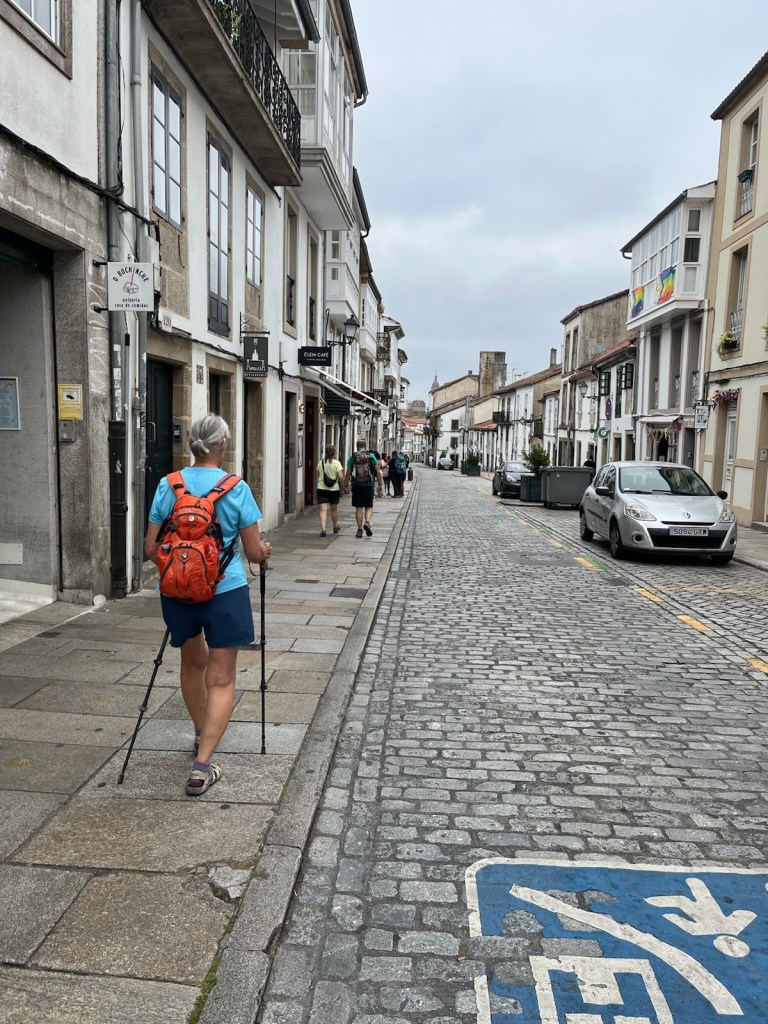
walk street… very quiet on a Sunday morning
…still a walk street, lots of bars and evidence of parties last night.
First sighting of Catedral tower
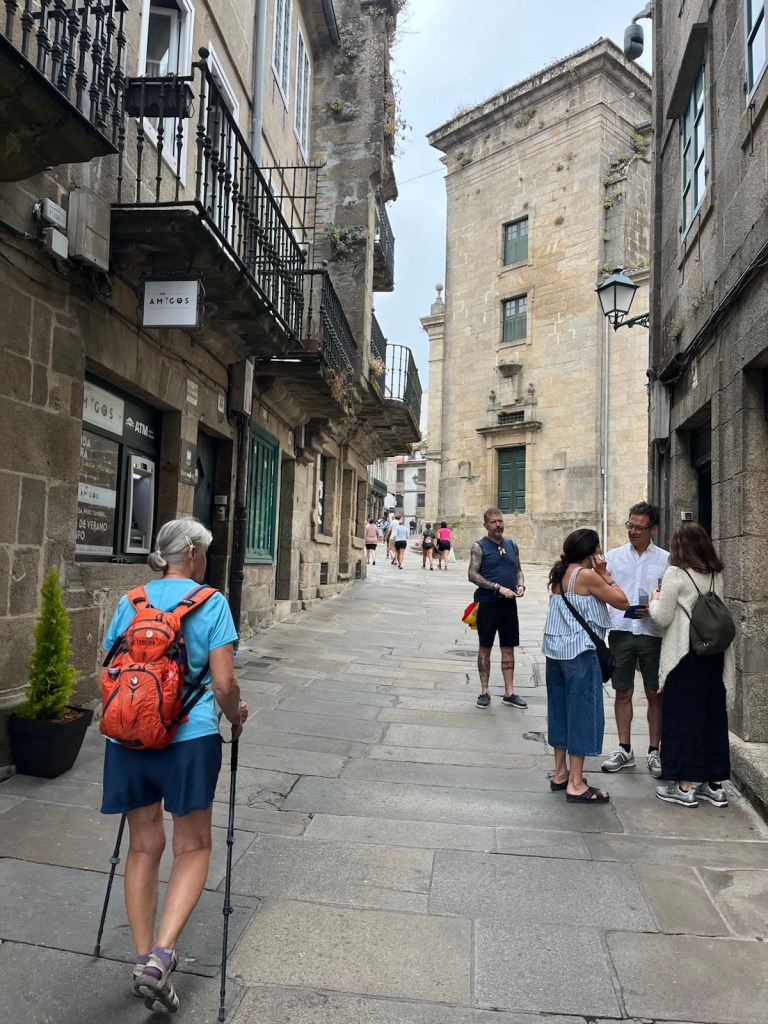
entrance to old city
Cervantes Square in old city
we stayed in apartment on right for 2 different past Caminos
North side entrance to Catedral.
Walking through the tunnel/passageway into Praza de Obradorio (usually with a musician performing for tips, but no one here today.)
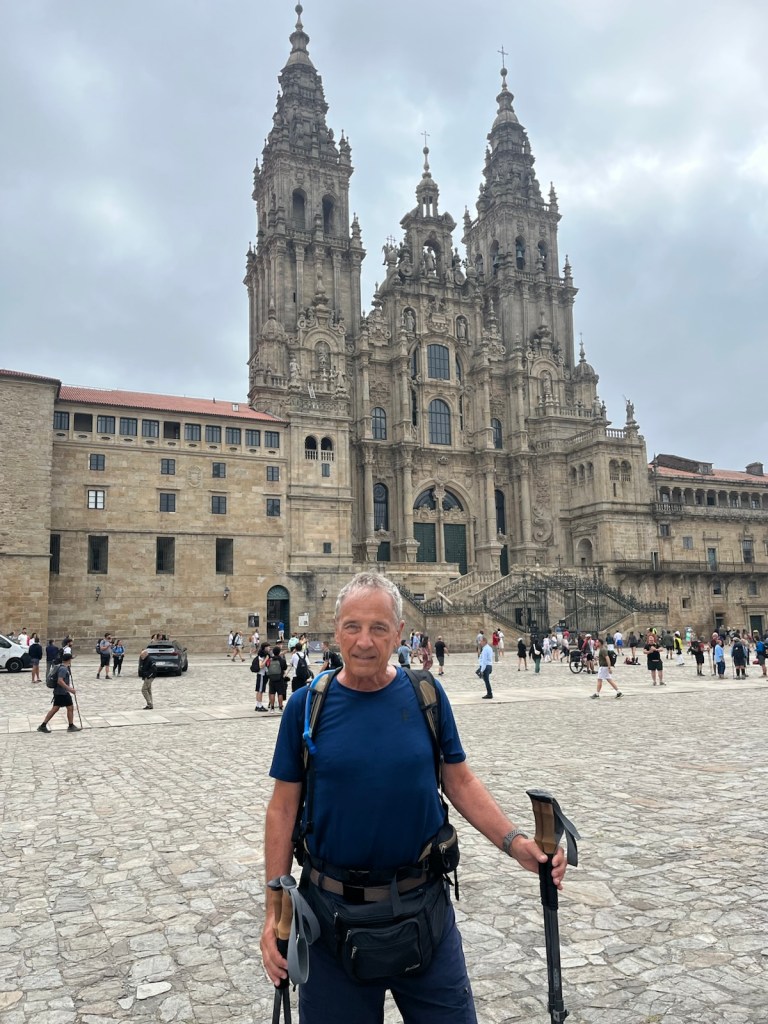
The Catedral viewed from Obradoiro Praza
Administrative offices across the square from the Catedral.

The position of the sun made decent photos impossible, so we’ll try again tomorrow.

We continued on to the pilgrim’s office where we received our Compostela. Our wait time was 5 minutes.

Linda receiving her Compostela in the pilgrim’s office.

The crowds were huge, mostly tourists on a Sunday morning. The lines were long and the sun was getting hot. We decided to focus on getting lunch, getting checked in and settled in our hotel and plan to see the Catedral inside and get better photos during our “extra” day, tomorrow.

So Camino2025, our 7th, is now history.

Linda’s Compostela
Jim’s Compostela

More on Santiago and the Catedral and reflections on Camino 2025, to follow.