Day 22 – Villafranca to Burgos

Walked today: 7.9 miles

Walked Camino 2019: 154.2 miles

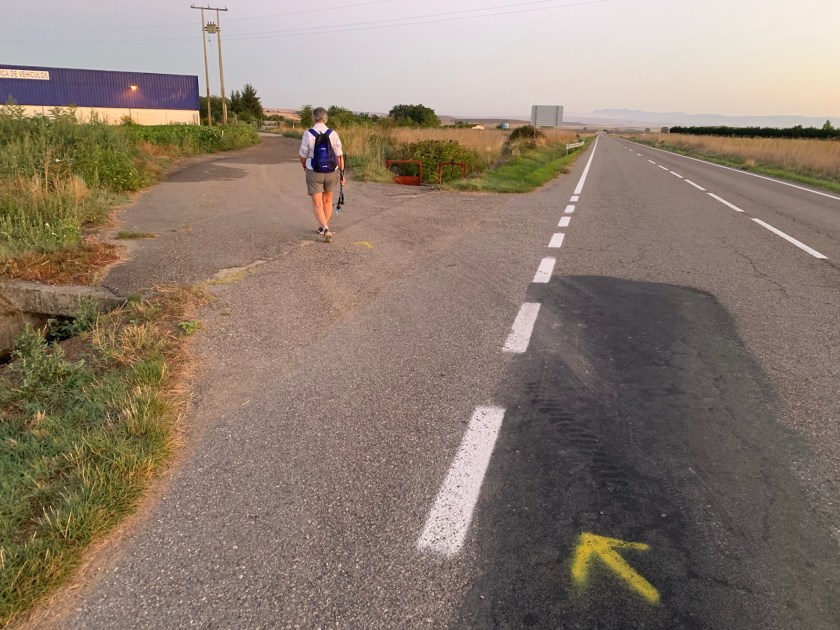
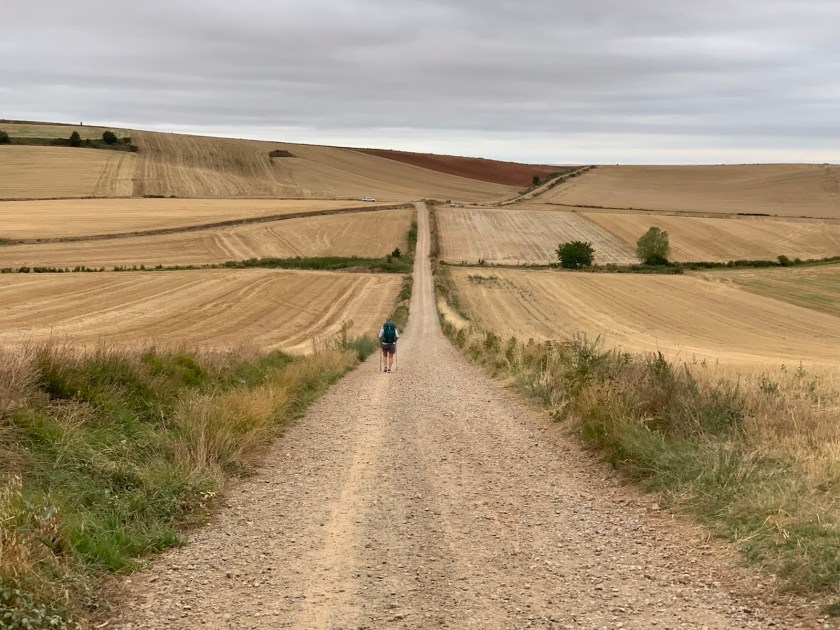
From Villafranca to the village of San Juan de Ortega is about a 6 mile stretch of difficult terrain including a three mile logging road infested with biting flies. We endured this in 2014 and 2017, but decided to take a pass this time. So a taxi picked us up at the hotel this morning at 7:00 and dropped us off at San Juan de Ortega, where we began our walk.

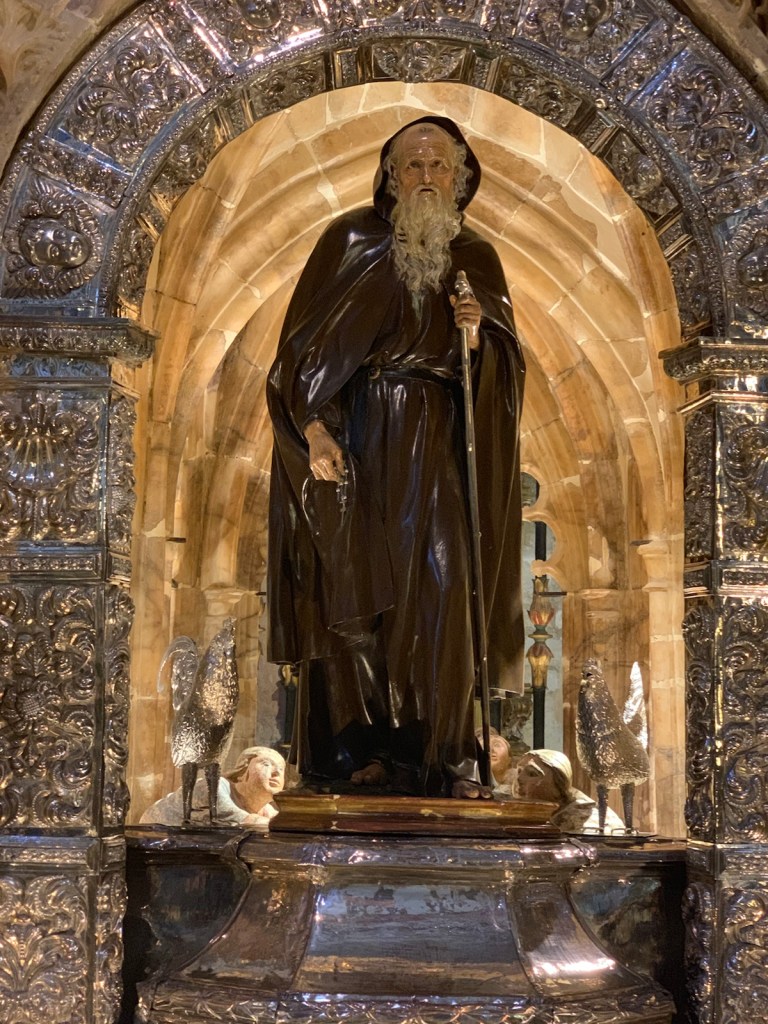
San Juan de Ortega or Juan Velásquez, was a young priest and disciple of Santo Domingo who was born near Burgos. San Juan helped Santo Domingo in the construction of bridges in Logroño, Santo Domingo and Nájera.

After Domingo’s death, Juan went on pilgrimage to Jerusalem. On the journey, he was caught up in a shipwreck and prayed to San Nicolás de Bari to save him. When he survived, he returned to the Burgos area determined to serve pilgrims in the notoriously dangerous and difficult Oca mountains.

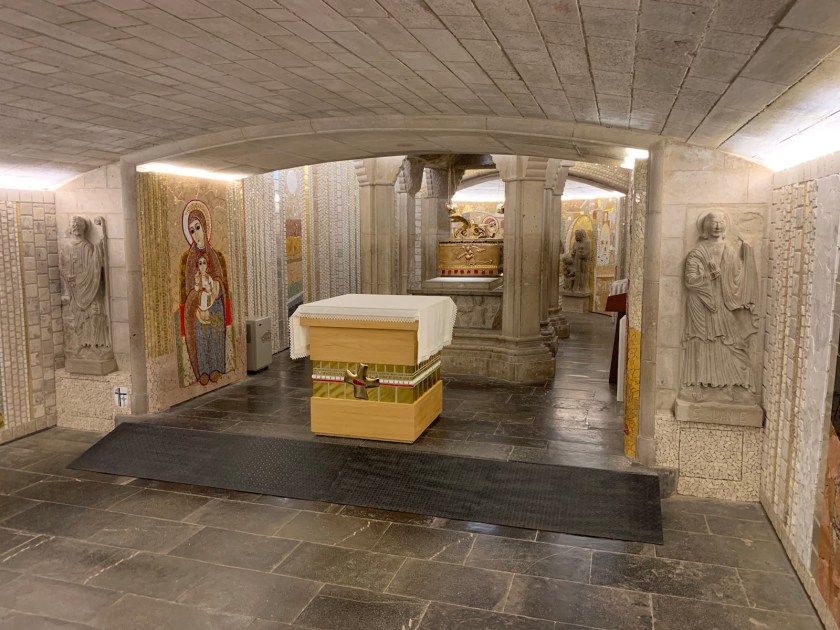
He is attributed with developing the road from Villafranca to Burgos (from which he took his name de Ortega, “of the nettles”) as well as a hospice and monastery in the wilderness. Along with being considered the patron saint of innkeepers, San Juan also became known as the saint of fertility. Legend says that when his tomb was opened, the air was fragrant and a swarm of white bees flew out. Queen Isabel la Católica was perhaps the most famous barren woman to pray at his tomb, which is inside the Iglesia de San Juan de Ortega. She visited twice and conceived two children, named Juan and Juana.
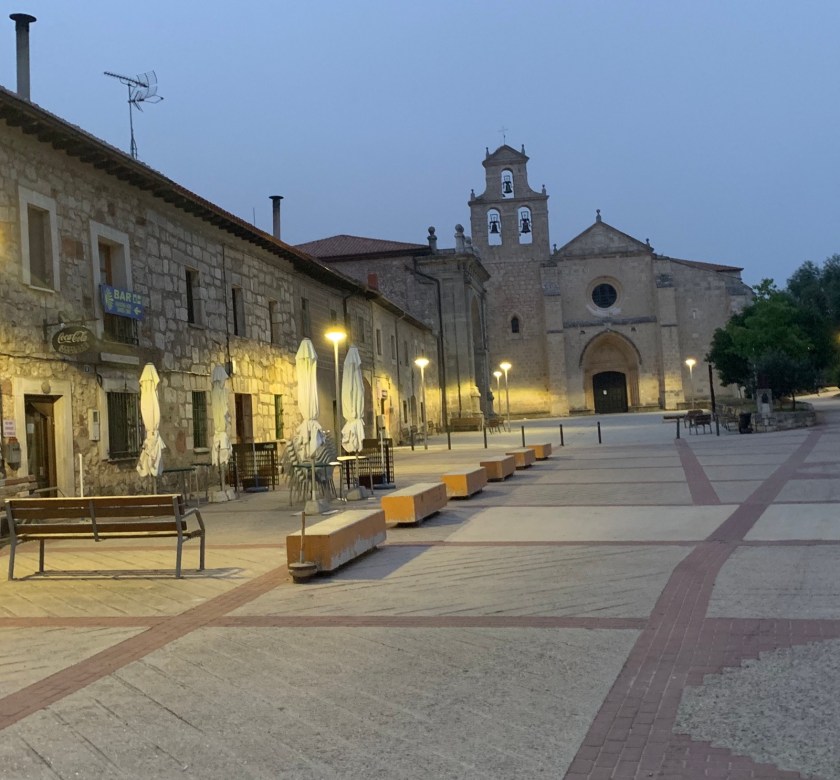
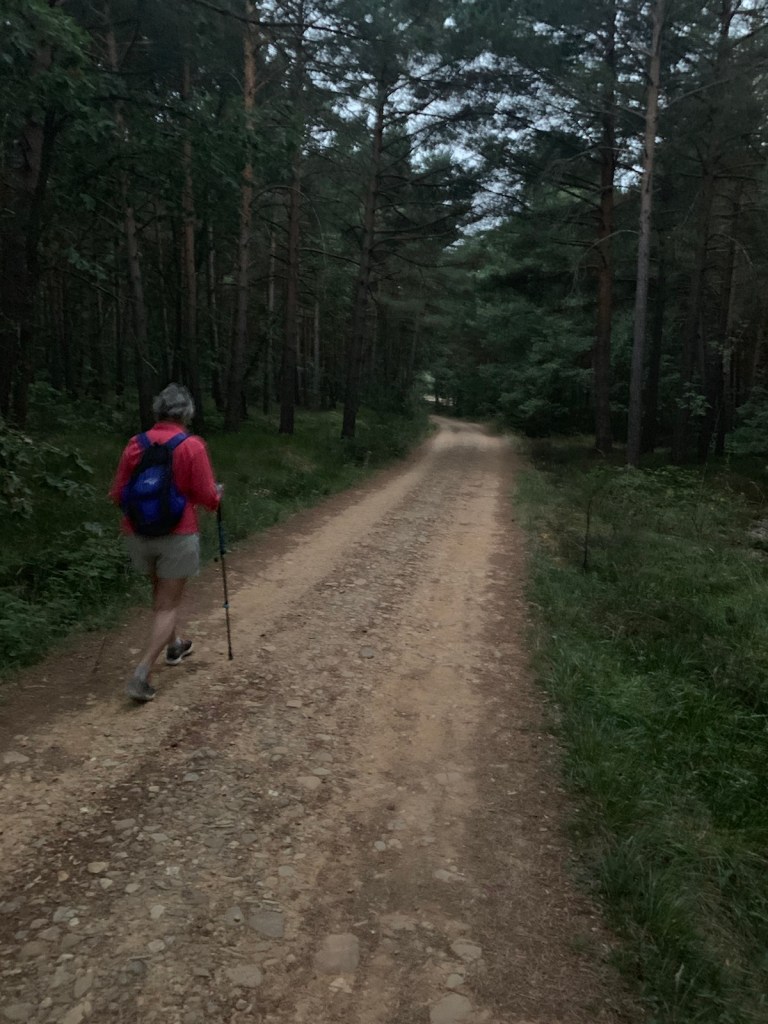
San Juan de Ortega was quiet and already abandoned by the pilgrims at the albergue when we arrived at 7:12.m.
We took off, literally, to keep warm in the 49F cool breeze

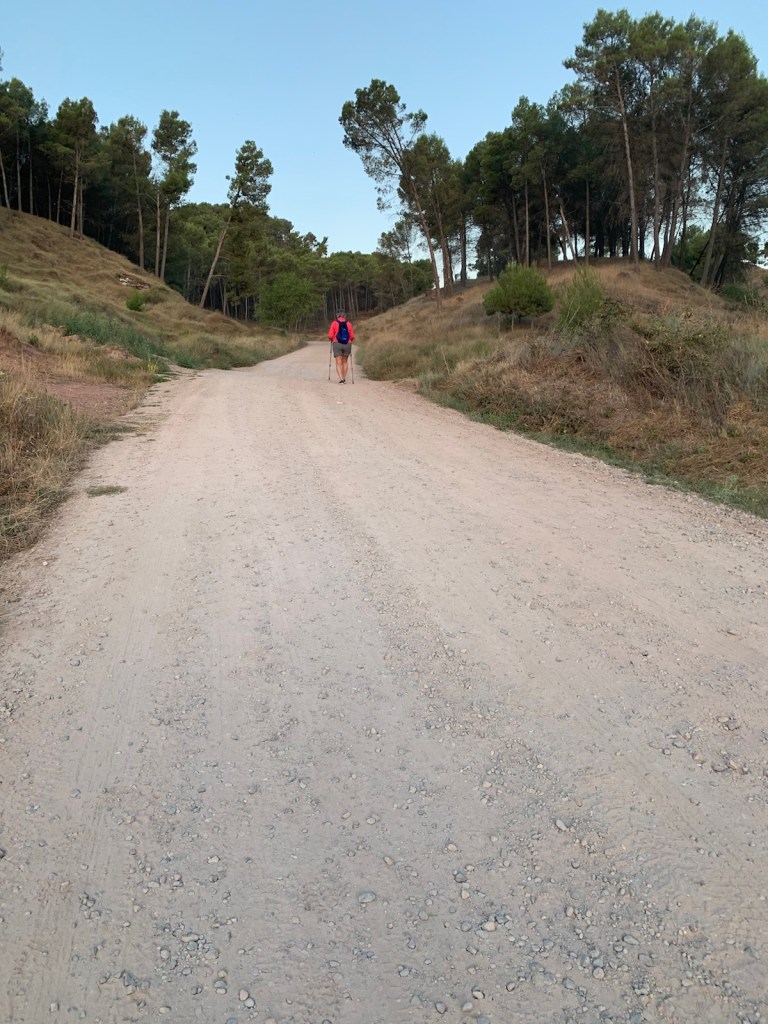
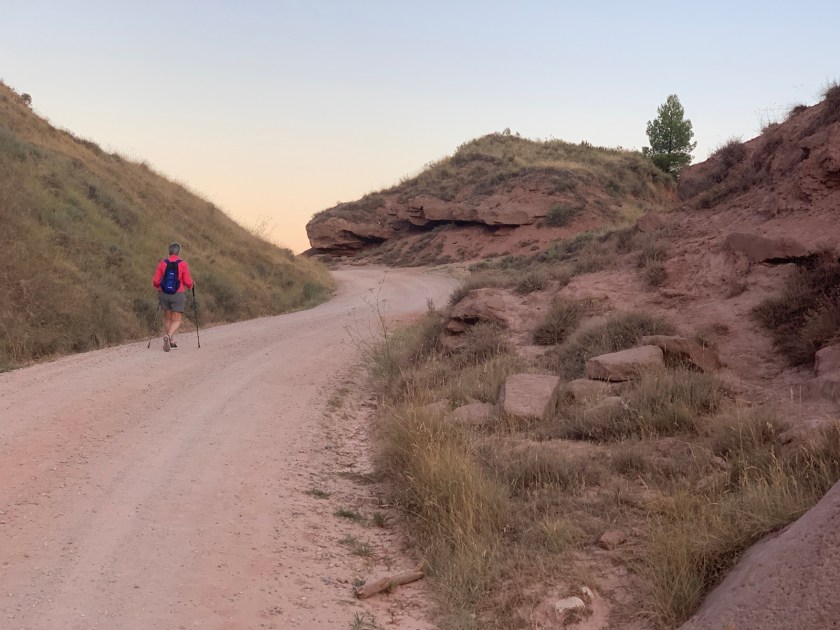
The initial mile or so was surrounded by forests, not nearly as dense as in San Juan’s day, but we couldn’t help ourselves, listening for possible bandits wanting to do us harm.
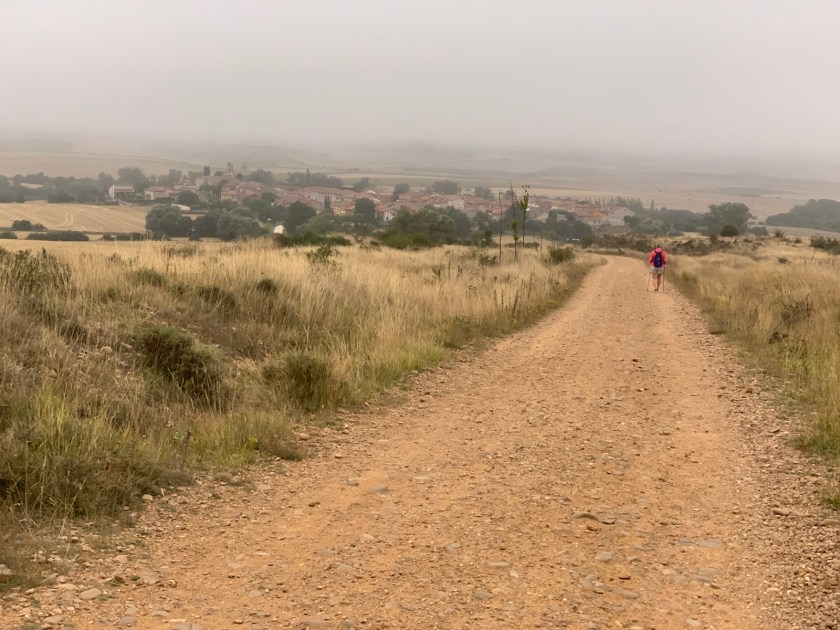
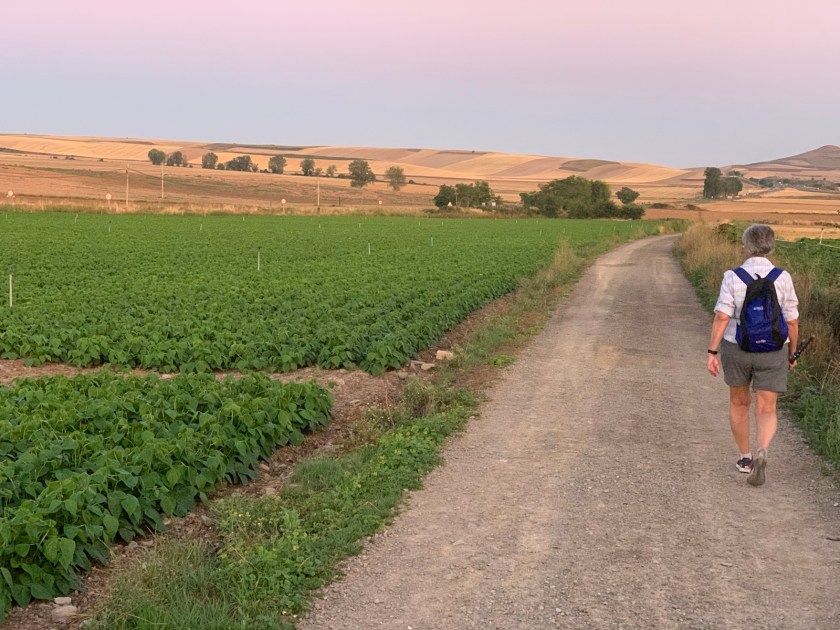
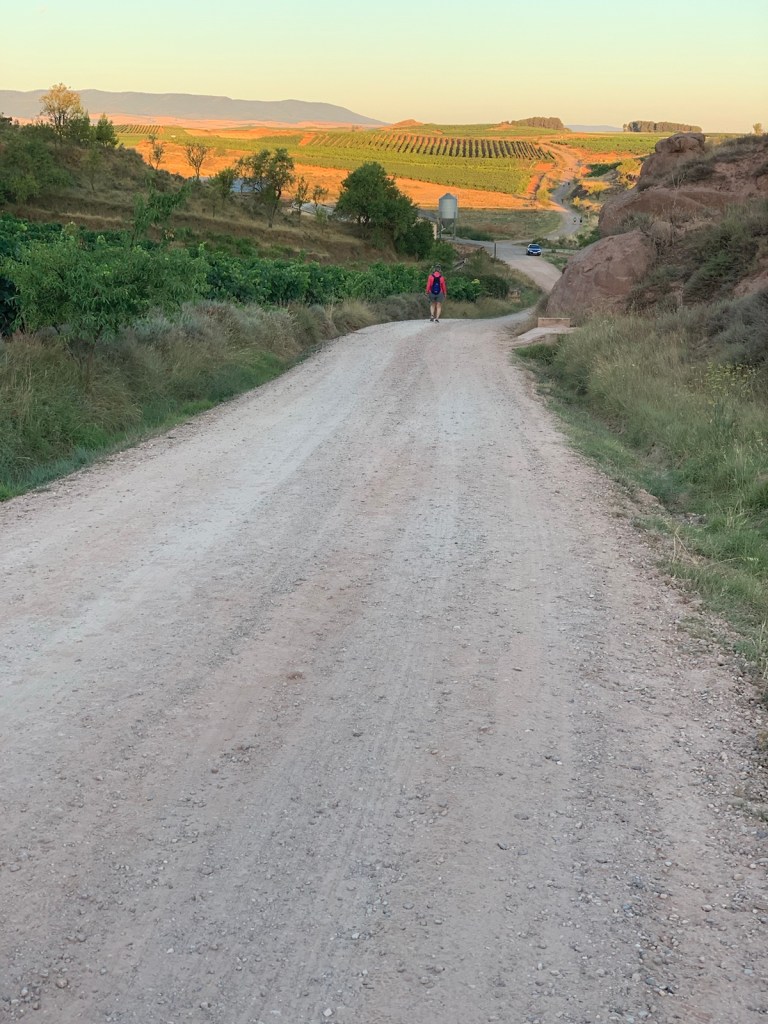
But before long, we emerged into more open spaces and saw the village of Agés (pop. 76) ahead hiding in the heavy morning mist and low hanging clouds.

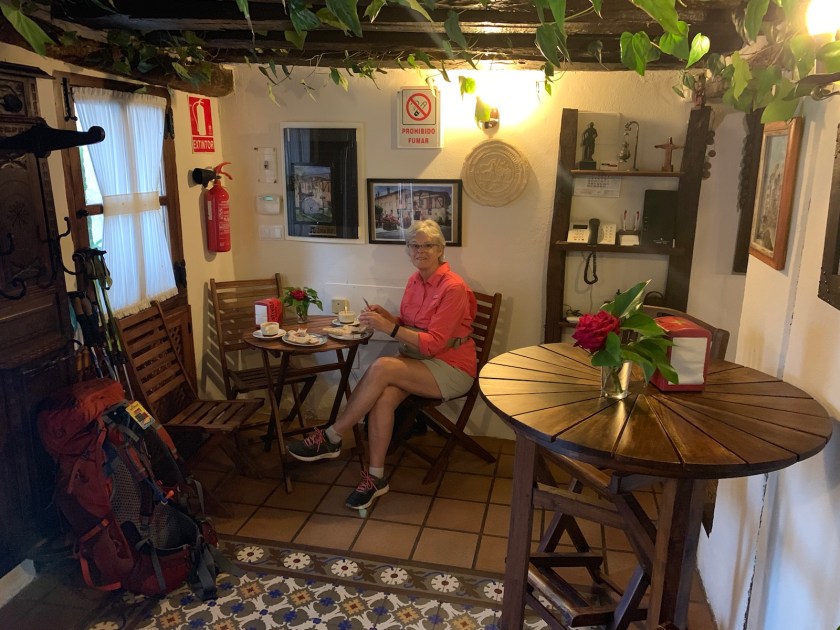
We made our first stop at a “boutique” albergue, judging from the decor of the bar dining area.
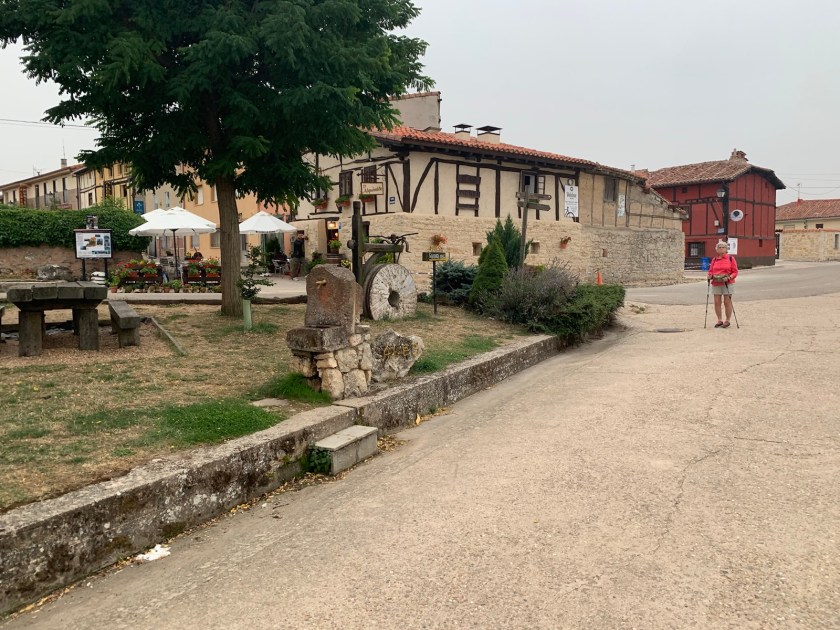
picking a breakfast stop in Agés
Breakfast in style

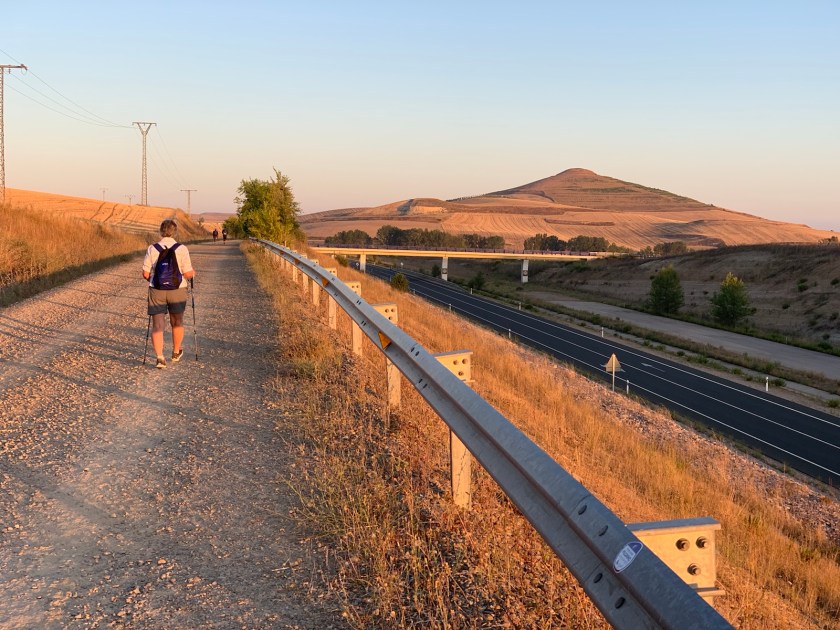
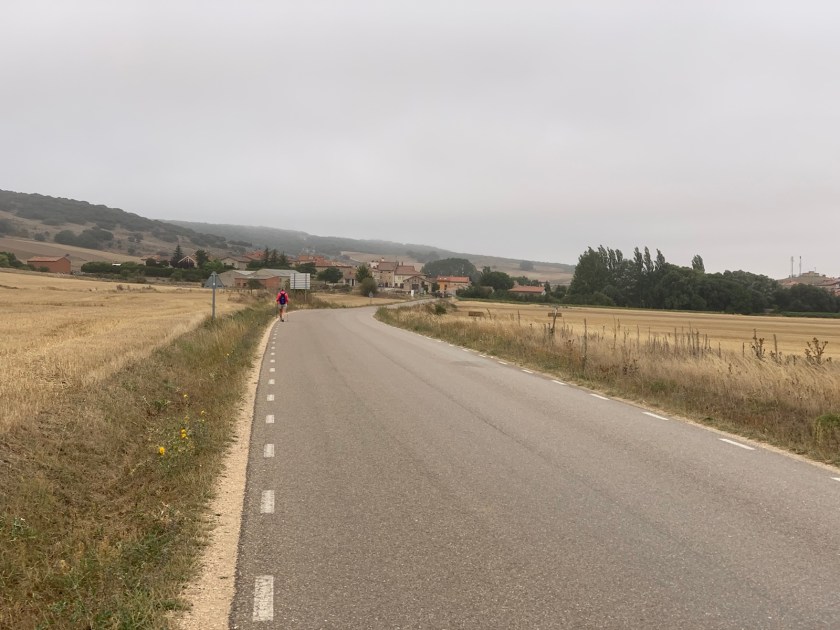
We were soon off again, headed along the road to Atapuerca, an intriguing place known for its archeological finds. If we had the time, Jim would love to spend a day at the site to learn more about the findings here.
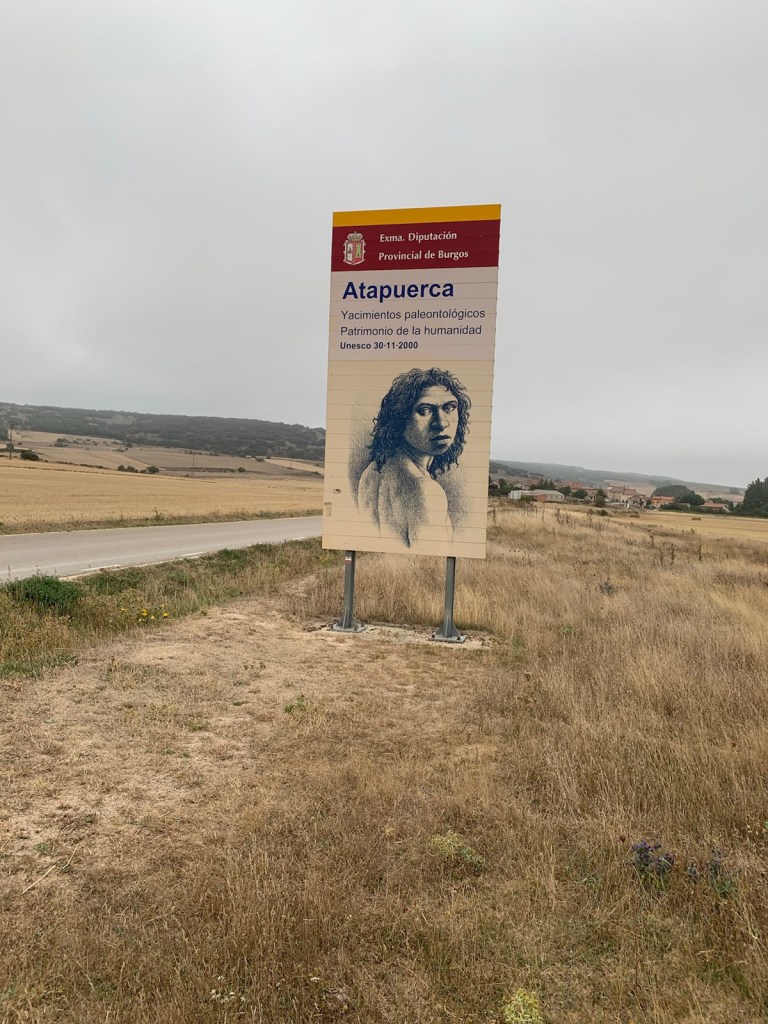
The earliest and most abundant evidence of humankind in Europe is to be found in the caves of the Sierra de Atapuerca.

On the outskirts of the village of Atapuerca (pop.206)

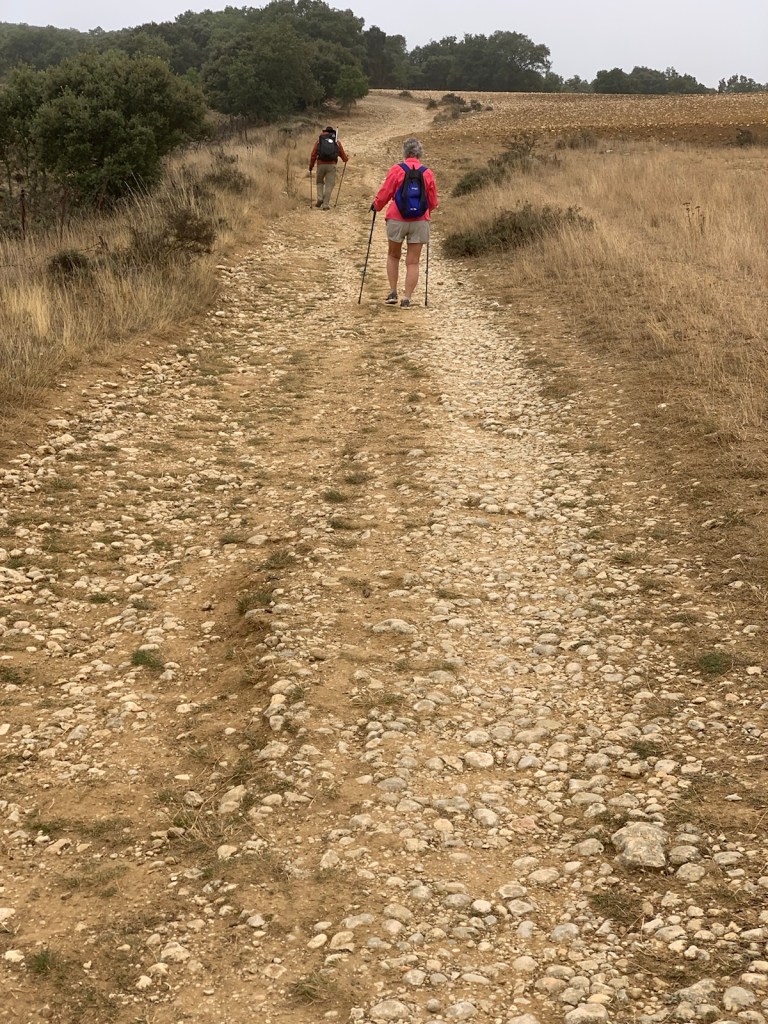
Halfway through the village we left the pavement and followed the path uphill.
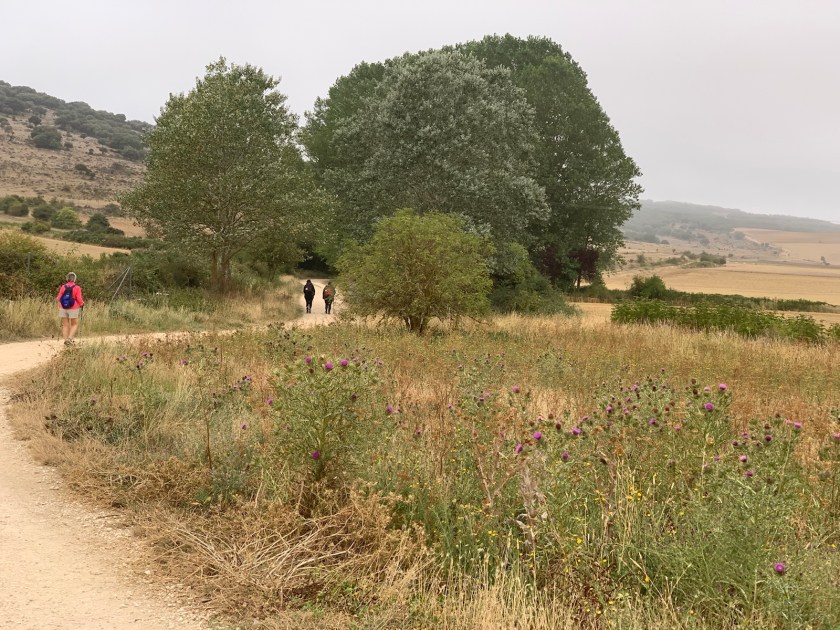
leaving the pavement onto an uphill path
looking upward
Looking back
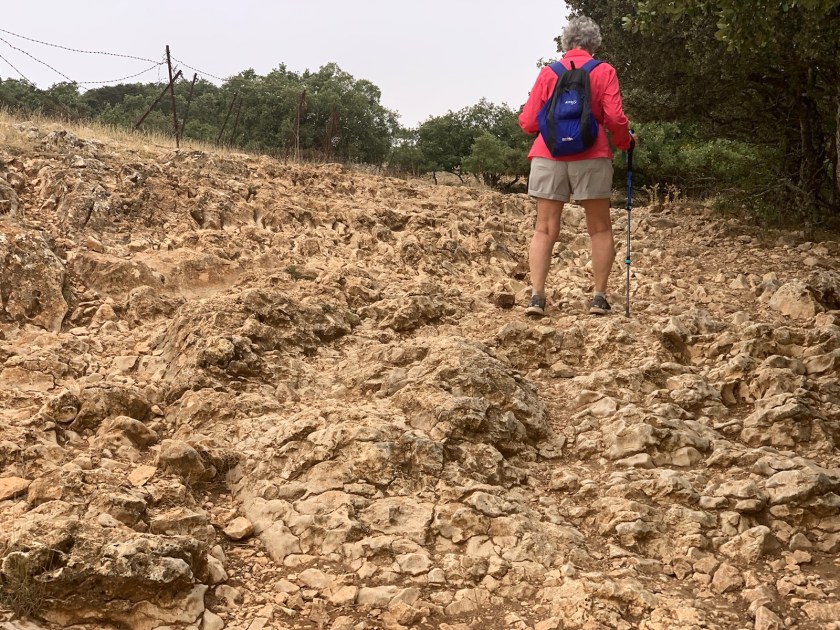
Steeper and more rocky

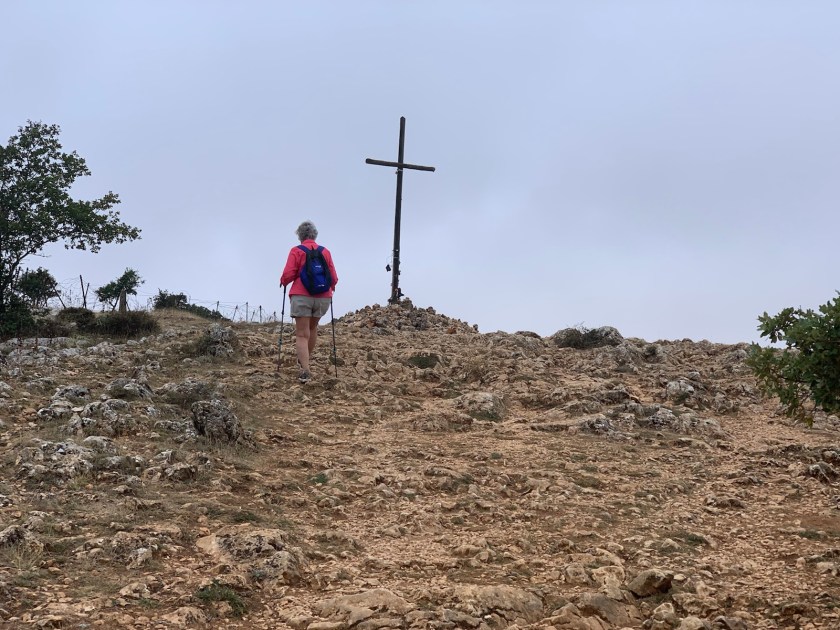
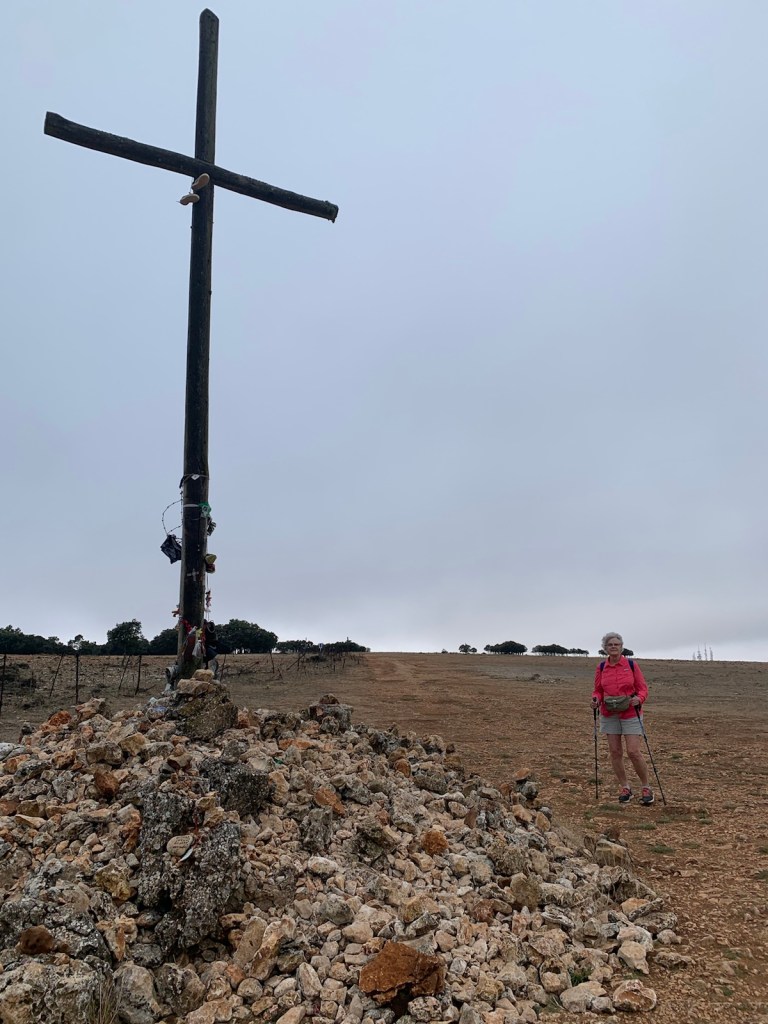
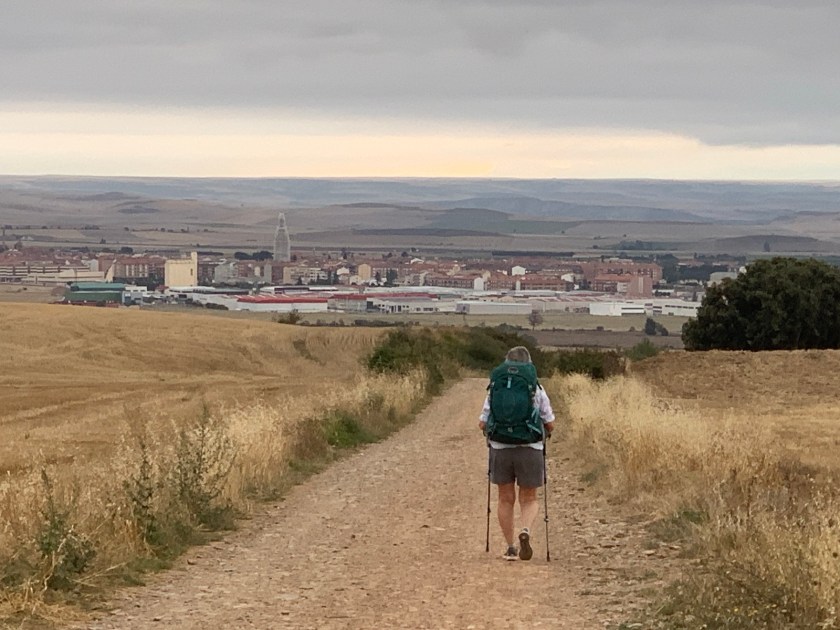
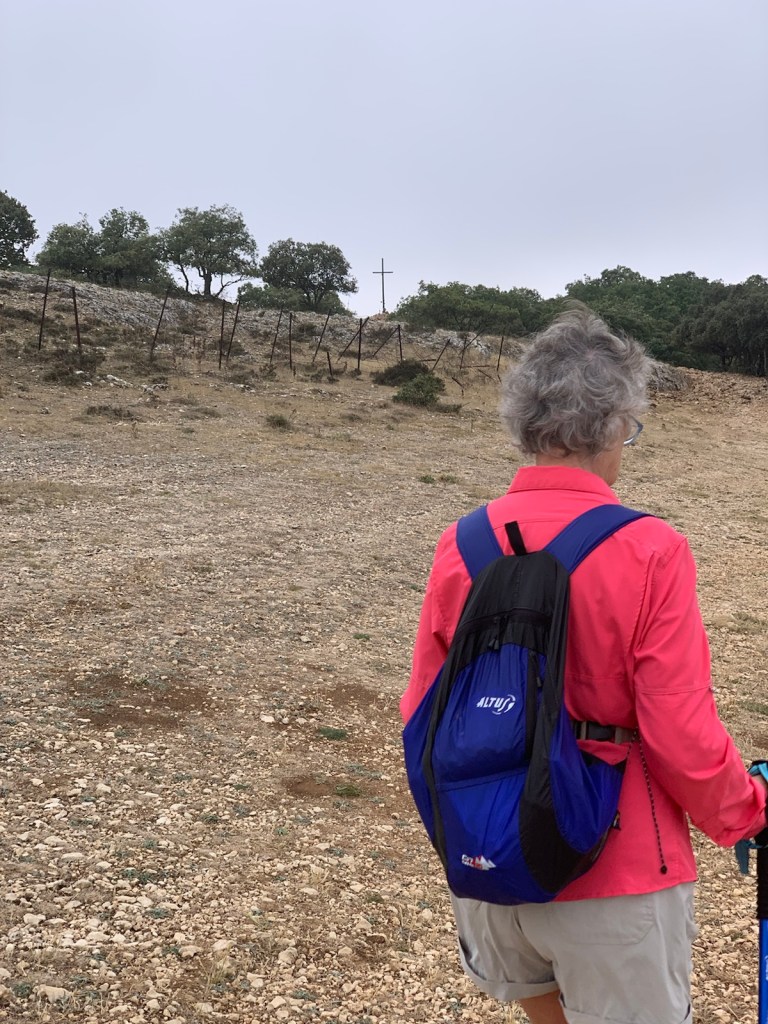
It became steeper and more rocky as climbed, eventually to a cross at the pinnacle, overlooking the valley ahead with Burgos in the distance.
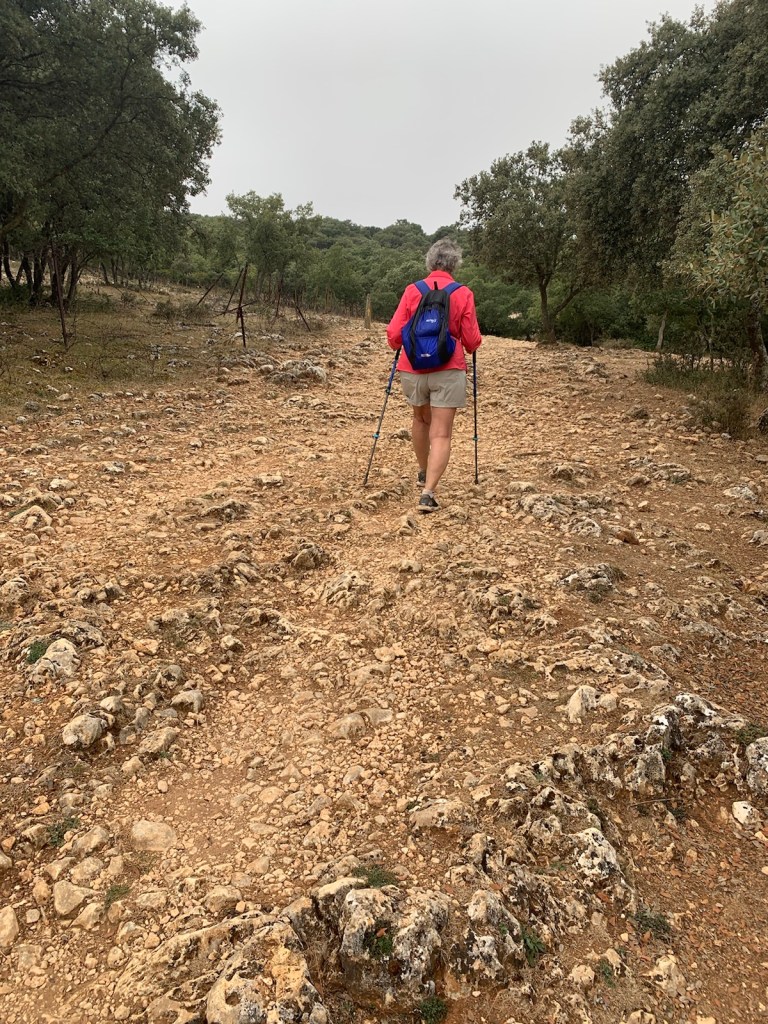
very rocky
The cross in view
One more hurdle..,
then another hurdle
almost there
made it!
photo op at the top
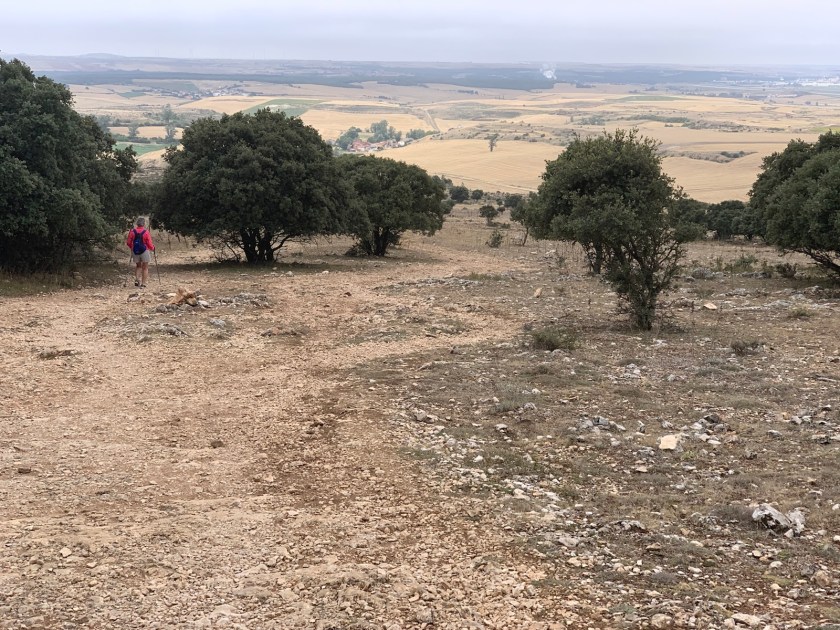
then back down

The walk down was also steep, but not nearly as rocky.

overdone Camino signage

When we got near the bottom, the signage was confusing (just kidding).

One more downslope and the path leveled our and for the next mile we walked on dirt road, then back on pavement before stopping at a bar in the village of Cardeñuela de Riopico. We had a cafe con leche while waiting for a taxi to take us into Burgos.

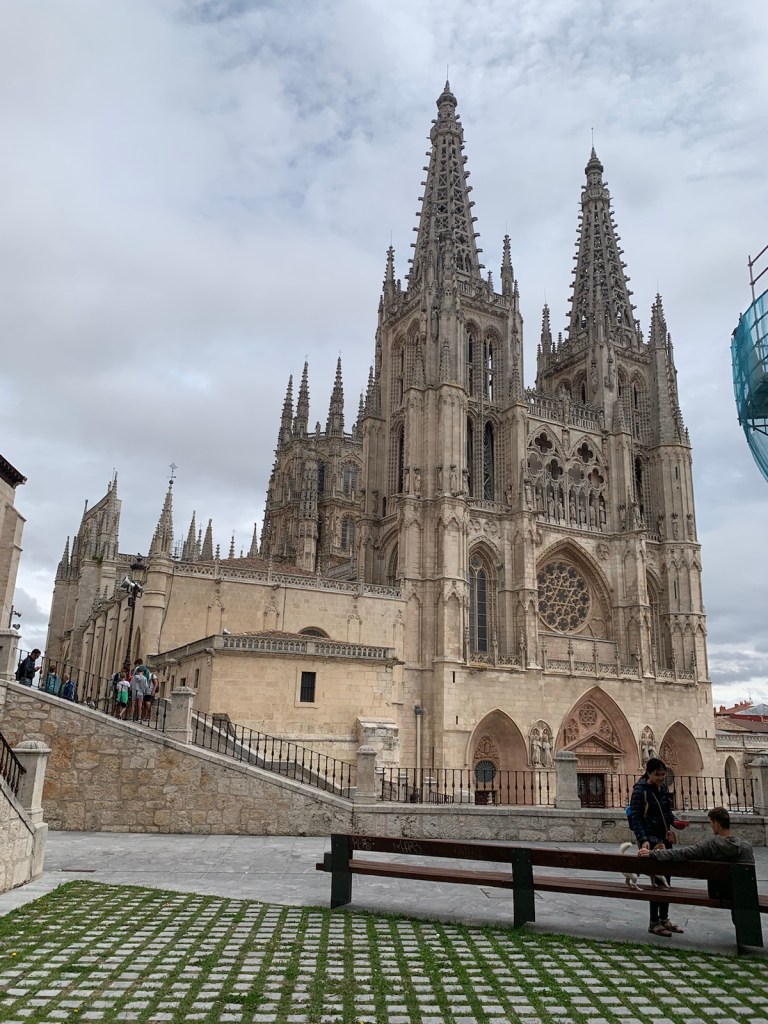
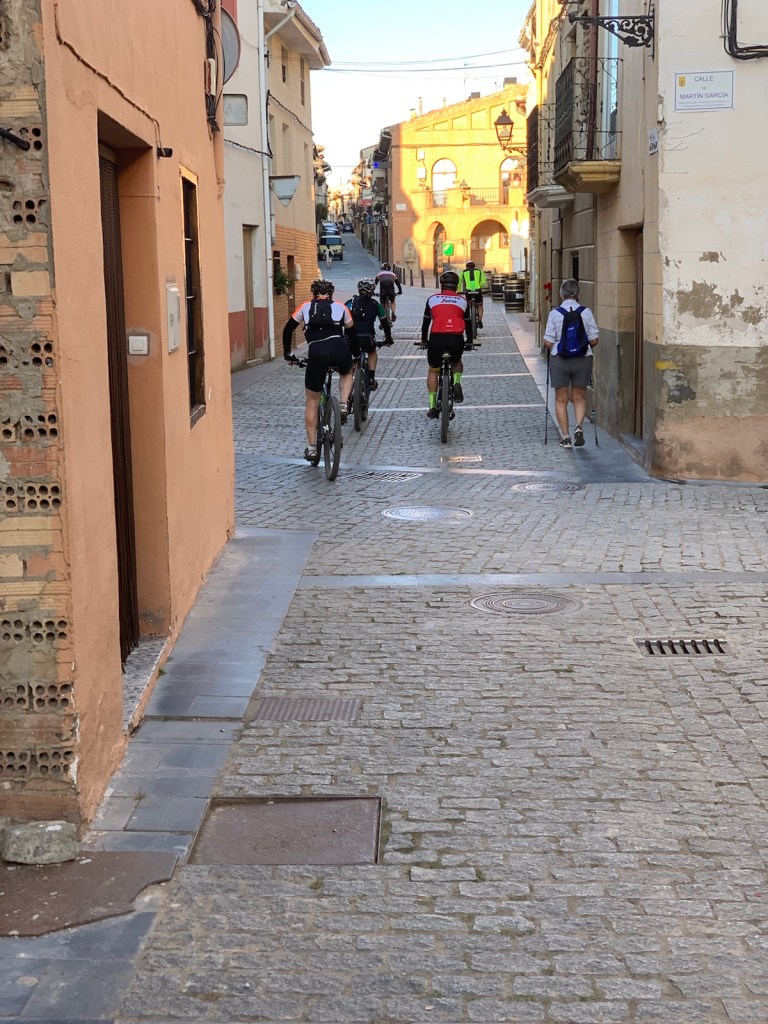
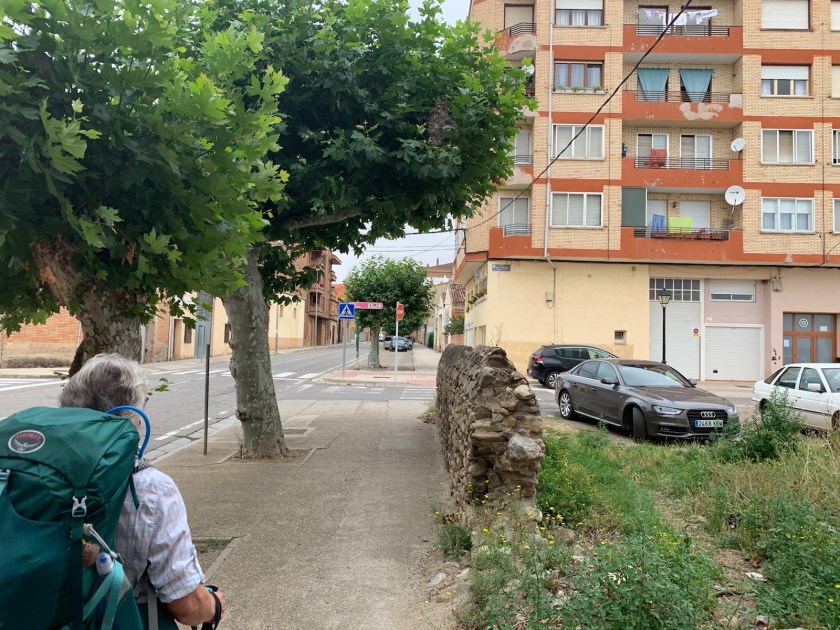
The rest of the way to Burgos was all on pavement, then around the security fence of the Burgos airport, then through an industrial section and city streets until reaching Plaza Santa María and the Burgos Catedral. We skipped the industrial section in 2014 via taxi, walked it all in 2017 and opted to go straight to the Catedral this morning, after already walking just under 8 miles.

Our taxi driver was not a real taxi driver. We think he was maybe the owner of the Cardeñuela bar or perhaps an employee. When he showed up at the bar we didn’t understand what he was saying and he didn’t seem to know any English. So he guided Jim back into the bar, determined where we were going and then directed Jim to pay 25€ to the lady tending bar. She took Jim’s 50€ bill and gave him his 25€ change from the cash register.

The driver looked a bit like a young, muscular, tatooed, Vladimir Putin.

During the 15 minute drive into the city, Vladimir was constantly on the phone, either calling or receiving calls. Most seemed contentious and soon he began commenting after each call to Jim, over his shoulder as if Jim understood. Jim began to laugh or gesture non-verbally in support or agreement, hoping to keep things cordial.

When we got near the Catedral, Vlad gestured toward several landmarks which we acknowledged and we even pointed out some landmarks of our own that we recognized from prior walks through the old city. Vlad obviously knew his way around old Burgos and made a stop at the Castile, ovetlooking the city and gestured for Jim to get out and take a photo, which Jim did and when the taxi was still waiting when he returned, Jim thanked Vlad profusely.

With our hotel now only a few hundred yards away on narrow winding streets, Vlad turned a corner and was confronted by a large tree that had just fallen and was blocking the road.

Rather then backup, Vlad opened the door, walked up to the tree and proceeded to move it out of the way.
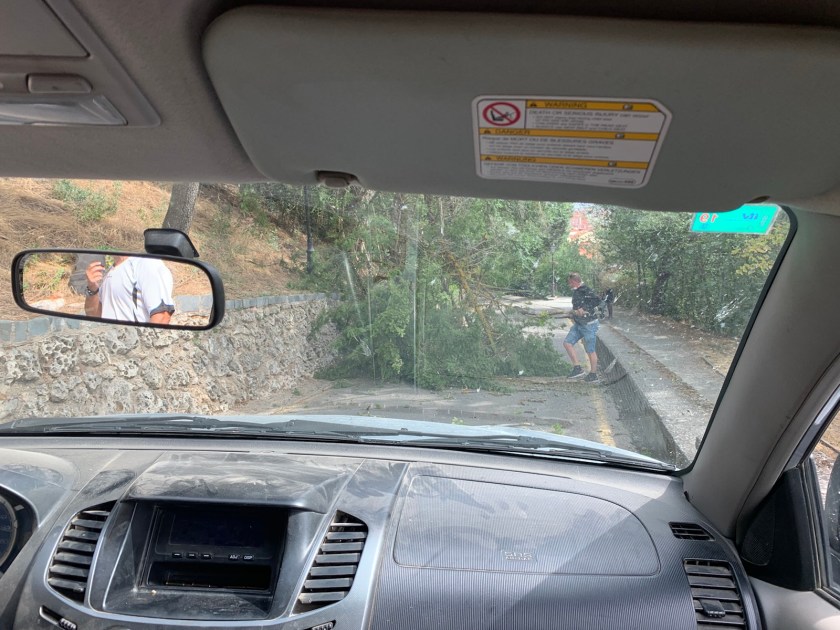
Our taxi driver assessing the blocking tree

Jim watched for about 15 seconds, gave Linda his camera and also exited the taxi and entered the fray not knowing whether to supervise or participate.
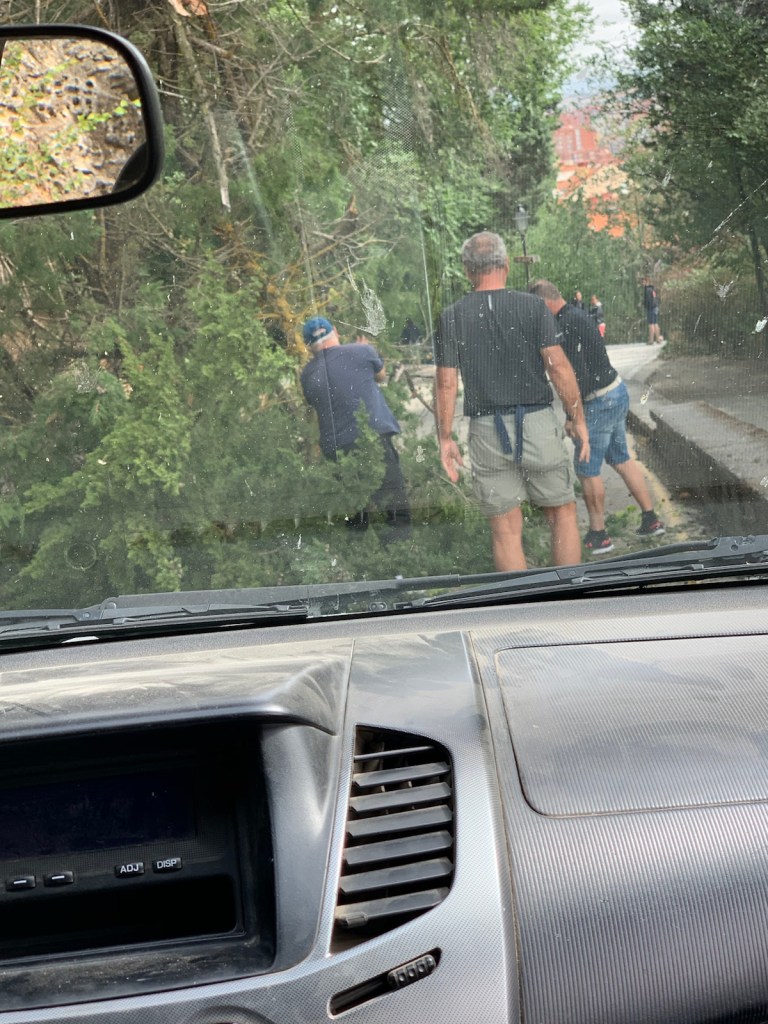
Jim entering the fray

Doing a little bit of both, totally with actions and not words, the two comrades began breaking limbs, pushing loose-leaning branches and making progress in clearing the way.
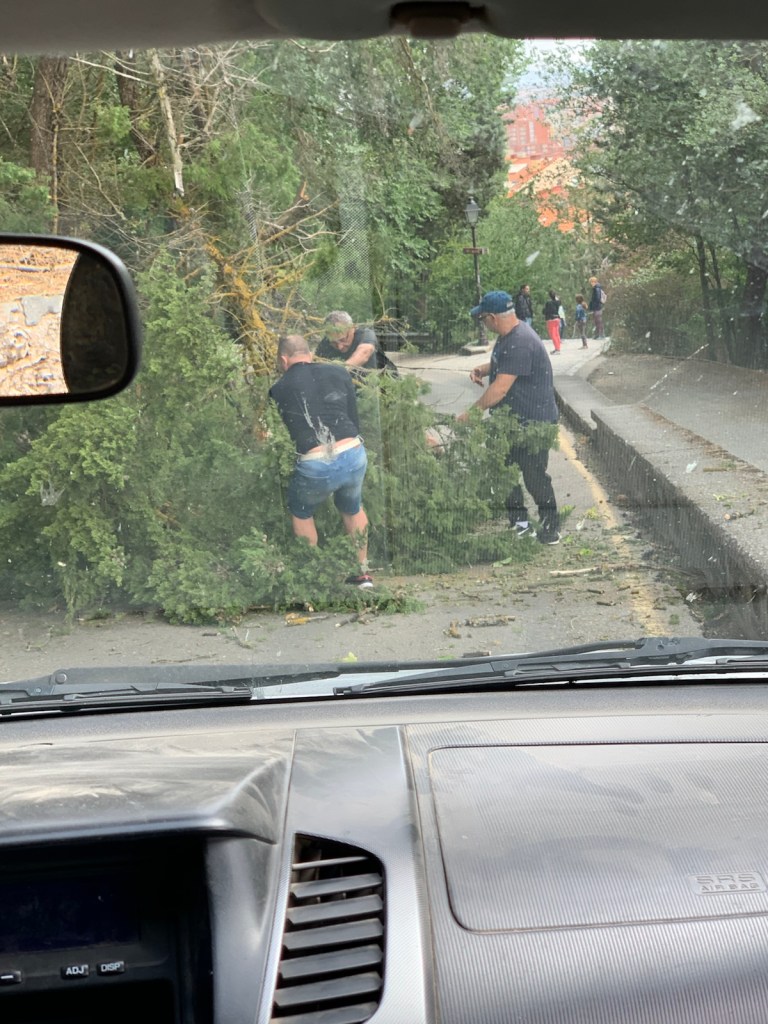
Everyone getting into the act!

A few other bystanders joined in and eventually Vlad determined he had enough room to get by and we both, triumphantly returned to the taxi.

Once in the vehicle, Jim offered a high five and Vlad returned it with a handshake and a smile. And we sighed in relief, as we squeezed by the remnants of the fallen tree.

We were further delayed a couple of minutes or so, having to follow a very slow-moving tour trolly but finally arrived at the Hotel Meson El Cid(133€). Vlad handed us our sack and we all exchanged a smile and a chuckle as Jim wished our new comrade a good day.

The rest of the day was less adventurous but still very pleasant as we enjoyed the Catedral views from our room and a short tour inside.
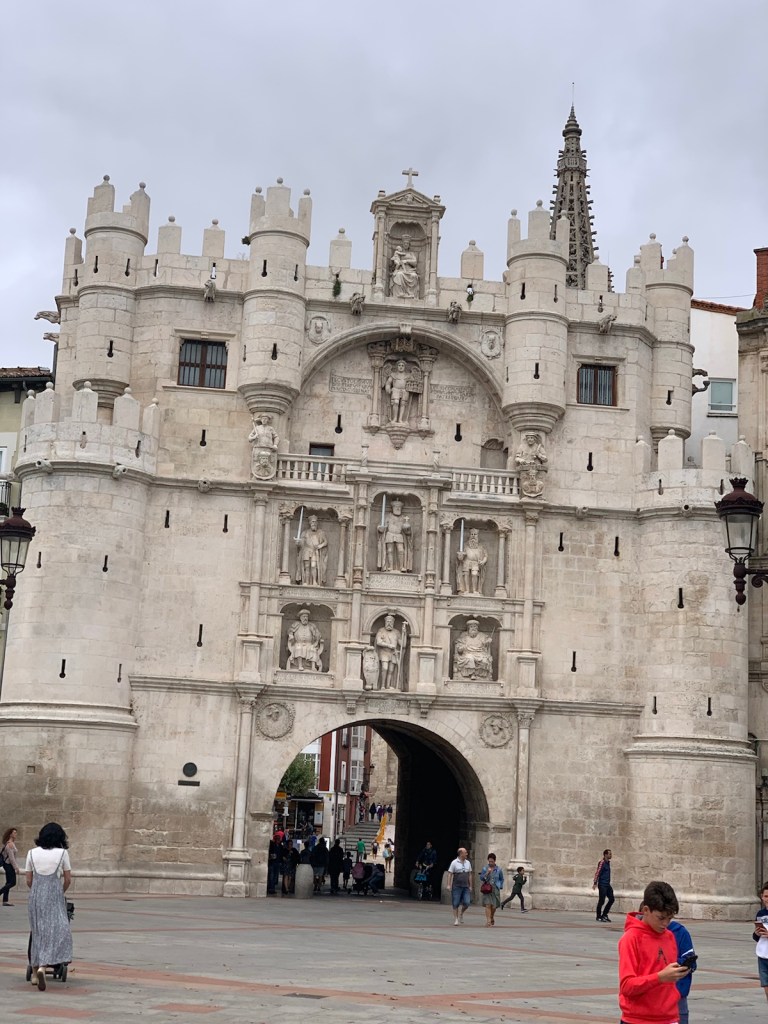
The gateway into Santa María Plaza
Santa María Plaza and the Catedral

The Catedral view from our hotel
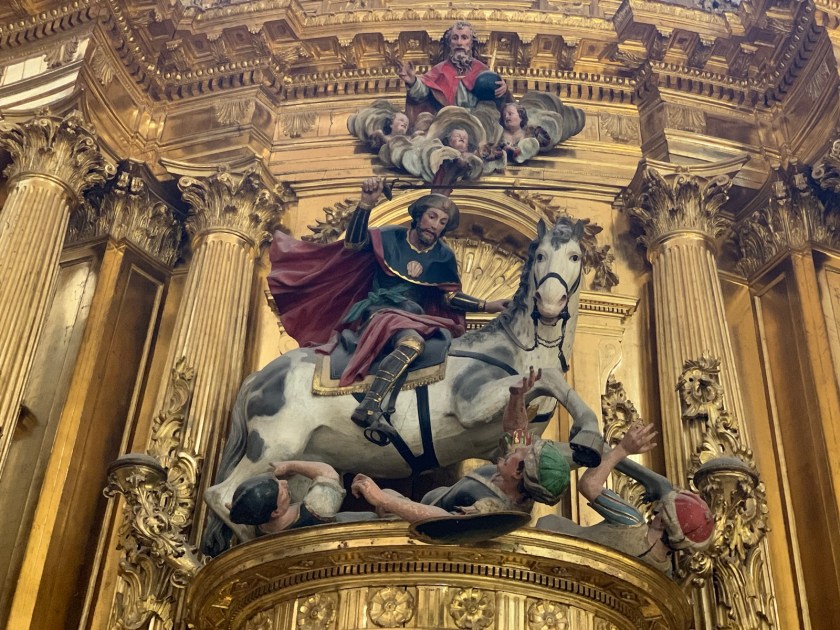
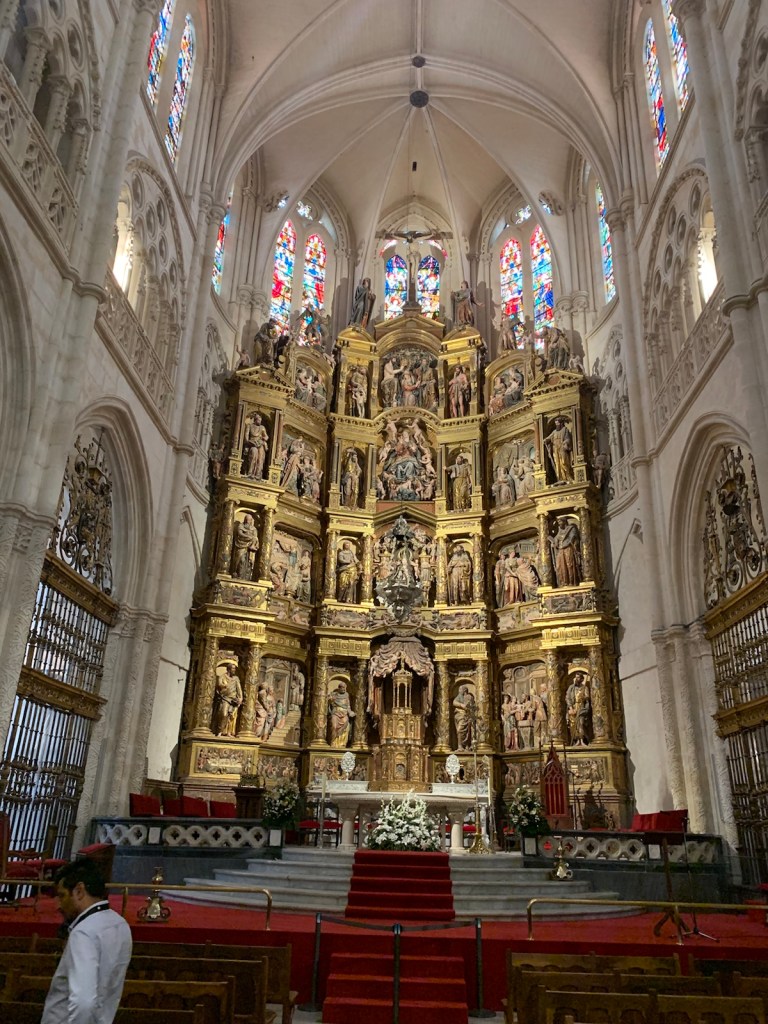
Catedral main sanctuary
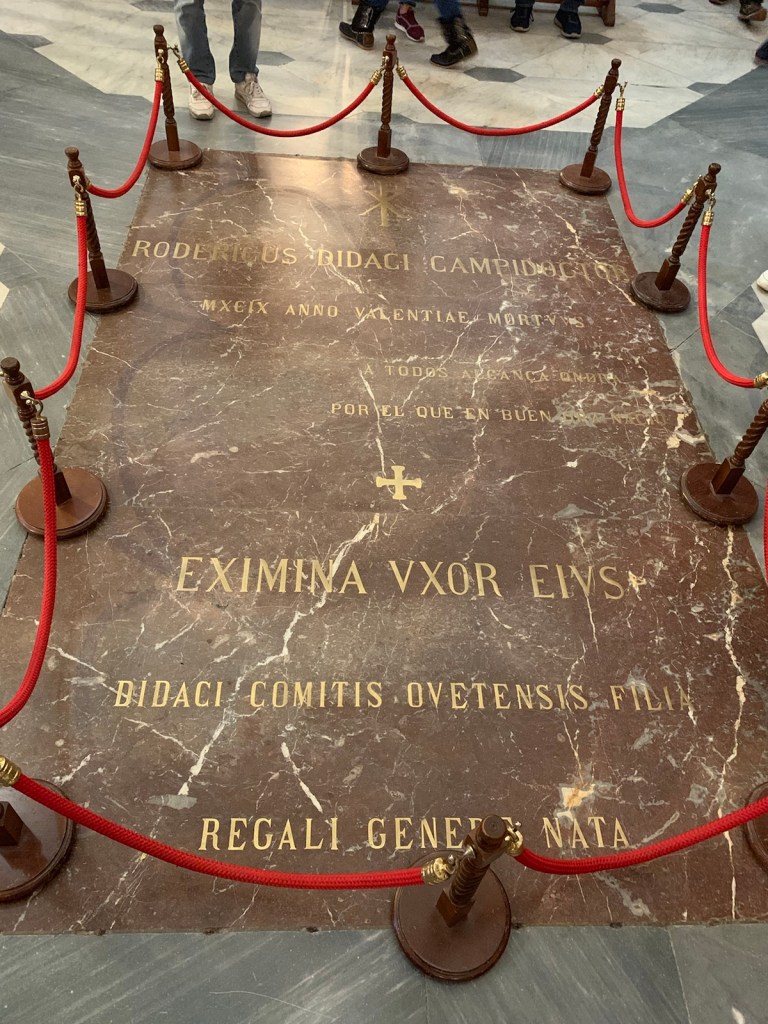
Gravesite of El Cid, Spain’s national hero
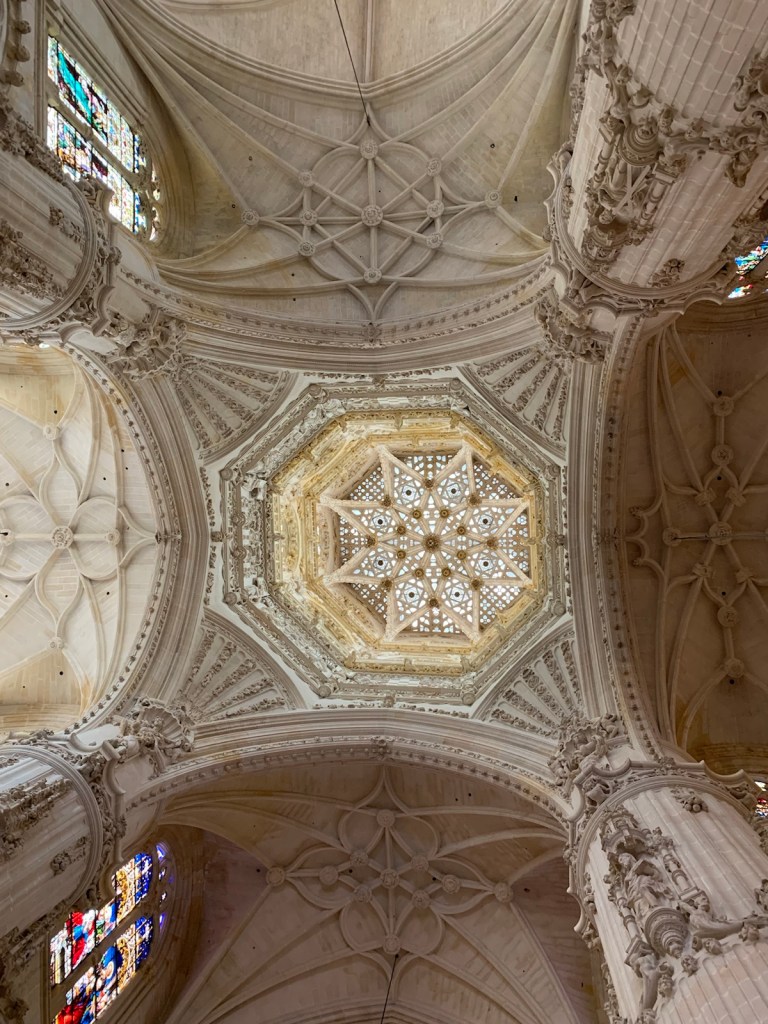
ceiling over El Cid
Statue of St James (Santiago) – Matamoros
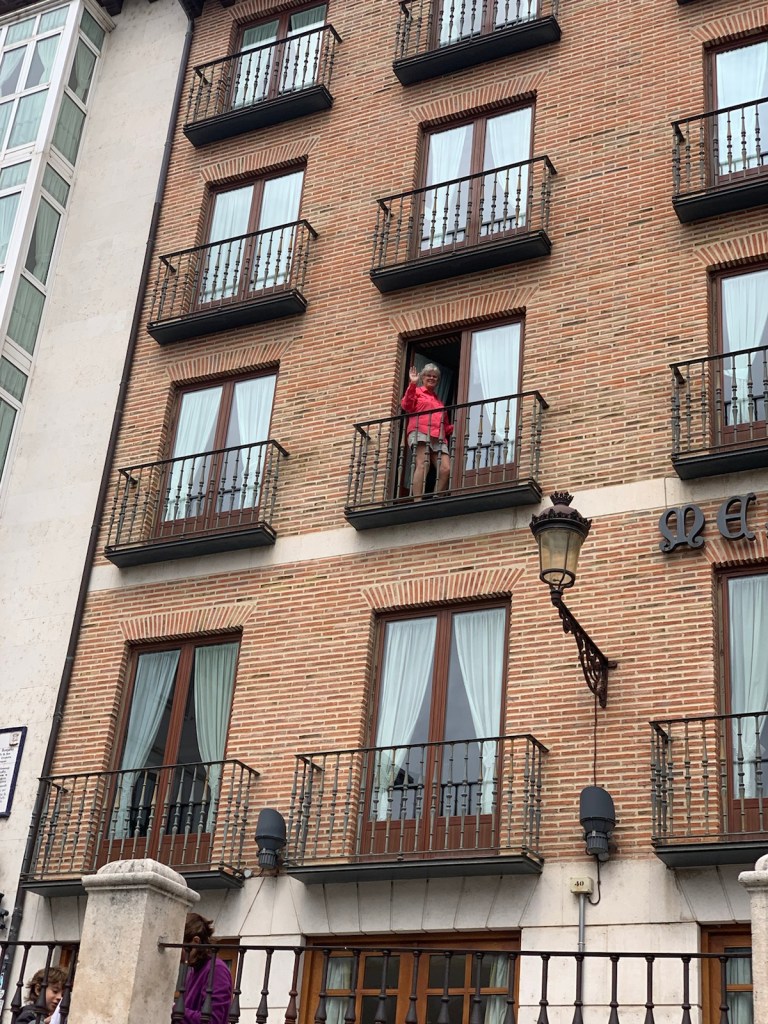
Linda waving from our room

Jim also spent a few minutes in the Iglesia de San Nicolás, one of his favorites and right next door to our hotel.
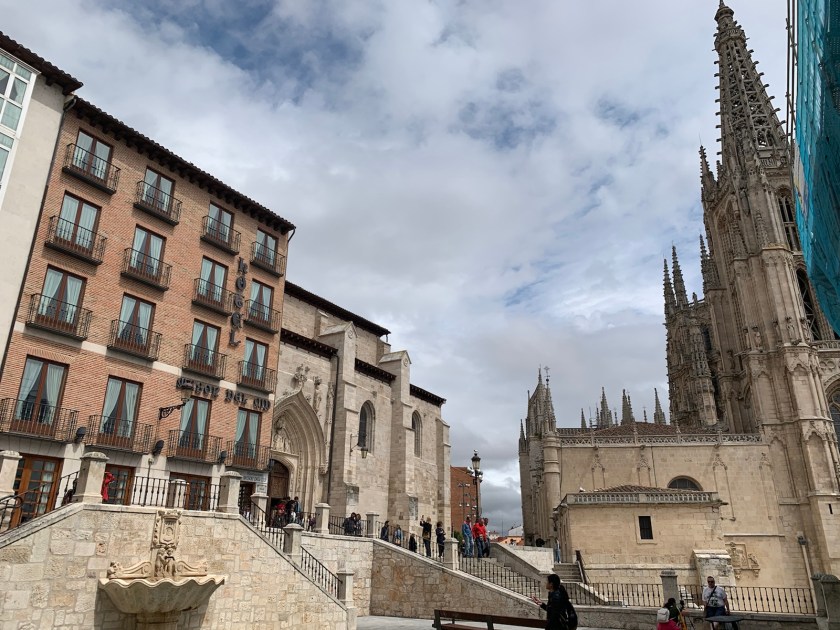
Meson El Cid, Iglesia de San Nicolás, Catedral
Entrance to Iglesia de San Nicolás
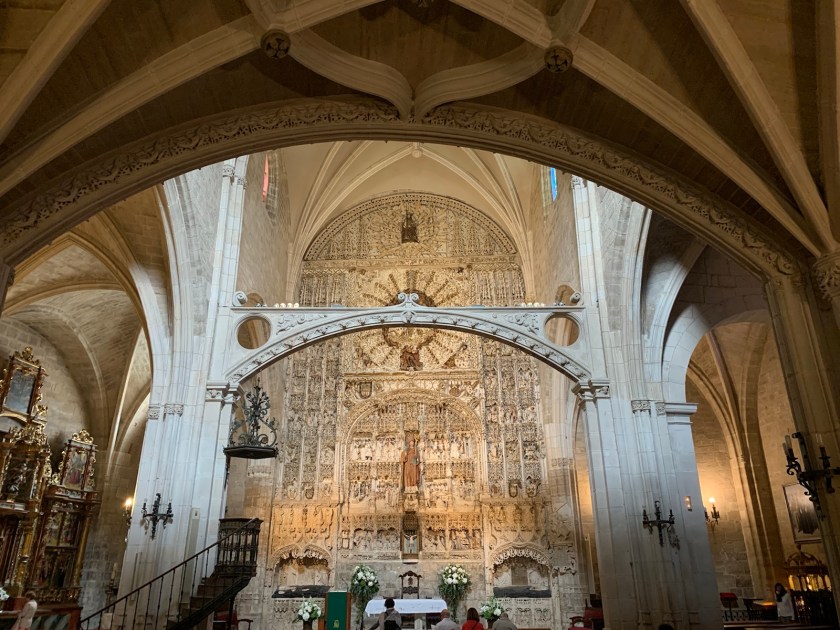
Inside Iglesia San Nicolás

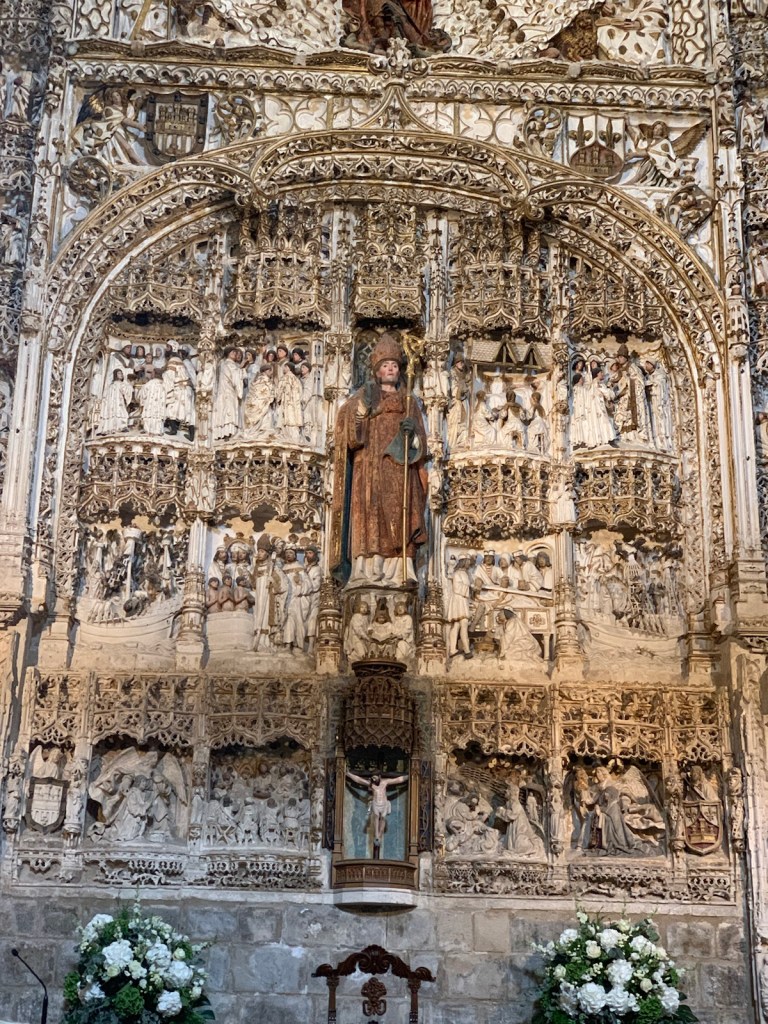
Iglesia San Nicolás altar

San Nicolás (de Bari) if you don’t already know, lived in the 4th century and is the original Santa Claus! And to all, a good night.
Day 21 – Belorado to Villafranca Montes de Oca

Walked today: 7.9 miles

Walked Camino 2019: 146.5 miles

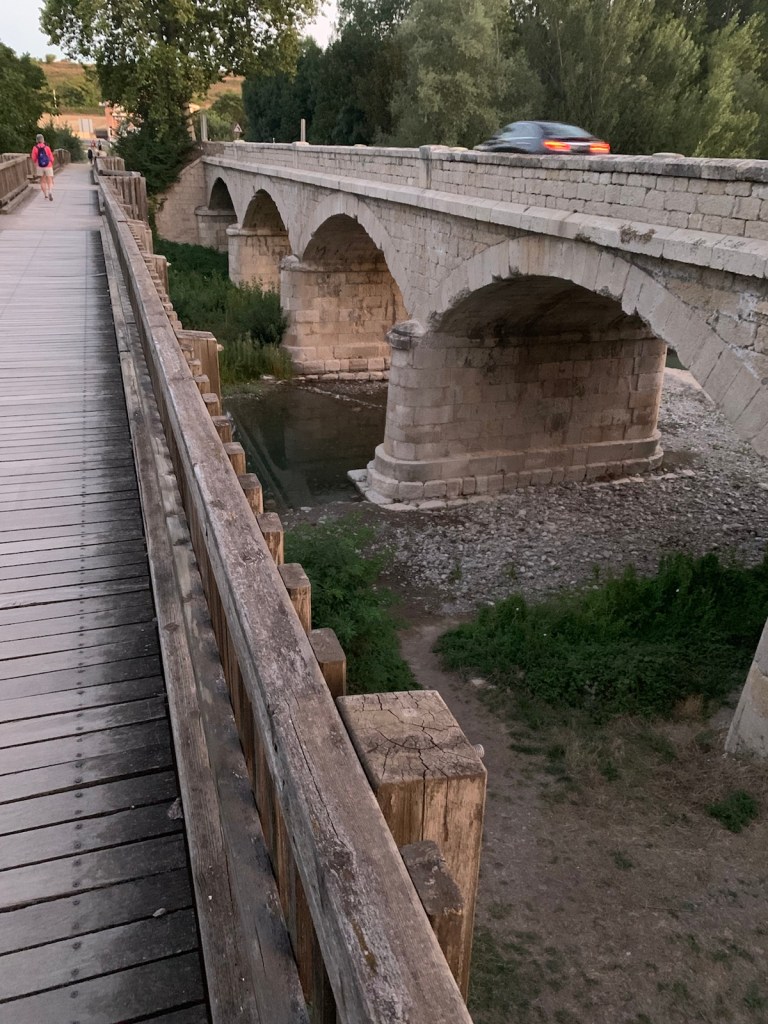
We walked almost a mile before leaving the streets of Belorado, then crossed a wooden footbridge, parallel to a stone bridge, attributed to San Juan de Ortega, a disciple of Santo Domingo de la Calzada.

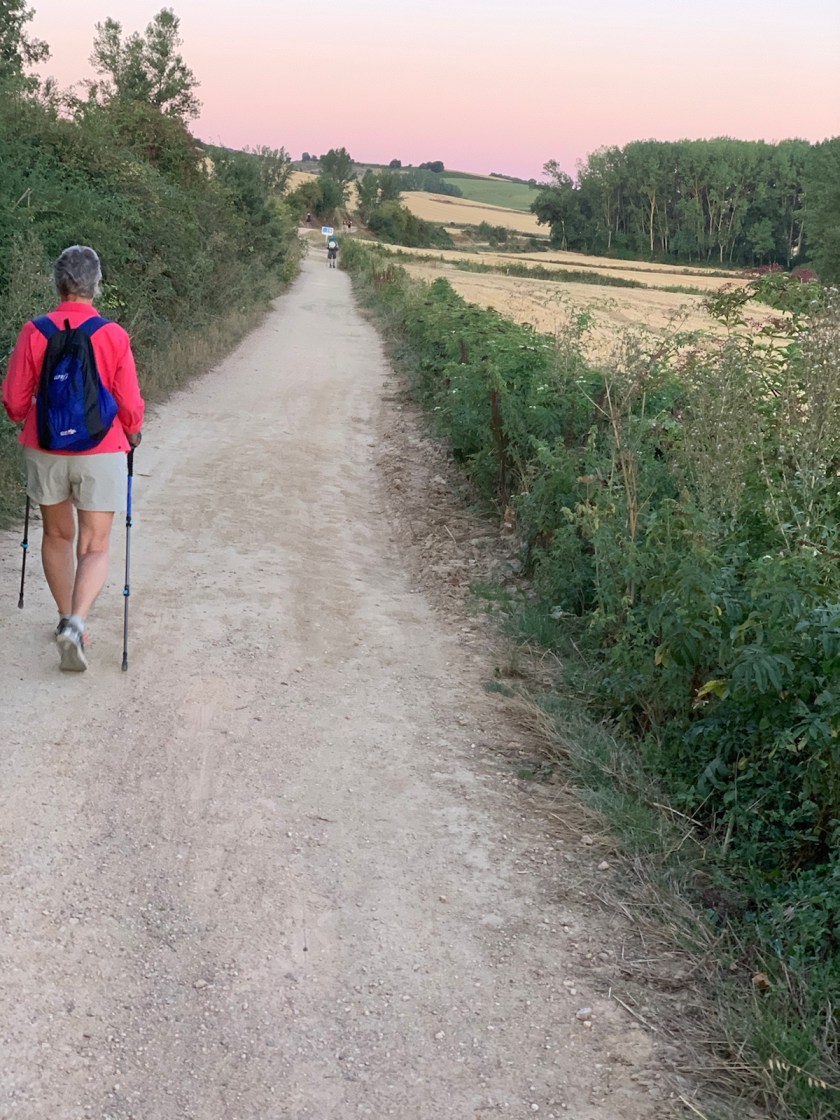
The trail today was almost entirely on earthen paths, passing through frequent villages.

We were crossing through the remote Oca hills, infamous in medieval times as a dangerous route rife with thieves and ne’er-do-wells. Legend credits San Juan de Ortega, with clearing this path through what was then, a thick oak and pine forest with its dense undergrowth.

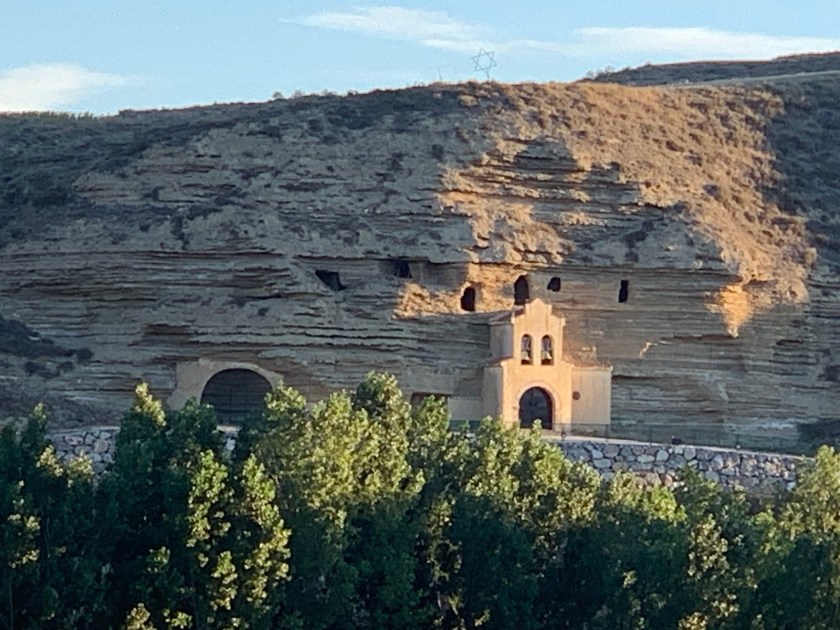
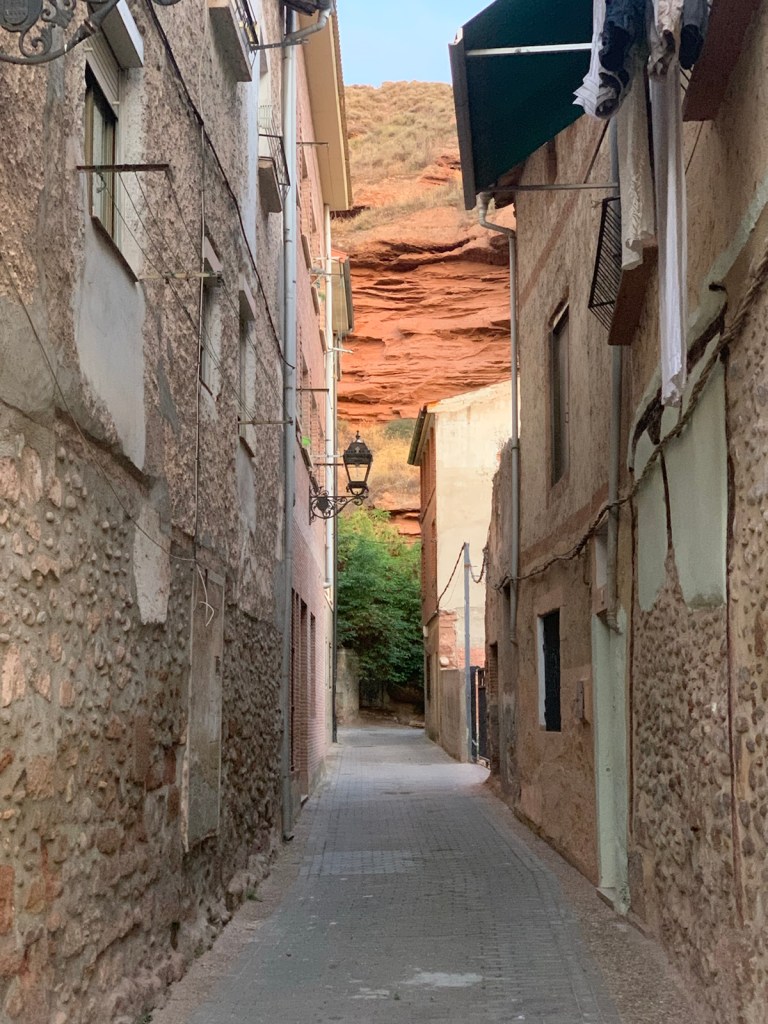
As we passed through the village of Tosantos (pop. 53) we looked for a place for breakfast but nothing was open, but to our right, as we left the village, we saw the Ermita Virgen de la Peña (” Our Lady of the Cliff”), built into the rock face above the town.

Legend has it an 8th-century statue of the child Jesus was hidden in this cave under a bell to protect it from invading Muslims.
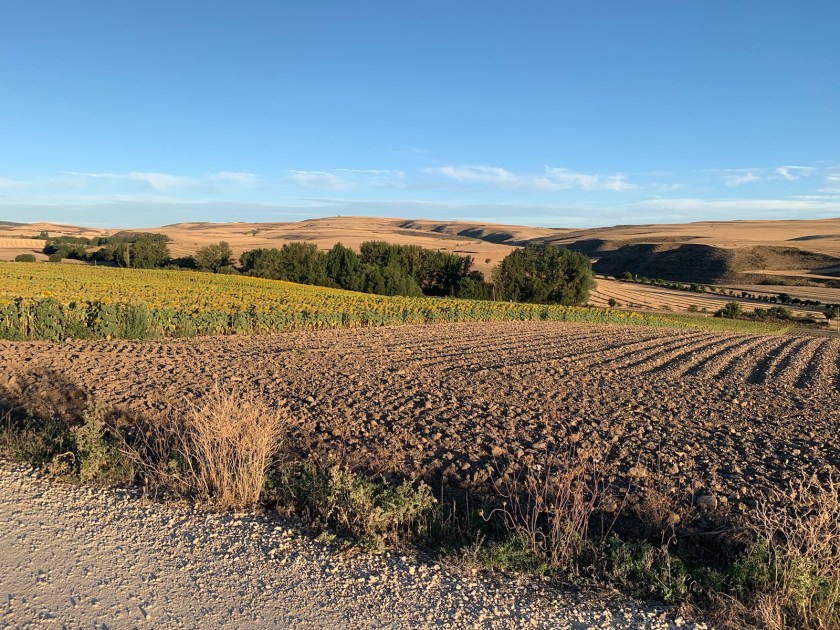
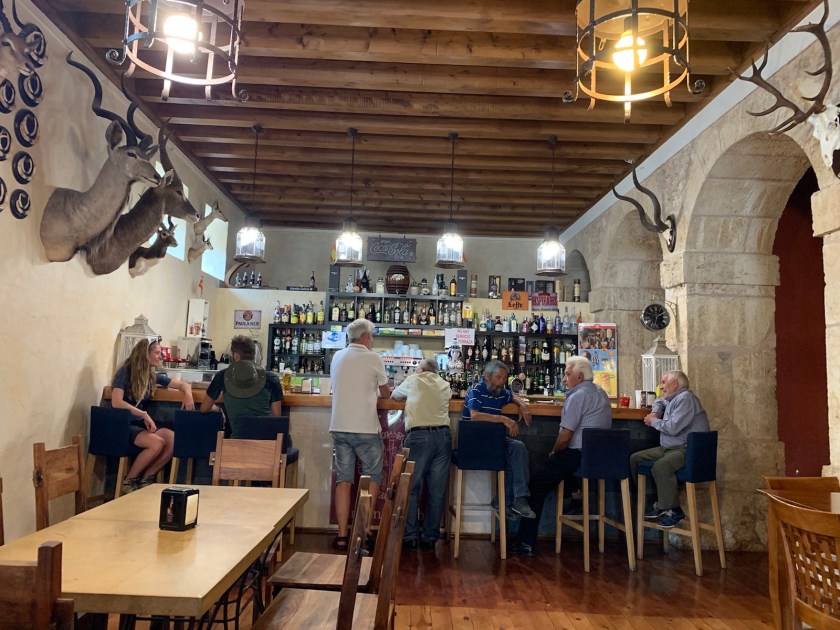
At the next village, Villambista (pop. 47), we stopped for breakfast, having our usual and resting our feet, before continuing.

We can’t help but include photos like the one above. The scenery all around us on the Camino is a constant distraction for any discomforts experienced during a day’s walking experience. We’re sorry that these photos, being two dimensional, fail to capture the three dimensional texture of what we see and savor.

As we approached Villafranca in the distance, we recognized from two prior visits, the Iglesia de Santiago and our hotel, the San Antón Abad (74€), restored from the original Hospital de la Reina, which hosted up to 18,000 pilgrims per year during the 17th century.

Church in center, our hotel to the right of it

We walked the remaining mile or so into Villafrance Montes de Oca (pop. 147) and sipped a glass of zuma naranja (freshly squeezed orange juice) in the hotel bar until our room was ready.

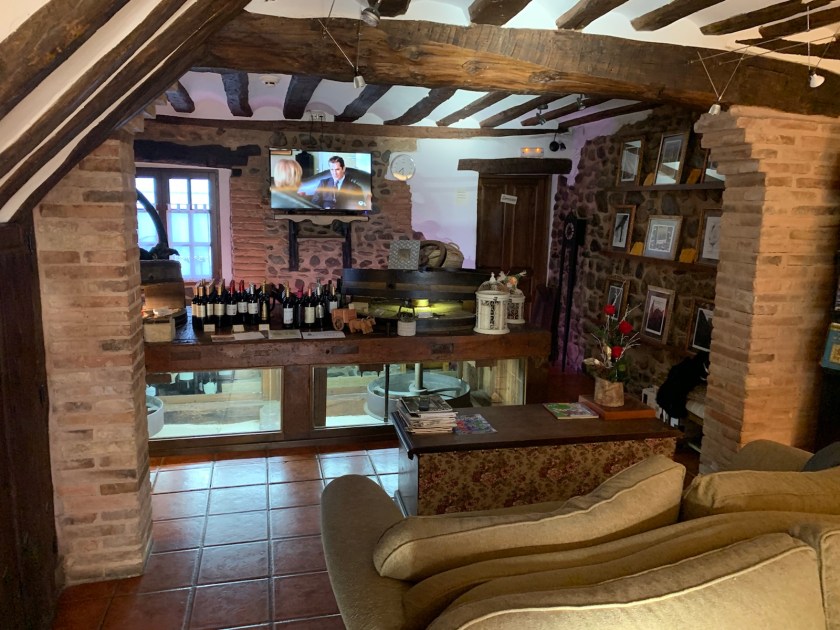
San Antón Abad bar
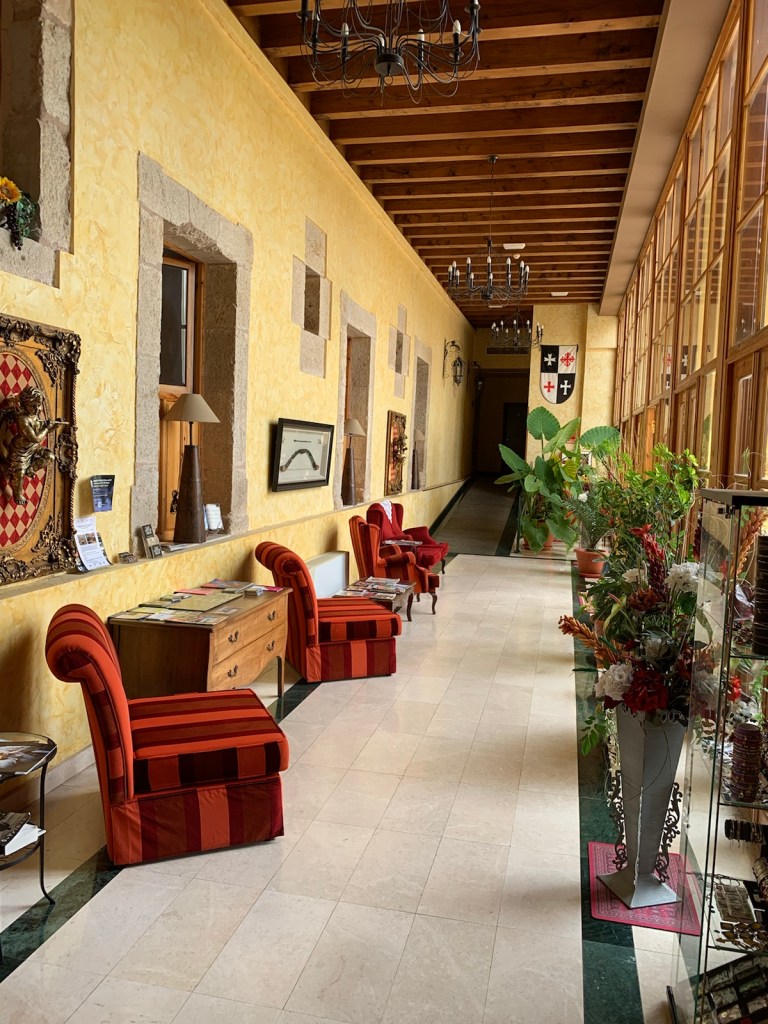
Hotel lobby
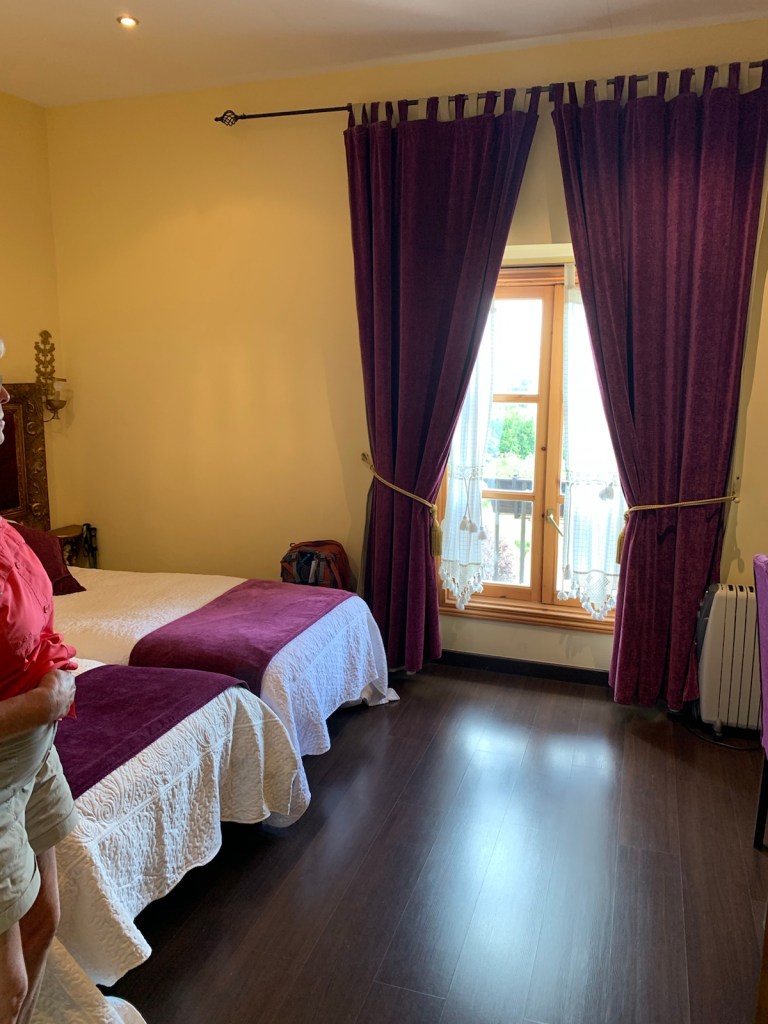
our double room with a bath
The view from our room window

The rest of the day was occupied with washing clothes, hanging them out on the albergue clothes line (they were bone dry in one hour!), having lunch in the bar and blogging, reading and resting until the pilgrim dinner at 7:00.

Our pilgrim dinner was in the hotel dining room. Nice variety of food, good service and interesting conversation with a lady from Kansas and two ladies from Germany, from Munich and Dusseldorf. Both of the German ladies were between jobs, a common time for young folks to walk the Camino. They had both struggled finding places to stay on the Camino de Nord, so had recently switched to the Camino Frances in hopes of having an easier time of it.

We wished each other well and returned to our rooms. We were all staying in the hotel, not the adjacent albergue.

Day 20 – Castildelgado to Belorado

Walked today: 6.4 miles

Walked Camino 2019: 138.7 miles

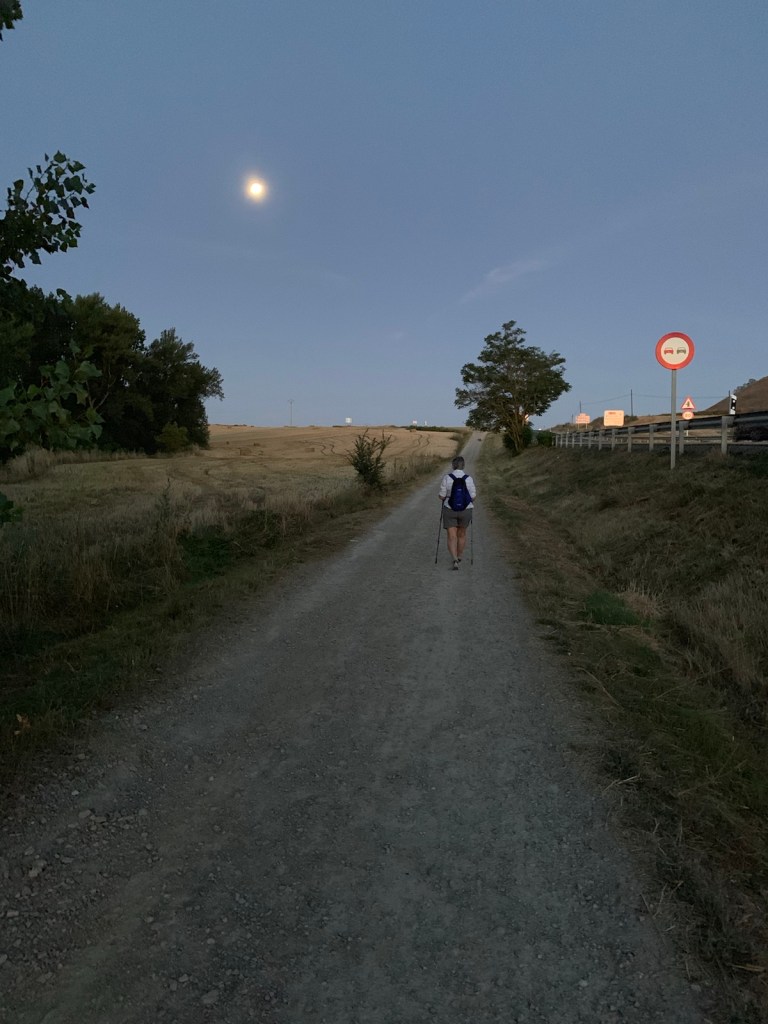
We had another cool morning to walk but out of habit we still left at first light (6:30).

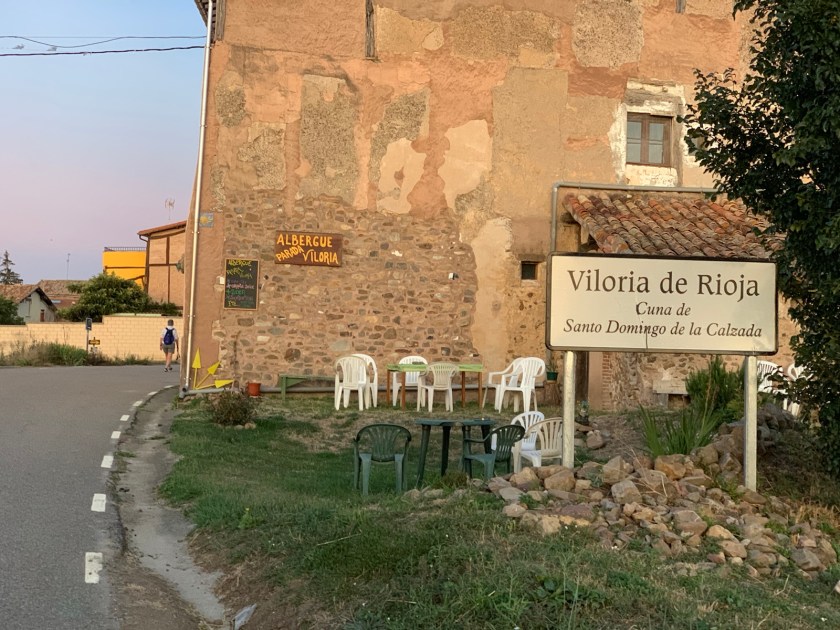
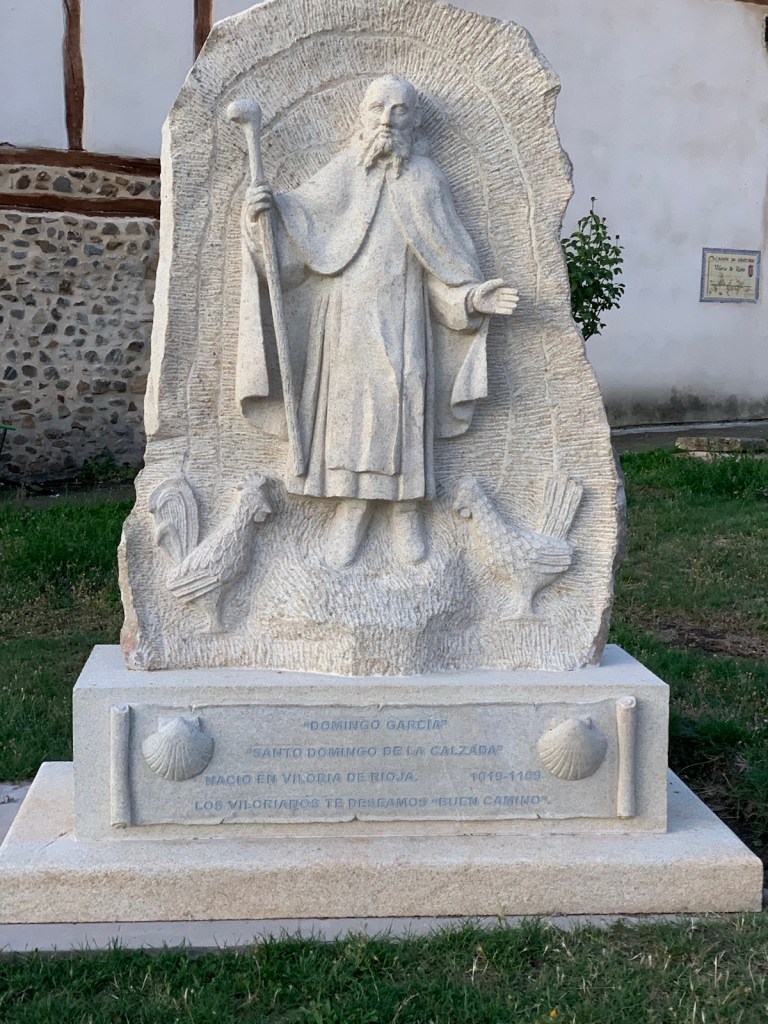
The first village we came to was Viloria de la Riója, the birthplace of Dominic García, aka: Santo Domingo de la Calzada.

Entering Viloria de la Riója, pop. 50

Monument to Santo Domingo in front of village church

Nothing else remains in the village belonging to Santo Domingo, all have gone to ruin in the 1000 years since his birth here.

Throughout Castile and León, simple maps like the above are posted at the entrance of each town or village showing the Camino route into and out of the the town, to keep us from getting lost. Very helpful.

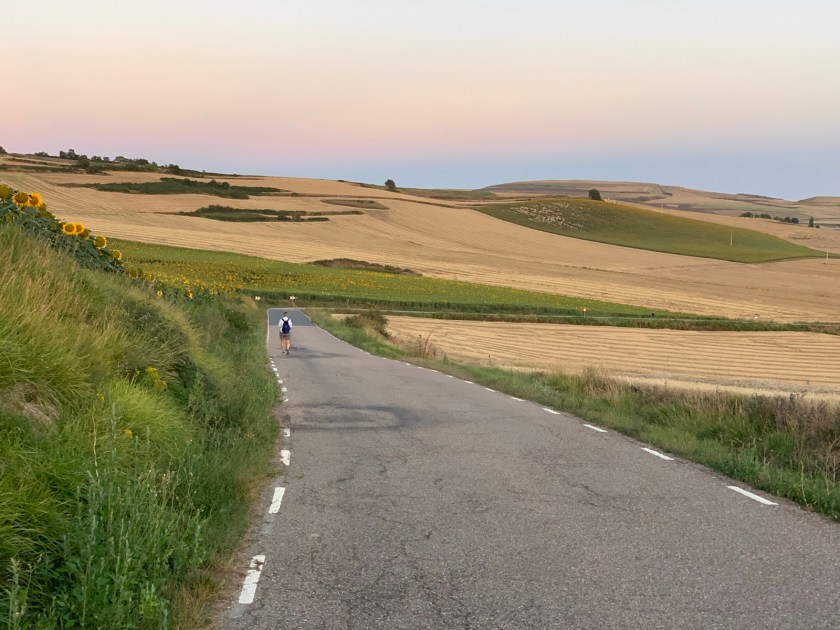
Briefly, after leaving Viloria, we walked through the fields again

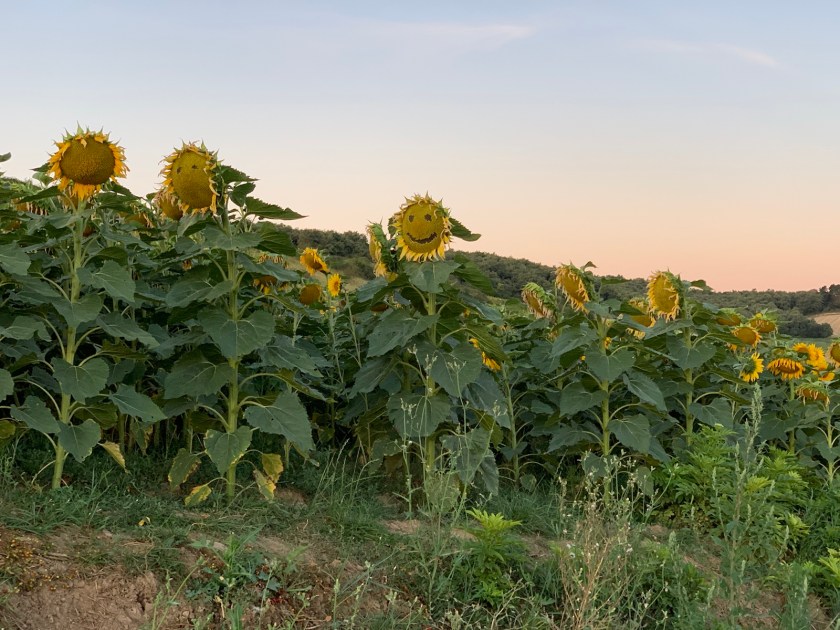
We passed by sunflower fields and pilgrim art?

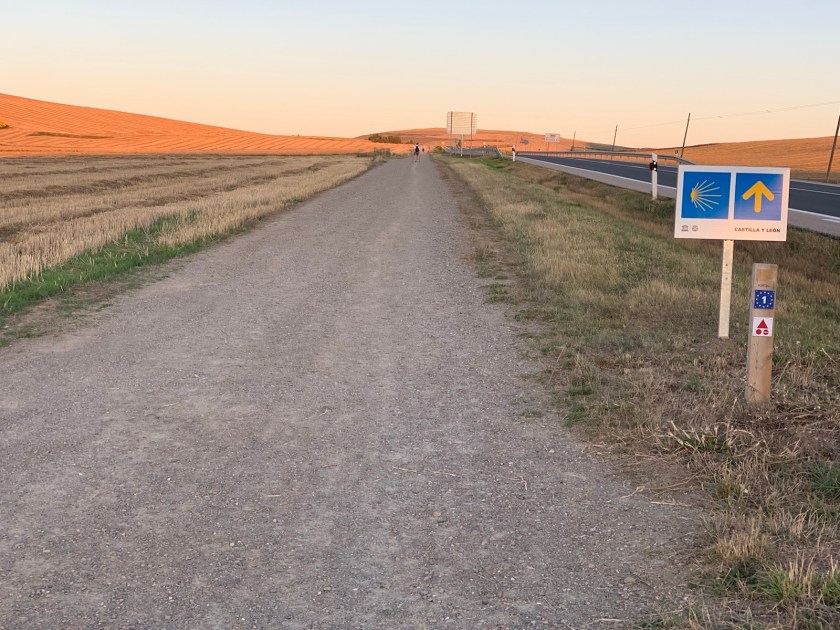
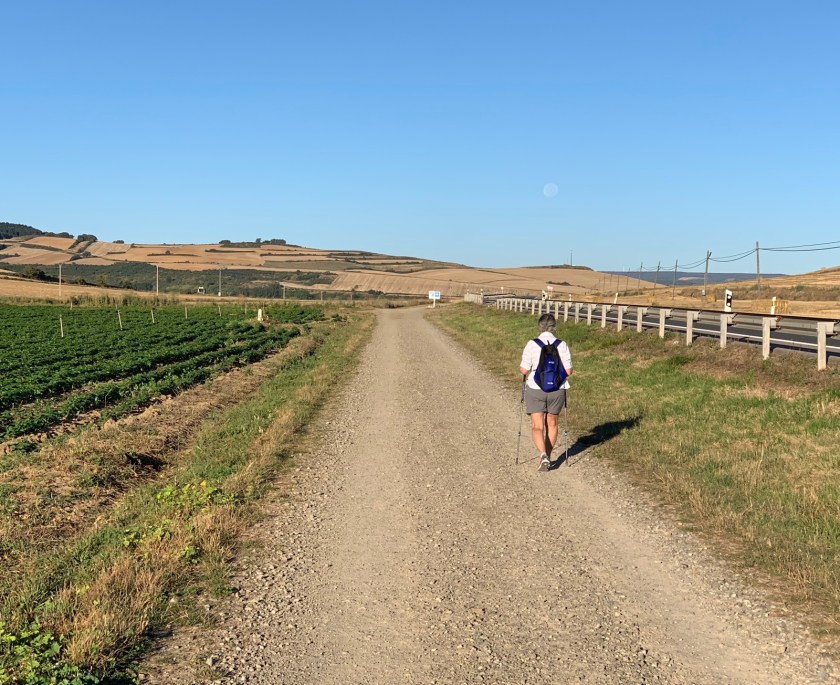
Following a brief break from the highway path, we resumed walking along N-120, the national highway that follows the Camino.

The next village we walked through is called the place of three lies. Villamayor del Río , translates: “the large town by the river”, is actually a small hamlet on a creek!

“The place of three lies” pop. 52

We walked another 2 miles along the highway

Next was Belorado (pop. 2140), which has been settled since Roman times.

In 1116, King Alfonso I, king of Navarre and Aragón, gave the Fueros ( judicial statutes and privileges) to certain villages to encourage re-population after the “reconquista”, when Christian kingdoms were being formed after the Muslims were driven out.

These Fueros established laws to establish acceptable behaviors and also granted privileges to the people to encourage stability and economic growth.

Belorado was awarded the right to have a market on Mondays and a fair every year on St Michael’s birthday. This was the first community in Spain to be given such a privilege. Belorado was also freed from paying fees to the local Feudal Lords and churches to hunt, fish and cut trees. They were also allowed to have their own representatives and judges, giving them more independence from the power of feudal lords and the church. This resulted in making Belorado an important commercial center and establishing an important local law system, unique for the middle ages.

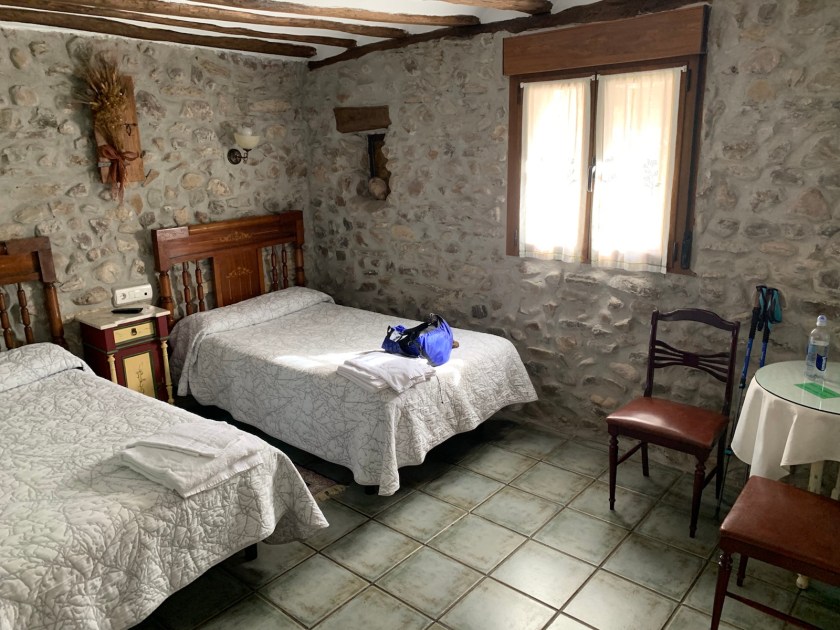
We’re staying in a very nice Casa Rural Verdeancho (66€).

Our room

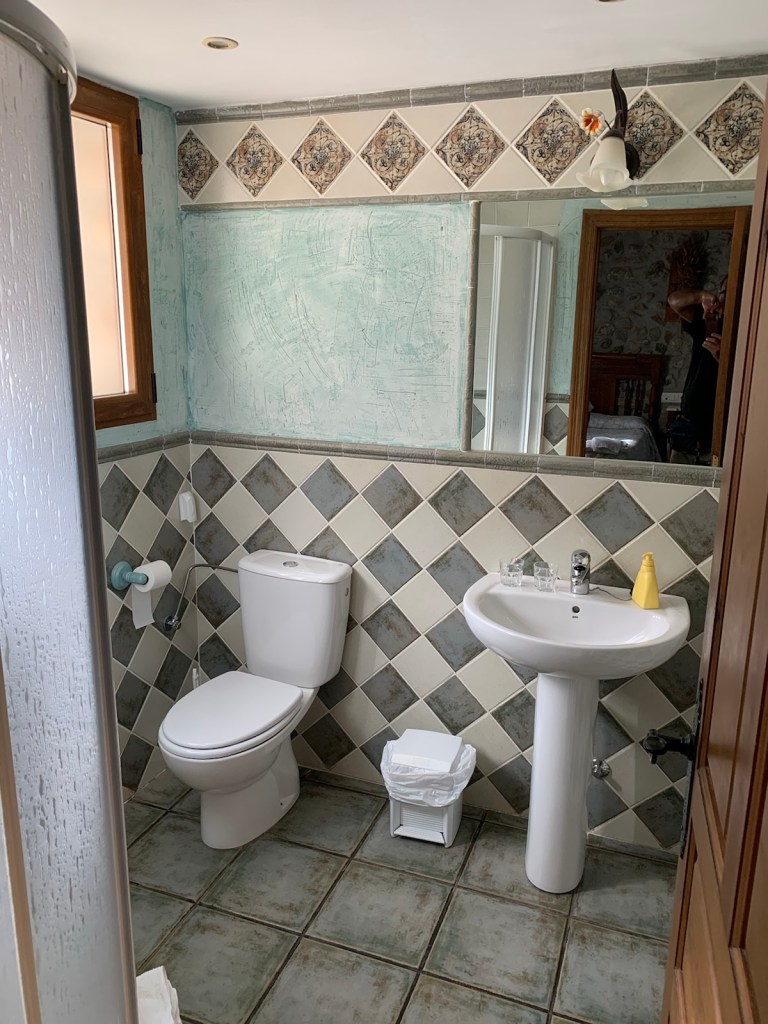
Our ensuite bathroom

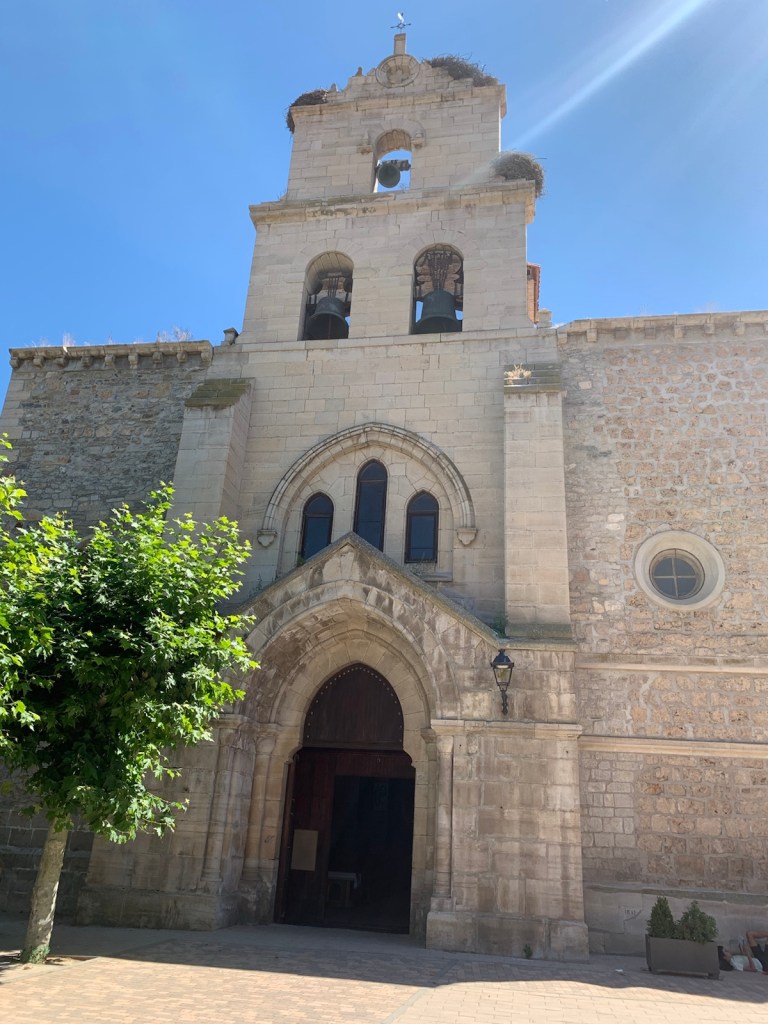
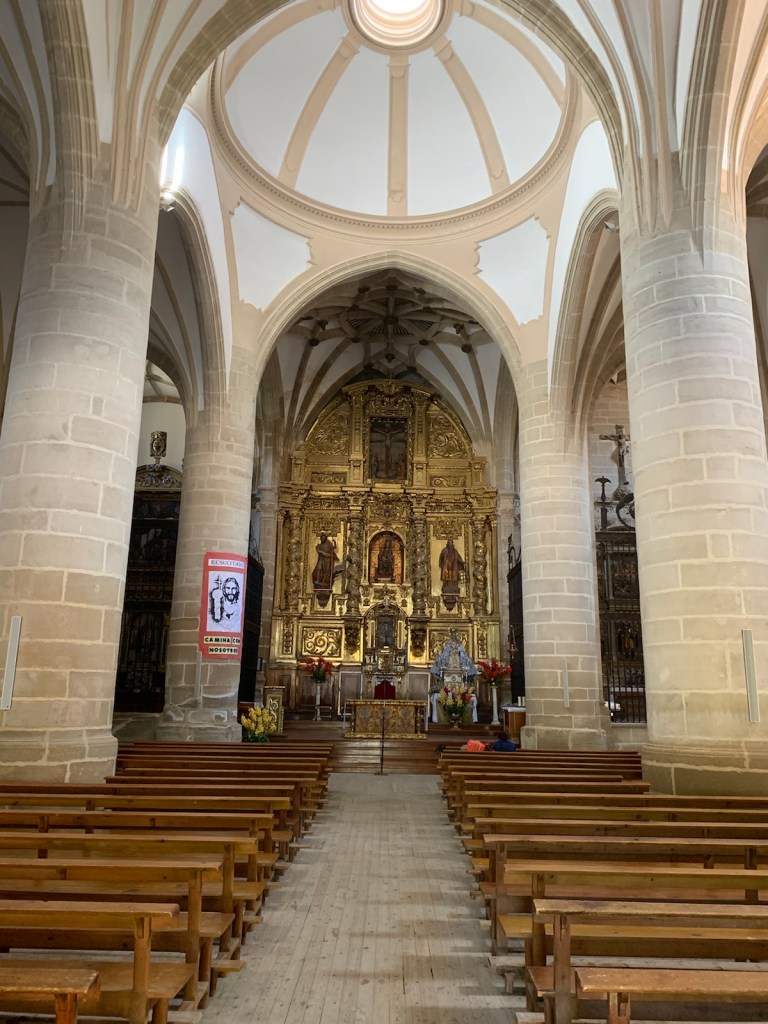
We ventured out into the town around 1:30 and briefly looked into Iglesia de Santa María which is right next door to our residence for the evening.

Exterior of Iglesia de Santa María – note stork nests in belfry
Interior of Santa María

We walked a few hundred feet to the Plaza Mayor and found a shaded bench and sat down to observe the natives.

Two groups of 20 something folks were frolicking about from one shady spot on the plaza to another, accompanied by a small brass band with drums.

We watched for a while, then found a restaurant that served a pilgrim dinner and had our 2:00 p.m. lunch/dinner for the day.

On the way back to our room we asked an English speaking group of 3 pilgrims if they knew what was going on and they also didn’t have a clue. (It turns out they were from Germany) Finally, we happened upon one group of the revellers and asked if they spoke English and a couple of them did and they explained that they were all 20 years old and the other group was 25 years old and since it was Saturday, they decided to party as a group. They even had matching tee shirts listing the names of each individual in their group. It was all in fun and we high fived several members of the group, they wished us Buen Camino and we headed back to our room for the day.

Day 19 – Santo Domingo de la Calzada to Castildelgado

Walked today: 7.5 miles

Walked Camino 2019: 132.3 miles

It was another cool morning for walking as we left over a later version of one of Santo Domingo’s many bridges

and joined the familiar dirt path.

We paralleled the main road most of the way to Grañón.

on the left appeared to be potato plants

Grañon had been a stopping place for us twice before and has been one of our favorites.

Welcoming pilgrim entrance into Grañon

Today was a mixed experience. We arrived at around 8:30 to find all the bars and stores to be locked up tight, which has not been the case in the past. The only exception was the bank (which doesn’t have food or public bathrooms) and a bakery.

We stopped in the bakery and purchased two pain au chocolats and asked the English speaking owner what was going on. She said that the merchants in town were getting rich from the Camino traffic and decided to reduce their hours, not opening until 10:00 a.m.! She said her customers, mostly local, still needed her to provide their daily bread, early.

We asked her if any aseos (toilets) were available and she said go around the church and go up the stairs in the albergue, which we did.

When got to the second level, a nice young lady asked us what language we spoke. We pondered between French and Spanish, then settled on English. She welcomed us and pointed to one bathroom and then another one upstairs. We split up and gratefully made use of the services.

We were offered coffee or tea which we declined but offered to make a donation which they would not accept. The lady and 3 other volunteers were from Italy and had just arrived to serve for 2 weeks. We rested for a few minutes, while Linda tended to a potential blister, and then thanked them for their hospitality and continued on to the next village.

Today we crossed the boundary between the region of Riója and the region of Castile and León. We will be in Castile and León for the next 200 miles or so.

The walk as we approached Redecilla del Camino

We stopped at the first village, Redecilla del Camino (pop.137) for breakfast. Then continued to the next village of Castildelgado, and checked in to Hostal El Chocolatero, for obvious reasons.

El Chocolatero is on the main highway, just outside of the village. Their are two very small albergues in the village with very limited facilities, so it was the best option for us.

Our hotel appears to be a popular truck stop (not with gas pumps and other services, just a place to stay/eat). Our room is spacious and has reasonable amenities. The lady at reception has helped us make future reservations and her English is good.

We had a late lunch/ early dinner in the hotel comedor (dining room) at 3:30, along with apparently most of the village’s 54 inhabitants (Lunch hours were 1-4 and dinner hours 8:30-11:00).

Most of the lunch crowd had left by the time we sat down at 3:30.

There are no services for our walk tomorrow, we’ll leave before the bar opens, so we bought a bogadilla to hold us until we reach our destination and have breakfast.

Oh, and by the way, we did buy a nice hunk of dark chocolate, very delicious and something to savor for the next few days.

Day 18 – Cirueña to Santo Domingo de la Calzada

Walked today: 4.05 miles

Walked Camino 2019: 124.7 miles

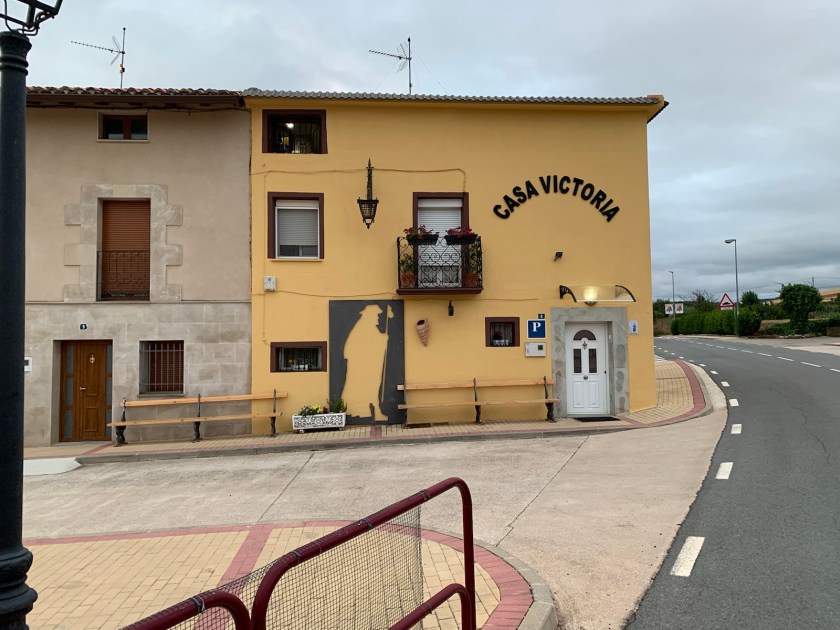
Leaving Casa Victoria behind…
and walking out of Cirueña at 7:25 this morning

Soon after leaving Cirueña, we began a walk through grain fields for nearly an hour.

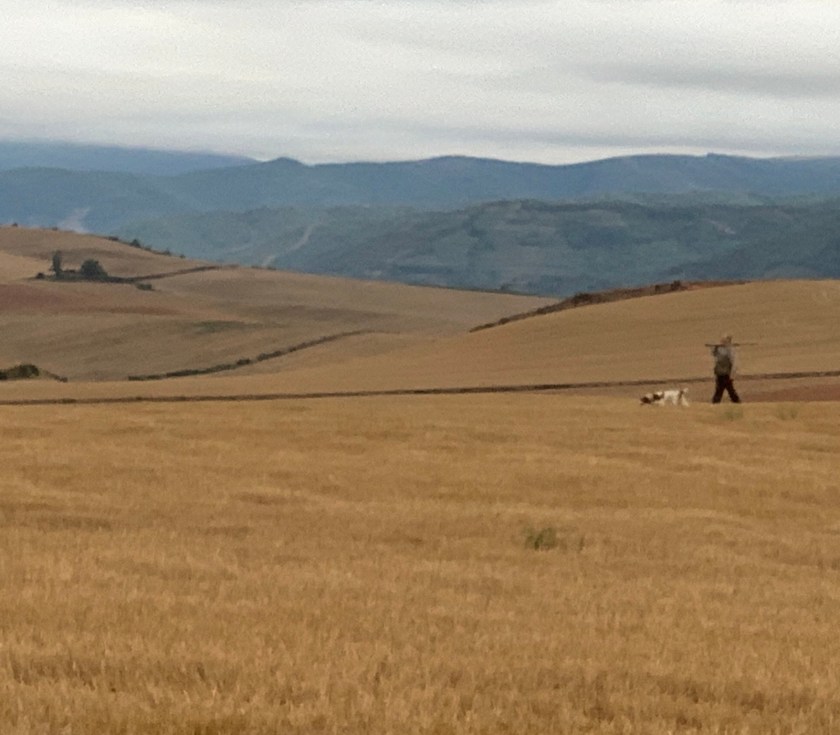
We saw a dozen or so quail hunters and their dogs along the way.

After about 3 miles, we could see the buildings and Cathedral tower of Santo Domingo de la Calzada. Off to our right was a large field of potatoes and in the distance, a flock of hot air balloons descending to a nearby airfield.

We next walked by a series of warehouses and processing facilities of some sort, then observed hundreds of stacked crates with evidence of the likely product… potatoes.

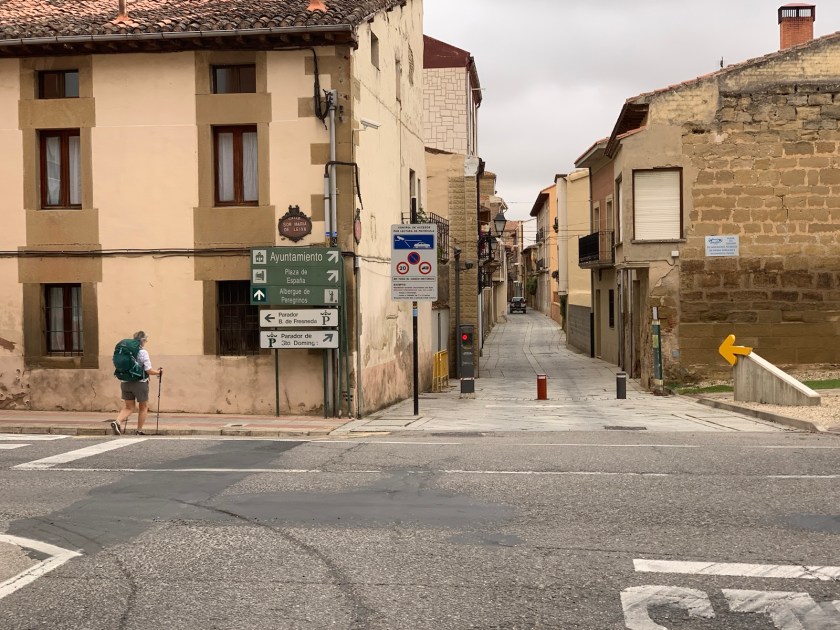
We next walked into Santo Domingo de la Calzada (pop. 6231) and then entered a walk street which took us to the Cathedral and the old city.

city streets toward old section
entered old city
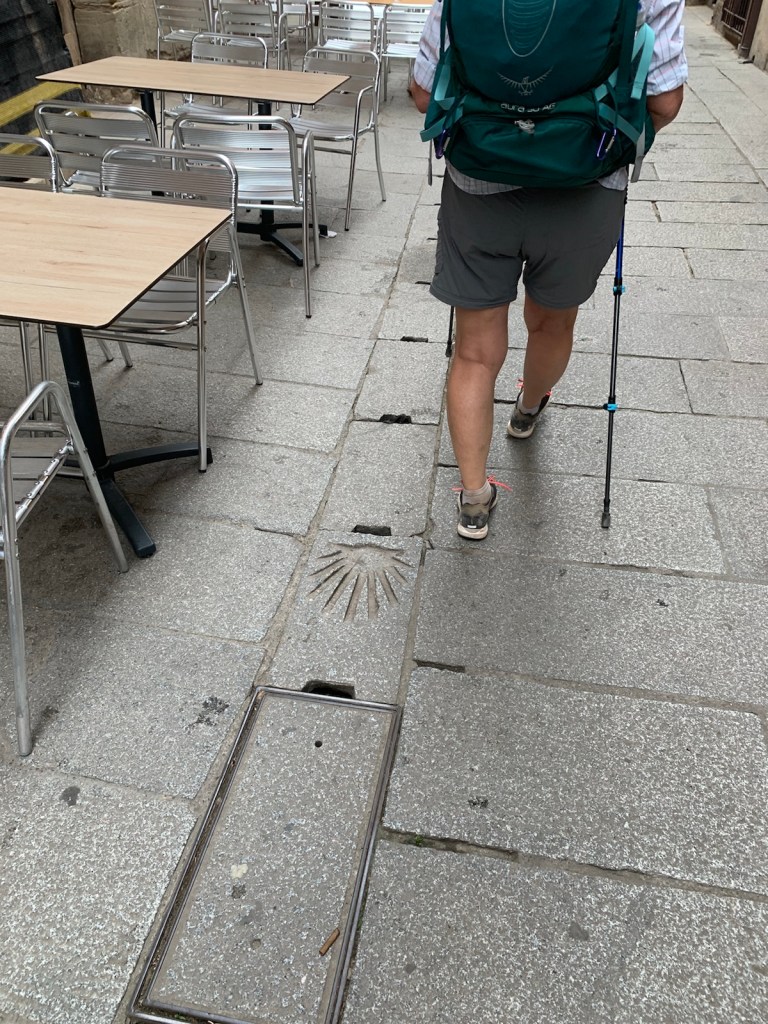
Camino markers typical of cities

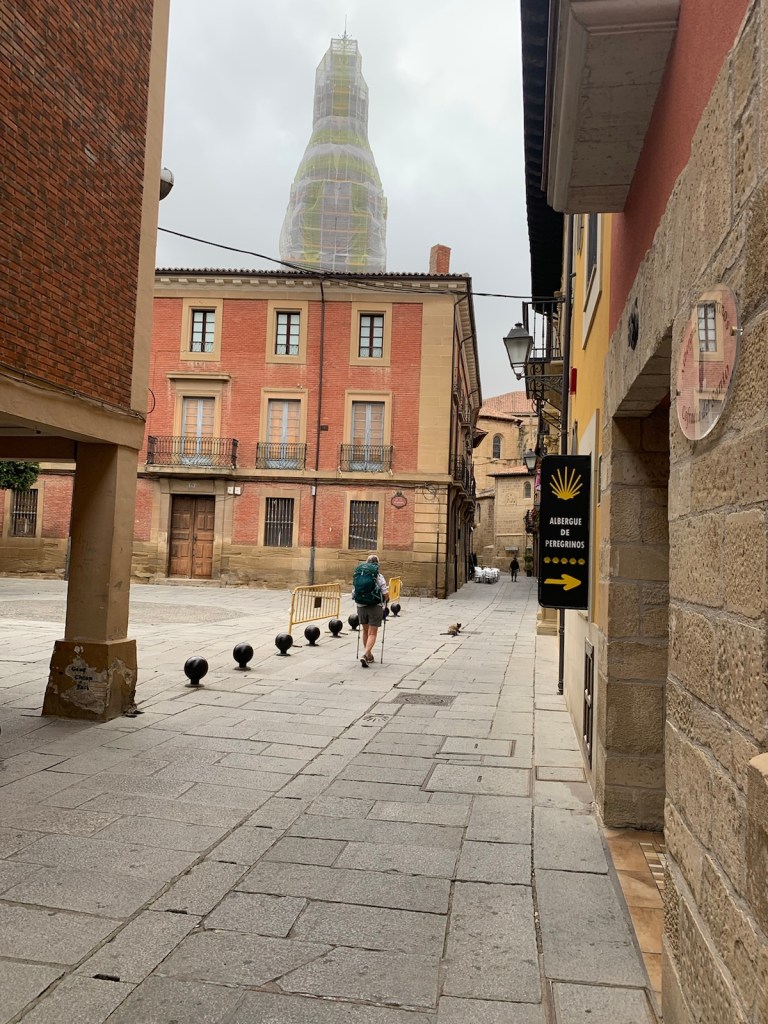
municipal albergue and Cathedral tower (reno work)

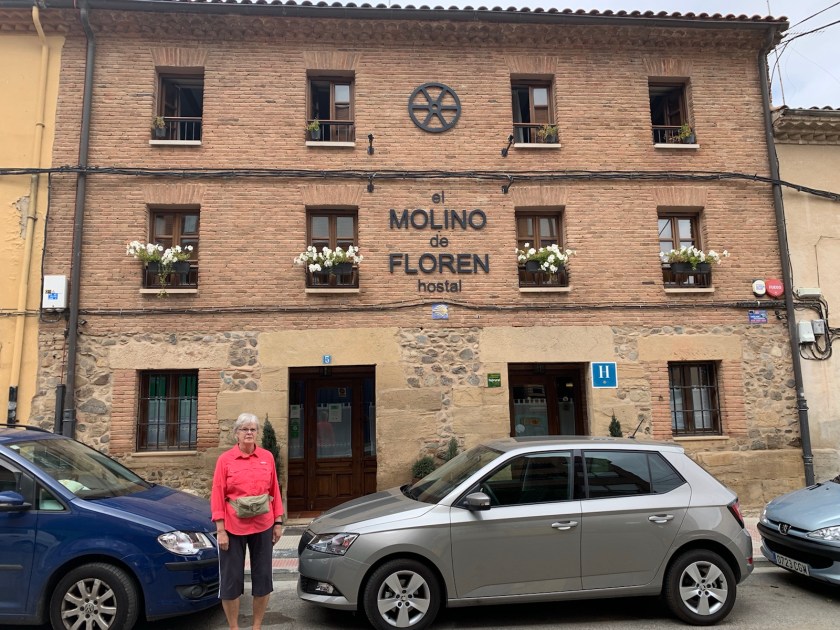
We stopped for breakfast at a bar next to the Cathedral and then walked on to our hotel, El Molino de Floren.

We were early, but the owner allowed us to wait in the lobby or restaurant until our room was ready. We opted for the restaurant and he prepared two cafe con leches for us.

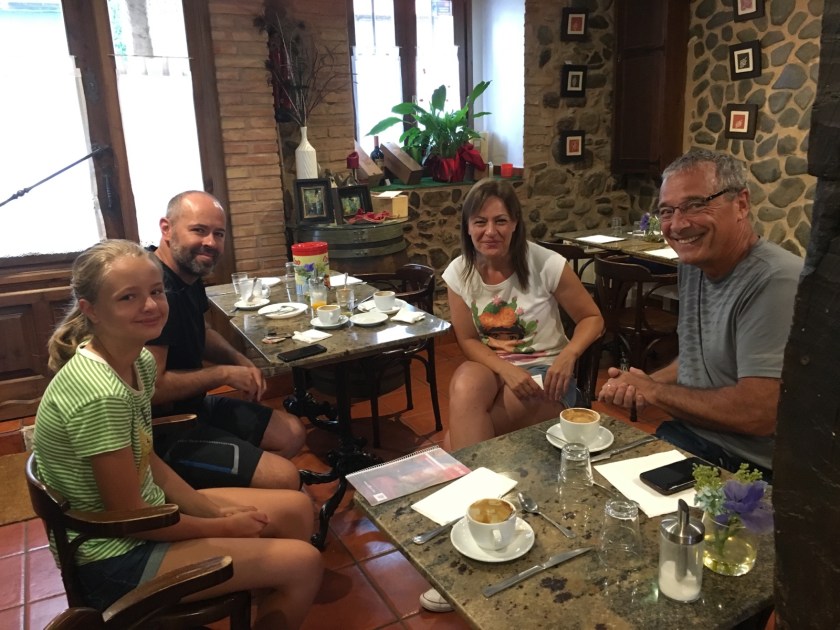
The young family at the next table seemed interested in us and guessed we were doing the Camino. So we initiated a conversation and we had a delightful exchange for the next hour or so.

The family was from Valencia and was on a three day holiday to walk part of a hiking trail mostly in the nearby mountains. The dad spoke a little English, but we soon learned that the 10 year old daughter was taking English in school, so we encouraged her do the translating and, as needed, supplemented our conversations with itranslate.

Nice family from Valencia

It was a really wonderful experience and we gave them our blog info, so they could follow us if they wanted.

Our room was ready around 11:30 and shortly thereafter we went back to our breakfast spot, about a 3 minute walk away, and had lunch.

A nice room with ensuite bathroom in our boutique hotel

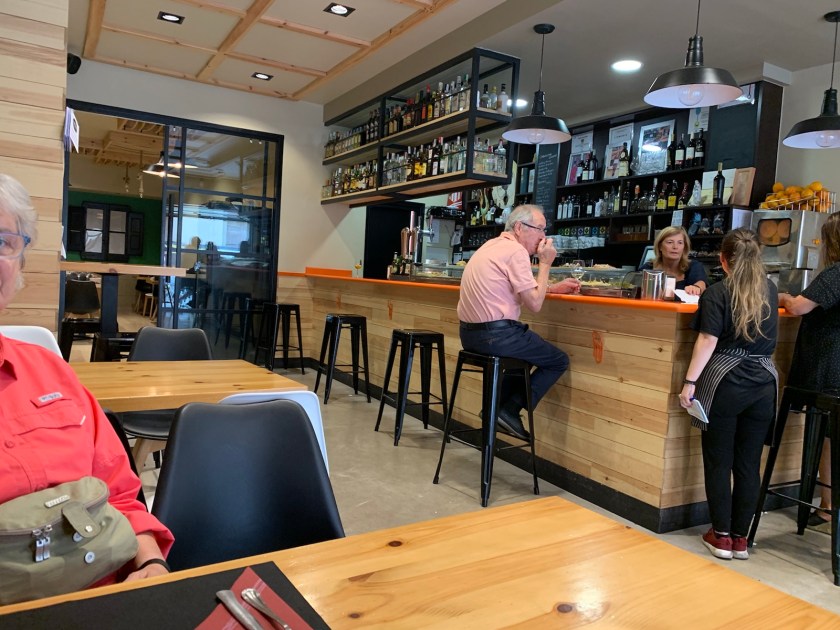
Bar Piedra, our choice for breakfast and lunch

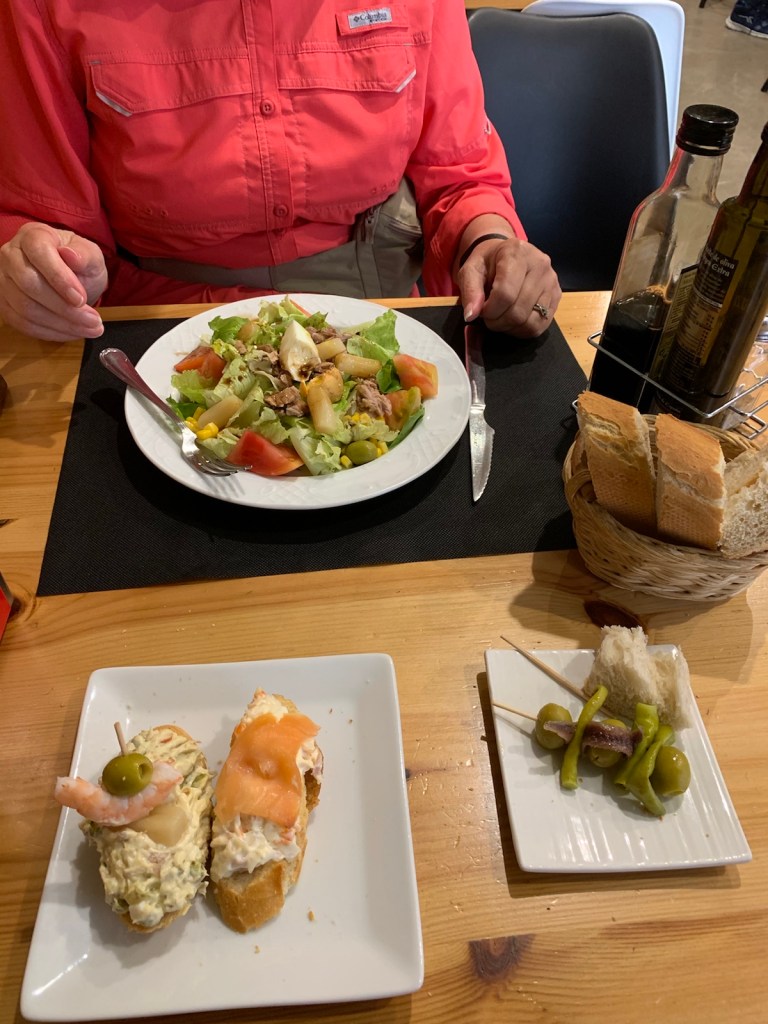
Ensalada mixta for Linda, pintxos for Jim

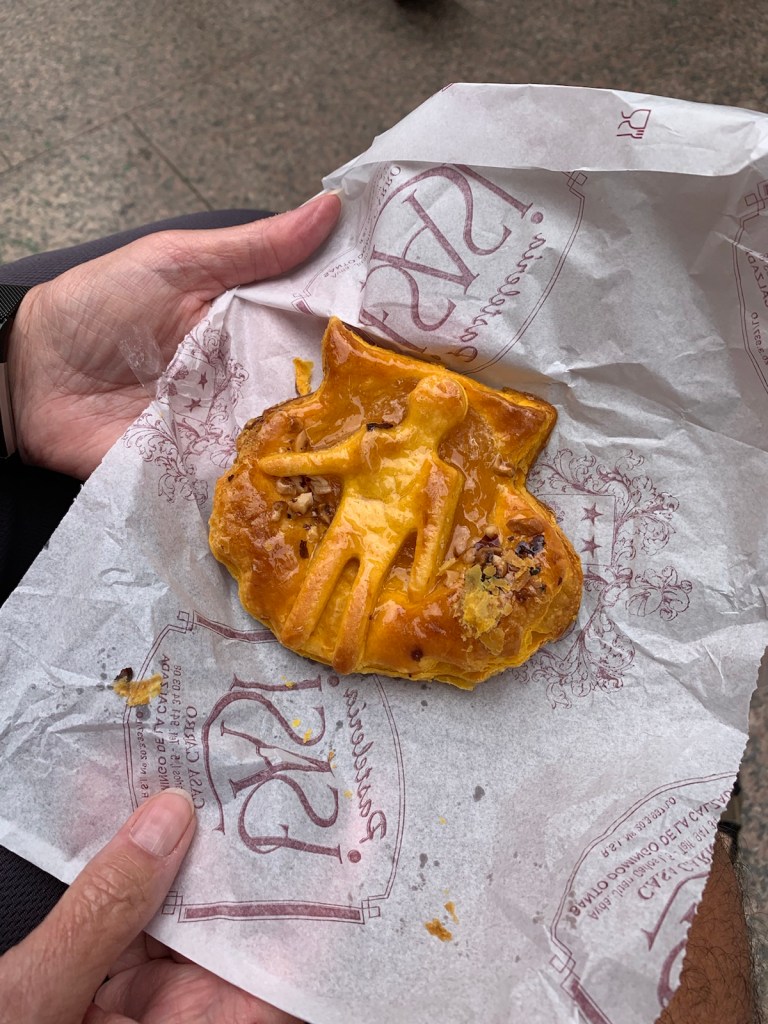
After lunch we searched for a popular snack called “ahorcaditos” or Little Hanged Man, which we”ll explain later.

Ahorcaditos, sweet almond creme pastries in shape of shell, a disappointment, but now we know.

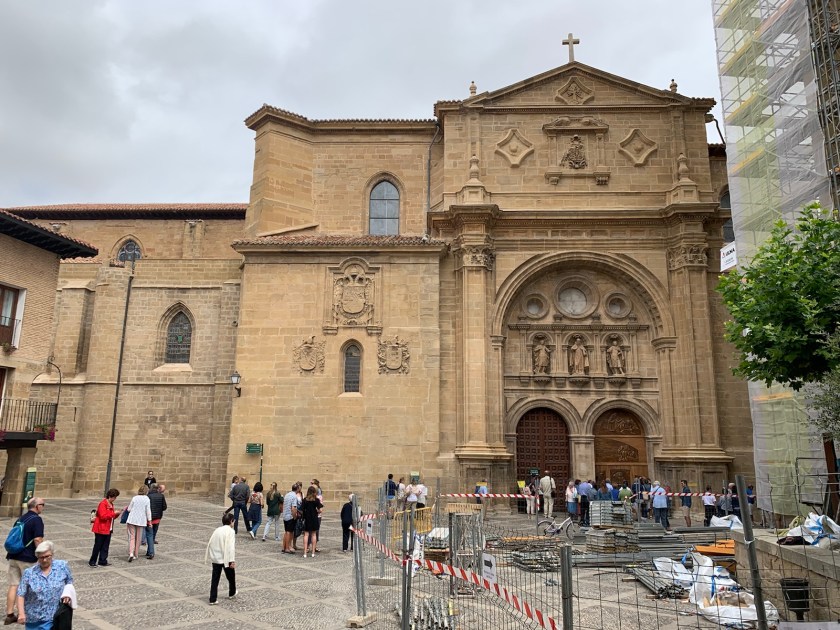
Cathedral de Santo Domingo de la Calzada
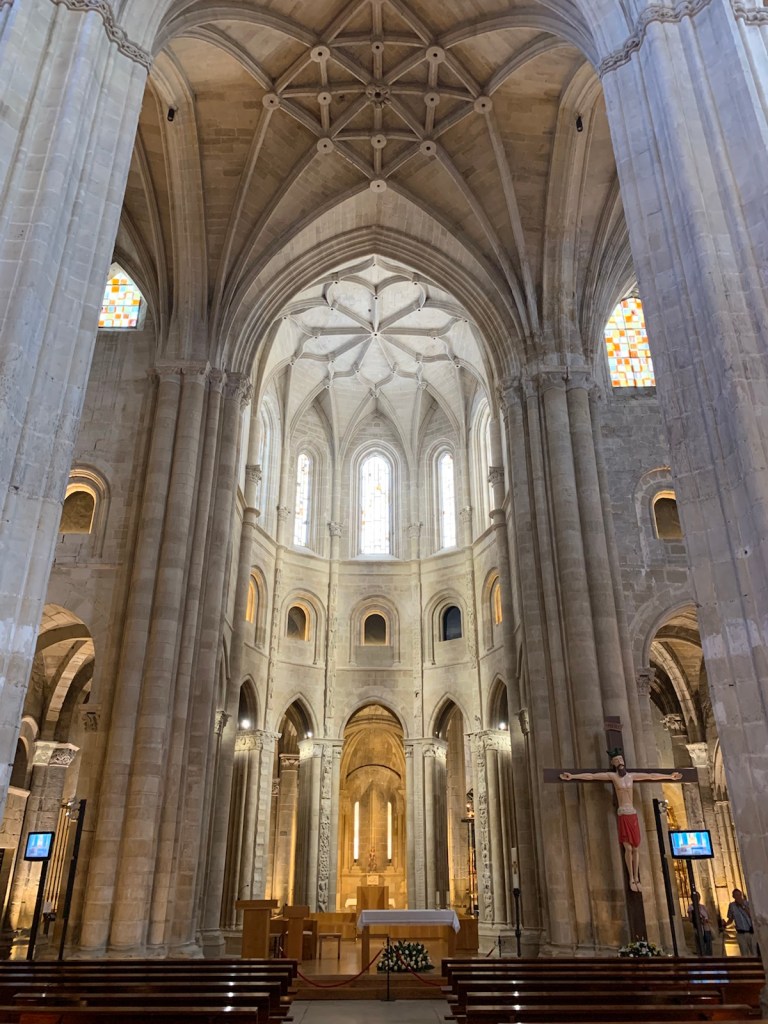
Altar and interior if the Cathedral,

Santo Domingo de la Calzada takes its name from Dominic Garćia, born in 1019 in nearby Viloria de la Rioja. He cared for and developed sections of the Camino in this area in the 11th century including building bridges and clearing the road.

Myths and legends abound about the saint, such as when he was clearing the forest he fell asleep and angels picked up his scythe and miraculously continued clearing! He also brought a pilgrim back to life that had been hit and killed by an ox cart.

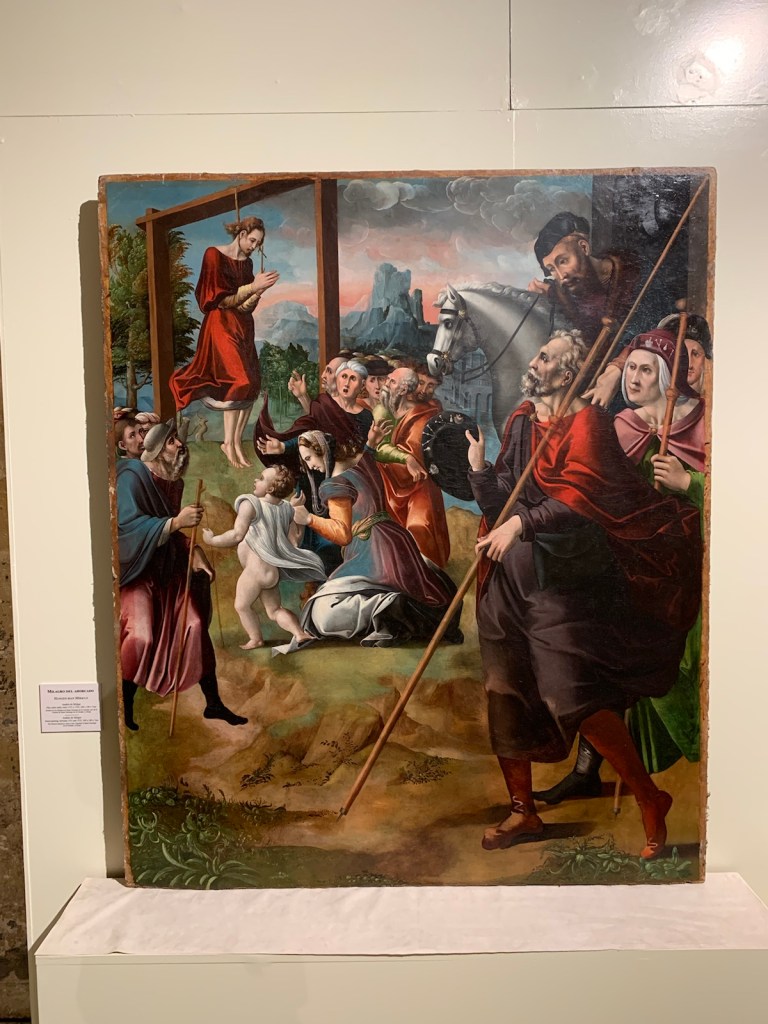
The most famous legend associated with Santo Domingo is “the hanged innocent.” A German family (father, mother and their son, Hugonell) were on the pilgrimage to Santiago. In Santo Domingo they stayed with a farmer’s family, and the farmer’s daughter tried to seduce Hugonell but, as a pious pilgrim, he refused her. She became so angry that she hid some silver items in his pack and after he left, called the authorities and accused the boy of theft. Upon finding the items in his pack, the boy was found guilty and hanged.

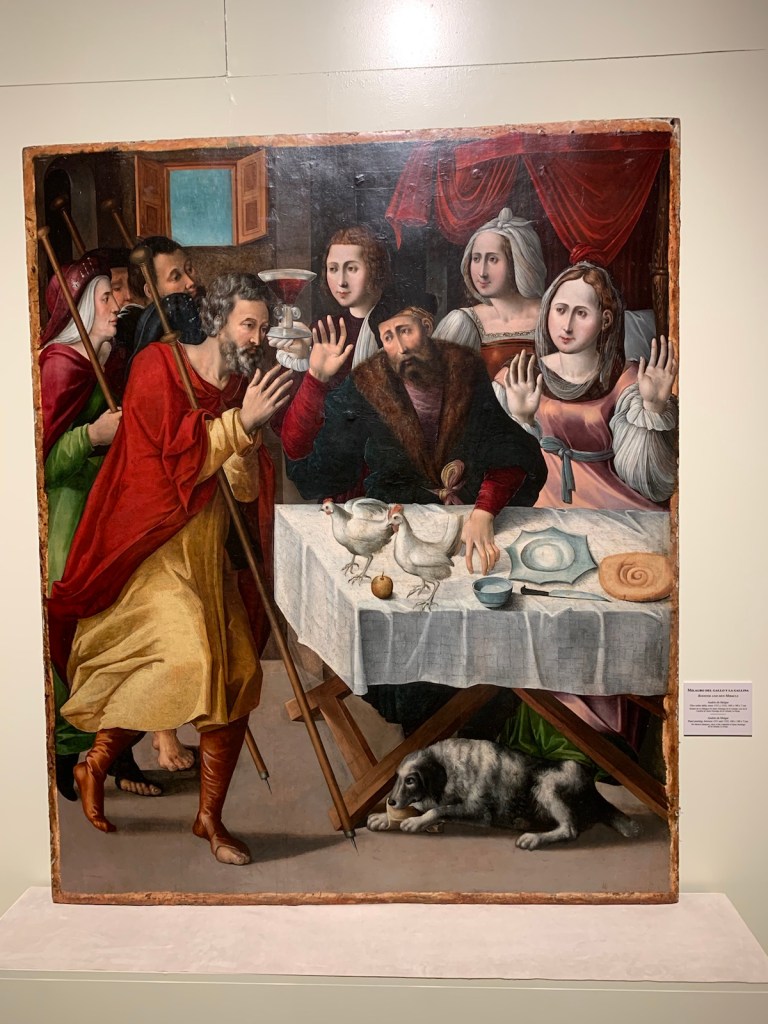
His grief-stricken parents continued to Santiago, but stopped to see their son’s remains on the return journey (thieves were left to rot on the gallows as a warning to others). They were delighted to find that he was still alive, claiming that Santo Domingo had held him up so he did not die. The parents hurried to the magistrate and asked them to cut down their son, as he was clearly innocent. The magistrate, who had just sat down to a hearty chicken dinner, shouted, “Why, he is no more alive that this roasted chicken I’m about to eat.” At this, the cooked chicken stood up on his plate, miraculously brought back to life feathers and all, and crowed.

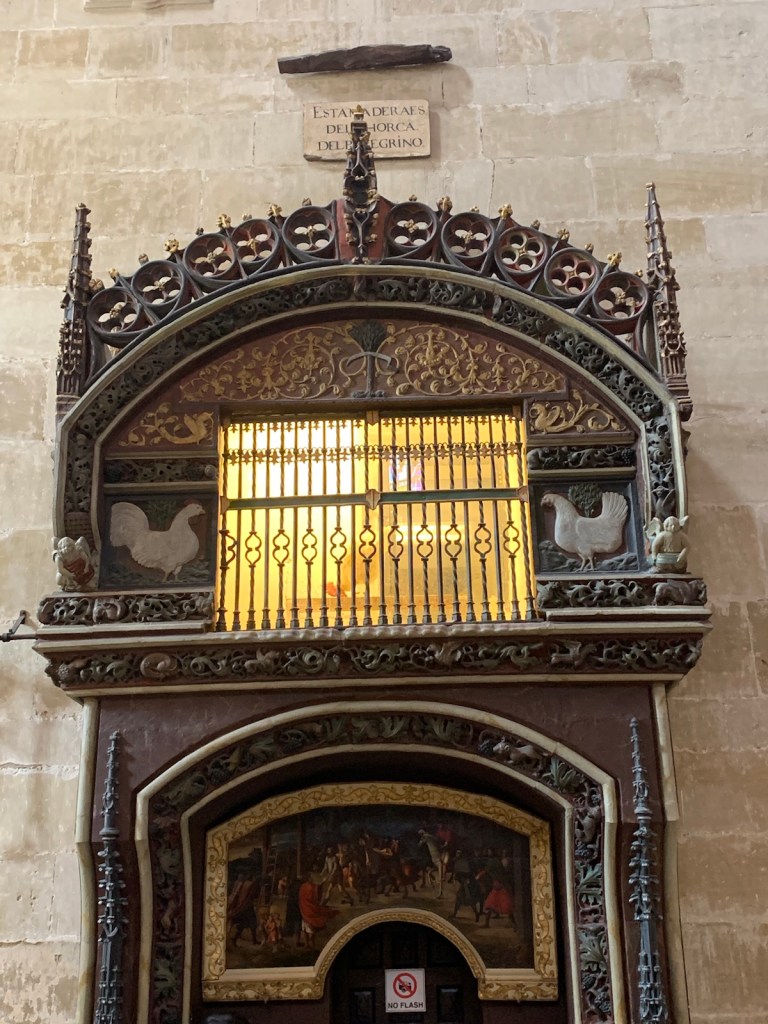
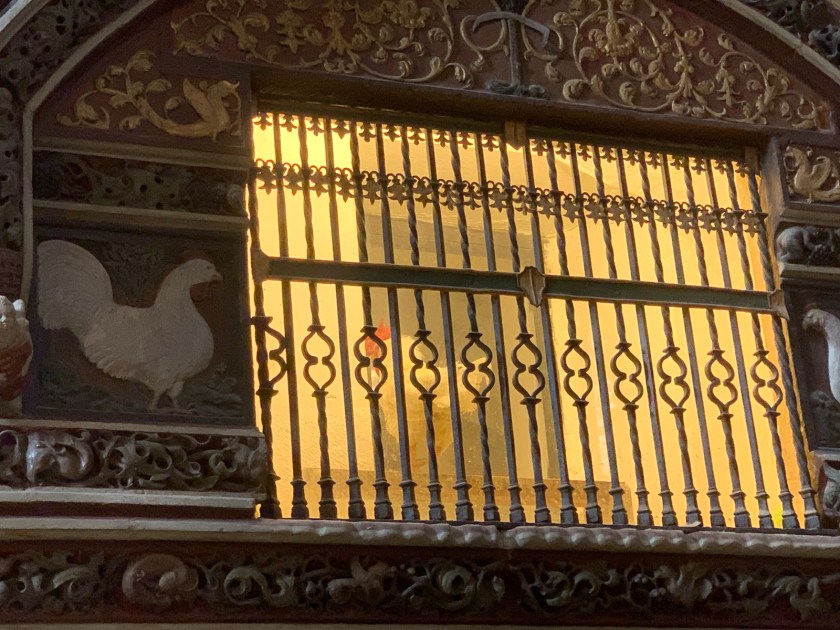
The cage housing the descendants of the “roasted chickens that crowed”.
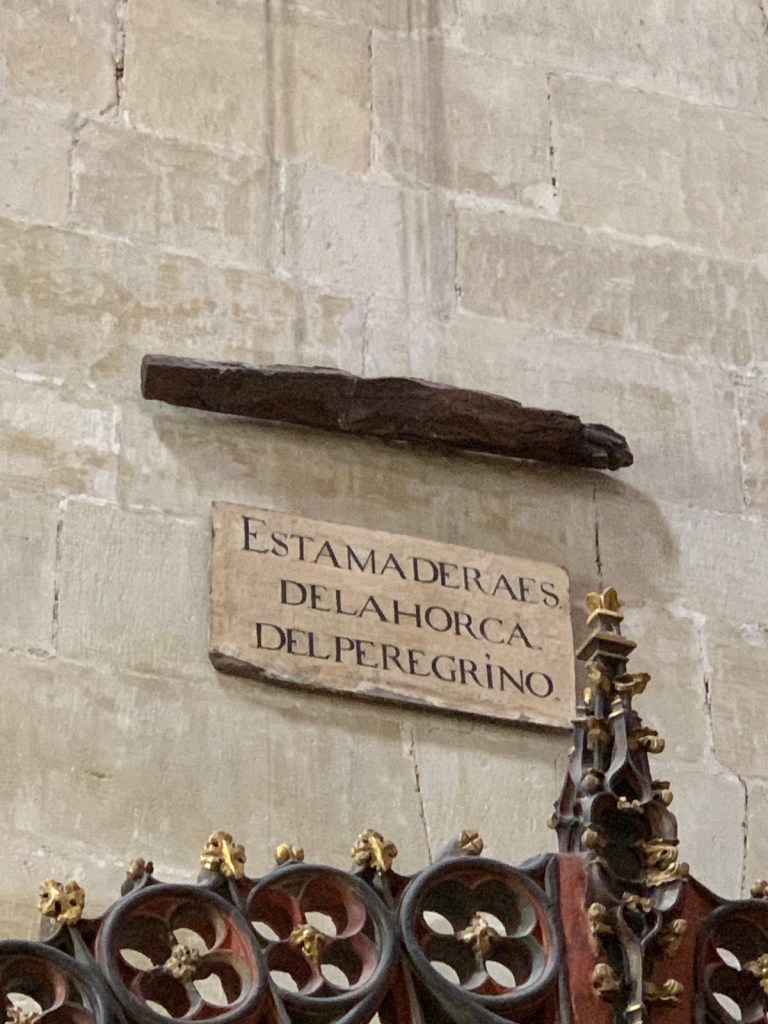
Relic of the gallows where Hugonell was hanged.
You can see the live rooster that actually crowed today, just as photo taken, hen not visible,

In remembrance of this story, live chickens are kept in the  Cathedral which are said to be the descendants of the resurrected fowl in the story. A piece of the gallows is displayed over the cage housing the chickens.

The Cathedral museum displayed numerous items related to Santo Domingo, including a number of beautiful 16th century paintings:

Miracle of saving of Hugonell from hanging
Miracle of the resurrected roasted chickens

Saint Domingo died in 1109 and was buried in the small church he built on the Camino, which grew into today’s Cathedral that houses his tomb.

Santo Domingo statue over his tomb
Cript for Santo Domingo’s remains

Tonight we had a tasty dinner in the hotel restaurant. Linda had chicken paella and very tender pork with rice pudding for dessert. Jim had lentil soup and beef stuffed relleños peppers and an ice cream tart. The wine was local and also quite nice.

Lobby and lounge of El Molino de Floren
El Molino de Floren restaurant

We retired to our room after finishing dinner at 8:30 and called it a day.

Day 17 – Nájera to Cirueña

Walked today: 9.9 miles

Walked Camino 2019: 120.7 miles

It was only 53F when we walked out of Nájera this morning at 7:15.

The mountain that forms the back wall of many of the buildings in the old town was our first obstacle of the morning.

Buildings backing up to cliffs of Alto Nájera
Following Camino markers out if town
End of the road ahead and rejoining Camino

The brick and stone streets ran out and gave way to a steep dirt path out of town and up to Alto Nájera.

As the case with many of these climbs, upon reaching the top, we’re rewarded with a view, either before us or behind.

working our way up Alto Nájera
near the pinnacle
heading down into the vineyards and grain fields
heading down into the rolling fields

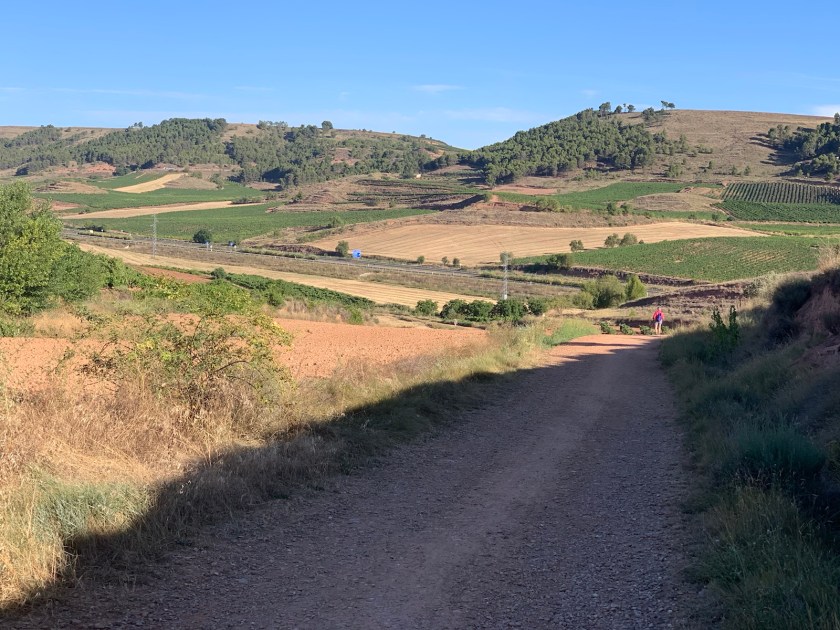
This morning the reward was a colorful landscape of rolling hills of green vineyards and harvested grain fields. They formed a quilt that kept us looking left and right not wanting to miss anything.

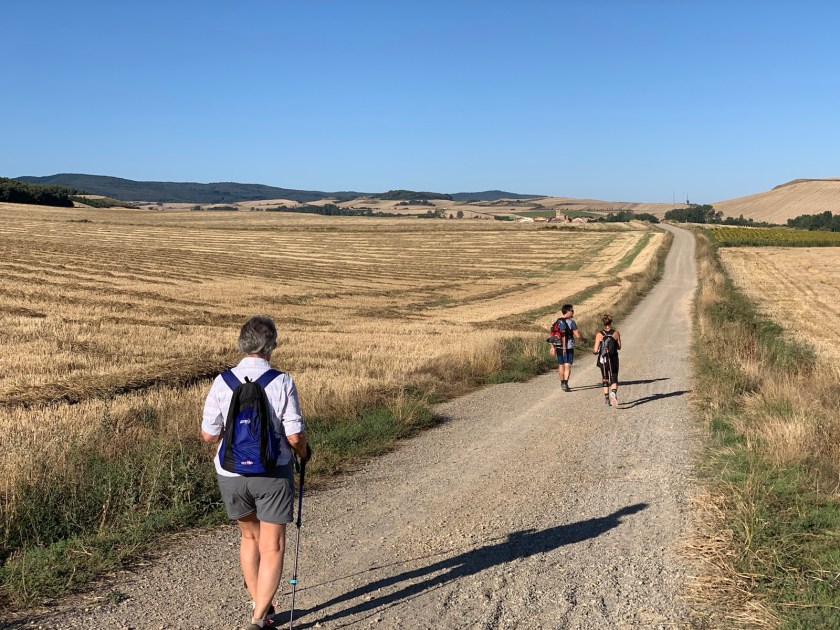
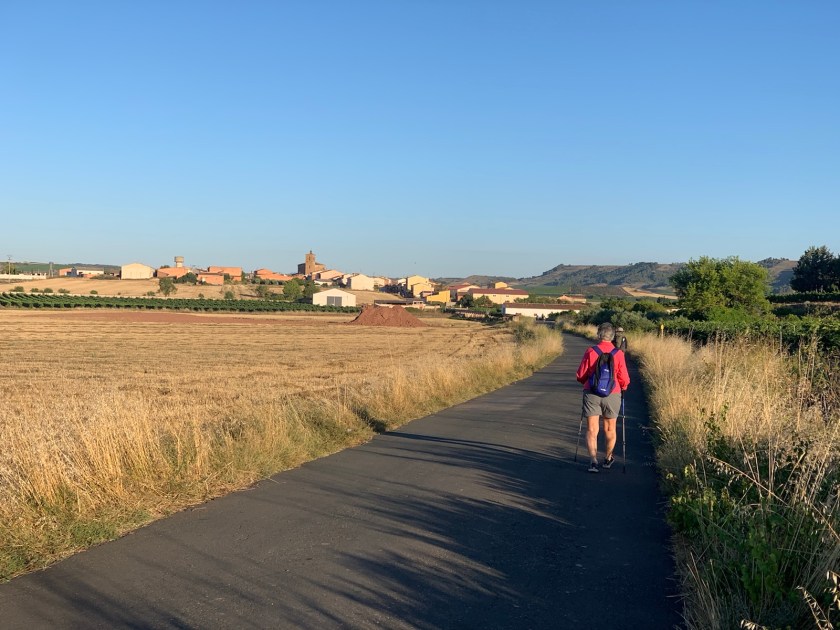
The smooth, unchallenging dirt walking surface and cool air and a slight refreshing breeze put all the focus on the colors and patterns around us.

Unusual pilgrim formation ahead … Straight line?!

approaching Asofra

After about 4 miles we stopped for breakfast in Asofra. We stayed here in 2014 in the unique albergue with all semi-private twin bed stalls with saloon like swinging doors at 7€/person. No bunk beds, no noisy sleep areas and an open shelf to put your stuff.

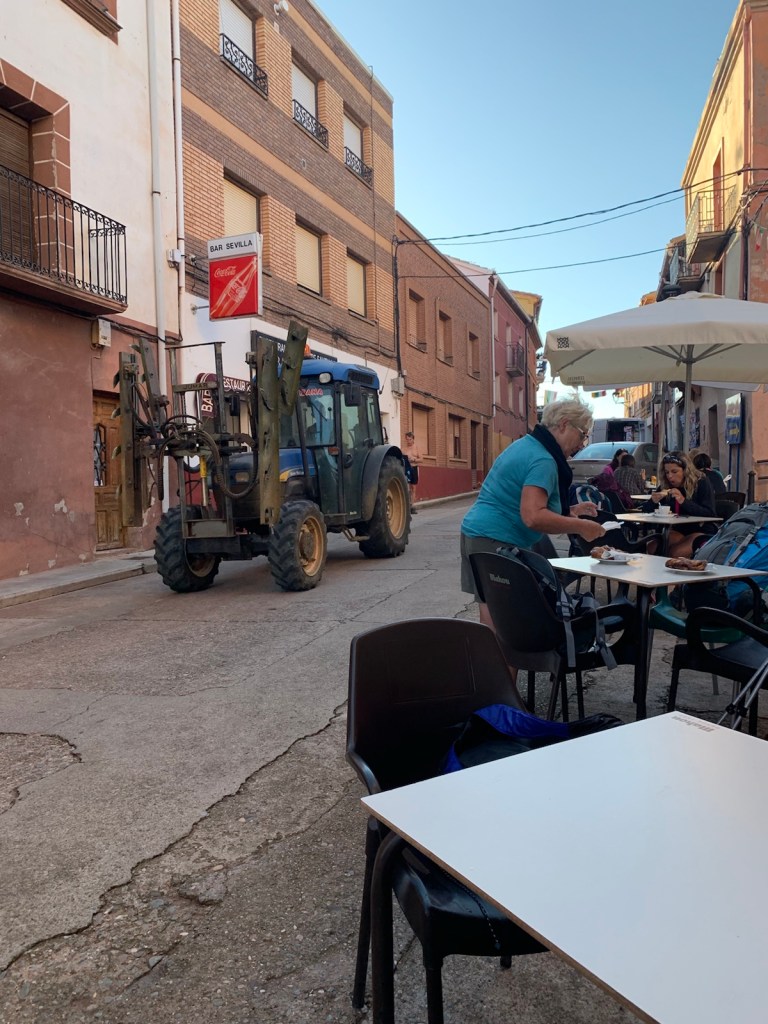
The other thing that made Asofra special was what we called the “tractor ambiance” at the Seville Bar. Outside seating is along Calle Mayor, the very narrow main street. During dinner we shared our seating area with passing tractors coming home from the vineyards.

Ah shucks, before we had our cafe con leche.

We had hoped that we’d have a “tractor” breakfast this morning, but our timing was off. One passed by before we got our order and all was quiet until just as we left, two tardy tractors ushered us out of town.

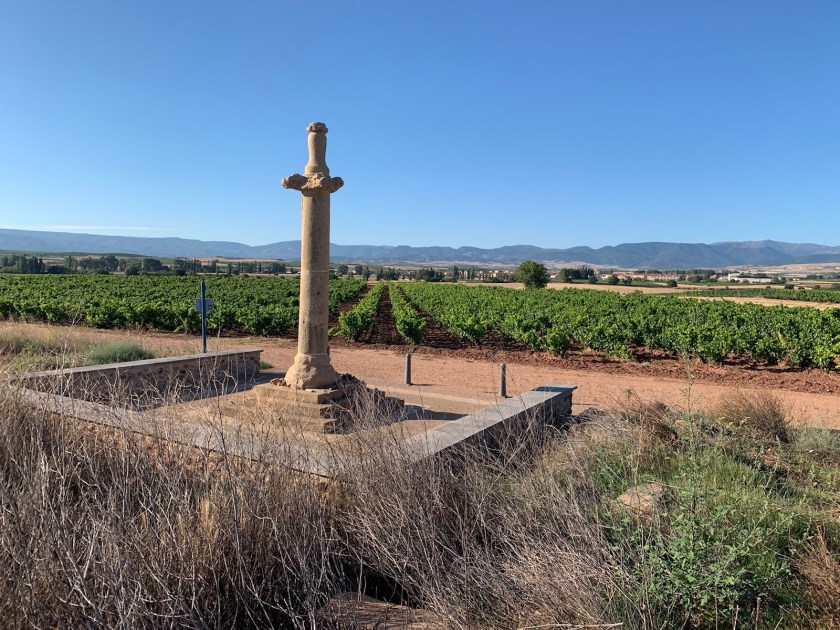
We walked past the Rollo of Azofra, which is a 16th century boundary marker.

Rollo of Asofra

Such markers originate from the Middle Ages, a period in which small villages were converted into important urban enclaves and consequently needed there own justice instruments. On this occasion, the stone marker is in the shape of a Rollo sword (an ancient symbol of justice) and was intended to deter potential offenders from committing a crime within the boundaries of the marker.

Midway we walked along an autovia, but with enough separation to minimize noise, etc.
A few miles later the path moved back into the fields with no end in site.
The “ too good to be true” walk, headed upward
…. and after almost two more miles we finally reached the top

and breathed a sigh of relief at the flat path ahead

We walked toward a modern development of sorts and to our left was a beautiful green 18 hole golf course, on the Camino!

It being a little after 11:00, we missed our tee time but stopped anyway at the 19th hole for a late morning snack and a much deserved rest.

We walked the final 3/4 mile to Casa Victoria (44€), a casa rural in Cirueña, and checked in at noon. Francisco remembered us from our two prior visits.

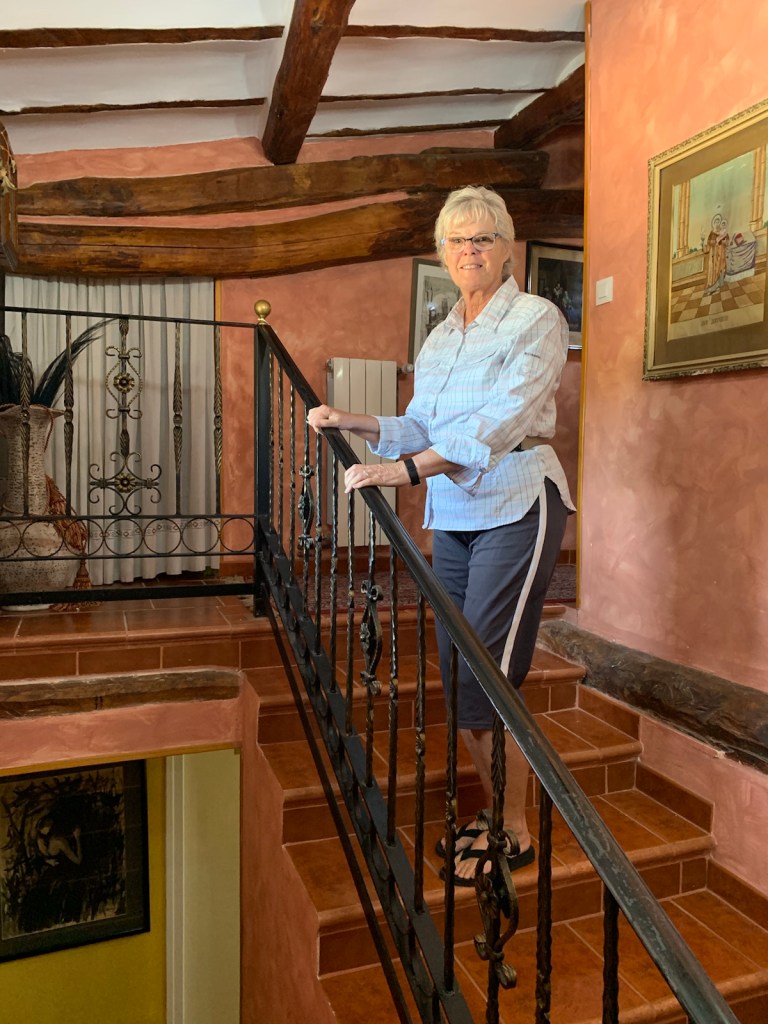
stairway to our room on third floor.
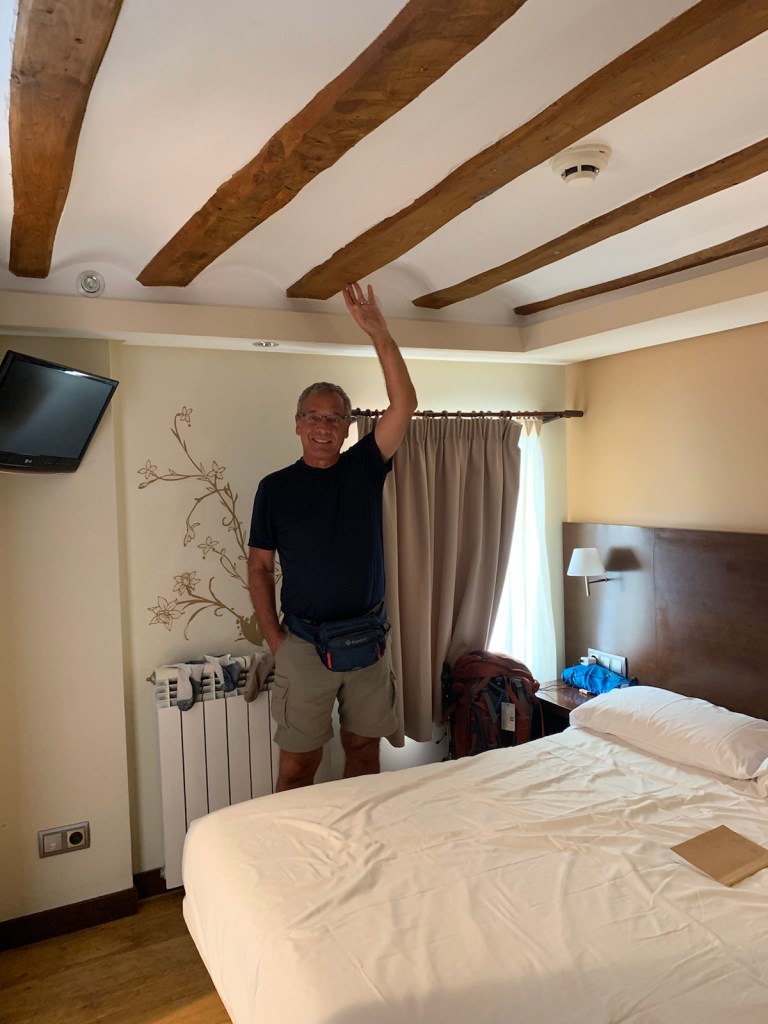
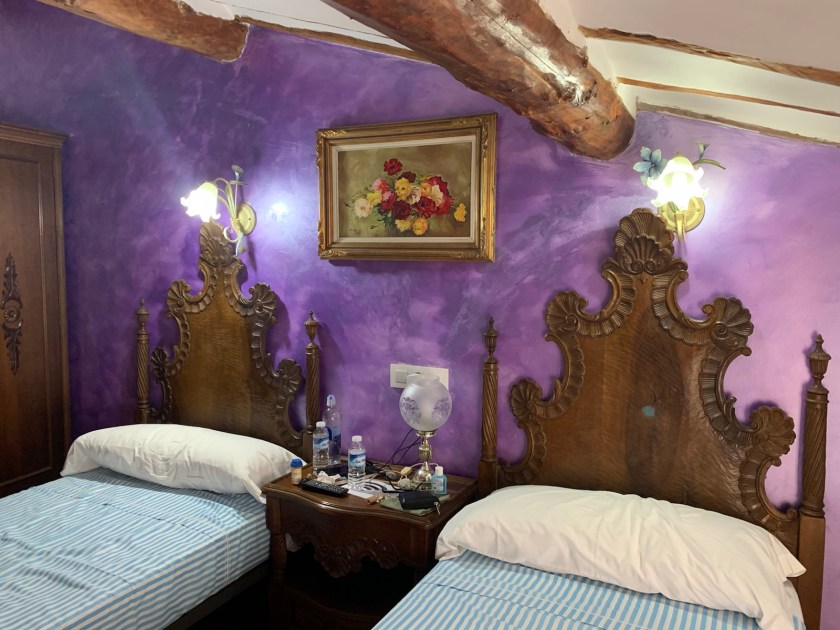
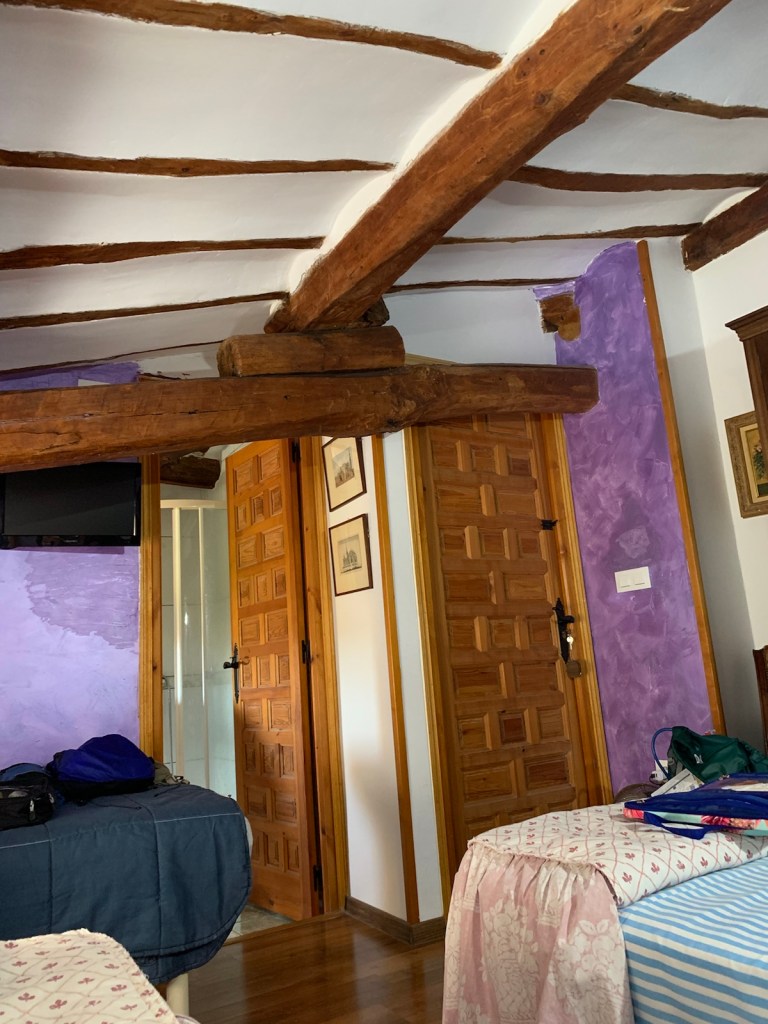
Beautiful antique furniture and real beams
Beautiful beams, but low, had to duck on way into ensuite bathroom

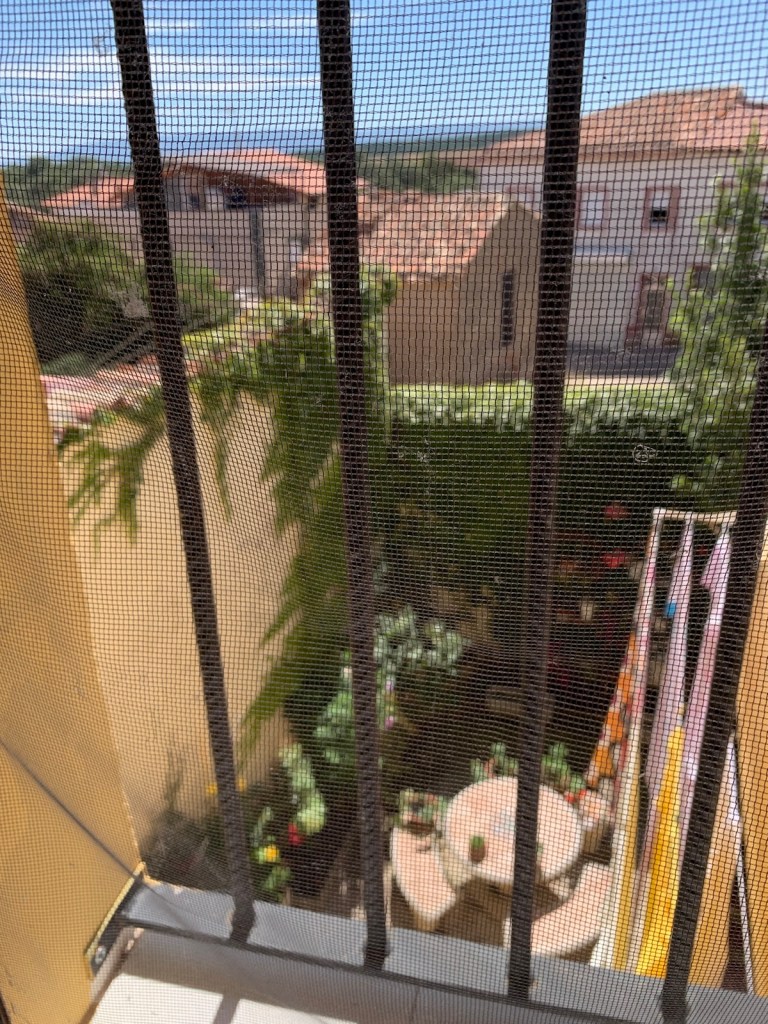
view outside our room window, patio, clothes lines, etc.

Cirueña (pop.131) is a favorite stopping spot for us, having stayed here in 2014, 2017 and now 2019. It is a home with 15 beds in 4 or 5 rooms, no bunk beds, all rooms beautifully decorated, w/shared or private bath.
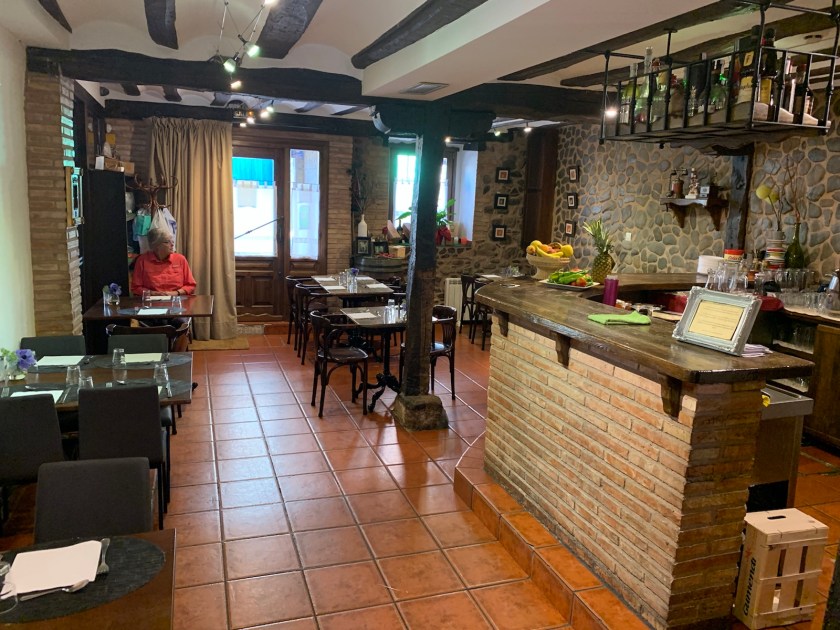
We think its a real bargain, upscale in all aspects and very comfortable.
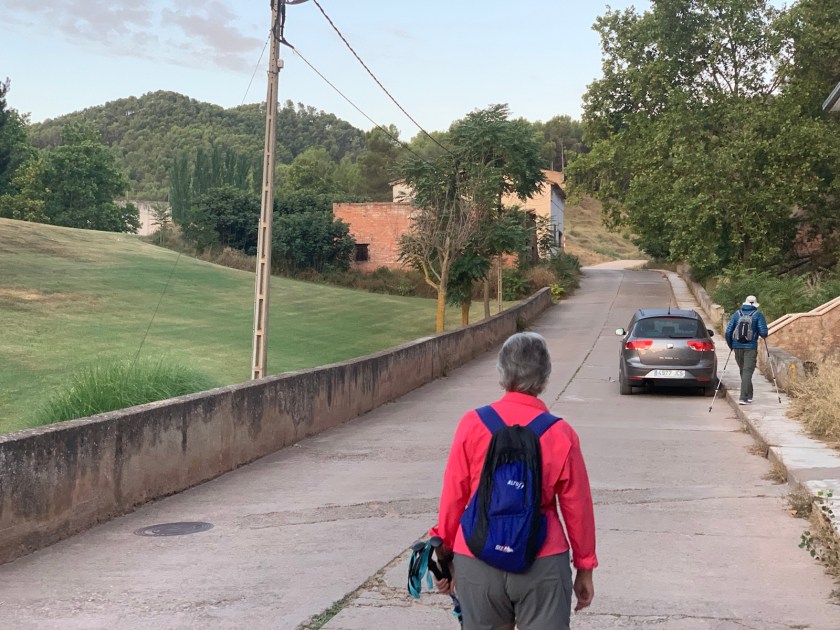
In addition to clothes washing and drying availability, it has a small kitchen for preparing a simple meal and a choice of drinks conveniently kept in a fridge for 1-5€.

A bar is across the small village square from the Casa and has food all day. A pilgrims dinner and breakfast is available a block walk away at the Casa Victoria albergue, which we understand is owned and operated by a relative.

We signed up for the 7:00 p.m. albergue pilgrim dinner (9€ each) when we checked in.

And if you bring your clubs, an 18 hole golf course is a 3/4 mile walk away with reasonable green fees and cart rental.

We walked down to the albergue to the pilgrim dinner at 6:45.

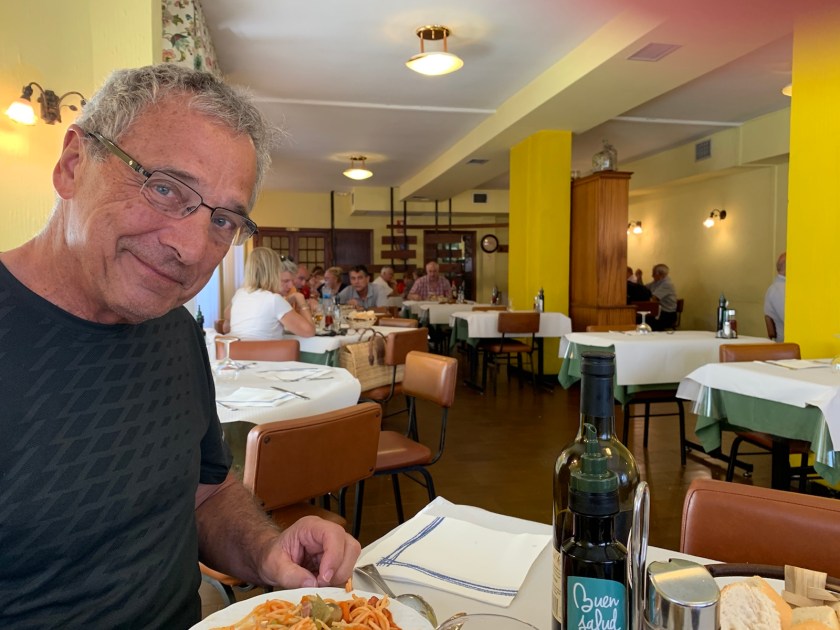
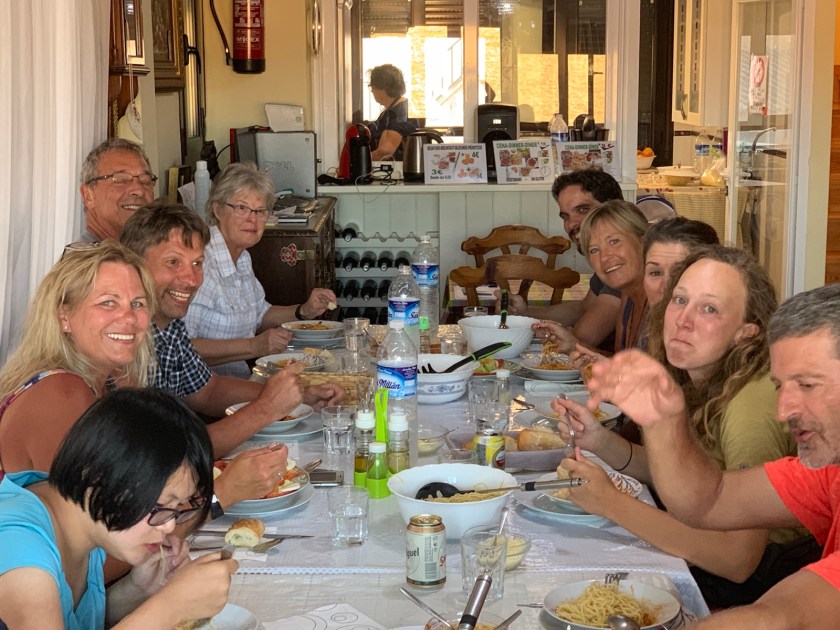
The pilgrim dinner was a nice experience. We shared a spaghetti/pork/chicken dinner with the 12 pilgrims staying at the albergue.

A photo of 10 of the 14 pilgrims at dinner tonight

And even with such a large group and a long table, we were able to have interesting chats with pilgrims from Brazil, Austria, New Zealand and Germany. We wish we’d had more time to get to know them better. Maybe we’ll see them again.

Another nice finish to a day on the Camino.