The walk to Carrión was very similar to yesterday’s.
We got to Carrion de los Condes at 8:30 and stopped for breakfast.
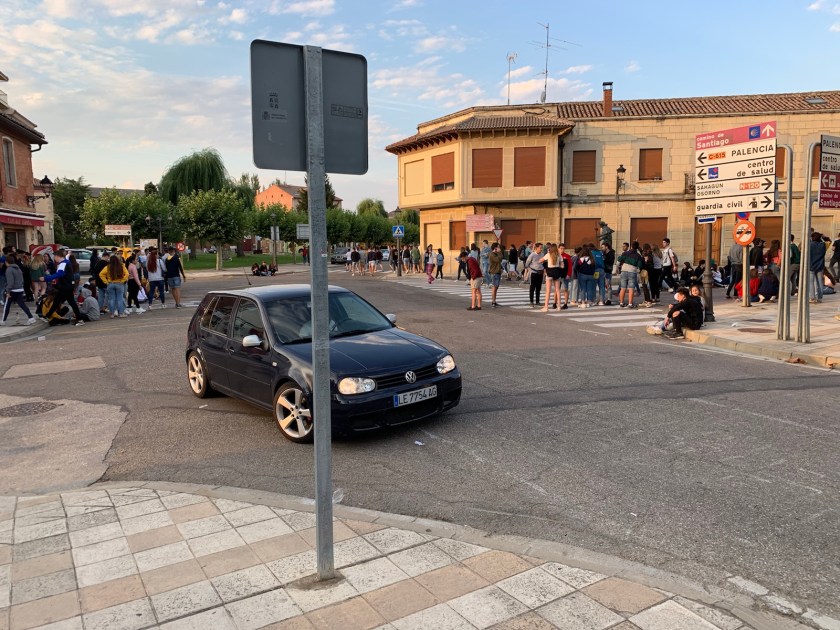
A festival was underway and the streets were full of revellers, mostly late teens and twenty somethings.
After breakfast, we caught a ride to the next village of Calzadilla de la Cueza. Between the two locations is a stretch of 11 miles of straight, path through grain fields with no place to eat, rest, or spend the night. We struggled along this section in 2014 and 2017 but decided to skip it today.
Our second starting point for the day at Calzadilla
Our driver dropped us off at a few minutes after nine
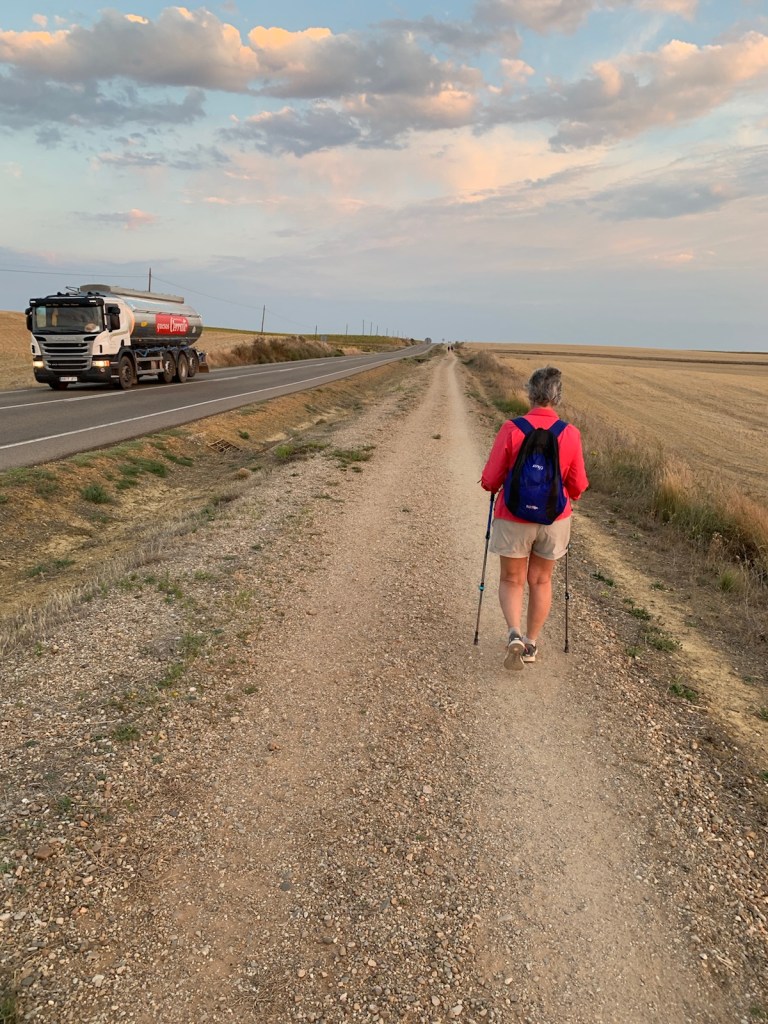
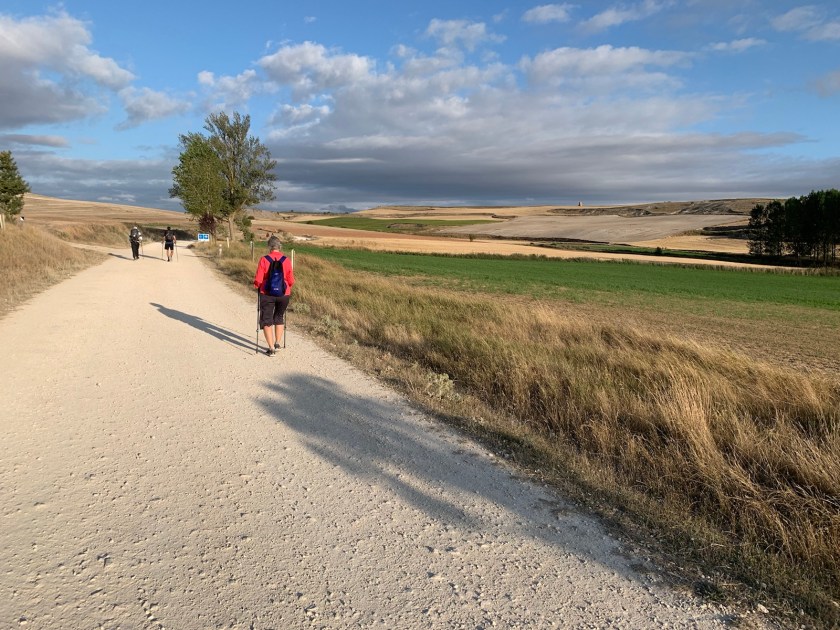
This was what our walk looked like after skipping one of our least favorite sections of the Camino
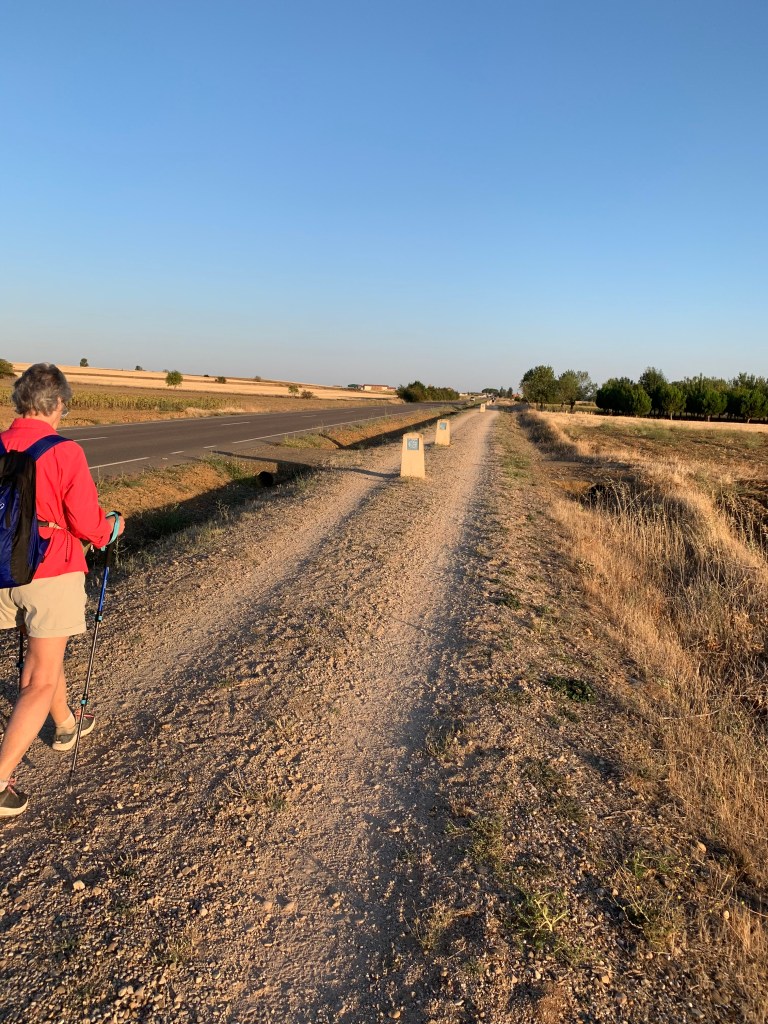
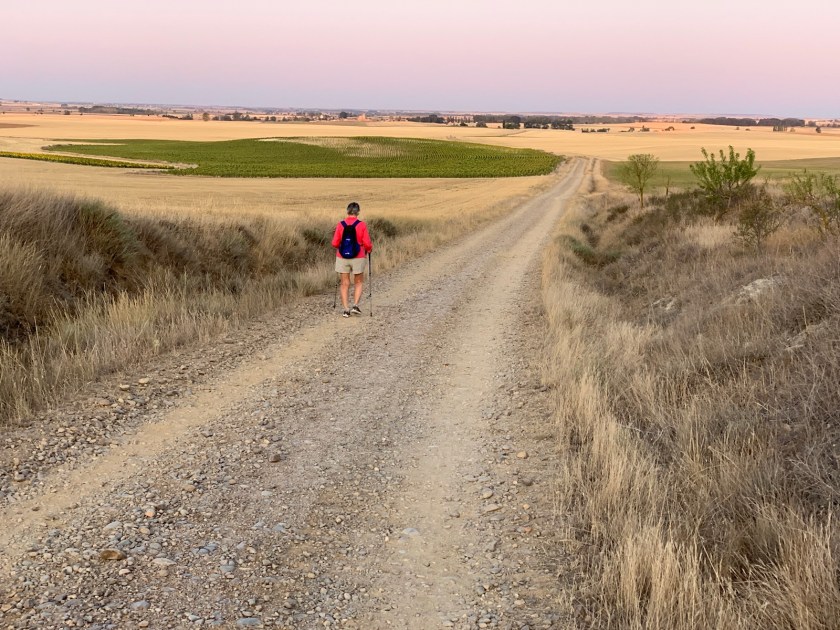
and we continued on the path that mostly paralleled a two lane road for some three miles to Ledigos (pop. 74), where we stopped for a brief break
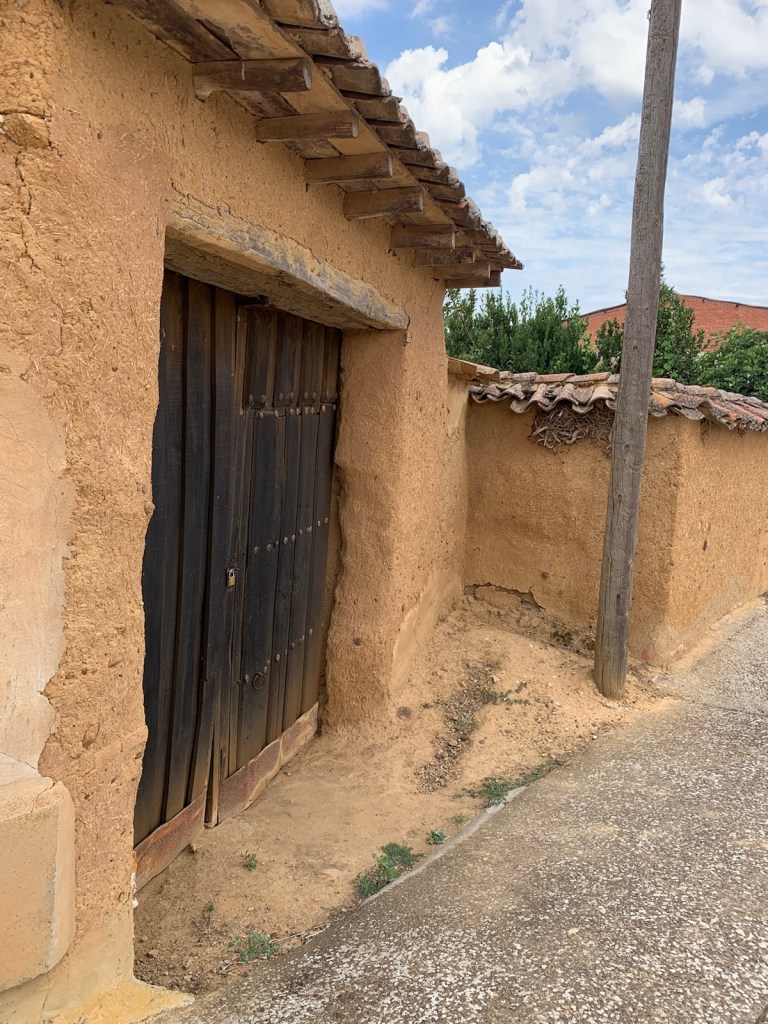
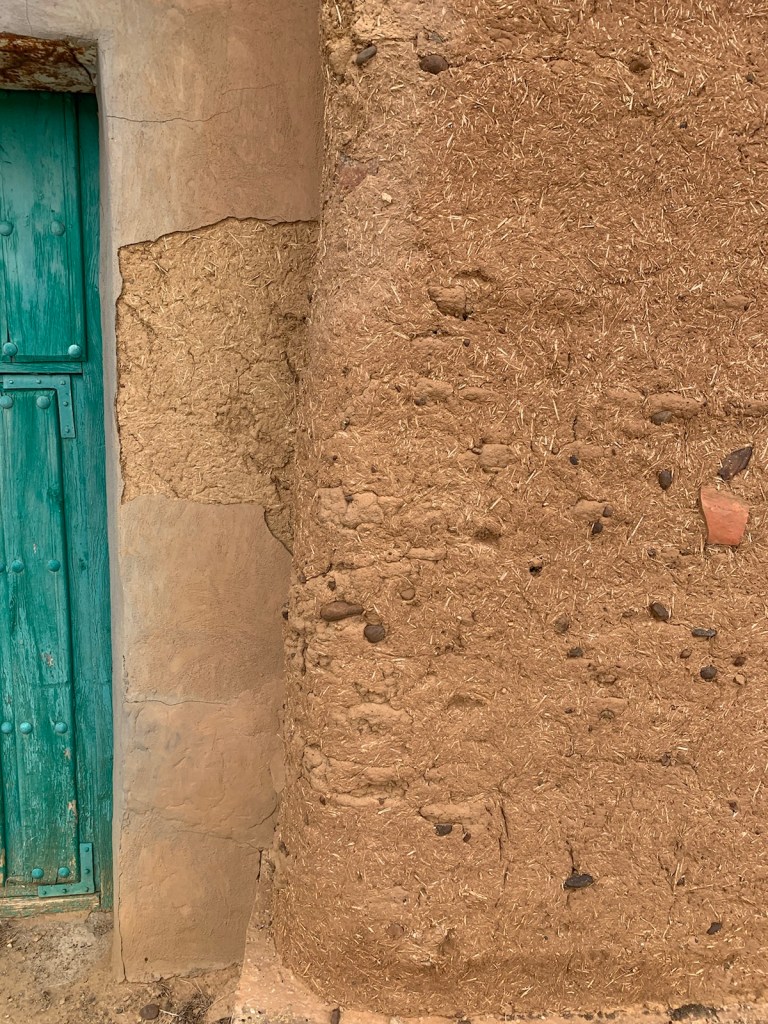
Many of the buildings in Ledigos were made of stucco from local materialsUp close you can see the straw mixed with local clay to form the stucco
and continued on to Terradillos de los Templarios, our destination for the day.
Approaching our albergue in Terradillos de los Templarios
Terradillos de los Templarios was once home to a 13th-century church belonging to the Knights Templar, but is one of the few pilgrimage towns that never had a pilgrim refuge until modern times.  Iglesia de San Pedro contains a Gothic crucifix but is rarely open. The church is built of brick rather than stone, as this area has very little local stone. Set aside from the N-120 highway, Terradillos has a peaceful sleepy town feel.
The Knights Templar were a medieval military order responsible for protecting pilgrims. While the order was popular and successful for almost 200 years, grand master Jacques de Molay was arrested in 1307 (on Friday the 13th, possibly the origin of this superstitious date) and burned at the stake for heresy and a variety of trumped-up charges. The order was disbanded in disgrace, though many think the charges had more to do with politics than any actual wrongdoing.
We checked in to Albergue los Templarios as soon as we arrived and arranged for machine washing our clothing, then spent the rest of the afternoon, Linda reading and Jim chatting with two bike riding peregrinos from Belgium, Chris and Fred. By dinner time they had learned a lot about the different cultures of their respective countries and become new friends. Jim also chatted a while with a French couple who arrived at the albergue the same time as we.
We stayed at this albergue in 2017 and consider it one of our favorites. The owners opened up a new albergue in late 2017 several days down the path, so we made a reservation today to stay there too on the 27th.
We had a tasty lunch and dinner at the albergue today and retired for the day around 9 p.m.
Our view as we walked this morning was pretty much the same:
Just as we left Población Jim began walking with a guy from Germany who had left his job and was using the Camino as a way to decide the direction for his life forward. He and Jim walked a little faster than Linda, who gradually drifted behind.
But another peregrina, a young lady originally from South Korea and currently working as a tour guide in Madrid, joined Linda as their paces pretty much matched.
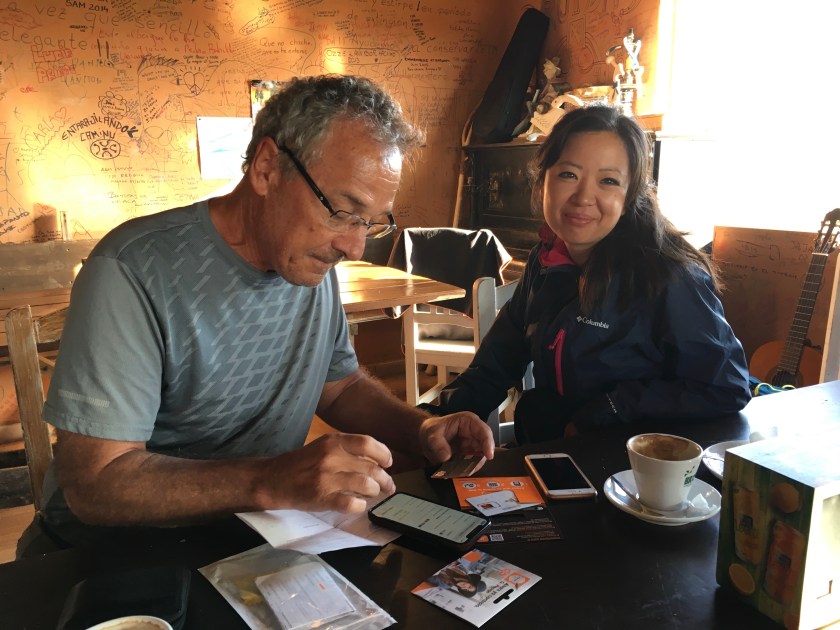
Eunji, spoke very good English and after a while, the subject of our Orange sim card problem came up. (If you remember, Linda and I talked about trying to find someone in Carrión tomorrow that spoke enough English and Spanish to understand our problem and possibly help us with a solution.)
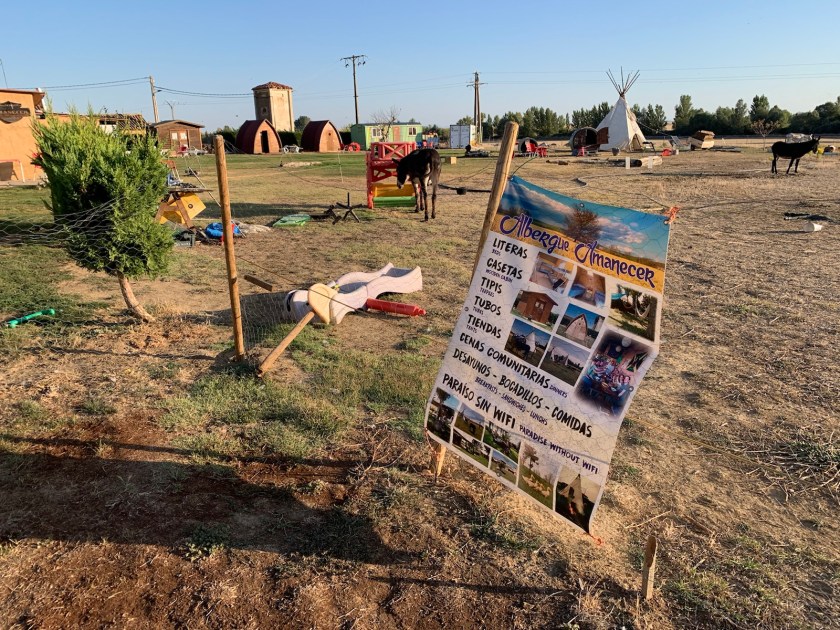
At the next village we stopped at an unusual albergue that offered accommodations ranging from bunk beds to teepees! Also, huge ducks, chickens (one looking at itself in a mirror in the bar), donkeys, llamas, sheep, goats and countless other fauna unseen.
During breakfast, Eunji offered to help us and 20 minutes later, we had renewed our sim cards and recharged them for another 30 days! Problem solved!
our savior and new friend, Eunji from Madrid/Korea
Eunji had used her Orange account to access our phones and pay the renewal fee for both our phones with her credit card. When we gave her a 50€ bill to cover the 40.20€ charges she initially refused, but we insisted and suggested she enjoy her dinner tonight on us with our thanks for her timely and “priceless” assistance.
It’s really amazing, this place, the Camino provides!
We walked on separately and eventually approached our destination for today:
The round-about to Villalcazar (pop.174)
As usual, we were too early to checkin, so we found the nearest bar and had mid-morning chocolate cake and CCL while we waited.
Eunji spotted us from a nearly table for another photo op, before parting again as we wished each other a ” buen Camino “.
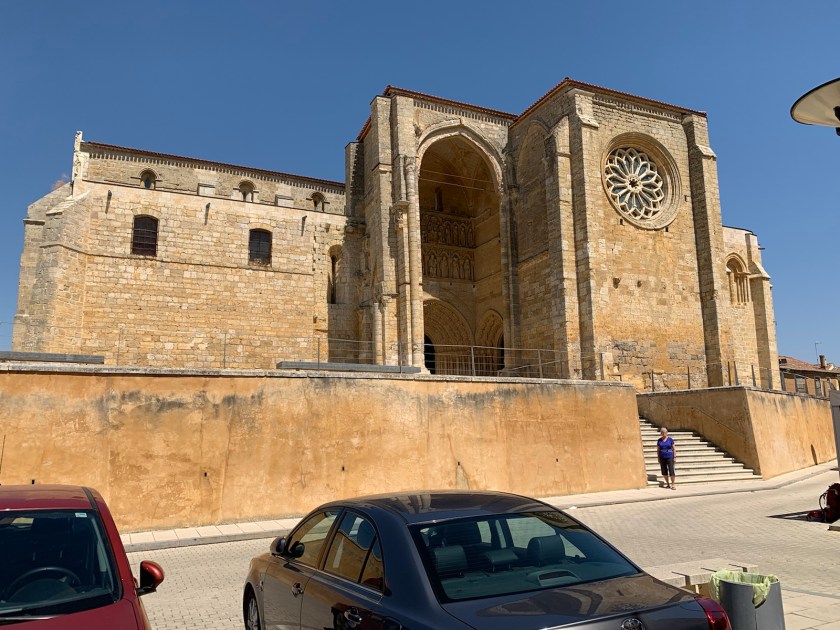
It was still early for checking in, so we noticed someone unlocking the door to the 13th century Iglesia de Santa María la Blanca.
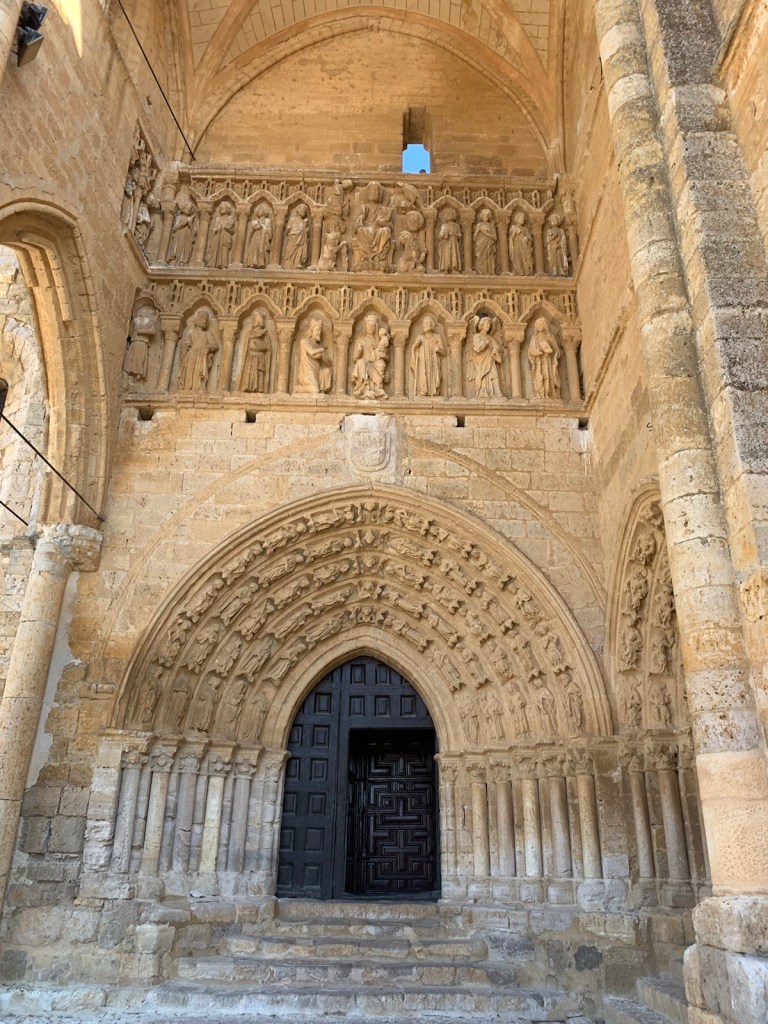
Linda was dwarfed by the immense size of this Templar “ fortress “Entrance of Santa María la BlancaSanta María la BlancaSantiago surrounded by images of his life
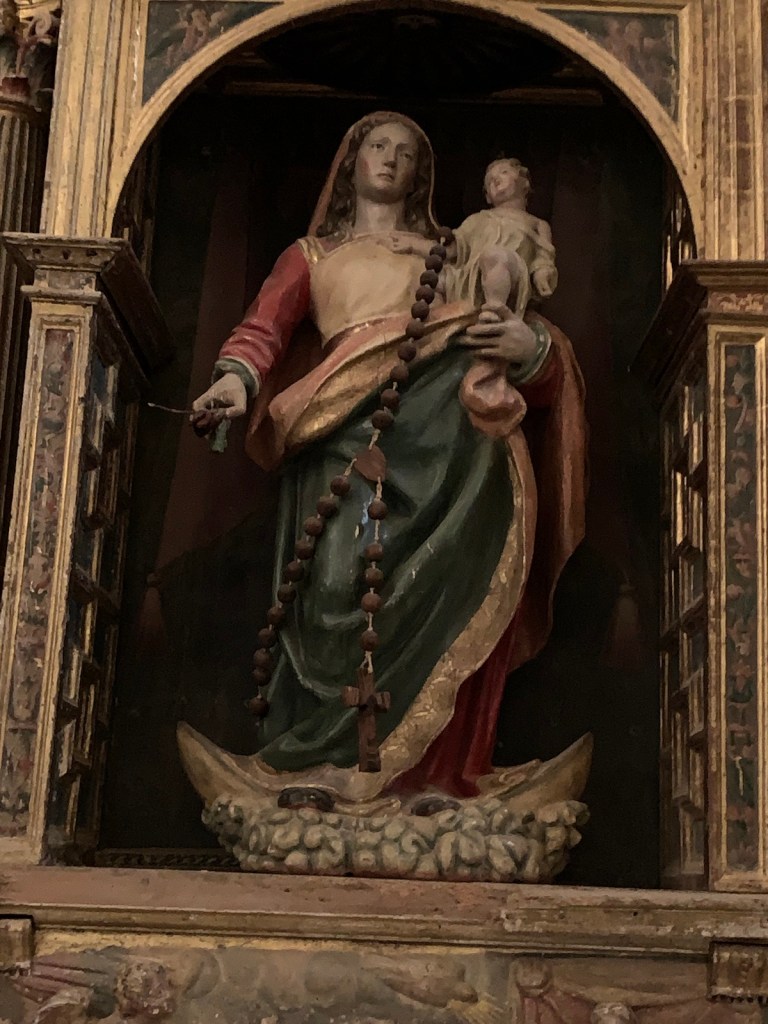
According to tradition, Villalcázar was under the protection of the Knights Templar. The Camino did not originally pass through this town, but later detoured when the fame of the Virgen Blanca (” white virgin”) and her many miracles spread.
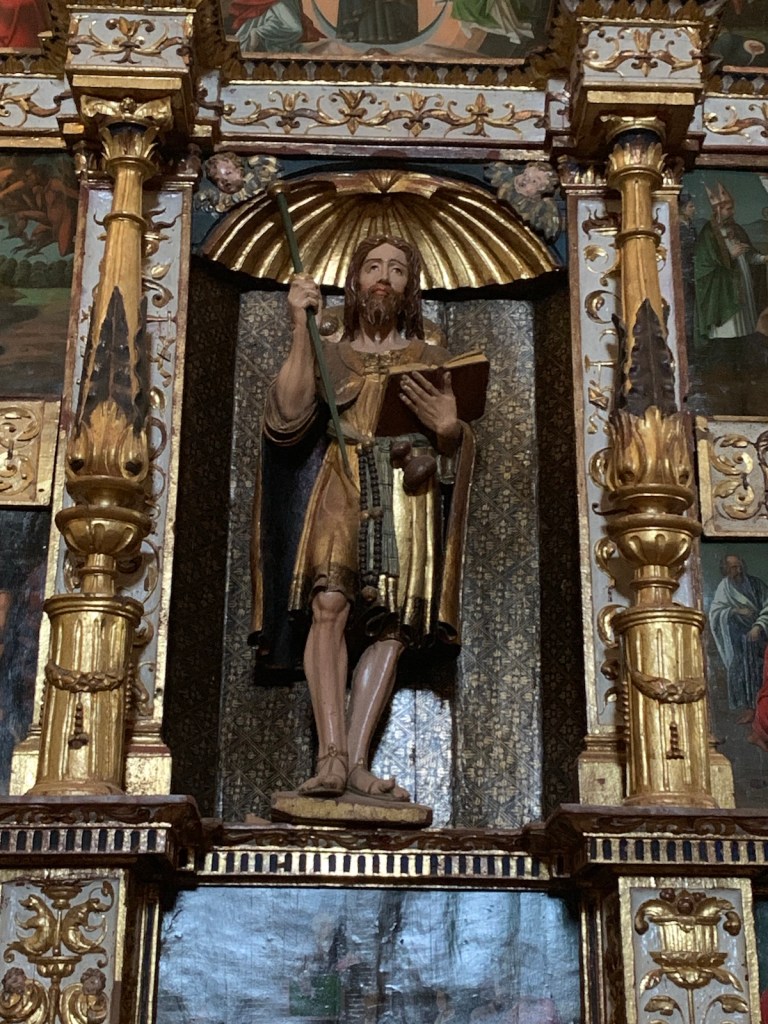
The church’s 1530 retablo has scenes from the life of Saint James, including his legendary run-in with the magician Hermogenes, who later converted to Christianity and burned his magic books.
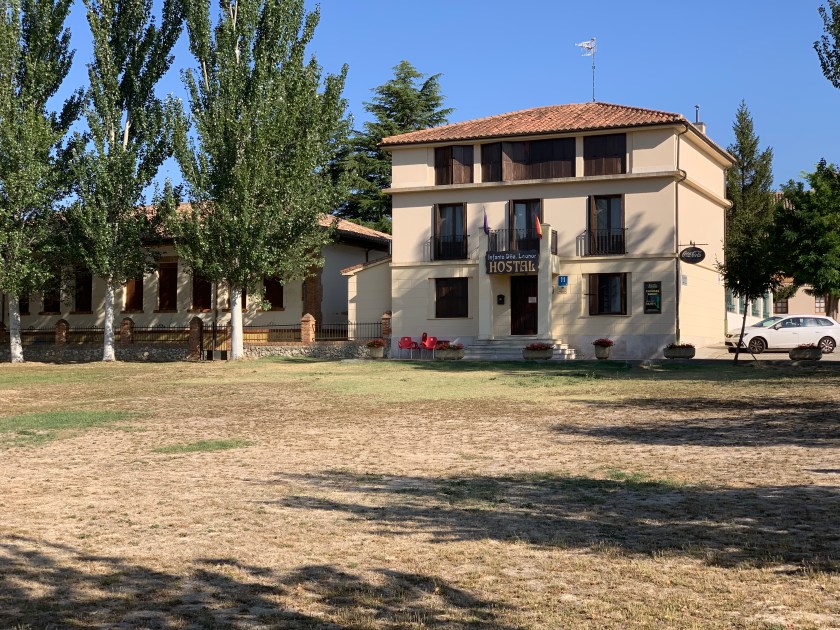
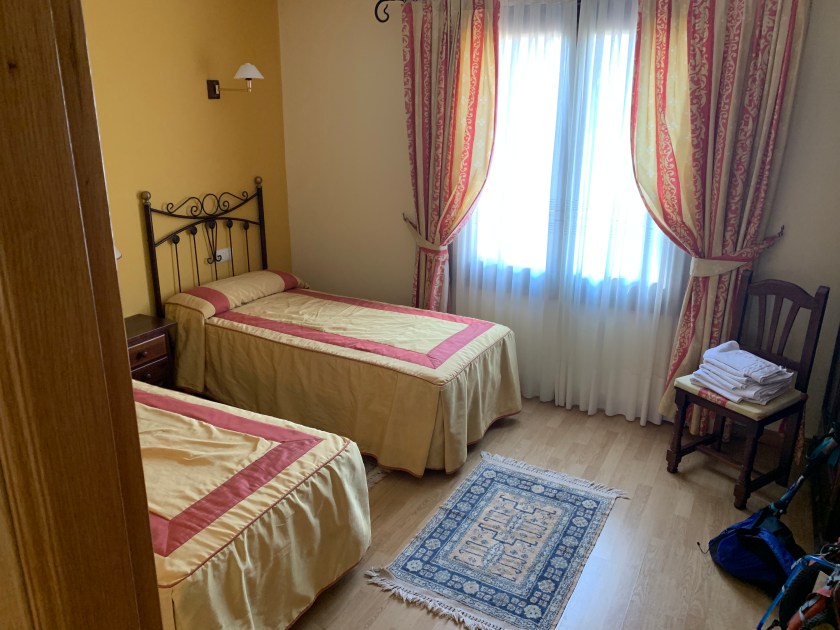
Hostal Infanta Doño Leonor (40€)our habitacion doble con baño
At about 11:30 we gained access to our room, which is roomy and comfortable with extra seating in a nice, cool (even in the 95F afternoon, w/o AC) common area.
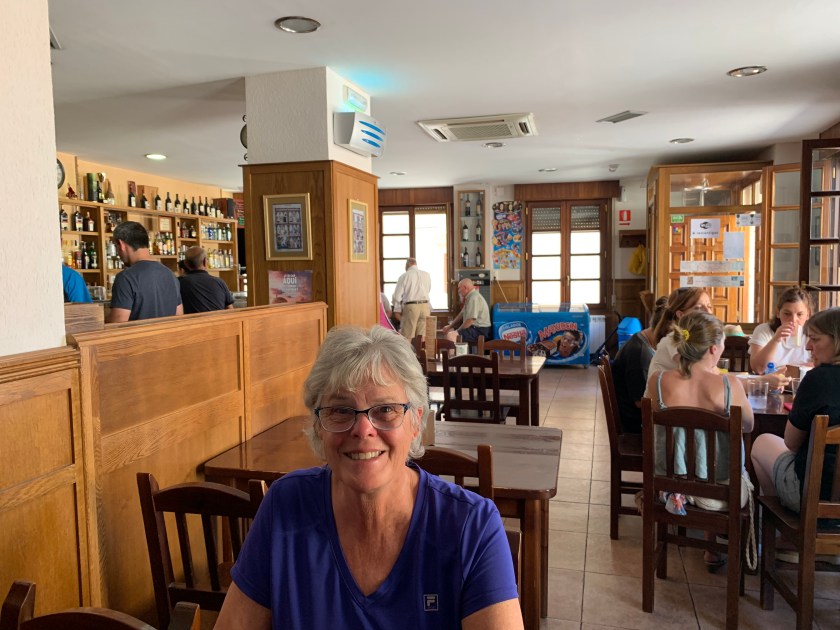
We relaxed until around 2:00, then returned to our mid morning snack place to have a nice lunch/dinner.
Bar Las CantigasDelicious Spanish cuisine
Jim finished this nice red wine (4.50€) from La Mancha while blogging
We returned to the neighborhood bar around 5:30, still pretty full from our earlier meal, needing to put an appropriate end to our day’s culinary experience, and ordered Postres (dessert), in this case, apple tarts then returned to our room to end another day on the Camino Frances.
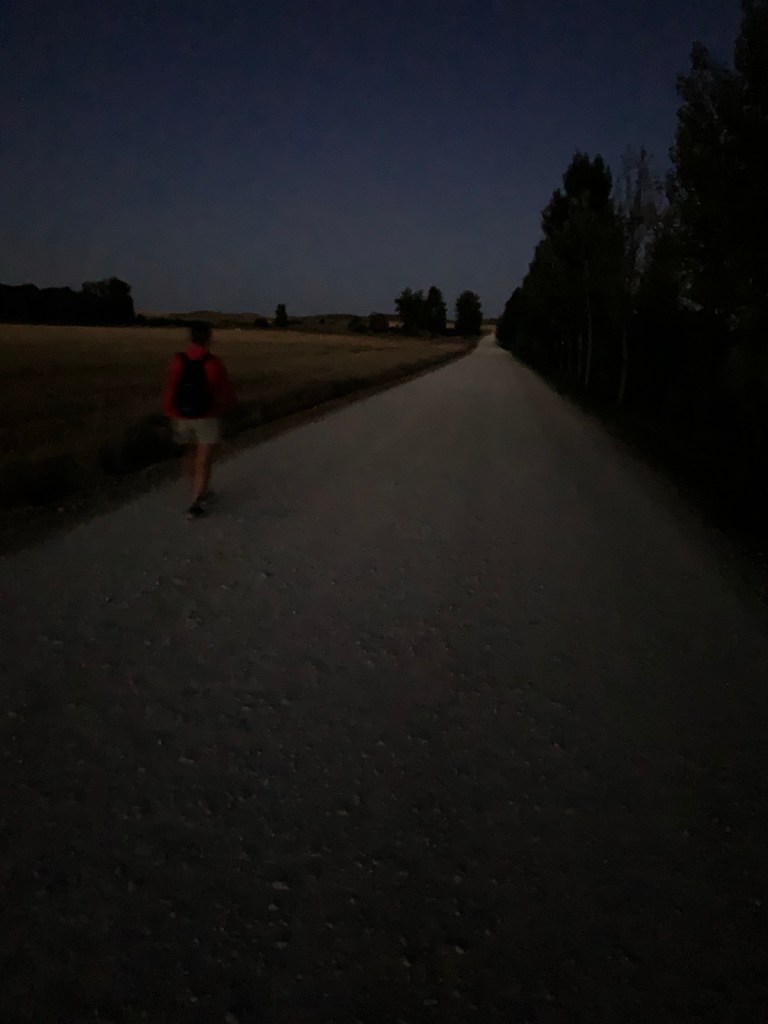
An early start had us in the dark for the first few minutes.
Linda walking just before first light
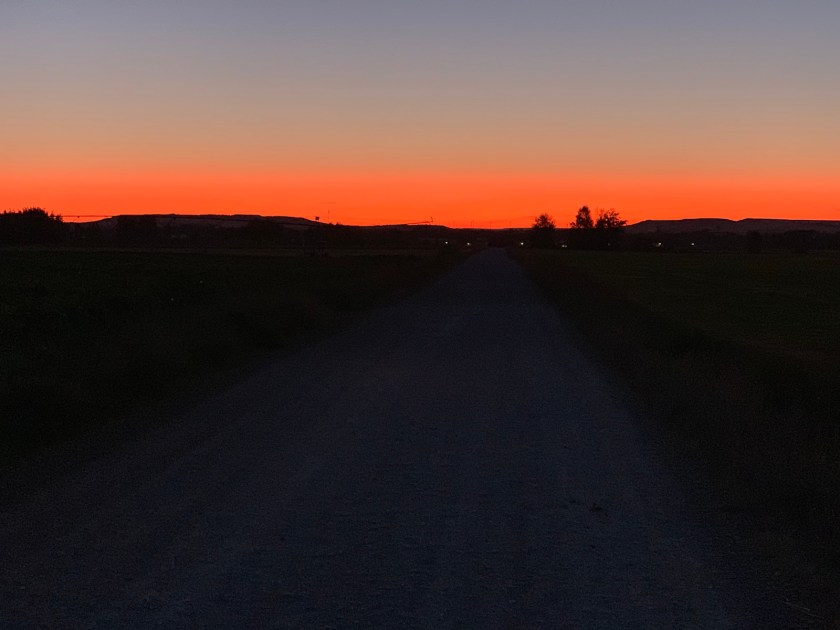
Our hands were actually cold in the 55F morning air. An advantage of starting this early, other than beating the later heat of the August sun is this…
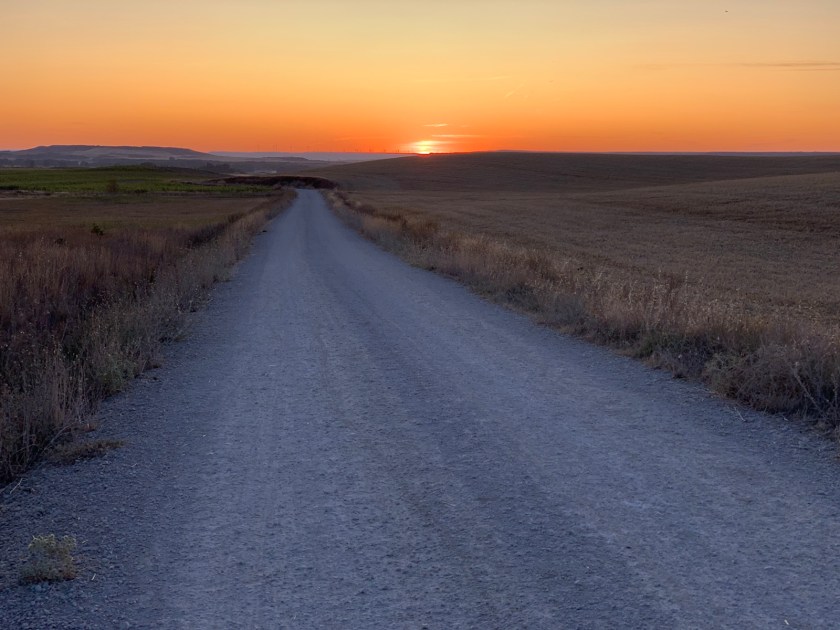
The pre- sunrise sky was in fire
The brilliant sky behind us soon opened our view for the way ahead.
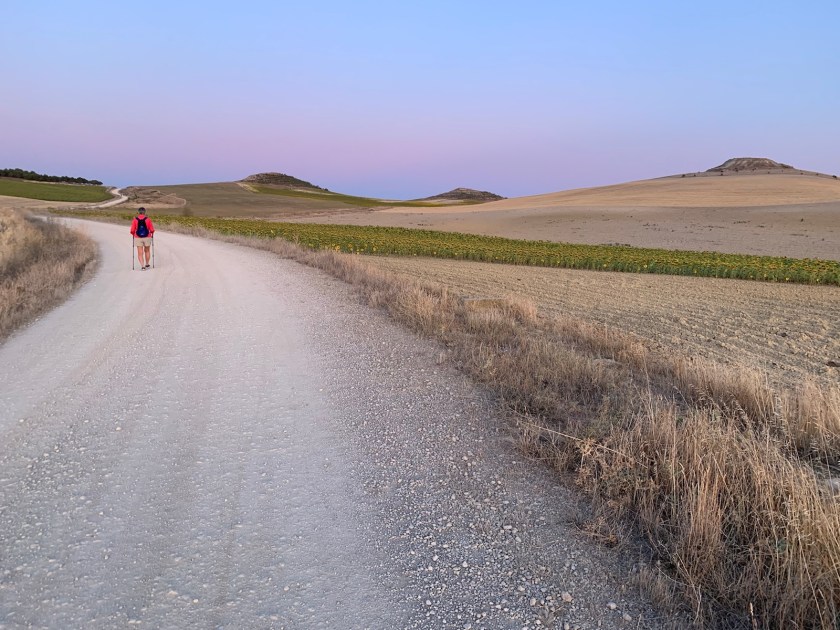
We walked through the fields of freshly cut hay and sunflowers..
… then turned around to this…
The sunrises on the Meseta are incredible and well worth a few minutes sleep loss for early risers.
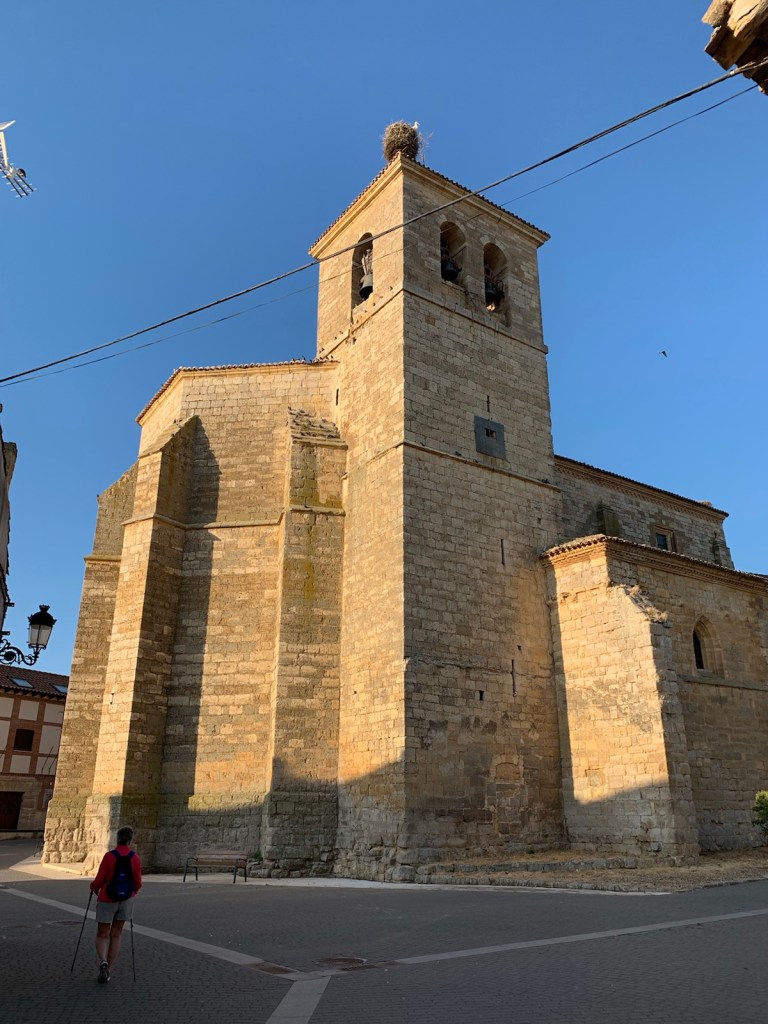
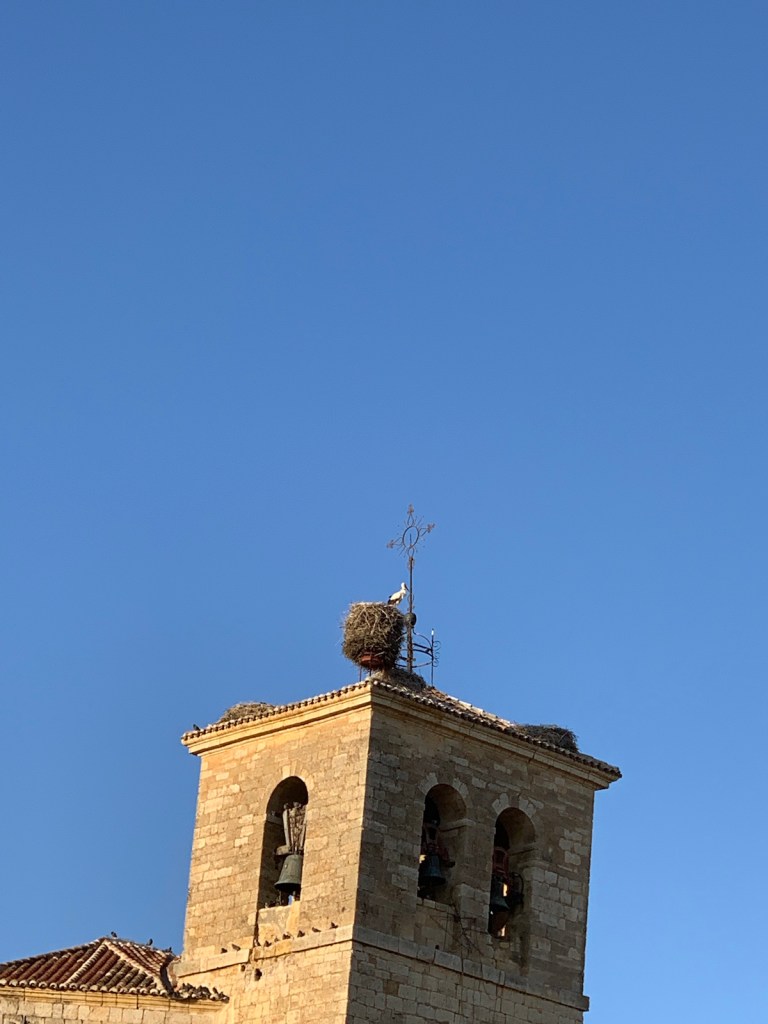
Our morning walk continued for nearly 5 miles before reaching the first village, Boadilla del Camino (pop. 124), where we observed another church, a stork’s nest and a resident stork.
Iglesia de Santa María de la Asuncíonview of stork in nest
We stopped at an open albergue for cafe con leche (but no tostadas) and moved on.
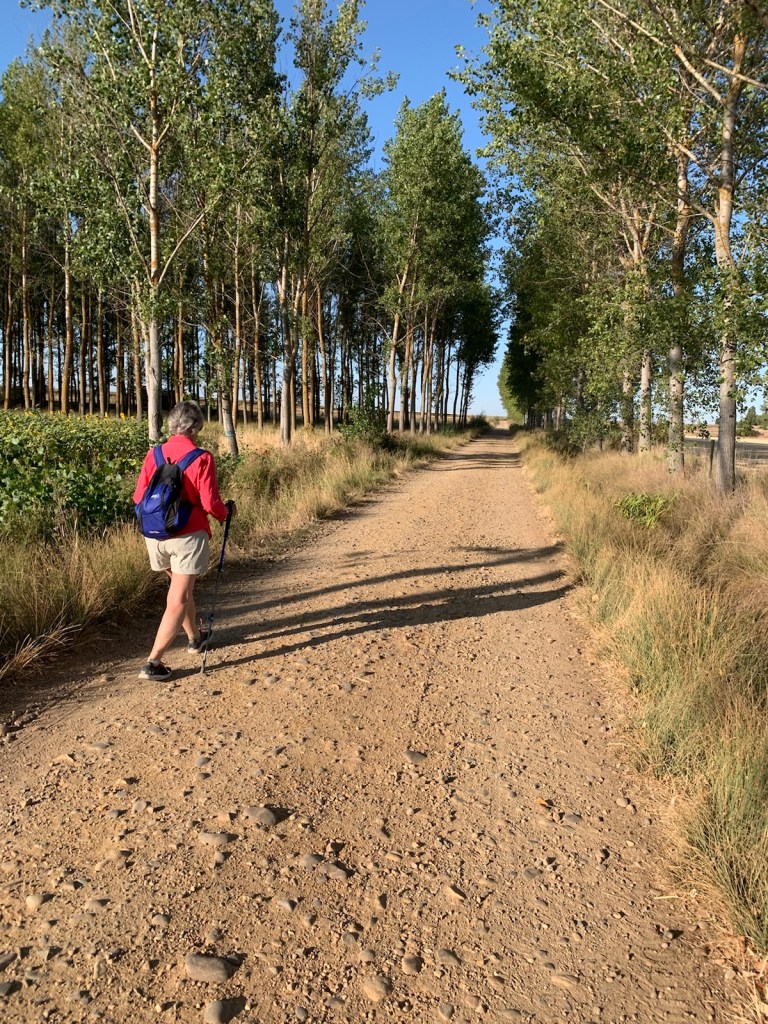
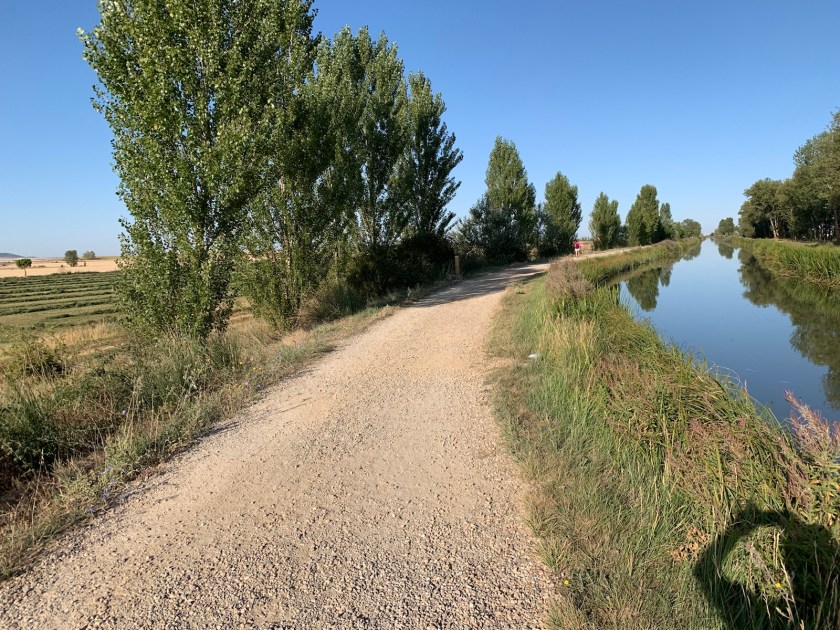
Shortly after leaving the village, we walked on a tree lined path which led back into the fields but without warning, began paralleling a canal.
The trees provided a nice break from the morning sun.The Canal Castile
Canal de Castilla was built from 1753-1859, covering 207km. The canal was used for ships that were pulled by mules on tow paths. Today the canals are used to irrigate agricultural fields.
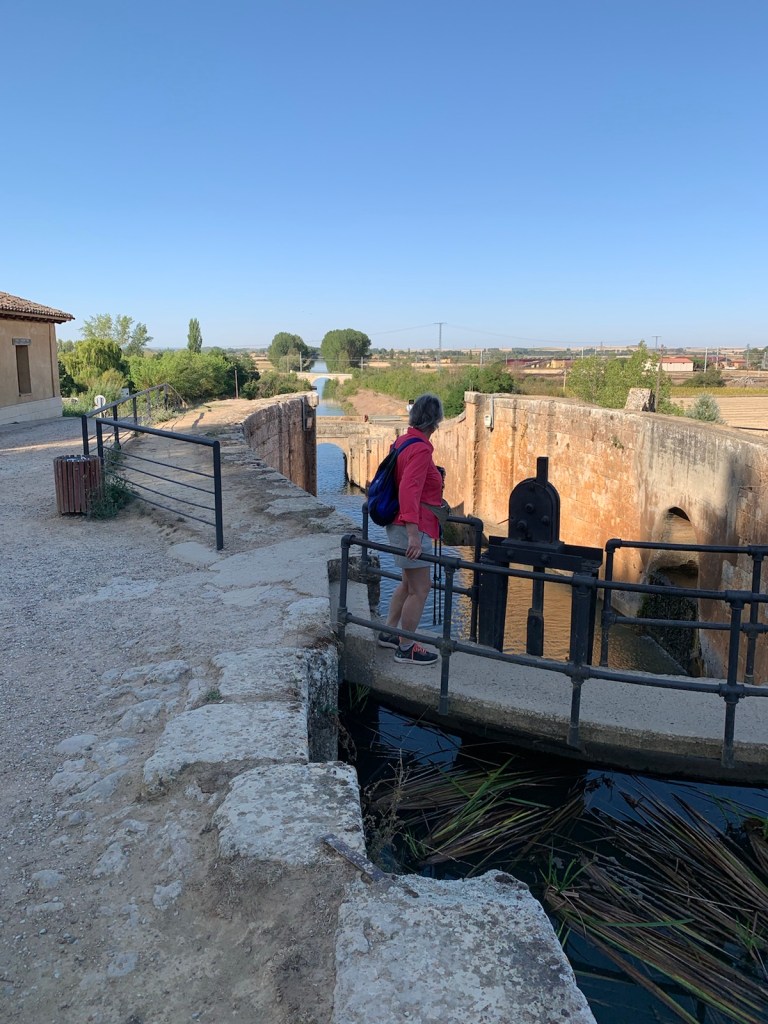
We walked along the canal for 2 miles until just outside Formista ( pop. 846) we carefully crossed the inactive canal locks and then walked into the town.
Linda crossing the old locks of Canal CastileLooking downstream
Frómista has been a breadbasket farming area since Celtic times until being destroyed by the Moors and later rebuilt in the 12th century. When the Jews of Castilla y León were systematically attacked in 1391, Frómista absorbed some of the Jewish refugees, though the Jewish population was exiled in 1492. In spite of being a successful market town in the 15th century, the town declined until a revival in 1773 when the canal brought water and enabled agriculture to again thrive.
We walked into Formista with a mission to renew our Orange sim cards which run out today. This has provided us with phone service and cellular internet service since we purchased them in Madrid in late July. It’s a much cheaper option than using the international cell service offered by Verizon.
After a few stops we concluded that our mission was not going to be completed in Formista. We had already walked 9 miles today and considered a taxi or bus to take us the final 2 miles to our destination for the day. The tourist info office, which was our source for bus/ taxi availability and timing, was closed at 10:30 Friday a.m. when we arrived with a ” be back in 20 minutes” sign on the door, and which remained for the entire hour we waited and probably much longer. A bit frustrated, we put our packs back on and walked the final 2 miles.
The Spanish sim card is a new luxury we added this Camino, just to see how it works. In the past, we have used the reception at wherever we’re staying to make calls for us for future reservations, arranging for pack (mochila) transport, etc. Wifi has been and still is our main method of communication, so doing without the simi card and cellular service us not a big deal. But we’ll try again in Carrión tomorrow and in subsequent large towns to get new sim cards, because we have gotten used to the convenience.
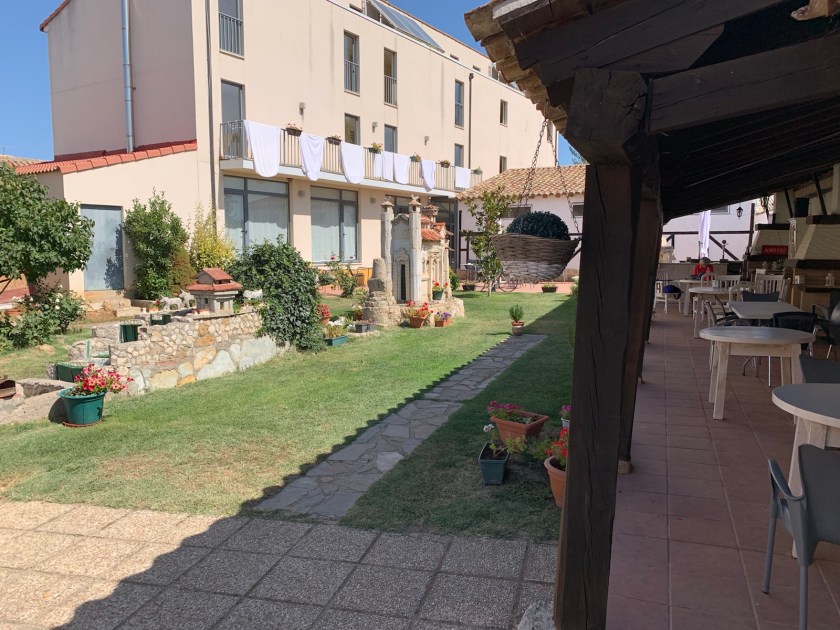
Other than the ever increasing heat of the mid-day sun, the walk to Pablación de Campos and the casa rural, Amanacer en Campos (45€),
Amanecer en Campos from the streetThe nice jardin common area of Amanecer en Campos
was not overwhelming and we were welcomed with a glass of sangria while our room was being prepared. We figured we could wait as long as the sangria kept coming.
Right after we checked into our nice room, there was a knock on the door. The sweet lady that runs the establishment, who speaks zero English, handed Jim her cellphone. Jim, without hesitation, said “Hola” and Rachel asked if there was a room available tonight. We began a three way conversation between the owner, Rachel and Jim, ending with Jim assuring Rachel that we had a single room for her at 30€ and we were holding it for her until she arrived two hours later.And the owner was noticeably happy that she had earned an extra 30€ + for the day. Jim decided not to ask for a discount. (Jim met Rachel later in the day. She was from Ireland, walking alone, her first Camino.)
We stayed here in 2014 and had a delightful experience, especially the food. This is where we were introduced to the Spanish version of lentil soup which has become a staple in Jim’s diet back in S.C.
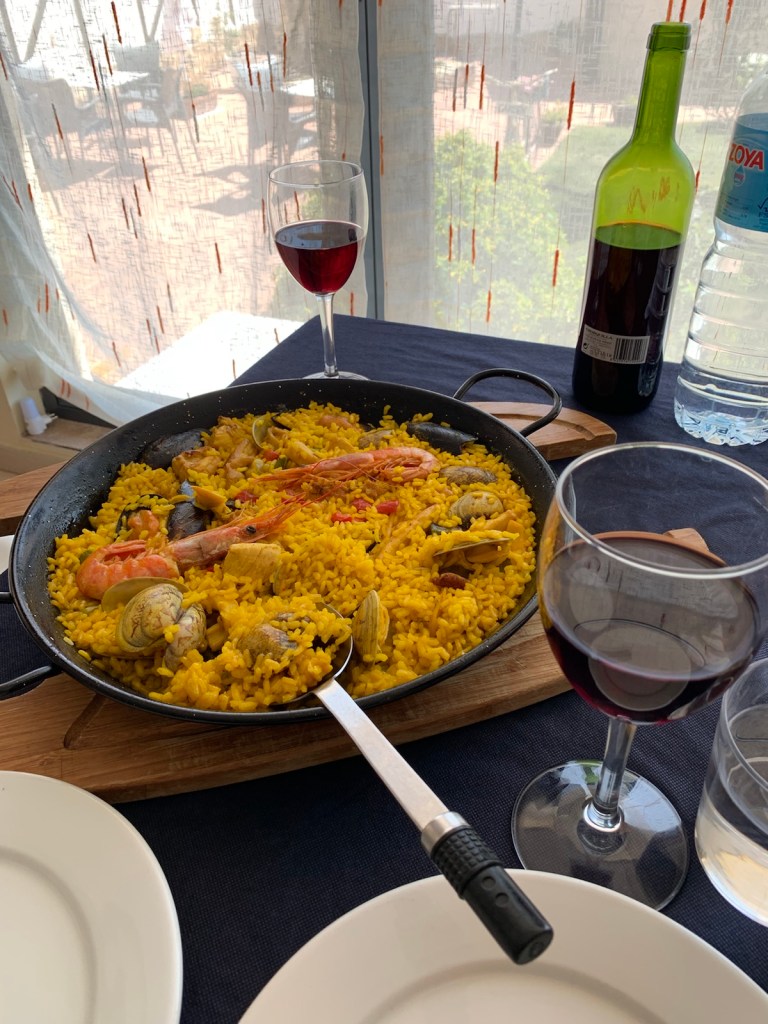
Today for our 2:00 late lunch/early dinner we had the most delicious paella anywhere.
The most delicious paella we’ve ever hadAll that was left of our delicious paella lunch/dinner
The simple salad of heirloom tomatoes and lettuce and “no-name” Riója red wine more than adequately complimented another extraordinary Camino culinarily experience.
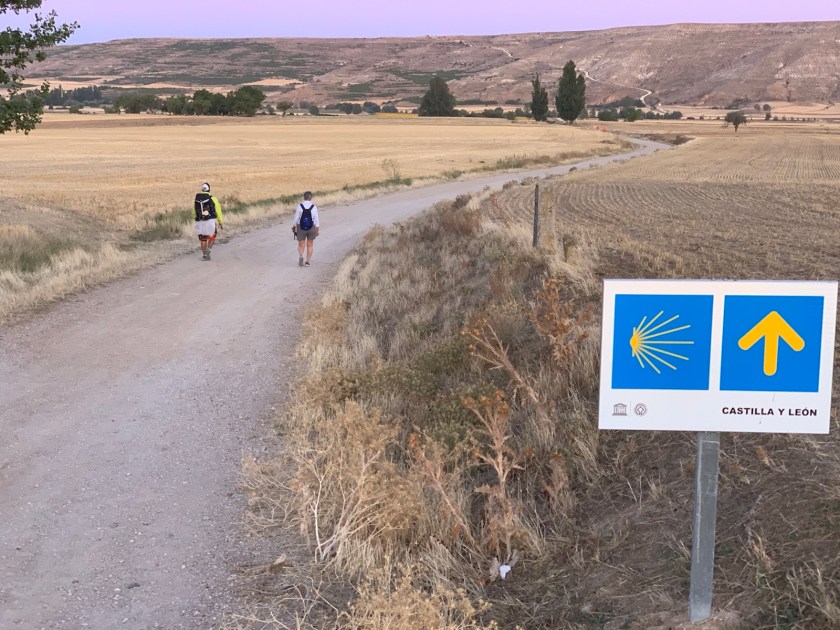
The first 2 miles of our walk was challenging, beautiful and Romantic.
These two wondered what we were doing up so early
Soon after leaving the town we picked up the dirt path and walked through what had been a swamp, when the Romans were beginning to transport gold through this area that they had mined in Galicia. They could have drained the swamp, but that would have taken years (at least 8) 😉.
So instead, they built a causeway across the swamp.
Linda walking across a 2000 year old causewayClassic Roman design to divert water from bridge structure
Incredibly, we walked across that 2000 year old causeway this morning, before heading up top again.
The climb back up to the Meseta was very difficult, a sign said it was a 12% grade. Linda and her Fitbit rated it 45 floors.
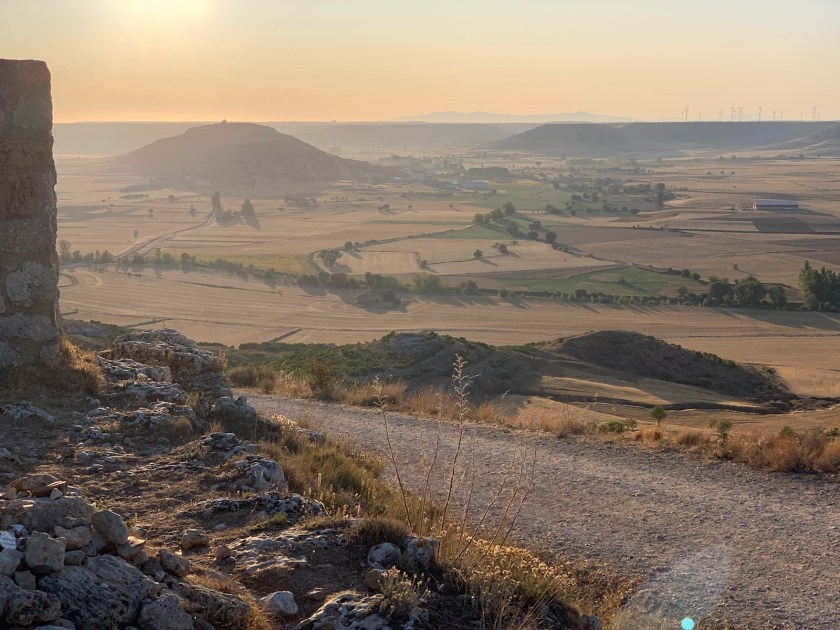
When we stopped to catch our breath, we looked back toward Castrojeriz into the extraordinary views in spite of the rising sun dominating a cloudless sky.
Photo effort number 1Photo effort number 2
We took several photos trying to capture what we were experiencing, with limited results, but you get the picture.😜
Linda reaching the topOne last look back
We took a break at the top and took reciprocal photos of a German couple who had become engaged just 10 minutes ago after climbing the mountain.
They even were wearing and showing off their shiny, matching rings.
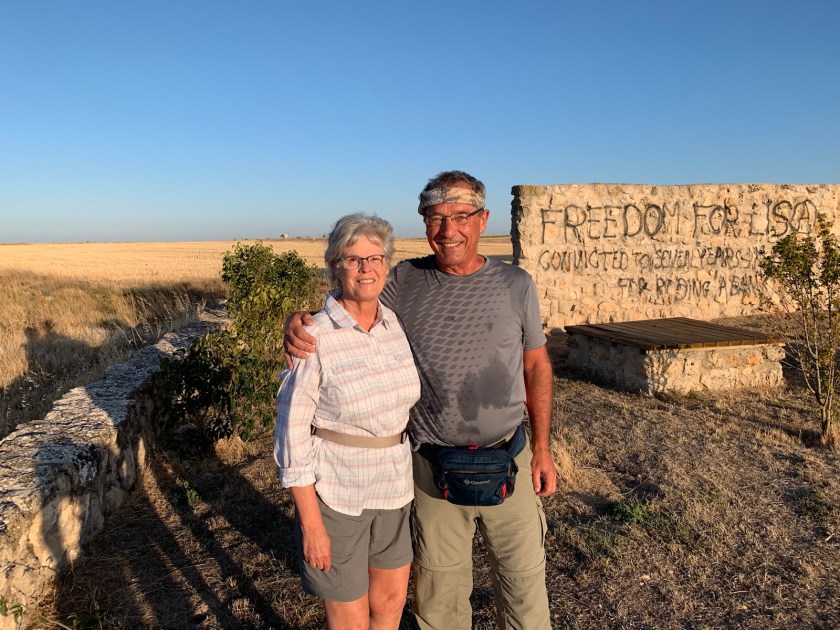
So, Roman or Romantic, we had it all during our first 2 miles.
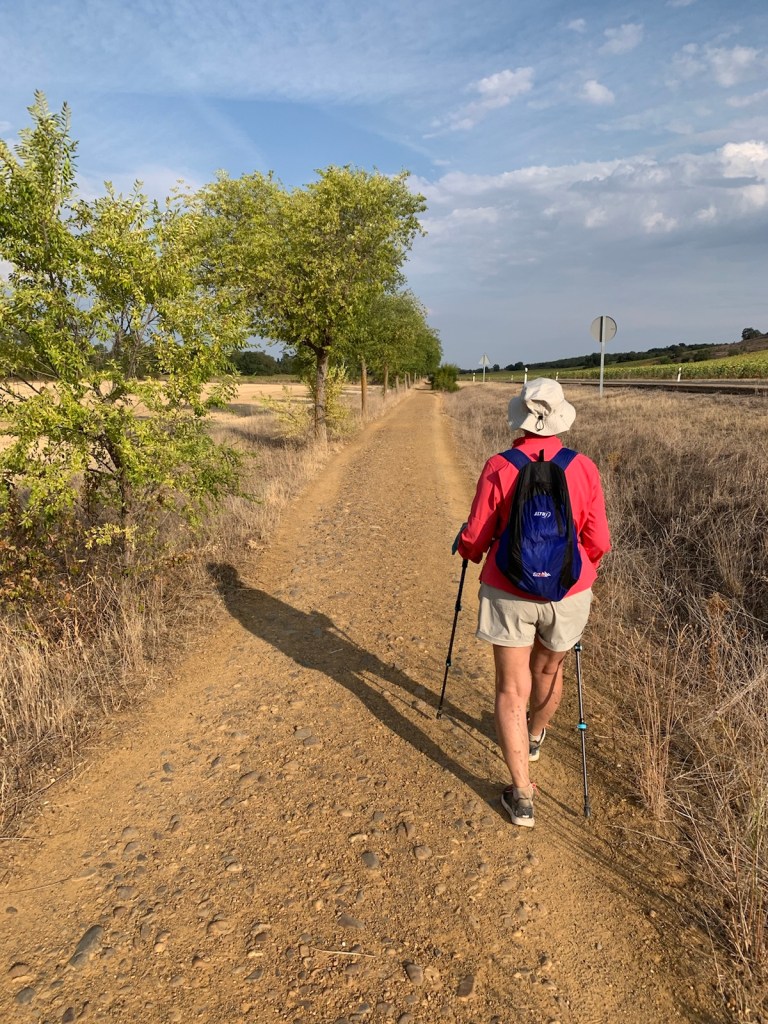
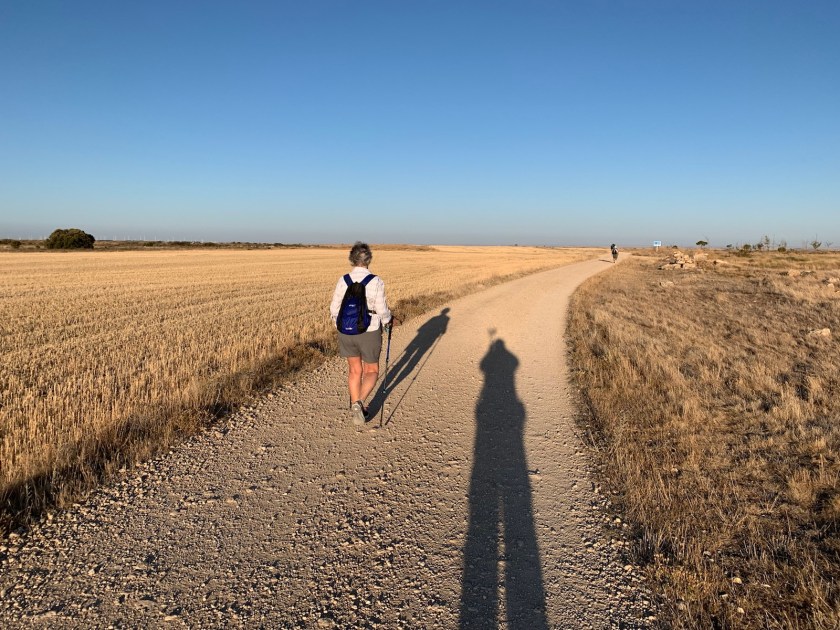
After a brief rest and a banana snack, we moved on into the familiar flat grain fields,
back on to the plain, we thought…
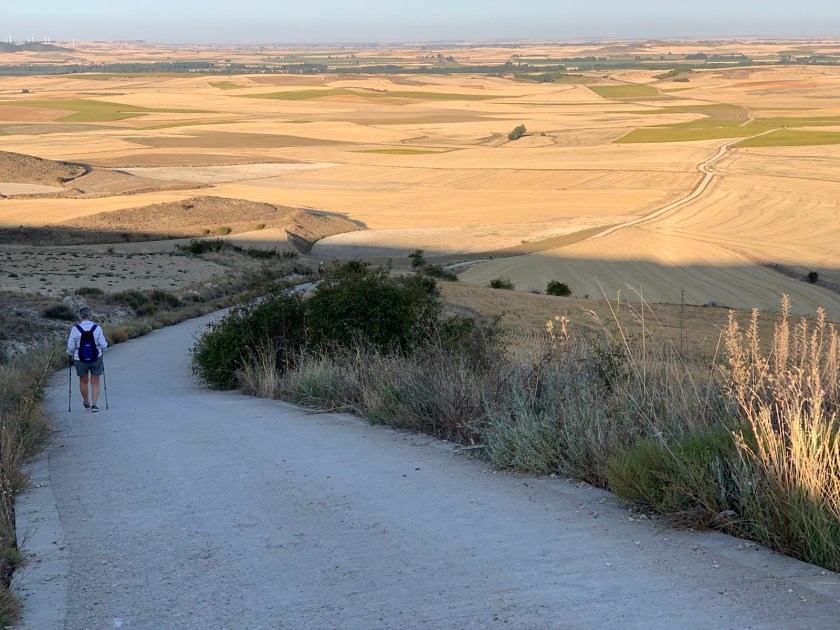
but a mere 0.3 mile later,
Ooops!straight down, no switchbacks like on the way up
we gulped at the 18% grade descent that would take us down into another valley as far as we could see.
The Meseta is boring? We don’t think so!
We walked for three miles through the fields before crossing the Puente Fitero. It was commissioned to be built in the 11th century by Alfonso VI and restored in the 17th century to its original Roman design, and is one of the longest bridges on the Camino.
The last half mile was a nice shady stroll beside a slow moving river, then through a small corn field and right to Puente de Fitero (40€) our place for the rest of the day and night in Itero de la Vega (pop. 177).
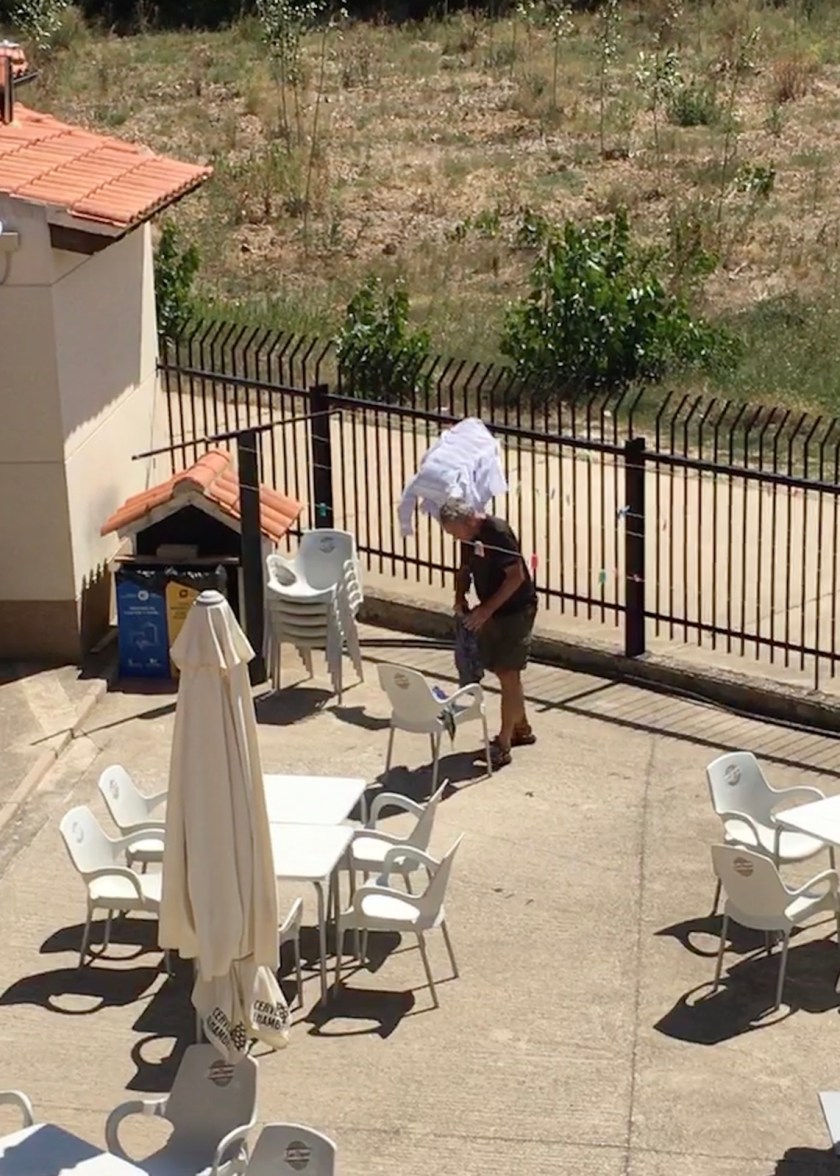
We felt right at home, having stayed here in 2014, ’17 & ’19. We had our clothes machine washed and Jim did clothes line duty.
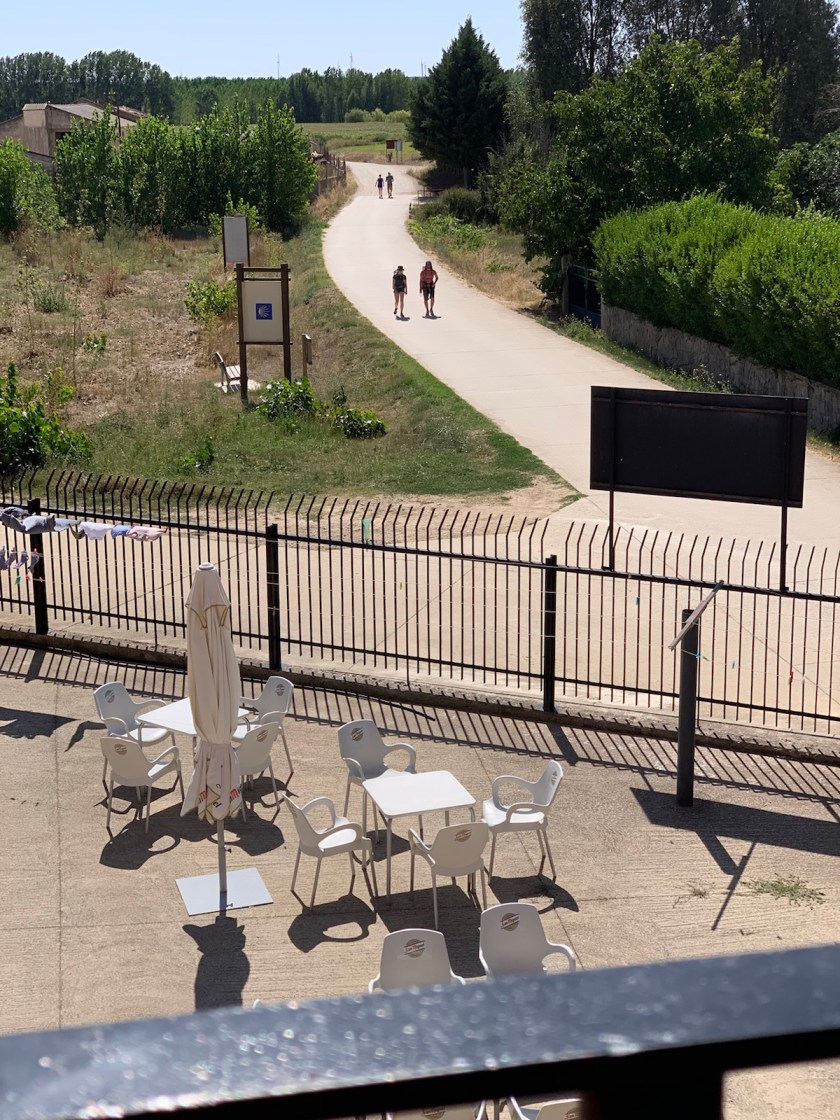
Our room overlooks the alberge terrace so we can see other pilgrims passing by, some staying for just a break, others staying overnight.
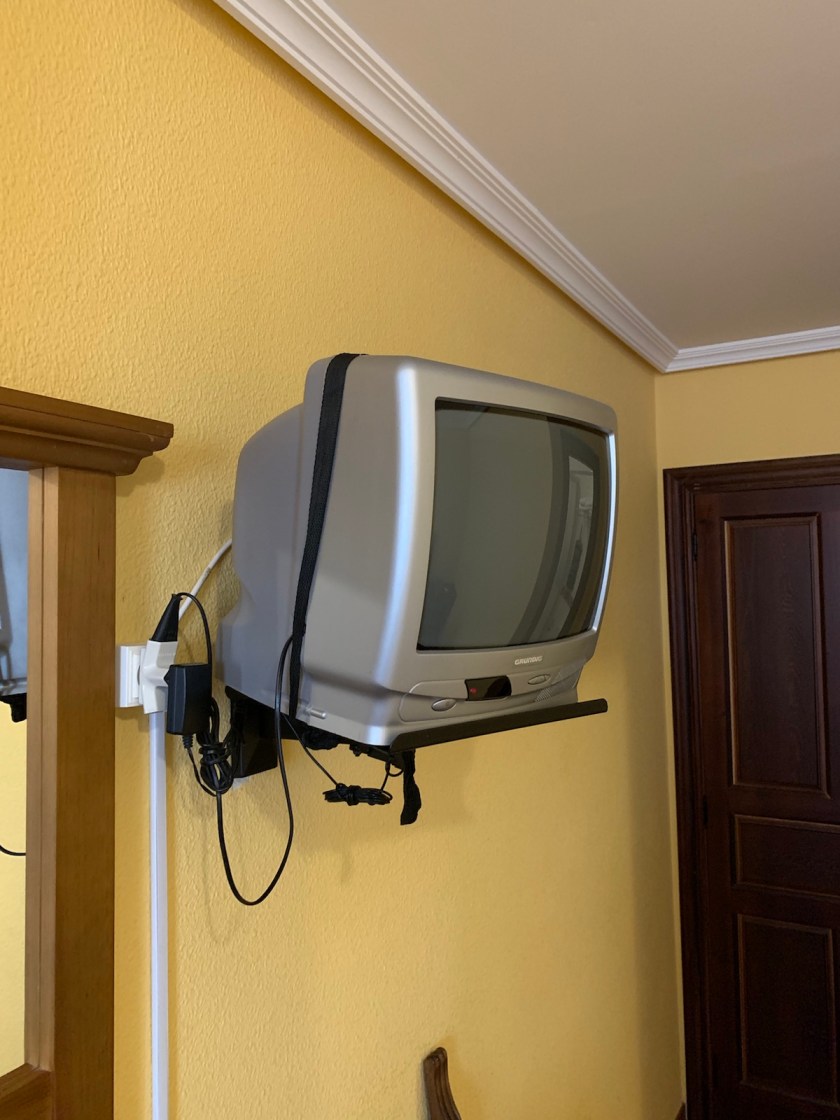
Our room is roomy and comfortable but not modern. We normally don’t use the TV but this one probably only had black and white!
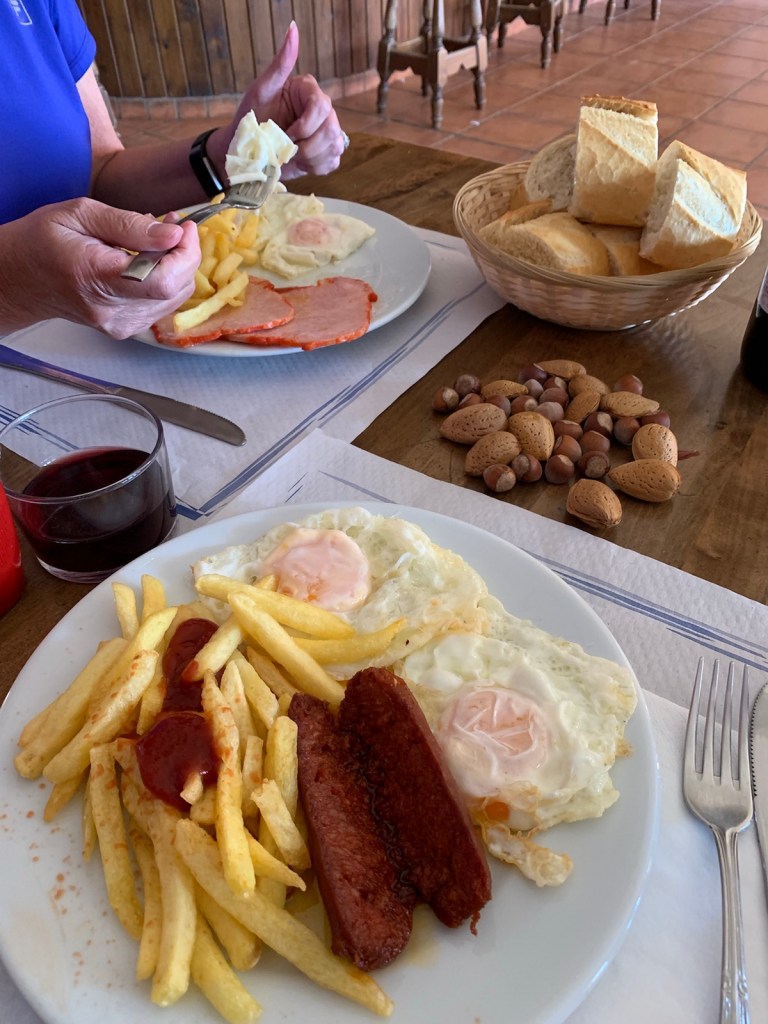
We had a simple, but tasty lunch/dinner at 3:30 and just coasted until bedtime.
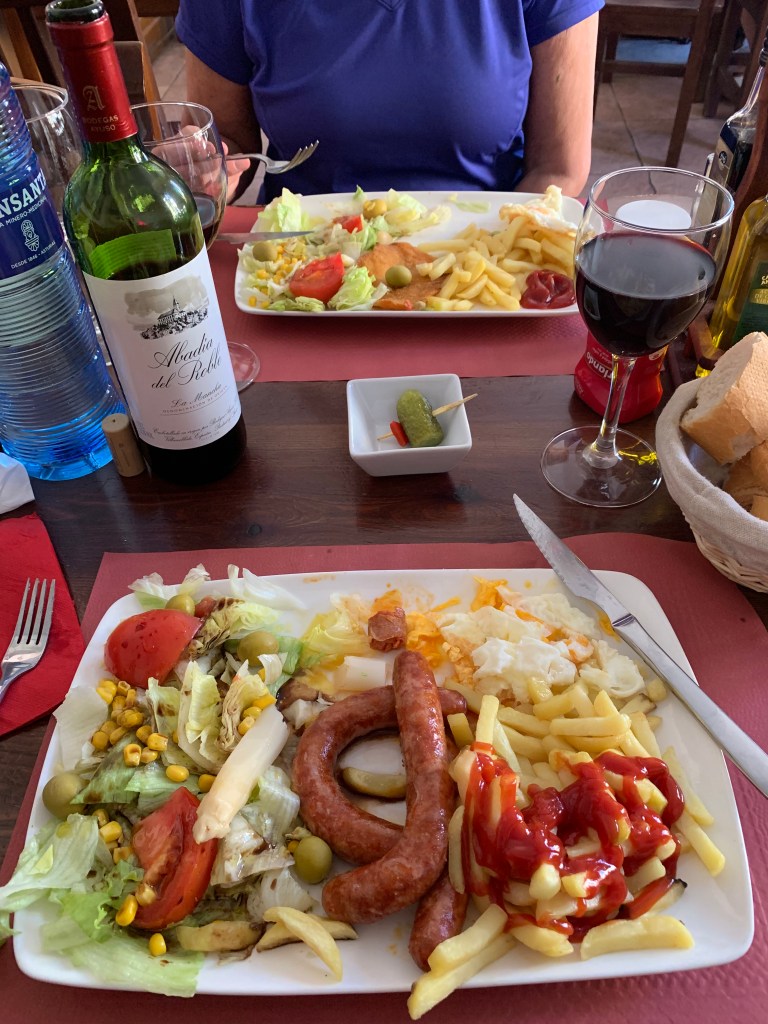
Linda liked her pork loin as did Jim his choriso w/eggs & fries
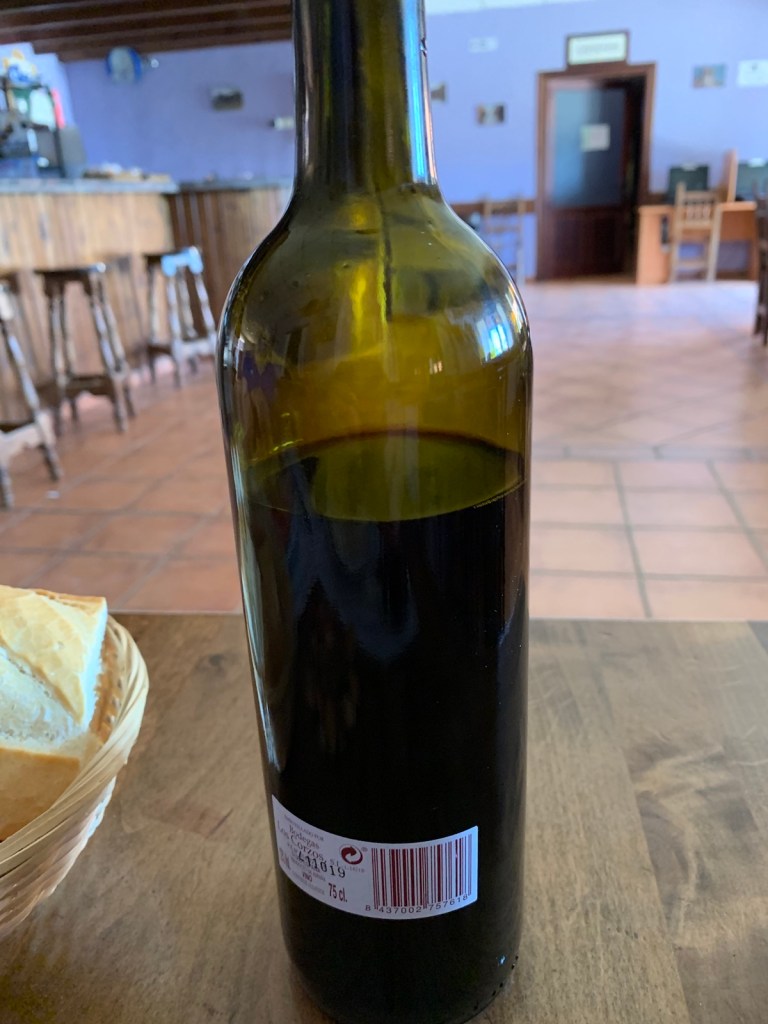
This was an excellent, no-name, local wine for 5€!
We’ll never see this one in Total Wine back in the U.S., so this will be a once in a lifetime experience for sure on the Camino Frances.
Note to followers: Several photos didn’t upload last night on the email you received due to poor wifi. With better wifi today, Day 23 is complete and can be seen by clicking on our photo to left of “Day 24” and scroll down to Day 23 to see the updated version.
We began walking out of the “bowl” this morning at 7:30 with a cool 54F wind at our back.
It took 2.2 miles to walk up the opposite side of the bowl that we entered yesterday into Hornillos. For comparison, “mule killer hill” only took 0.7 mile to come down into the Hornillos… making it 3 times steeper than this morning’s assent.
Beginning to head up the wall of the “bowl”Reaching the top of the bowl’s edge, looking back toward Hornillos… the Meseta ahead of us
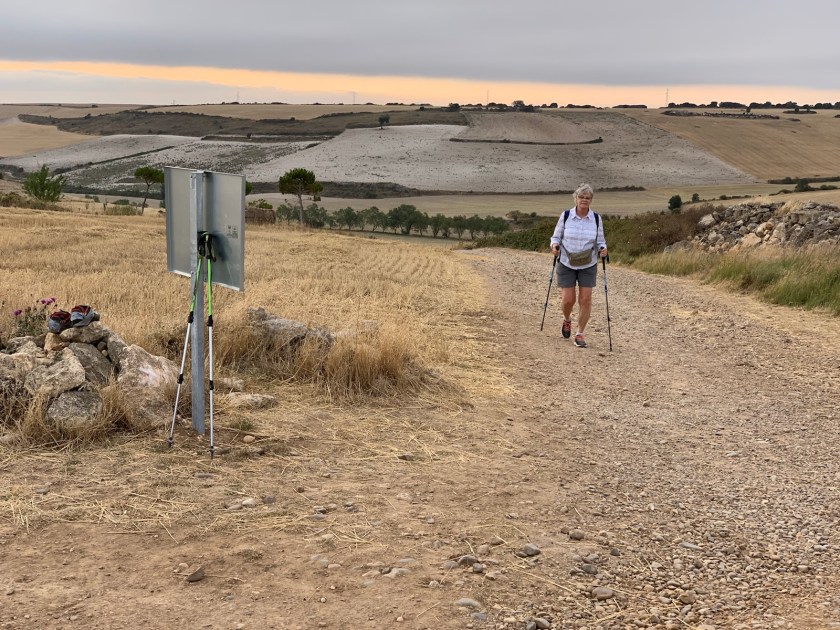
We walked along the Meseta for several miles until the next “bowl”, a smaller one, called San Bol (pop.2?) with a primitivo albergue as its sole structure.
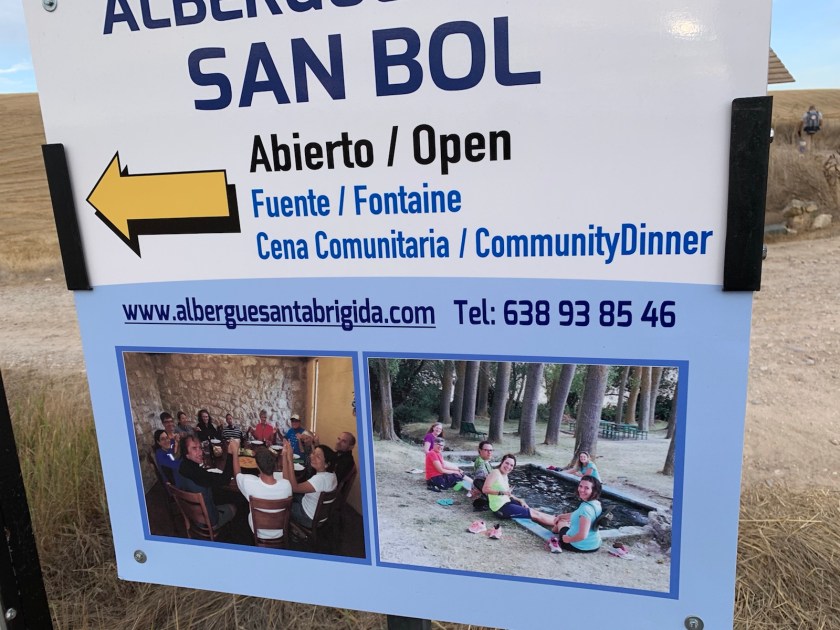
That’s the albergue in upper right centerSan Bol sign
Legend has it that pilgrims who soak there feet in the San Bol fountain will be cured of all foot pain.
Our feet still in pretty good shape, we opted to pass on the foot-soaking to conserve the fountain water for subsequent pilgrims in greater need.
Ruins scattered nearby are from the monastery of San Boadilla from the 11th century and for whom San Bol is named.
We climbed out of this smaller bowl rather easily and continued onward toward Hontanas.
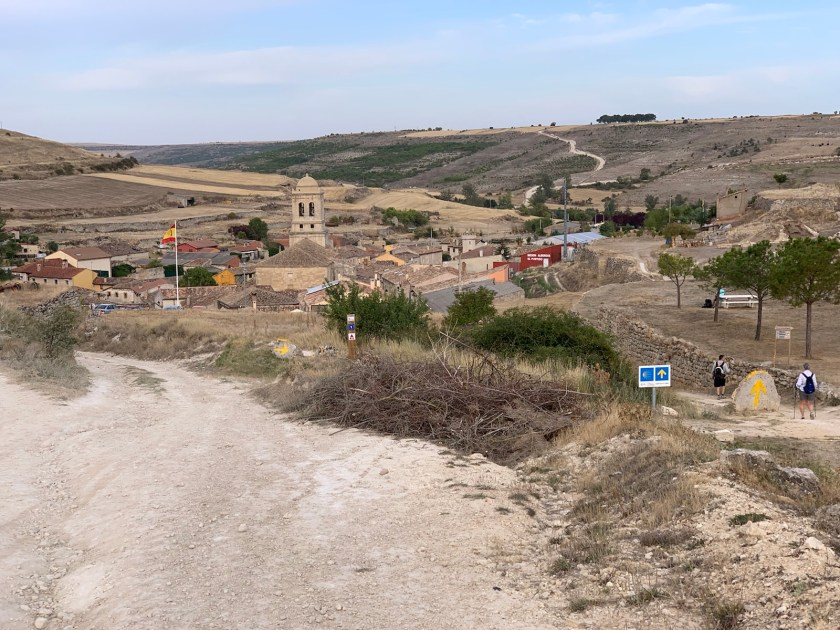
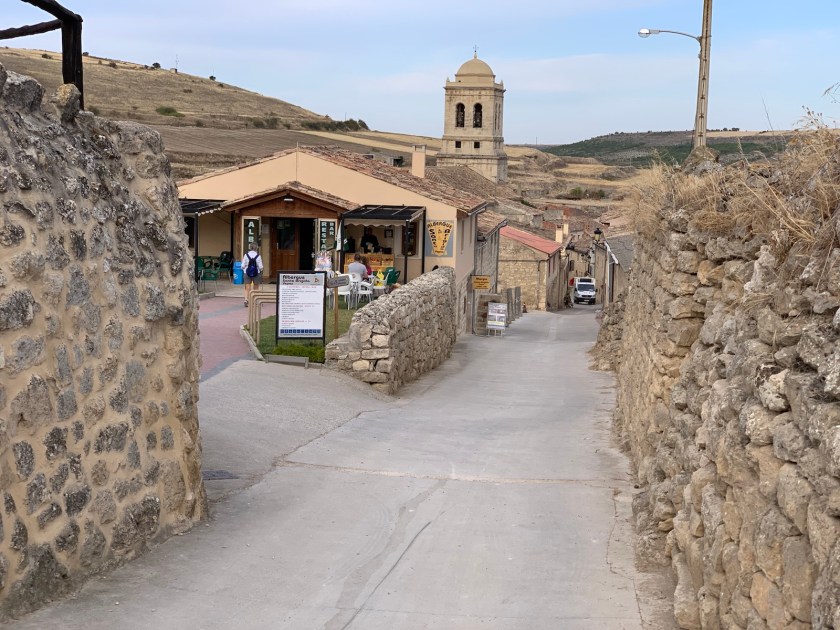
The first sight of Hontanas is the steeple of Iglesia de la Imaculada Concepción, as this village is also in a valley, not bowl shaped, but with the Meseta all around.
the first sign of Hontanas from up on the MesetaMore of Hontanas being revealedWe stopped at this first albergue on the way into the village.Great rest/breakfast stop
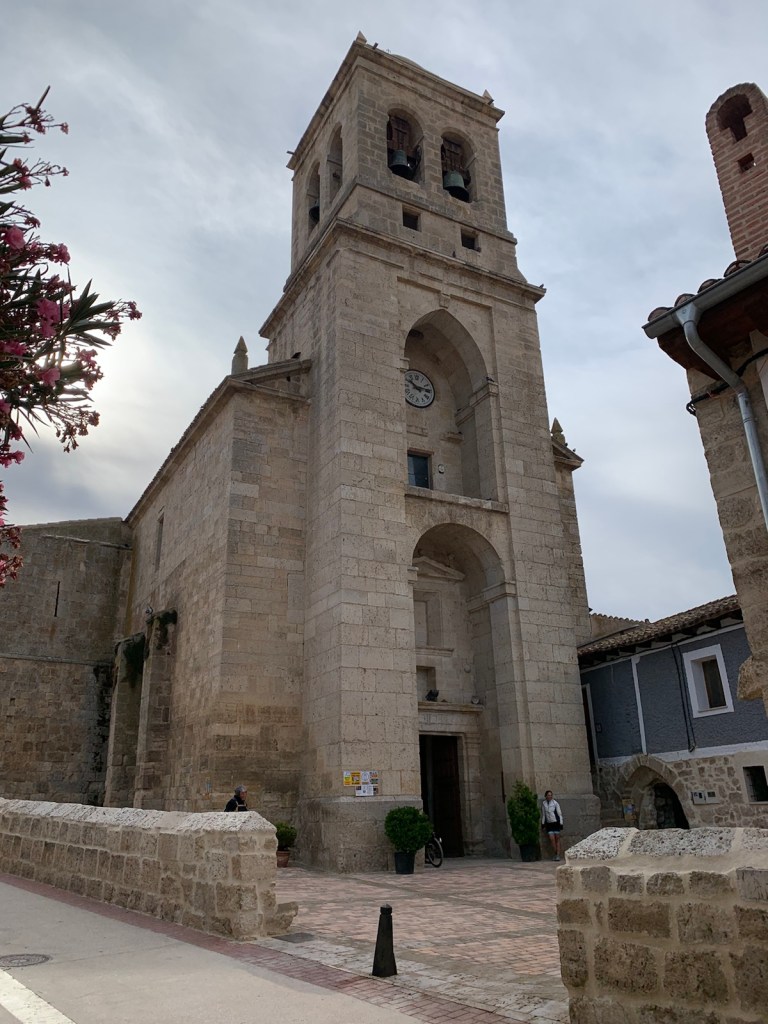
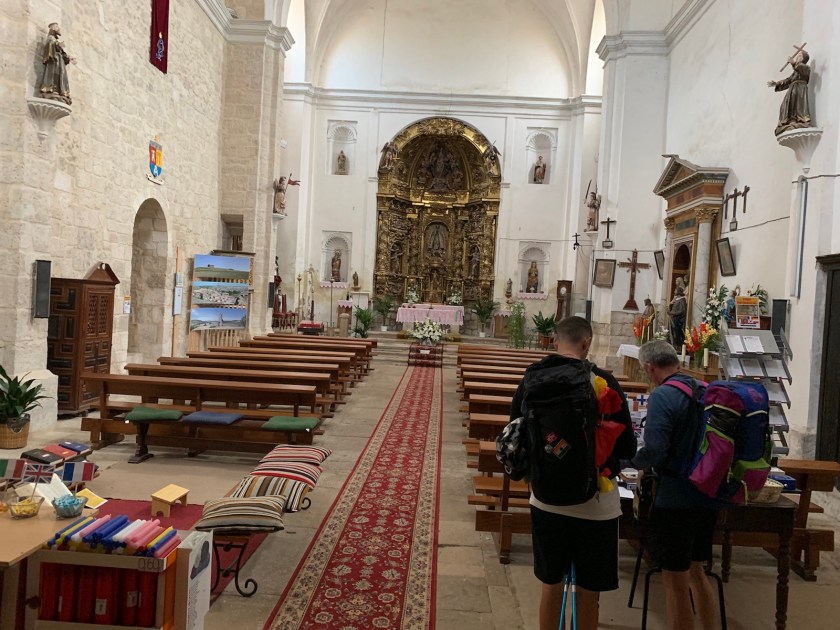
After a brief rest and refreshment, we walked on through Hontanas (pop. 70), getting a quick inside look and closer outside look at the Iglesia then continued on toward Castrojeriz.
Iglesia entrancea quick look inside
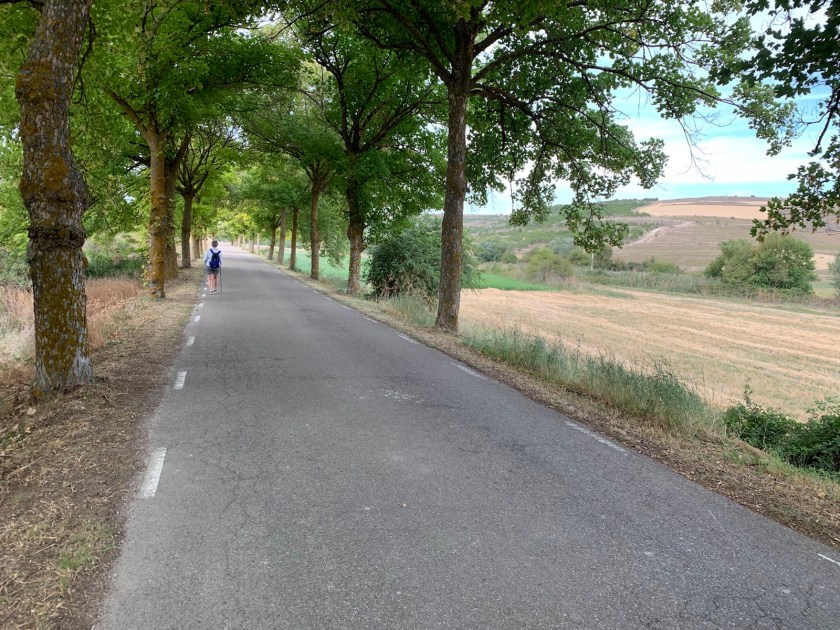
Leaving Hontanas, pilgrims can rejoin a dirt path or walk on a parallel road. We decided to take the apparently less traveled option as we were the only pilgrims on it for the next 3 miles
“The road less traveled “
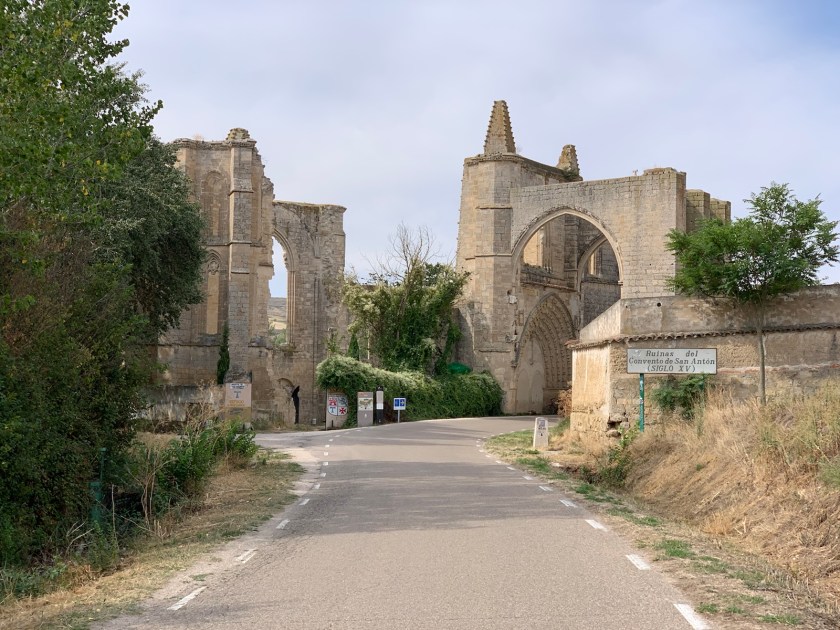
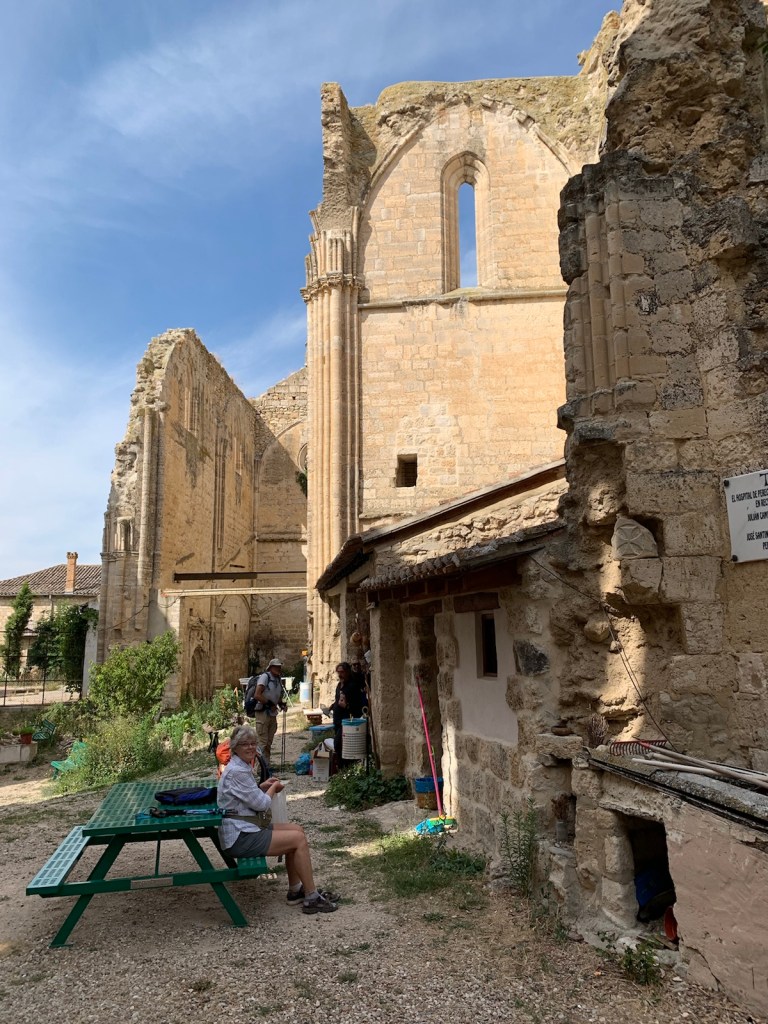
approaching the ruins of San Antón
until the two paths merged shortly before we reached the ruins of the Convento de San Antón.
The San Antón church complex was started by the Order of St. Anthony, a 11th-century order dedicated to the 3rd-century Egyptian hermit whose relics it held.
A man brought his daughter to the relics and she was healed of a particularly pernicious disease reminiscent of leprosy. This disease became known as St. Anthony’s Fire, which caused a terrible burning feeling, loss of circulation and eventually gangrene. This disease was in fact likely ergotism, caused by a fungus that grows on rye bread. The order developed a reputation for healing this disease, though serendipitously, pilgrimage was an excellent antidote to the disease as vigorous exercise and plenty of wine helped to overcome it.
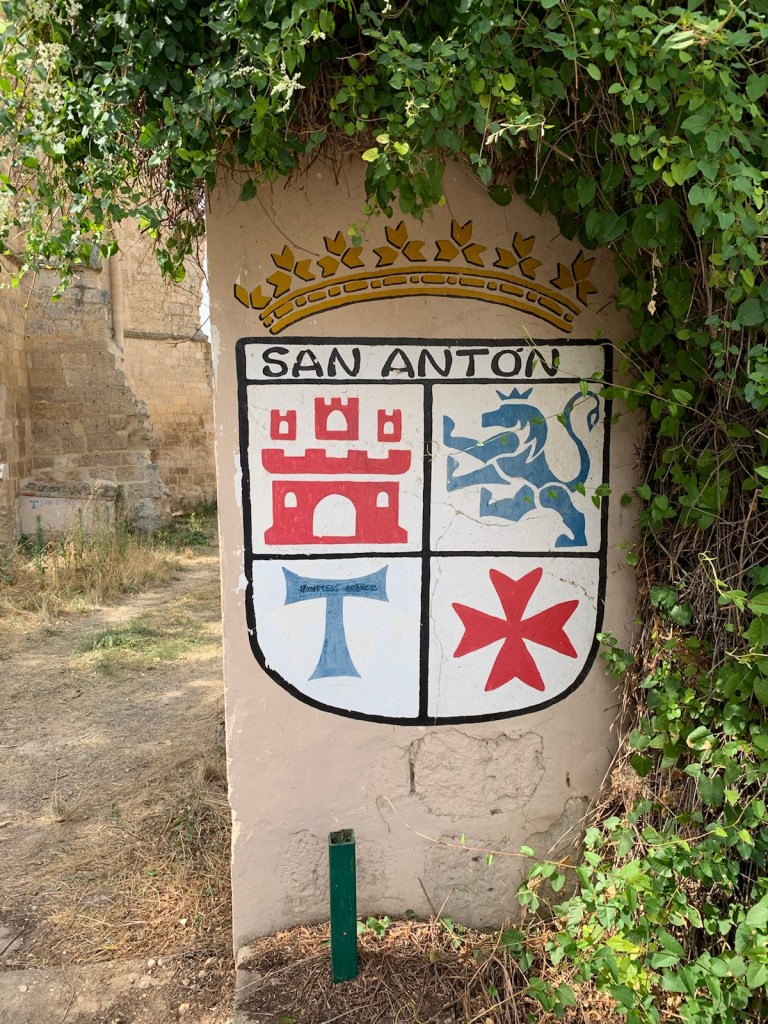
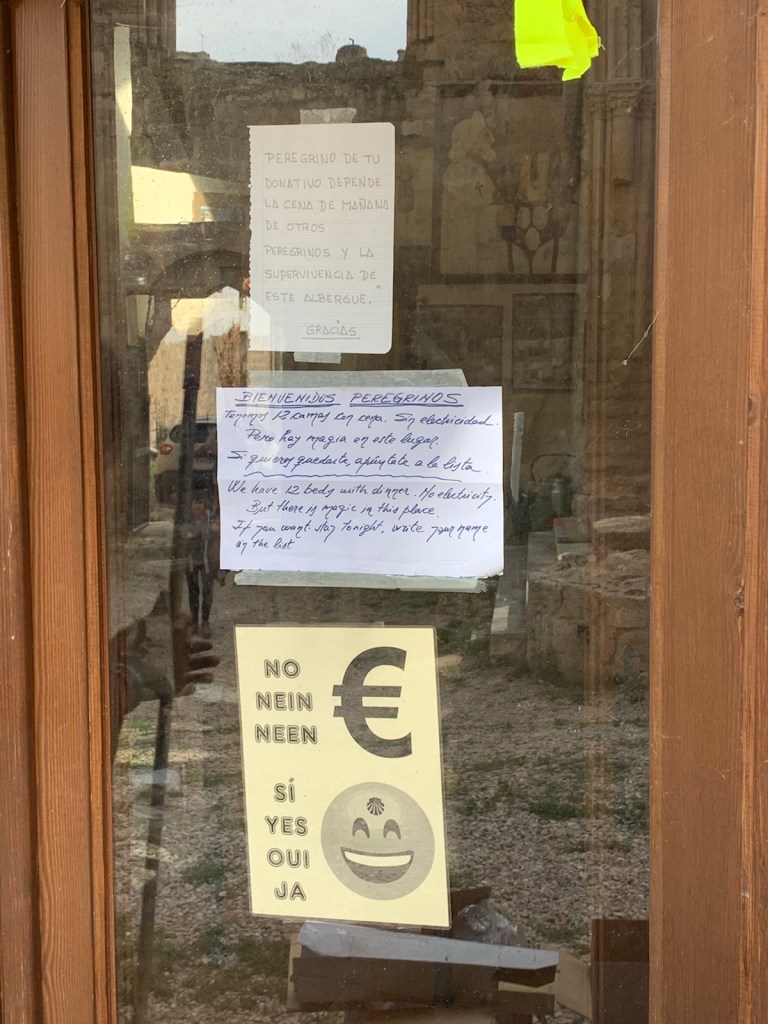
St. Antón is the patron saint of animals, and across Spain people bring their pets to be blessed on his saint’s day. The church ruins include a high archway over the Camino path, and the remains of rosette windows featuring the Tau cross (t-shaped), used as a symbol of the order. An unusual but beloved albergue now exists in the ruins.
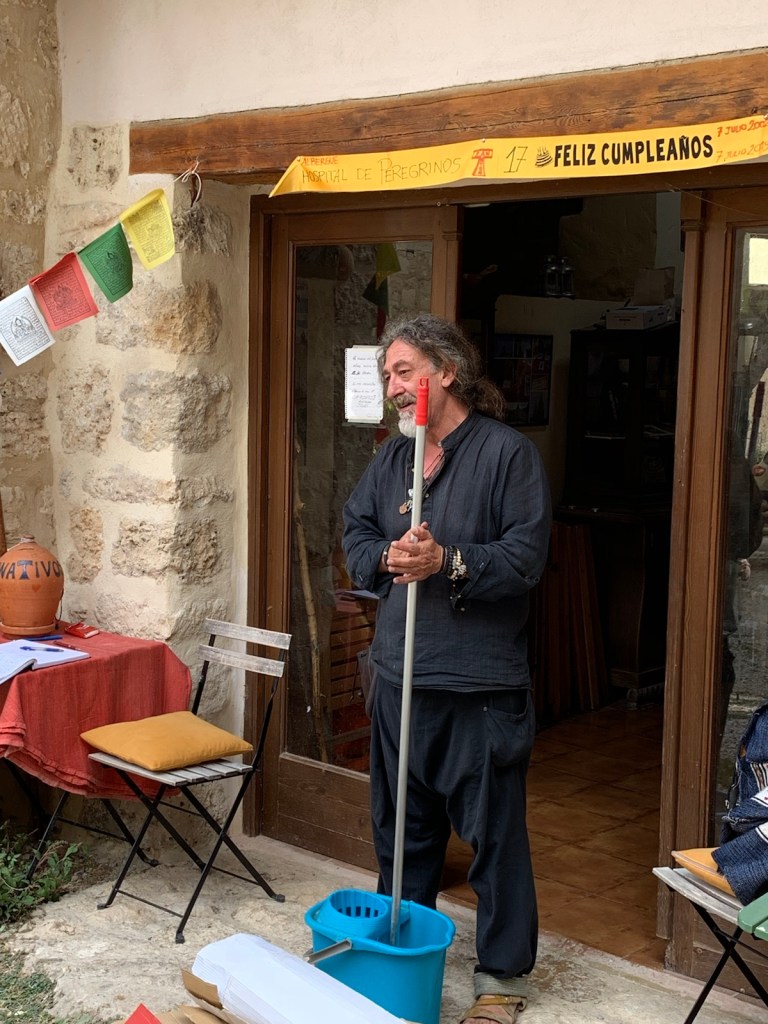
We stopped at the albergue and were welcomed by a very soft-spoken and kind volunteer (2 months) who was the keeper/caretaker of the albergue.
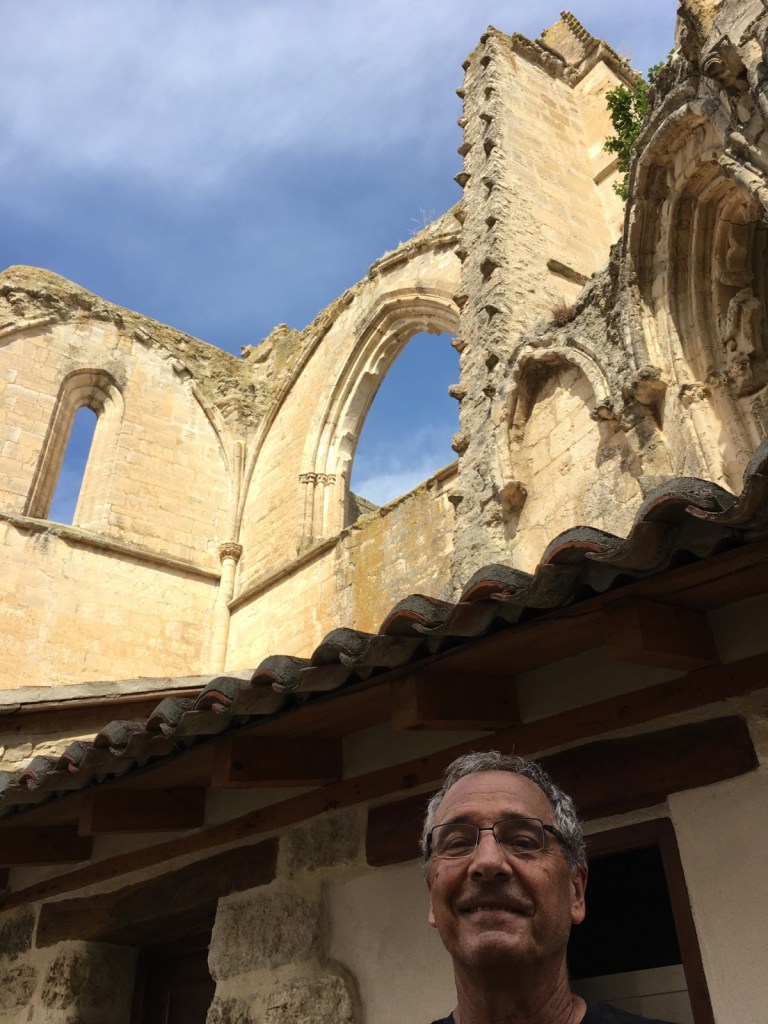
Jim surveying the ruins
The couple from South Africa that we met at dinner last night arrived here shortly after we did. They decided to stay here tonight even though there is no electricity or hot water. The communal dinner is by candlelight.
San Antón coat of arms with tau ☦️ symbol for the St Anthony order.Particulars for staying at the albergueThe interesting volunteer keeper of the albergue
We had walked beyond our targeted 7 miles for the day and with another 4 miles to go to our reserved room in Castrojeriz, we called a taxi to take us the rest of the way.
Linda among the ruins waiting for our ride into town
Castrojeriz (pop. 873) occupies a perfect position for defense along the steep mesa topped by the  Castillo de San Esteban. The Romans used the castle, said to be founded by Julius Caesar, to protect the roads to Galicia’s lucrative gold mines. The city changed hands frequently and the Castle was used and built upon by the Romans, Visigoths, Moors and Christians.
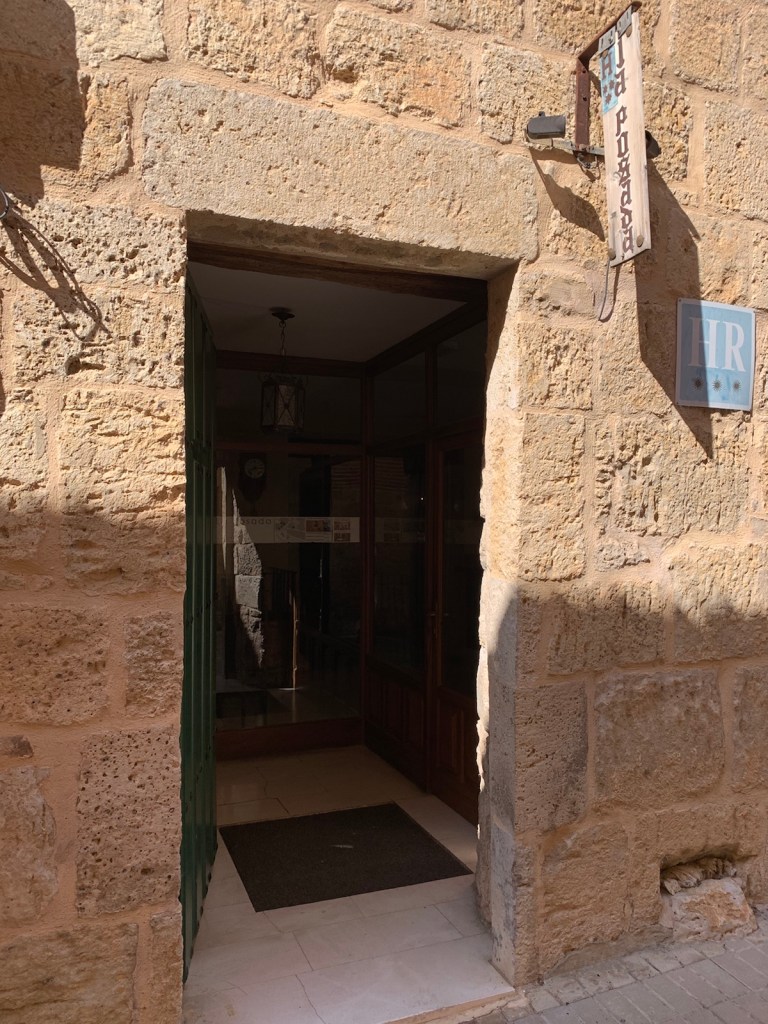
We’re staying in La Posada (64€) in the center of the small town. It’s comfortable and has an adjacent restaurant which offers a Pilgrim Menu tonight at 7:00. We stayed here in 2017 and the owner recognized us when we checked-in at noon and cordially escorted us to our room.
The understated entrance to our hotel
We had an easy afternoon, decided to snack for lunch after our 10:00 breakfast and held off for cena (dinner).
The pilgrim dinner was just a menu available for pilgrims at 11€. So we occupied a table for 4 in the hotel with no other obvious pilgrims around, except for a quiet couple sitting across the room, the lady with a shell on her purse, appearing highly suspect.
For entres, Linda had an ensalada rusa, which is potato salad with some dressing up and Jim had gespacho, muy delicioso.
Jim’s tuna steak smothered with tomato sauce
We both opted for a tuna steak with tomato sauce and dessert was flan for Jim and yogurt for Linda. Of course we were compelled to split a bottle of local vino tinto.
The comfortable hotel lounge area
Tummies full, we took a brief reconnaissance walk to verify our path back to the Camino in the morning, returned to our room and turned off the lights around 9:30.
We took a taxi to the edge of Burgos and began our walk, stopping at a bar in Tardajos (pop.856) for breakfast.
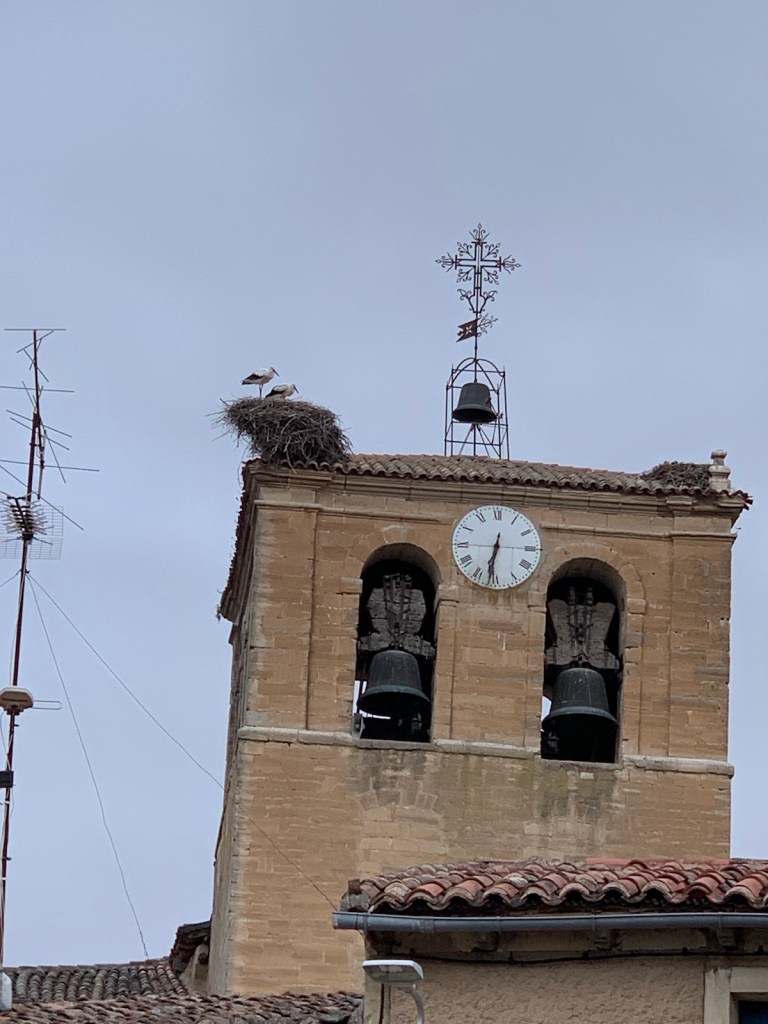
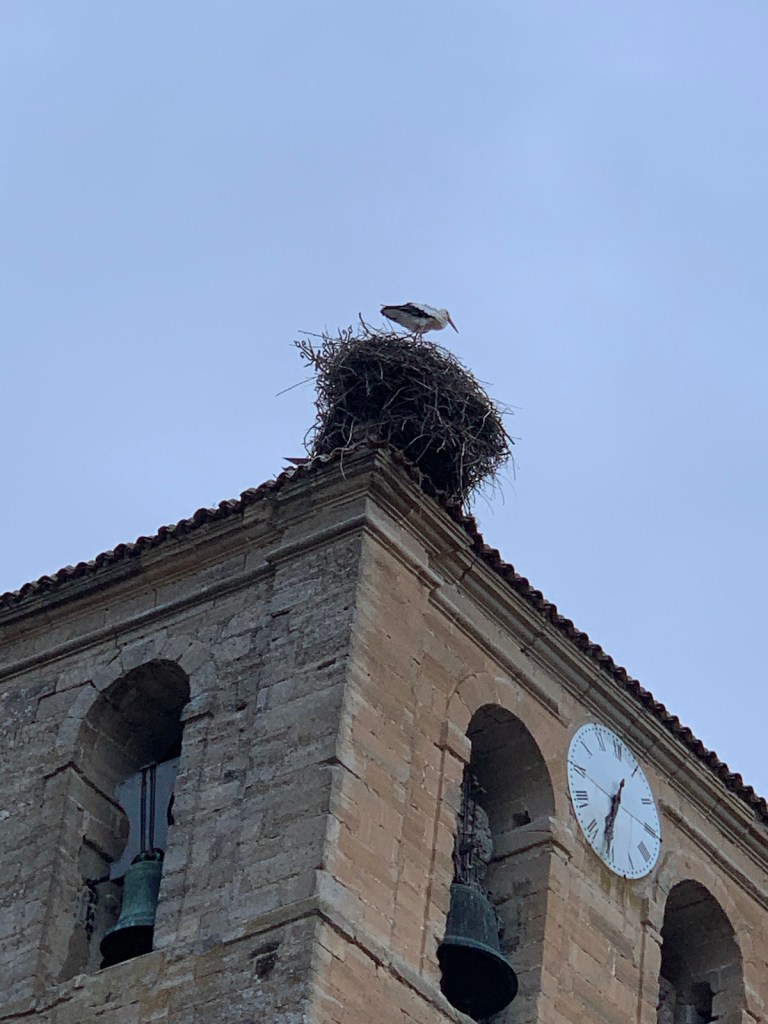
As we walked through Tardajos we noticed that several stork nests had been built in the belfry of the Iglesia de Nuestra Señora de la Asuncíon. But as we looked closer there were actually two storks in one nest.
two storksone stork up closer, very unusual site
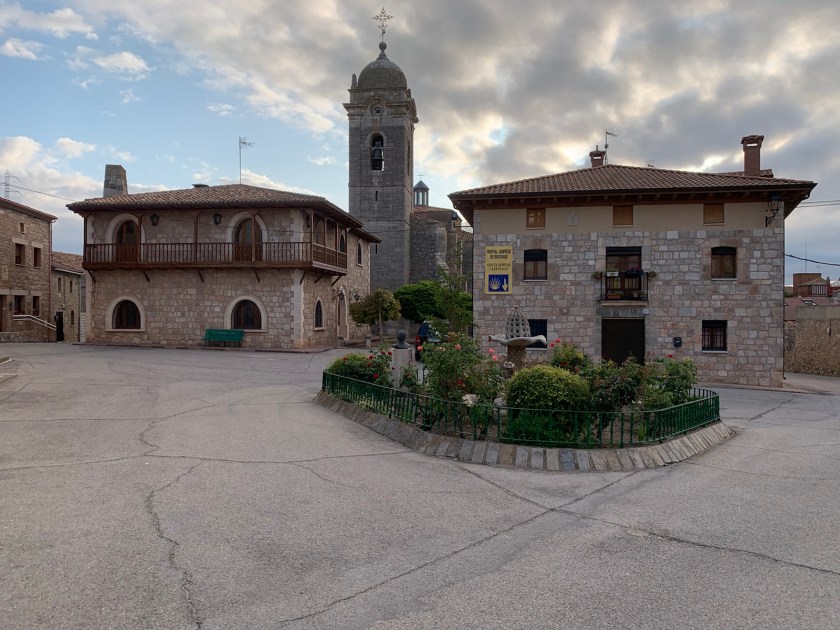
The next village of Rabé de las Calzadas ( pop. 221) also had an impressive church and what appeared to be a convent attached.
Rabé village square and fountain
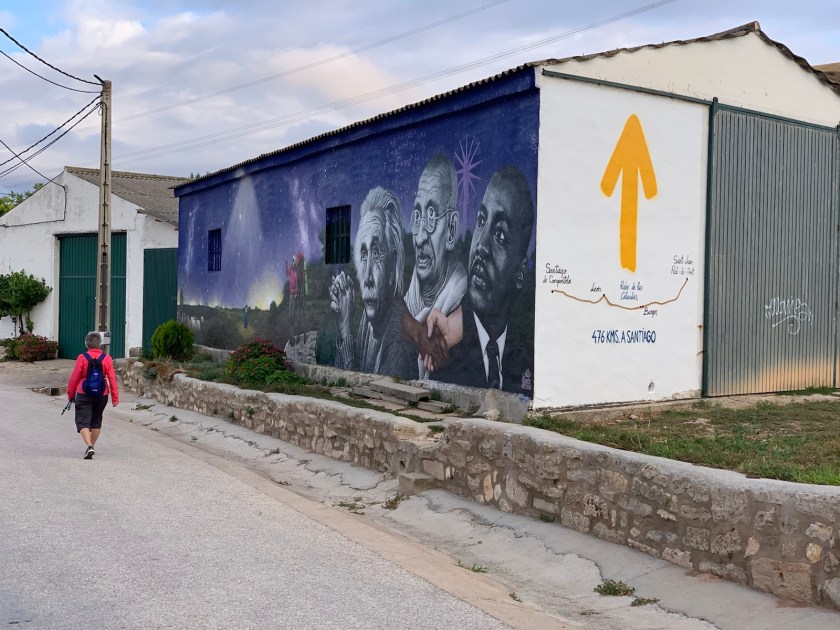
Interesting mural as we walked out of Rabé
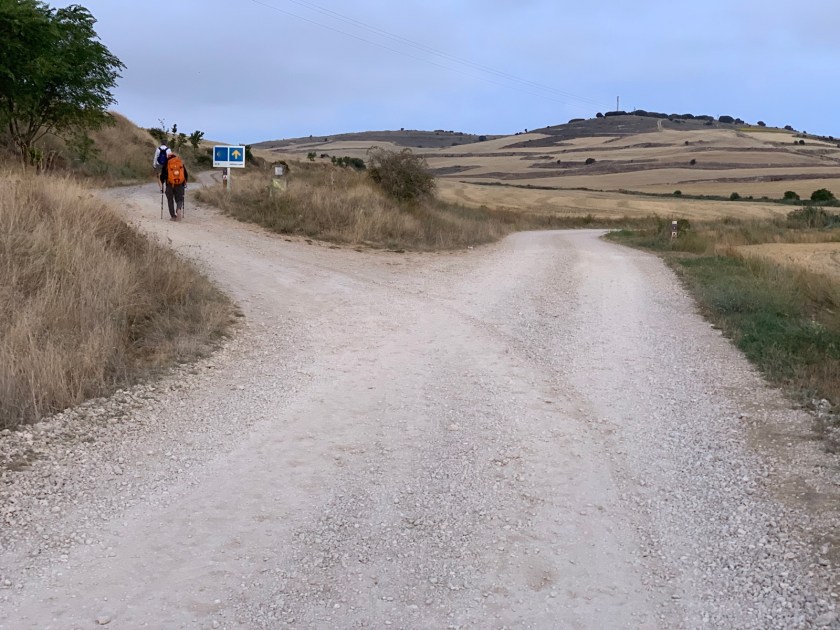
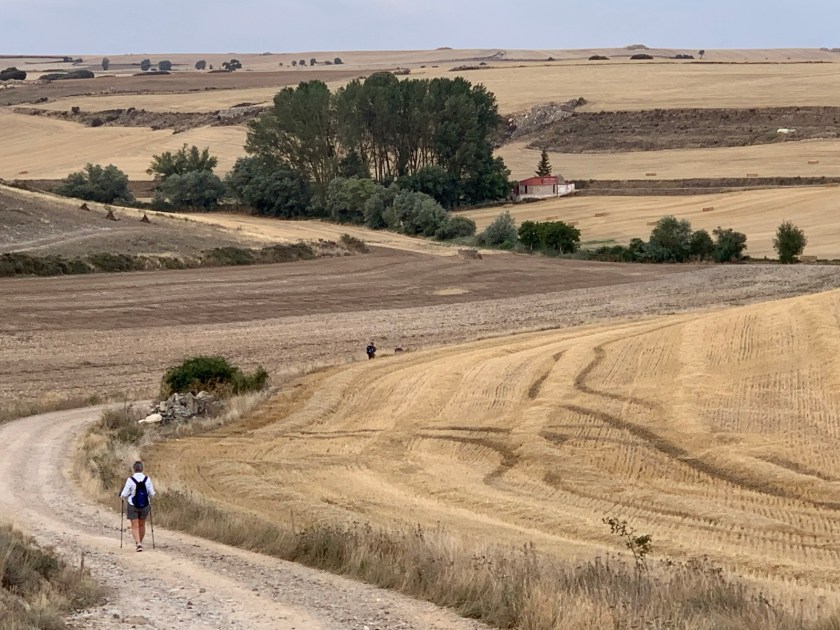
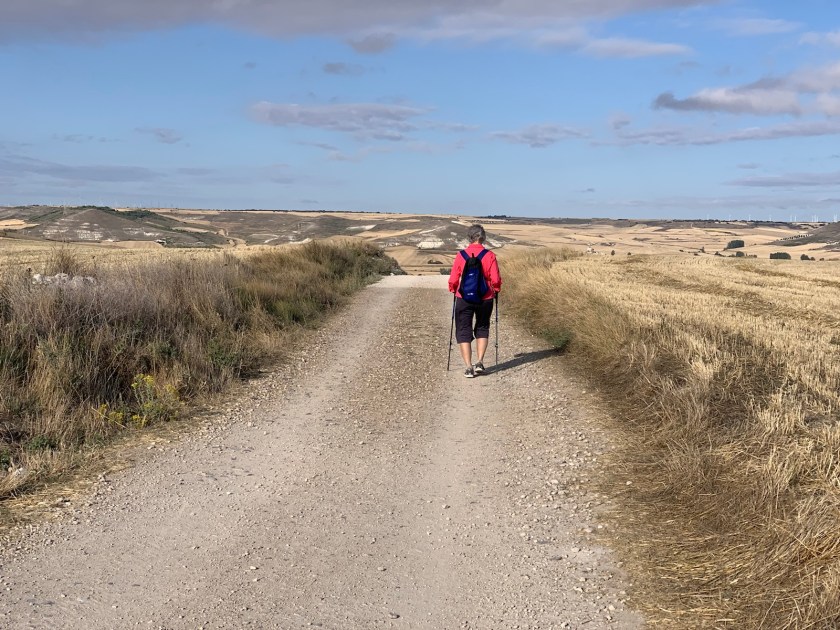
The earthen path out of Rabé started a gradual climb that continued for nearly two miles and carried us up to the Meseta.
on our way up to the Meseta
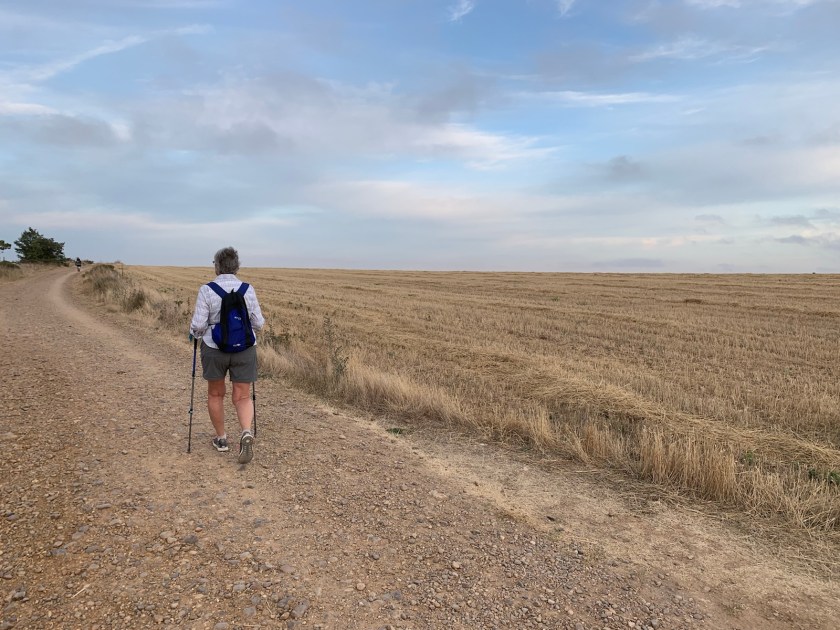
There is a saying that the landscape of the Meseta is not found in the land, but in the sky with its diverse colors and expansive clouds. Dreaded by some, relished by others, the Meseta has a distinct reputation for being boring, repetitive and bleak. However, the Meseta begins and ends with such vibrant cities as Burgos and León and there is a certain beauty and awe in the endless horizon and wide open space in between.
Sometimes, visible to the north are the jutting mountains of the Cordillera Cantábrica. Towns are often set down in shallow river valleys, that appear to be large bowls, practically invisible along the horizon until arrival.
The lack of trees means little to no shade. The Meseta can be blistering hot in summer and quite cold in winter and very windy with fast developing storms. The flat landscape glimmers with golden wheat and flocks of sheep ramble the area along ancient sheep paths known as cañadas.
In spite of the monotony, the Meseta can serve as a memorable wilderness experience with plenty of time for personal thought and reflection.
With the lack of stone in this area, there are more buildings made of brick or adobe. Many towns feature bodegas, wine cellars dug into the earth that resemble hobbit homes, as well as mudbrick dovecotes.
a 180 degree pano of the Meseta ahead of us
Upon reaching the Meseta, the expansive views are initially breathtaking, maybe a bit unsettling and humbling.
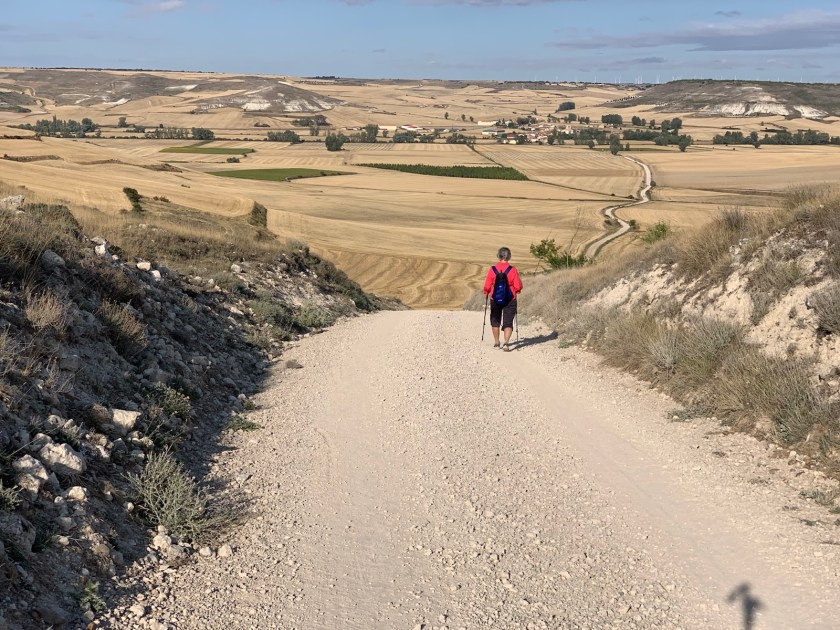
We walked on the Meseta for about two miles before approaching our first “bowl”.
Out first sign of a valley or bowl on the Meseta.
In the valley was Hornillos del Camino (pop. 61), our destination for the day.
But to get to the valley we faced a very steep descent, referred to by locals as “cuesta matamulas” translated, “mule killers hill”.
Taking on the “mule killer”Easy walking from here in, BUT tomorrow we have to climb back out!
There weren’t any mules around but the hill into Hornillos was accurately named.
We had an early lunch at a nearby bar and checked into Albergue Meeting Place at 11:30, did our chores and spent the afternoon recovering, blogging and struggling with a weak wifi.
Most places in Spain, hotels, bars, albergues, etc. have wifi. Most pretty good, some not so good. We rely on a good wifi signal to upload photos and the daily blog. If you fail to get a daily post, it’s probably a wifi problem and not our falling off the end of the earth, which is located about 50 miles west of Santiago!😜
The pilgrims dinner tonight was a delightful experience. First of all, the albergue has been owned and operated by a brother and sister in their 20’s for 4 years. It is a very well run, well organized albergue with modern facilities.
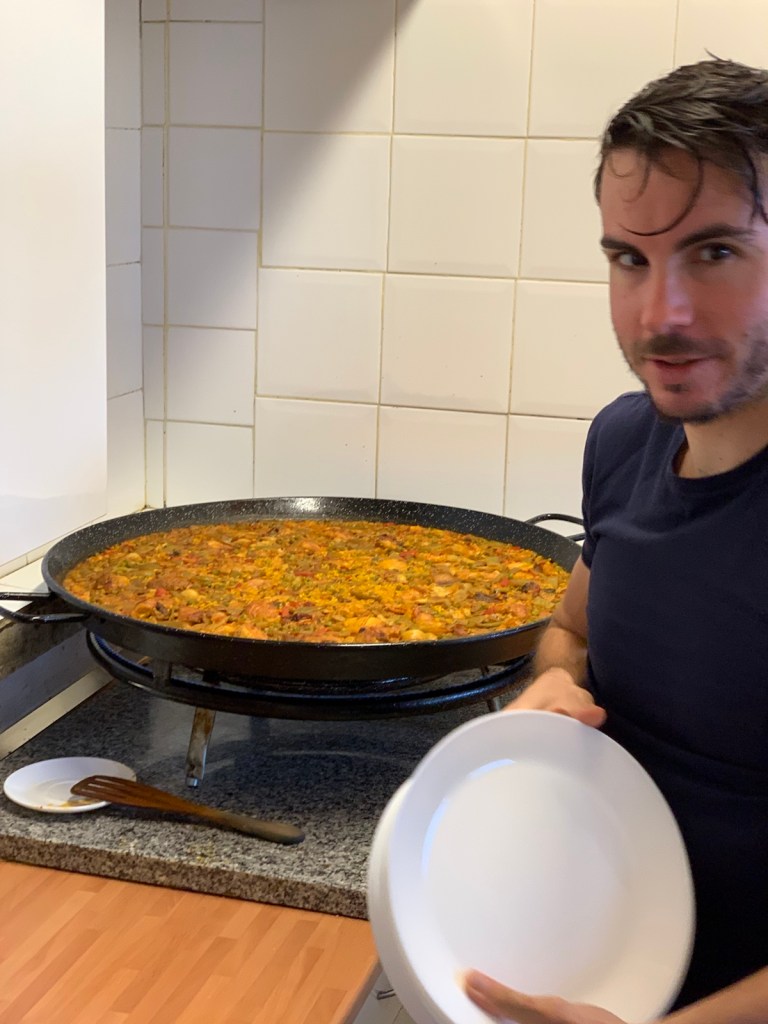
Paella in the making
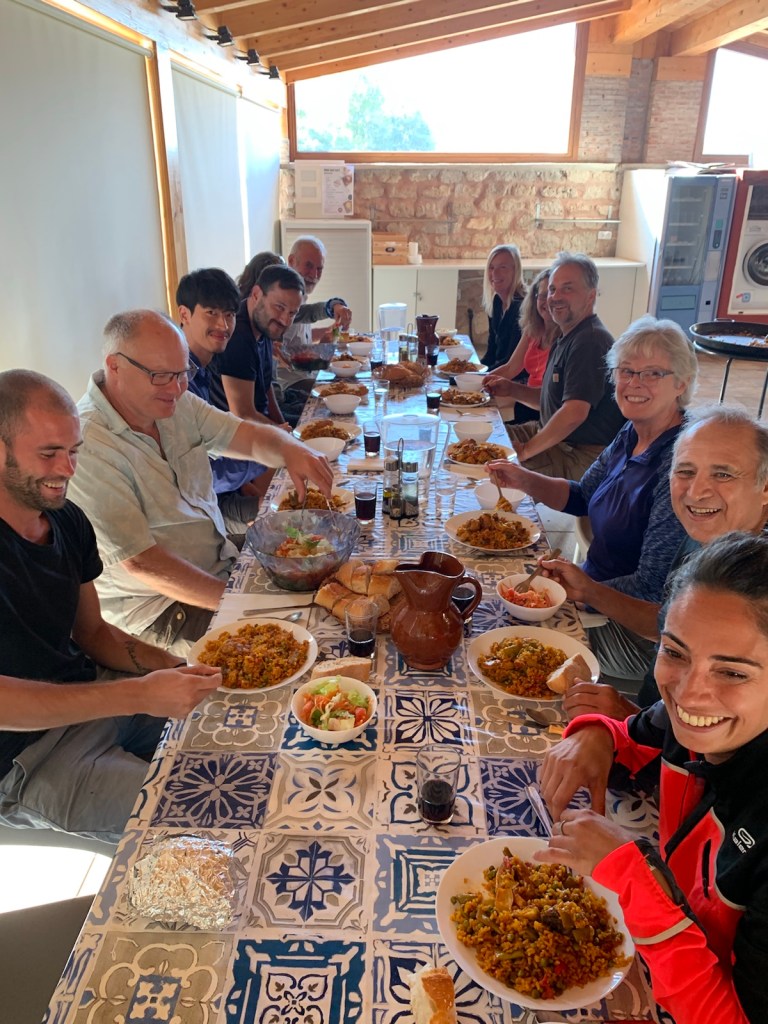
The dinner was a simple green salad, freshly baked bread, homemade paella (we watched them prepare it this afternoon) and a delicious lemon pudding for desert with red wine or water to drink. They have served the same menu every night for 4 years.
There were 14 pilgrims at the family style meal from Denmark, Spain, Germany, South Africa, Korea, Colombia and the U.S. (Texas & New York).
A happy, delicious international pilgrim dinner
Our conversation was interesting and engaging and though sad to end so soon, as we will all go our different ways in the morning, it was the kind of experience that makes the Camino so special for us.







 The most delicious paella we’ve ever had
 All that was left of our delicious paella lunch/dinner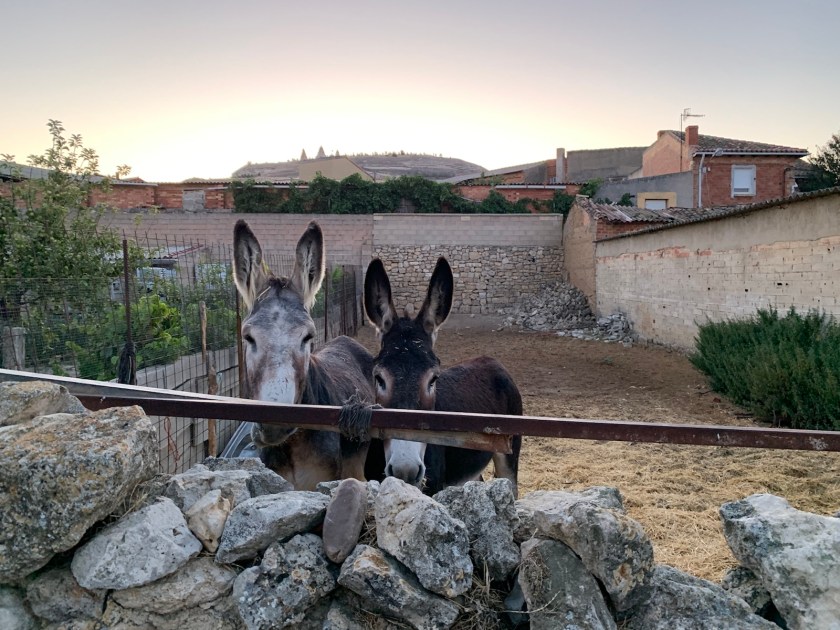
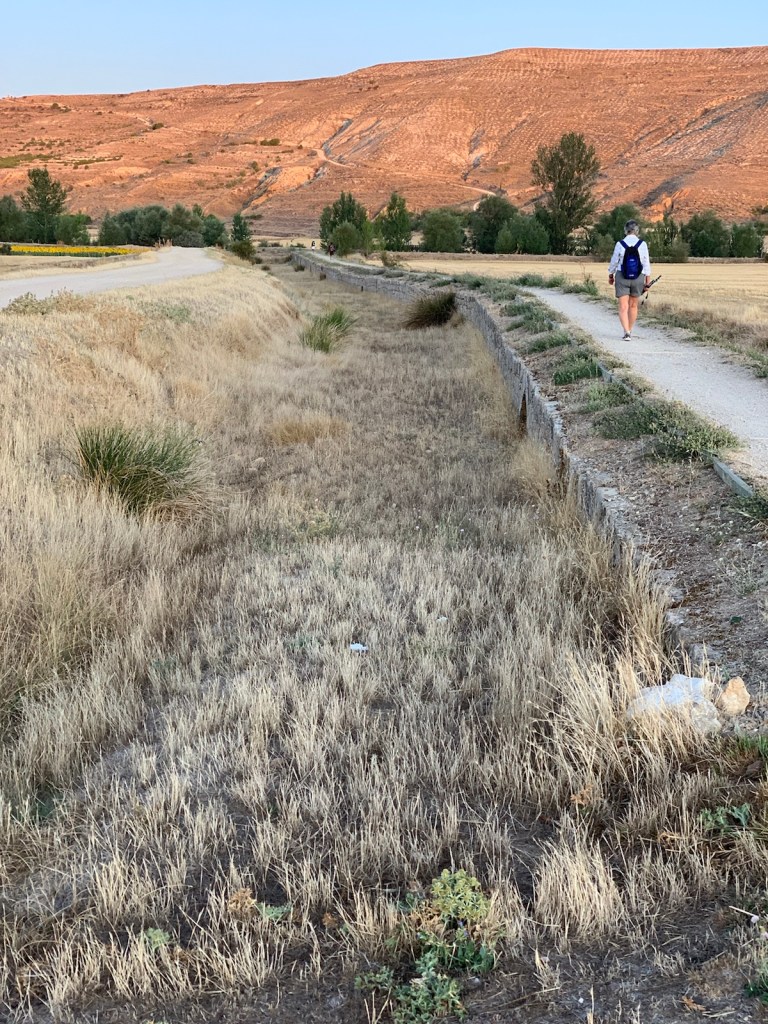 Linda walking across a 2000 year old causeway
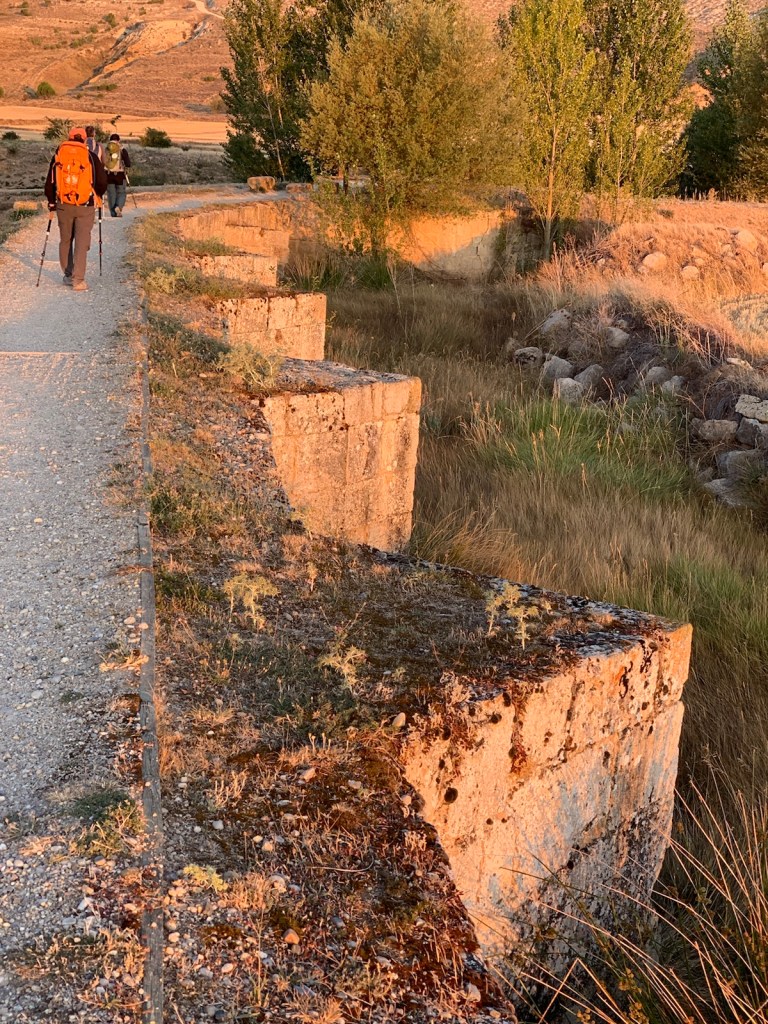 Classic Roman design to divert water from bridge structure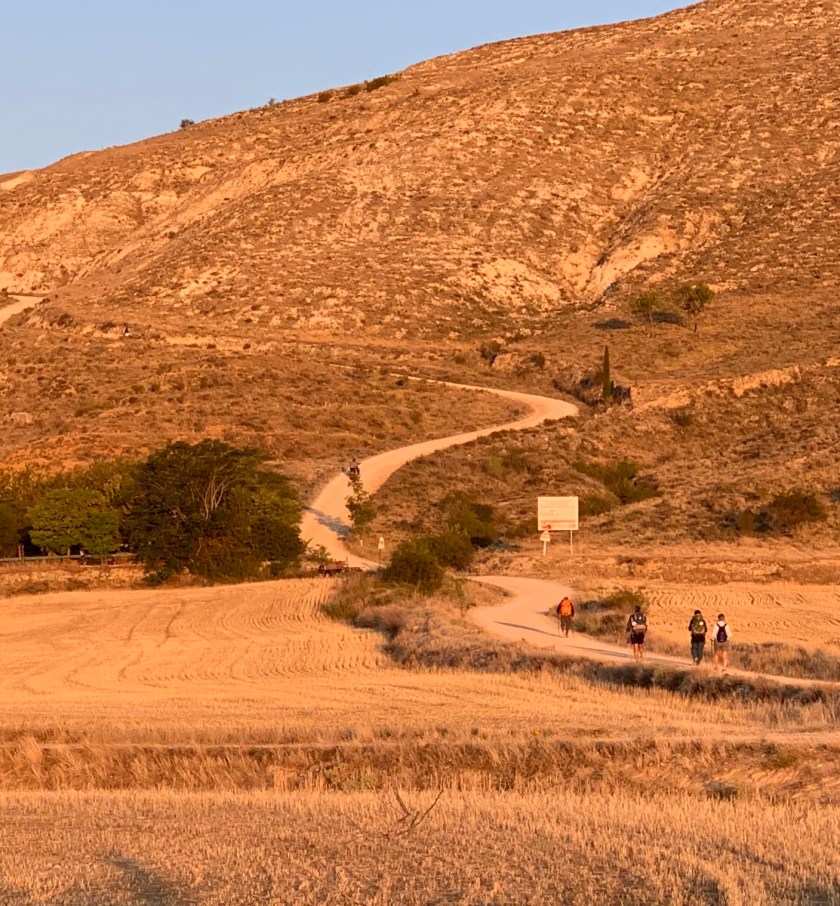
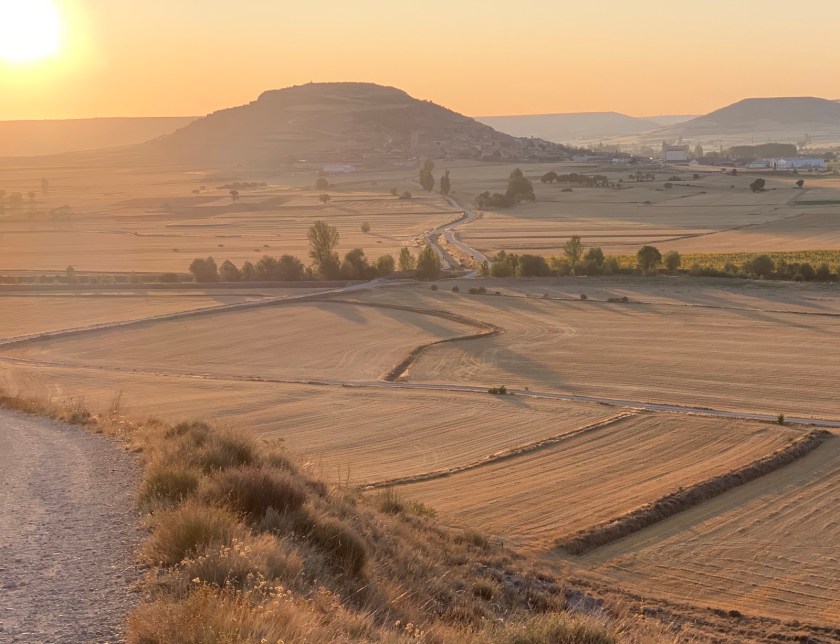
 Photo effort number 2
 Linda reaching the top
 One last look back
 They even were wearing and showing off their shiny, matching rings.
 So, Roman or Romantic, we had it all during our first 2 miles.
 back on to the plain, we thought…
 Ooops!
 straight down, no switchbacks like on the way up
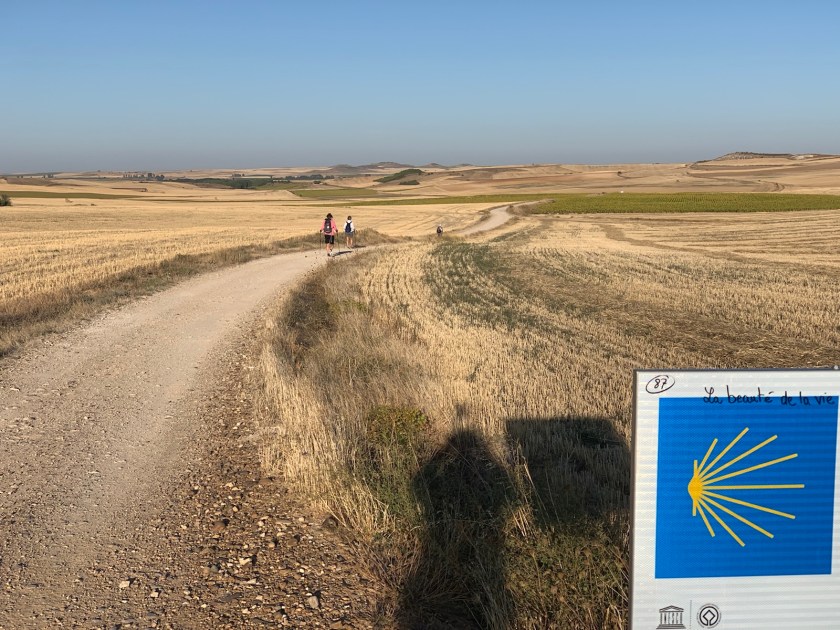 The Meseta is boring? We don’t think so!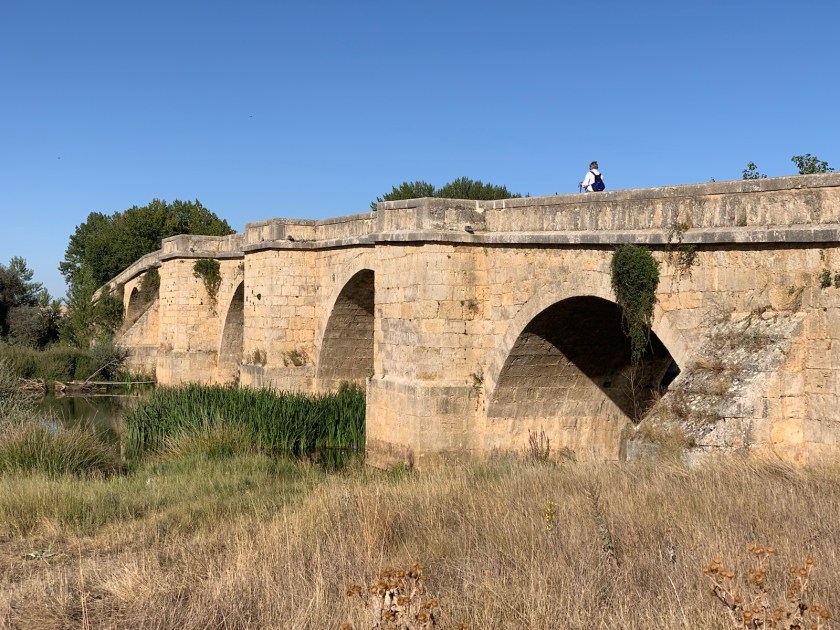




 on our way up to the Meseta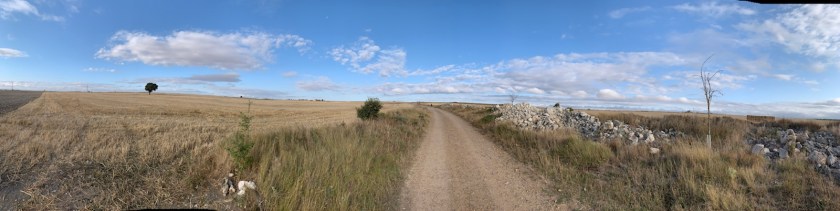
 Out first sign of a valley or bowl on the Meseta.
 Taking on the “mule killer”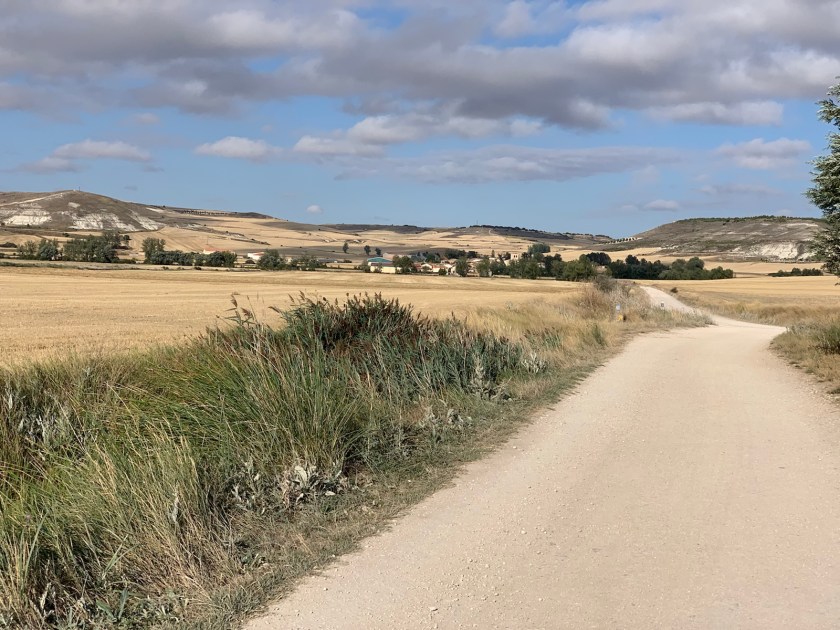
 Jimandi