It was in the high 30’s when we began walking at 8:20.
Leaving our El Acebo albergue at 8:20 and 38F.
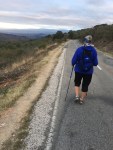
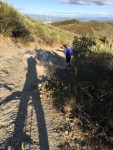
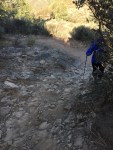
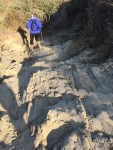
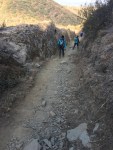
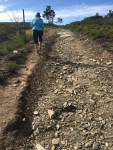
The walk from El Acebo to Molinaseca included some very difficult paths dominated by protruding and loose shale. We were frequently slowed to a snails pace by truly terrifying treacherous terrain. Linda twisted an ankle in this area on our first Camino in 2015, so we were perhaps more cautious this time to prevent a Camino ending injury.
Whenever possible we walked on the parallel narrow asphalt road, but returned to the path when the road swung a significant distance away from the path.
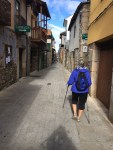
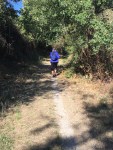
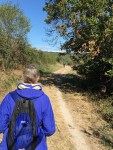
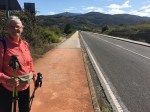
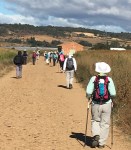
From Molinaseca to Ponferrada we walked on sidewalks and a path that supposedly was a shortcut by 1.2 miles, but only took us into the city in a roundabout way with no saving in time or distance.
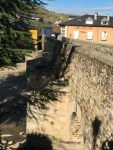
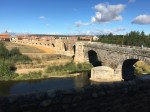
Peregrino bridge into Molinaseca
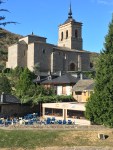
Iglesia de San Nicolas in Molinaseca
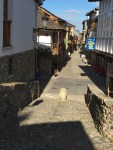
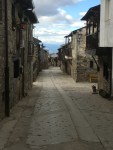
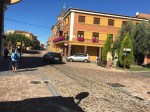
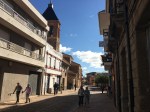
Walking through old Molinaseca
The beginning of our “shortcut”
So far, the short cut is only taking us along the normal highway entrance into Ponferrada.
A long short cut!
The weather was chilly but the sky was clear so we were rewarded with beautiful scenery for our efforts.
Ponferrada started off as a Celtic settlement, followed by a Roman mining town. The city was destroyed first by the Visigoths and then Muslim invaders. After the Reconquista, Bishop Osmundo of Astorga commissioned a pilgrim bridge here, which was unusually constructed with steel beams, giving the city its modern name. Ponferrada was a booming pilgrimage town, with diverse merchants including Franks and Jews, who were protected during a 15th-century restriction that called for segregating communities. The railroad came to the city in 1882 and in the 1940s the town grew with the coal industry.
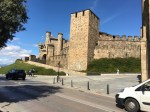
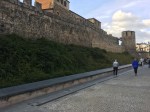
The most impressive site is the  Templar castle built in the 13th century over a destroyed Visigoth fort, which was built over a Roman fort, which was built over a pre-Roman castro. Soon after its completion, the Templars were banished.
According to legend, the castle holds all kinds of secret Templar symbolism, such as the 12 towers representing the 12 months or the 12 disciples.
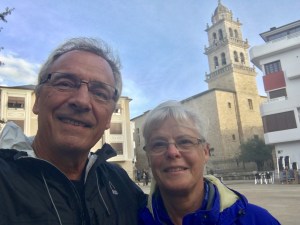
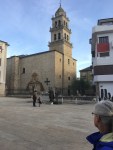
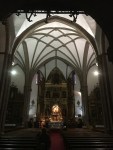
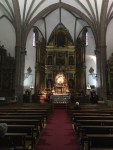
Iglesia de Santa María de la Encina on the Plaza Encinas, houses an image of Mary said to be originally in the Astorga cathedral, but it was hidden in the 9th century for protection from invading Muslims.
Years later, the image was miraculously found in an oak tree, hence the name “Our Lady of the Oak.” There is a statue in the plaza depicting the miracle.
We had a late lunch in our hotel, El Castillo, (55€) and pizza in a nearby plaza at 7:30 and called it a day.
Today was all about scenery and a spiritually significant location on the pilgrimage of Camino Frances.
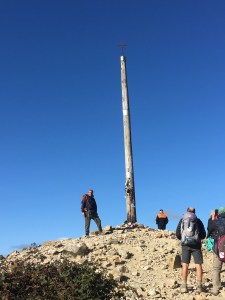
The taxi dropped us off at Foncebadón where we concluded our walk yesterday afternoon and we climbed the remaining 1.2 miles to the Cruz de Ferro, 4934 ft, the highest point on the Camino Frances.
Our starting point at Foncebadón
Ruins and newer buildings at Foncebadon
Leaving Foncebadón
Looking back at Foncebadón on our way to Cruz de Ferro
Approaching Cruz de Ferro, pentacle of the Camino Frances
Where the cross is now located is thought to have originally been an altar built to the Roman god Mercury, whereas some stories say that it is where the Celts worshiped, either way the origins were pagan. The cross is believed to have been placed here in the 11th century by Gaucelmo.
Traditionally pilgrims have left a rock here, whether picked up along their journey or brought all the way from their homeland. Some of the rocks that have been left here contain little messages to loved ones or the name of the pilgrim’s home town.
The tradition of pilgrims leaving a stone at the Cruz de Ferro was originally a very religious one and the purpose was to say a prayer at the Iron Cross and leaving the stone behind was very symbolic in that you were really leaving behind all your sins.
More recently, the tradition has been built on the recognition of leaving behind not only the sins that pilgrims carry but also other burdens in their life or the burdens of a loved one.
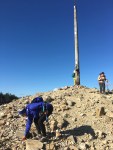
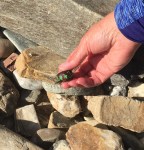
Linda placing memorial for Ed
Linda placed a hand painted chestnut inscribed “Ed + Jo” for our friend Joselle, in memory of her beloved husband, Ed.
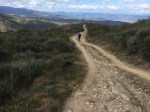
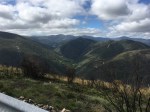
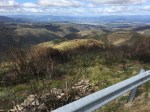
From the Cross, we walked another 5 miles, nearly every few steps an incredible new breathtaking view from the top of the world,
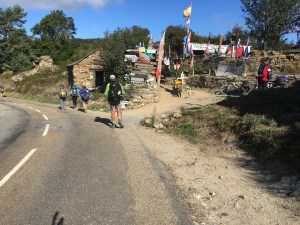
walking down Monte Irago, passing Manjarin and continuing down a very steep, loose stone laden path into El Acebo (elevation 3770 ft).
Two pilgrims on rocky switch-back below Jim
Linda waiting for Jim to make it off the downslope into El Acebo
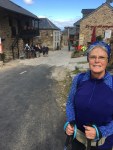
Just arriving in El Acebo
El Acebo (pop.37) is a picturesque village typical of mountain villages of upper Bierzo with houses built from and covered in slate, the typical building material of the region. The slate laden paths add to the difficulty of the steep descent into the village. Another characteristic of the homes are the street-facing wooden balconies, that sometimes reach outside of an outdoor staircase. After finally breathing a a sigh of relief upon reaching the cobble stone street through the village, even it is built on a 30 degree slope.
We stopped at Hostel La Rosa del Agua (57€) and had lunch at 1:00pm until our room was ready.
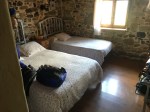
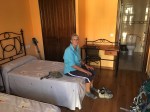
Our room
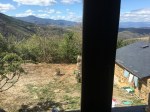
The view out our room window
Today has been chilly and windy beginning at 31 degrees in Foncebadón at 10:00 am and still a cool, windy sunny afternoon in the low 60’s, so we pretty much camped out in our room, washed clothes and rested from the morning hike,
Main Street… with a 30 degree slope.
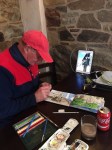
An artist from New Zealand who was painting local scenery at the lunch table next to us
Two delightful German ladies who sat next to us at dinner. They are only walking for 10 days but we have encountered them several times over the past three days.
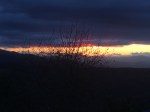
took a brief walk and finished the day viewing a dramatic sunset.
As we left Santa Catalina, it was a nice walking morning except for the 10mph wind in our face.
Clouds overhanging mountains and strong winds as we left Santa Catalina de Somoza
Camino paralleled the road all morning, windy but sunny initially, but strange cloud formations as we approached the Cantabrian Mohntains warned of changing weather.
Our breakfast stop at El Ganzo
We stopped at Ganzo (pop.30) for breakfast and for Jim to put on a windbreaker and Linda a buff to cover her ears.
We continued on and the clouds got more ominous as we climbed deeper into the Cantabrigians Mountains, so we put on our pack covers and put our ponchos in outside, easy-to-reach pouches for the inevitable deluge. But thankfully, all we got was continuing winds and drizzle.
Still windy and beginning to drizzle as we left El Ganzo
The Camino several miles outside of Rabanal del Camino… threatening sky all the way
Just outside Rabanal, pilgrim crosses in fence.
We reached Rabanal del Camino (pop.73) after climbing over 650 feet to an elevation of over 3800 ft.
The Hosteria El Refugio (50€) didn’t open until 11:30, so we had an early lunch at a nearby bar while we waited to check in.
Walking into Rabanal del Camino (all uphill)
Our hotel
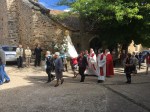
Religious procession this afternoon at church across from our hotel
We settled into our room and as we had hoped, the skies began to clear around 2:00 so we had a pilgrim lunch/dinner at 4:00 and then decided to walk to Foncebadón, another 3.5 miles up.
We originally wanted to stay tonight at Foncebadón but everything was booked so we opted to stay in Rabanal. This put us in the situation of having to walk nearly 11 miles tomorrow starting with the steep climb to Foncebadón, another steep climb to the Cruz de Ferro, the highest point on the Camino Frances, then another 5 miles down steep, rocky terrain to El Acebo.
Just outside Rabanal del Camino on our way to Foncebadón
Scenery made the steep climb worth it
Brush got quite heavy and path narrow on the way up to Foncebadón
Rough going on the steep and rocky path
Why did the pilgrim cross the road?
Almost to the top on rocky path
Finally at Foncebadón with cows grazing and views of Astorga in distant background
An albergue dining room and bar in Foncebadón where we called for taxi
We made our way to Foncebadón, by climbing another 800 ft to an elevation of 4600 ft, enjoying the beautiful views on the way up and at the top, allowed now by clear, blue skies. Once we got to the first albergue, at about 6:30pm, we called for a taxi and by 7:15, we were back in our room for the night in Rabanal del Camino.
We’ll sleep easier tonight knowing that we won’t have to tackle the walk to Foncebadón in the morning.
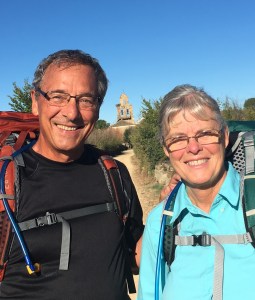
At 7:40 it was light enough to walk without headlamps and long sleeves/long pants were very comfortable at 48F with no wind. The rising sun had the beautifully, clear blue sky all to itself.
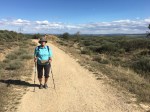
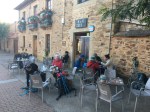
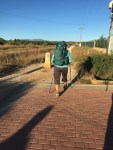
Sidewalks through Astorga and the adjacent village of Valdeviejas, then a path alongside a lightly travel secondary road got us to Murias de Rechivaldo. It was a really attractive village with a wide bricked walkway that led us to a strategically placed bar that was perfect for breakfast.
Attractive village of Murias de Rechivaldo (pop. 108) with brick street/walkway
Our breakfast spot
Leaving the nice brick walkway in Murias…
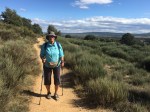
The next 3 miles were on a narrow, mostly straight dirt path surrounded by bushes and small trees, that gradually climbed 300+ feet in elevation before taking us into the village of Santa Catalina de Somoza (pop.60).
About to walk into Santa Catalina de Somoza
Main Street (Calle Real) in old Santa Catalina de Somoza.
Our albergue, El Caminante (40€) is a real diamond in the rough in what some Camino guides call a ghost town. We really love this place.
Our habitacion doble con bano is immaculate, adequately spacious and on the second floor, overlooking a closed courtyard surrounded by dormitory rooms housing bunkbeds (litera) at 5€ each.
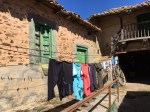
It has a separate area for washing clothes by hand or machine(3€) and hanging them out to dry with plenty of line and clothespins. Kinda like we died and went to heaven. (Thanks, Camino)
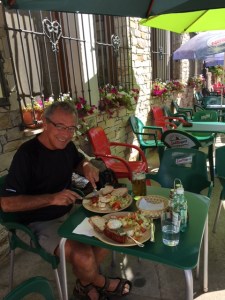
The bar/restaurant/albergue is beautifully decorated, the staff is very friendly, professional and service oriented. An abnormally wide range of tasty foods are available all day and the prices are very competitive.
Jim spent much of the afternoon sitting under an umbrella outside the albergue on “Calle Real”, working on the blog, greeting passing pilgrims, sipping a “cervesa grande” and occasionally coaxing an undecided pilgrim (be they German, Italian, Spanish. Australian, etc) to either stay for a meal or overnight.
Linda spent her afternoon exploring the small village, trying unsuccessfully to keep Jim out of mischief and stealing a few winks in our quiet, cool room.
At about 6:30, we took a nice walk around the village and viewed some of the great scenery around us, as we are on our way up to Foncebadón and nearby Cruz de Ferro, the highest point on the Camino. Our appetite built. We then returned to our albergue dining room and had a nice dinner including a bottle of the local wine, a fitting finish for another day on the Camino Frances.
Today we left the meseta and begin to walk among rolling hills with more green trees and even mountains came into view, previewing the nature of our challenges for the coming days.
A change in terrain and scenery after nearly a month on the meseta
Walking among hills again after crossing the meseta
After walking for 6 miles in our new terrain and just outside San Justo de la Vega, we stopped at the Crucero de Santo Toribio. It is named for the 5th-century bishop of Astorga who was said to have fallen to his knees in despair at this spot, after being banished from his beloved city. We haven’t been able to determine why he was banished, but you’ll be the first to know if we find out. One clue is that he became a saint immediately after his death.
From the Crucero, we could see the spires of the Astorga Catedral.
We left the rolling hills and packed clay path and walked onto the sidewalks of San Justo and on into Astorga, after crossing the railroad tracks via another high, zig-zag pedestrian bridge.
Walking from San Justo de la Vega to Astorga
Pedestrian crossing over railroad tracks
Final climb into the old town of Astorga
The final climb up a very steep hill into Astorga old city was tough, especially at the end of a 9+ mile walk.
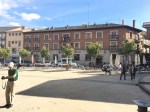
The Tuesday market completely jammed our walk from the Plaza San Francisco with a display of excavated Roman ruins
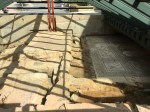
Excavation of Roman ruins in San Francisco Plaza
Excavation of Roman home occupied by a wealthy family for several hundred years beginning in 1st century AD
all the way to Plaza del Eduardo Castro.
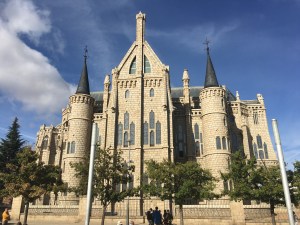
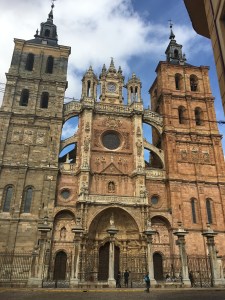
The Gaudi Hotel (65€) was located directly across the plaza from Palacio de Gaudi and diagonally across from the 15th century Santa María Catedral.
The Gaudi Hotel
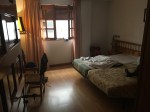
Our room after being lived in for half a day
The Palacio de Gaudí, was a palace for Archbishop Juan Bautista Grau Villespinós until his death. It sat empty until serving as a military headquarters for the Falange movement. In 1963, it became a Camino Museum.
The Santa María Catedral was impressive and imposingly huge in the relatively small space it occupied on the plaza. Later in the day when it was open for visitors we took a tour inside.
Beautiful front portal of the Catedral
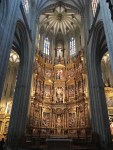
Retablo and ceiling in front of sanctuary
Person standing near base of one column shows the enormous size of the Catedral
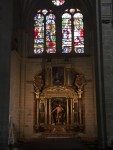
Beautiful stained glass above one of over a dozen chapels within the Catedral
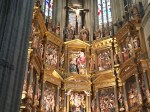
Top half of large Renaissance Retablo
Astorga, (pop 12,078), first a Celtic settlement, developed into an important Roman city at the crossroads of the Via Trajana and the Vía de la Plata, as well as an important center for Christianity. According to legend, both St. James and St. Paul preached here. The bishopric of Astorga was one of the earliest Christian titles. The city passed to the Visigoths in the 5th century and was destroyed by the Muslims in 714, then reconquered by Ordoño I in the mid-9th century. After León was destroyed by Al-Mansur’s army, Astorga acted as the capital of the kingdom. The city flourished with the pilgrim trade and housed 21 pilgrim hospitals, the second most on the Camino Francés (after Burgos). One of these hosted Saint Francis of Assisi on his pilgrimage in 1214.
What a difference a day makes. We were beginning to have some negative feelings based on the walks before and after León.
An early break from walking beside N-120
Camino still alongside N-120
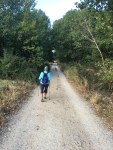
Walking along highway but more agreeable than yesterday
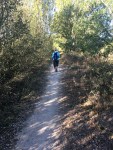
But this morning, even though we were again walking along N-120, the Camino started out with a walk in the woods, then a little later, found some more trees that sheltered us a bit from the traffic noise and even took us by some blackberries.
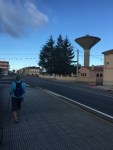
Walking toward San Martin with unusual water tower
San Martin del Camino with alien spacecraft masquerading as water tower.
Our breakfast stop in San Martin del Camino was also positive with a beautifully decorated albergue, very pleasant owner and monstrous cafe con leches and tostatas for only 3€ each… oh, and a spotless bathroom.
Path with tree buffer from auto traffic
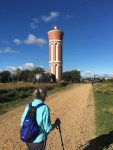
Brick water town on way into Hospital de Órbigo
We didn’t consider walking on asphalt today because of the high level of Monday morning traffic. So we stuck to the path, which also was variably pleasant.
About 6 miles into our walk we came to Hospital del Órbigo (pop.1031), a lovely town with beautiful cobblestone and brick streets, well maintained buildings with colorfully filled window flower boxes especially in the old town section and perhaps the most impressive bridge we’ve seen.
El Paso Honroso
Heading across 13th Century bridge
Hospital de Órbigo old town square
Hospital de Órbigo old town looking back toward bridge
We picked a bar with a good vantage point and stopped for an OJ while we admired the bridge.
The impressive 13th century Gothic bridge over the Río Órbigo is the site of a legendary medieval jousting competition. Don Suero de Quiñones, a wealthy Leonese knight, was rejected by the woman he loved. In his heartbreak, he locked his neck in an iron collar and swore he would not take it off until he had defeated 300 knights in jousting. The call went out, and knights from all over the kingdom came in the Holy Year of 1434. Quiñones succeeded in his quest, freeing him from the torment of love. He took off the collar and made a pilgrimage to Santiago where he left a bejeweled bracelet, which can still be seen in the cathedral museum. The bridge became known as El Paso Honroso “the Honorable Pass.”
We returned to the Camino and as we walked out of town we were engulfed by 20-30 apparent tourists.
Tour group moving ahead of us… can you guess the tour leader?
Pretty scenery just before reaching Villares de Órbigo
How could we tell? Well, they all were wearing clean, unwrinkled clothing. The men’s shirts and women’s blouses were colorful, smart casual at the least, their shoes were not dusty and they all had nice, new small day packs.
Jim surveiled (profiled) the group, identified and walked alongside the leader and opened a conversation. The leader was Alberto, an Italian, and the group was traveling by bus, walking sections of the Camino that held particular interest for the group. The were traveling for 30 days, had begun in Roncesvalles, skipped the entire meseta and were eventually targeting Santiago. Countries represented in the group were Italy, Great Britain, USA, Spain, Japan and China. When Alberto heard we were from South Carolina he immediately was concerned about our home and family due to Hurricanes Irma. We assured him that we were in contact with family and all were safe.
Our albergue on right
Front of albergue
He wished us “Buen Camino” and the group continued on as we reached Villares de Órbigo and stopped at the Albergue Villares de Órbigo (25€) for the night.
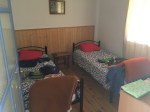
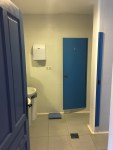
We occupy the only habitacion doble in the albergue. It has two bathrooms, men’s and womens with WC, showers and sinks.
Entrance of albergue
View of albergue courtyard/common area
Our double room
Men’s bathroom
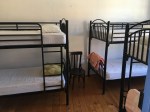
A look at a 6 bed room
Shortly after we arrived, checked in and began our chores, we met Ken, a retired Lutheran Minister from St Marks church in Williamsport, Pa! This is his second Camino and like us, he is going the full 500 miles this time after doing the Camino in parts his first time.
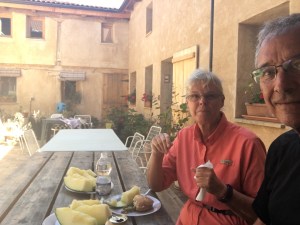
The albergue has a communal kitchen and so we shopped at the village “supermarket” for canned tuna, baguette, olives and mayonnaise and fixed our own tuna bocadillos for lunch. We also bought a large melon, which we shared with the other pilgrims in the albergue.
The albergue also has a centrifuge. Why? To ring out hand washed clothes. And it really works! Jim washed several items, used every muscle in his upper body to squeeze the water out and then got another pint of water out with the centrifuge. Needless to say, the clothes were dry in less than an hour.
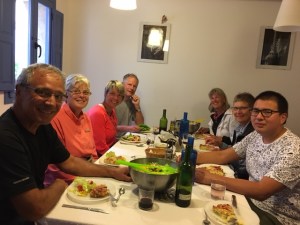
Our pilgrim dinner was prepared by our hostess and albergue owner, Christine, originally from Belgium. We had a nice pumpkin squash soup, a mixed salad, delicious tortillas and rice pudding for dessert… and delightful interaction with fellow pilgrims.










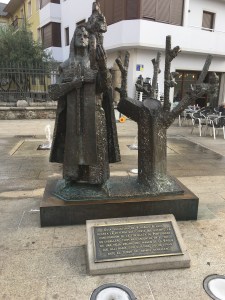 There is a statue in the plaza depicting the miracle.
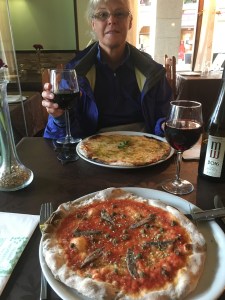 in a nearby plaza at 7:30 and called it a day.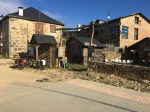
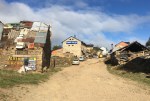
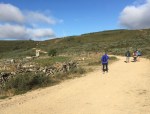




 and continuing down a very steep, loose stone laden path into El Acebo (elevation 3770 ft).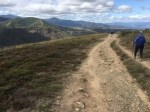




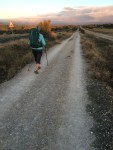

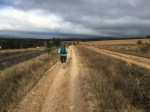
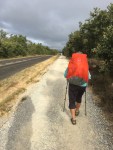
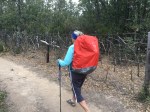



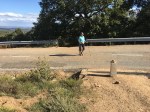
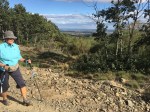
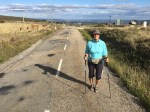
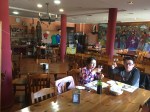
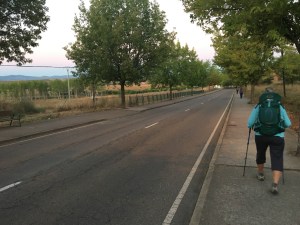 then a path alongside a lightly travel secondary road got us to Murias de Rechivaldo.
 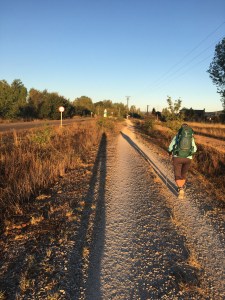 It was a really attractive village with a wide bricked walkway that led us to a strategically placed bar that was perfect for breakfast.
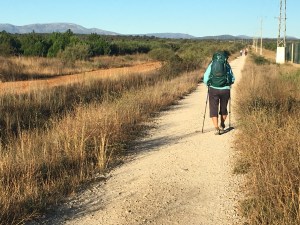 that gradually climbed 300+ feet in elevation before taking us into the village of Santa Catalina de Somoza (pop.60).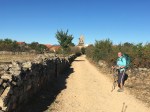
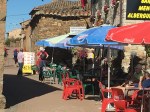
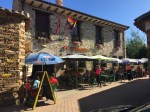
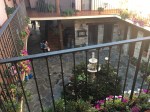
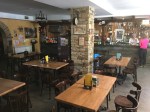
 An abnormally wide range of tasty foods are available all day and the prices are very competitive.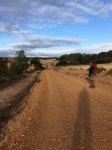
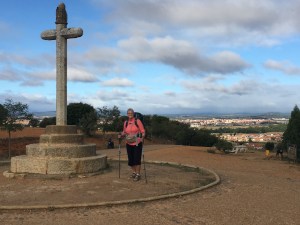 It is named for the 5th-century bishop of Astorga who was said to have fallen to his knees in despair at this spot, after being banished from his beloved city. We haven’t been able to determine why he was banished, but you’ll be the first to know if we find out. One clue is that he became a saint immediately after his death.
 It sat empty until serving as a military headquarters for the Falange movement. In 1963, it became a Camino Museum.
 Later in the day when it was open for visitors we took a tour inside.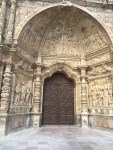





 Jimandi