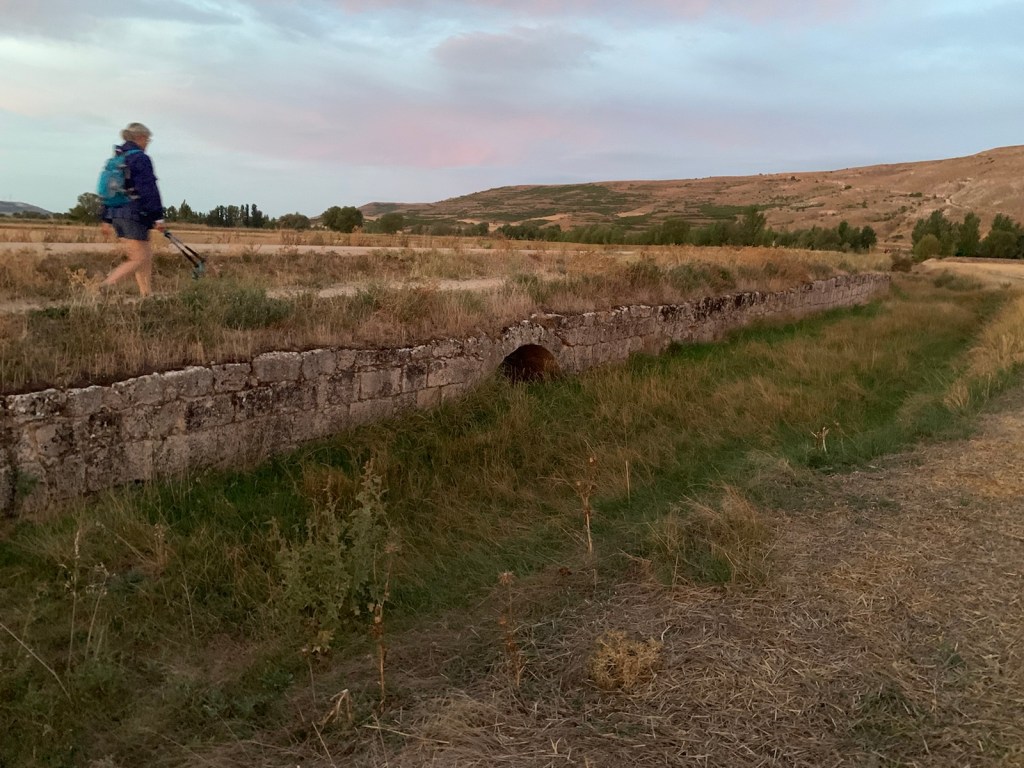
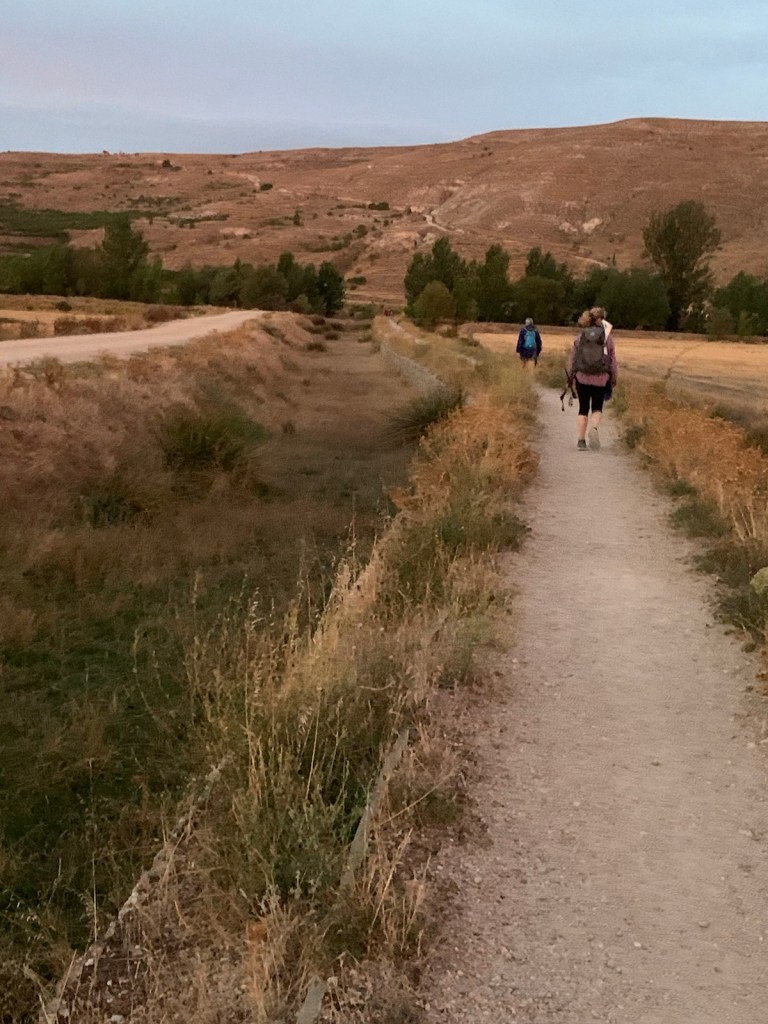
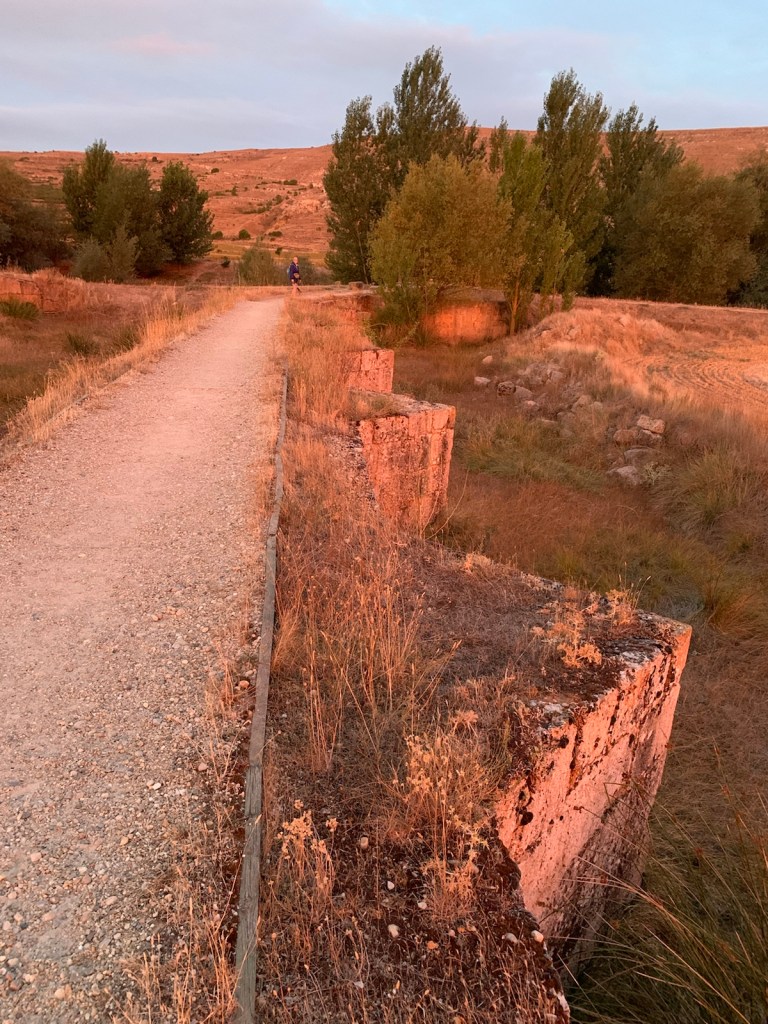
lobby of Hotel Iocabus as we left this morningJust a few hundred yards outside of Castrojeris, we began walking over a Roman causeway! … then the remains of a connecting Roman bridge!!…the Roman bridge ruins, with red highlights from spectacular sunrise rise behind us.Another progressively spectacular sunrise as we walked toward the mountain
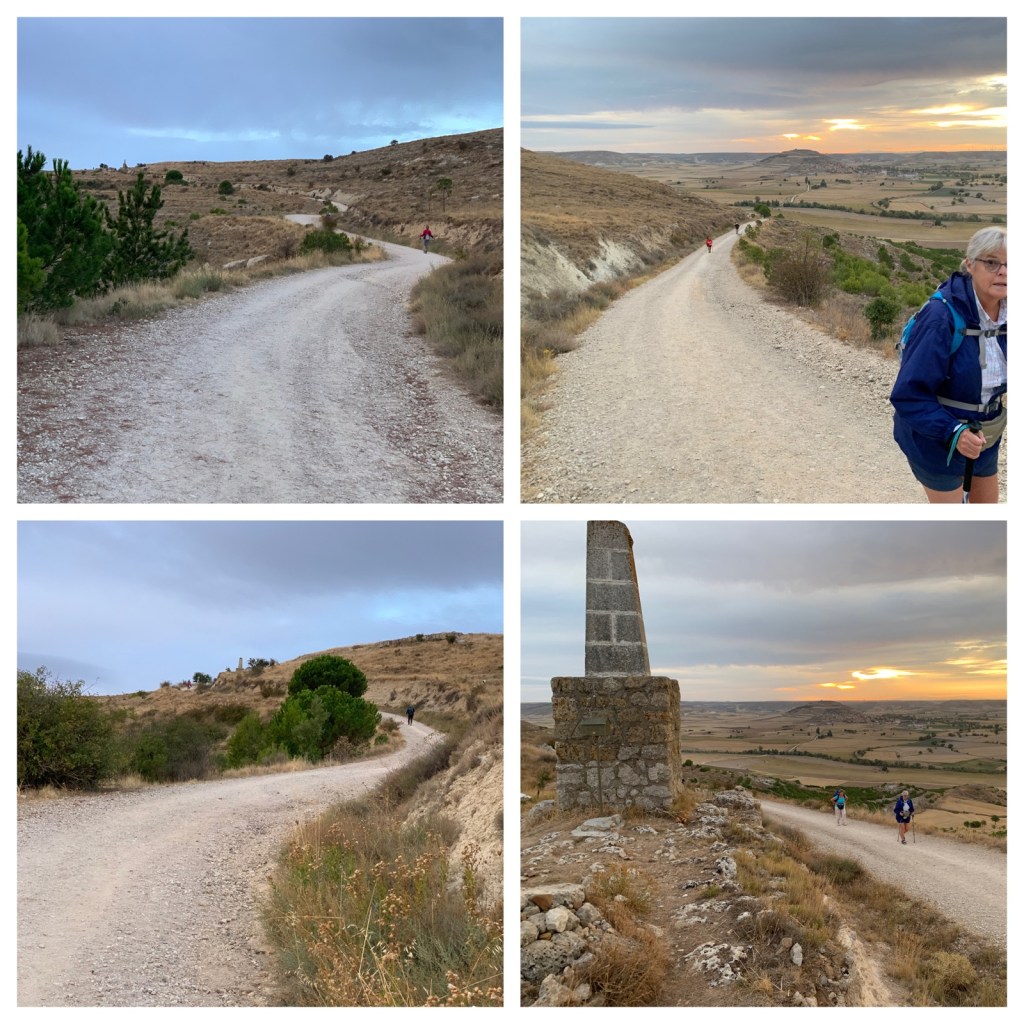
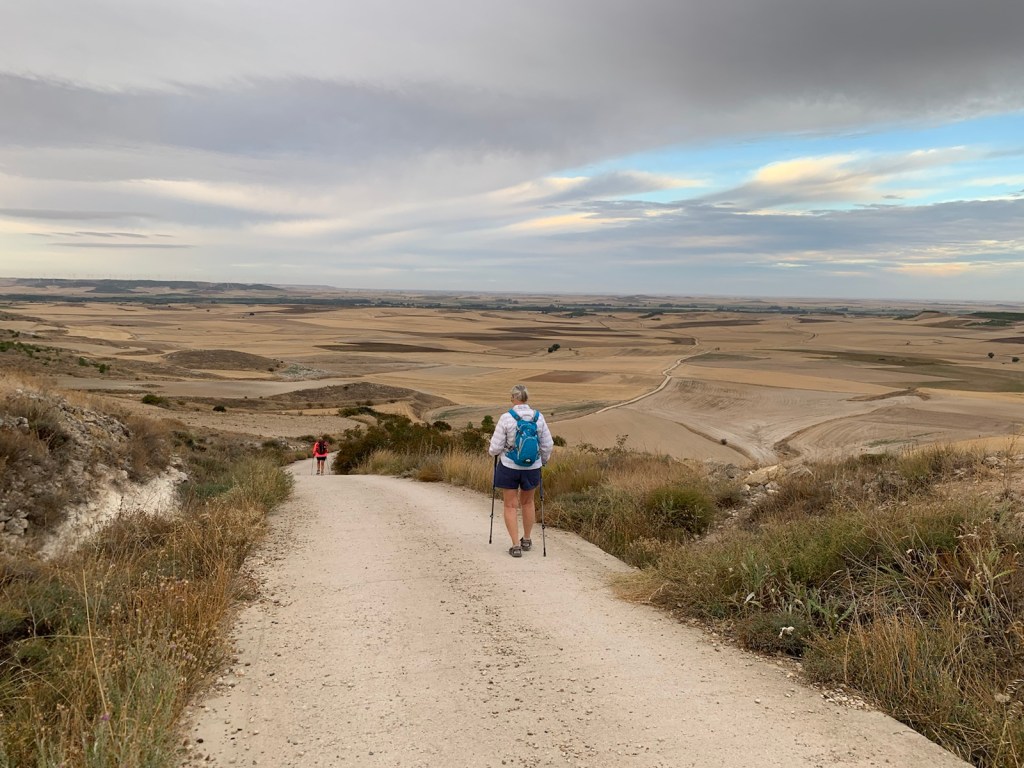
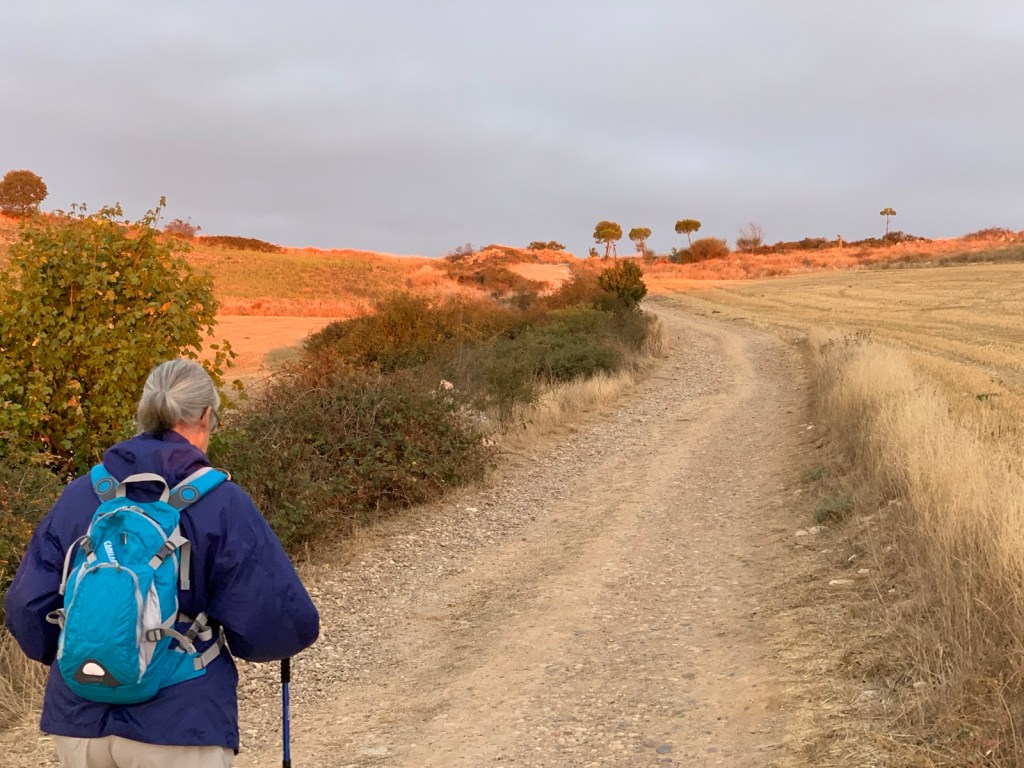
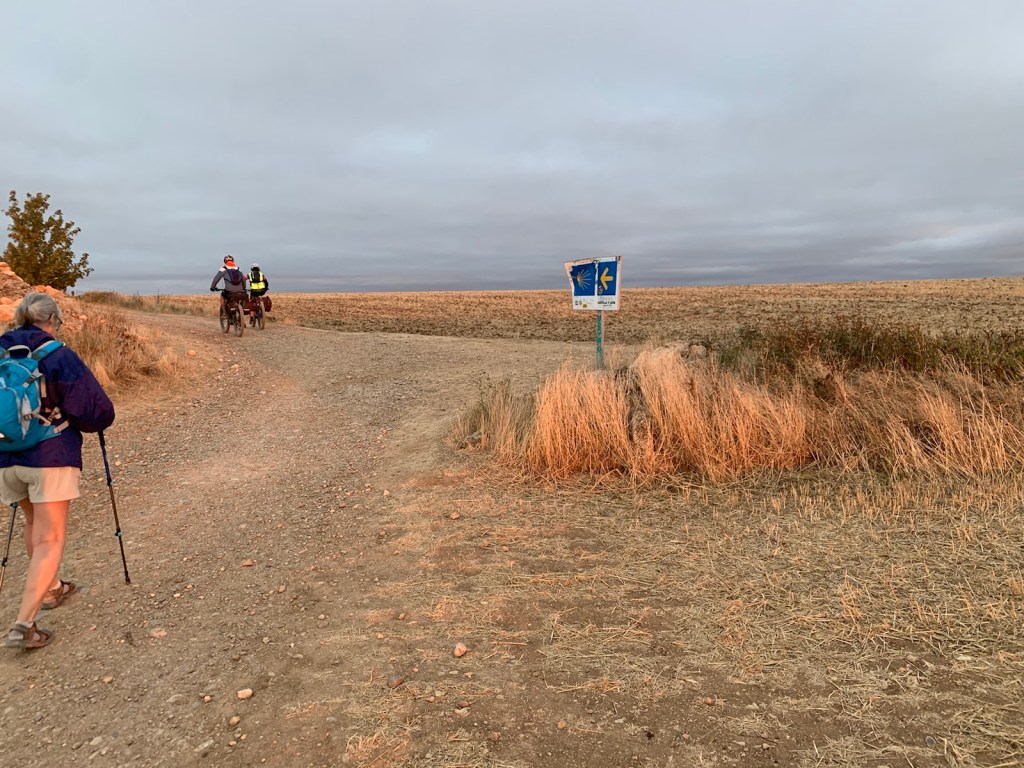
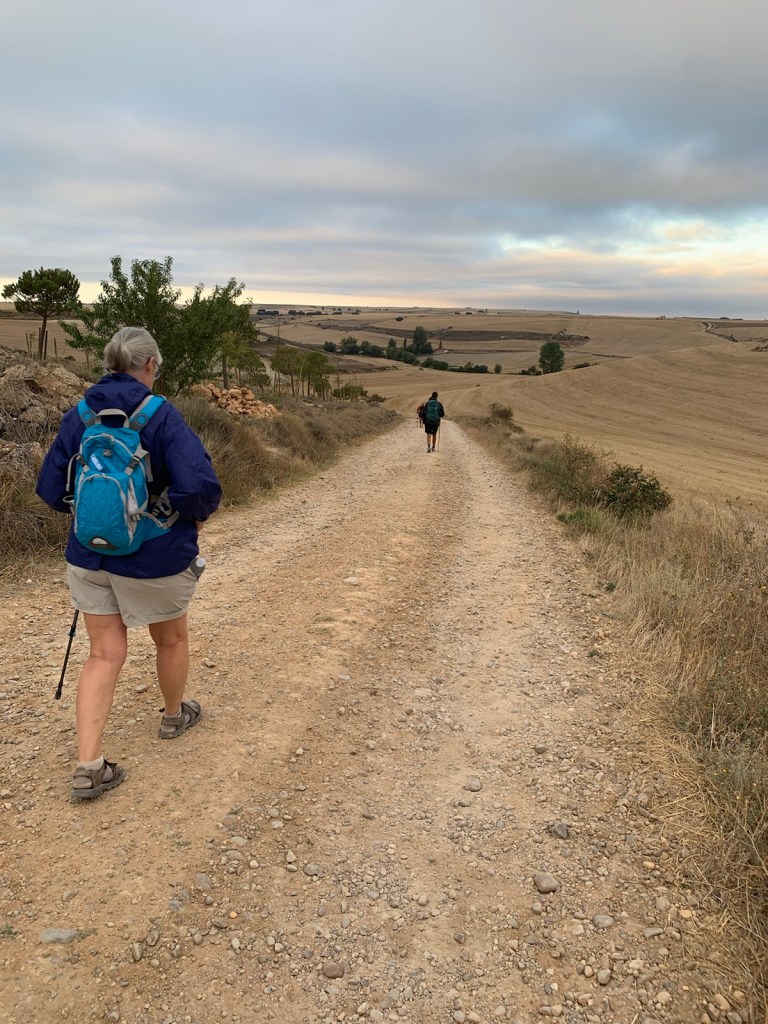
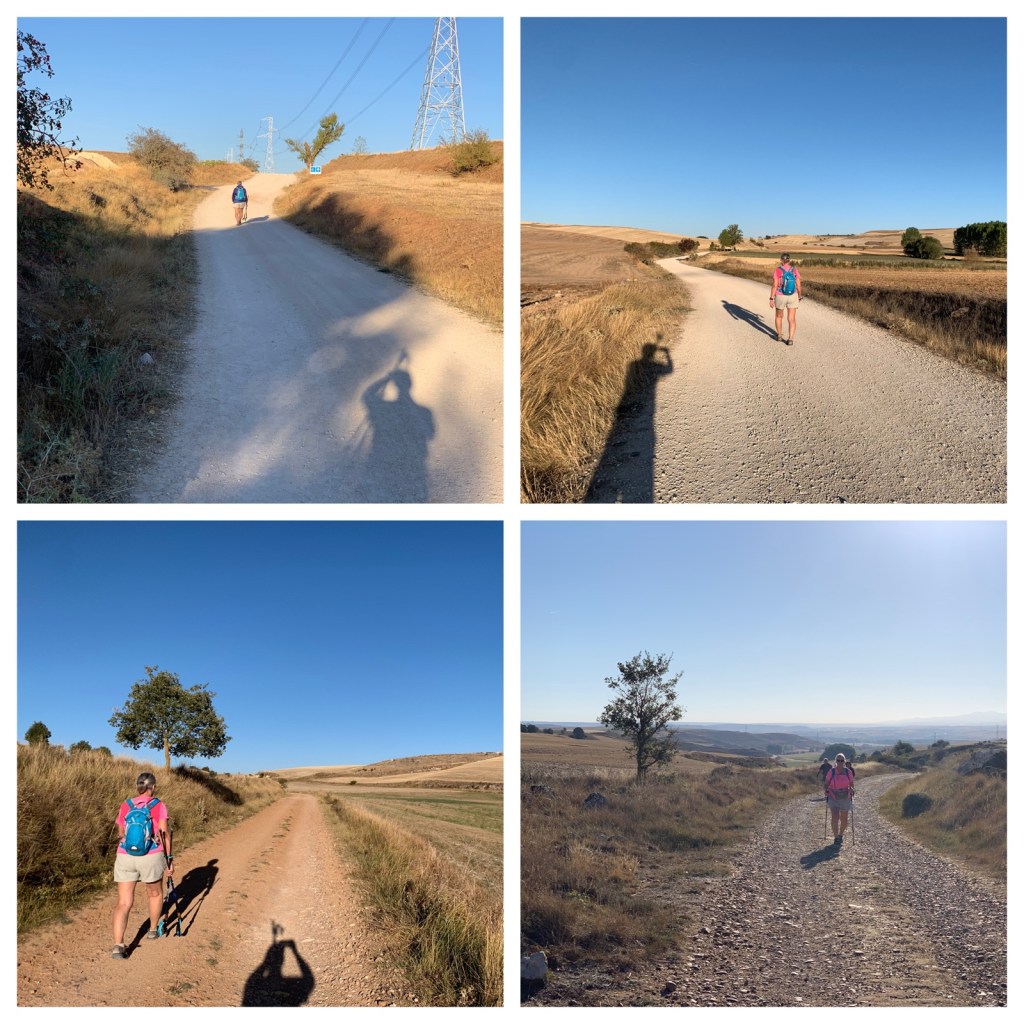
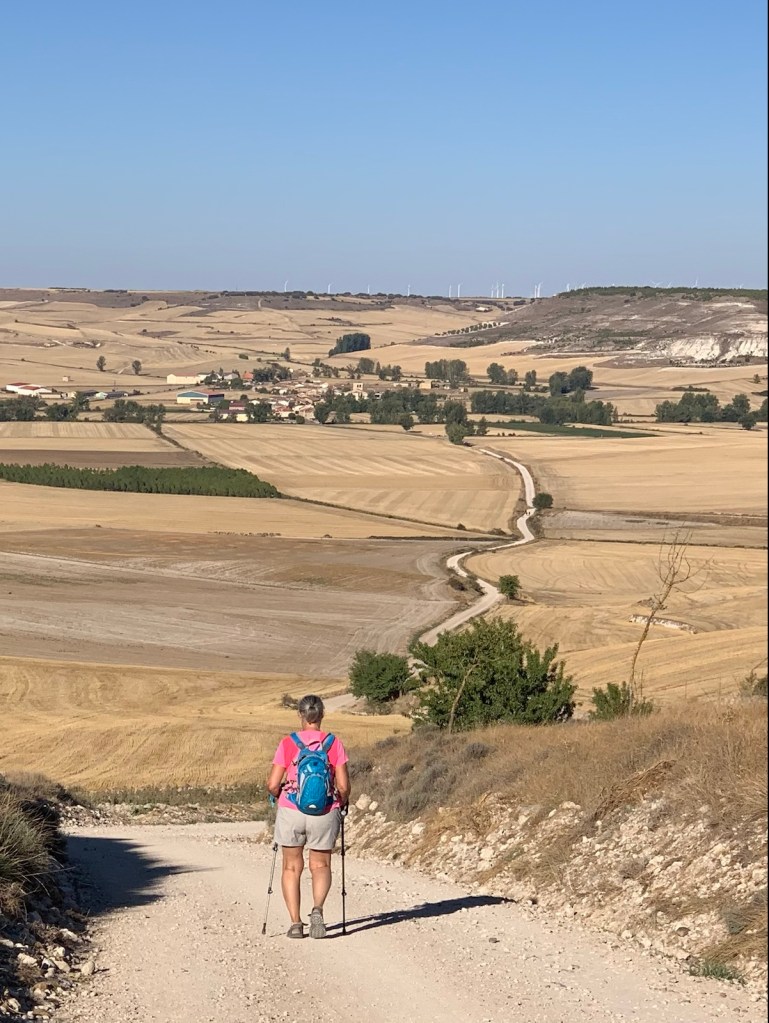
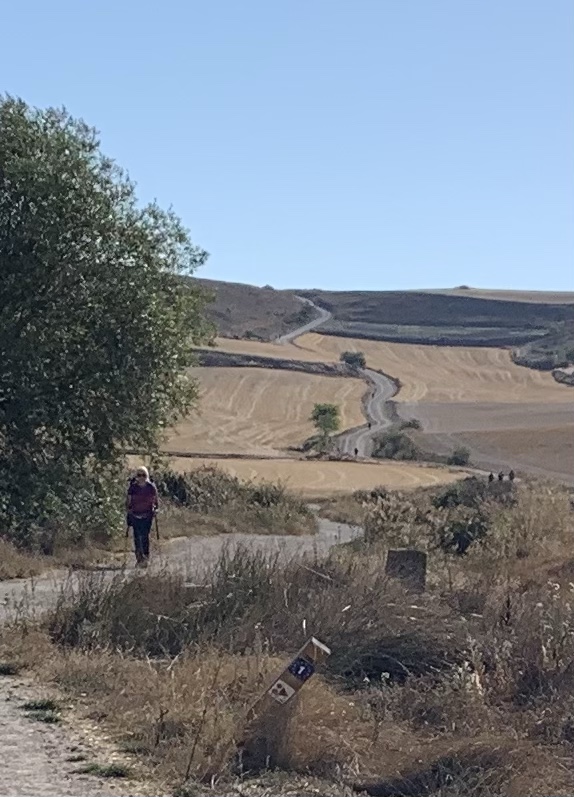
We thought we’d let you walk up the mountain with Linda this morning. Follow the photos below in left-to-right order… her perspective looking ahead and looking back on her way up.
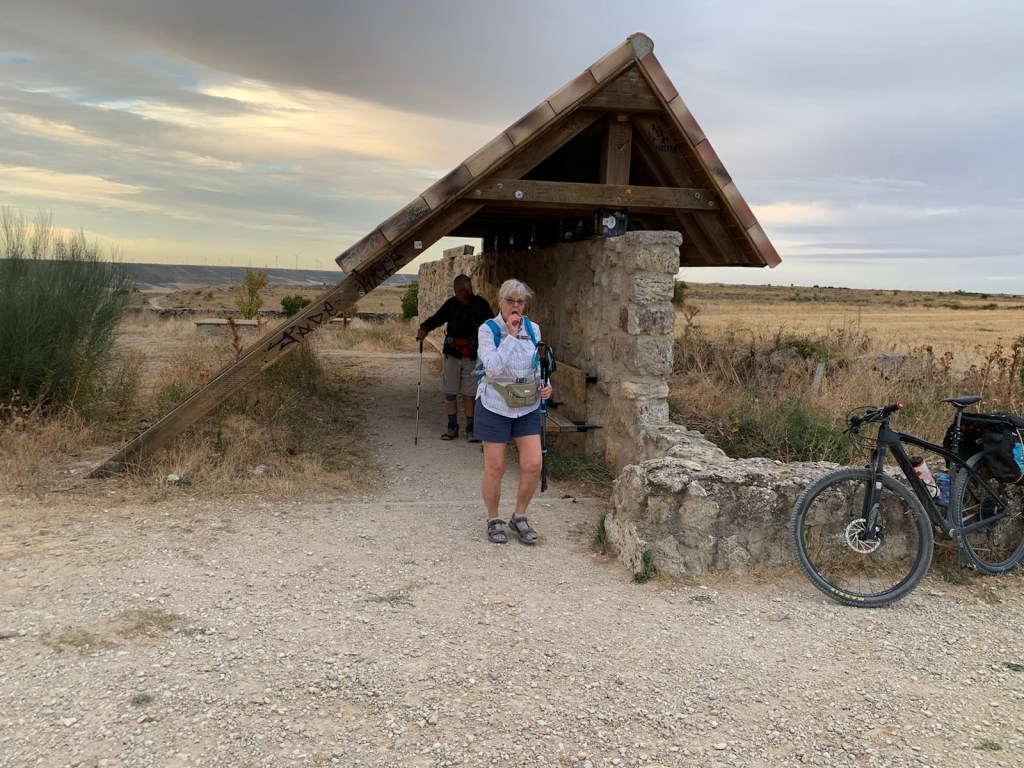
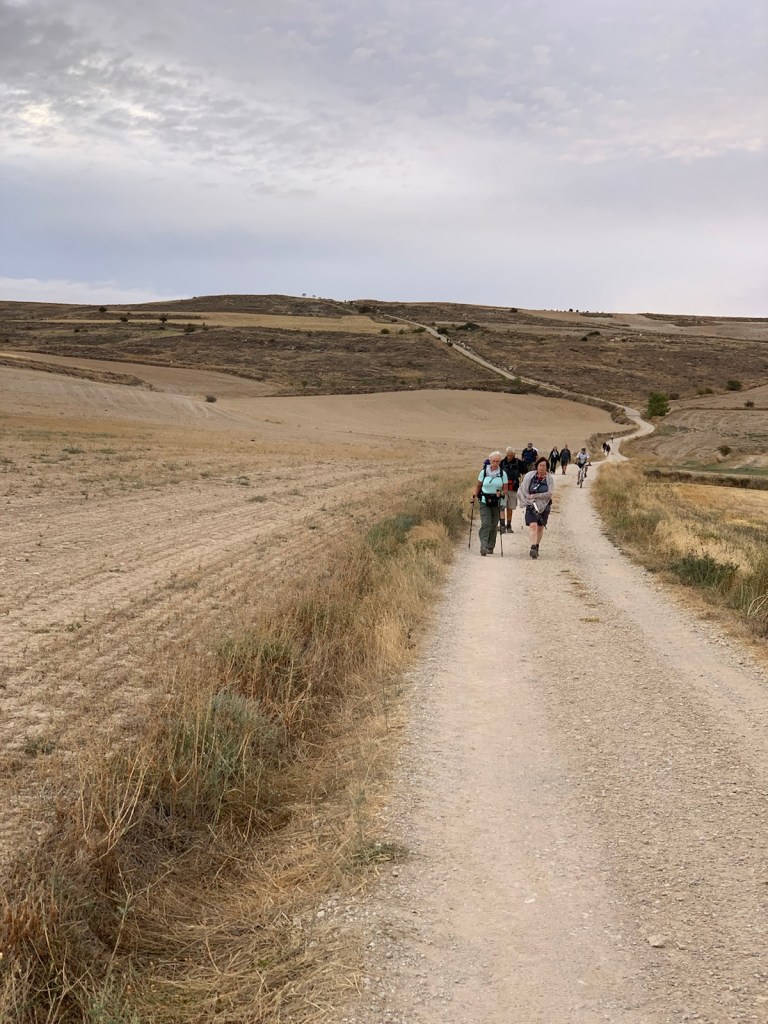
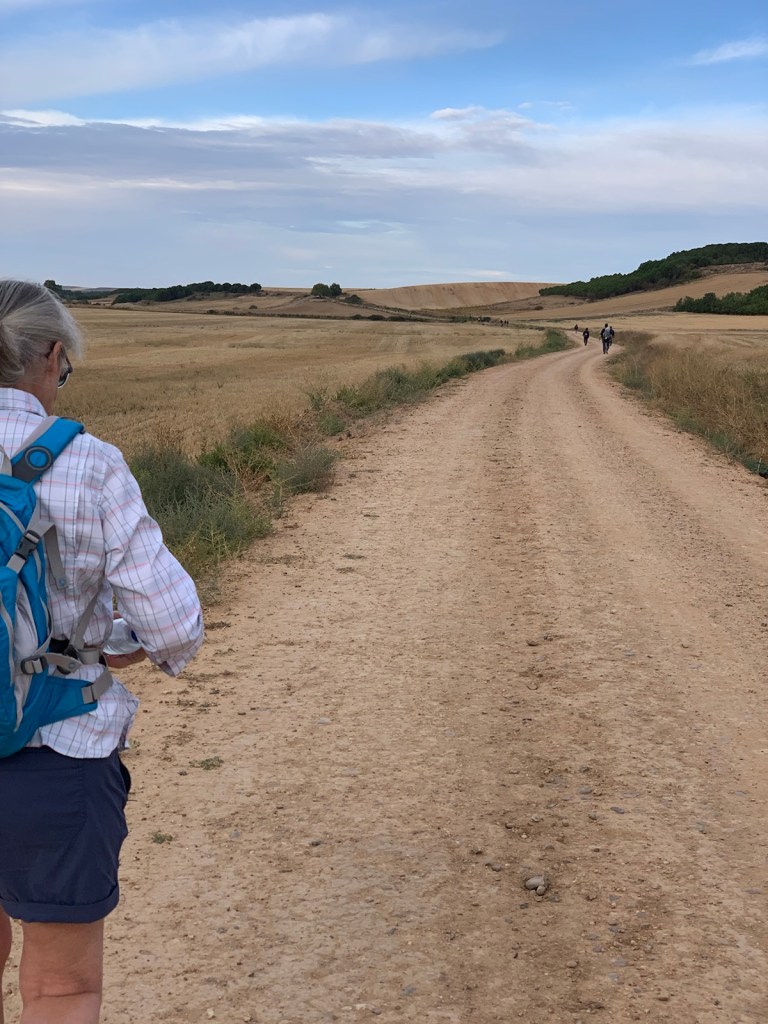
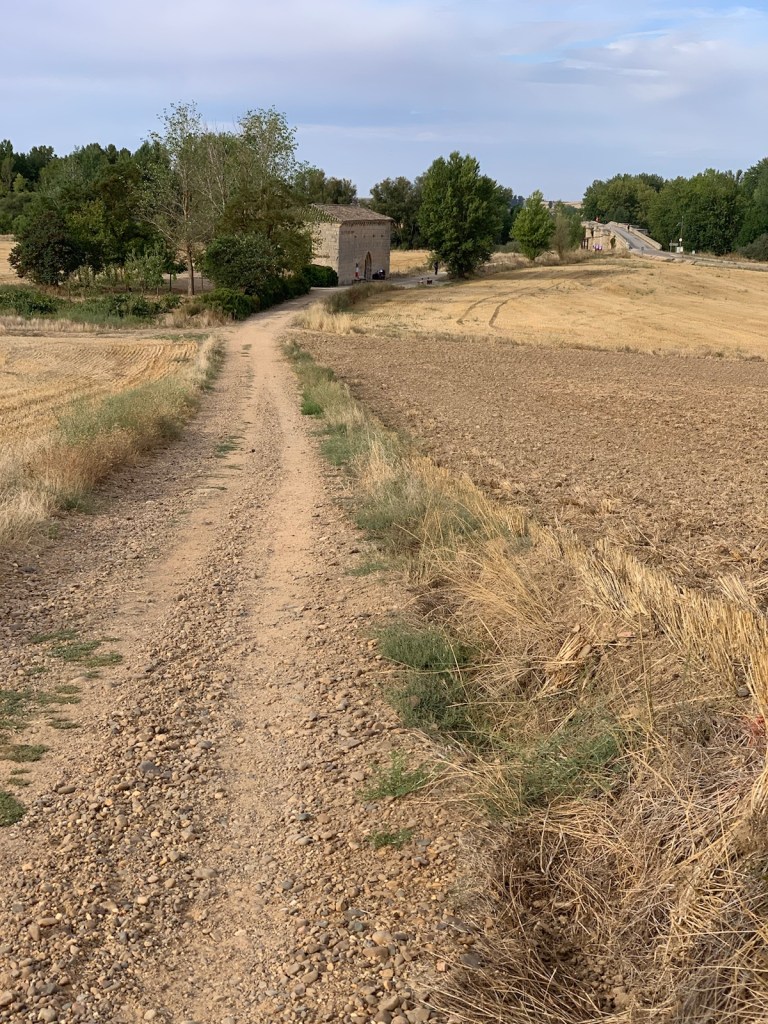
Linda working her way upYeah!!! Linda!!!…moving on, after catching our breath and a snack…back on topwhat goes up, must come downverrryyy steeeeepmade it!!looking back … lots of pilgrims “ chasing” uschange of scenery not far aheadWe’re walking on pavement for first time today with huge fields of sunflowers around us, nearing harvest time.“hermitage” and bridge ahead
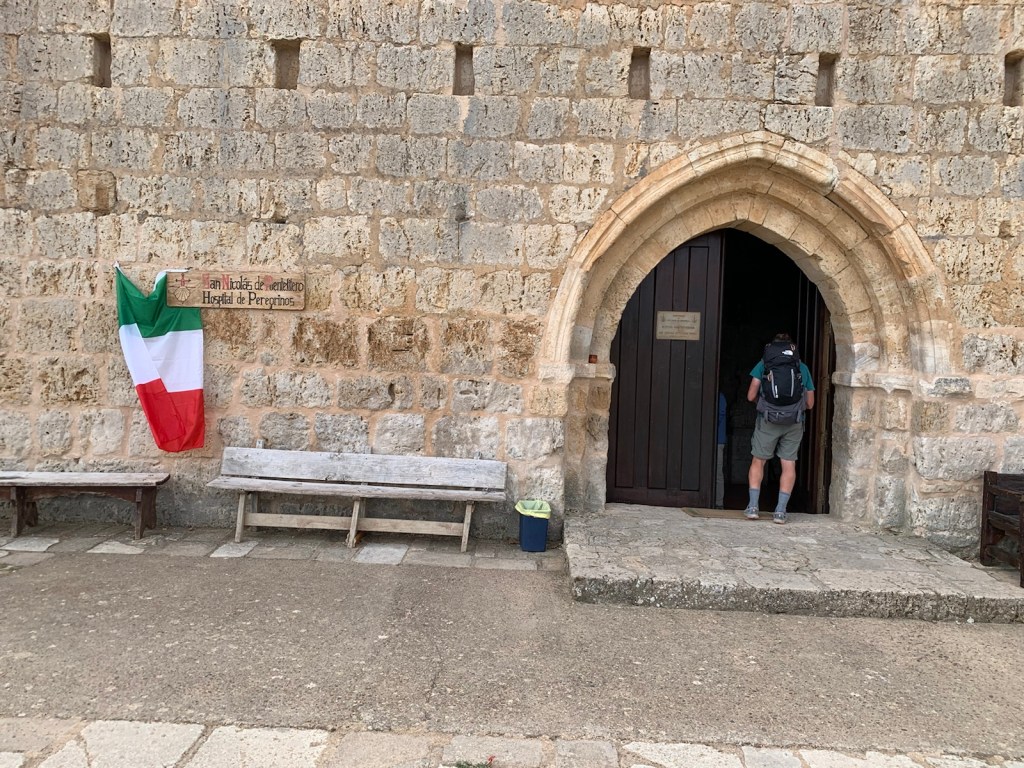
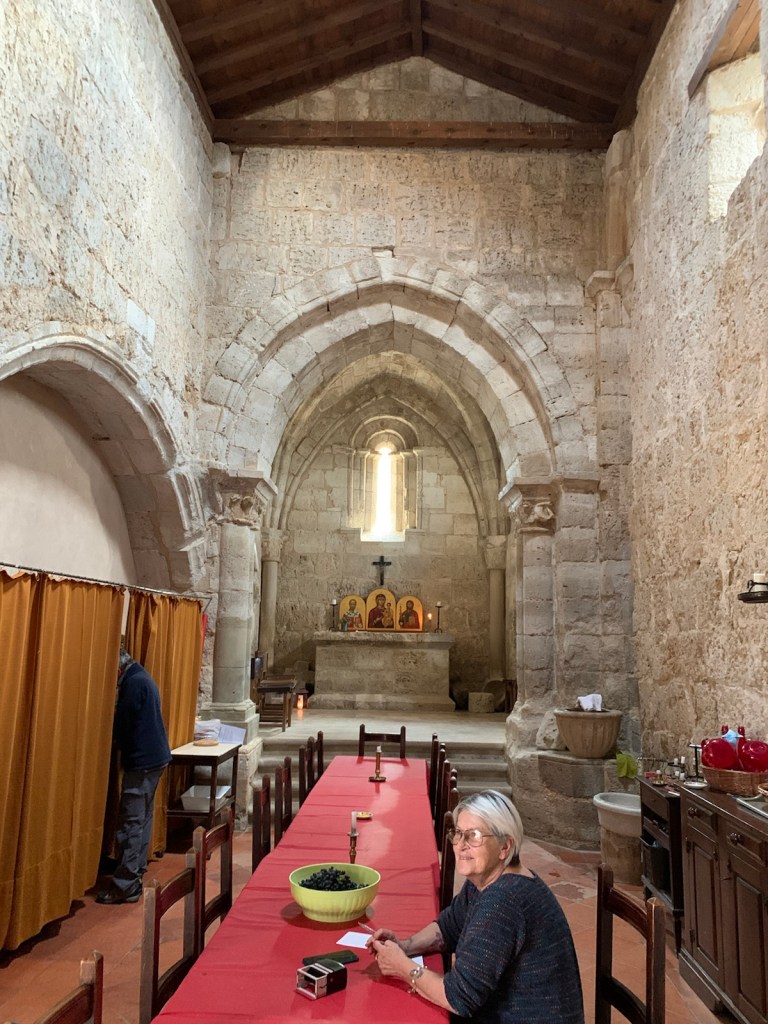
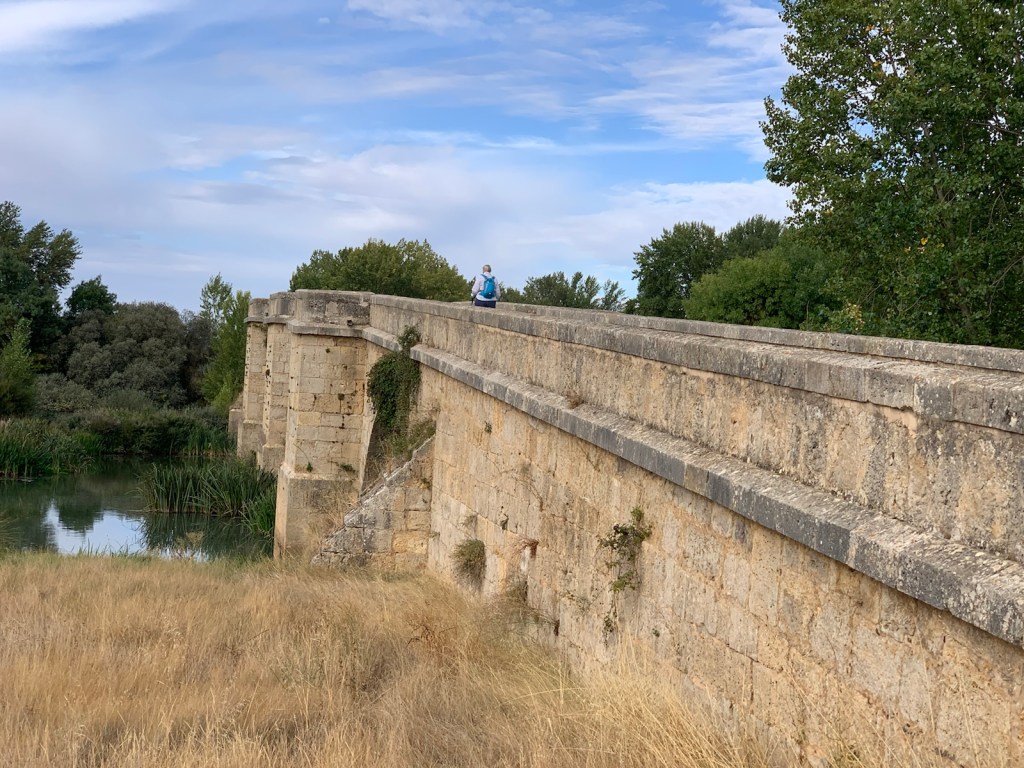
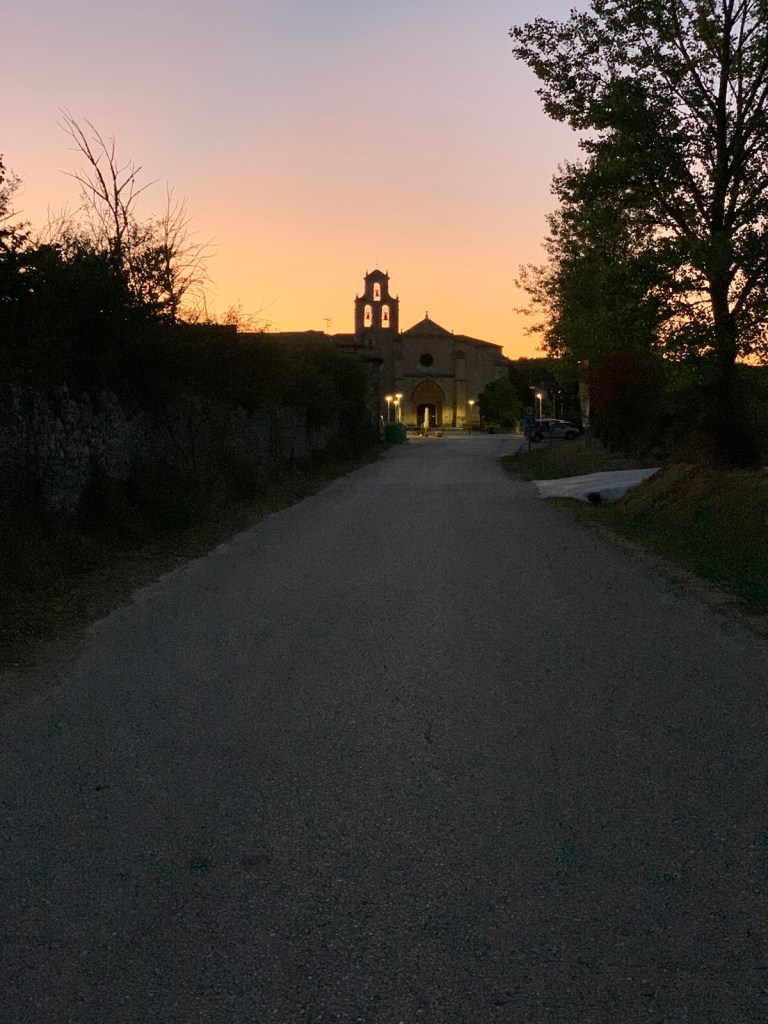
The hermitage of San Nicholas de Puentefitero dates back to the 12th and 13th centuries. Its membership in the Order of the Knights of San Juan, later known as the Order of Malta, is documented and linked to the presence of the nearby Fitero Bridge over the Pisuerga River, an infrastructure of great importance that linked the kingdoms of Castilla y León and, today, to the provinces of Burgos and Palencia. The Knights of San Juan would have taken care to keep the bridge in good condition, facilitating the passage of pilgrims and also offering them their hospitality.
San Nicholas de Puentefitero
A famous traditional pilgrim shelter, it was restored by and is supported by the Italian Pilgrims Association.
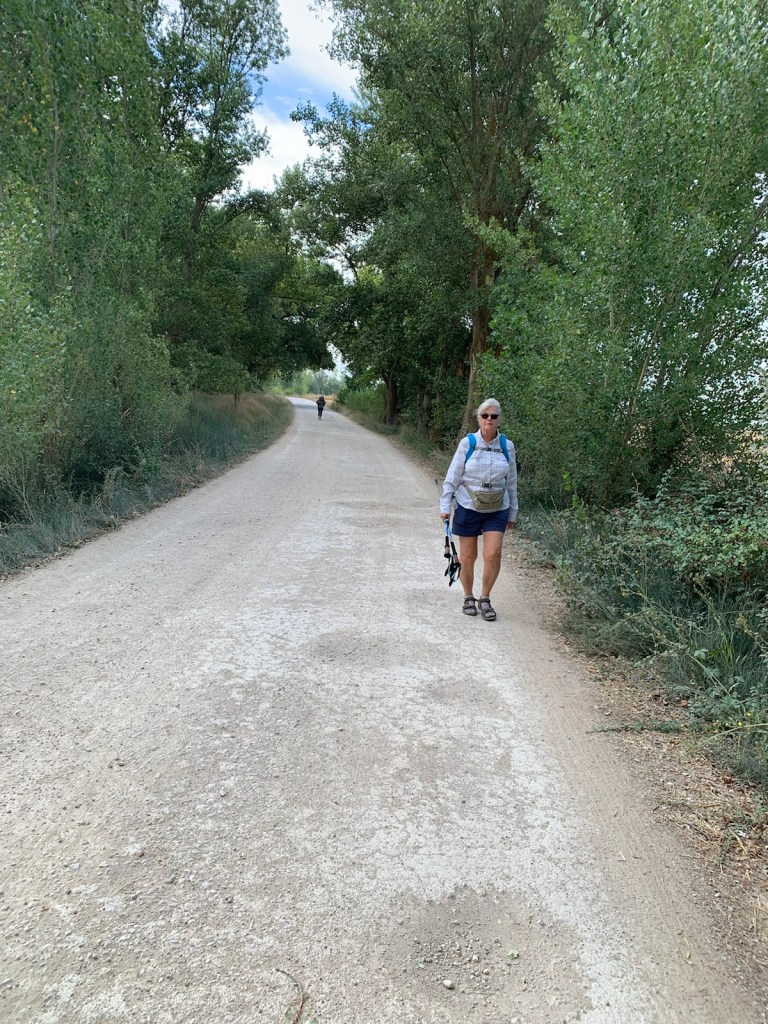
Puente de Fitero (11th century) one of the most beautiful and longest bridges on the Camino Frances.walking along the Pisuerga Rio and along the edge of a (poplar?) tree farm.Puente de Fitero alberge… now permanently closed.. was our initial choice to stay tonight
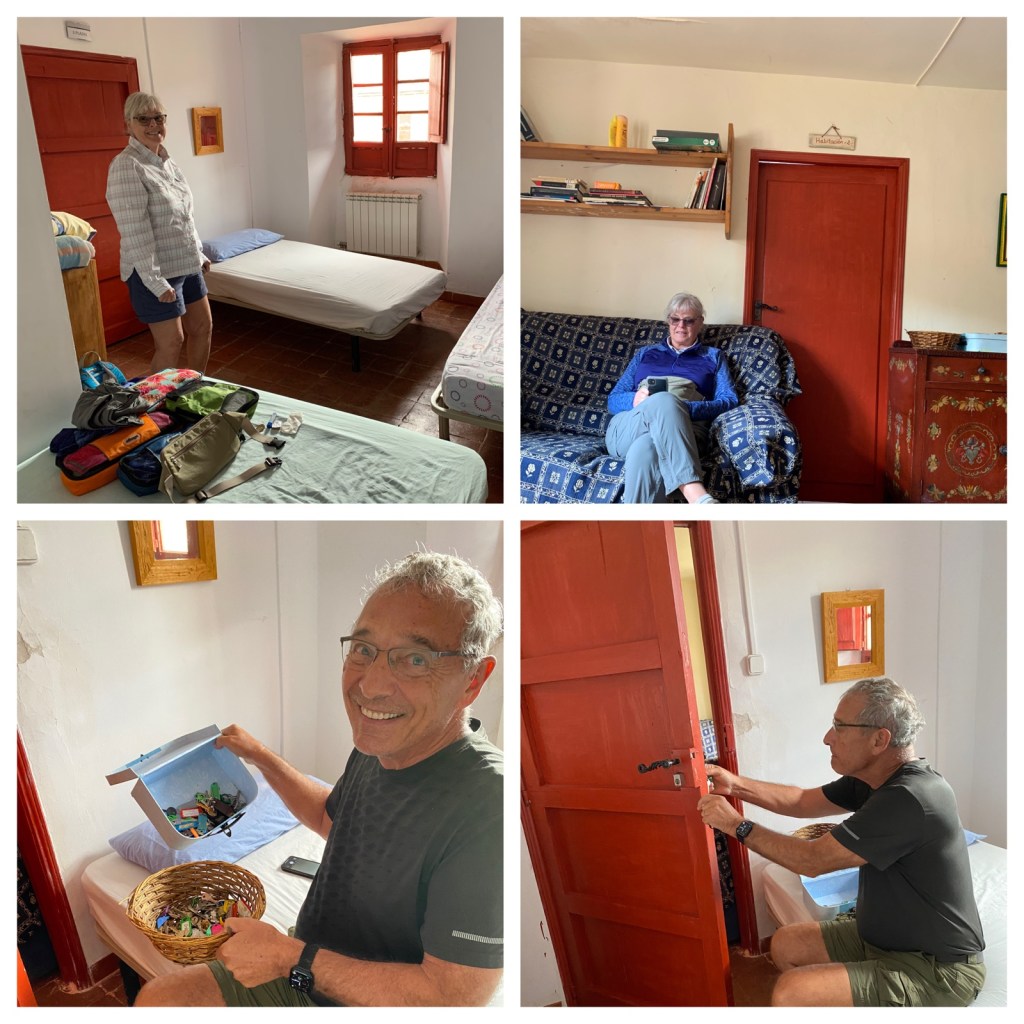
We checked in to La Mochilla albergue soon after arriving in Itero de la Vega at 10:45. The albergue is a very old, make-shift collection of rooms with possibly 30 beds ( dormitory style) and two private rooms (w/o bathroom) of which we have one. There are two bathrooms with sinks, 1 working shower and ourdoor patio for socializing and meals, a basic kitchen for doing your own meal and a kitchen for albergue prepared breakfast, lunch and dinner. Soon after occupying our room we had no key so Jim asked the owner for one and he came back with two containers of keys to try to find one that fit our door. He said (we think) that a prior occupant of our room apparently took the key with him as the owner began trying keys in the two boxes. Jim offered to look for him so he could get back to processing the line of other pilgrims waiting to rent beds for the night.
Our room, the shared sitting area for us and a 8 bunkbead dormitory like room. Jim busily at work looking for the “ key” for “ habitacion #2”.
After trying all the keys in our door without a fit, we abandoned the effort and accepted that our room tonight is not “technically” private. (Jim considered asking for a discount but decided against it). This may not be the most primitive albergue we’ve stayed in, but it’s close… at 35€.
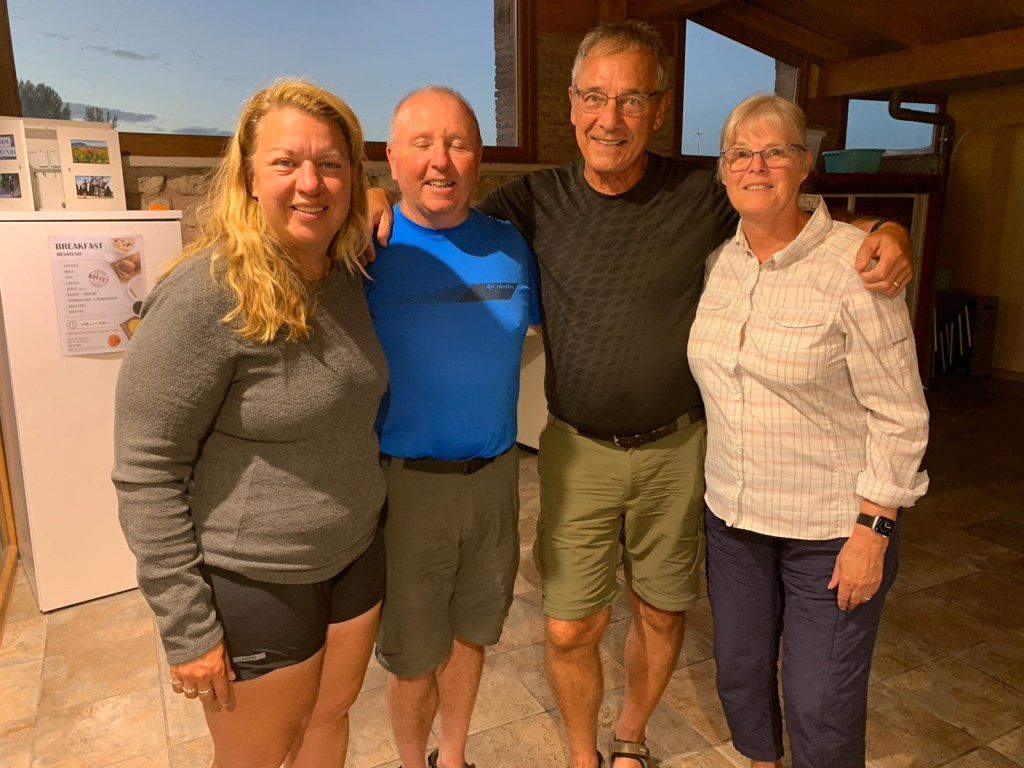
our new pilgrim friends from New Zealand
We met two delightful sisters from New Zealand who checked-in shortly before us. We had chats with them during breakfast and later for lunch in a nearby bar in Itero de la Vega.
Dinner tonight was with 8 other pilgrims. We had interesting conversations, mostly in English, even though 5 were from Spain. The other pilgrims were from Norway, Switzerland and Philadelphia. It was enjoyable and lasted until our new, normal bedtime, 8:45 p.m.
It was a chilly 52F when we left Hornillos at 6:50. We walked over two miles on a gradual incline until getting back to the “ table top”. We stopped all the way up to check the progress of another “flaming” sunrise.
Just before we got to the top, the brilliant sunrise was coloring the rocks and other surfaces red.…back to the top…
then another mile, before going back down into a steeper but smaller bowl as we passed San Bol, off the trail on the left, a very primitive albergue (no electricity or running water) and then returned to the top.
heading down toward San Bolback on top
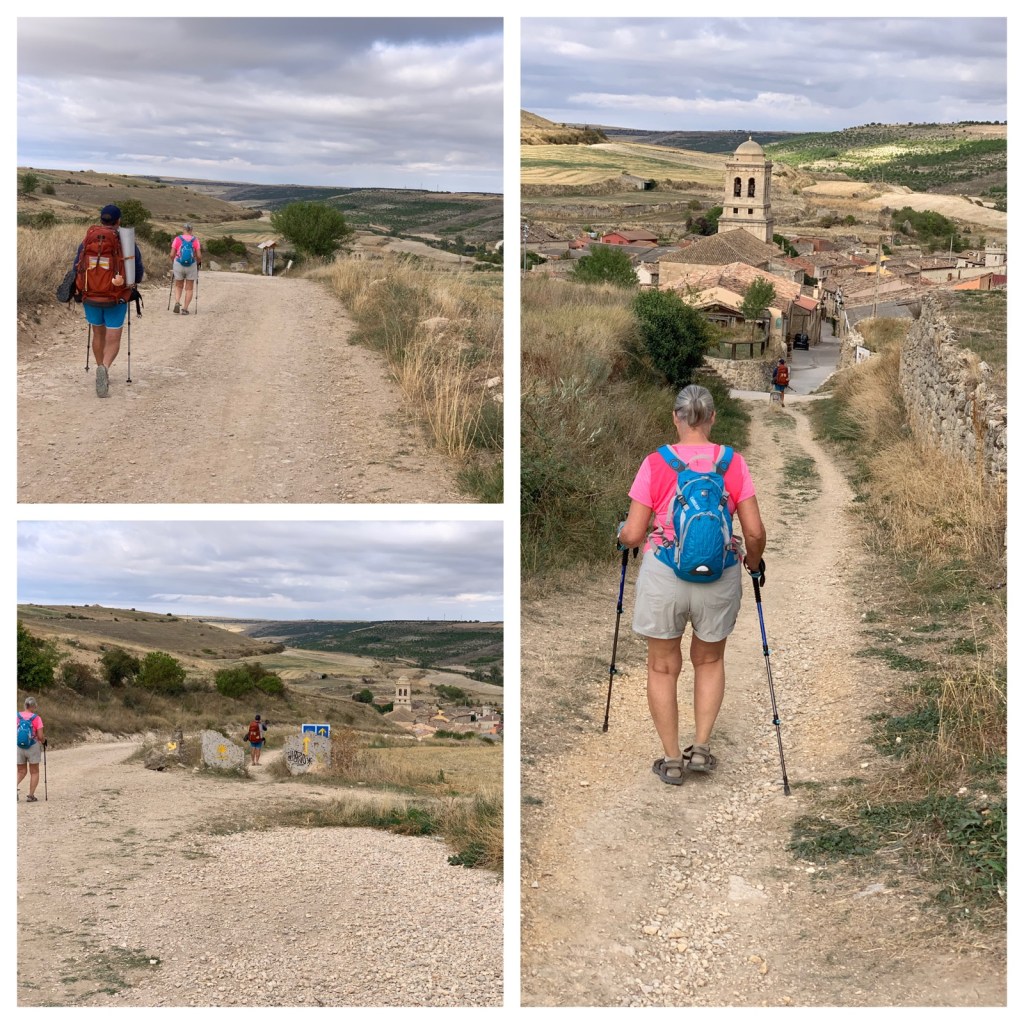
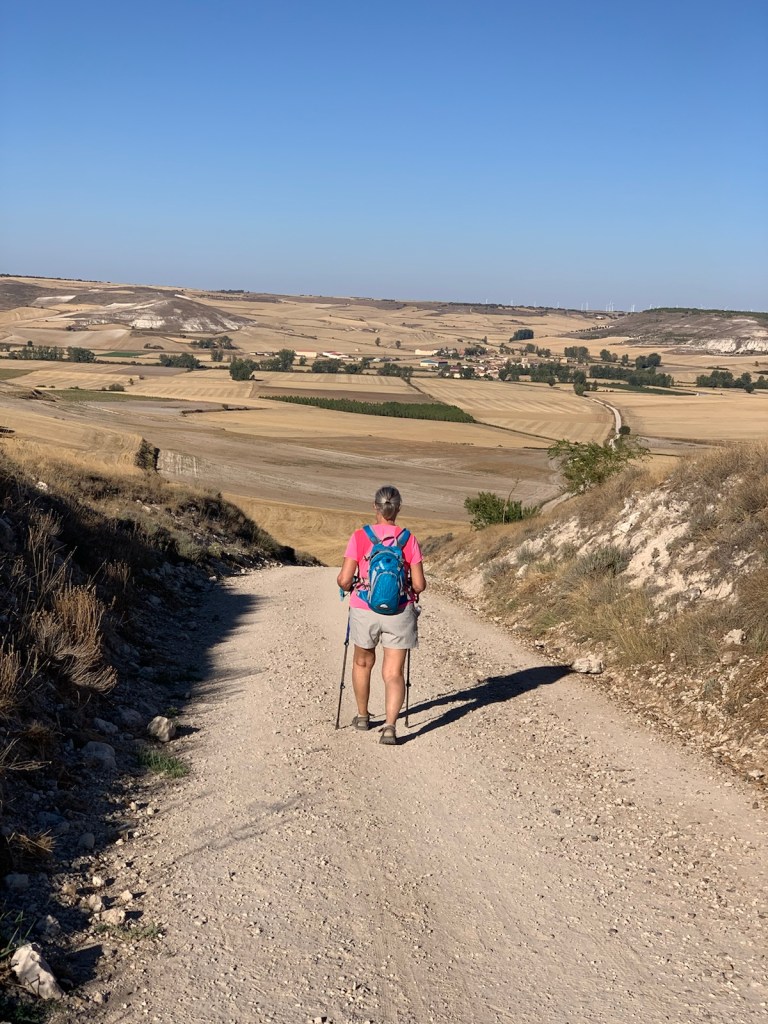
The approach to Hontanas is interesting. After walking several miles or so on top of the meseta, one gets impatient, if not tired, and wonders, “ where’s Hontanas”?
Almost at the entrance of Hontanas, but only the hint of a new bowl to walk into, then a church steeple, and alas, there it is.
Our previous Camino breakfast stop, an albergue (with no name to be found) was open, so we got a table and went inside to a dark building. Apparently they lost power a few minutes before we arrived and were doing their best to serve hungry, thirsty pilgrims that kept coming down the road into the village.
We had croissants, orange juice and pastry and plain coffee with milk and decided to call it a day. We called for a taxi and rode the final 5 miles into Castrojeris.
Castrojeris is one of Jim’s favorites. He began using trekking poles in 2014 and his first set broke on the meseta on the way to Hontanas. We figured he would have to wait until Leon to buy a replacement set. By chance, while in Castrojeris the next day, he saw some poles hanging in the window of a hardware store in the village square but the shop was closed. He made a fairly long walk from our albergue on the edge of town back to the store when it reopened in late afternoon. Luckily the poles were still there and he purchased the set for 39€ and used them for the rest of our walk in 2014. When we got back home, we found that comparable poles cost nearly $150. He has continued to use the same set through 2022, so far, over 1500 miles of Camino. Today the store was closed but Jim looked in the window at what was on display, with fond memories of that joyous day.
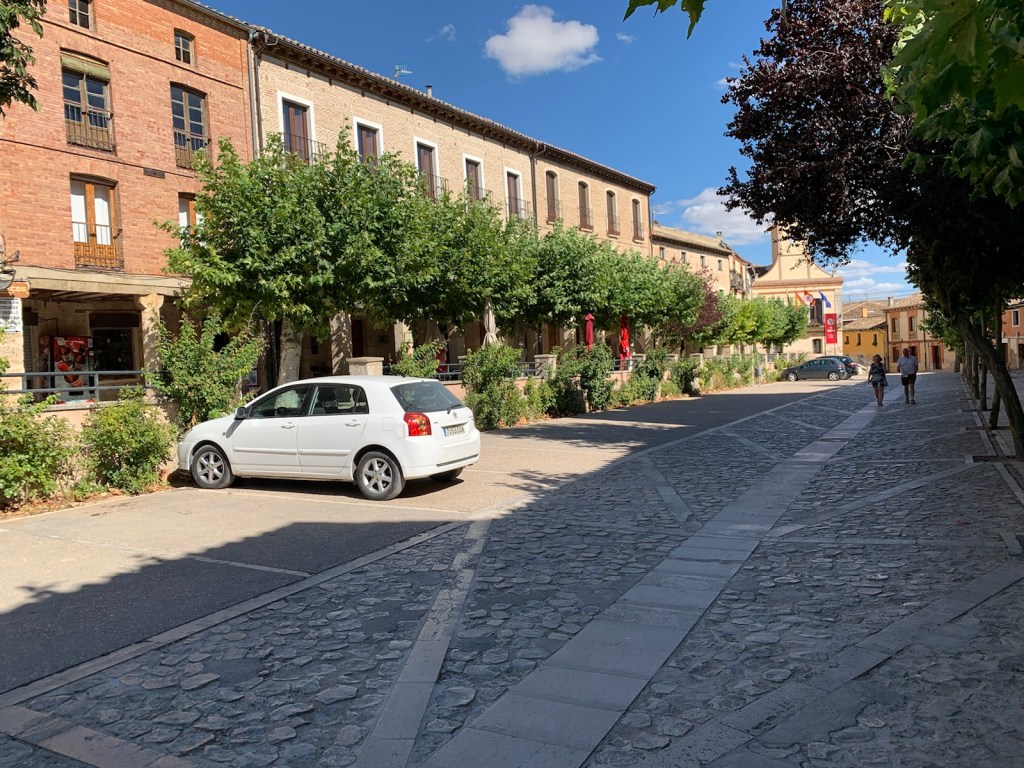
the plaza where Jim purchased trekking poles in 2014.
The Camino is getting really crowded the last several days. We think a new wave of pilgrims started September 1 and are now catching up and passing us. The net effect is extra stress on places to stay coupled by pandemic related closures. This became apparent to us as we tried to book places to stay in the coming week. Today we found out that the place we planned to stay tomortow night is permanently closed and no other alternatives were available to reserve.
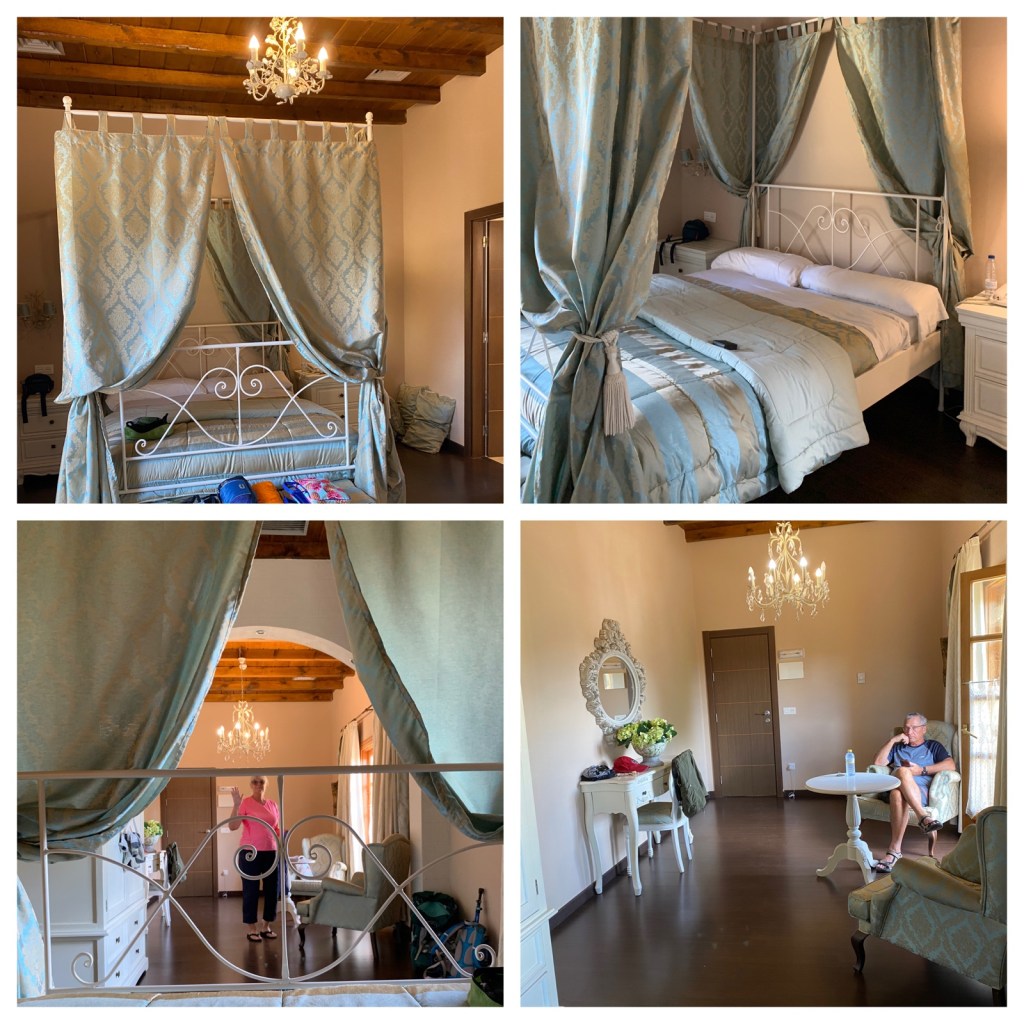
So after having our main meal in our Hotel Iacobus (which, by the way, is very nice and comfortable) restaurant at 4:00, we got to work and planned our walks for the next 2 weeks and booked rooms for each night to eliminate the concern if not having a place to stay.
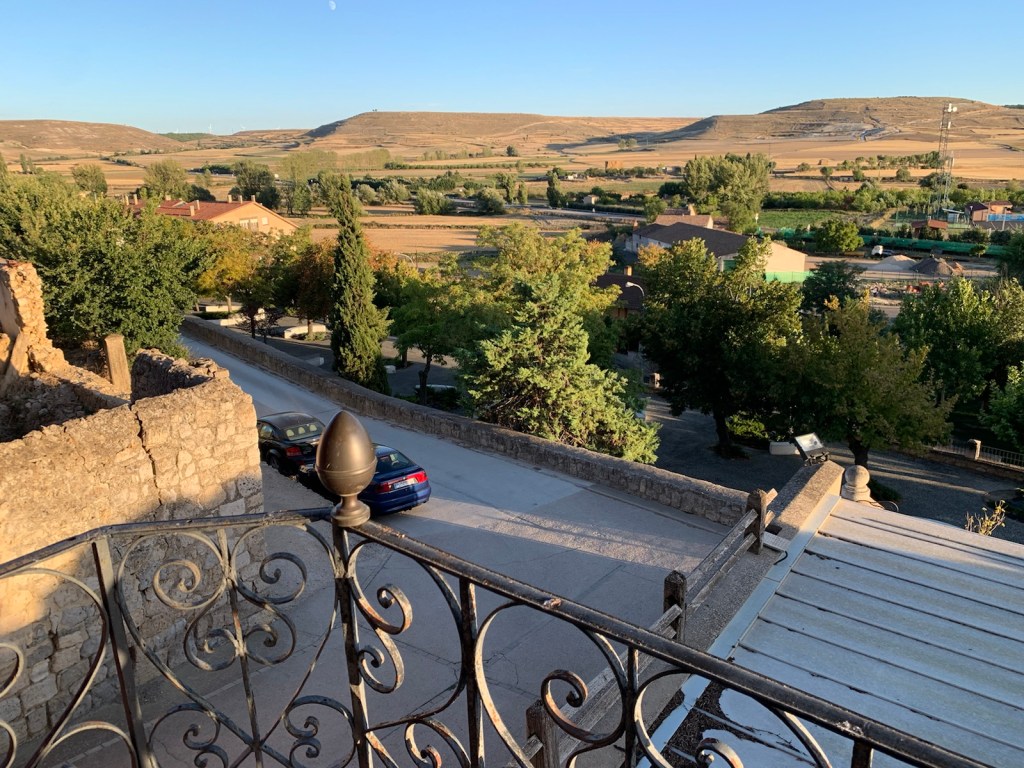
the view from our room in Hotel Iacobus, Castrojeris
Photos cannot begin to show the beauty and magnificence of this creation
We left Meson del Cid at 7:00 via taxi to Tardajos, skipping the walk through the suburbs and along the expressway. It was a chilly 49F. Every morning for the past week has been high 40’s to low 50’s, excellent for walking.
Our breakfast stop was at Albergue La Casa de Beli, where we stayed in 2019. After finding our way through the maze of Tardajos streets, we continued on pavement for a mile to Rabe des Las Calzadas before beginning the gradual 2 mile climb up onto the Meseta.
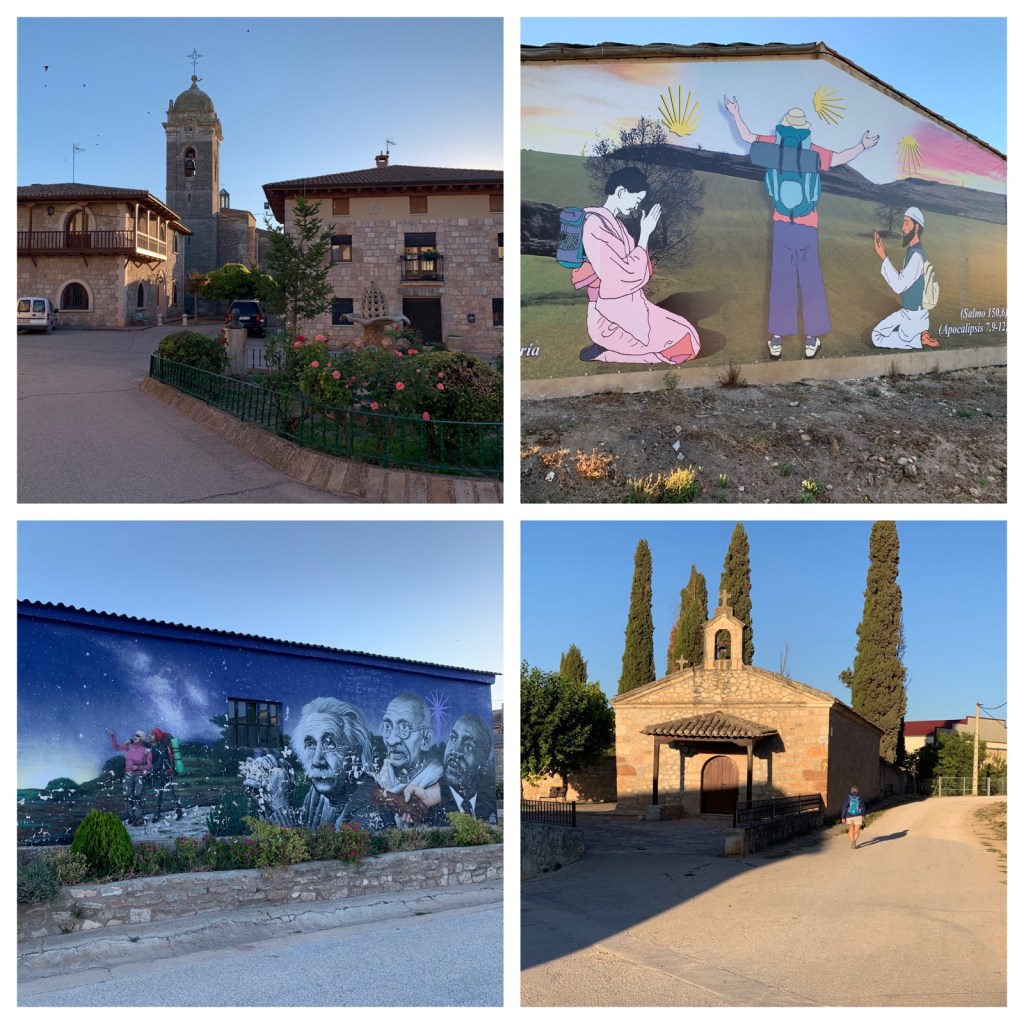
Rabe de Las Calzadas: (clockwise) … the village square, walk art, more wall art, chapel as we exited the village for the meseta
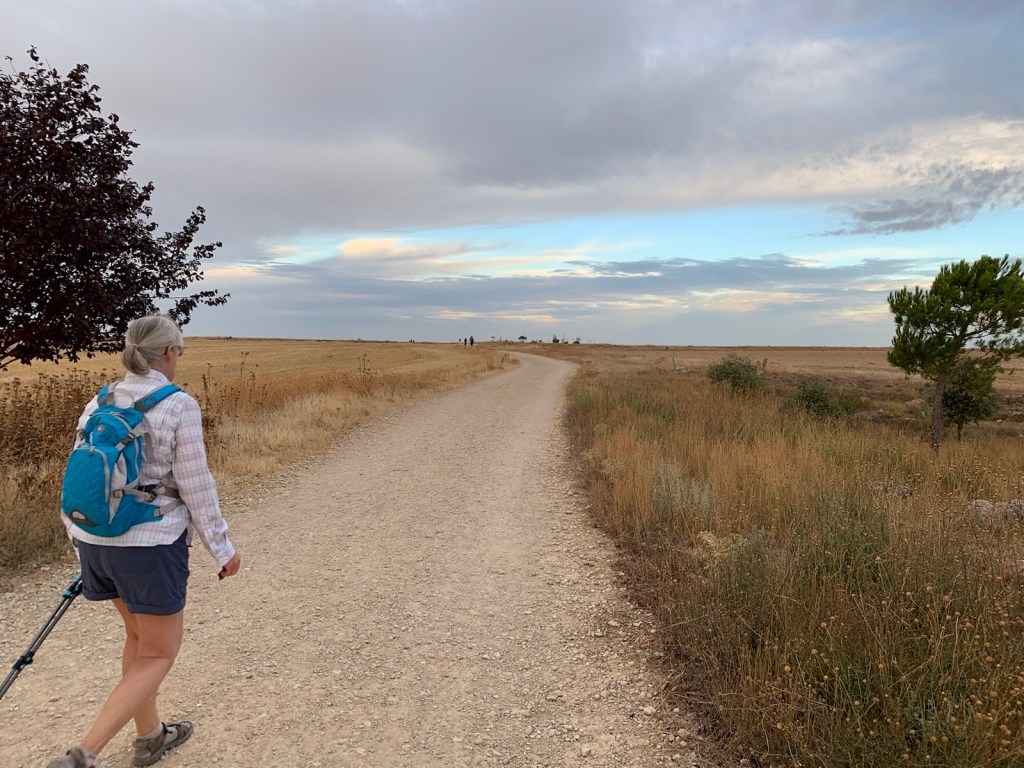
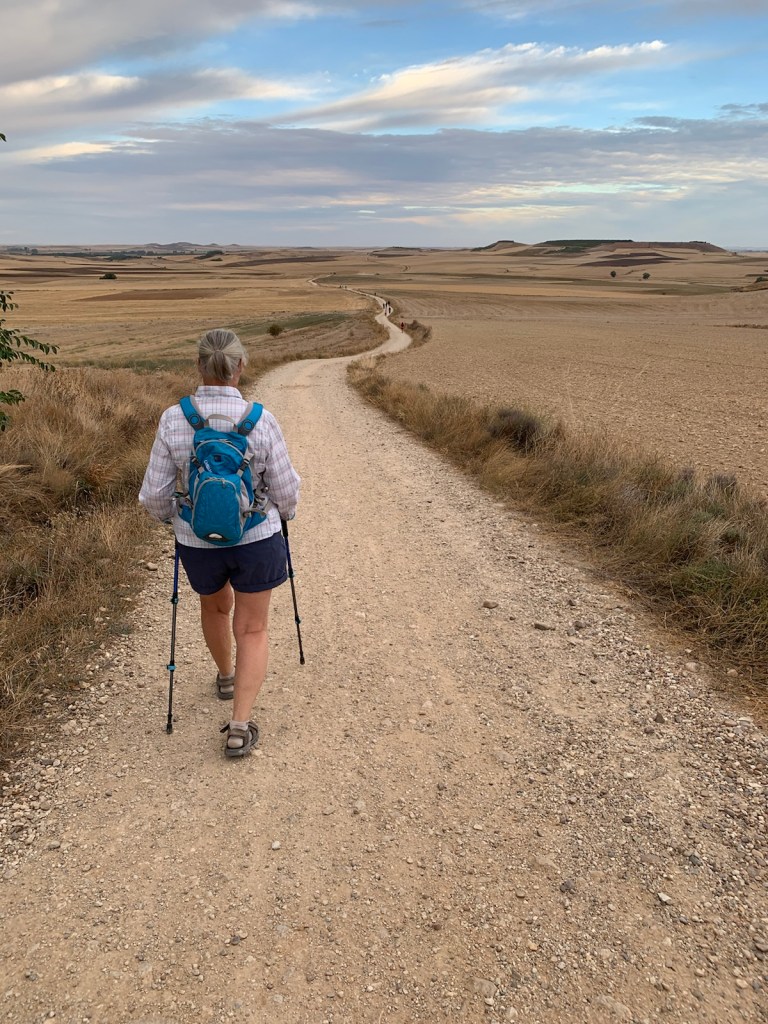
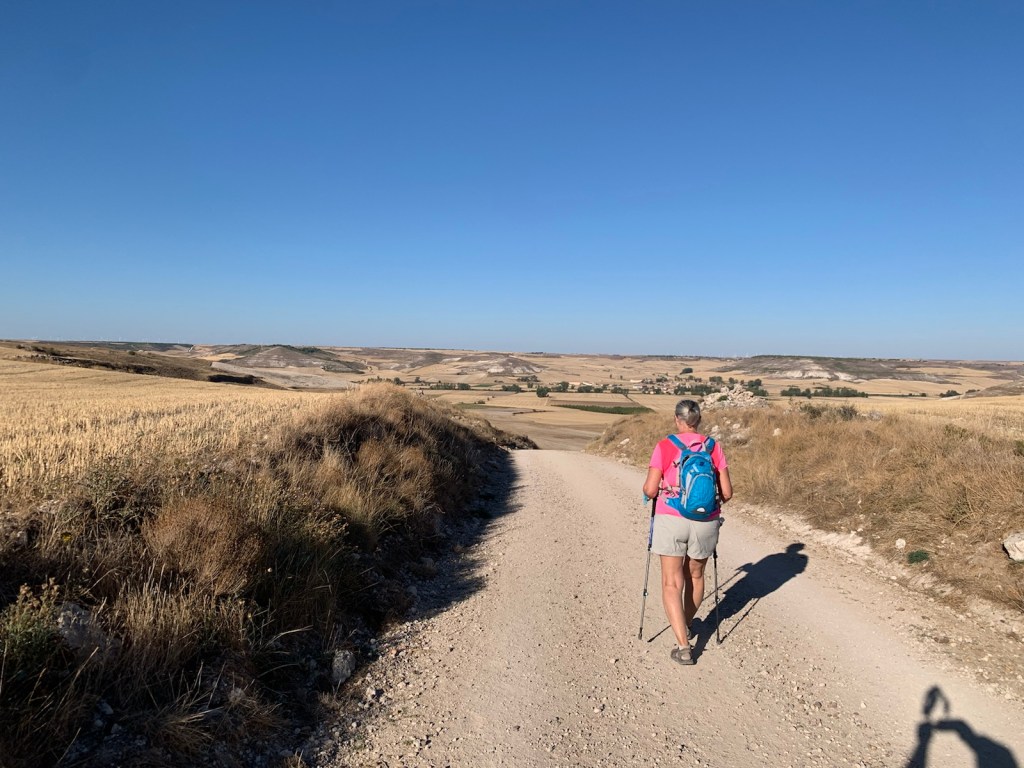
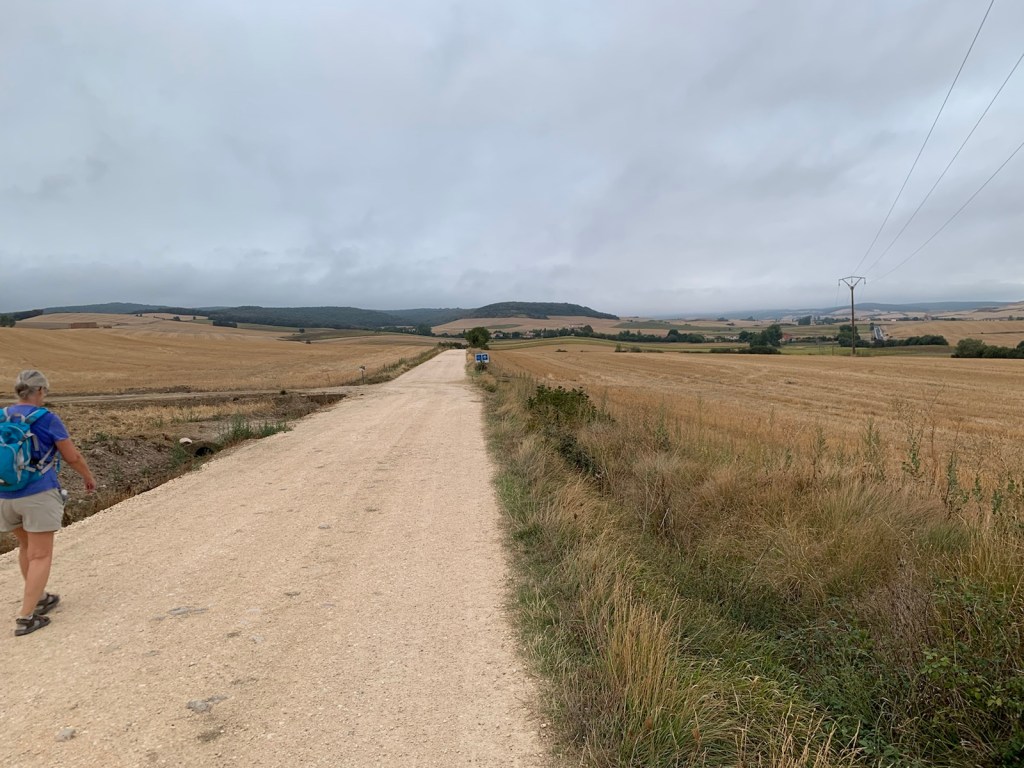
For 2 miles after Rabe…., we walked on a gradual incline on our way up to the meseta. The meseta in northern Spain stretches some 120 miles from Burgos to Astorga. It is very flat, with few trees for shade. The Camino between the different towns/villages on the meseta has scarce services and water. Many of the towns along the meseta are in valleys or “bowls” several hundred feet below the meseta. Thus, the walk is typically flat terrain between villages, descending down to the village then climbing back up to the meseta to move on to the next village.
Climbing to the meseta (clockwise) then looking back toward Burgos once we reached the “ table-top”
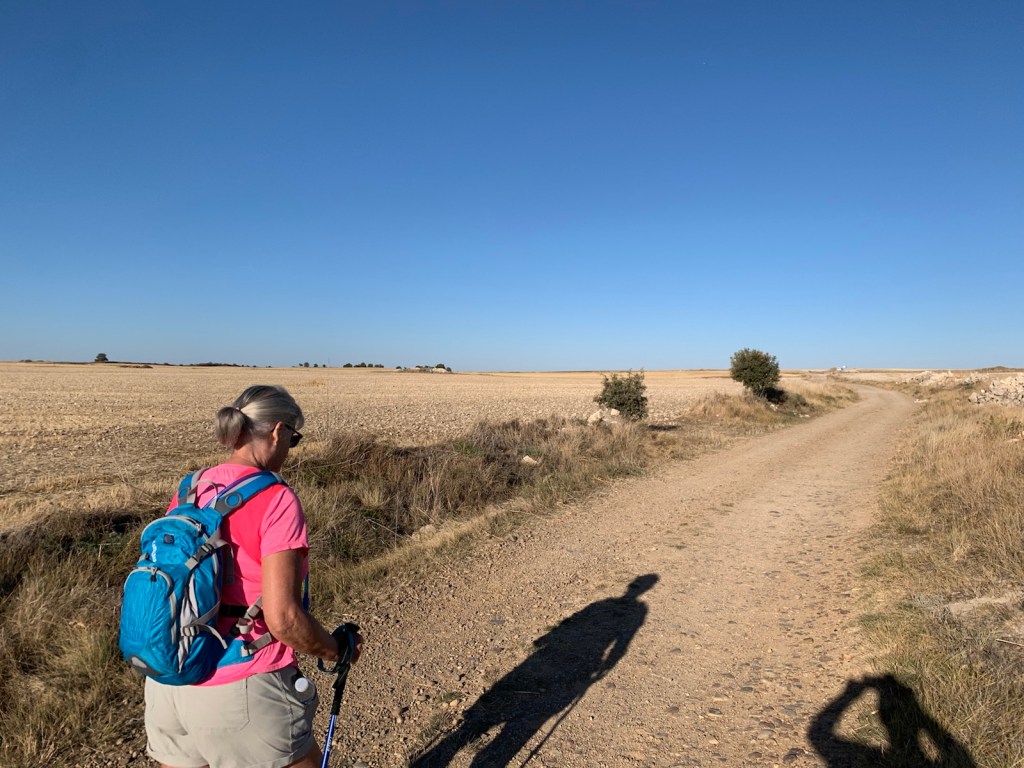
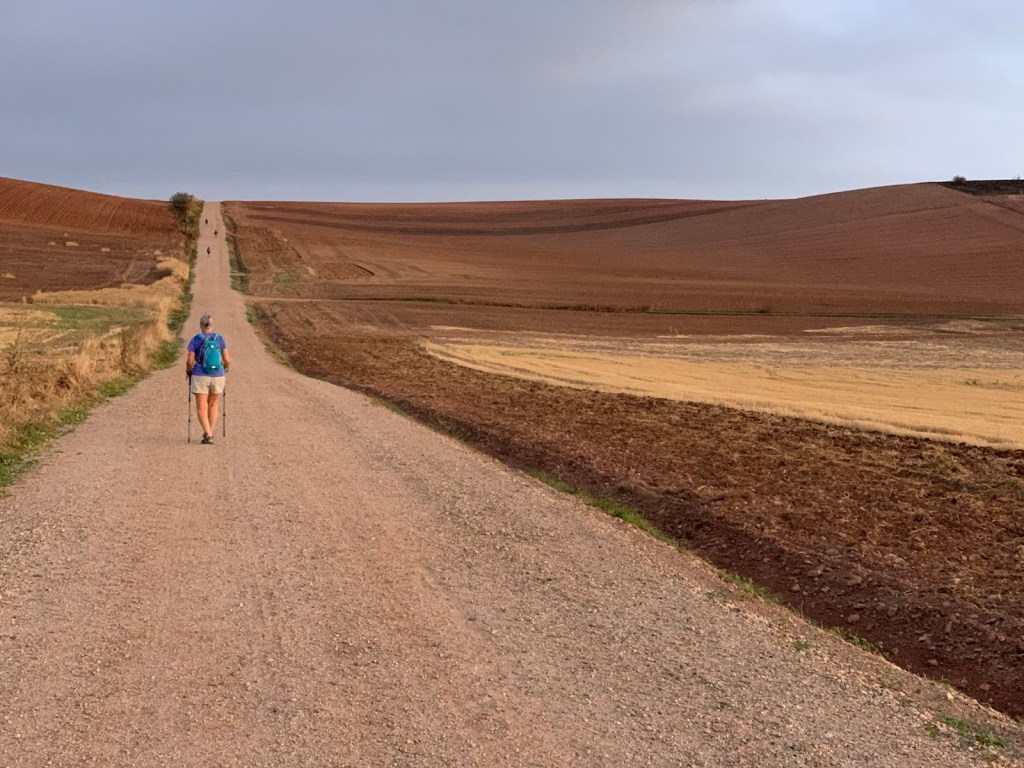
When we reached the meseta all we could see ahead of us and left and right was flat plain and blue sky.
On the meseta – left and aheadon the meseta – right and straight ahead
We walked on the meseta for about a mile, then saw a”bowl” descending down to Hornillos del Camino then back up to the meseta.
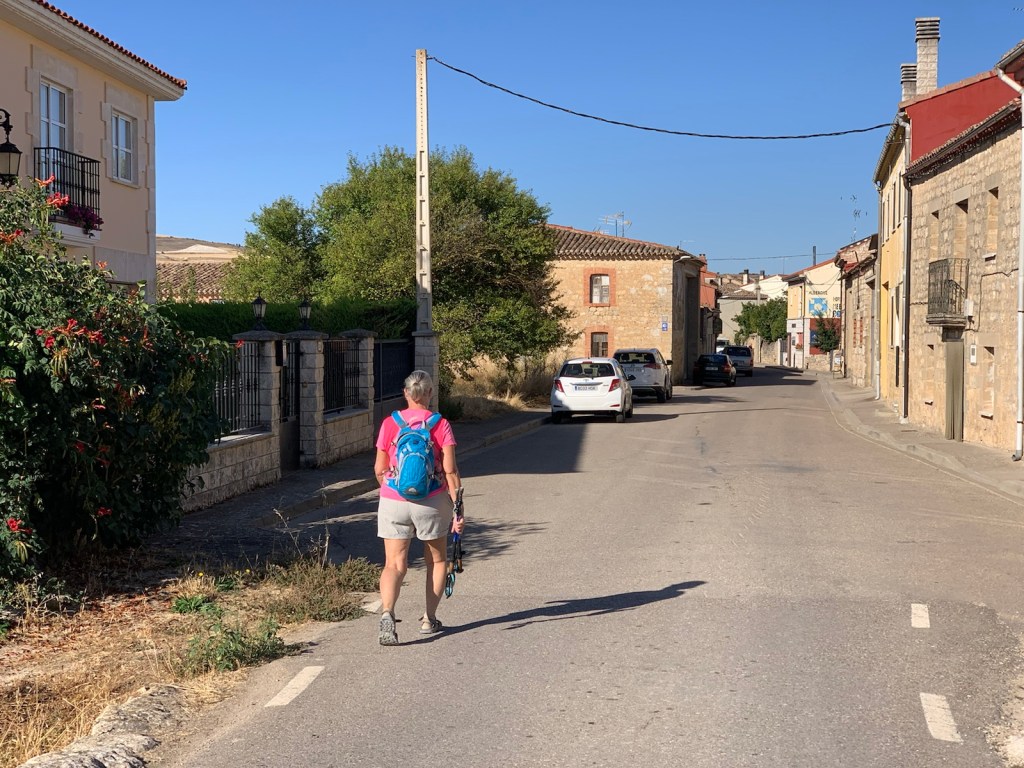
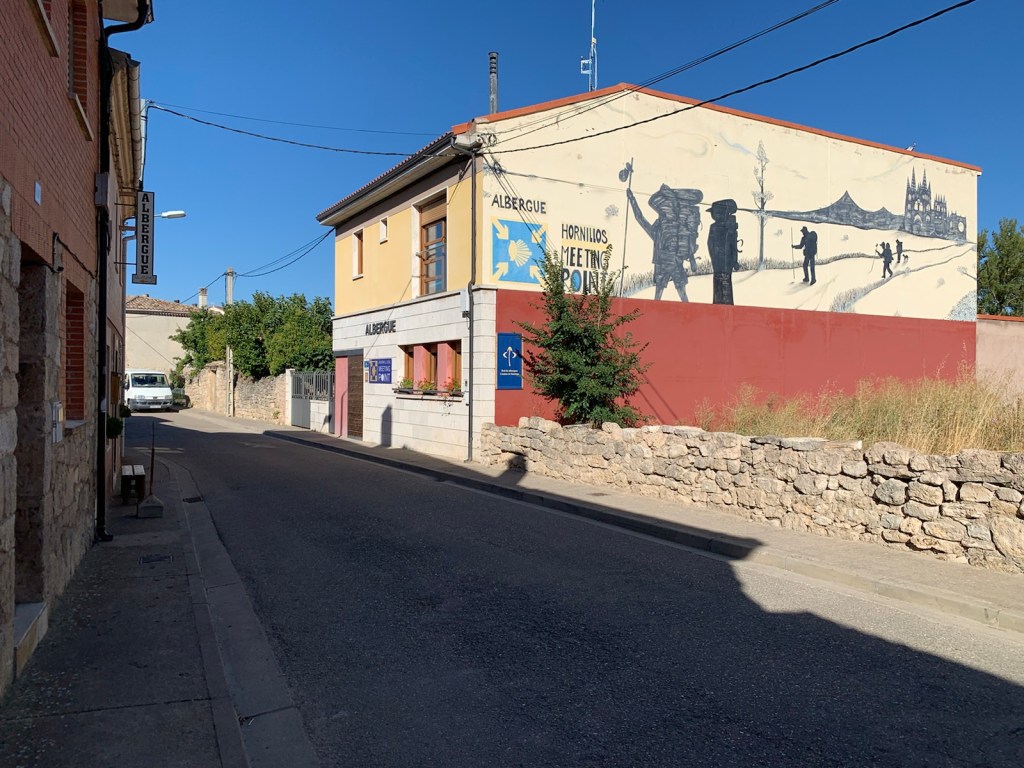
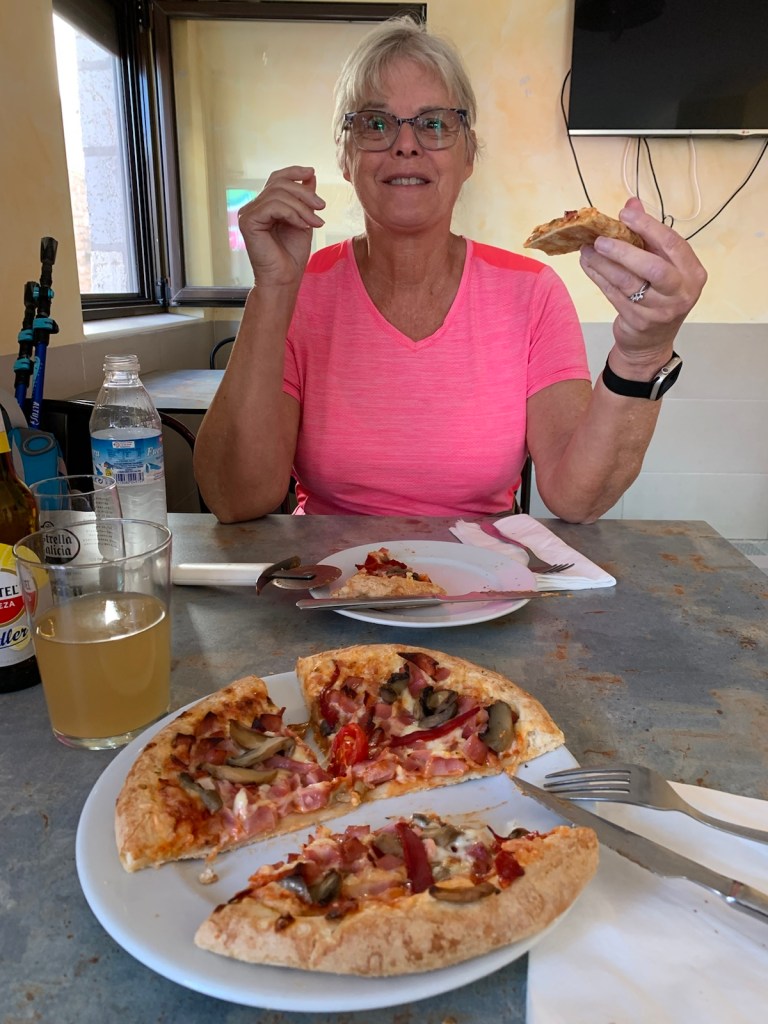
one lone tree, a string of wind turbines and blue sky, as far as we could see.our first view of Hornillos del Camino.approaching “ mule killer hill”taking on “ mule killer hill”looking back after surviving “ mule killer hill”entering Hornillos on main street (the only street in town)Meeting Street Albergue, our home for the day and night.And just so we don’t get into a rut… homemade pizza for lunch!! Yum!
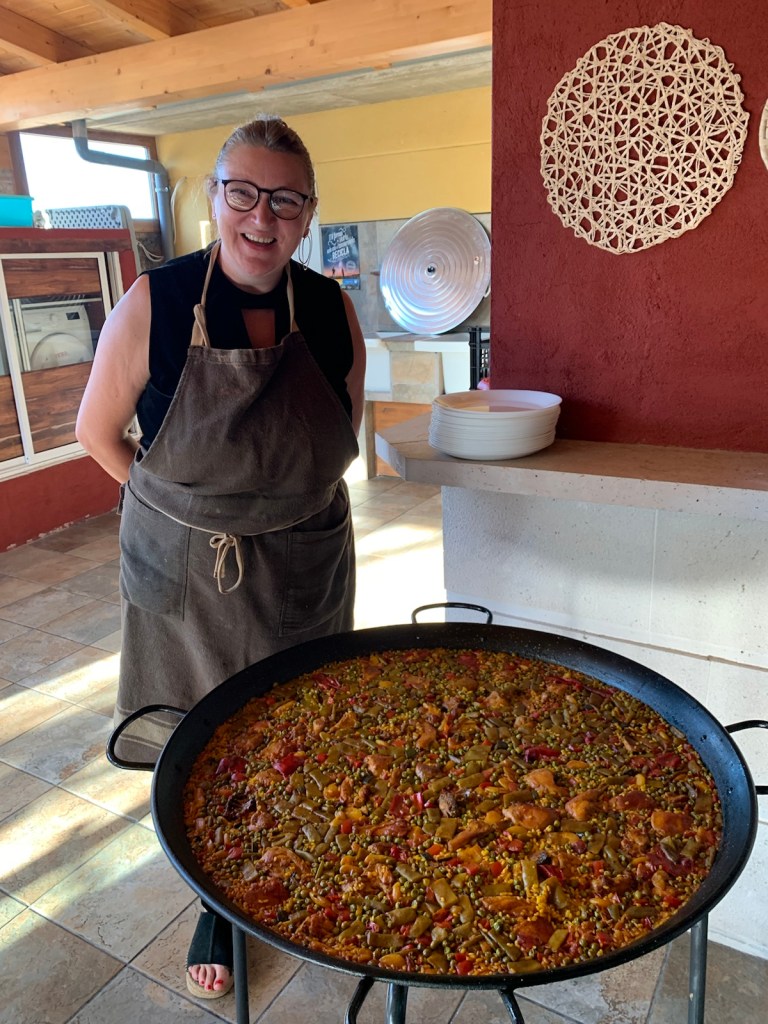
We had a great dinner with over 30 pilgrims chowing down. A meeting place specialty is paella.
A brother and sister own Meeting Place Albergue and we have stayed here 3 times, looking forward to and enjoying the paella each time.Emma is the cook. We chatted with her earlier today, before check-in. She is from Ireland and met her future husband in Belorado while walking the Camino.
At the pilgrim dinner we were seated with some delightful Canadians from Montréal and Manitoba. We laughed a lot and shared lots of Camino stories. It was a fun evening.
This morning we began by taking a taxi from our hotel door to the hamlet San Juan de Ortega, named for an understudy of Santo Domingo de la Calzada. He also built roads and bridges in and around Burgos to help improve the pilgrim experience in the 12th century. San Juan probably built this church, too.
Iglesia de San Juan Ortega
The taxi enabled us to skip a 7 mile stretch of the Camino that we walked in 2014 and 2017, but skipped in 2019 and today to avoid some difficult terrain without any services, and a logging road infested with aggressive, biting flies!
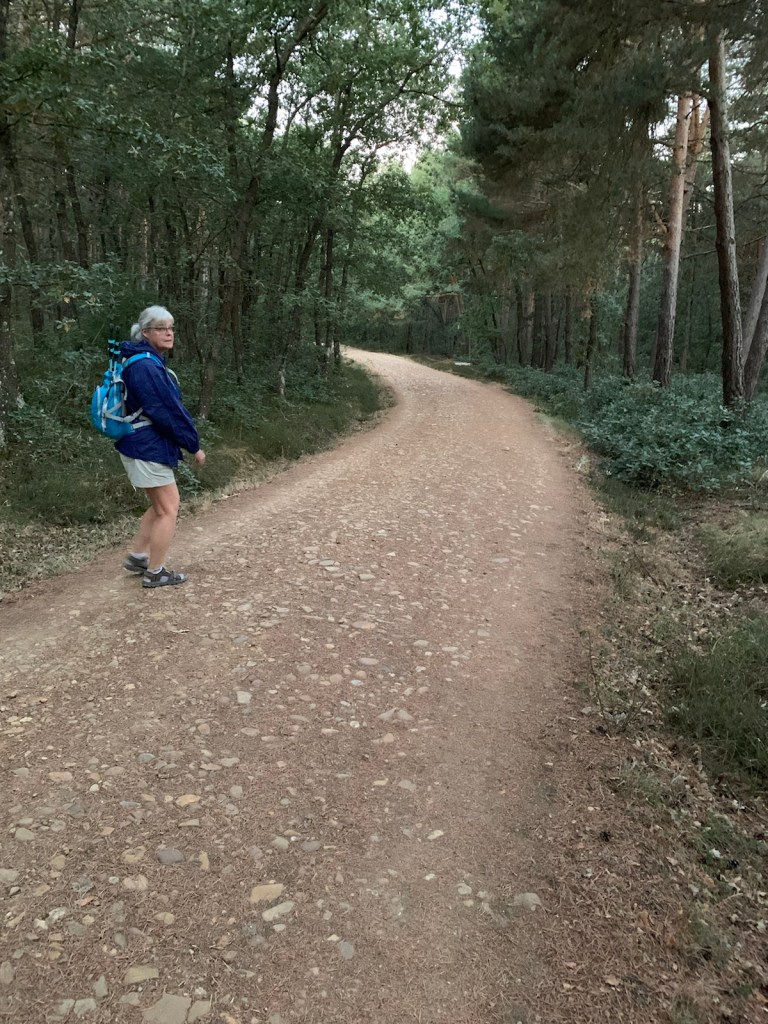
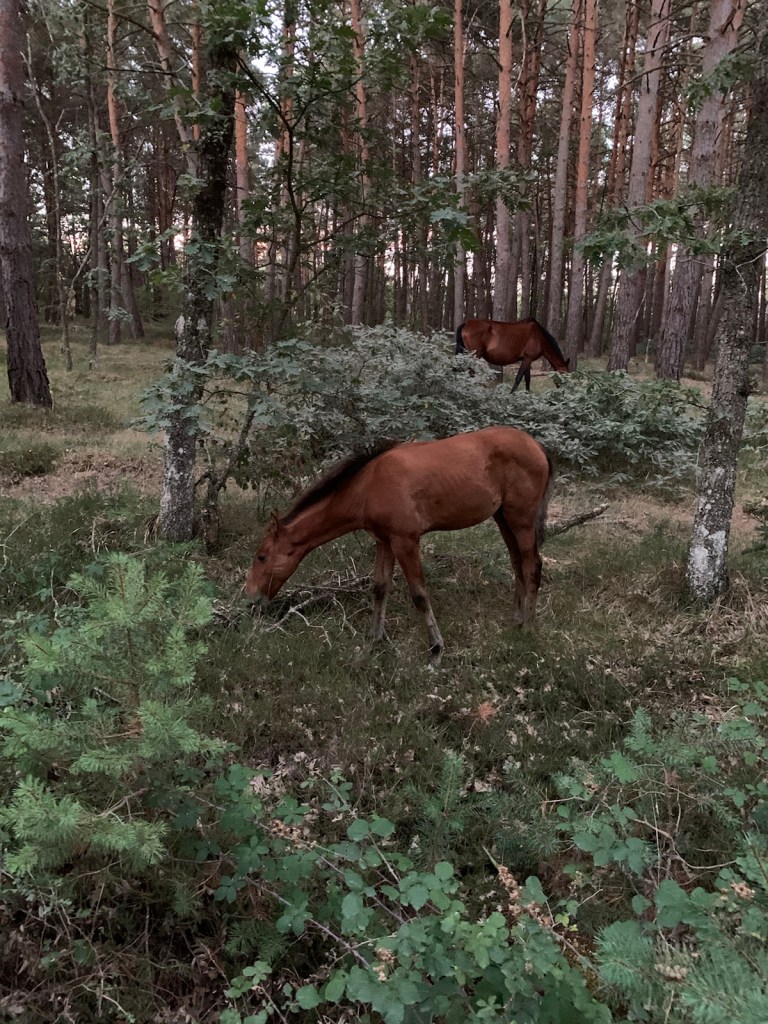
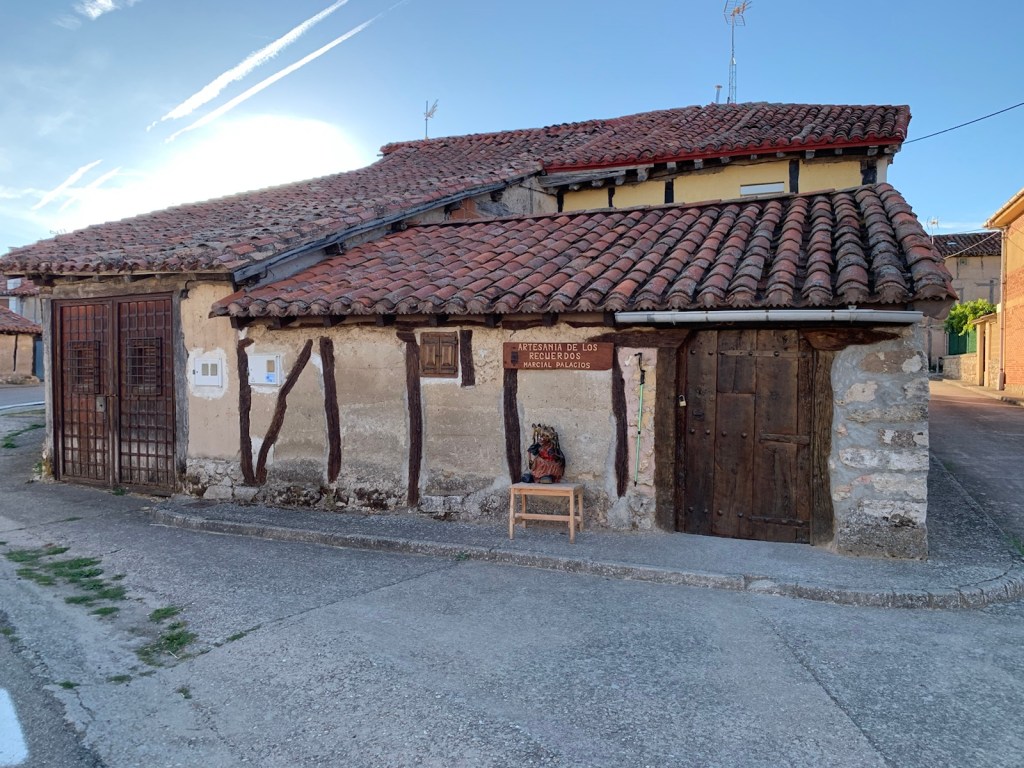
soon after we left San Juan… we began walking in the woods…. and were pretty much ignored by a mom and her young colt…our road through the woods became a road through a more open pasture…and after a couple of miles, we approached AgésThis is the workshop of the Agés artisan, Marcial Palacios, who we met in 2014. He had retired from Michelin’s Valladolid tire plant and we noticed his Michelin cap as we walked by and when he motioned for us to enter, we spent an enjoyable hour or so appreciating the products of his woodworking skills. Much of it consisted of miniature wood depictions of buildings and farm equipment seen in and around his village. He wasn’t at his shop this morning, but our memories of that delightful visit surely were.
We stopped for breakfast at an albergue where we stayed in 2014, stopped for breakfast in 2017 and saw it was closed in 2019. It has a new owner, who has upgraded it from its former state to a very desirable property, and renamed it Fagus. Jim shared some photos we had from our 2014 stay and the owner seemed to enjoy them.
We finished our breakfast and left for Atapuerca, the next small pueblo. About a half-mile later, Jim remembered he had not paid for our breakfast. So we reversed ourselves and returned to Fagus to pay our bill of 7€. The owner was perplexed when he saw us return, but when we explained, began taking the blame for forgetting to collect payment. Actually, he and Jim were both distracted by looking at the old photos. But he very appreciative that we came back.
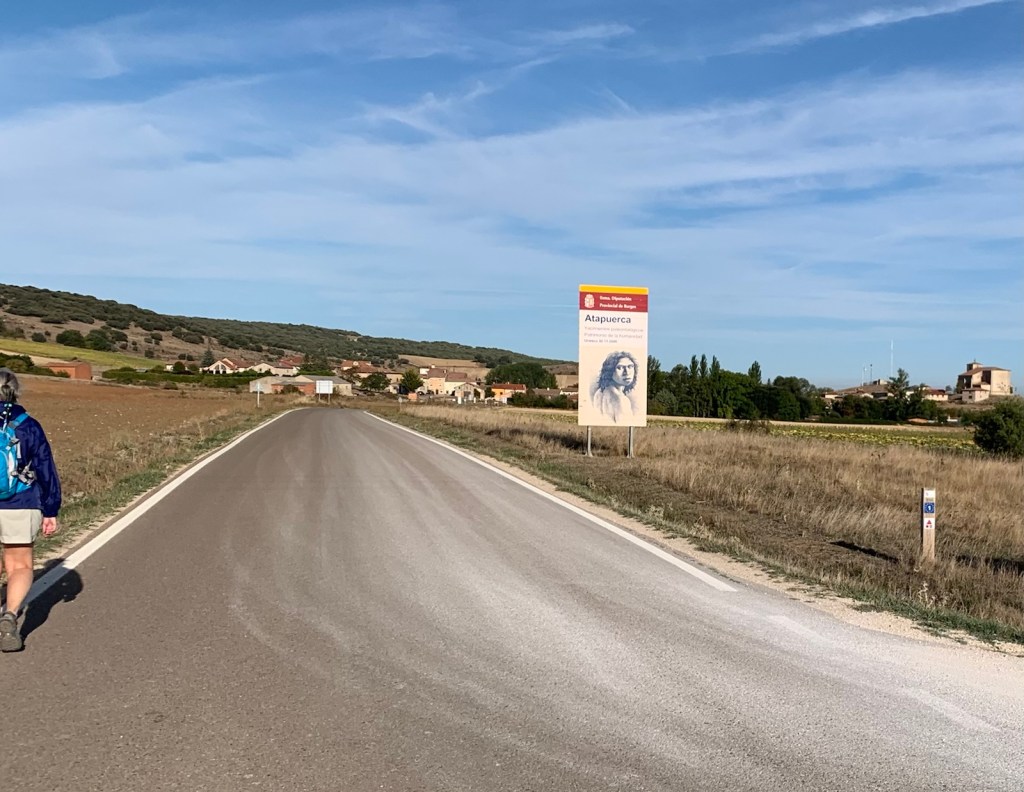
the path and road leading from Agés to Atapuerca.
Atapuerca, site of several limestone caves near Burgos in northern Spain, is known for the abundant human (genus Homo) remains discovered there beginning in 1976. The site called Sima del Elefante (“Pit of the Elephant”) contains the earliest evidence of humans in western Europe—fragments of a jawbone and teeth date to 1.1-1.2 million years ago.
We passed the entrance to the site and walked into the small village, stopped at a bar and called a taxi to take us the next 12 miles into Burgos.
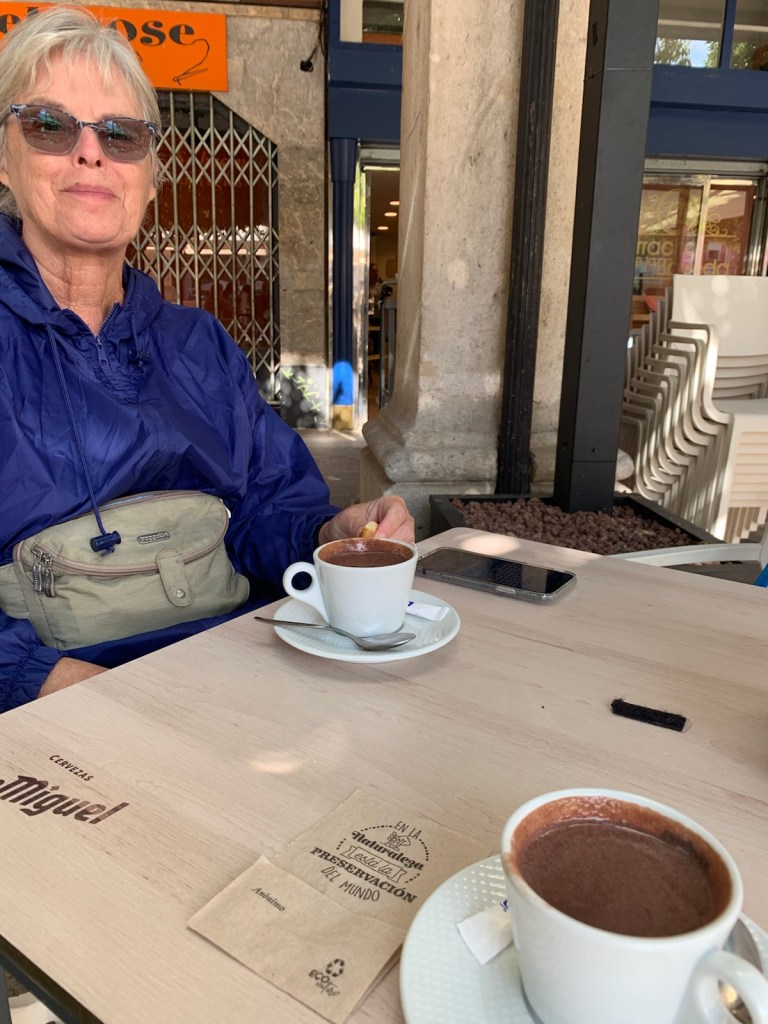
We arrived at our hotel at 11:00… much too early for the 2:00 check-in time. We passed the time ambling around the Plaza Santa Maria, just enjoying this fascinating, very old city, with origins reaching back over 2 thousand years. We didn’t do the Catedral tours, as in prior visits, feeling more like temporary residents rather than tourists. We found a outside bar off the plaza and ordered hot chocolate to break the chill from the cool breeze with our still damp clothes from our morning stroll of 5 plus miles… and relaxed…. until grabbing some lunch to occupy the remaining wait.
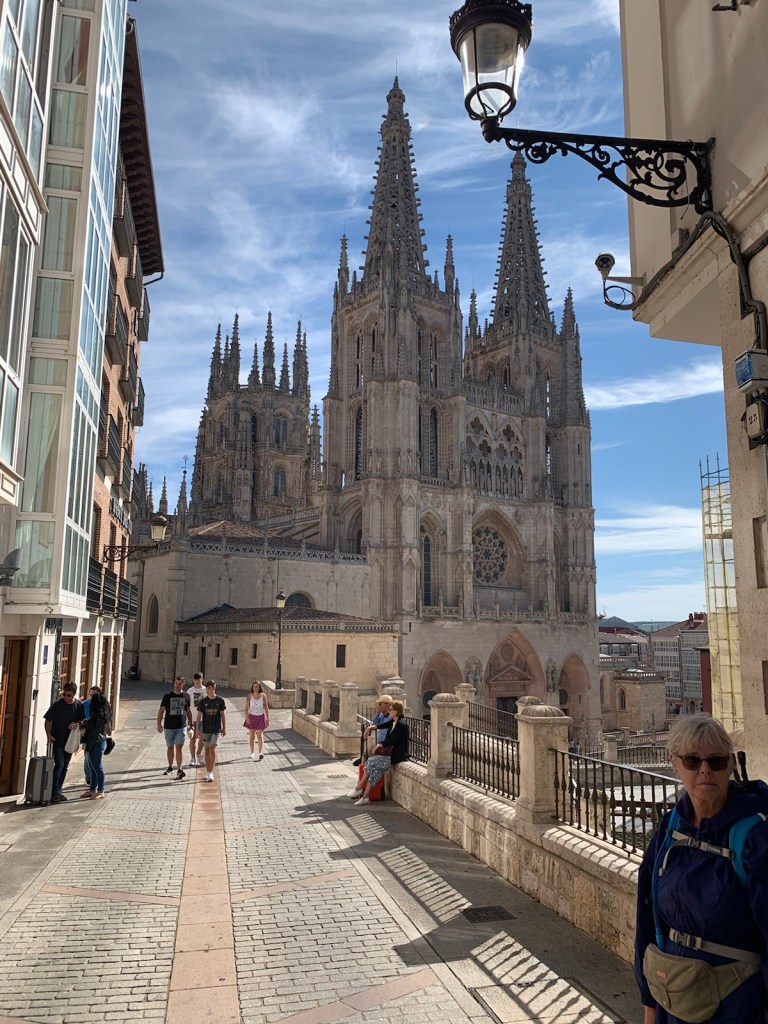
We arrived early for check-in, but had to snap a photo of the gargantuan magnificence of the Burgos Catedral. Our hotel is on the left.nice way to wait for check-inthe view from our hotel room in Masón Del Cid.
The rest of the day was spent just enjoying our comfortable room, making preparations and reservations for upcoming days and recharging our € supply via a nearby ATM.
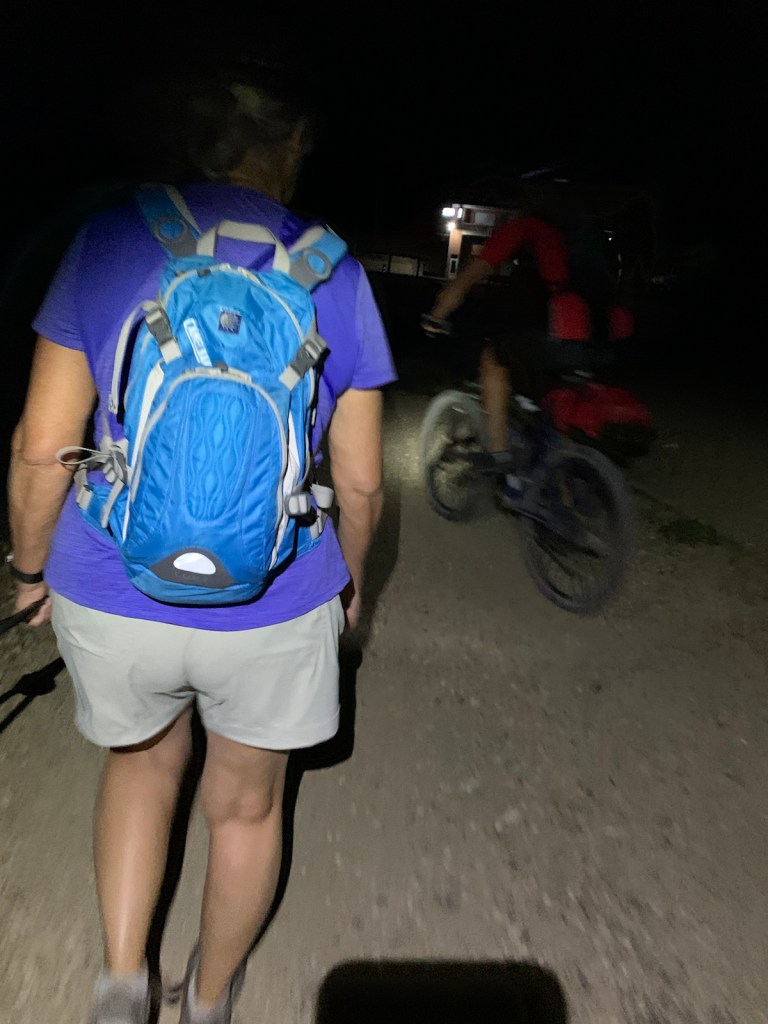
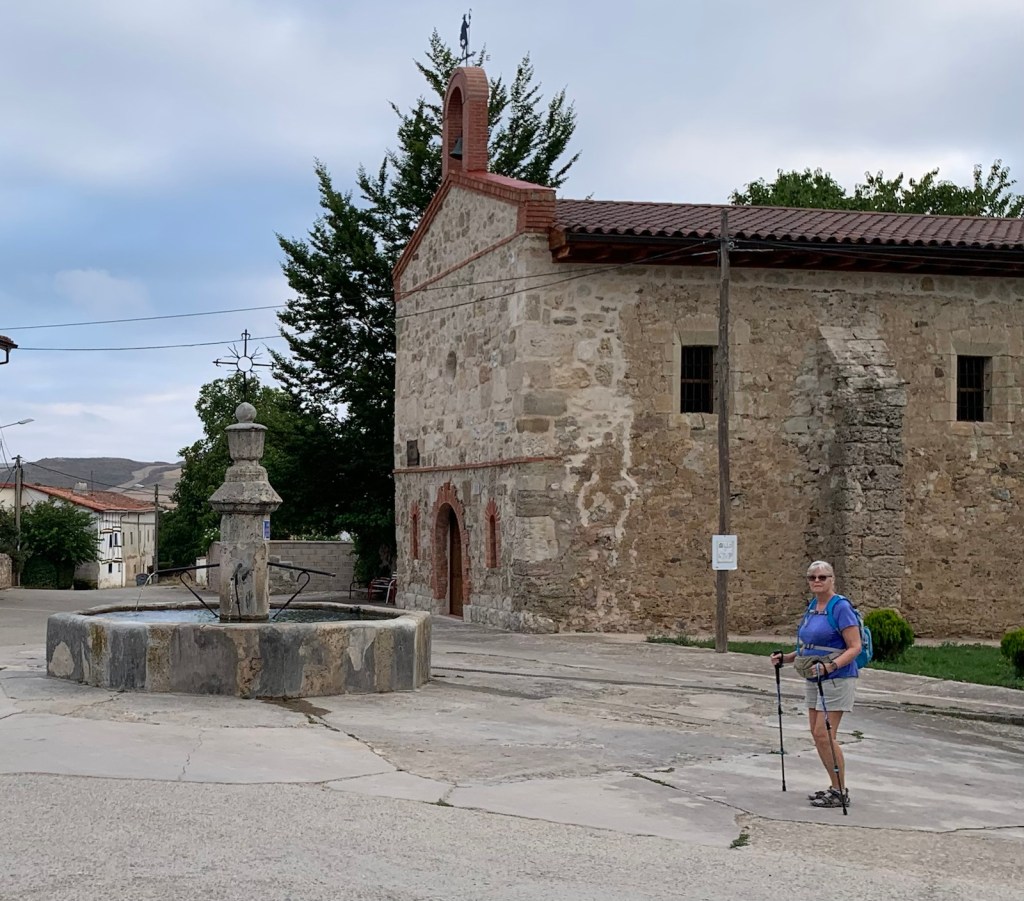
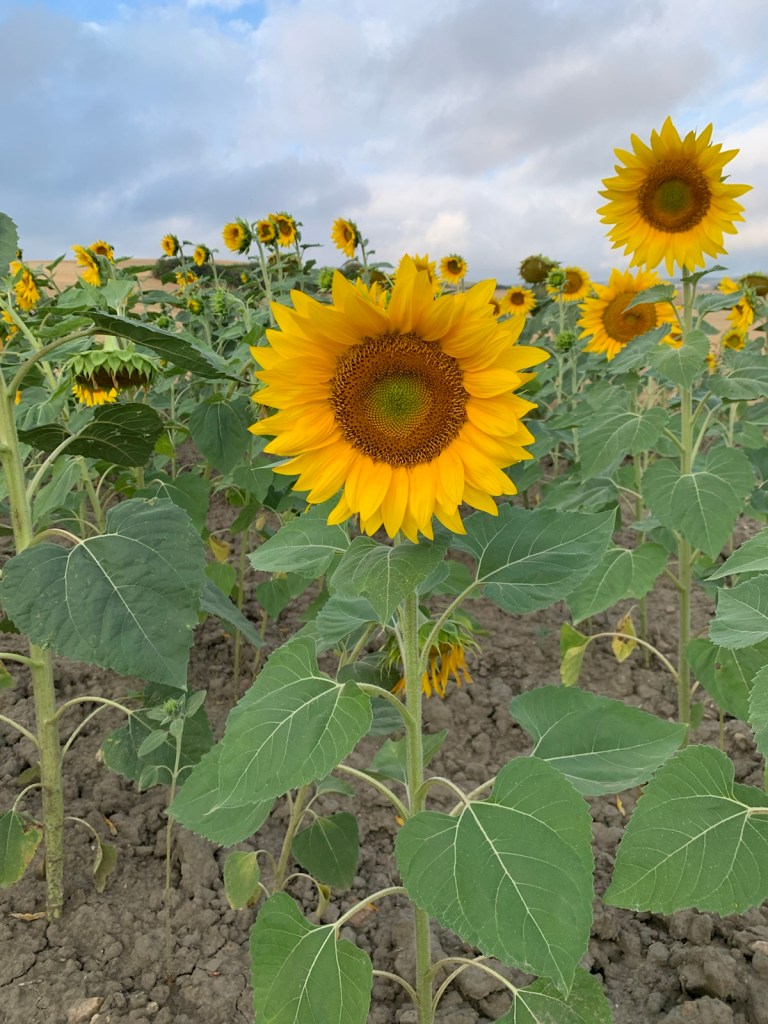
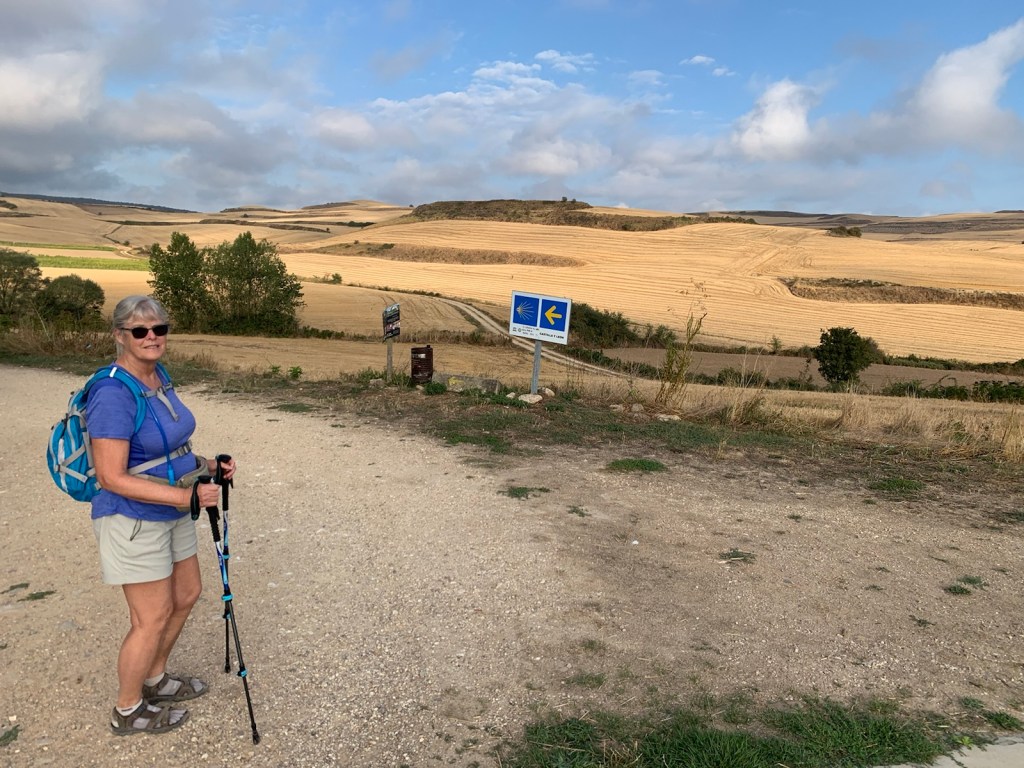
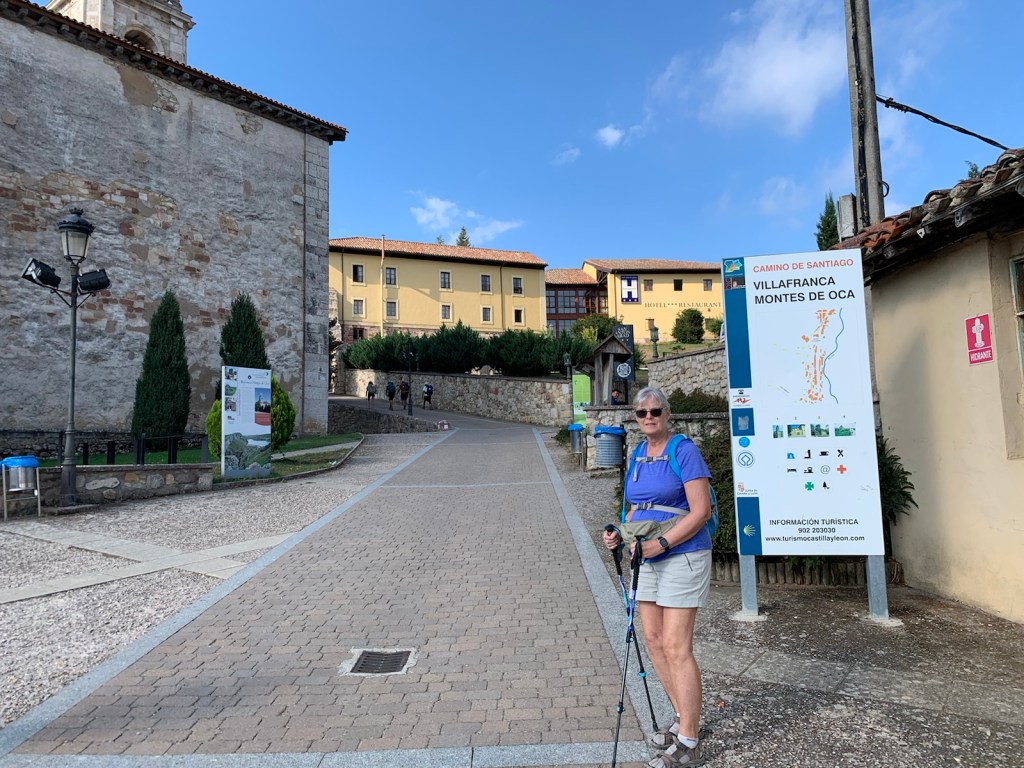
Walking and dodging cyclists in the darkTypical scenery before our breakfast stopA favorite breakfast stop in Villambistia, pop. 65.The Villambistia Fountain is supposed to eliminate tiredness if you immerse your head in the water. We were all set to give it a try (given our recent run with Covid), when Linda noticed the Non Potable sign… and so we opted instead to continue with our paced Camino approach. In the background is the Hermitage of San Roque, patron saint of bachelors, diseased cattle, dogs, falsely accused people, invalids, Istanbul, surgeons, tile-makers, grave-diggers, second-hand dealers, pilgrims, apothecaries as well as of dogs and epidemics.Nothing more uplifting to a walk than fields of sunflowers along the wayMultiple shades of brown provided a colorful view as we crossed these hills and walked down into Villafranca Montes de Oca.Walking up a very steep hill to San Anton Abad, a former pilgrim hospital of the 13th century.our room at San Anton Abad (75€)
We had a nice pilgrim dinner in the Abad dining room with about 25-30 pilgrims attending between 7:00-9:00. A French couple sat at the table beside us and provided a test for Jim as we discussed a number of Camino and non-Camino topics. We think Jim got a C+.
The plan today was to walk to Santo Domingo de Calzada, have breakfast, then stop by the nearby turisto office to make arrangements for preferably a bus (4€) or a taxi (35€) to Belorado. We have a reserved room at El Salto, and transported our backpacks there this morning. El Salto, is a place we have never stayed before.
Our plan was precipitated by our nearly 10 mile long walk yesterday, and our desire to have a short walk today then a longer walk tomorrow.
From Cirueña the path was straight, all the way to Santo Domingo ….Simplicity and colors … ever-present on the CaminoApproaching Santo Domingo de la Calzada
We walked 3.5 miles to Santo Domingo, arriving at 8:05, and then our plan began to crumble.
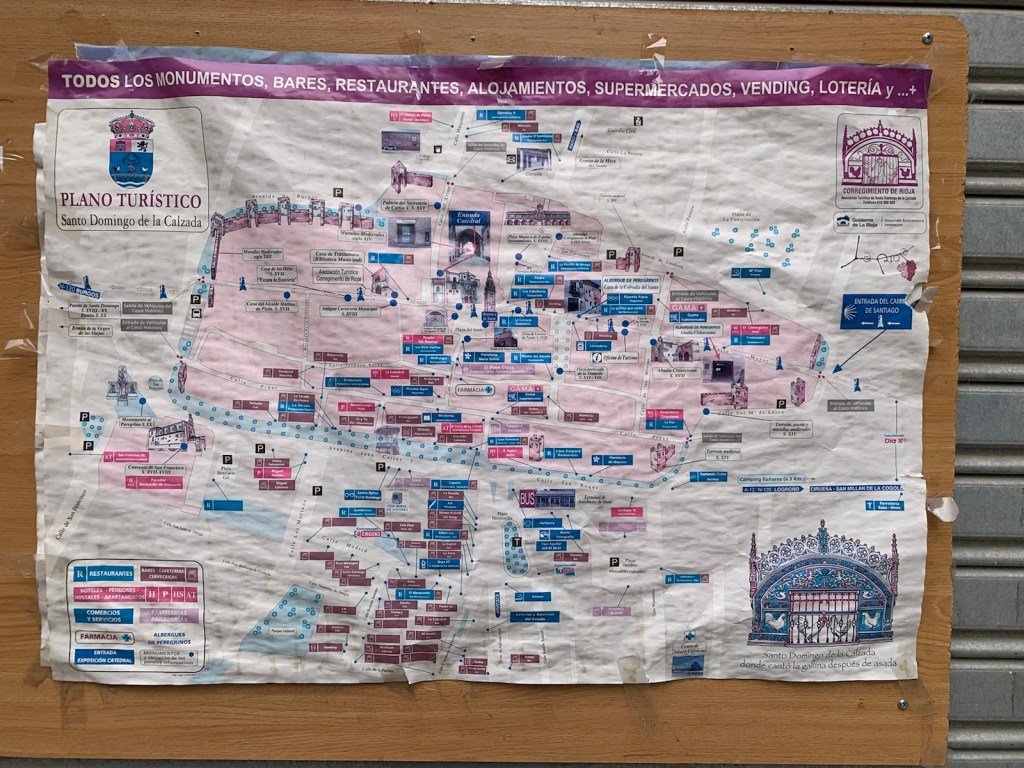
Our breakfast place of the past 3 Caminos was closed up tight, with no signs of opening anytime soon. So we walked around town looking for any place that was open. After a 20 minute tour we found a single bar open and had breakfast. We took our time, anticipating a 10:00 opening time for the tourist office. At 9:45 we ambled to the tourist office and confirmed its 10 o’clock opening time and also, from literature on and around the door, it would not be a good source for getting us to Belorado. Around the corner was a town map and Jim discovered a building marked, “ Estacion Bus”. He took a photo of the map and we moved in that direction.
Note Estacion Bus in middle, bottom third of map
After walking around the target area on the map, we finally discovered the bus station was actually THE town bus stop with schedules and itineraries for all buses. A few minutes later we sadly realized the none of the buses went to Belorado.
It was now 10:30 and we realized our only option was a taxi and to our luck, a taxi was parked just a few steps away. It was the only taxi service and the only taxi in town. We approached the driver who was seated nearby and after several exchanges with equally ineffective telephone translation apps, we surmised that the driver was waiting for a prearranged fare. He said he could take us to Belorado next, maybe 15-30 minutes later and the fare would be 35€. We said ok, and settled on a nearby bench to wait.
After a 10 minute wait, the driver approached us and we eventually figured out that his other fare agreed for us to ride along to drop him and his bicycle at his location and we could then leave from there to Belorado. So we all hopped in and off we went.
Ironically, the taxi took us to the Cirueña golf course, where the other rider worked and where we departed from at 6:40 a.m. this morning for Santo Domingo!!
The ride to Belorado took about 30 minutes. We saw pilgrims along the way and remembered how long and hard the walk had been mostly along a heavily traveled highway, with little or no shade on our three previous Caminos. We both agreed it was a good decision to skip this 12 mile stretch, consistent with our Camino2022 paced approach.
According to our Booking and Wise Pilgrim apps, our albergue was located near the Hotel Belorado, so that’s where the driver dropped us off (the taxi driver had never heard of El Salto). So at 10:54 we began our search for El Salto. We got directions from people in restaurants, local residents, gas station attendants, a relative of a nursing home resident, until finally, Jim found it, tucked among some trees, without any signage on or near the Camino…at 12:15.
We arrived at El Salto and found “no one at home”, until we discovered the owner in the backyard, working with a crew to expand his deck.
Entrance to El Salto
He welcomed us, sort of, as he struggled with english, but not nearly as much as we struggled with Spanish. He said we couldn’t checkin because our room, the only private room, was still occupied by last night’s tenants and would need to be cleaned before we could have access. We also learned that no food is served or available and there is no wifi. But, our backpacks were delivered mid-morning, so somebody obviously has heard of E Salto besides us and the owner and Booking and Wise Pilgrim.
So, off we went back into Belorado to find lunch, dinner and backup provisions for tomorrow. By now, we had walked more than twice the miles we had planned for today.
We returned to El Salto at 2:30 to find our room free and clean, so we could get back to our routine and chill the rest of the day and evening.
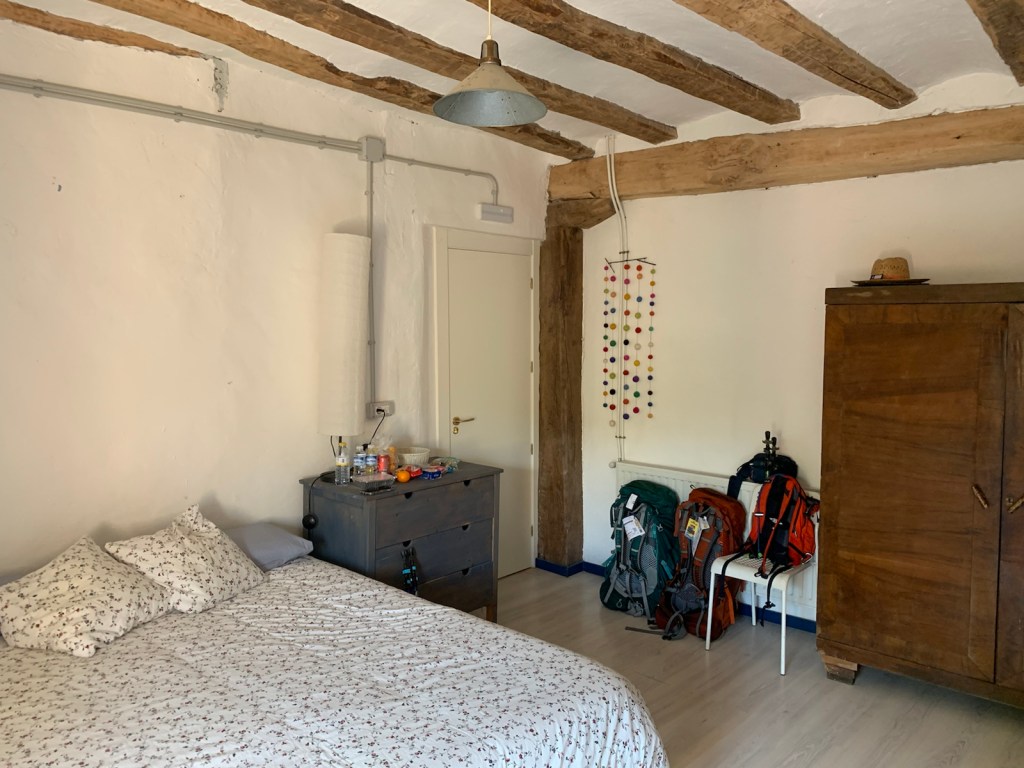
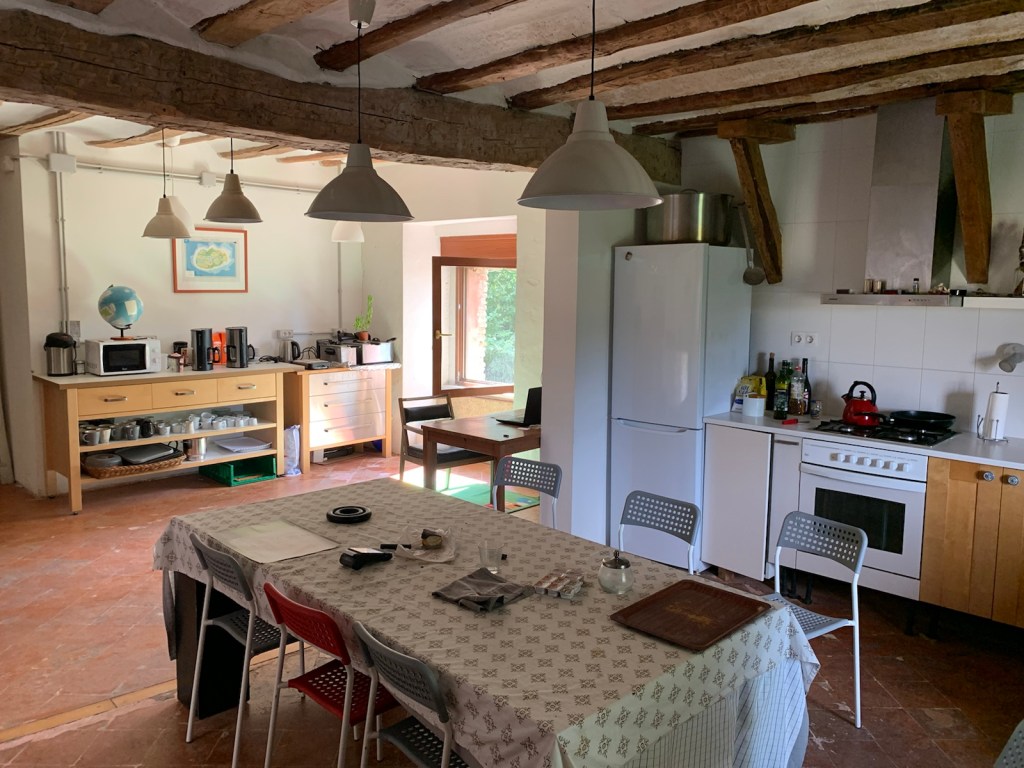
our roomthe family’s original kitchen, now available for guests to prepare a meal, if they bring their own food. Also serves as Fernando’s office.
Fernando, the owner, shared some information with us about El Salto.
El Salto from the huge back yard, garden and construction workshop/material storage.
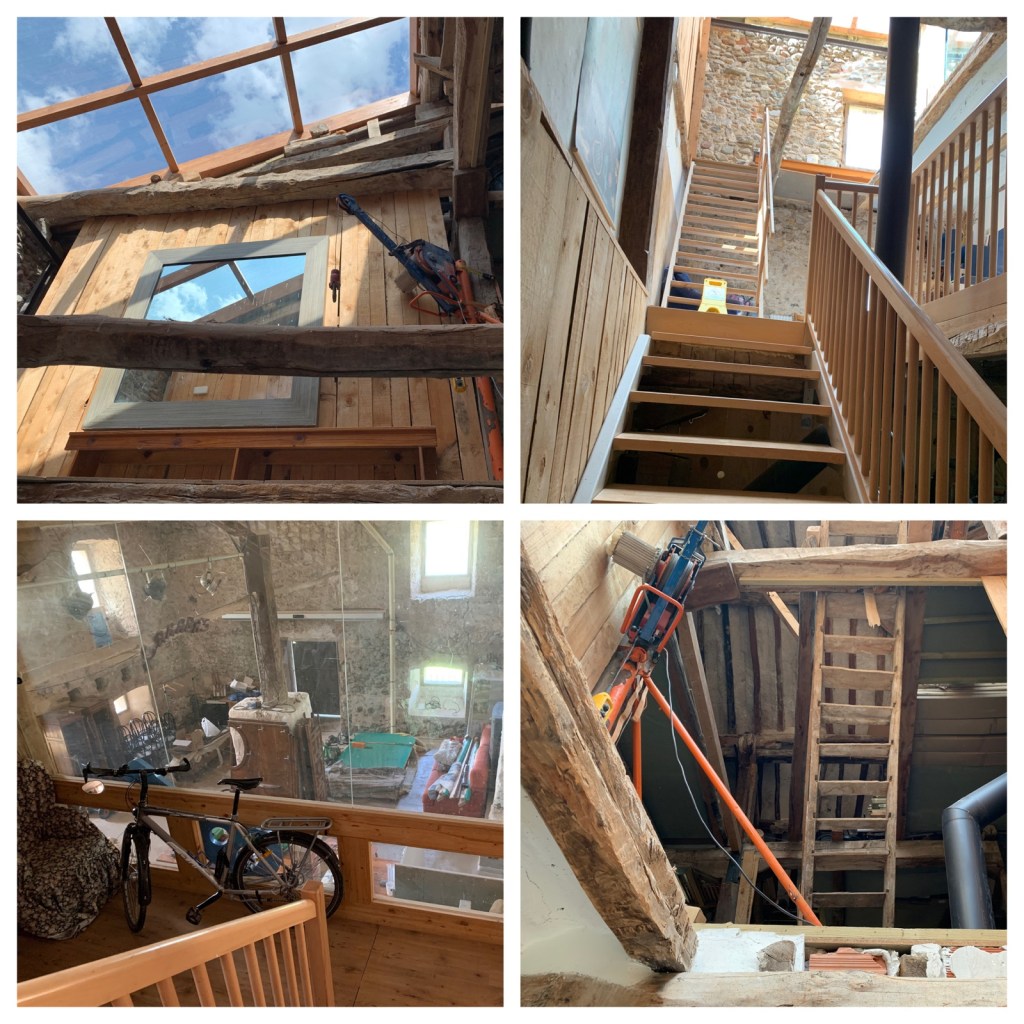
It seems that he and his brother bought the property some 20 years ago and have been converting the original late 1800’s hydroelectric plant. It’s still very much a “ work in progress” and Fernando admits, more likely a life long one.
Al Salto… a work in progress
He and his brother also have a successful bicycle repair business and restaurant in Burgos as their “day” jobs.. Fernando and his family first lived in the property but decided to open up several rooms for overnighting cyclists and an occasional tourist or pilgrim, like us. It also has a small shop for minor bicycle repairs. Their current residence is nearby. Our conversation ventured into grandchildren and soccer and Fernando revealed that he played for Real Madrid when he was 17!
Jim and Fernando chatting after our “do-it-yourself” supper.
Bloggers Note: Some of our shared experiences may seem overly critical or negative to some, but they are part of what one can expect when walking the Camino Frances. We love the Camino and all it has to offer, it has affected our lives in so many fulfilling ways and we know first-hand that it truly provides. Many of our readers use our blog to learn more about what to expect. Many of the things that you read here, will not be found in Camino guides. We also document our frustrations and fears, which for us also become learning experiences and morph into chuckling memories that add to the richness of the our Camino experience.





















 Jimandi