At 8:10 we began walking in heavy fog and an hour later almost missed the “Castro” (fort) of Castomaior, the remains of a Roman fort occupied from the 4th century BC to the 1st century AD.
Standing on highest mound of the fort and building ruins below on right
What remains are several concentric circular mounds up to 20 feet high with ruins/foundations of stone buildings protected in the center. It was difficult to photograph due to the fog but fascinating to see… over 2000 years old.
Our walk today was very pleasant with gentle ups and downs and even some level places. We passed thru no less than 8 small villages and hamlets ranging in population from 2 to 120. Each had at least one place to stop for refreshment. Small farms with sheep and cattle and chickens filled the area in between.
Interesting homemade chairs as we walked through Hospital Alta da Cruz (pop.<10)
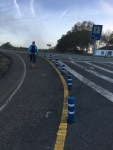
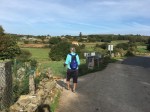
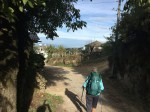
Brief transition from one country road to another
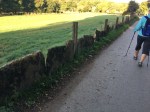
Interesting fence and farmland
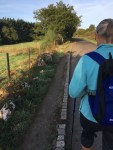
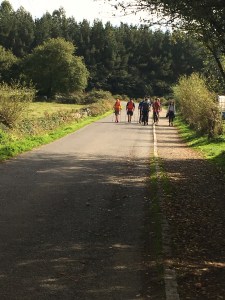
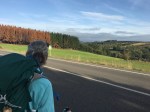
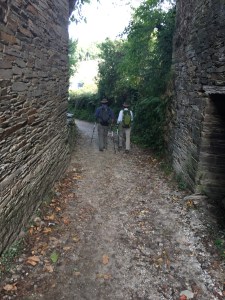
Right after crossing highway we got back onto this tranquil section of road
Small farm between two Albergue’s in Ventas de Narón.
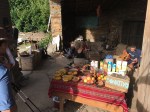
Our breakfast stop in Ventas de Narón
A gentle uphill walk after leaving Ventas de Narón, site of an 820 battle between Christian and Muslim armies.
A “gentle” downhill walk
Pretty flower and “busy bee” photographed by Linda on our walk through Eirexe (pop.23)
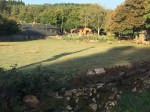
Back onto a short section of path to join another road through farms just before Portos (pop. 2)
We saw almost no pilgrims during our 9 mile walk! We’re guessing that the sunami of yesterday moved on ahead of us at least 5 miles before stopping last night. And because we had a 5 mile lead on today’s wave from Portomarin, they didn’t have time to catch us before we reached our destination of Lestedo (pop.7) at 12:30. Actually we could see them coming as we walked into Hosteria Calixtino (60€).
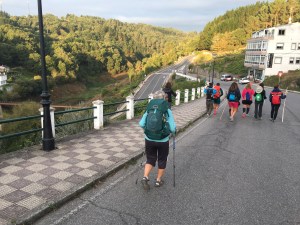
Here they come just as we got to Lestedo.
Our Hotel is only 6 months old and very nice. The staff has been very helpful and the food and wifi were good. Jim even tried their hamburguesa (Spanish version of hamburger) and was very pleasantly surprised. At lunch we chatted with Jill and Dennis, a nice couple from Brisbane, Australia who had a reservation in the next town.
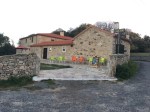
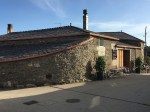
Front of our hotel in Lestedo
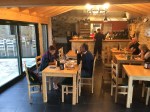
Bar and dining area
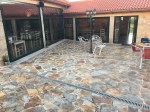
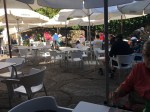
Outside common area
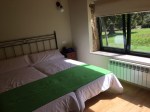
Our sunny bedroom in Hosteria Calixtino
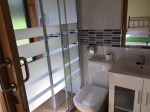
Our very modern bathroom
Another great day on the Camino has come to an end as we upload today’s blog entry and retire for the evening.
In just three days the atmosphere of the Camino has dramatically changed, and in our opinion, not for the better. We especially noticed it this morning when we walked out of Portomarin at 8:45.
Literally hoards of people of all ages, neatly dressed in new, unblemished shoes, brand new, unstained small daypacks and particularly, women adorned with designer blouses and slacks, earrings, heavy makeup and not a wrinkled garment in sight.
We counted over 50 “pilgrims” in front of us walking down the hill from Portomarin and an endless stream behind them unloading from tour busses. For the first 400 miles of the Camino we might have walked for two days without seeing 50 pilgrims.
As we began the steep climb out of Portomarin passing a few older folks but having most pilgrims pass us, we didn’t hear one unsolicited “buen Camino” from a passing pilgrim. Our “buen Camino’s” were mostly not responded to in wonderment while others looked blankly at us or just smiled.
Hoards behind us!
Hoards ahead of us!
We stopped for a break just outside Gonzar and this is one of two school groups of 20-30 kids and parents we have been hopscotching with this morning.
At one point along the way on a narrow section of path, a group of four well dressed middle aged Spanish adult “pilgrims” stopped and began chatting as one member of the group placed their pack in the path and decided to remove a jacket. They completely blocked the path until a couple “holas” from this particular pilgrim caused them to slowly make way for us and other pilgrims to pass, the four seemingly unaware that they were not the only people on the Camino this morning.
We’re sure that many of these pilgrims are here for a meaningful experience either spiritual, religious, educational or otherwise. It’s obviously not appropriate to judge other people’s motives or actions, especially with little or no facts about their life or situation. It is, nonetheless, troubling to see such a change in atmosphere for what has been a truly sobering, meditative, energizing, tranquil and otherwise wonderful experience. Maybe these last few miles to Santiago will be the ultimate challenge to not allow the external environment to diminish the personally satisfying and enriching life experience that is the Camino Frances.
High schooler wearing regional (Sevilla?) flag as cape
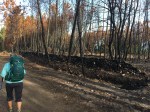
This section of forest had recently burned
We are staying in Gonzar (pop.43) at Casa García (35€) with nice accommodations, tasty food and a good environment for a restful afternoon and evening.
Albergue Casa García
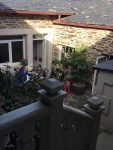
Courtyard of albergue Casa García
The bar and part of eating area in albergue Casa García
The most significant part of today’s walk was not the terrain or walking surfaces, which were very tame,
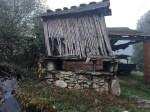
Old hórreo, a rectangular stone corncrib that is elevated off the ground to protect the corn from vermin, frequently seen in Galicia.
Newer horreo.
Lady farmer tending to her morning chores.
but instead the number of pilgrims. For the first day since we began the Camino 2017 there were always one or more pilgrims visibly in front or behind us. Further, the demographics also shifted to much younger and more Spanish pilgrims.
We expected an increase in the number of pilgrims after passing Sarria, but today when ever we reached a bar along the way there were typically 20-30 pilgrims present. Waiting in line to use the bathroom or to order breakfast or a drink was common. And when we reached the 100 km to Santiago marker,
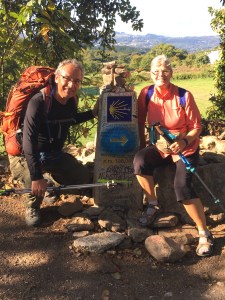
100 km (62 miles) to Santiago
halfway through our 10 mile walk, a dozen or so pilgrims were lined up to have their photo taken.
We stopped several times today to rest, pacing ourselves for the longer than average walking distance,
Our breakfast stop at Serra
Albergue bar in Morgade, just before the 100km marker
Having our lunch early in Mercadorio
Busy bar at albergue in Mercadorio
A rest break in Vilachá
including stopping for both breakfast and lunch breaks and didn’t reach Portomarin (pop. 1737) our destination until 1:30. But the cool morning air, late rising fog and shady walking areas made the walk quite pleasant.
Gradual incline along shady path
These shady pilgrims have been in front of us every morning for nearly two months
Nice walk just before Vilachá
Harvesting potatoes the old fashion way
Portomarín has been around for a while with a bridge from at least the late 10th century, but the current city is a relocation of the historic city including buildings transferred stone by stone.
New bridge and 12th century bridge below and new site of Portomarin above right
Closer look at bridges
Original Portomarin
Original site of Portomarin
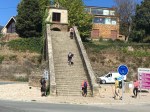
Steps leading up to relocated town of Portomarin
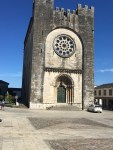
Iglesia de San Nicolas was moved brick by brick in 1950’s from original site.
Main Street in Portomarin
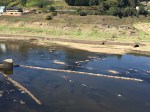
This was all due to a dam constructed in 1956, which flooded the former city that was located on both sides of the river. Today the water is normally low enough to see the remnants of the former city including the Roman bridge. Many bridges have spanned the river at this strategic point. Al-Mansur destroyed an early bridge in his campaign of devastation in 997. After being rebuilt, the bridge was taken out again by the 1112 war between Queen Urraca and her husband. Later, Urraca had the bridge rebuilt along with a pilgrim hospital. The strategic town needed to be protected, and this role fell first to the Order of Santiago, then to the Order of San Juan de Jerusalén. The town became an important pilgrim stopping point, including for royal pilgrims such as King Ferdinand and Queen Isabella. Domenico Laffi described it as, “an excellent place that has plenty of everything.” The city declined in the 19th century as the nearby city of Lugo rose to prominence.
The only difficult part of the walk today was the last mile going into Portomarin which was a long, steep stretch of downhill pavement resulting in an atypical blister for Jim.
We checked in to Pencion El Caminante when we arrived (45€) and tended to our chores.
Our pension in Portomarin
Then, we struggled with wifi both in our room, the hotel common areas and nearby bars and restaurants. The hotel had a weak signal, but elsewhere was due to the high number of users as tonight this town with a huge number of places to stay was completely booked (or “completo”).
We had a delicious margarita pizza for dinner overlooking the picturesque town square and then retired to our room for the day.
This morning was foggy when we left and stayed that way all the way through Sarria, a major starting point for those wishing to do the minimum 100km to receive a Compostela.
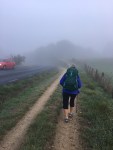
Typical of our early walk in fog from Pintin to Sarria
Walking along highway into Sarria in the fog
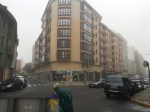
Still foggy as we walked through Sarria
The Camino experience can change dramatically here as groups enter the Camino who may be less familiar with pilgrim etiquette. While Sarria is a convenient and well-equipped pilgrim town, many guidebooks suggest to continue on to Barbadelo, the next hamlet for a more rural and relaxed setting.
We hurried through Sarria as suggested as it is not an attractive town, doesn’t project a very cordial Camino atmosphere and we had a reservation in Rente, a village about 3 miles beyond.
The most difficult part of our walk today was the 300 ft hill we had to climb between Sarria and Barbadelo. 300 ft doesn’t seem like that much, but we did it in less than a 0.2 mile stretch. Otherwise the ups and downs were not significant.
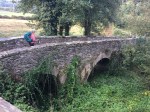
Crossing the medieval Ponte Áspera over the Rio Celerio as we left Sarria
Nice flat path along railway tracks between Sarria and steep hill leading up to Barbadelo
On our way up the steepest section of our walk
Struggling up our steepest walk of the morning
That’s a ” finally-reached-the-top” smile
We stopped at an albergue in Barbadelo to rest and to order bocadillas for lunch to take with us. Our home for the afternoon and evening, Casa Nova (31€) only provides an evening meal and breakfast.
We arrived at Casa Nova in Rente just before noon and were given a nice room in a lovely B&B which is a converted farmhouse and is run by a family who still works the farm and lives onsite.
Casa Nova
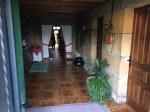
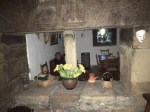
View upon entering throughout the front door
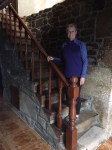
Beautiful original stone steps and hardwood railings
Doors in this converted farmhouse were designed for shorter folks
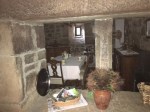
Original thick stone walls given character throughout the house
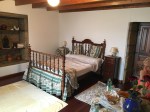
Our room
We spent the afternoon resting and Jim caught up on blogging as our wifi was fast and we had a good signal in common areas as well as our room.
Our dinner (10€) was a typical pilgrim offering of farmhouse soup (collards, potatoes, white beans and broth), delicious marinated and roasted lamp shanks over vegetables and Santiago cake for dessert, red local wine included.
We ate with two French ladies that have been hopscotching with us the past several days and followed Jim’s recommendation staying at Casa Nova (we stayed here in 2015) and they and we were not disappointed.
Our hostess fed us a desayuno (breakfast) at Casa da Veiga and then drove us along with two other pilgrims to where we stopped yesterday in Triacastela. We thanked her for her hospitality and were on our way to San Xil, the main Camino route toward Sarria. There is an alternate route from Triacastela which goes through Samos and adds 6.5 km to the walk, which we wanted no part of, so we were careful not to miss the turn.
We walked for a while with a nice young man from Switzerland who had started a very successful business in the event planning field, which created an instant basis for continued conversation. He was walking 15 miles/day versus our 7.5 miles/day rate, so after a mile or so he had to pick up his pace.
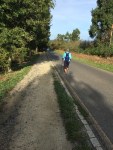
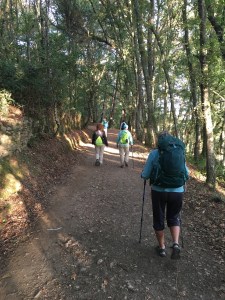
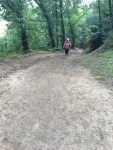
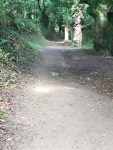
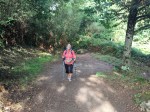
After a short distance on a small country paved road, we took a path up the side of the mountain for about 1.5 miles climbing about 900 feet, walked another mile or so on a relatively level paved road (probably the same one we started on) and then, in typical Camino fashion, proceeded to walk down 900 feet in elevation on a very steep dirt path to compensate for the earlier climb!
Puffing and panting at this point
Arriving at San Xil
Checking scenery (and resting) on the way up
Still climbing gradually
Moving to path beginning steep downhill section
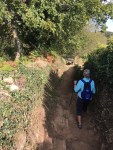
Pretty woods, steep walk down
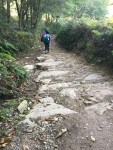
Rocky descent near bottom of mountain
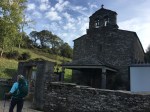
Church at base of mountain
As the path/pavement leveled out again, we chatted and walked with a father (now 68 and a Georgia Tech ’72 grad) and son from Monterey, Mexico. They both spoke impeccable English. The son was in the process of making a job change and moving to Boston.
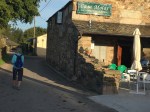
First village after coming down the mountain
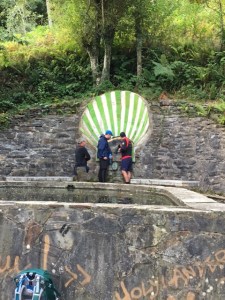
“Donative” rest stop in small hamlet with no services
Pass through a small hamlet
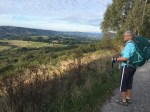
Pausing to appreciate the scenery
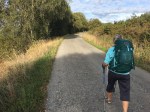
Switching from dirt road to dirt path… gotta watch for arrows and markers
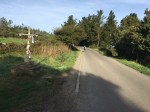
More tractors than cars on this farm road
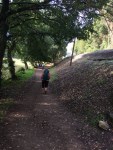
Back on the path outside of Pintin
The remaining walk was much more humane through farms and rolling hills but with no stopping places so when we strolled into Pintin and checked in to pension Casa Cines (40€) we were pooped.
We stayed in Casa Cines on our first Camino in 2015, so we feel right at home. Some upgrades to the bar and restaurant have been made recently and it is a popular rest stop about half way between Triacastela and Sarria. We farmed out washing and drying our clothes to the staff and rested most of the afternoon.
There is not much else to see in Pintin so we had lunch and dinner at Casa Cines.
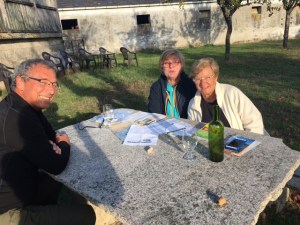
We had dinner tonight with Mike from Toronto, a recently retired school teacher. Our meal was enriched with shared Camino experiences and we retired for the evening after another great Camino day.
The old saying “What goes up must come down” could never have been truer than today.
This morning at 8:00 we left Casa Lucas with clear blue skies and 49F with a little wind to add to the chill. Two days ago we climbed 2000 feet in altitude and then continued walking at or near the 4200 ft level yesterday. Today we walked back down over 2000 ft in elevation!
Fortunately for us, the weather was clear, dry and perfect for walking. The path was quite steep over half of the way but the walking surface provided good traction, well spaced level spaces to give our bodies a momentary break and there were very few sections that were rocky or covered with loose stones.
Though challenging, what made this another wonderful day on the Camino were the constantly changing, breathtaking views.
The first 1.5 miles we dropped only 300 feet in elevation, stopping for breakfast at Biduedo (pop.31) and upon leaving the village passed a small stone church that is reportedly the smallest on the entire Camino.
Blackberries have been a disappointment this so far
The initial path as we left Fonfria
Gradual downslope through a forest
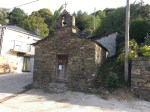
Smallest church in the Camino in Biduedo
The next two miles we dropped 700 feet and took a breather at the hamlet of Fillobal and savored a nice glass of fresh squeezed OJ.
Jim is actually standing straight up with gravity, path is sloping down
Going down gradually in this section
This shows the angle we walk when going down, here we are walking on gradual slope along edge before going straight down
Walking into Fillobal
An OJ stop and breather on the way down
After another 2 miles, we had descended an additional 900 feet as we entered the hamlet of Ramil and were amazed at the large numbers of chestnut trees.
Scenery on our way down the mountain
Beautiful old trees shade the path
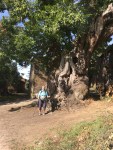
Very old chestnut tree
We continued on the final half mile or so into Triacastela dropping the final 100 feet, totaling a 2000 feet descent for the morning.
We stopped at a nearby bar and called Casa da Veiga (32€) to send a driver to pick us up and take us to our place for the day, some 2 miles off the Camino.
Waiting for our ride at Triacastela bar.
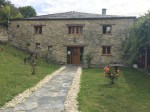
Casa la Veiga in the hamlet of Vilavella, near Triacastela
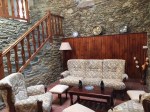
Living area in Casa la Veiga
Our room
Our room is in a building that has about a dozen rooms, living areas and meeting rooms. It is a former rectory for the nearby church. It appears to be an ideal place for events or corporate meetings and is adjacent to a nice home of the absentee owner, who lives in Barcelona. The surrounding property is very isolated with a small, old, inactive church a cemetery and a farm with cows and horses, owned by our hostess and property caretaker, her mother and grandmother.
Having lunch/dinner in Triacastela
Our hostess’s family farm next to our Casa
The facility provides only breakfast, so the caretaker shuttles guests into Triacastela for lunch and dinner as needed… which makes it a suitable housing option for pilgrims like us.

















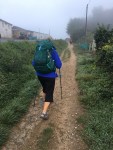



 on a relatively level paved road (probably the same one we started on) and then, in typical Camino fashion, proceeded to walk down 900 feet in elevation on a very steep dirt path to compensate for the earlier climb!


 They both spoke impeccable English. The son was in the process of making a job change and moving to Boston.











 Jimandi