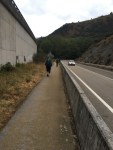
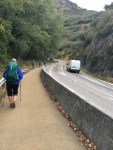
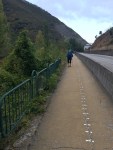
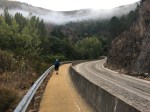
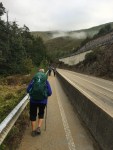
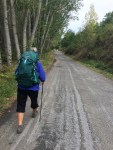
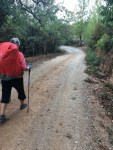
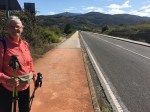
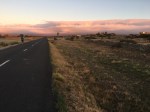
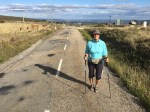
Our entire walk today was on the road. Fortunately, we had a nice concrete barrier between us and the vehicles, mostly local cars, as we were also weaving through a gap in the mountains with the autovia crossing above us periodically. Also, fortunately, the road was flat with a very gradual upward slope.
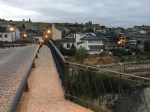
Crossing the river as we left Villafranca del Bierzo this morning
We walked for a mile or so through the mountain gap before sharing the gap with the autovia.
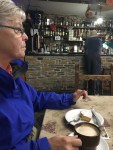
A stop for breakfast and Santiago cake to go with our cafe con leche
We were dwarfed by steep mountains on both sides of us as we worked our way through the gap and we’re thankful that they were “up there” and we were “down here”. We’ll have plenty of mountain to climb in a couple of days.
We had a slight glitch in plans today. When we arrived in Trabadelo (pop.456) at our intended destination, the owner had never heard of us. Jim had listed the albergue in our itinerary as reserved through Booking.com.
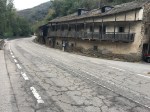
Finally leaving the highway as we headed into Trabadelo.
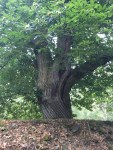
Beautiful very old chestnut tree. Many in the region are well over 1000 years old
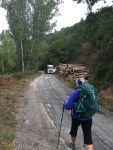
Logging and evidence of nearby sawmill
And next we walked by the sawmill
This is where we thought we had a reservation… actually we liked our eventual place better
But we couldn’t find the confirming email, etc from Booking. We’re guessing that we made the reservation on line but perhaps lost wifi during the transaction and we failed to verify that we had received the confirming email. Anyway, the place was “completo” but the owner sent us across the street to another “complete” hotel who also managed a nearby casa rural, which, lucky for us, was available.
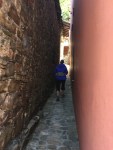
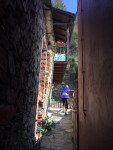
We were grateful for the help as there is no way we or anyone else would have found the place we are staying in on our own. Which is probably why it was still available.
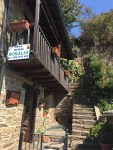
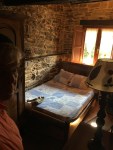
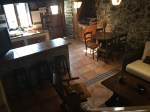
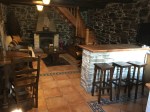
Our place for the day is a nice casa rural Rosalie(42€) with full kitchen, living area and nice outdoor patio. Another couple from northern Spain on vacation arrived around 8pm and occupies the other bedroom. We both have our own bathroom.
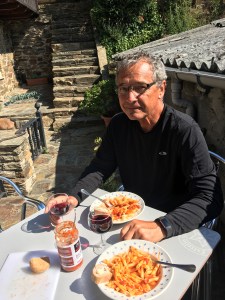
There isn’t much in this small village but we found a market a few doors up the street and got the fixin’s for lunch and dinner. So we shopped, cooked, napped, cooked, made reservations a few more days ahead and vegged the rest of day away.
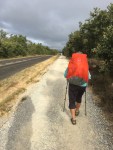
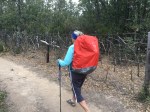
The weather was threatening this morning so we retaliated with our pack covers, successfully.
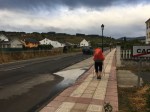
Finally leaving Cacabelos, dark clouds threatening.
We walked for almost a mile to get out of Cacabelos, stopping for breakfast on the way.
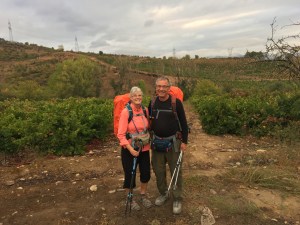
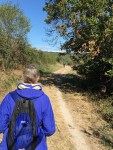
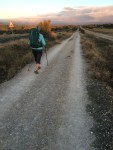
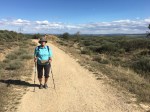
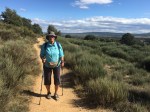
The path continued along the road for several miles. We ran into some pilgrims that we had seen a few days ago, one a young lady from Greenville. We walked with her until her other two companions took an alternate route that was longer and supposedly more scenic, also more difficult. She took a photo of us and joined her companions. We chose to stick with the traditional path along the road.
For the last few miles, the path took a turn through the vineyards and countryside,
After a “climb” through a vineyard
weaving left, right, and up and down as we worked our way into Villafranca del Bierzo.
Villafranca del Bierzo is one of the most beautiful towns on the Camino, retaining much of its medieval and Renaissance character in spite of an increase of modern hotels and buildings. Several Roman castrum have been found in the area, with the strategic location at the confluence of the rivers Burbio and Valcarce and just below the mountain pass. This location later drew merchants from all over, giving the city its names (literally “city of the Franks” but more accurately, of the “foreigners.”) Villafranca marks the end of the 10th stage in the Codex Calixtinus and was home to numerous pilgrim hospitals.
Life wasn’t all that easy for the people of Villafranca, who suffered an outbreak of plague in 1589 and destruction by flood in 1715. In the Peninsular Wars of the early 19th century, French soldiers overtook the city only to be driven back by British soldiers who ravaged Villafranca, destroying the castle and stealing from churches.
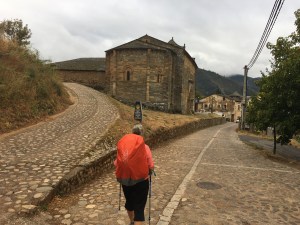
On the way into town, we passed the  Iglesia de Santiago with its Puerta del Perdón, a doorway for pilgrims who were too sick to continue to Santiago. They could walk through the door in lieu of completing the pilgrimage and receive the same indulgences. 
Iglesia de San Francisco, according to legend, was founded by Saint Francis of Assisi himself on his pilgrimage to Santiago.
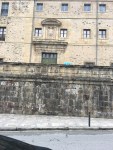
Finding our hotel was difficult. We walked around, asking directions for about 30 minutes. It was right in front of us, a convent, which we thought was a church, no signs!
Guess who we thought of when we saw this place.
On front of convent was a blue “H” for hotel but no name of hotel.
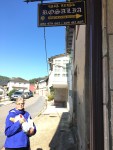
Only sign to identify our hotel
By now it was 11:30, and the hotel didn’t open until 12:00 so we returned to a restaurant we had seen on our unplanned tour of the town, that looked like it had good pizza. Pizza also wasn’t available until after noon, so we sipped more cafe con leche and churros and then had a nice lunch while we waited for our room.
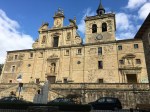
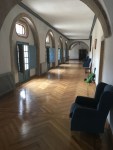
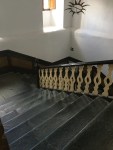
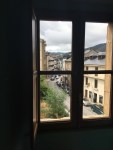
We checked into the hotel, Hotel San Nicolas del Real (50€), at about 1:00. It is a real convent with all the rooms around a courtyard. It has wide hallways, and wide stone stairs. Our room has a view of the old town and surrounding mountains.
Our “convent” hotel
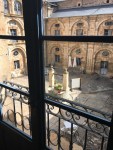
Courtyard of convent
Hallway outside our room
Our room in convent
View from our room of town and mountains
Jim has been fighting early cold symptoms, so we didn’t do much site seeing, spending the afternoon resting while our clothes were being washed and dried (8€).
We had a very nice pilgrim dinner (just the two of us) in the cloisters of the 17th century Convent and Iglesia and then retired for the evening.
We spent most of the morning walking out of Ponferrada
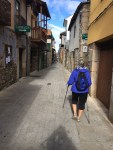
Working our way through Ponferrada
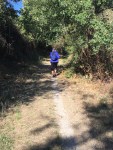
A dirt path and a steep hill inside Ponferrada just for pilgrims… how thoughtful
and through several small residential communities, each promoting the wines of the Bierzo territory of Castile and León. Ponferrada is the current capital of the Comarca of Bierzo, while Villafranca del Bierzo was the historical capital. Cacabelos is between the two locations.
The territory of Bierzo is surrounded on all sides by mountains which makes the area very isolated. In pre-Roman times the region was populated by the Astures, a Hispano-Celtic Gallaecian people. They were conquered by Emperor Augustus in the Astur-Cantabrian Wars (29–19 BC) and the area quickly became the largest mining center of the Empire during the Roman period, where gold and other metals and minerals were extracted. Numerous Roman mining sites are still visible in the area as well as evidence of coal and other mining operations which dominated the economy up until the mid-20th century.
The Romans also imported grapevines, and wine production thrived in the region until the propagation of Phylloxera at the end of the 19th century, which destroyed the majority of the vineyards. The wine industry has since had a resurgence since the 1990’s and is now a major contributor to the economy as is tourism associated with the wine industry and the Camino Frances.
Today, the Camino took us through the older sections of Columbrianos, Fuentasnuevas, and Campanaraya.
Renewing old house
Right across the street from newly renovated house
Still standing
While there are still a number of very old, abandoned buildings, in very poor condition, there doesn’t seem to be an effort or apparent desire to raze them. We have observed this all along the Camino and in many other parts of Europe we have visited. Old buildings, especially homes, eventually get converted to something newer, usually preserving the outside, historical architecture. Instead of demolition, a “se vende” (for sale) sign is placed on the structure and eventually, we assume, a new owner will restore it or convert it to a different end use, as we have observed, rather than starting from scratch (which says a lot about the design and integrity of the original structure).
Another interesting observation today were the gardens. The homes along the road between the villages almost all had large gardens, beautifully maintained with evidence of bountiful crops even this late in the season. And on this Sunday morning several owners could be seen with hand implements, weeding and nurturing the items still growing.
The final 4 miles of the walk took us back onto dirt paths through vineyards and other fruit and vegetable fields, in varying sizes.
The grapes in this region have apparently been harvested as very few are visible on the vines and therefore inaccessible for pilgrim snacks.
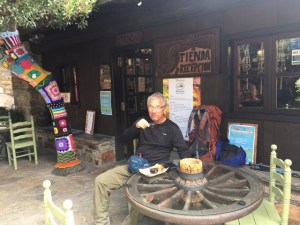
As we walked into Cacabelos, (pop.5475), on our right was Moncloa de San Lázaro (75€), our hotel, a converted 13th century pilgrim hospital. It only has 8 rooms and is apparently a destination itself, with a very popular restaurant featuring regional cuisine which was packed nearly all day, a large shop with local wines, art, crafts and sweets and a variety of facilities for groups.
While our room was being readied we were given a glass of the local Bierzo wine made from Mencía grapes, unique to the region, and a homemade empenada to occupy the 10 minute wait… an apparent tradition for Peregrinos.
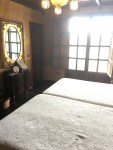
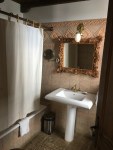
The hotel and our room is traditional and upscale in an understated way.
Yes, it’s a sweater knitted around the tree
Roasted peppers was a specialty of Moncloa
We both ordered the restaurant’s traditional 4 course lunch, which was very filling. It was nothing special and over-priced at 25€ per person.
After lunch (around 3:00) we returned to our room to rest from our walk, chill and swear off eating for the rest of the day.
It was in the high 30’s when we began walking at 8:20.
Leaving our El Acebo albergue at 8:20 and 38F.
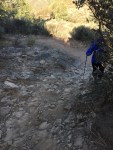
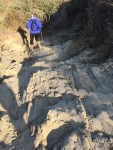
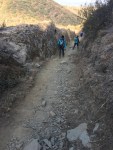
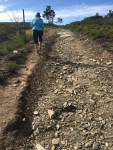
The walk from El Acebo to Molinaseca included some very difficult paths dominated by protruding and loose shale. We were frequently slowed to a snails pace by truly terrifying treacherous terrain. Linda twisted an ankle in this area on our first Camino in 2015, so we were perhaps more cautious this time to prevent a Camino ending injury.
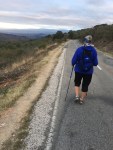
Whenever possible we walked on the parallel narrow asphalt road, but returned to the path when the road swung a significant distance away from the path.
From Molinaseca to Ponferrada we walked on sidewalks and a path that supposedly was a shortcut by 1.2 miles, but only took us into the city in a roundabout way with no saving in time or distance.
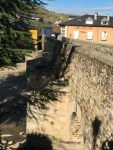
Peregrino bridge into Molinaseca
Iglesia de San Nicolas in Molinaseca
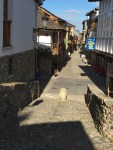
Walking through old Molinaseca
The beginning of our “shortcut”
So far, the short cut is only taking us along the normal highway entrance into Ponferrada.
A long short cut!
The weather was chilly but the sky was clear so we were rewarded with beautiful scenery for our efforts.
Ponferrada started off as a Celtic settlement, followed by a Roman mining town. The city was destroyed first by the Visigoths and then Muslim invaders. After the Reconquista, Bishop Osmundo of Astorga commissioned a pilgrim bridge here, which was unusually constructed with steel beams, giving the city its modern name. Ponferrada was a booming pilgrimage town, with diverse merchants including Franks and Jews, who were protected during a 15th-century restriction that called for segregating communities. The railroad came to the city in 1882 and in the 1940s the town grew with the coal industry.
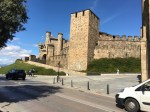
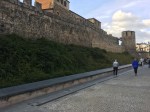
The most impressive site is the  Templar castle built in the 13th century over a destroyed Visigoth fort, which was built over a Roman fort, which was built over a pre-Roman castro. Soon after its completion, the Templars were banished.
According to legend, the castle holds all kinds of secret Templar symbolism, such as the 12 towers representing the 12 months or the 12 disciples.
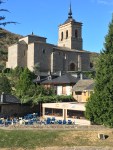
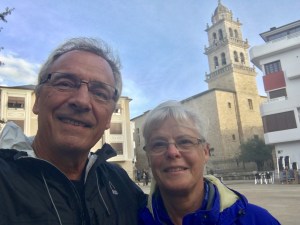
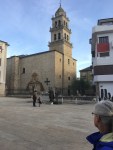
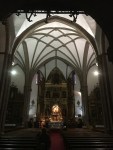
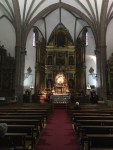
Iglesia de Santa María de la Encina on the Plaza Encinas, houses an image of Mary said to be originally in the Astorga cathedral, but it was hidden in the 9th century for protection from invading Muslims.
Years later, the image was miraculously found in an oak tree, hence the name “Our Lady of the Oak.” There is a statue in the plaza depicting the miracle.
We had a late lunch in our hotel, El Castillo, (55€) and pizza in a nearby plaza at 7:30 and called it a day.
Today was all about scenery and a spiritually significant location on the pilgrimage of Camino Frances.
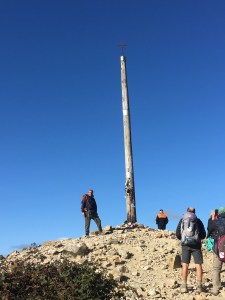
The taxi dropped us off at Foncebadón where we concluded our walk yesterday afternoon and we climbed the remaining 1.2 miles to the Cruz de Ferro, 4934 ft, the highest point on the Camino Frances.
Our starting point at Foncebadón
Ruins and newer buildings at Foncebadon
Leaving Foncebadón
Looking back at Foncebadón on our way to Cruz de Ferro
Approaching Cruz de Ferro, pentacle of the Camino Frances
Where the cross is now located is thought to have originally been an altar built to the Roman god Mercury, whereas some stories say that it is where the Celts worshiped, either way the origins were pagan. The cross is believed to have been placed here in the 11th century by Gaucelmo.
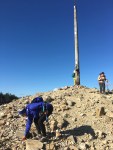
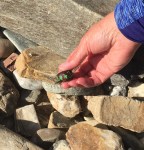
Traditionally pilgrims have left a rock here, whether picked up along their journey or brought all the way from their homeland. Some of the rocks that have been left here contain little messages to loved ones or the name of the pilgrim’s home town.
The tradition of pilgrims leaving a stone at the Cruz de Ferro was originally a very religious one and the purpose was to say a prayer at the Iron Cross and leaving the stone behind was very symbolic in that you were really leaving behind all your sins.
More recently, the tradition has been built on the recognition of leaving behind not only the sins that pilgrims carry but also other burdens in their life or the burdens of a loved one.
Linda placing memorial for Ed
Linda placed a hand painted chestnut inscribed “Ed + Jo” for our friend Joselle, in memory of her beloved husband, Ed.
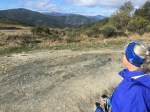
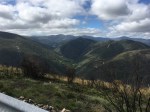
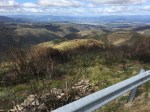
From the Cross, we walked another 5 miles, nearly every few steps an incredible new breathtaking view from the top of the world,
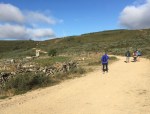
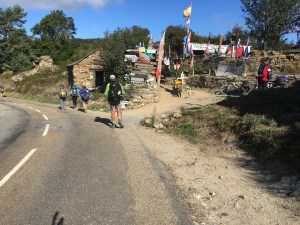
walking down Monte Irago, passing Manjarin and continuing down a very steep, loose stone laden path into El Acebo (elevation 3770 ft).
Two pilgrims on rocky switch-back below Jim
Linda waiting for Jim to make it off the downslope into El Acebo
Just arriving in El Acebo
El Acebo (pop.37) is a picturesque village typical of mountain villages of upper Bierzo with houses built from and covered in slate, the typical building material of the region. The slate laden paths add to the difficulty of the steep descent into the village. Another characteristic of the homes are the street-facing wooden balconies, that sometimes reach outside of an outdoor staircase. After finally breathing a a sigh of relief upon reaching the cobble stone street through the village, even it is built on a 30 degree slope.
We stopped at Hostel La Rosa del Agua (57€) and had lunch at 1:00pm until our room was ready.
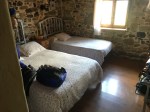
Our room
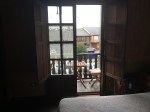
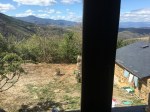
The view out our room window
Today has been chilly and windy beginning at 31 degrees in Foncebadón at 10:00 am and still a cool, windy sunny afternoon in the low 60’s, so we pretty much camped out in our room, washed clothes and rested from the morning hike,
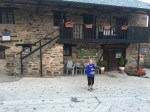
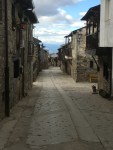
Main Street… with a 30 degree slope.
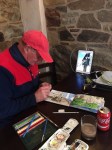
An artist from New Zealand who was painting local scenery at the lunch table next to us
Two delightful German ladies who sat next to us at dinner. They are only walking for 10 days but we have encountered them several times over the past three days.
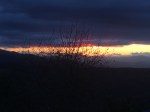
took a brief walk and finished the day viewing a dramatic sunset.
As we left Santa Catalina, it was a nice walking morning except for the 10mph wind in our face.
Clouds overhanging mountains and strong winds as we left Santa Catalina de Somoza
Camino paralleled the road all morning, windy but sunny initially, but strange cloud formations as we approached the Cantabrian Mohntains warned of changing weather.
Our breakfast stop at El Ganzo
We stopped at Ganzo (pop.30) for breakfast and for Jim to put on a windbreaker and Linda a buff to cover her ears.
We continued on and the clouds got more ominous as we climbed deeper into the Cantabrigians Mountains, so we put on our pack covers and put our ponchos in outside, easy-to-reach pouches for the inevitable deluge. But thankfully, all we got was continuing winds and drizzle.
Still windy and beginning to drizzle as we left El Ganzo
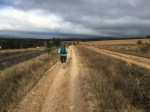
The Camino several miles outside of Rabanal del Camino… threatening sky all the way
Just outside Rabanal, pilgrim crosses in fence.
We reached Rabanal del Camino (pop.73) after climbing over 650 feet to an elevation of over 3800 ft.
The Hosteria El Refugio (50€) didn’t open until 11:30, so we had an early lunch at a nearby bar while we waited to check in.
Walking into Rabanal del Camino (all uphill)
Our hotel
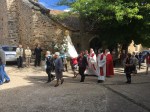
Religious procession this afternoon at church across from our hotel
We settled into our room and as we had hoped, the skies began to clear around 2:00 so we had a pilgrim lunch/dinner at 4:00 and then decided to walk to Foncebadón, another 3.5 miles up.
We originally wanted to stay tonight at Foncebadón but everything was booked so we opted to stay in Rabanal. This put us in the situation of having to walk nearly 11 miles tomorrow starting with the steep climb to Foncebadón, another steep climb to the Cruz de Ferro, the highest point on the Camino Frances, then another 5 miles down steep, rocky terrain to El Acebo.
Just outside Rabanal del Camino on our way to Foncebadón
Scenery made the steep climb worth it
Brush got quite heavy and path narrow on the way up to Foncebadón
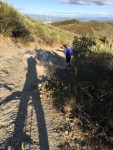
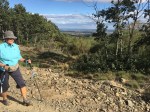
Rough going on the steep and rocky path
Why did the pilgrim cross the road?
Almost to the top on rocky path
Finally at Foncebadón with cows grazing and views of Astorga in distant background
An albergue dining room and bar in Foncebadón where we called for taxi
We made our way to Foncebadón, by climbing another 800 ft to an elevation of 4600 ft, enjoying the beautiful views on the way up and at the top, allowed now by clear, blue skies. Once we got to the first albergue, at about 6:30pm, we called for a taxi and by 7:15, we were back in our room for the night in Rabanal del Camino.
We’ll sleep easier tonight knowing that we won’t have to tackle the walk to Foncebadón in the morning.





 So we shopped, cooked, napped, cooked, made reservations a few more days ahead and vegged the rest of day away.
 She took a photo of us and joined her companions. We chose to stick with the traditional path along the road.
 They could walk through the door in lieu of completing the pilgrimage and receive the same indulgences. 

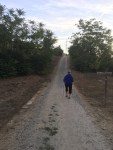

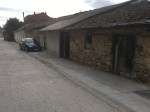


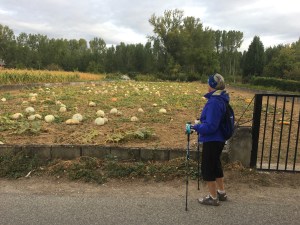 The homes along the road between the villages almost all had large gardens, beautifully maintained with evidence of bountiful crops even this late in the season. And on this Sunday morning several owners could be seen with hand implements, weeding and nurturing the items still growing.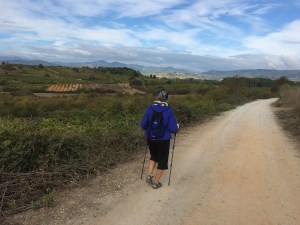
 It only has 8 rooms and is apparently a destination itself, with a very popular restaurant featuring regional cuisine which was packed nearly all day, a large shop with local wines, art, crafts and sweets and a variety of facilities for groups.
 and a homemade empenada to occupy the 10 minute wait… an apparent tradition for Peregrinos.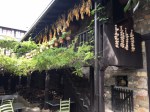











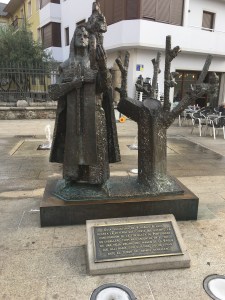 There is a statue in the plaza depicting the miracle.
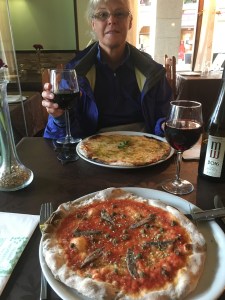 in a nearby plaza at 7:30 and called it a day.




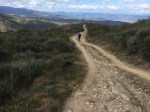
 and continuing down a very steep, loose stone laden path into El Acebo (elevation 3770 ft).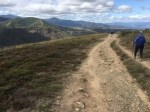








 Jimandi