We encountered a steep climb up the mountain behind Nájera at the beginning of our walk and a gradual, steep incline carrying us from the valley up into Cirueña, but otherwise the terrain was not an issue for our longest walk since we began nearly 3 weeks ago.
Looking back at Nájera from Alto Nájera
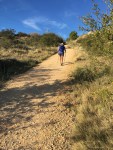
Reaching the top… Alto Nájera.
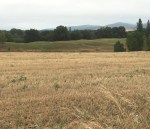
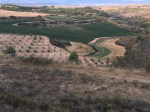
Just past Alto Nájera and moving into the farmlands.
Shortly after our breakfast stop in Asofra,
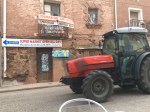
Small tractors use in vinyards… small enough to travel between vines without harming fruit,
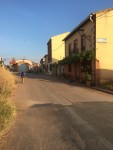
Entering Azofra
Azofra “ambiance a la tractor” at breakfast
Jim chatted for a few minutes with Gary from England who was walking 25-30 km per day for only a week, as he has done the last few years. With him were his daughter, a college student, and his two cousins.
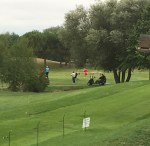
Is that a golf course???
Yep, it’s a beautiful 18 golf course that’s quite popular based on number of autos in parking lot.
We stopped for a second cafe con leche and zuma naranja at a golf course for an unusual 19th hole Camino experience to conclude our walk.
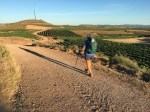
Today was much of what we enjoy about the Camino. The rolling farmland of Rioja, extending out in all directions from a winding seemingly endless Camino soothed the senses. The dark green rows of fruit filled grape vines randomly patched among already harvested fields of grain and occasional, occurring lighter green olive orchards formed a comforting quilt. The sounds of rustling water in the open irrigation trenches, the gentle rhythm of crunching footsteps and an occasional dog bark punctuated the soundless void that was relaxing and meditative and sustaining.
Just past Alto Nájera and moving into the farmlands.
Moving on from Nájera
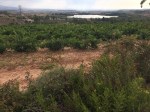
Rows and rows of healthy green vines
Narrow roads thru the farmland
These roads rarely see anything but small tractors and pilgrims on bikes or on foot.
Unspectacular, but very much one of Linda’s favorite areas .
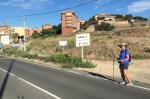
Approaching Azofra
Looking back at Azofra.
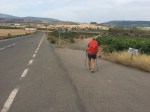
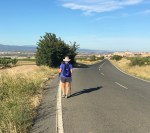
We even walked along this stretch of autovia
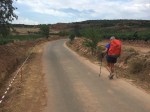
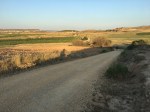
The Camino going on forever
The cloudy sky with showers off in the distance and a gusty wind threatened rain most of the morning, but provided only a minor threat and instead made us thankful and satisfied as we completed today’s not hard, not easy but satisfying daily journey.
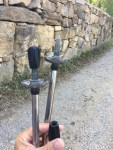
Jim changing tips on trekking poles. We are constantly changing tips to get best contact for changing walking surfaces: dirt vs pavement or concrete.
Close up of pole tips. Wear out metal tips and you have to replace poles. Wear our rubber tips, you can replace for several $ each. Rubber tips give better traction on hard surfaces and eliminate irritating clicking noise. Metal tips give superior traction in dirt and don’t wear as fast as on hard surfaces
We arrived in Cirueña (pop. 127) at 11:45 and we able to check-in to Casa Victoria (42€), a home that rents out 3-4 nice rooms for guests. After completing our chores we had a sandwich for lunch at the “only bar in town”, literally, then had a nice relaxing afternoon.
Casa Victoria in Cirueña
Our double room at Casa Victoria. We also had private bath, but not ensuite
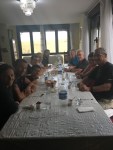
For dinner we joined a group at the Albergue Victoria which is owned by the same family that owns ours. Our fellow pilgrims all spoke a little English.
Our fellow pilgrims at dinner at Albergue Victoria in Cirueña
One lady, originally from Peru was with her American husband and they live in Connecticut. The others were from Brazil, Italy and Ireland.
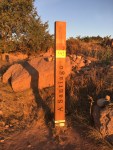
Camino signpost typical of Rioja region, just after leaving Ventosa
On a July 778 morning, Roland and his knights broke camp here, in Alesón village…
Between Ventosa and Nájera is the village of Alesón where the legendary knight, Roland had camped in July 778 with his knights on his way to Santiago with Charlemagne and the French army. Early the next morning they marched to the Poyo Roldan (Roland’s Hill),
… and marched to Poyo Roldan (hill with tall thin tower), the watchtower for Nájera castle.
which was a large mound serving as a watchtower over the castle of Nájera. The Moors occupied Nájera and had sent the giant, Ferragut, of Syrian origin and 20,000 soldiers from Turkey to fight Charlemagne’s army, who was marching to Santiago and driving the Moors from northern Spain. Ferragut was reportedly a descendent of Goliath (of David and Goliath fame), was 9 feet tall and weighed over 400 pounds. (He was ugly, too!)
Ferragut came out from Nájera into the open field between Poyo Roldan and Nájera, challenging any of the opposition to fight him one-on-one. Many tried and failed. Finally, Roland insisted on having his turn and fought with the giant for three days. In between spurts of fighting the two conversed about their respective faiths, and Ferragut revealed that his one weak place (his Achille’s heel if you will) was his belly button. A final duel ensued, having both agreed that the winner would be the one espousing the true faith. Ferragut tried to fall on Roland to crush him to death, but Roland stabbed him in the belly and won.
The duel lost, the Moors vacated Nájera and moved south, clearing the way for Charlemagne’s army to continue on their way toward Santiago. And Roland became the greatest knight in Christianity.
We must be getting stronger. Maybe not strong enough to take on Ferragut, but today’s walk seemed actually easy. We were pleasantly surprised when we stopped just outside of Nájera (pop. 8144) for our standard breakfast and weren’t really tired from our nearly 7 mile trek.
Waiting at a bar in old Nájera until we can check in to Pencion Calle Mayor.
Pencion Calle Mayor (30€) didn’t open until noon so we explored Nájera a little and hung around a bar with wifi (most every place has wifi, especially bars) and made like efficient pilgrims waiting for their room.
Our twin bed room is small and shares 2 bathrooms with 5 other private rooms and a communal bedroom with 6 twin beds (not bunks).
Our habitacion doble
One of two shared bathrooms
Pencion Calle Mayor communal kitchen
Communal bedrooms but not bunk beds
There is a communal kitchen which is large enough to include a washing machine and racks to dry clothes near several windows. Being the first pilgrims to arrive, we had the bathrooms to ourselves for showers and washing socks and underwear, so we didn’t actually share.
Calle Mayor (Main Street) in old Nájera
The river separates old Nájera from present day town
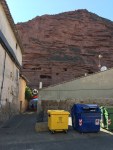
Old Nájera built right up against the solid rock
Closeness of mountain to old town is intimidating
Buildings in old Nájera up against the solid rock mountain. Note caves in the mountain
Late afternoon (4:30-5:30) we walked around Nájera and discovered as we often do in Spain, that a meal like dinner, is not offered by restaurants before 8:00 p.m. We finally found a bar and ordered pasta.
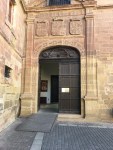
Before calling it a day we walked to the Monasterio de Santa María la Real.
Entrance to monastery
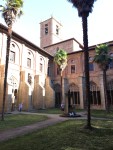
Cloister of monetary with shadows of stone “drapery”
Lacy stone “drapery” surrounding courtyard
Looking across courtyard and church tower
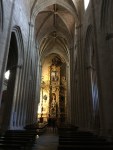
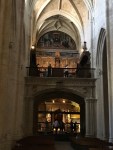
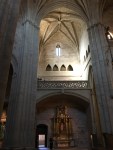
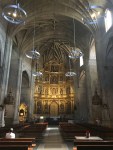
Church interior and retablo.
The choir loft and the entrance to the cave below.
To get perspective on height of this church see Linda standing at bottom left of center
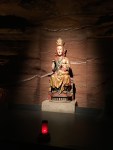
According to legend, in 1044 Navarran King Don Garcia III was hunting partridge with a falcon. The two birds entered a cave and the king followed them in and deep inside he found a statue of the Virgin Mary, with a vase of fresh lilies and a burning oil lamp.
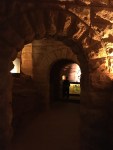
The church was built around the cave with the Virgin Mary Statue. This cave entrance is located under the choir loft
The statue of the Virgin Mary discovered in 1044 in this cave.
He saw this as a blessing on the Reconquista and used some of the money he had plundered from the Moors to build a church around the cave leaving the statue in place. At one point the statue wore a crown of jewels, which were later stolen and divided. The Black Prince Ruby made its way to England’s coronation crown.
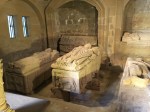
Tombs on opposite side of cave entrance
Tombs of Navarrean kings surround both sides of cave entrance
Ornate tomb of Sancho III’s wife, Doña Blanca.
Very old tombs
This tomb has almost deteriorated after more than a 1000 years
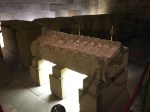
The church is also a burial place for Navarran royalty and also contains the remains of monarchs going back to 918 AD.
Today’s walk was relatively short and mostly unremarkable, by design, as our main objective was to stay in Ventosa at the Hotel Rural Las Aquedas, a significant highlight of our previous Camino.
Walking out of Navarrete
This morning we walked by this cemetery. The facade of the San Juan de Acre hospital that we passed yesterday was moved from the ruins of its original placement on the opposite side of Navarrete to form the entrance of this cemetery in 1887.
Yesterday, on the way into Navarrete we passed these ruins of an ancient hospital for pilgrims. When pilgrims began to frequent the Camino in the Middle Ages, the Church built hospitals along the way to minister to the physical and spiritual needs of pilgrims. These are the ruins of San Juan de Acre, founded in 1185 by Maria Ramirez, the mother of a bishop.
Camino moved from road pavement to dirt path along road
Camino dirt path begins to wind among vinyards
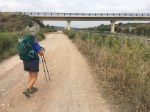
Vineyards on the left, A-12 on our right
Still winding through vineyards, Ventosa in background
Furthermore, the normal stopping points available for the 45 miles after Logroño would require 4 or 5 days in a row of walking 10 miles. By staying last night in Navarrete and tonight in Ventosa, our mileage from Logroño for the next several days will be: 8, 5, 6, 9, 7, 10… resulting in an extra overnight but hopefully much easier on our feet and bodies.
Las Aquedas (63€) would be considered a very nice B&B in the U.S., so for us it seems like a bargain. It is owned and run by Rocio Juesas Bonet, a gracious Spanish Señora. She welcomes you like an old friend into her beautifully decorated home, a converted 18th century bakery.
Rural Hotel Las Aquedas
Nice little courtyard in front of Las Aquedas.
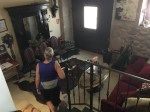
Las Aquedas lobby
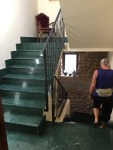
Staircase from our 2nd floor room to lobby
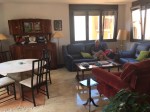
Guest living area on second floor of Las Aquedas
Our room (the same room we occupied in 2014) is spacious with a modern bathroom and separate vanity area, solid hardwood doors and trim, classic furniture, comfortable seating, a crystal chandelier over a king size bed, marble tiled floors and well placed windows that create natural cross ventilation eliminating the need for air conditioning even in the middle of August.
Our room in Las Aquedas
Bathroom and vanity area of our room
There is a common, functional living area for guests, suitable for reading, a game of cards or just enjoying the view of the surrounding mountains, valleys, vineyards and farmland.
Dinner guests are received in her green garden before being seated at her dining room table and served traditional and deliciously prepared Northern Spain foods, family style.
Because Las Aquedas is located on the Camino, the blend of Camino and non-Camino guests, potentially from anywhere in the world, makes for a unique, enriching dinner conversation and experience.
Tonight we were the only guests in the inn for dinner, but our culinary experience was still outstanding as well as our interaction with our hostess.
Ensalada mixta. An interesting and tasty salad of orange slices, apple slices, beets, carrots, corn, assorted lettuces, tomatoes tossed with a light oil/red wine vinegar dressing. Yum! Yum!
Paella (after Jim anxiously served Linda)
Mocha ice cream dessert
There is still a very special feeling about this place. Today was the most comfortable, restful day and evening so far on Camino 2017. An unforgettable experience and memory.
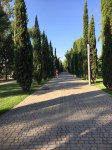
Today was a walk-in-the-park, at least for the first 4 miles. Shortly after walking through and leaving Logroño center city, we were directed to a wide, brick paver walkway surrounded by green grass and children’s play areas, which divided what appeared to be large apartment buildings, which extended for at least a half-mile.
Walking in center city on out way out of Logroño
Picturesque walkway on our way out of Logroño
Paved bike/walking trail
Lake in camping park
The walkway then began winding through more green areas and a small pond and eventually narrowed as we left the city, but continued as a paved walk/bike trail with concrete benches every few hundred feet for at least another 1.5 miles. The concrete path became a dirt path through a camping park with playgrounds, a lake and a nearby golf course (according to signage). We stopped at a bar in the park that was just opening and had a cafe and shared a tortilla.
During our combination breakfast stop/feet rest, we chatted with a young couple in their late 60’s from Holland, Pete & Katia. They were walking their 5th Camino, but started from Pamplona each time to avoid the difficult first stage over the Pyrenees. We asked them to take a photo of us before they departed. They were walking a bit faster than we, so we wished them “buen Camino” as we left the rest stop together.
Photo op at our breakfast stop thanks to our Dutch friends
Rain covers and ponchos handy we continued on after “breakfast in the park”.
Rain has been threatening all morning and we can see showers in the distance. When a few drops hit us, we stopped, put on our pack rain covers and put our ponchos in an easy to reach place, then continued on. Like carrying an umbrella, activating our rain gear can prevent rain as it did today!
Winding through vineyards on paved road
Looking back toward Logroño and lake in camping park after climbing through the vineyards.
This section of chain-link fence along the highway presented pilgrim artists a chance to make crosses with pieces of wood, etc.
Leaving pavement to walk through vineyards with Navarrete in background
The rest of the walk was also on pavement, a road winding through and up the side of a hill through vineyards and an asphalt path parallel to the highway until we got on dirt again just outside Navarrete, where we got back on asphalt and climbed a very steep hill into this small town (pop. 2865).
After a steep climb into Navarrete, time for some fresh “oj” and a rest for tired feet
As soon as we entered Navarrete at the top of the hill, we stopped at the first bar for orange juice/cafe con leche and another feet rest.
We continued on into and almost to the opposite side of town before reaching albergue El Cántaro.
Passing Iglesia de la Asunción on the way to El Cántaro albergue
El Cántaro
Our “Purple Palace” in El Cántaro
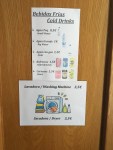
Offerings in the albergue and prices
More items available to pilgrims staying in El Cántaro and prices
Kitchen and dining area if you want to prepare your own meal. Sometimes pilgrim’s pool their resources to have a communal meal to socialize and save money.
Linda checking our clothes
The owner, whose wife completed the Camino in 2015, said they didn’t open until 12:00 but he allowed us to check in anyway and guided us to our room.
There is a festival going on in town, so immediately after we completed our chores, we walked back to town center for a pintxos lunch
A Navarrete street between the town square and our albergue.
This was the main square in Navarrete where people congregated and were served by several nearby bars… not a seat available today during fiesta.
We got our pintxos just before the 12:30 mass let out… notice empty bar behind Jim.
As soon as a fiesta 12:30 mass let out, more folks flooded the square and bars.
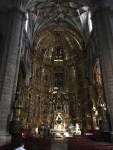
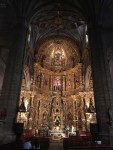
plus a visit to the Iglesia Nuestra Señora de la Asunción, which has one of the most impressive baroque retablos in all of Spain.
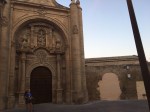
The entrance to Iglesia Nuestra Señora de la Asunción in Navarrete.
Interior of Iglesia de la Asunción in Navarrete without auxiliary lighting
The retablo with auxilary lighting
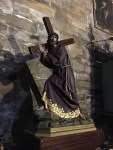
A display in the Iglesia de la Asunción
Another display in the Iglesia de la Asunción
A beautiful display in the Iglesia of Navarrete
Santiago
Linda acquired two small blisters with today’s longer walk, but applied her standard treatment and as with previous ones, should not be a problem.
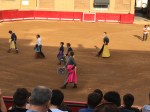
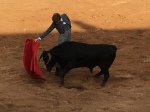
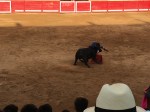
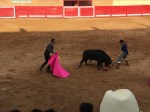
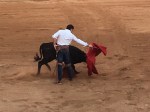
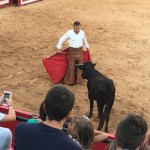
We walked back into the main town square at 6:00 p.m. to get something to eat. But every restaurant or pintxos bar we went to, the food was either gone or picked over due to the apparent large festival turnout. We finally found a couple of sandwiches and were about to return to the room when a band marched by and we followed it to an arena next to the square. We couldn’t believe our eyes, so we bought two tickets and attended a bullfight!
5 different toreros performed
The best of the toreros we saw… probably 18-20 years of age
Taunting the bull and maneuvering the cape while on his knees!
Still another bullfighter and very fast, aggressive bull.
Close call on this one but no one was hurt
After the close call, the bull, with his foot on the red cape, faces off the unhurt torero. Another torero is about to distract the bull with the bright colored cape so other torero can retrieve his cape and continue the “fight”.
Similar form to other bullfighters
This bullfighter was dressed in non-traditional costume and used effective but less formal techniques with the bull… not as cocky.
This young torero couldn’t have been older than 13 years old. Here he is taunting this young but very fast bull to charge the red cape.
The young bull charges as the young torero gracefully dodges.
It was really neat. Great fun to watch 5 young toreros (a torero is a bullfighter, whereas, a matador is a torero who actually kills the bull in the bullfight) ranging from low teens to maybe 20 perform in the ring and neither toreros nor bulls were hurt.
So ended another gem of a day on the Camino Frances.
When we left our penćion at 7:15 a.m., Linda smelled baking bread. We followed our noses in the opposite direction of the Camino until we came upon a bakery that was just opening for business, made an appropriate purchase, reversed direction and ate a light breakfast as we walked out of Viana.
Remains of old church in Viana wall, just before exiting town gates
After our rollercoaster walk yesterday, the rather flat, unremarkable section of Camino between Viana and Logroño was a welcome change. Most of the morning we walked on pavement or dirt paths with fist size embedded stones creating a nuisance rather than a major hazard.
Typical scenery between Viana and Logroño
Finally some normal pathway before crossing N-111
Crossing N-111
After crossing N-111
Paved Camino in Logroño outskirts
We walked through a number of underpasses while weaving through the roads accessing Logroño, the capital of the wine making region of Rioja.
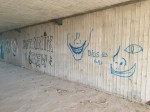
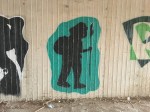
Graffiti is common on all underpasses on the Camino. They contain the usual religious, political, humor and maybe even gang territorial markings. But today, because we walked through so many, the artwork and writings made more of an impression.
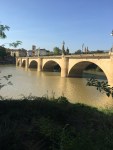
After a moderately steep, paved descent, we continued through a nice park along the Rio Ebro before crossing the 19th century Puente de Piedra into Logroño (pop. 150,000).
Logroño in background… a mile or so to go
Getting closer to Logroño
Nice park along Rio Ebro
Puente de Piedra crossing Rio Ebro into Logroño.
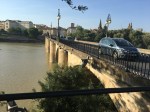
Linda walking across Puente de Piedra (“stone bridge”) – that’s her next to second lamp post on left
The original bridge was built by Santo Domingo de la Calzada in the 11th century and rebuilt by his disciple, San Juan de Ortega.
On our way to finding our room for tonight, we stopped at a nice bar and had cafe con leche and a variation of our usual tostadas, with Jim having a small baguette with chorizo and egg.
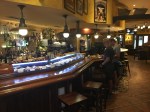
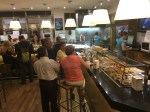
Bar where we ordered breakfast… note breakfast pintxos displayed on counter
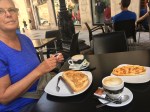
A real Camino breakfast at 9:45 a.m.
Jim’s view from our breakfast table
Jim finishing breakfast
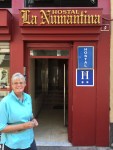
We used the bar as a base camp as Jim ventured off, packless, to find our Pencion. Not an easy task, after 15-20 minutes and aid from two pedestrians, a shop worker and two policemen our obscure destination, Hostal La Numantina (60€) was located.
Press bottom button to open street door, then walk up 3 flights of stairs to hotel entrance.
Easy to see our hotel if you are standing right in front of it. No other signs on the street.
Entry to the hotel on 3rd floor
Our double room is spacious, new, clean and has a balcony with clothesline, wifi is strong and has the best shower we’ve experienced thus far… and therefore not too pricey considering its location in city center.
Chores completed, we had ensalada mixtas at one of hundreds of nearby bars for lunch, followed by a visit to Iglesia de Santiago en Real, a visit to a large fresh market, a walk and sitting in the shade at Espolón Square and nap (Jim) and reading (Linda) for the rest of the afternoon.
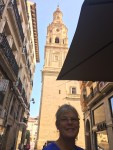
Front of Iglesia de Santiago en Real
Inside Iglesia de Santiago en Real
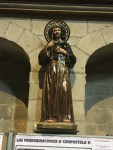
Statue of Santiago
Close-up of retablo
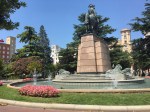
Our view from a bench in the shade
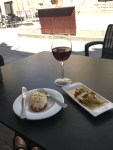
For supper, we had to wait until 8:00, since all eating establishments close at 4:00 and reopen at 8:00. There are at least several 100 pintxos bars and restaurants within a three block radius of our hotel. All were standing room only at 8:00 and it’s a weekday evening! I guess everyone gets hungry waiting for dinnertime. We finally gave up and ordered at a bar where we stood up while splitting four pintxos with a glass of wine.
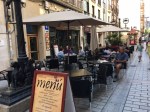
Standing room only… we split 4 different pintxos in this bar but had to stand, so we searched for another to sit down.
Finally a place to sit down.
Chocolate mousse & lemon chiffon desserts
That wasn’t working so we moved on until finding another restaurant with a half empty table, sat down and sampled two more pintxos and two desserts, before walking back to our room at 9:30 to get some sleep before our hike early tomorrow morning.
Sunrise silhouetting the Iglesia in Sansol this morning as we left Torres del Rio.
Looking behind us as we began the rollercoaster
A few minutes after leaving Torres del Rio we began a rollercoaster ride. A 3 mile rollercoaster ride going up and down and up and down with very short intervals of flatness to recover. The good news was the mostly absent sun. Every time we reached a peak, the ever rising sun got stronger, but we then headed down again to a bottom then back up again, all the time shaded by the hills around us.
The rollercoaster begins just outside of Torres del Rio
If only these berries were ripe, the climb wouldn’t be so bad
Heading down again with path going back up ahead
Pausing after a multi-switchback steep climb
One of few flat spots before going back down, then up again
Going down again
After about 3 miles we carefully maneuvered our way down a steep hill with over a dozen, steep switchbacks into an apparent valley and took advantage of the reprieve to munch a walking breakfast of a tortilla (frittata) in a baguette. We know, it doesn’t sound all that appetizing, but with growling stomachs, it was delicious and gave us a needed burst of energy for what came next.
Coincident with swallowing our last bites, the valley stroll changed into the steepest climb of the morning as we inched back up to the top into the sun and adjacent to a two lane highway that has shadowed the Camino since Roncesvalles.
One last steep incline on the way to Viana
On and off the asphalt the last mile to Viana
One last section of dirt path before Viana
Entering Viana
The shade gone now, we put on our hats and walked the next mile or so either beside or on the asphalt pavement, which fortunately had scant auto/motorcycle traffic on this Sunday (Domingo) morning.
Just before we arrived at Viana, the Camino veered away from the highway and we followed a dirt path until entering the town limits at 9:45 am.
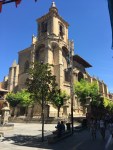
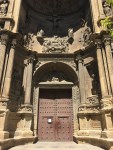
Viana is dominated by the Iglesia Santa María de la Asunción, a very large Gothic style church built between 1250-1312. It’s massive door was locked, unfortunately typical of many churches on the Camino ( go figure), so we took some outside photos of the impressive structure and moved on.
Iglesia de la Santa María of Viana
Front door of St Mary’s of the Asunción
The Camino continued along Rua de Santa María through this delightful walled town with attractive cafes which specialize in pintxos. Our brunch, lunch and dinner consisted of a variety of pintxos sampled at cafes, mere steps from Pencion San Pedro, our Viana residence for the next 20 hours.
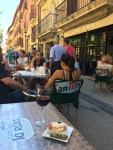
We had a brief panic when Linda’s backpack wasn’t included with those delivered to our hotel. The hotel manager got on the phone and tracked it down and arranged to have it expedited to our hotel, averting a potential issue. The pack was delivered a couple of hours after we checked in and Jim left Linda to catch up on her routine activities, while he ventured out into the town and began sampling pintxos and tinto (red Navarre wine). After verifying they we were indeed in a pintxos paradise, Jim returned to the room and with Linda sought out one of true delicacies of the Camino Frances.
Pintxos
Pintxos
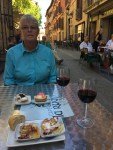
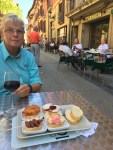
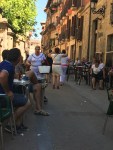
Pintxos and serenades
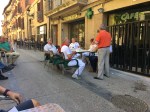
An extraordinary Camino moment occurred while we were savoring our pintxos. First, a 70+ (young) something Spanish serenader began singing with a opera quality voice, personally serenading various people seated at tables lining the Rua Santa María outside the cafes. After several marvelous performances, a lady at one of the tables began singing with him, she with an equally professional voice. They appeared to be singling out people who they knew and making a personal tribute to them in the serenade.
Serenading another table
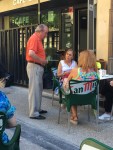
Guy in the red shirt and lady in white outfit serenading to three folks looking on
Singing away … filling the street with song
Even when they had to leave they sang and danced as they walked away
This was all impromptu and just folks enjoying themselves and each other. Several other male and females joined in and we sensed we were in the midst of an opera. We did not know any of the pieces they were singing, but we couldn’t help but become engaged as teary eyes appeared in several singers and listeners alike. It was a very moving experience and helped us appreciate the lifestyle and values of this community and others that have based their existence on supporting pilgrims on the Camino Frances for over 1000 years.
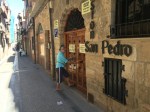
Entering our place for the day/night
With smiles on our faces and our pintxo appetites sated (for today), we relaxed outside the Cafe la Rua in the warm, dry afternoon shade for just a while longer before retiring to our room for the day.






















































 Jimandi