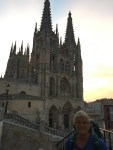
Just before sunrise, after snapping one more photo of the Burgos Catedral, we rejoined the Camino right outside our hotel.
It took us nearly an hour and over 2 miles to get to the outskirts of Burgos and begin walking on a dirt path again.
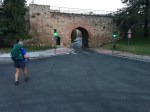
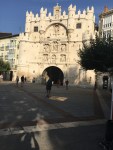
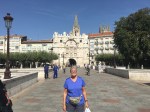
Passing through one of Burgos fortified gates
Beginning to leave city center. Our German friends walking ahead
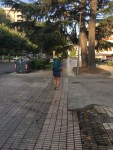
Walking through park on outskirts of city
Passing by a university campus
German mom and her son
Pavement about to run out
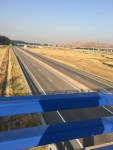
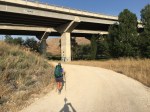
The next couple of miles, we followed a winding path through recently mowed grain fields before crossing over major highways and then along them until eventually working our way back along a two lane (N-120) highway until entering the small town of Tardajos (pop. 856).
Back to dirt paths in country again after two days.
Walked through this kind of path for 2 miles
Crossing autovia
Weaving around major freeways and railways
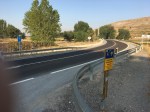
Crossing N-120 to a path along highway
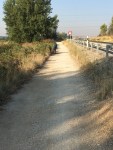
Final stretch of path into Tradajos
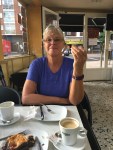
Having walked for 6 plus miles with no places to stop, we crashed at the first bar we saw in Tardajos and had breakfast.
We had a nice conversation with a German lady and her 12 year old son. We had hop-scotched with them most of the morning. They had started in SJPDP three weeks ago and had to return home to Munich on Monday as her son’s soccer practice was starting.
We parted after breakfast, they walking on to Hornillos del Camino planning to stop there for the day and we to albergue Casa de Beli (45€) here in Tradajos.
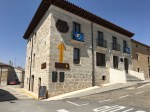
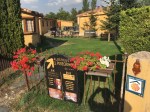
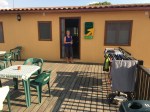
Albergue Casa de Beli in Tradajos
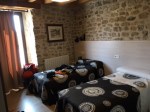
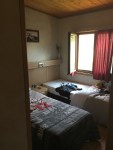
Our room
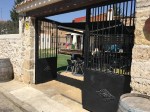
Yard and outside bar in back of albergue
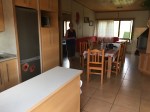
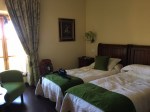
We waited in the albergue cafeteria until our room was ready at 11:30. It’s apparently a new albergue and our room is a good size with two twin beds, two arm chairs, beautiful hardwood floors and a full bath that’s bright and spacious.
Jim used the albergue’s washing machine to get all our clothes nice and clean after being hand-washed for the past 8 days and then hung them out to dry in the garden area of the albergue. The warm, wind had them fresh and bone dry in less than an hour.
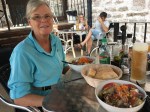
We had lunch at the albergue’s bar, a delicious ensalada mixta. This fresh “mixed salad” included lettuce, hard boiled eggs, olives, corn, shredded carrots, white asparagus, tomatoes and tuna accompanied with freshly baked bread.
The remainder of the day we just relaxed, read, worked on blog, made reservations for the next two nights and had a simple pilgrim’s dinner in the hotel bar. An easy day following our busy day in Burgos.
P.S.:
If you haven’t already discovered it, at the top of our blog page is a menu and one menu item is “map”. This is a google map that lets you track our path across Spain and even get an idea of the terrain, etc. We try to keep this current as time and wifi permits. Hope you enjoy.
As most of the guide books indicate, the traditional Camino goes through an industrial section for the walk into Burgos and many recommend talking an alternative route along the river or taking a bus into town, which incidently picks up at Hotel Buenos Aires.
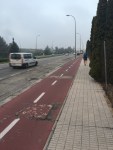
However, we planned to walk the traditional Camino, so this morning we left the hotel at 6:55 and immediately began passing through what turned out to be a very well organized and maintained industrial area for about 2 miles.
Beginning our walk through industrial area toward Downtown Burgos
Near the end of our walk through industrial area. Bridgestone factory and offices on left
Bridgestone factory on left as we begin to enter downtown area of Burgos
The sidewalk was wide, unobstructed and well lighted and consequently, wasn’t that objectionable to us. There were some unoccupied buildings but most had activity of workers entering the buildings and trucks loading and unloading goods. For us it meant jobs and a positive economic impact on the total community, directly or indirectly and we were thankful to see it and delighted to experience this aspect of the Camino Frances as well.
The final 1/4 mile we walked along a huge Bridgestone manufacturing factory, probably car and truck tires with hundreds of workers entering the facility as we passed by just before 8:00.
The industrial area abruptly changed into a high rise residential area for another mile or so before we stopped at a bar for breakfast.
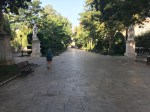
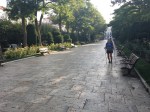
As we continued toward town center, the lack of signage for the Camino concerned us that we might be straying off path. We’re staying at the Hotel Meson del Cid (79€) which is on the Camino and very close to the Catedral, so Jim searched “Burgos Catedral” with his google earth app and the walking directions took us right to our destination while passing through some lovely parks and pedestrian walkways, creating a very favorable impression of city center on our way in.
Unusual tree in residential area as we walked thru center city to Catedral
Walking through residential area and shops
Walking through Burgos
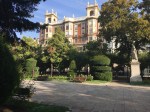
Park in center city along our walk into Burgos
Walking through Burgos
Entrance to Catedral plaza
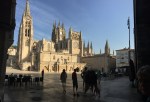
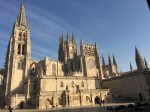
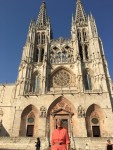
Our first glimpse of Burgos Catedral
An truly awesome sight
View of our hotel from Catedral plaza
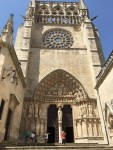
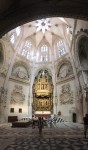
The Burgos Catedral or Santa Iglesia Catedral Basílica Metropolitana de Santa María de Burgos was consecrated in 1260 and has undergone numerous modifications and additions in the centuries that followed.
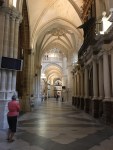
Side entrance of Catedral where we began our tour
View from side Catedral entrance … Santiago in top
Another chapel
Open area between main sanctuary (choir) and many sanctuaries
Another chapel
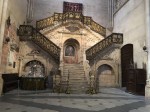
Beautiful stairway in a transept
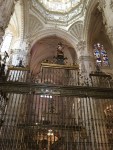
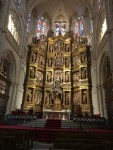
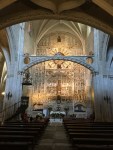
Main sanctuary of Catedral
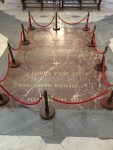
El CID’s grave in center of Catedral
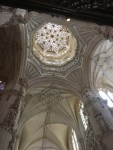
The dome over El Cid’s grave
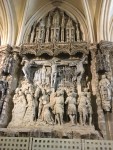
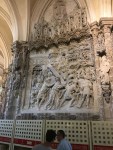
Still more sculpture surrounding outside of altar
More sculpture surrounding outside of altar
A dome in one of the chapels inside Catedral
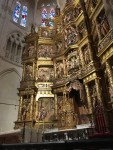
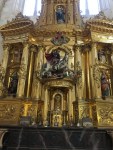
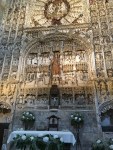
Closeup of retablo in main sanctuary of Catedral
Another chapel within Catedral
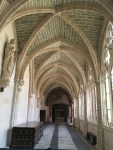
Another section of cloister
Cloister
Retablo in another chapel … guy on horse is St James (Santiago)
Returning to our room after dinner
It is the most incredible house of worship we have ever seen. The exterior is breathtaking but is matched by the extraordinary size, beauty and variety of chapels, art work and historical relics inside. And it is the final resting place of Rodrigo Díaz de Vivar, El Cid, the “Master”, and the national hero of Castillo.
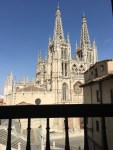
… and our hotel is just a few steps away and do we have a room with a view?
We got to the hotel at 10:00 and were advised that it would be at least another hour before our room would be ready. They stored our packs for us and we set out to complete our shopping list while in the big city of Burgos (pop. 178,500).
First we found an ATM and refilled our € stash. Next we found a farmacia to buy some extra bandaids, sunscreen and toothpaste. Finally, Linda has been having a few too many blisters with her walking shoes so she wanted to try some new walking sandals that have been recommended by several pilgrims along the way.
Heading out for some shopping
Our excursion into the ‘burbs’
Great sports equipment super store
They are a British brand, Quechua, and so we stopped at several shoe stores nearby with no luck but finally got directions to a French owned sports store called Decathlon, similar to our Academy Sports store in Greenville, but several miles on the outskirts of Burgos. Having already completed our stroll for the day, we asked the store owner to call a taxi and 7€ and 15 minutes later we were trying on and finding new sandals for Linda. The Decathlon clerk who helped us, kindly called another cab and another 7€ and 15 minutes later we were back at Meson del Cid, entering our room.
Oh, our room with a view..
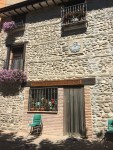
Entrance to our hotel
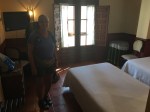
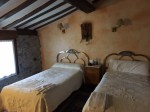
Our room
Very upscale bathroom
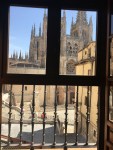
Our view from room
View with windows open
View from our bed
View from our balcony
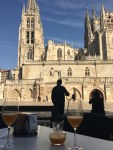
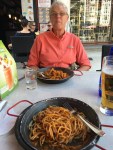
When we weren’t shopping, we spent time outdoors in the plazas around the Catedral, still awestruck and having OJ when we arrived, a pizza lunch and a pasta dinner… at 1:30 and at 6:30!
OJ in the plaza
We also made a quick visit to the Iglesia de San Nicolas, located between our hotel and the Catedral.
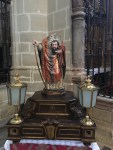
San Nicolas de Bari (270-343AD) was a 4th century Saint and Greek Bishop of Myra (present day Turkey). He was a very rich man because his very wealthy parents died when he was very young. He spent his life helping the needy and performed numerous miracles as well as giving gifts to others anonymously. He also performed many miracles protecting and reviving sailors and is considered the Patron Saint of sailors.
His remains were transported by Italian sailors to Bari in 1087, hence the origin of his name.
As we discovered during our pilgrimage the past week, San Juan de Ortega’s dedication to pilgrims en route to Santiago is a direct result of his own pilgrimage to the Holy Land. During his return journey, his ship was wrecked, and a promise was made by Juan to San Nicolas de Bari. Juan would, in exchange for safety, devote himself to pilgrims and to make good on his prayer and promise to the Saint, became a disciple of Santo Domingo.
As a result, awareness of San Nicolas spread to the west bolstered by Juan’s devotion to him. Juan was originally from a village near Burgos and died in 1163. Coincidentally in 1163, Pope Alexander III named a new church in Burgos, San Nicolas.
And if you haven’t guessed it by now, San Nicolas and Saint Nicholas and Santa Claus are one in the same.
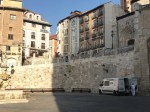
San Nicolas church (at top right above the van) sandwiched between our hotel and Burgos Catedral
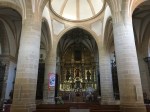
Interior of San Nicolas Iglesia
Retablo of San Nicolas church
Our day in Burgos has been a real treat and we could easily stay much longer and still not begin to take in all this beautiful city has to offer. That’s one more extraordinary day on the Camino Frances.
It was dark when we began walking this morning at 6:20 with a cool 55 degrees and a slight breeze. Headlamps were critical as we followed a footpath up the side of the mountain with hints of farmland on the right and an army base bordered with rusty, coiled, barbed wire and no trespassing signs on the left. The last half mile or so the path got very rocky making walking quite difficult.
Walking on this rocky “path” was very difficult! Note barbed wire at top of image, bordering army base.
First light appeared when we had climbed up some 400 ft and were arriving at the top (3500 ft).
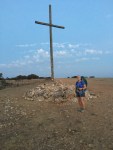
Cross at top of mountain just after daybreak
All alone on the barren rocky surface at the mountain pentacle stood a simple, tall cross surrounded by a mound of stones and other items placed there by passing pilgrims.
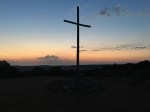
Before beginning our descent we looked back and paused to gaze at the beautiful image of the silhouette of the cross overlaid on the emerging sunrise.
We then turned around and could now see in the distance the lights of Burgos and for the first time, the flat terrain beginning at Burgos known as the Meseta.
A large labyrinth on top of the mountain
Heading down the mountain with lights of Burgos off in the distance
The path down the mountain was about as steep as the assent, but even though it was less rocky it was enough to compel these two pilgrims to take it slow and easy to prevent unpleasant knee and ankle issues. The path eventually became a farm road with a more gradual slope then joined a paved farm road and then a secondary road leading toward Villafria.
After 3.5 miles, the road began to level out and shortly after, we stopped at a popular pilgrim bar/albergue/rest area for breakfast as we entered the village of Cardeñuela de Riopico (pop. 111).
We walked on road like this for several miles
Popular stop for pilgrims in Cardeñuela Riopico
A feet rest and breakfast completed, we began the final several miles on pavement into Villafria. The hard surface was predictably tiring, but traffic was not an issue and the morning clouds were hanging around, keeping the temperature tolerable and the breeze cool.
The last mile, we walked around a fence providing security for the east half of the Burgos airport, then shared a bridge with some large trucks crossing railway tracks and then entered the Burgos suburb of highly industrialized Villafria.
Beginning of our walk around Burgos airport
Last half of our walk around Burgos airport
The Hotel Buenos Aires(40€) is an average hotel with restaurant/bar and nice size rooms and modern bathrooms.
Our hotel in Villafria. It’s on the Camino which follows this 4 lane road into Burgos. Factories and warehouses located on both sides of the road for 3-4 miles.
Ironically it doesn’t have an easy way to dry hand washed clothes, because its clients are typical tourists and business people and not pilgrims, mostly due to the price range. So we minimized our hand washing and hanged items out in the room or out the window, securing them from blowing away from our 3rd floor room.
We had a tortilla lunch after we settled in and when we found out their restaurant didn’t open until 8:30, we also had a tortilla dinner.
The afternoon and after dinner was spent resting, updating the blog and did I say resting?
We had a rough start this morning. It was still dark when we dropped our key at the front desk at 6:15 and walked into the courtyard to exit through the medieval, 4 inch thick, 1 ton wooden door which was locked. We fiddled with all the old and new locking mechanisms. None of this would have occurred, had we left at 7:00, when the hotel staff was awake and there to serve us.
Finally, Jim found a heavy metal steel rod and forced open one of the latches and the door miraculously opened just as an awakened staff member was apparently coming to our aid. Jim returned the steel beam to its place and we left, hurriedly, to avoid potential retribution, waving to the staff member, and saying “gracias”!
The narrow path up Oca Mountain viewed with headlamp
No more than 5 paces outside the door we rejoined the Camino and with headlamps beaming, did our best to navigate a very steep, rocky, narrow path straight up the side of an Oca Mountain. This continued for about 3/4 mile until we merged with a slightly wider path with better footing and proceeded the climb to the top of the mountain … another mile.
A further test of our resolve occurred after 2 miles. It was a really big dip that began at a monument for 30 or so Franco supporters that were assassinated during the 1936-39 Spanish revolution that brought Franco into power.
The “dip”, a lot worse than photo reveals
The other side of the “dip” seen from halfway down
The path went straight down abruptly for at least 200 feet to a small bridge over an insect infested creek and then immediately climbed straight up 200 feet. This spot of the Camino definitely warrants a long, level bridge!!
When we thankfully leveled off, we left the small path and joined a wide almost level 30-40 ft wide logging road that continued for at least another 5 miles.
The logging road was so boring, pilgrims created some art to spruce things up a bit.
The logging road was boring except for the constant buzzing of flies and other annoying insects. To make matters worse, there were no places for a rest stop or any other types of services.
After 7.4 miles and no break, we finally arrived at San Juan de Ortega, named for the disciple of Santo Domingo.
Finally, San Juan de Ortega
San Juan de Ortega Iglesia
Tomb of San Juan de Ortrga
Altar in San Juan Iglesia
San Juan de Ortega Monastery and albergue
Juan Velásquez, was a young priest and disciple of Santo Domingo who was born near Burgos. San Juan helped Santo Domingo in the construction of bridges in Logroño, Santo Domingo and Nájera. After Domingo’s death, Juan went on pilgrimage to Jerusalem. On the journey, he was caught up in a shipwreck and prayed to San Nicolás de Bari to save him. When he survived, he returned to the Burgos area determined to serve pilgrims in the notoriously dangerous and difficult Oca mountains. He is attributed with developing the road from Villafranca to Burgos (from which he took his name de Ortega, “of the nettles”) as well as a hospice and monastery in the wilderness. Along with being considered the patron saint of innkeepers, San Juan also became known as the saint of fertility. Legend says that when his tomb was opened, the air was fragrant and a swarm of white bees flew out. Queen Isabel la Católica was perhaps the most famous barren woman to pray at his tomb. She visited twice and conceived two children, named Juan and Juana.
Continuing our fun morning, we had cafe con leche at the only bar in San Juan de Ortega, but there was no tostada available and no zuma naranja. We still rested our feet and after a brief visit to the Iglesia de San Juan De Ortega continued another 2.5 miles to Ages where we stopped for a zuma naranja, ummmm!
Walking toward Ages with Atapuerca in distance, upper right
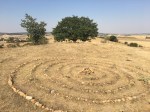
Labyrinth on hill overlooking Ages
Entering Ages
Feet rested and a cool glass of OJ finished, we’re leaving Ages and moving on to Atapuerca in the 90 degree heat
Entering Atapuerca
The sun was beginning to bare down so we finished our OJ and walked the final 1.2 miles to Atapuerca.
Just outside the village of Atapuerca is a still ongoing excavation campaign, rich in fossil deposits and stone tool assemblages discovered in the complex of local caves that are attributed to the earliest known hominin residents in Western Europe. The nearby Atapuerca Mountains, served as the preferred occupation site of Homo erectus, Homo antecessor (or Homo erectus antecessor) and Homo heidelbergensis communities. The earliest specimen yet unearthed and reliably dated confirm an age between 1.2 Million and 600,000 years.
El Peregrino albergue
Entrance to building with 5 habitacion doble con bano and shared living area and kitchen
Kitchen, living area shared by double room units
Our room
Linda checking to see if clothes have dried
We really like our place for tonight, Casa El Peregrino (35€). It appears to be relatively new and has given us a much needed haven to relax and recover from today’s walk.
Tonight we had a nice dinner at an nearby albergue, El Palomar.
Waiting for restaurant to begin serving dinner 8:30!!!
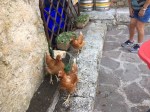
These birds are taking a big risk waltzing around the outdoor bar of El Palamor among hungry dinner patrons.
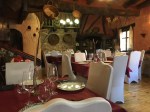
Interior of El Palamor restaurant
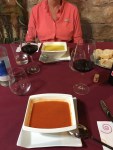
A delicious vegetable soup for Linda and gazpacho for Jim
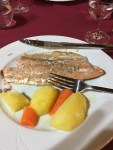
We both had salmon and veggies
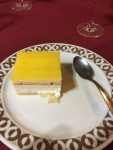
Lemon dessert
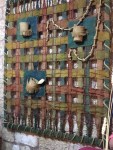
Interesting artwork made from chainlink fence, rope and burlap bags
After dinner Jim sat on the deck just outside our room trying to upload photos to the blog. Strangely, the only place we could get wifi was outside our unit, not inside. Several young Spanish pilgrims were using a karaoke app (words and notes only) on one of their cellphones and were accompanied by one pilgrim with a guitar as they all apparently were singing traditional songs. Jim gave up eventually on uploading but still enjoyed the nice “concert”.
We left Belorado in the dark, as the high today is supposed to be 101 by 3:00 p.m. It was only 55 when we left at 6:15.
The terrain was similar to yesterday. There seemed to be more pilgrims out this morning, probably because Belorado is the end of a traditional stage of the Camino, meaning that more people stop and spend the night in Belorado, than in the towns/villages in between stages.
We try to avoid the end of stages for that very reason, which reduces the competition for places to stay plus it gives us a chance to visit the less visited places and contribute to their local economy by staying in their accommodations and buying food and drink in their markets and bars.
Our morning walk started like this as soon as we left Belorado
Mystery of how those bales got stacked so high… solved!
Sunflowers and wheat dominated early morning walk
Breakfast stop number one
We stopped at the first village Villambistia (pop.47) with an open bar (Casa de Los Deseos) and had breakfast. When Jim paid the bill he guessed it was 5€ and the bar tender agreed and Jim responded with voila when giving her the 5 euros in coins, to which she responded merci, thinking we were French (tee hee).
Jim getting modified head immersion to reduce tiredness.
Leaving toward Espinosa
An extra stop to rest feet and share a banana and zuma naranja
Villambistia has a tradition that says if you immerse your head in the village fountain it will cure you of tiredness . So as we walked up to the fountain (which incidentally had a warning about potability), Jim almost fell into the fountain trying to immerse his full head with backpack, etc. So he opted instead for a self baptism with the fountain water. He followed that with a second baptism while Linda snapped a photo. Incredibly, Jim’s pack got lighter almost immediately and he got noticeably stronger all the way to Villafranca… no kidding!
We walked on for another mile and needed an excuse for another rest (we’re a little tired, still, from our walk yesterday) so we stopped in the village of Espinosa del Camino (pop.36) at La Cantina and shared a banana and zuma naranja while occupying a bench outside in the cool shade… and then moved on.
The last few miles into Villafranca included a long grade up and a short grade down and then a flat section that almost merged but then the paralleled the road into town busied with cars, vans and big trucks… adding new meaning to the concept of “share the road”!
Typical scenery our last 4 miles, including passing pilgrim
Leaving toward Espinosa
Last incline before Villafranca
First view of Villafranca Montes de Oca
Ruins of San Felicia de Oca 9th century hermitage just outside Villafranca
Camino nearly merging with N-120 (on left) as we near Villafranca
Camino sharing rode with lots of vehicles going into Villafranca Montes de Oca
Busy route N-120 going through town
We’re staying in Villafranca Montes de Oca (pop. 147), at the Hotel San Antón Abad(59€), a former hospital for pilgrims, built in 1377. It’s an upscale hotel, beautifully decorated with period antique furniture, paintings and pieces and with spacious modern rooms, restaurant and bar and an attached more primitive albergue facilities at 12€ per bed.
View from our hotel room
Iglesia de Santiago seen from our hotel room
Pilgrim entrance to San Antón Abad hotel, original 14th century facade and portal to pilgrim hospital.
Interior hallway on our floor
Our room
Late (2:30) lunch at San Antón Abad bar
Jim chatted with John from Raleigh on the terrace after a late lunch. John is staying at the albergue and is trying to walk to Santiago in 4 more weeks so he can fly back home in time to his granddaughter’s wedding.
That’s us having our pilgrim dinner dessert. Photo taken by lady from Denmark, walking her 4th Camino
San Antón dining room and pilgrim dinner
Our desserts: rice pudding for Linda, tiramisu for Jim
Our pilgrim’s dinner was in the hotel dining room with approximately 19 pilgrims in attendance.
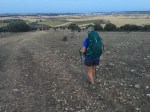
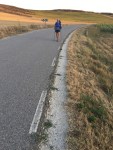
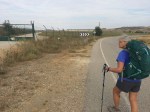
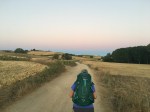
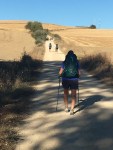
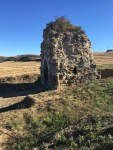
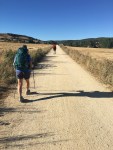
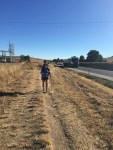
we passed through three nearly equally spaced villages: Redecilla (pop.137), where we stopped for breakfast, Viloria de la Rioja (pop.50),
Huge bales of hay seen regularly along the Camino, especially in Rioja & Castillo and Leon.
Birthplace of Santo Domingo de la Calzada
the village where Santo Domingo de la Calzada was born and Villamayor del Rio (pop.53), known as “the place of three lies”.
Yeah! Linda working her magic by finding a nice place to sit in the shade… here in Villamayor del Rio ( the small hamlet by the creek)
Leaving the “place of three lies”
Instead of being as it’s name implies, the large town on a river, it is actually a small hamlet on a creek!
Grañon to Belorado is a little more than 10 miles via the Camino.
Walked along highways most of the day
The typical view for today’s walk
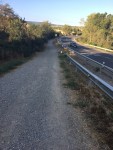
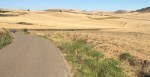
It’s mostly a dirt path along long straight stretches of a two lane highway and pavement into and out of the towns and villages. We walked on rolling hills and were surrounded by recently mowed wheat fields and occasional fields of not-yet-harvested sunflowers.
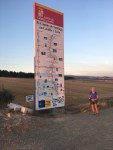
Today, shortly before entering the village of Redecilla, we left the region of Rioja and entered Castillo & Leon, the largest region in Spain and it encompasses the next 400 km (250 miles) of the Camino.
We made another stop, just after entering the Belorado town limits for some refreshment and to let our feet cool.
Hotel Rural Verdeancho
Our room at “Verdeancho” in Belorado
We’ve had a nice relaxing afternoon, recovering from our longer walk today. Other than doing our routine chores, our only activity was to walk about 20 steps to take a look at church with 4 huge stork nests in its belfry.
This chapel was originally built in the Middle Ages and served the castle whose ruins remain on the hill above it. It was rebuilt and enlarged in the 16th century. The huge nests in the belfry are storks and are seen frequently all along the Camino.
Interior of the Holy Mary Chapel
Interesting statue in Holy Mary Chapel of Santiago.
At about 6:00, we walked a few blocks from our hotel to the town square and after some serious searching, found a restaurant that served something beside pintxos before 8:00.
Our search for food revealed the only restaurant “Etoile”, that would serve anything but pintxos before 8pm
Margarita for Linda, Pepperoni for Jim
Our tummies full we returned to our hotel for the evening.
Belorado’s fiesta is not for another week or so, consequently things have been quiet, for a welcomed change of pace.

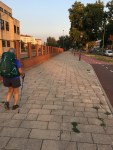

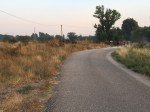
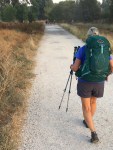
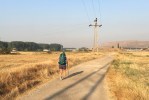















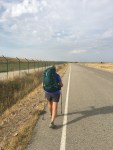

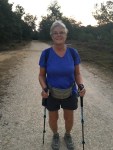
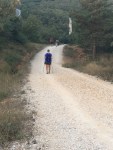
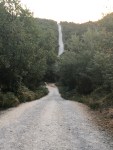
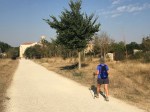
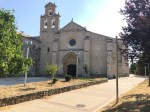
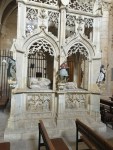
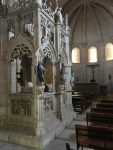
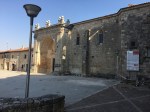
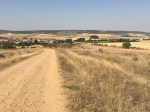

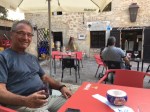

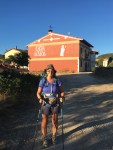
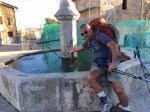
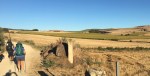
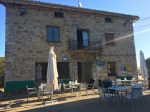


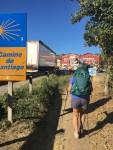
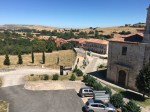
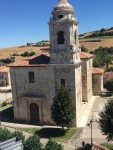
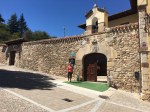



 where we stopped for breakfast, Viloria de la Rioja (pop.50),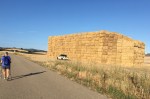

 Castillo & Leon, the largest region in Spain and it encompasses the next 400 km (250 miles) of the Camino.


 Jimandi