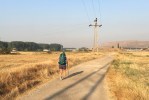
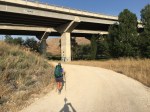
Day 30-Hontanas to Castrojeriz

Distance today:                  5.8 mi

Distance Camino 2017:   211.9 mi

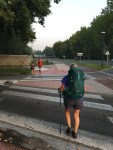
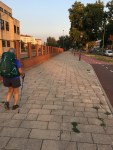
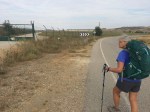
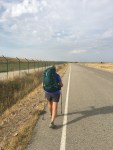
We “slept-in” this morning, not leaving El Pundito albergue until 7:30. Rain is expected so we decided to try to miss it by using our hour-by-hour forecast app.

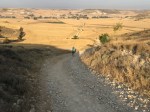
In 2014 when we walked this section of Camino we had walked over 12 miles the previous day in extreme heat and were exhausted when we got to Hontanas. The next morning we got up very early, still recoverying from the day before. As we left the village in the dark we followed a road which we assumed was the Camino. After about a half-mile, six pilgrims were walking toward us, visible only by their headlamps. They stopped us and after overcoming typical language barriers, we realized they thought they had missed the Camino. Jim consulted his guidebook in more detail and found that for a 4km section there were actually two Camino routes, one that went partially back up to the meseta and the other which continued along the road we were on, both merging after 4 km (2.5 miles)… since the next town was in the same valley as Hontanas. We decided, after our previous day experience and 3 nano-seconds of consideration, we would continue on the road. Four of the six pilgrims took the dirt path route, the other two came with us.

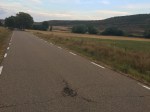
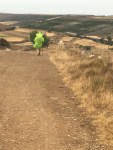
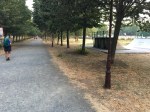
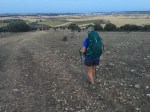
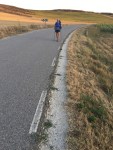
So today as we left Hontanas, to commemorate our good fortunes in 2014 and since, we once again took the easier section of Camino.

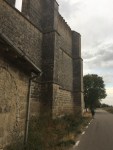
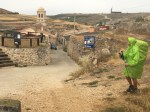
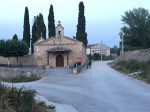
After about 3 miles we passed the ruins of San Antón church complex, started by the Order of St. Anthony, a 11th-century order devoted to the 3rd-century Egyptian hermit, whose relics it held and dedicated to helping pilgrims.

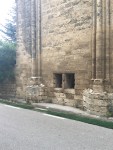
In the Middle Ages, a pilgrim brought his stricken daughter to the relics and she was healed of a particularly pernicious disease reminiscent of leprosy. This disease spread in the Middle Ages and became known as St. Anthony’s Fire, which caused a terrible burning feeling, loss of circulation and eventually gangrene. This disease was in fact likely ergotism, caused by a fungus that grows on rye bread.

The order developed a reputation for healing this disease, though serendipitously, pilgrimage was an excellent antidote to the disease as vigorous exercise and plenty of wine helped to overcome it. Also, St. Antón is the patron saint of animals, and across Spain people bring their pets to be blessed on his saint’s day.
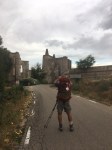
An unusual but beloved albergue has existed since 2002 in the ruins of convent, consisting of communal meals by candlelight, no electricity or hot water: a very basic, but unique experience for some.

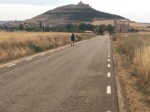
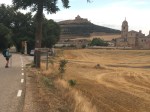
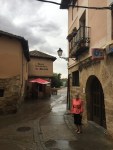
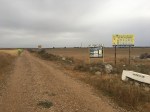
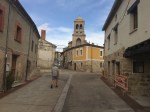
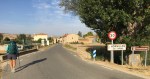
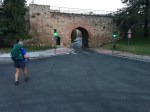
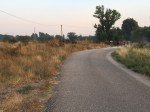
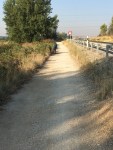
Shortly after we cleared the bend in the road at San Antón, the road straightened again and we could see Castrojeriz (pop.873) in the distance.
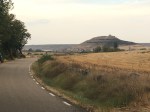
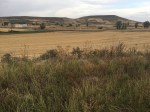
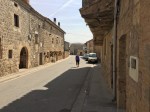
Towering above the town is Castillo de San Esteban. The Romans used the castle, said to be founded by Julius Caesar, to protect the roads to Galicia’s lucrative gold mines. The city changed hands frequently until coming under Christian rule in the 10th century. The charter for the city was progressive for its day—the punishment for killing a Jew was the same as for killing a Christian. Franks and Jews settled in the town, which became a way station on the pilgrimage road with five churches and seven pilgrim hospitals along the “long road” through the city.
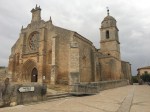
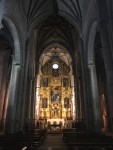
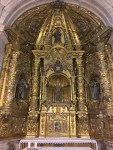
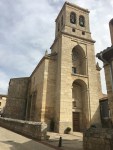
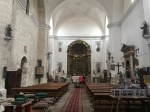
Also prominent upon entering the town is the 14th century Iglesia de Santa María del Manzano (“apple tree”). Legend has it that Mary appeared to St. James from an apple tree and he was so startled that his horse reared up and came down heavily, leaving hoofprints in the stone outside the entrance.

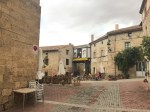
We stopped at Bar Manzano for breakfast, then walked hurriedly another mile to the other side of town as the inevitable rain closed in.
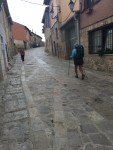
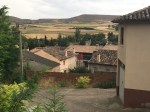
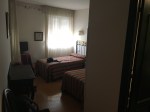
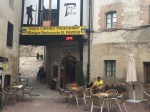
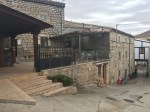
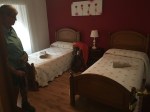
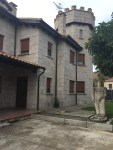
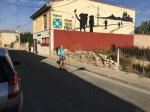
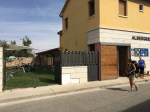
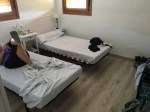
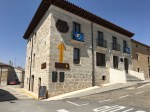
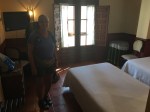
Arriving at Meson de Castrojeriz (36€), at 10:30, we were warmly received and the housekeeper quickly prepared our room & home for the afternoon and evening.

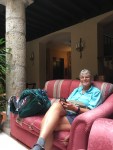
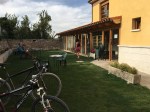
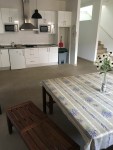
We were very pleasantly surprised at the general ambiance, hospitality and relative elegance of this Hotel Rural (HR).
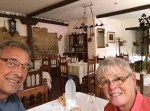
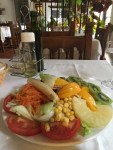
After we got settled in our room we had a nice salad for lunch in the hotel restaurant, sat a while in the cozy living area, then returned to the our room, where we spent a pleasant, relaxing afternoon while the windy, gray, rain continued outside.

At 7:00, our hotel restaurant opened for cena (dinner) and we had a routine pilgrim dinner. We asked if they could prepare us one ham and cheese bocadillo (sandwich) to take with us and share for tomorrow morning as there will be no place to get food for the entire walk.  When we had completed our meal the waitress brought us a bag with a ham & cheese baguette sandwich as requested plus a small bottle of orange juice, a small bottle of water, a yogurt, a plastic spoon, a banana and four packaged cookies for 5€!!!

We paid the remainder of our dinner bill including a bottle of wine (20€) and retired to our room to complete day #30 for Camino 2017. We love Spain and we love the Camino!
Day 29- Hornillos del Camino to Hontanas

  • Distance today:                      6.5 mi
  • Distance Camino 2017:    206.1 mi

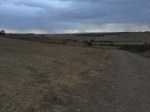
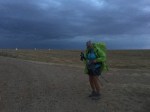
At 6:10 we walked out the door into the dark. A few steps after the pavement stopped and we began walking on dirt, the wind picked up and we saw lightning on the horizon up ahead. It was actually kind of spooky, especially in the dark.

We stopped and checked the weather and discovered the forecast was 80% precipitation for the next 3 hours. We paused, but then decided to go on. But we also put on our back pack covers and ponchos so we would be prepared for a storm and as a deterrent in much the way we sometimes carry an umbrella to keep it from raining.

Our walk back up to the meseta was 2 miles compared to the 1.5 mile walk down to Hornillos yesterday. The difference was the walk out incline was much more gradual and there wasn’t a mule killing hill going up, thankfully.

We were on the meseta less than a mile when we headed down into a shallow valley (150 ft deep) and passed San Bol, a very primitive albergue located near the ruins of an 11th century Monastery, named after San Boadilla, a local saint.

A not-so-steep incline brought us back up to the meseta and we began the remaining 3 mile walk to Hontanas. A few minutes on the meseta and the wind picked up dramatically. The sky ahead looked brighter and Linda commented that it looked like the rain had moved on and Jim, observing the fast moving dark clouds moving to where we had been, agreed.

But the Camino, like Mother Nature does not like to be fooled (with). So within minutes, the drizzles we had weathered all morning became larger rain drops and with the ever increasing wind driving against us, we walked into a cold, stinging, horizontal, in-your-face gale for the next 15-20 minutes.
Finally the rain once again became a light, intermittent drizzle and the wind died down to a nice breeze, to which Linda commented,
“This is great, sure beats walking in the sun!”

When we thought we’d never get to Hontanas, several signs appeared along the path, advertising Hontanas albergues being less than a half-mile away, but all we could see was the just the meseta.

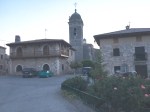
A few hundred yards later, we saw the domed steeple of the Iglesia de la Inmaculata Concepcíon emerging and then more village appeared as we got closer to the point where the Camino descended into Hontanas (pop.70).

We’re staying at the El Puntido (28€) albergue with a habitacion doble con bano compartido (private double room with shared bathroom).

It’s been raining off and on since we arrived at Hontanas. We washed and hung out clothes in an area designated for such things with a covered area that lets sun in while keeping water out (no clothes dryers available). At 3:00 with only short periods of sunlight, it will be interesting to see what happens.

We had a light lunch at 2:00 in the albergue dining room and reserved two places for the pilgrim dinner tonight at 7:00.

Later this afternoon it cleared up a bit and we took a walk around this very small village. We visited the 14th century Iglesia de la Inmaculada Concepción in Hontanas.

We also saw an interesting home on the edge of town with an equally interesting yard art/fountain.
The sun let us down on clothes drying today so we brought the socks that were still damp into the room and hung them in different places and they will probably be dry by morning.

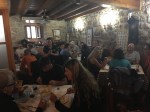
Pilgrims dinner at El Pundito

There were 35 pilgrims at dinner tonight. Our main conversation was with two guys from the states, one from D.C., the other from Virginia Beach.  They had walked 97 miles in last 4 days.  We got tired just listening to them!


Day 28- Tardajos to Hornillos del Camino

  • Distance today:                        5.9 mi
  • Distance Camino 2017:      199.6 mi

We witnessed a dramatic change in landscape today.

First we left our hotel at 6:45 in the dark and trying to get out of Tardajos, wandered through a maze of streets with direction changes at every intersection.  There were arrows but some were on curbs, some on pavement, some on buildings and the faded yellow paint was impossible to see without a light beam pointed directly at it. If either Linda or I had been alone we would have taken a wrong turn for certain. Teamwork and good reconnaissance got us through.
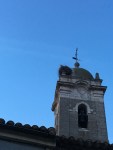
Once free of the maze, we continued a mile or so to Rabé de las Calzadas (pop.221), a pueblo with a monastery and a church with a stork nest in the befrey and this morning at least one visible stork in the nest!


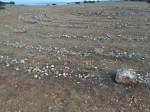
As we left the pueblo, passing Ermita de Nuestra Señora de Monasterios, the now dirt path began to gradually ascend over the next 3 miles until we reached the pentacle and gazed at the flatness and vastness of the meseta.

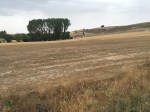
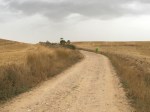
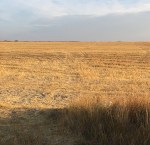
The Meseta is not an autonomous region, but rather a geographical area within the region of Castilla y León—the largest region in Spain. This central high plateau makes up 40% of Spain, with elevation ranging from 400-1000m. There is a saying that the landscape of the meseta is not found in the land, but in the sky with its diverse colors and expansive clouds. Dreaded by some, relished by others, the Meseta has a distinct reputation for being boring, repetitive and bleak. However, the Meseta is also home to such vibrant cities as Burgos and León and there is a certain beauty and awe in the endless horizon and wide open space. Towns are often set down in shallow river valleys, practically invisible along the horizon until arrival. The lack of trees means little to no shade. Medieval pilgrim records often complain of becoming hopelessly disoriented and lost in the Meseta, though recent tree planting along the trail helps to keep pilgrims heading the right direction. The Meseta can be blistering hot in summer and quite cold in winter. The flat landscape glimmers with golden wheat and flocks of sheep ramble the area along ancient sheep paths known as cañadas.
We walked on the meseta for less than a half mile before seeing a large bowl shaped valley which appeared from nowhere. At the base was Hornillos del Camino, our destination for today.

But to get there we had to walk down a steep path known as the cuesta matamulas (“mule killing incline”). We dropped 300 feet in a half mile then continued the decline another mile into Hornillos.

We stopped at the first open bar and had breakfast, then knocked on the door at our albergue, called Meeting Point(45€) at 10:30. It was still being cleaned but the proprietor checked us in and we went to our room, which was clean, as it had not been occupied yesterday.

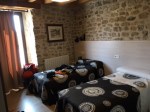
This is either a new or recently renovated albergue because the common areas and our habitacion doble con bano is modern, shows no signs of wear and is comfortable and spotless.

Hornillos del Camino is not a normal stopping point for pilgrims so there are not a lot of things to do or see, which made for a nice relaxing afternoon and evening to go with our not-overtaxing-walk this morning.

Great news!! Linda’s new Quechua walking sandals have now been worn nearly 15 miles without generating a single blister. And she began wearing them at Decathlon without any break-in wear. Equally important, they don’t rub against any of her older blisters. This lets the old ones completely heal without making new ones. For the remainder of Camino 2017, she will have alternate footwear to match the conditions and probably reduce future blisters.

Tonight we had a pilgrim dinner in the albergue’s dining area with a couple from New Mexico, a guy from Brazil and another guy from Luxembourg.  We enjoyed each other’s company and had fun trying to communicate with each other.

Day 27- Burgos to Tardajos

  • Distance today:                  6.4 mi
  • Distance Camino 2017:   193.7 mi

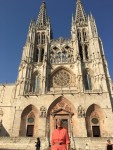
Just before sunrise, after snapping one more photo of the Burgos Catedral, we rejoined the Camino right outside our hotel.

It took us nearly an hour and over 2 miles to get to the outskirts of Burgos and begin walking on a dirt path again.
The next couple of miles, we followed a winding path through recently mowed grain fields before crossing over major highways and then along them until eventually working our way back along a two lane (N-120) highway until entering the small town of Tardajos (pop. 856).

Having walked for 6 plus miles with no places to stop, we crashed at the first bar we saw in Tardajos and had breakfast.

We had a nice conversation with a German lady and her 12 year old son. We had hop-scotched with them most of the morning. They had started in SJPDP three weeks ago and had to return home to Munich on Monday as her son’s soccer practice was starting.
We parted after breakfast, they walking on to Hornillos del Camino planning to stop there for the day and we to albergue Casa de Beli (45€) here in Tradajos.

We waited in the albergue cafeteria until our room was ready at 11:30. It’s apparently a new albergue and our room is a good size with two twin beds, two arm chairs, beautiful hardwood floors and a full bath that’s bright and spacious.

Jim used the albergue’s washing machine to get all our clothes nice and clean after being hand-washed for the past 8 days and then hung them out to dry in the garden area of the albergue. The warm, wind had them fresh and bone dry in less than an hour.

We had lunch at the albergue’s bar, a delicious ensalada mixta. This fresh “mixed salad” included lettuce, hard boiled eggs, olives, corn, shredded carrots, white asparagus, tomatoes and tuna accompanied with freshly baked bread.

The remainder of the day we just relaxed, read, worked on blog, made reservations for the next two nights and had a simple pilgrim’s dinner in the hotel bar. An easy day following our busy day in Burgos.

P.S.:

If you haven’t already discovered it, at the top of our blog page is a menu and one menu item is “map”.  This is a google map that lets you track our path across Spain and even get an idea of the terrain, etc.  We try to keep this current as time and wifi permits. Hope you enjoy.

Day 26- Villafria to Burgos

  • Distance today:                      6.3 mi
  • Distance Camino 2017:    187.3 mi

As most of the guide books indicate, the traditional Camino goes through an industrial section for the walk into Burgos and many recommend talking an alternative route along the river or taking a bus into town, which incidently picks up at Hotel Buenos Aires.

However, we planned to walk the traditional Camino, so this morning we left the hotel at 6:55 and immediately began passing through what turned out to be a very well organized and maintained industrial area for about 2 miles.

The sidewalk was wide, unobstructed and well lighted and consequently, wasn’t that objectionable to us. There were some unoccupied buildings but most had activity of workers entering the buildings and trucks loading and unloading goods. For us it meant jobs and a positive economic impact on the total community, directly or indirectly and we were thankful to see it and delighted to experience this aspect of the Camino Frances as well.

The final 1/4 mile we walked along a huge Bridgestone manufacturing factory, probably car and truck tires with hundreds of workers entering the facility as we passed by just before 8:00.

The industrial area abruptly changed into a high rise residential area for another mile or so before we stopped at a bar for breakfast.

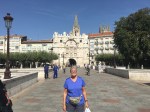
As we continued toward town center, the lack of signage for the Camino concerned us that we might be straying off path. We’re staying at the Hotel Meson del Cid (79€) which is on the Camino and very close to the Catedral, so Jim searched “Burgos Catedral” with his google earth app and the walking directions took us right to our destination while passing through some lovely parks and pedestrian walkways, creating a very favorable impression of city center on our way in.

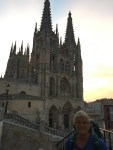
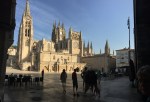
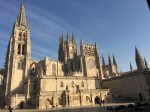
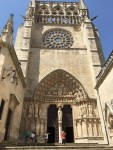
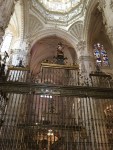
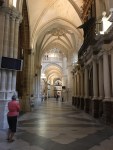
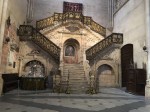
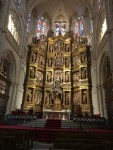
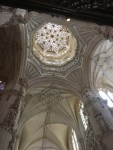
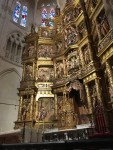
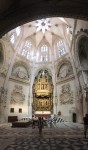
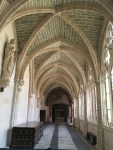
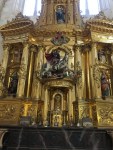
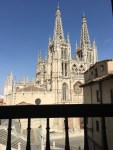
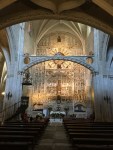
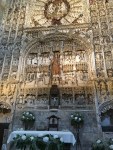
The Burgos Catedral or Santa Iglesia Catedral Basílica Metropolitana de Santa María de Burgos was consecrated in 1260 and has undergone numerous modifications and additions in the centuries that followed.

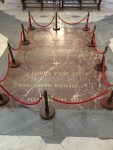
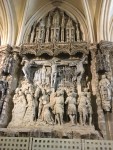
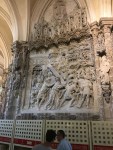
It is the most incredible house of worship we have ever seen. The exterior is breathtaking but is matched by the extraordinary size, beauty and variety of chapels, art work and historical relics inside. And it is the final resting place of Rodrigo Díaz de Vivar, El Cid, the “Master”, and the national hero of Castillo.

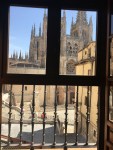
… and our hotel is just a few steps away and do we have a room with a view?

We got to the hotel at 10:00 and were advised that it would be at least another hour before our room would be ready. They stored our packs for us and we set out to complete our shopping list while in the big city of Burgos (pop. 178,500).

First we found an ATM and refilled our € stash. Next we found a farmacia to buy some extra bandaids, sunscreen and toothpaste. Finally, Linda has been having a few too many blisters with her walking shoes so she wanted to try some new walking sandals that have been recommended by several pilgrims along the way.


They are a British brand, Quechua, and so we stopped at several shoe stores nearby with no luck but finally got directions to a French owned sports store called Decathlon, similar to our Academy Sports store in Greenville, but several miles on the outskirts of Burgos. Having already completed our stroll for the day, we asked the store owner to call a taxi and 7€ and 15 minutes later we were trying on and finding new sandals for Linda. The Decathlon clerk who helped us, kindly called another cab and another 7€ and 15 minutes later we were back at Meson del Cid, entering our room.

Oh, our room with a view..

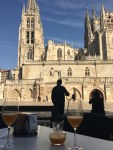
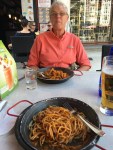
When we weren’t shopping, we spent time outdoors in the plazas around the Catedral, still awestruck and having OJ when we arrived, a pizza lunch and a pasta dinner… at 1:30 and at 6:30!

We also made a quick visit to the Iglesia de San Nicolas, located between our hotel and the Catedral.

San Nicolas de Bari (270-343AD) was a 4th century Saint and Greek Bishop of Myra (present day Turkey). He was a very rich man because his very wealthy parents died when he was very young. He spent his life helping the needy and performed numerous miracles as well as giving gifts to others anonymously. He also performed many miracles protecting and reviving sailors and is considered the Patron Saint of sailors.

His remains were transported by Italian sailors to Bari in 1087, hence the origin of his name.

As we discovered during our pilgrimage the past week, San Juan de Ortega’s dedication to pilgrims en route to Santiago is a direct result of his own pilgrimage to the Holy Land. During his return journey, his ship was wrecked, and a promise was made by Juan to San Nicolas de Bari. Juan would, in exchange for safety, devote himself to pilgrims and to make good on his prayer and promise to the Saint, became a disciple of Santo Domingo.

As a result, awareness of San Nicolas spread to the west bolstered by Juan’s devotion to him. Juan was originally from a village near Burgos and died in 1163. Coincidentally in 1163, Pope Alexander III named a new church in Burgos, San Nicolas.

And if you haven’t guessed it by now, San Nicolas and Saint Nicholas and Santa Claus are one in the same.

Our day in Burgos has been a real treat and we could easily stay much longer and still not begin to take in all this beautiful city has to offer. That’s one more extraordinary day on the Camino Frances.

Day 25-Atapuerca to Villafria

  • Distance today:                    7.5 mi
  • Distance Camino 2017:     181 mi

It was dark when we began walking this morning at 6:20 with a cool 55 degrees and a slight breeze. Headlamps were critical as we followed a footpath up the side of the mountain with hints of farmland on the right and an army base bordered with rusty, coiled, barbed wire and no trespassing signs on the left. The last half mile or so the path got very rocky making walking quite difficult.


First light appeared when we had climbed up some 400 ft and were arriving at the top (3500 ft).

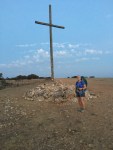
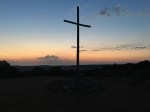
All alone on the barren rocky surface at the mountain pentacle stood a simple, tall cross surrounded by a mound of stones and other items placed there by passing pilgrims.

Before beginning our descent we looked back and paused to gaze at the beautiful image of the silhouette of the cross overlaid on the emerging sunrise.

We then turned around and could now see in the distance the lights of Burgos and for the first time, the flat terrain beginning at Burgos known as the Meseta.

The path down the mountain was about as steep as the assent, but even though it was less rocky it was enough to compel these two pilgrims to take it slow and easy to prevent unpleasant knee and ankle issues. The path eventually became a farm road with a more gradual slope then joined a paved farm road and then a secondary road leading toward Villafria.

After 3.5 miles, the road began to level out and shortly after, we stopped at a popular pilgrim bar/albergue/rest area for breakfast as we entered the village of Cardeñuela de Riopico (pop. 111).

A feet rest and breakfast completed, we began the final several miles on pavement into Villafria. The hard surface was predictably tiring, but traffic was not an issue and the morning clouds were hanging around, keeping the temperature tolerable and the breeze cool.

The last mile, we walked around a fence providing security for the east half of the Burgos airport, then shared a bridge with some large trucks crossing railway tracks and then entered the Burgos suburb of highly industrialized Villafria.

The Hotel Buenos Aires(40€) is an average hotel with restaurant/bar and nice size rooms and modern bathrooms.


Ironically it doesn’t have an easy way to dry hand washed clothes, because its clients are typical tourists and business people and not pilgrims, mostly due to the price range. So we minimized our hand washing and hanged items out in the room or out the window, securing them from blowing away from our 3rd floor room.

We had a tortilla lunch after we settled in and when we found out their restaurant didn’t open until 8:30, we also had a tortilla dinner.

The afternoon and after dinner was spent resting, updating the blog and did I say resting?