We left in the dark at 6:25 even though we have a short walk today. We wanted get to El Burgo Ranero ahead of Ken and Mandy so we could have breakfast together before they move on ahead of us.
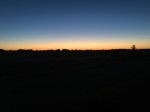
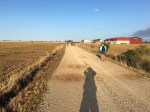
Silhouette of Jim’s favorite pilgrim against first light.
Emerging sunrise with Venus still visible in a clear sky.
Colors changing minute by minute with a typical meseta sunrise.
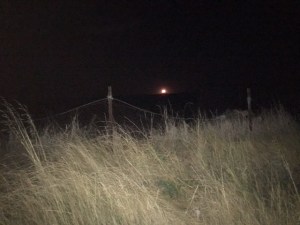
We saw another first this morning. Still in the dark, we noticed a full harvest (orange) moon just above the horizon as we left Bercianos.
Limits of our iPhone didn’t capture the vivid orange moon and corona as it sank below the horizon.
As it sank below the horizon it had an orange glow much like a sunset. Our first “moonset”.
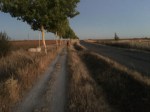
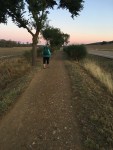
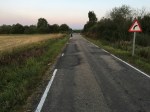
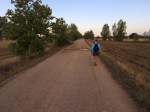
The Camino this morning was a narrow path about a yard wide and it paralleled a narrow two lane paved road. Traffic was light on both the road and the path.
At daybreak
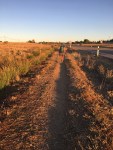
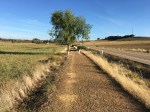
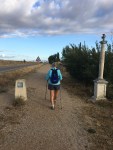
Typical Camino today
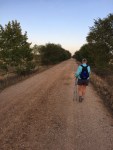
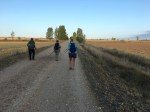
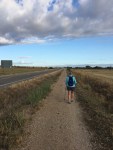
Walking at sunrise
We arrived at El Burgo Ranero at 8:20 and stopped at the first bar, a likely place to stop for breakfast. We didn’t know when Ken and Mandy would walk by or if we had missed them. But 10-15 minutes later Jim saw them walking by and flagged them down. We had a nice chat over breakfast and about 9:20, we said our goodbyes and our fellow bloggers continued on toward Religios, our target destination for tomorrow.
After getting directions from the bartender, we walked on to El Peregrino (45€) and because we had a reservation were taken to our double room w/bath and began our pilgrim chores at 9:30, a record, we think.
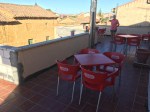
Deck outside our 2nd floor room. Great for drying clothes
El Burgo Ranero (pop.826) was a wool-producing town, the biggest business of Castilla during the Middle Ages. Huge flocks of sheep (up to 40,000) were tended. They grazed in the mountains in summer while the Meseta fields were occupied with wheat, and returned in winter via specially developed sheep roads known as cañadas.
A pizza lunch in the hotel bar, reading (Linda), blog (Jim) and nap (Jim) occupied the afternoon.
Before dinner we walked to the Iglesia San Pedro Apostol and had some quiet moments and took some photos.
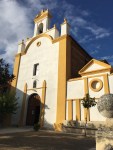
Exterior of San Pedro Apostol
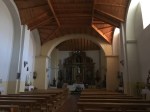
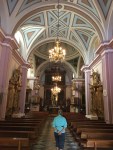
Interior of Iglesia San Pedro Apostol in El Burgo Ranero
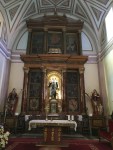
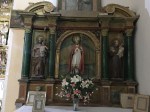
Retablo of Iglesia San Pedro
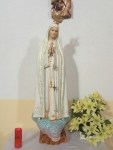
Delicate porcelain Virgin Mary in San Pedro
Dinner, also in our hotel restaurant, included melon with Serrano and veal for Linda and Russian salad and rabbit for Jim. We had a nice local house red wine, which we won’t be able to find in the states.
Our wine, probably a blend of Mencía grapes.
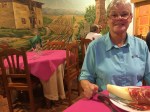
Melon with Serrano ham for Linda. Hand painted mural of local scenery in background.
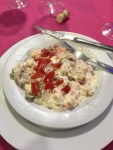
Russian salad for Jim
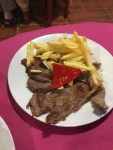
Veal, roasted pepper and fries for Linda
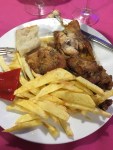
Rabbit, roasted pepper and fries for Jim
It was a tasty and filling meal, so we climbed the stairs to our room and called it a day.
We stopped by our “sweets spot” on the way out of Sahagún this morning to get croissants for the road. There aren’t any places to stop on our walk this morning unless we want to add an extra 2 miles by walking to a village not on the Camino and that’s not gonna happen.
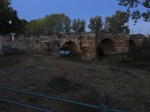
Kinda dark to get a decent photo but couldn’t resist this medieval bridge as we left Sahagún.
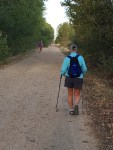
Path got pretty narrow part of the way this morning
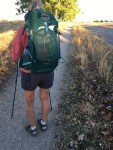
That paper in Linda’s pack is about to be opened for our morning snack from the “sweets shop”
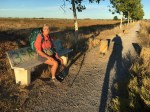
Leave it to Linda to find a nice spot for a pause
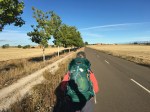
Shady path or asphalt, take your choice
We walked on paths alongside local roads the entire time but it was a pretty smooth walking surface, lined with shade trees most of the way. The path got narrow several places and because of very light auto traffic, we had the choice between path and asphalt most of the way.
When we reached Bercianos del Real Camino (pop.195) we stopped at the first bar/albergue, “Bercianos 1900” (www.bercianos1900.com). It’s a very nicely done bar with spacious, inviting tables and sitting areas, inside and outside. As we were eating our breakfast, the young lady sitting next to us was on a computer and initiated a conversation with us in very good English. It turns out that she was the owner and this was their first day of operation.
Bercianos 1900
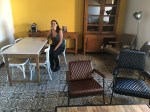
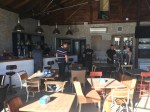
Pilgrim lounge and multiple purpose room. Our hostess and owner/manager seated.
Bercianos 1900 bar
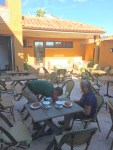
Nice outside dining and lounging areas of Bercianos 1900
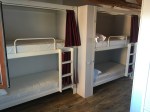
Sleeping units with thoughtful privacy curtains
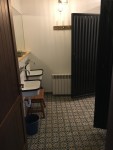
Bathroom and shower areas
She gave us a tour of the albergue and she and Jim discussed several ideas about growing her new business.
We wished her luck and walked on into the village and after wandering around and getting all kinds of interesting and conflicting directions from residents we finally arrived at Albergue Santa Clara (45€).
Our first impression was that this was a very primitive albergue and we thought maybe we should go back to the other albergue. But as soon as the owner showed us our room, we were speechless.
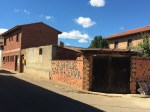
Our first impression of Albergue Santa Clara
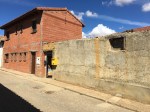
Second impression of Santa Clara not so good
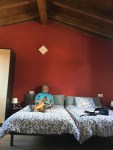
This may be the most comfortable, clean, spacious habitacion double con bano, we have stayed in on the Camino!
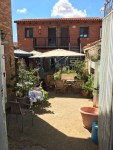
Another view of the courtyard, our room on second floor, right.
Even a desk, fridge, expresso maker & xtra chairs
Great shower in spacious bathroom
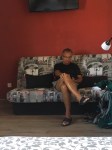
Comfy couch a plus
Oversized twin beds, beautiful, high ceiling
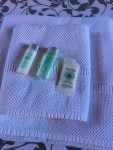
Pilgrim spoiling amenities and extra towels
Courtyard and entrance to bar/ reception
Santa Clara courtyard
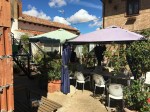
Lots of shady seating in the courtyard
It has a large futon type couch (very unusual), two oversized twin beds, a desk, three straight-back chairs, a wardrobe, extra & strategicly placed outlets (very unusual), a small (but stocked) refrigerator, roomy bathroom with a large shower with rain shower head & hand wand & 4 horizontal massaging water jets. It it even has screens on all 3! windows: one, overlooking the garden, another overlooking a street and a small window in the bathroom. And did I mention a Keurig style coffeemaker with coffee, cream & sugar? Pilgrims have never had it so good!
Our albergue doesn’t serve meals, only bar items like bocadillas, tortillas and drinks. So we had bocadillas (sandwiches) for lunch with a bottle of wine from the Bierzo region of Spain made from Mencía grapes (both a first for us) which was quite nice.
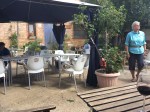
We met Carl from Norway. He’s staying in the albergue. He had met Jim earlier when he arrived after us and asked Jim if this was a good place to stay. Jim said if our room was any indication of the overall value and quality, the albergue should be great. Jim waved to Carl later and asked him if the albergue was ok and Carl said yes. We waved him over and asked him to join us for lunch in the courtyard between the owner’s house, the albergue and the two double rooms of the hostal. We ate and chatted for a couple hours enjoying the pleasant, comfortable atmosphere in the outdoor sitting and eating area. Carl had made a miraculous recovery from a previous illness by walking the Camino in 2014 and is walking it again to complete his recovery.
We had a restful afternoon in our lovely room with Jim taking a short walk to photograph the unusual church tower which is a steel structure with two large bells in the belfry. Another nearby steel structure had a large stork nest on top, perhaps to give the stork an alternative to the belfry.
We returned to Bercianos 1900 for dinner and Carl joined us. Halfway through dinner, Jim was completely surprised when two fellow bloggers, Ken and Mandy from South Africa introduced themselves. We had connected with them when they began following our blog in July as they were preparing to begin their Camino in mid-August and joked that maybe they would catch us. And so they did and what a pleasant surprise to connect and meet this delightful couple. Hopefully we’ll meet for breakfast tomorrow morning in the next village before they move on, as they plan to get to Santiago from SJPDP in 34 days compared to our 70 day plus plan.
We left Terradillos de los Templarios at 7:45… our latest start so far.
Just after leaving Terradillos de los Templarios
Walked in road for maybe 1/4 mile… yes, solar panels along the Camino
From road back onto path
Just finished a long grade prior to Moratinos
The weather has been so cool (55F when we got up) it hasn’t been necessary to start in the dark. We walked only 2.5 miles before stopping for breakfast at Moratinos.
Walking into Moratinos
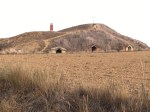
Moratinos bodegas
Moratinos village square and Iglesia
This area has been producing wine for over 2000 years in the surrounding fields and digging caves or “bodegas” into the clay hillsides for producing and storing the wine for their families. Only two or three families in this village of 68 people still use the bodegas to make wine and we saw only a few scattered vineyards as we approached the village.
Moratinos is also a village that may once have been Muslim or had a significant Muslim population. Many moriscos (Muslims who converted to Catholicism) settled as farmers in the flat areas of Castilla, only to be removed in 1609.
There wasn’t much to see in the 16th-century  Iglesia Parroquial de San Tomás, but the roofed porch would provide a shady spot for pilgrims as would the trees in the small square adjacent to the church.
Interesting bar in St Nicolas
Linda buckling up after our OJ break in St Nicolas de Camino Real
We walked another 1.5 miles and stopped for fresh squeezed orange juice in the village of San Nicólas del Real Camino (pop.48), a village that was under Templar control until the late 12th century.
Still very much on the meseta.
Still on the meseta we caught a glimpse of the Cordillera Cantábrica mountains north of us as we close in on Leon.
Very few vineyards along the way today, this one even had scarecrows.
First look at Sahagún
We got down to some serious walking for the next 4 miles to reach Sahagún. (pronounced “SA GOON” with accent on last syllable.)
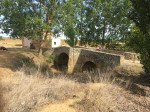
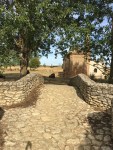
Linda crossing medieval bridge to hermitage
Medieval bridge to Ermita
Exterior of Ermita Virgen del Puente
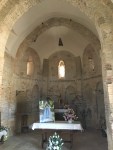
Interior of Ermita
Altar of Ermita del Virgen del Puente
Just before arriving at Sahagún, we crossed over a medieval bridge and made a brief visit to the Ermita Virgen del Puente, built in the Sahagún historic Romanesque-Mudéjar architectural style, which incorporated Islamic decorative motifs and was built primarily out of brick rather than stone. It was built in the 12th century and underwent some renovations in 2011. Also at the site was the geographic halfway marker for the Camino Frances, if you start in Spain as opposed to SJPDP.
We continued on into Sahagún, found our hotel, La Codorniz (45€), checked and did our daily pilgrim chores.
When our growling stomachs announced it was time to eat, we ventured out into the town and found an albergue near many of the historical buildings of the town and had a tortilla lunch.
Fireplace and entrance to Peregrino area of albergue where we had tortilla lunch
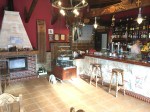
Bar in albergue where we had lunch- notice stone bar
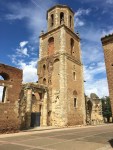
On our way back to the hotel, we took some photos of some of the key historical sites. Sahagún (pop.2830) dates back to Roman times, however the current town developed from the worship of the remains of two Christian martyrs, St. Facundus and St. Primitivus, who’s beheaded bodies were thrown into the waters of the Rio Cea, recovered and placed in a tomb that became a primary sanctuary. The original church was established in 872 and thereafter received the favor of princes and nobles alike, its golden age culminating during the reign and patronage of Alfonso VI.
Arcos de San Benito (originally the main entrance for St Benedictine Monastery now in ruins)
Ruins of San Benidictine Monastery- burial place of Alfonso VI
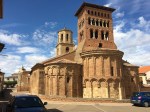
Exterior of San Tirso church
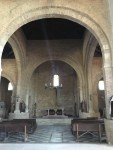
Interior of 12th century Iglesia de San Tirso
17th century Iglesia de San Juan built over birthplace of San Juan de Sahagún. Also holds the chest with remains of Sts Facundus & Primitivus
Sanctuary of Iglesia de San Juan
Altar and retablo of Iglesia de San Juan. Note chest with two saints remains above statue of San Juan
Alfonso VI was responsible for opening up Spain to the rest of Europe, granting a charter to Sahagún and promoting the Camino Frances passing through the town. Alfonso VI and his 4 wives are buried in the museum of the Monastery of San Benito.
Our “sweets” spot
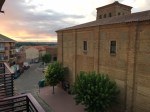
View from our room of 13th century Church of La Trinidad converted to municipal albergue, concert hall and information center.
We stopped at a sweets shop on the way back to our hotel, then ventured out around 6:30 for pasta at one of the few bars serving food, then returned to our room for the evening.
We slept in this morning leaving Calzadilla de la Cueza at 7:30. We walked nearly 4 miles before stopping at 9:00 in the village of Ledigos (pop.74) for breakfast.
The Camino after Ledigos
Just after breakfast
The path shortly after leaving Calzadilla this morning
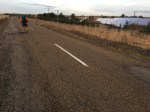
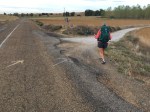
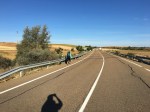
Camino and highway N-120 were one in the same for a short while today
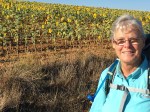
We’ve missed seeing the beautiful fields of sunflowers (“girasoles”) with their bright yellow blooms along the way. They peaked in early to mid-August and the fields are kinda drab. But alas, this morning we passed several late blooming fields with a few scatterered, near-peak plants.
Finally, some pretty sunflower plants
Linda getting sunflowers to pose for photos
Great to see these again
Hopefully we’ll see more along the way.
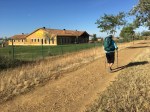
At around 10:00, we stopped at Albergue Los Templarios, our home for the day, at the edge of Terradillos de los Templarios (pop.78) once home to a 13th-century church belonging to the Knights Templar.
The Knights Templar were a medieval military order responsible for protecting pilgrims. While the order was popular and successful for almost 200 years, grand master Jacques de Molay was arrested in 1307 (on Friday the 13th, possibly the origin of this superstitious date) and burned at the stake for heresy and a variety of trumped-up charges. The order was disbanded in disgrace, though many think the charges had more to do with politics than any actual wrongdoing.
The Knights Templar was a Catholic military order recognised in 1139 by pope innocent II’s papal bull Omne Datum Optimum of the Holy See. The order was founded in 1119 and active from about 1129 to 1312. This ruling meant that the Templars could pass freely through all borders, were not required to pay any taxes, and were exempt from all authority except that of the pope.
Although the primary mission of the order was militaristic, relatively few members were combatants. The others acted in support positions to assist the knights and to manage the financial infrastructure. The Templar Order, though its members were sworn to individual poverty, was given control of wealth beyond direct donations. A nobleman who was interested in participating in the Crusades might place all his assets under Templar management while he was away. Accumulating wealth in this manner throughout Christendom, the order in 1150 began generating letters of credit for pilgrims journeying to the Holy Land: Pilgrims deposited their valuables with a local Templar preceptory before embarking, received a document indicating the value of their deposit, then used that document upon arrival in the Holy Land to retrieve their funds in an amount of treasure of equal value. This innovative arrangement was an early form of banking and may have been the first formal system to support the use of cheques; it improved the safety of pilgrims by making them less attractive targets for thieves, and also contributed to the Templar coffers.
Based on this mix of donations and business dealing, the Templars established financial networks across the whole of Christendom. They acquired large tracts of land, both in Europe and the Middle East; they bought and managed farms and vineyards; they built massive stone cathedrals and castles; they were involved in manufacturing, import and export; they had their own fleet of ships; and at one point they even owned the entire island of Cyprus. The Order of the Knights Templar arguably qualifies as the world’s first multinational corporation.
The order, which was among the wealthiest and most powerful, became a favoured charity throughout Christendom and grew rapidly in membership and power. They were prominent in Christian finance. Templar knights, in their distinctive white mantles with a red cross, were among the most skilled fighting units of the Crusades.
The Templars were closely tied to the Crusades; when the Holy Land was lost, support for the order faded.
King Philip IV of France was heavily in debt and had borrowed huge sums of money from the Knights Templar and he had no intention of paying them back. He used the Knights Templar loss of support to his advantage by colluding with Pope Clement V, a relative who was heavily influenced by Philip. Since the papacy was at that time located in Avignon, France, Philip convinced Clement to bring charges against the Knights Templar and disband the order and arrest them, charging them with heresy during the Inquisition.
The order was disbanded by the Pope in 1308 and Jacques de Moray, the Grand Master of the Knights Templar and 70 other Templar leaders were arrested on October 13, 1307 and were tortured into confessions.
Even though De Moray, age 71, recanted his tortured confessions, he was burned at the stake in front of the Notre Dame Cathedral on March 18, 1314 after 7 years of solitary confinement and torture.
While burning on the pyre, De Molay cursed King Philip IV of France, his descendants, Pope Clement V, and everyone else who supported his death. De Molay said that within a year and a day, Clement V and Philip IV would die. He also said Philip’s bloodline would reign in France no more
It happened as De Molay wished for, and death came for Clement first. He lost a battle with a damaging disease on April 20, 1314 at age 54. Shortly after the Pope, Philip died of a stroke while hunting at age 46. A tragic death was also the destiny for all of Philip’s successors. Between 1314 and 1328 all three sons and grandsons of the French king died. Within fourteen years from the death of De Molay the House of Caped no longer existed – after it had stood for 300 years.
In September 2001, a document known as the “Chinon Parchment” dated 17–20 August 1308 was discovered in the Vatican Secret Archives by Barbara Frale, apparently after having been filed in the wrong place in 1628. It is a record of the trial of the Templars and shows that Clement absolved the Templars of all heresies in 1308 before formally disbanding the order in 1312,[57] as did another Chinon Parchment dated 20 August 1308 addressed to Philip IV of France, also mentioning that all Templars that had confessed to heresy were “restored to the Sacraments and to the unity of the Church”.
The current position of the Roman Catholic Church is that the medieval persecution of the Knights Templar was unjust, that nothing was inherently wrong with the order or its rule, and that Pope Clement was pressed into his actions by the magnitude of the public scandal and by the dominating influence of King Philip IV, who was Clement’s relative.
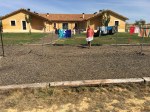
Albergue Los Templarios (opened in 2007) is the nicest albergue we’ve stayed in, so far. It has bunk bed rooms (literas-8€) and single bed rooms (camas) with private or shared bathrooms. Grassy areas surround the albergue and there are clotheslines aplenty. After machine washing our clothes, the owner gave us an extra handful of clothespins. (Clothespins are always in short supply when hanging out your clothes to dry!) Los Templarios has an all day open bar and pilgrim menus for lunch (1:30-3:00) and dinner (6:30- 8:00 ).
OJ just after arriving at Los Templarios albergue
Linda just finishing hanging out clothes
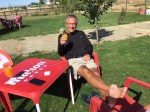
Great way to wait for the clothes to dry
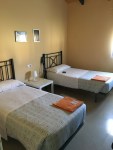
Our habitacion con bano (38€) is bright, spacious with two comfortable twin beds, an adequate sized bathroom with complementary soap! Even though it was too early to check in, the owner gave us a room anyway and within a half hour we had showers and our dirty clothes were being machine washed (4€).
Note the orange towels, which surely must indicate there are Clemson fans in the area!
We had lunch in the albergue cafeteria including wine for 12€ and a nice pilgrim dinner for 10€ each.
In a lot of ways, today’s walk was like yesterday’s. It was what we consider a long walk (>16km or 10 miles). The path was mostly flat with only gentle ups and downs. The weather was perfect: temperature in 50-60 range, slight breeze behind us, no precipitation.
Even though today we walked a mile less than yesterday, what made today more difficult was: the first 3.5 miles were paved rather than dirt, there were no villages or bars or restrooms for the entire 10.6 miles and it occurred a day after walking nearly twelve miles.
Nevertheless, it was on balance, a good day, a satisfying day for both of us.
Unlike most of our walks, there’s not a lot to share about our day.
In summary, we left Carrión at 6:45 in the dark and walked for the first 3.5 miles on a very
straight Roman road that had been restored by paving it with asphalt.
Beginning our walk on upgraded? Roman road
Looking back at Carrión before sunrise
First and only curve on paved Roman road at 3 miles
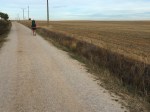
The next 7 miles were also on a straight Roman road that had been covered with a mixture of gravel and dirt and packed down by farm equipment and pilgrims for many years.
Asphalt stopped, but continued on what was originally a Roman road
After 4 miles
Around 5 miles walked
2 French ladies passed us at 6 miles
Just a barn, no rest stop here
Between 6 and 7 miles
After 7 miles
After 8 miles
First and only hill at between 8 and 9 miles.
Getting close to Calzadilla de la Cueza
Calzadilla emerging from a hole on the meseta
Finally approaching Calzadilla de la Cueza
Entering pueblo of Calzadilla de la Cueza
Our hotel
We arrived in Calzadilla de la Cueza (pop. 54) at 10:45 and were allowed to check-in to our room at the Camino Real hostel (40€) right away and did so as soon as we ate a late breakfast.
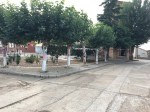
This small village of 54 inhabitants has a church but it was locked. Main Street is at best 100 yards long with a few crossing streets with maybe 4-5 houses deep. Other than 2 albergues, our hotel, and a tiny grocery store (which was also closed) there isn’t anything else here but houses and buildings housing farm equipment.
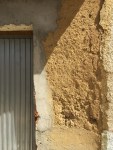
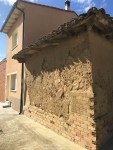
Exposed stucco with straw and stone reinforcement on main street house
Another stucco building used as is.
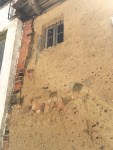
Plaster and concrete broken away exposing stocco from local clay, straw and stones,
Owner still using adobe with brick facing as his house with modern stucco addition.
Because of lack of stone, most of the houses are made of brick and stucco. The bricks appear to be very crude but have been around for a long time. You can see the straw mixed in with the clay and several houses have very old brick that has been maintained and retained with newer brick add-ons.
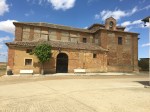
San Martin Iglesia (16th century) exterior
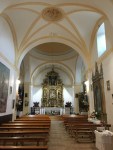
Interior of 16th century San Martin of Tours Iglesia
That’s San Martin in the center
13th century icon in San Martin.
After a pizza dinner we took a walk and found the 16th century church, Iglesia de San Martin, open and an 87 year old, lifetime resident took us on a tour. We understood a little of what she said, enough to keep her from being as frustrated as we. Several of the wood icons in the church were from the 13th century and her describing them to us made it extra special. She wouldn’t let us take her photo because she wasn’t dressed up for it. It created another wonderful memory for Camino 2017.
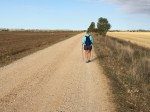
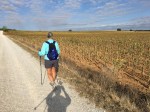
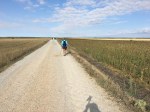
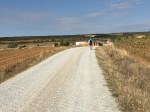
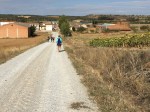
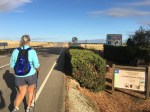
Today almost all of our walk was on a gravel/dirt path parallel to a two lane, lightly traveled highway.
We walked through the villages of Población de Campo (pop. 140):
Entering Poblocíon del Campos
Leaving Poblocíon del Campos
Revenga de Campos (pop.179):
Before Revenga de Campos
Revenga de Campos
Leaving Revenga de Campos
Villarmentero de Campos (pop. 11)):
Before Villarmentero
Villarmentero
Leaving Villarmentero
and Villalcazar de Sirga (pop.174):
Approaching Villalcazar
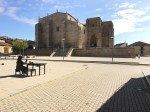
13th-century  Iglesia de Santa María la Blanca
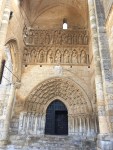
Entrance to Iglesia of the White Virgin in Villalcazar
The Camino did not originally pass through this town, but later detoured when the fame of the Virgen Blanca (” white virgin”) and her many miracles spread. She is on display in the 13th-century  Iglesia de Santa María la Blanca.
A pilgrim having his cafe con leche
Leaving Villalcazar
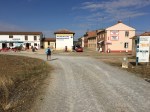
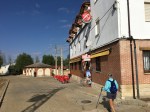
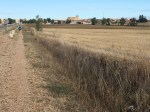
They were all spaced 2-3 miles apart and few if any services were available in each village. It usually took less than 5 minutes to pass through each village. In between the villages were flat, fields as far as you could see in all directions.
This is the meseta. Many guidebooks and other writings describe the meseta as dull, monotonous, repetitive, bleak, hot, cold, uninteresting, etc. We’ve known many pilgrims who skip it altogether by taking a bus. Many walk to Burgos and stop. Others begin in Leon and walk to Santiago.
We love the meseta. The endless fields and frontier-like villages scattered along the Way, because of their simplicity, are actually soothing, proving time for reflective thinking or non-thinking (meditation) while you walk without distraction or stimulus, other than the breeze, the sun, the sky, the endless fields and what you are feeling physically and/emotionally.
Today was a great day. We felt good both during and after what was our longest and fastest walk so far…averaging 3 miles an hour for almost 12 miles!
We walked straight to our Hotel Santiago in Carrión de Los Condes (pop.2221) and were warmly received by the owner who happens to be the grandson of the owner of the hotel we stayed in two nights ago.
Just before Carrión
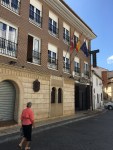
Hotel Santiago
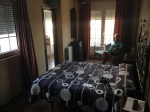
Our room
Today was market day in Carrión and it was in Santa María Plaza, just outside our hotel
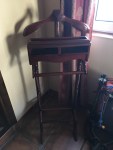
Even a place for Jim to hang sports coat, trousers and for cuff links!
Our habitacion con bano (40€) is one of the nicest, spacious we have occupied so far.
After completing our chores we had lunch at a nice restaurant a few blocks away. We had two delicious meals and will definitely snack for dinner.
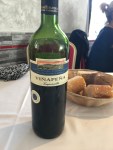
A nice local wine
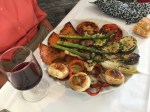
Linda’s roasted vegetables
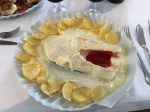
Jim’s salmon
Dessert was half gone before Jim remembered to take photo
Tonight we attended a mass at the Iglesia de Santa María del Camino for Peregrinos, which we attended passively as it was all in Spanish and we didn’t recognize any of the songs, ritual or responsive readings. At the end of the service the 50-60 pilgrims attending came down to the front of the church to be recognized by country (we were the only Americans). The priest gave a personal blessing to each of us. Also we were each presented a handmade star to carry with us, representing the blessing for a good Camino and a good life afterwards.












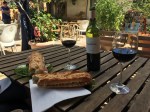 So we had bocadillas (sandwiches) for lunch with a bottle of wine from the Bierzo region of Spain made from Mencía grapes (both a first for us) which was quite nice.
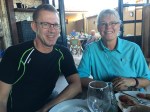 Carl had made a miraculous recovery from a previous illness by walking the Camino in 2014 and is walking it again to complete his recovery.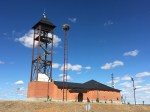
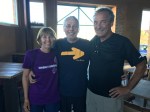 We had connected with them when they began following our blog in July as they were preparing to begin their Camino in mid-August and joked that maybe they would catch us. And so they did and what a pleasant surprise to connect and meet this delightful couple. Hopefully we’ll meet for breakfast tomorrow morning in the next village before they move on, as they plan to get to Santiago from SJPDP in 34 days compared to our 70 day plus plan.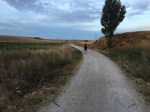











 our home for the day, at the edge of Terradillos de los Templarios (pop.78) once home to a 13th-century church belonging to the Knights Templar.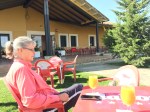









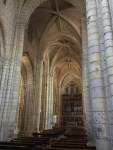


 which we attended passively as it was all in Spanish and we didn’t recognize any of the songs, ritual or responsive readings. At the end of the service the 50-60 pilgrims attending came down to the front of the church to be recognized by country (we were the only Americans). The priest gave a personal blessing to each of us.
  Also we were each presented a handmade star to carry with us, representing the blessing for a good Camino and a good life afterwards.
 Jimandi