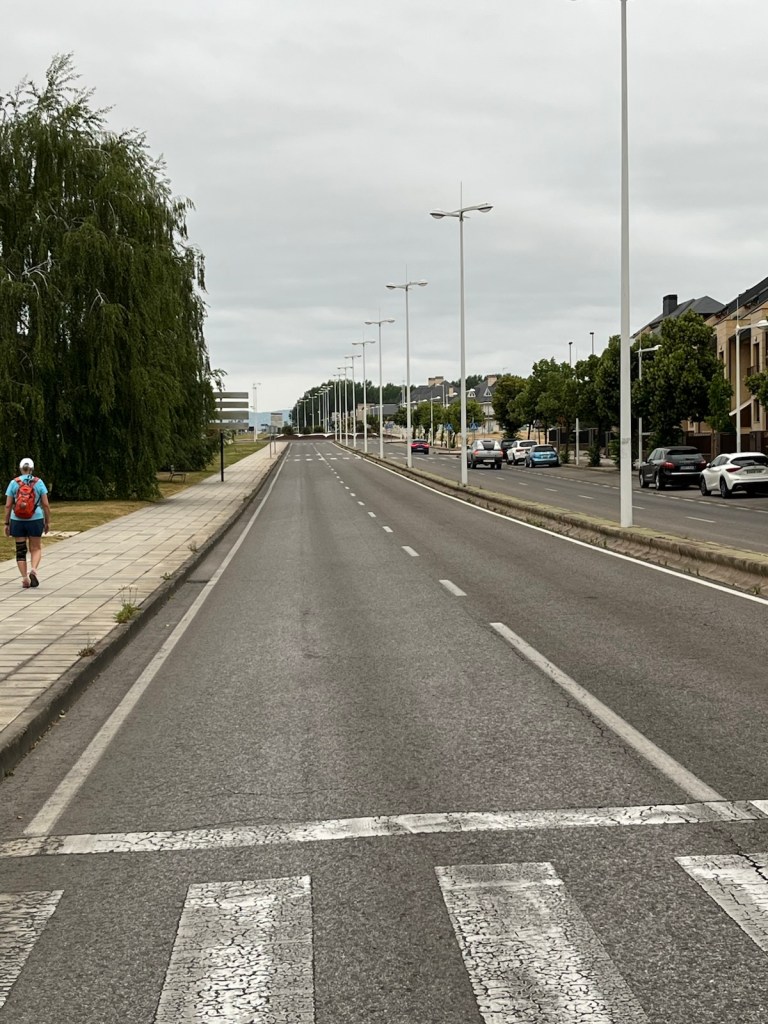
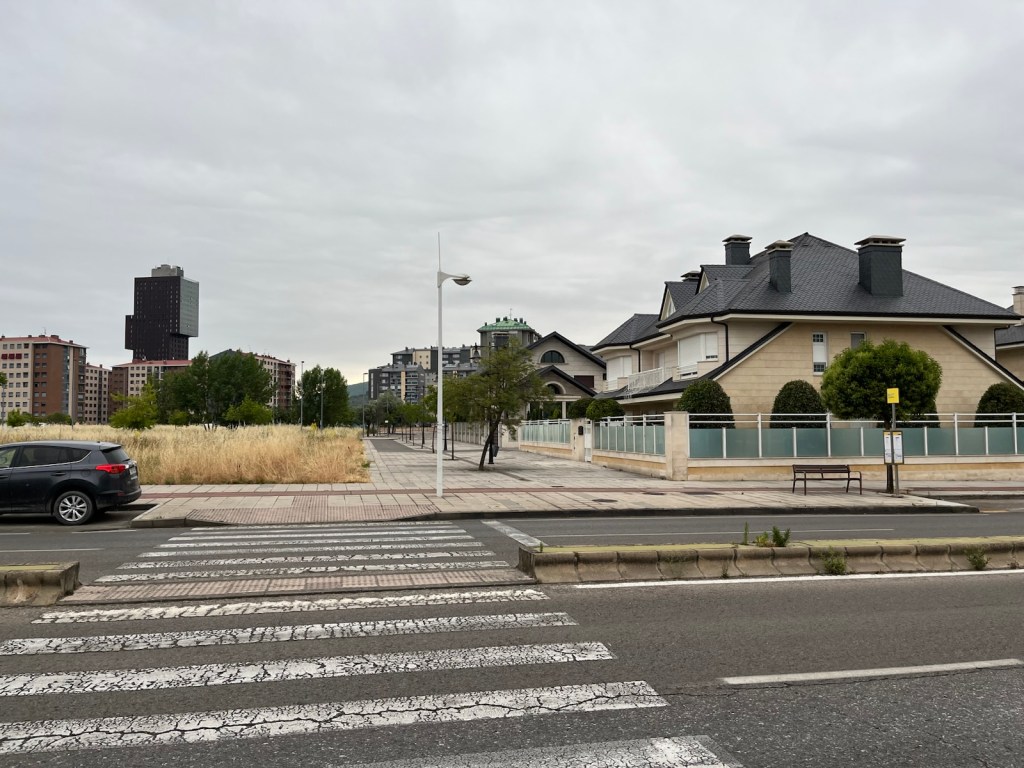
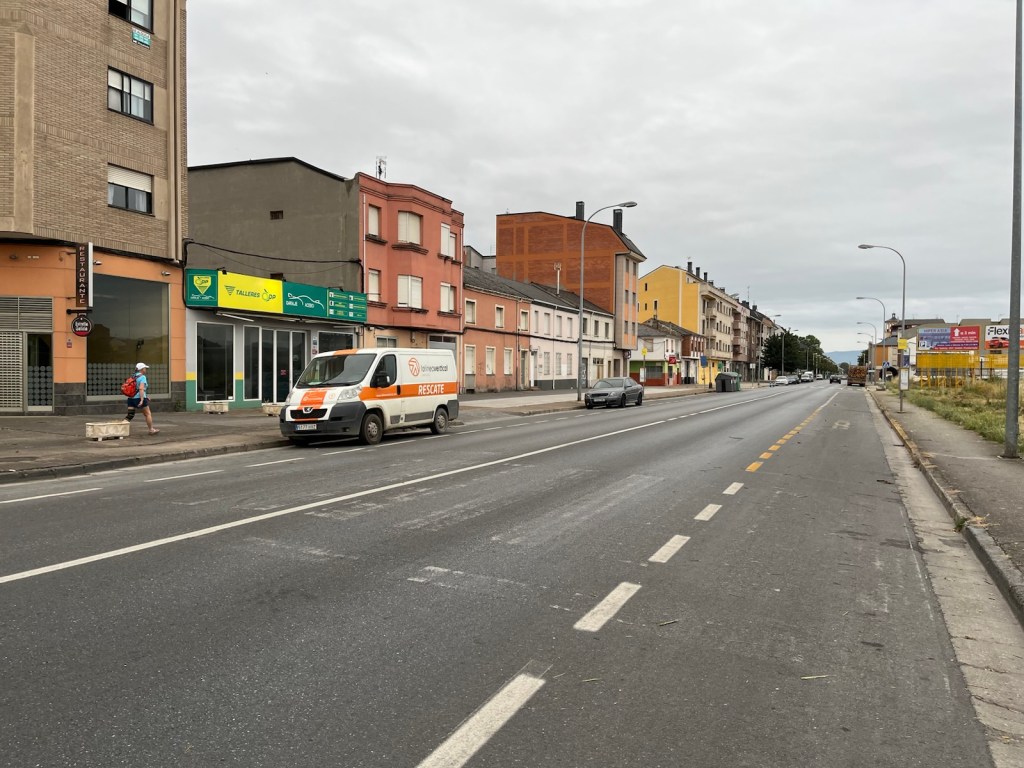
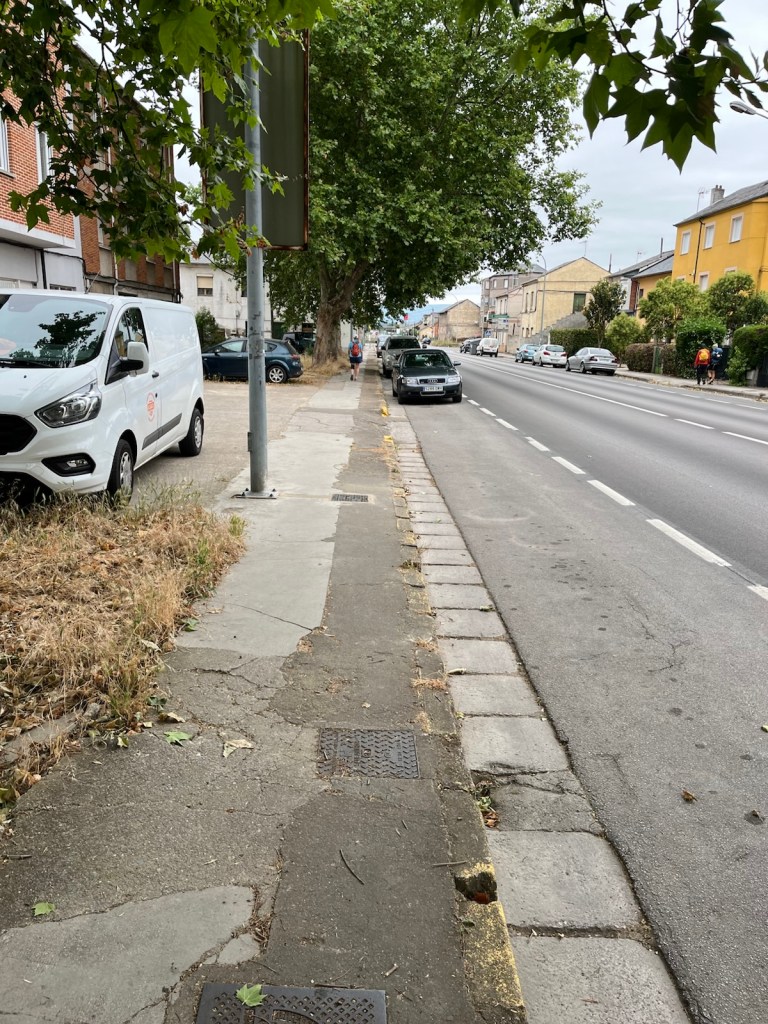
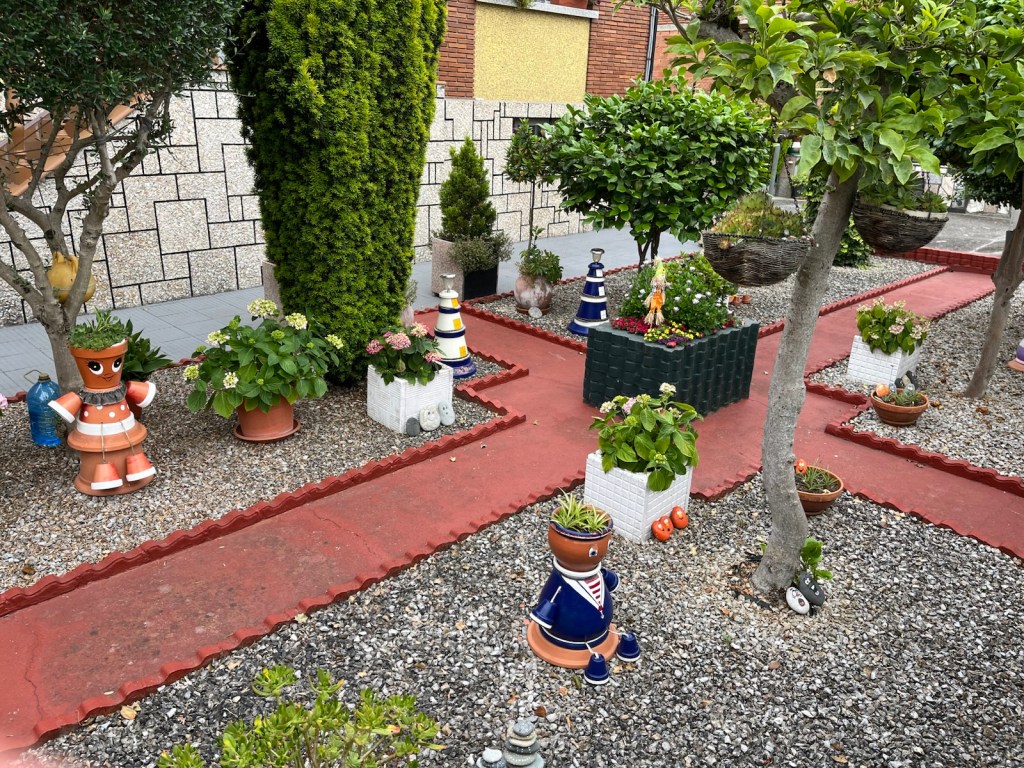
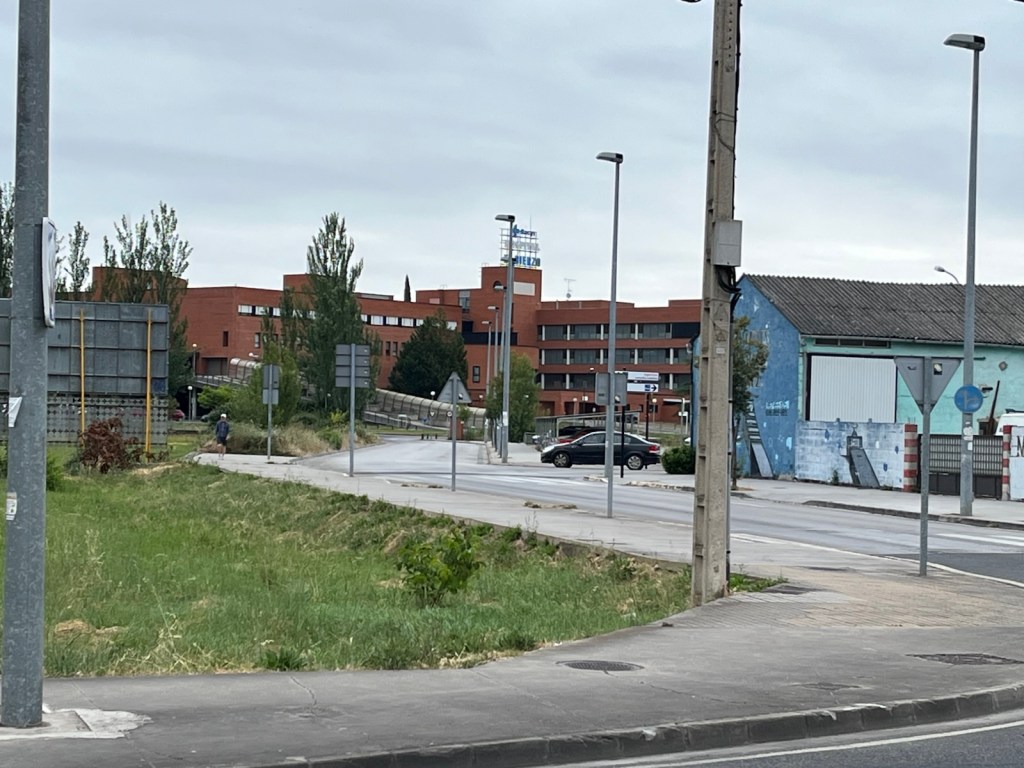
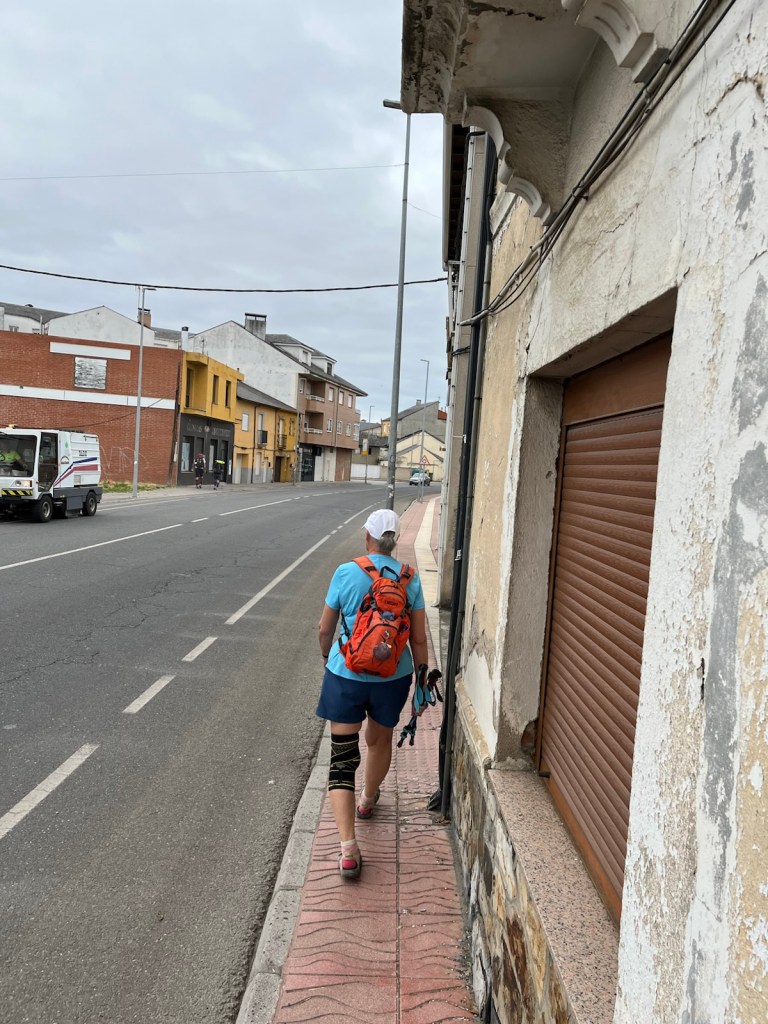
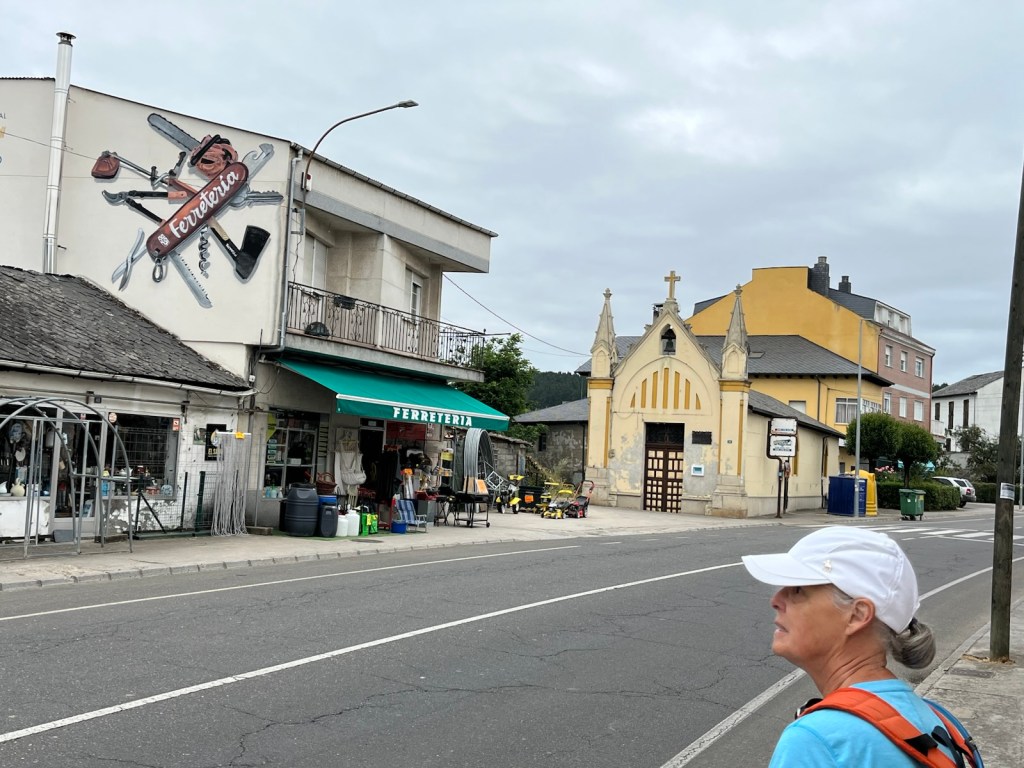
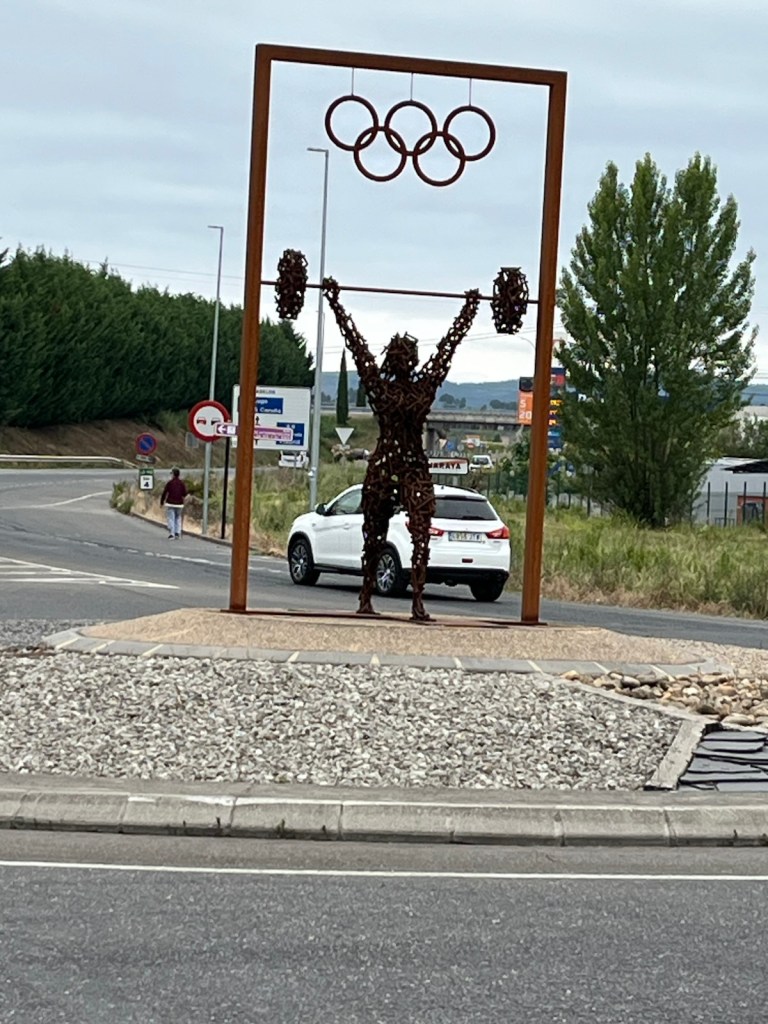
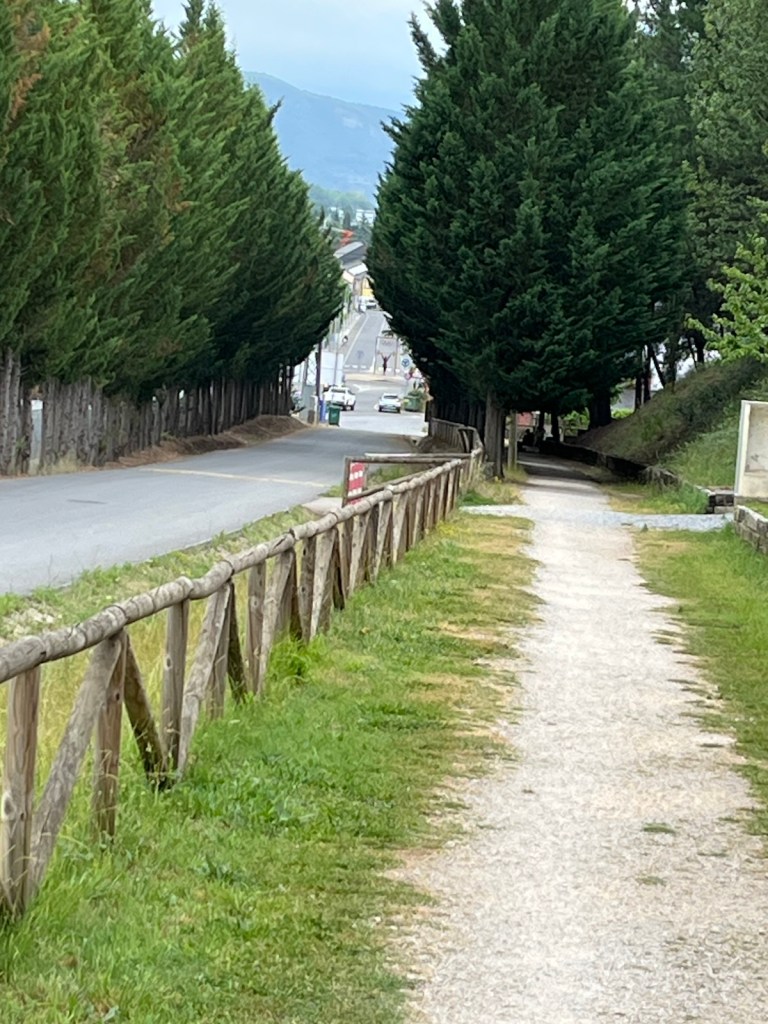
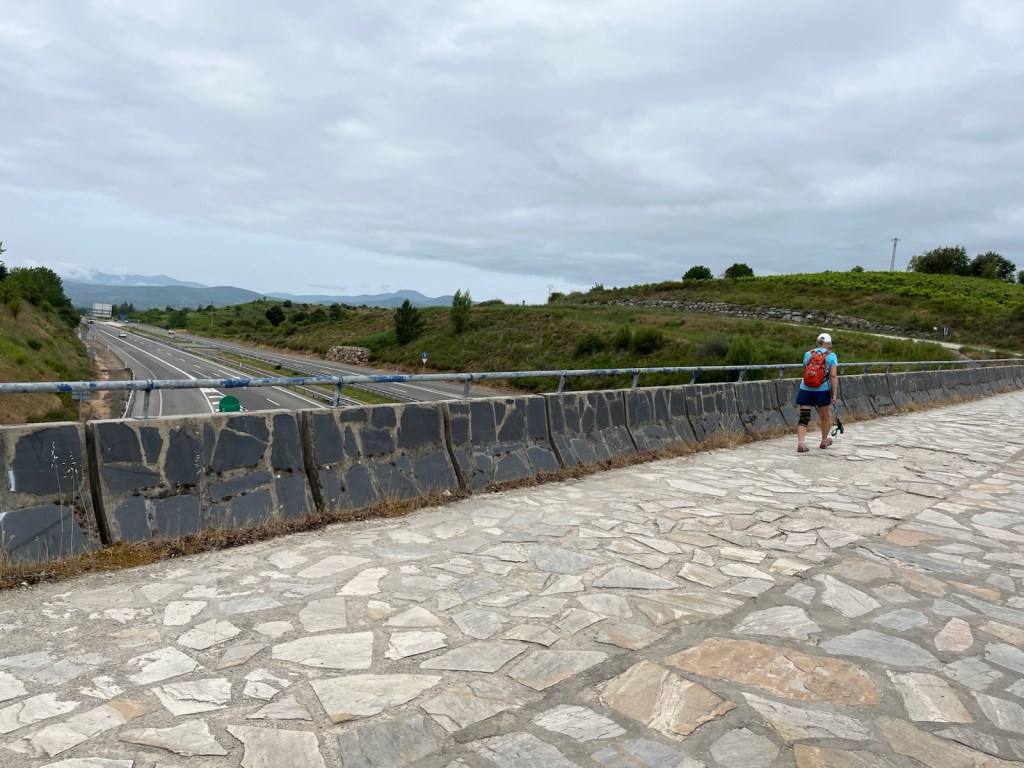
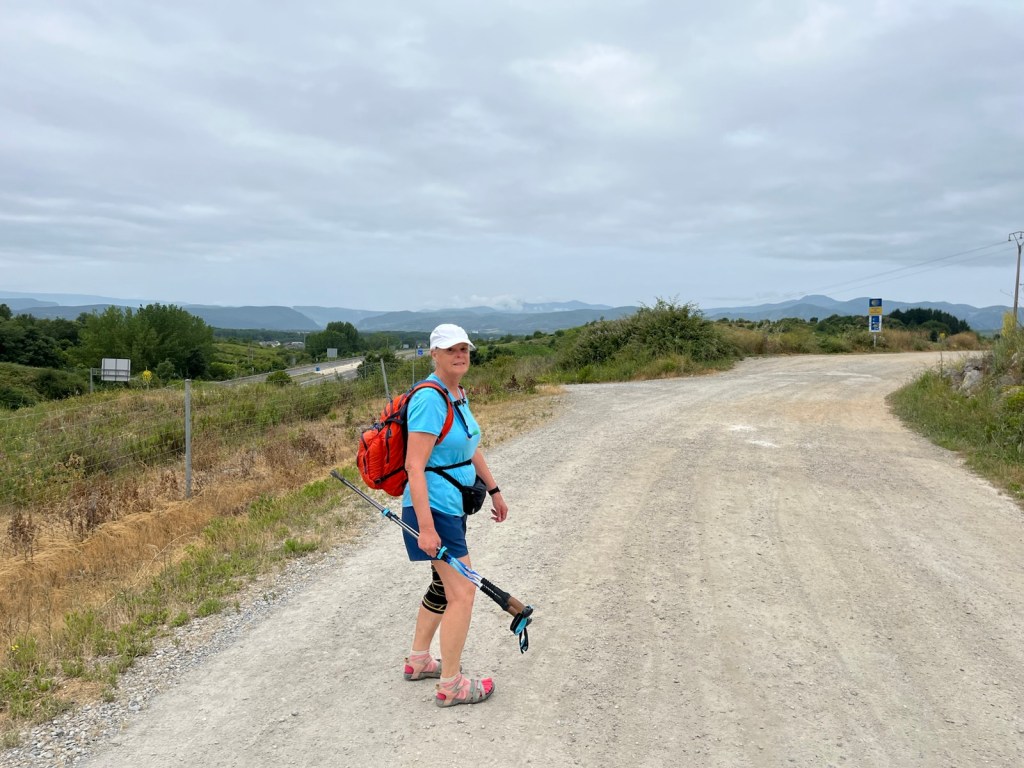
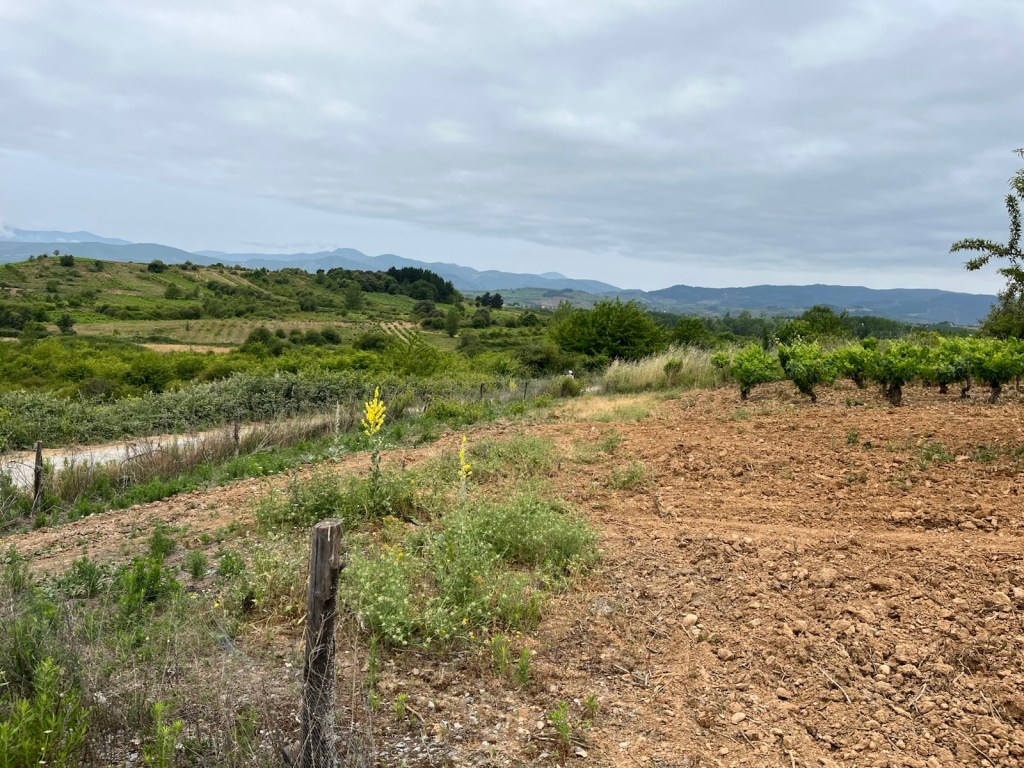
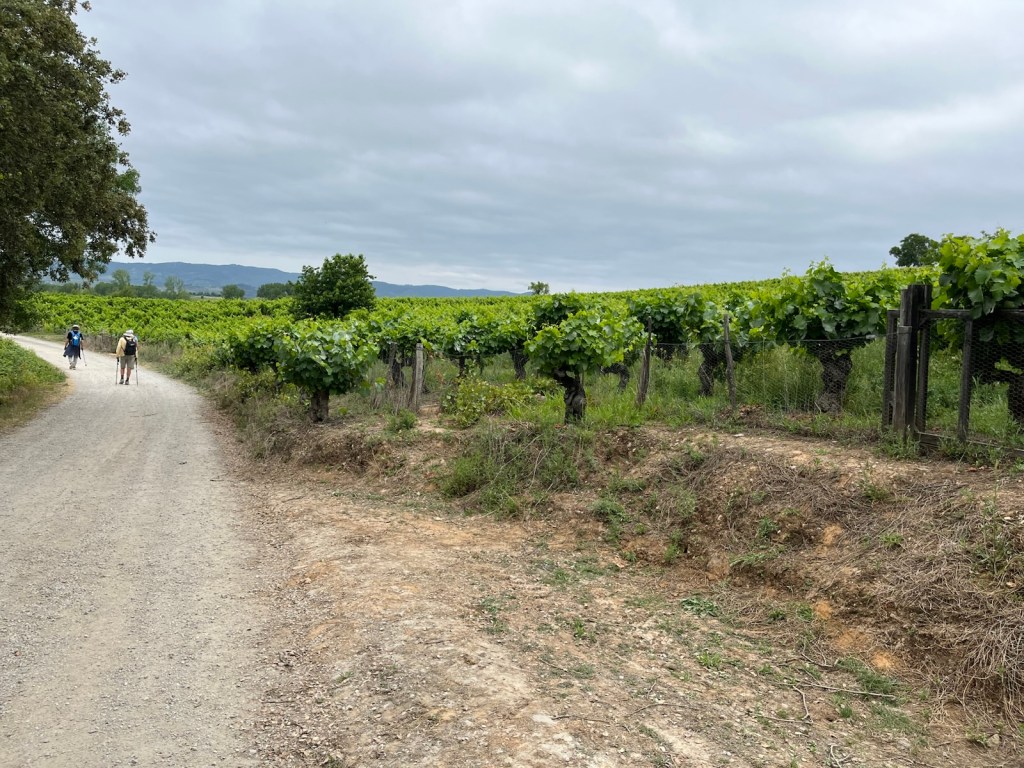
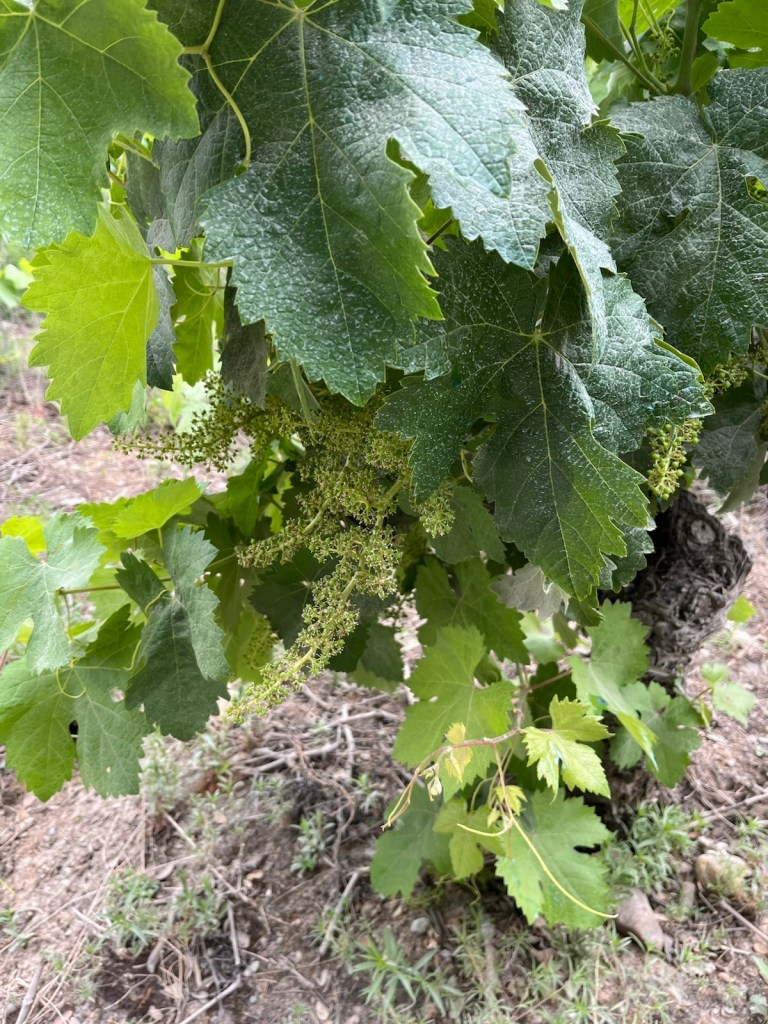
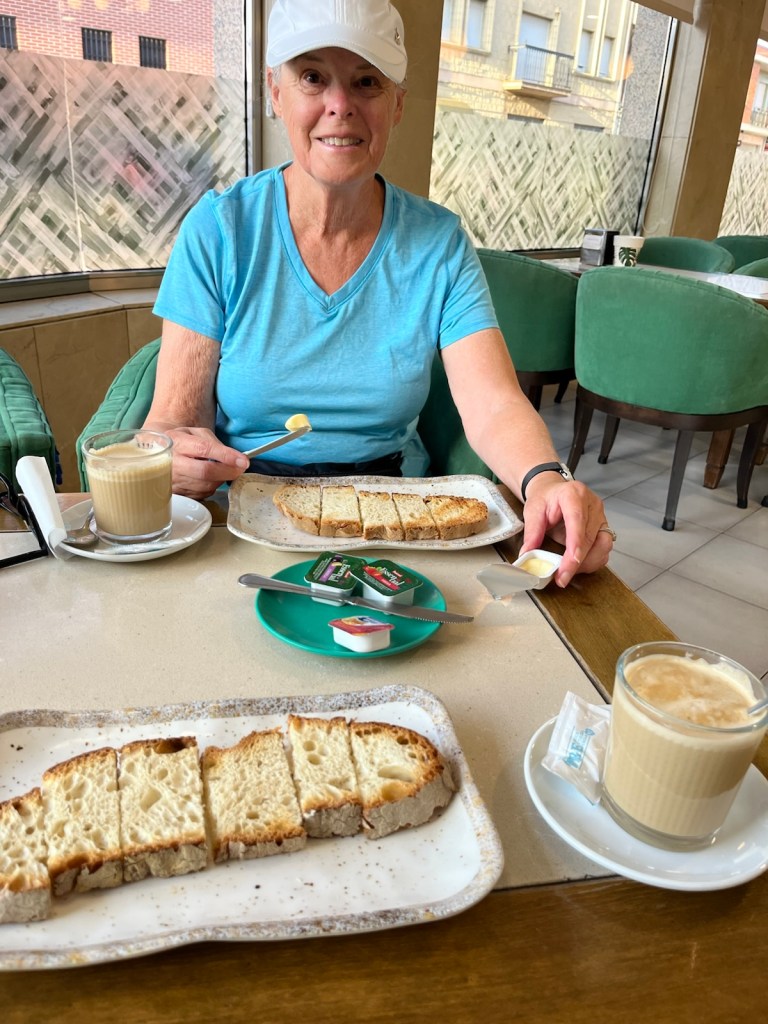
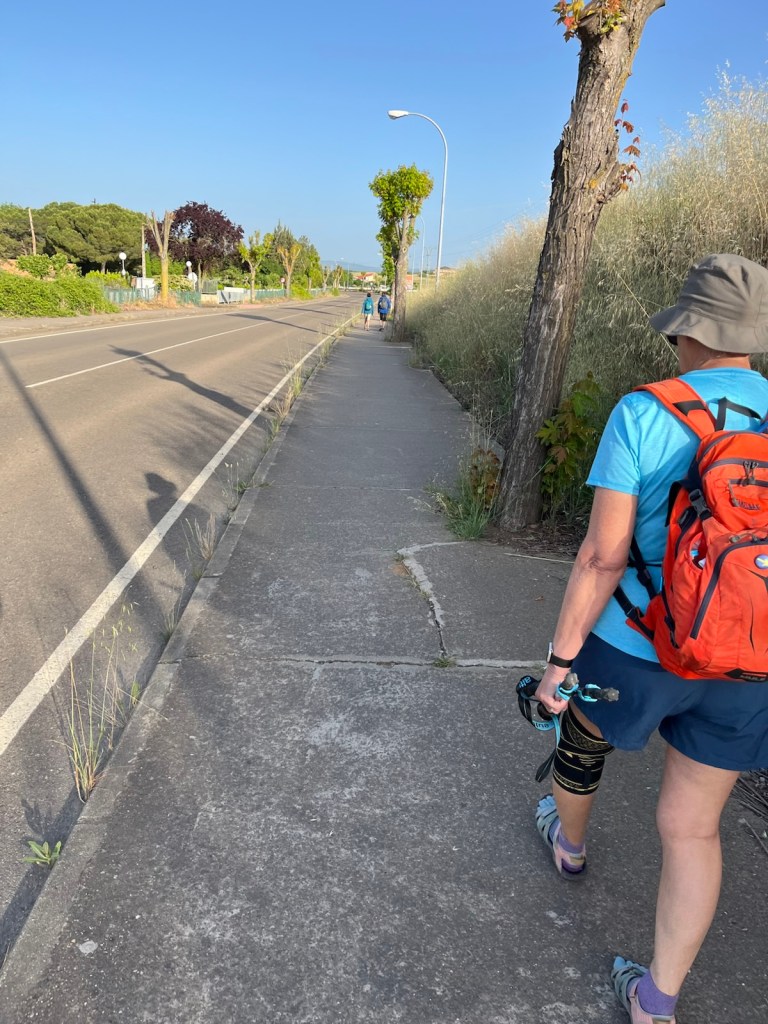
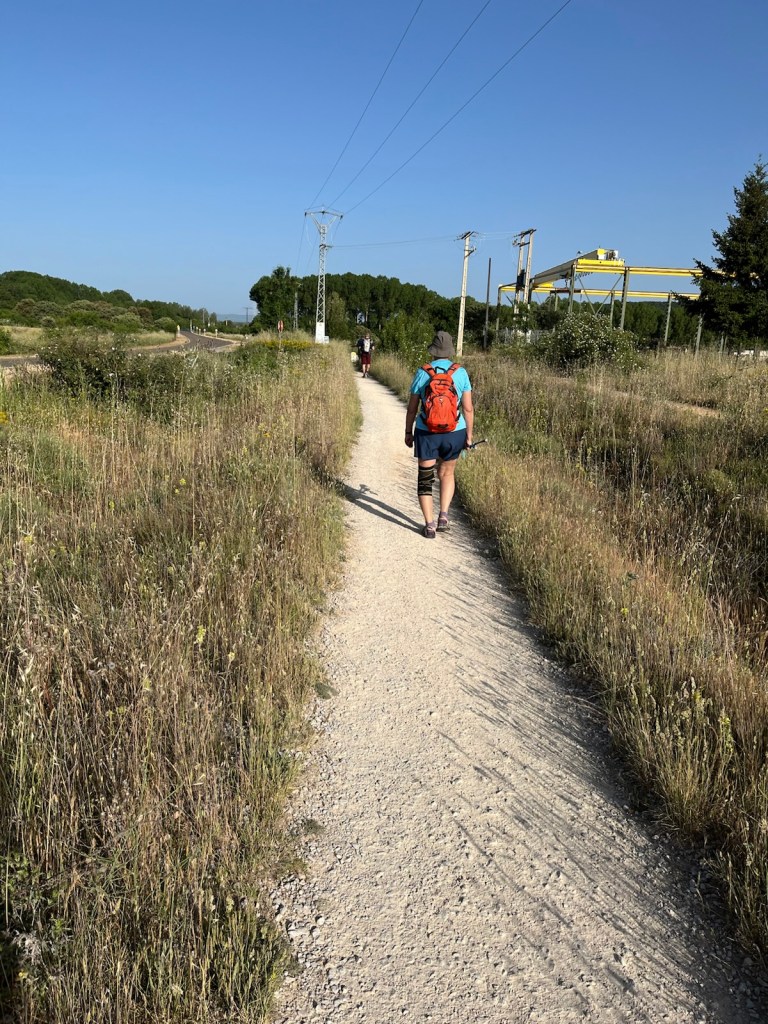
Our hotel was in the midst of an upscale residential area of Ponferrada, so we needed to walk a few blocks to join the Camino.The Camino has two routes through Ponferrada. We chose the one which is a straight line from our hotel to Camponaraya. The other route takes a less direct route north of the city, through a rather run-down area with little or no services and not very interesting scenery. We have chosen the more direct route since 2019 including today.Upscale houses and modern office buildings and residences.Less modern housing and buildings as we walked away from the city center.We stopped after two miles for breakfast.A nice breakfast for 6.40€.Sidewalks were not as nice as we got further from Ponferrada.An interesting front yard as we moved into the Bierzo region.A major hospital serving the Bierzo region.The sidewalks got kinda narrow as we walked into Companaraya.Jim’s favorite hardware store on the Camino with beautiful wall mural.Tribute to Lydia Valentin, Olympic Gold medal, Women’s Heavyweight Weightlifting, 2012 Summer Olympics, from Companaraya, Spain.Leaving Companaraya, looking back at Lydia Valintin statue.Crossing the Auto Via into Ponferrada and heading into the Bierzo region. Back on the dirt path of the Camino and heading into the vineyards.The vineyards of Bierzo, and the home of Mencía and Godello grapes.Healthy looking vineyards, with only tiny beginnings of grapes forming on very old plants.Grapes normally mature in August for harvesting.
The walk from Camponaraya to Cacabelos is normally a challenge in the summer heat. Today, however, was overcast and cool and we walked and talked with a group of Canadians (Montreal) and Cristina, from Estonia, which made the time pass much faster and the walk much easier.
We arrived in Cacabelos a half-hour before checkin. We waited in s nearby eatery and improved our hydration with OJ, Sangria and gazpacho.
After checkin, we had lunch in a familiar nearby restaurant and spent the rest of the day washing/drying clothes, blogging, reading and napping.
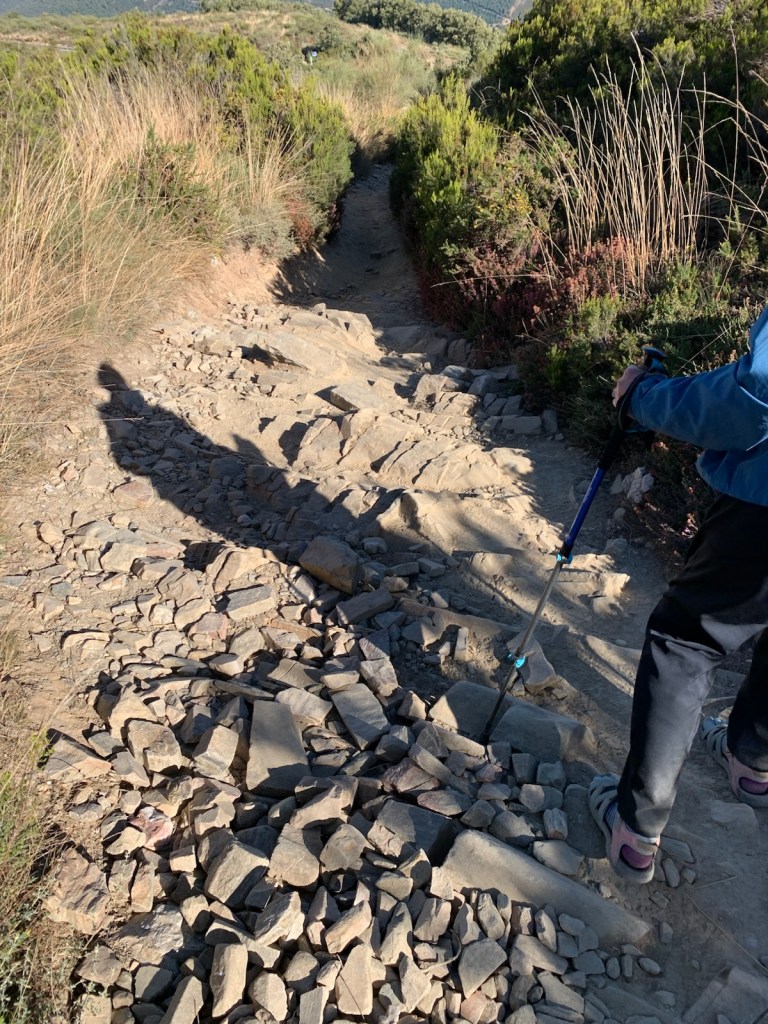
We decided to give ourselves a gift today by employing a taxi to help us skip the section between Foncebadón and Molinaseca. Although the scenery is extraordinary “top-of-the-world”, the potential for Camino ending injury trying to navigate the paths (actually washes) down into El Acebo, for us, far outweighs the reward. We confirmed this assessment when we walked this section last year, after skipping it for several previous Caminos.
Further, having walked from El Acebo to Molinaseca 3 times before deciding the risk/reward ratio on that section was too high… we have skipped it the last 4 Caminos, including today.
Typical of the walk into El Acebo in 2024.
So, we had breakfast at La Posada del Druida in Foncebadón first, then met the taxi at our door and made the very scenic ride down the mountain through El Acebo…
Riding in the taxi through El Acebo.
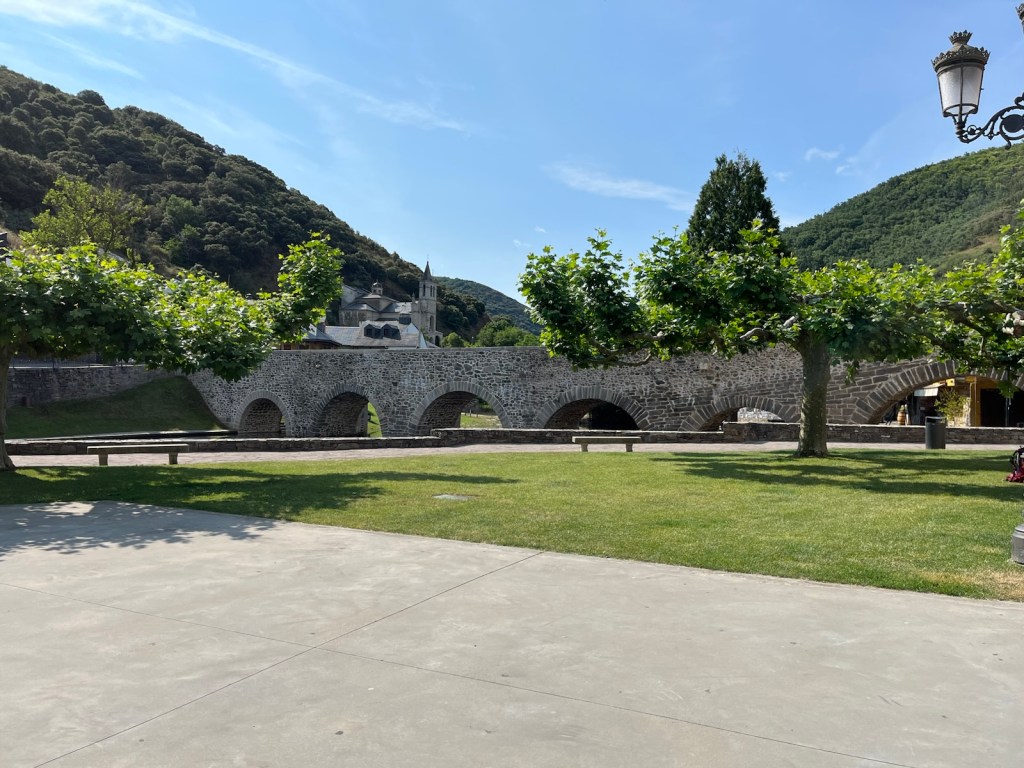
… then continued on to the Roman bridge going into Molinaseca, where the taxi driver let us out.
The Roman bridge into MolinasecaLinda just crossing the Roman bridge before our OJ and rest stop.
We walked across the bridge, stopped for an OJ, then began walking toward Ponferrada.
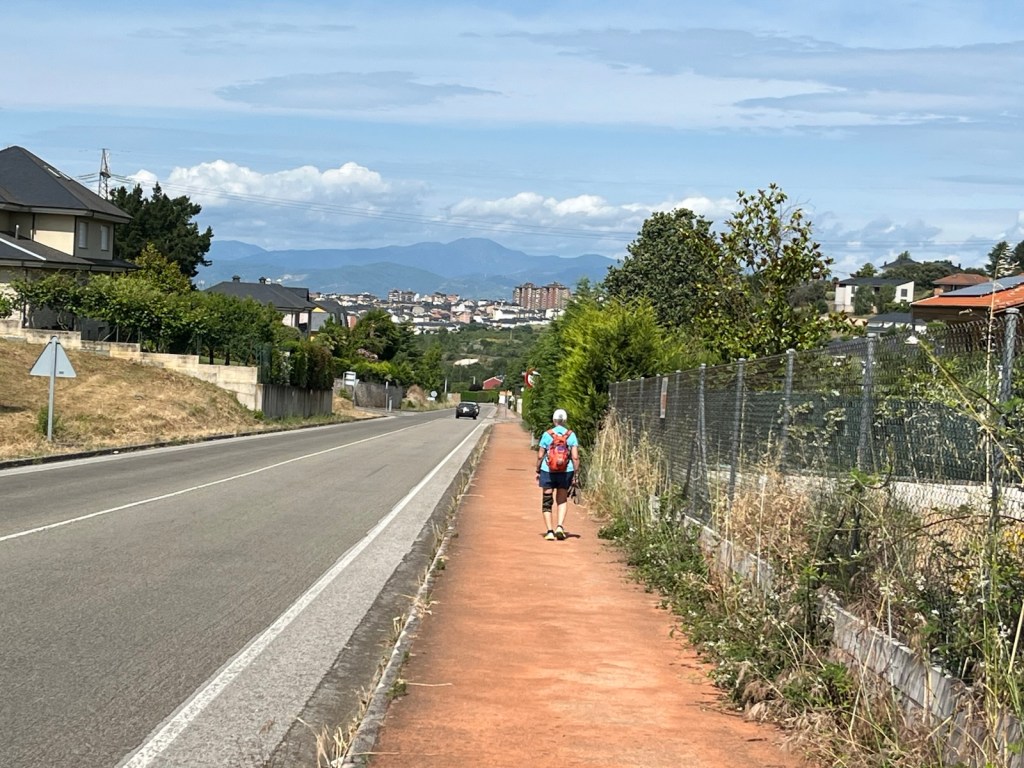
Walking through old town Molinaseca.On the way out of Molinaseca.Pretty flowers decorated many of the homes we walked by on the way out of modern day Molinaseca.The Camino path was a wide sidewalk from Molinaseca to Ponferrada. Here the path splits to the left to swing around into the countryside before finally entering the old section of Ponferrada. We chose to stay right and take the more direct route seeing more of the modern city before entering the old city near the Templar Castle.Ponferrada, straight ahead, is in a valley surrounded by high mountains, the ones we drove out of this morning and the ones that will surround us most of the way as we continue through the valleys and passes over the next few days.A nice section of walkway on our way into the old city
Ponferrada started off as a Celtic settlement, followed by a Roman mining town. The city was destroyed first by the Visigoths and then Muslim invaders. After the Reconquista, Bishop Osmundo of Astorga commissioned a pilgrim bridge here, which was unusually constructed with steel beams, giving the city its modern name. Ponferrada was a booming pilgrimage town, with diverse merchants including Franks and Jews, who were protected during a 15th-century restriction that called for segregating communities. The railroad came to the city in 1882 and in the 1940s the town grew with the coal industry.
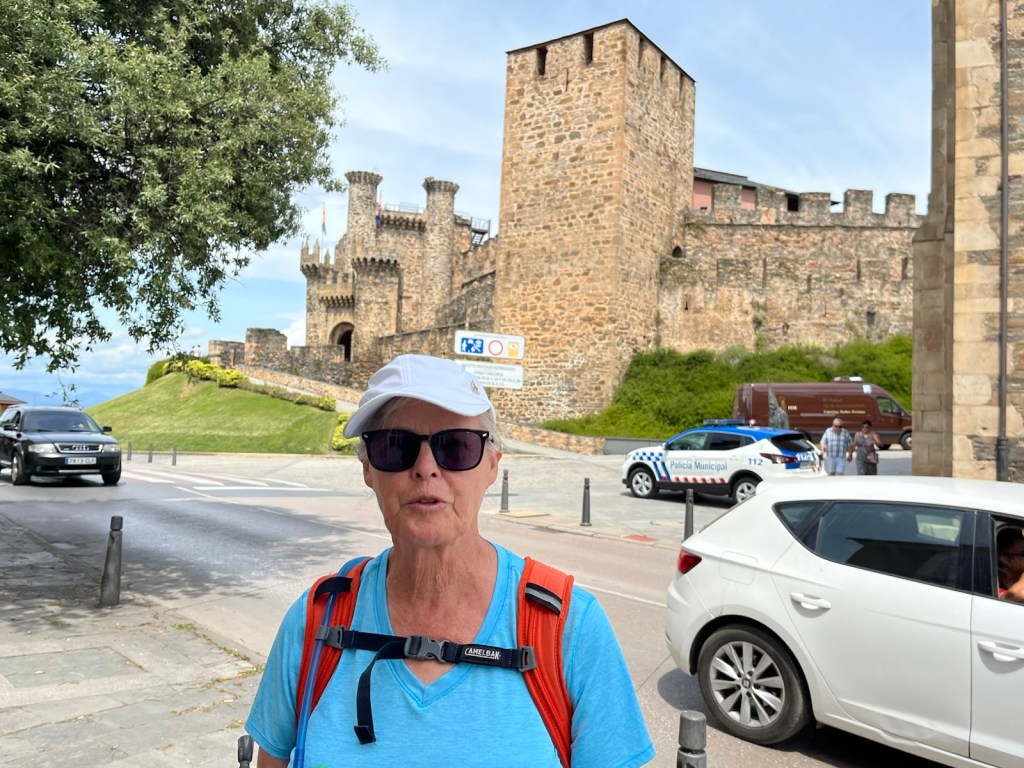
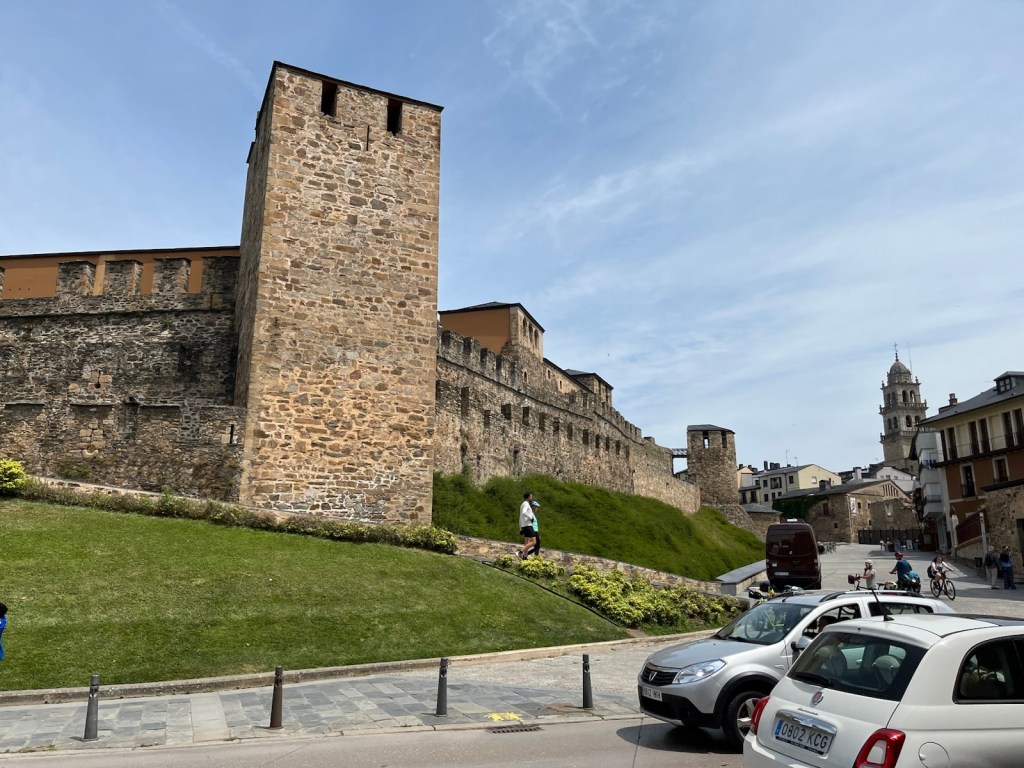
The Templar Castle
The Templar Castle was built in the 13th century over a destroyed Visigoth fort, which was built over a Roman fort, which was built over a pre-Roman castro. Soon after its completion, the Templars were banished.
Looking back into the old city with Iglesía de Santa María de la Encina with the steeple to the right of the castle.
We didn’t spend any time at the old city or the castle, having visited many times before today. We continued on into the modern city looking for a place to have lunch before walking on to our hotel for the evening.
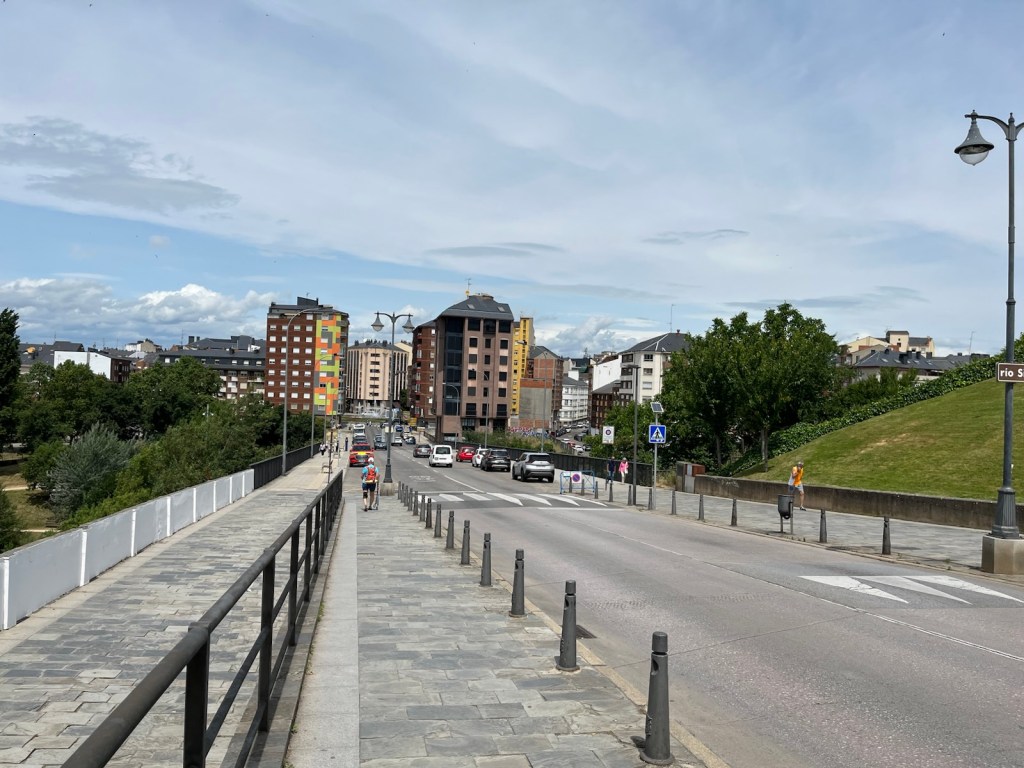
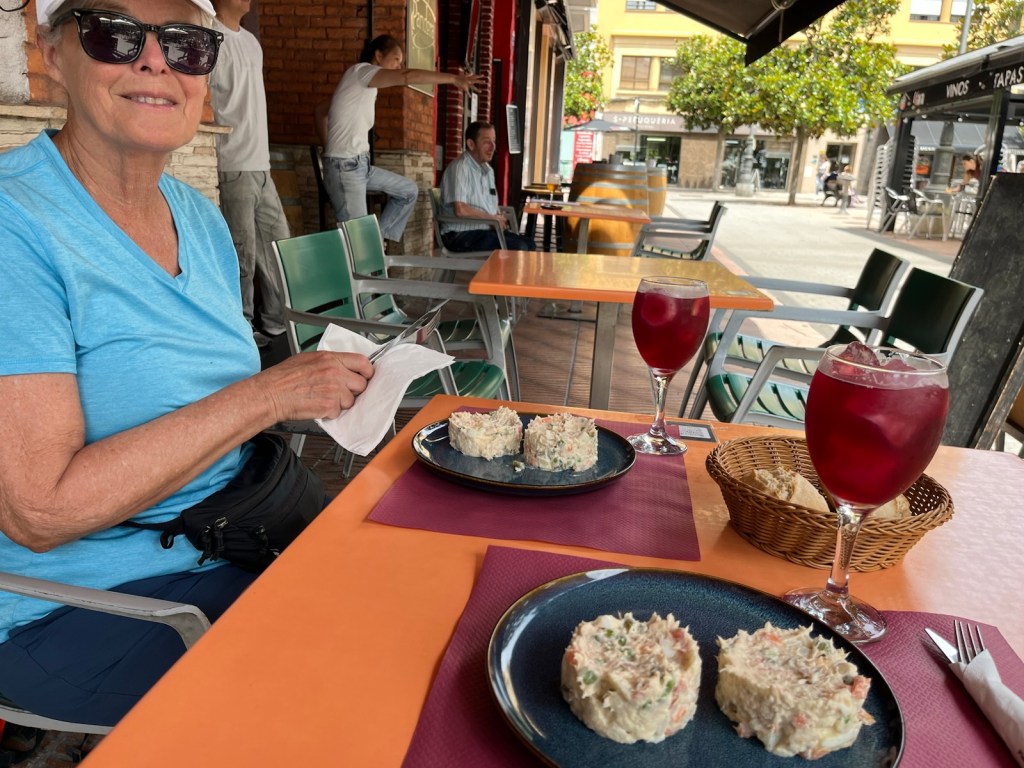
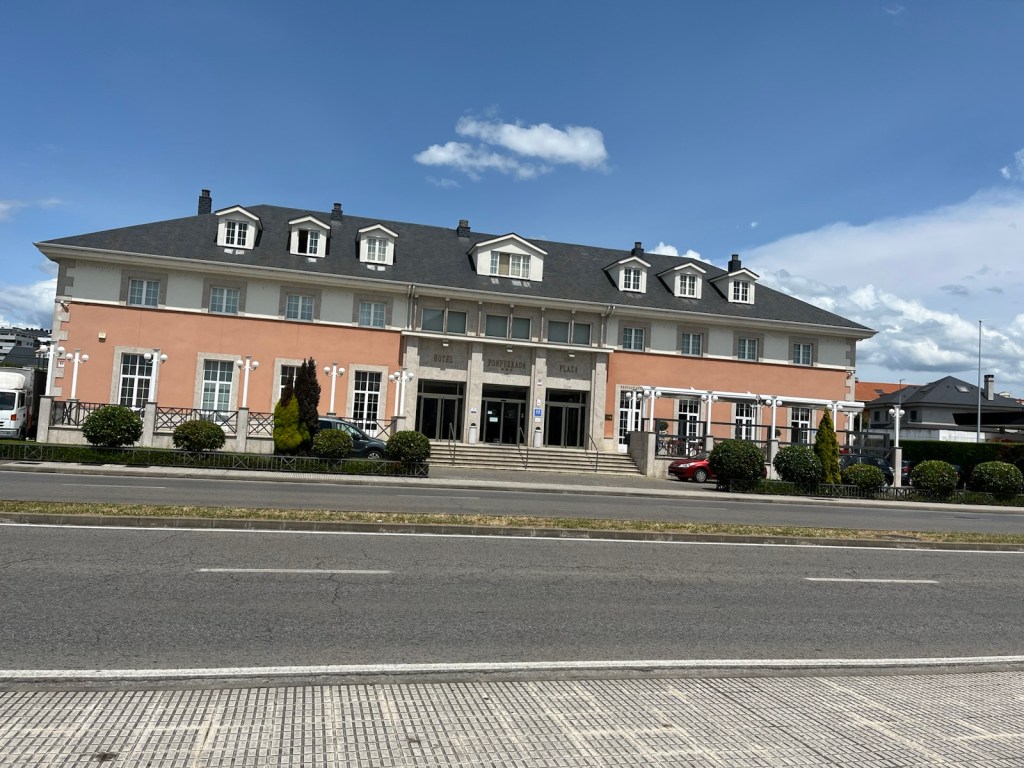
Walking across one of several bridges that cross the Rio Sil that runs through the city.We found a local restaurant just off the Camino and had our main meal, beginning with large glasses of sangria (for hydration, of course).After our late lunch we walked the final steps to Ponferrada Plaza Hotel, our home for the afternoon and night.
We paced ourselves today after a strenuous day yesterday and a longer than usual walk planned for tomorrow. The first half of our walk is through the city and suburbs of Ponferrada with the second half through vineyards and countryside. We’re looking forward to it!
The Pilgrim Stone B&B is a “vegan” B&B so rather than walk before breakfast we had a Vegan B before beginning our walk.
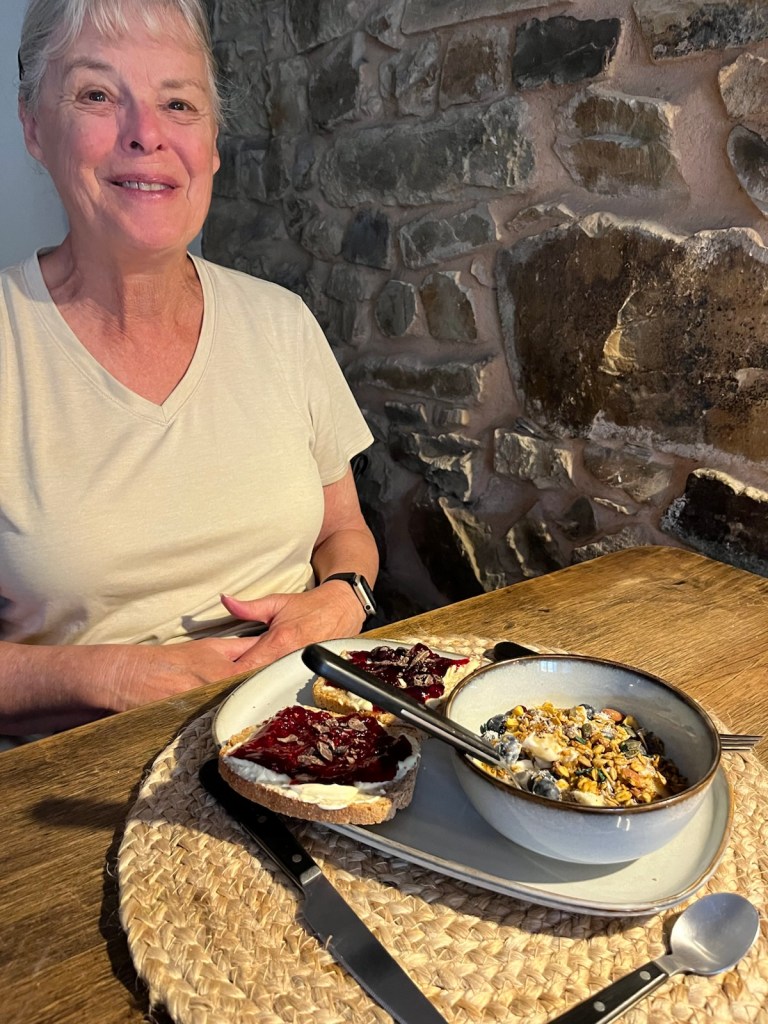
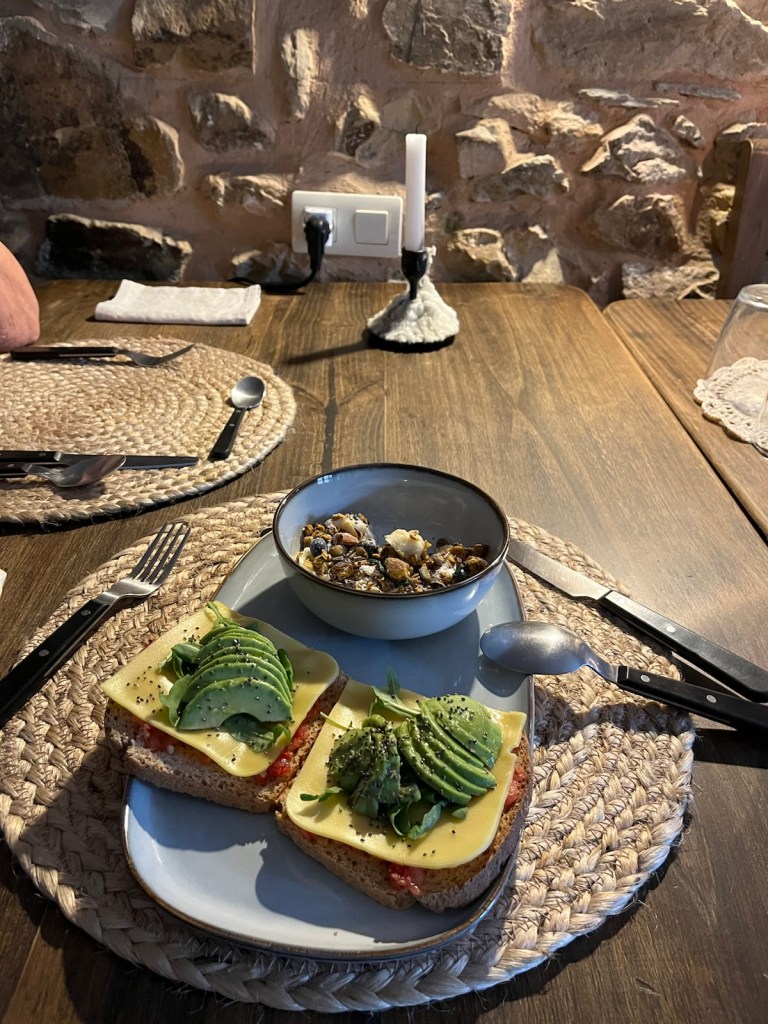
Linda had a homemade granola with greek yogurt and toast with a light cream spread, topped with black cherry jam and our usual cafe con leche.Jim also had the yogurt and granola mixture also but his toast had s thin layer of crushed tomatoes and oliver oil, covered with a slice of cheese and sliced avocado on top.
It was our first vegan breakfast, we think, and we were pleasantly surprised. Jim may go for the tomatoes with toast at a future breakfast instead of the usual mantequilla and marmalade combination… or not.
The mosaic of stone and brick streets of Rabanal became the familiar dirt path as we left the village (pop.74)Some really fine looking cattle wished us buen Camino as we headed up the mountain from our elevation of 3770 ft.The walk was not difficult at first with good footing and a gradual incline,The path got steeper and rockier Breaks in the trees gave us periodic looks at the scenery below and made us more aware of the ascent.More rocks and steeperThe higher altitude was revealed by the lack of trees and more frequent tundra and stone.One final push…… and Foncebadon finally appeared.Walking into Foncebadon (pop. 26), elevation 4690 ft.
We arrived in Foncebadon at 10:30, tired but not quite finished our walk.
We got a table in perhaps the best restaurant on the Camino, Albergue/Restaurant, El Trasgu. We stayed here in 2024 and savored the delicious dishes preparef by the owner/Italian cook/former pilgrim. We ordered and drank a tall glass of OJ while we rested and regained our strength.
Jim checked across the street at La Posada del Druida, also a nice property, where we will be staying tonight as Trasgu was sold out, when we made our reservations in February. Checkin was no sooner than 1:00.
Next we checked for when the cocina ( kitchen) was open today for meals and learned that today it would only be open from 1:00 -2:00!!!
We asked if we’d need a reservation and the owner said no, we would have a table.
So, at 11:00, we took on the final leg of today’s walk… to continue on to the Cruz de Ferro.
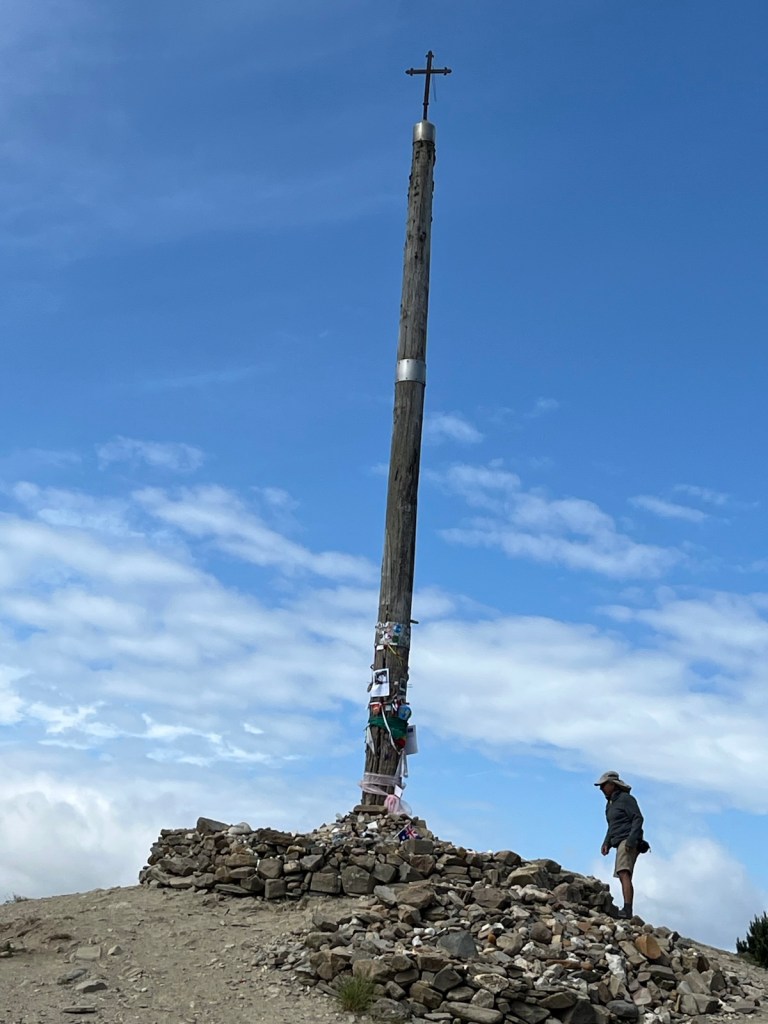
Cruz de Ferro occupies the highest point on the entire Camino Francés. The site consists of a tall wooden pole topped with an iron cross. This is said to be an ancient monument, first erected by the ancient Celts, then dedicated by the Romans to their god Mercury (protector of travelers) and later crowned by the cross and renamed as a Christian site by the 9th-century hermit Guacelmo. For centuries, pilgrims have brought a stone to the place (either from home or the flatlands below) to represent their burden. The stone and the burden are left here, leaving the pilgrim lighter (literally and figuratively) for the journey ahead. Today all sorts of symbolic items are left behind, and some stones bear written messages.
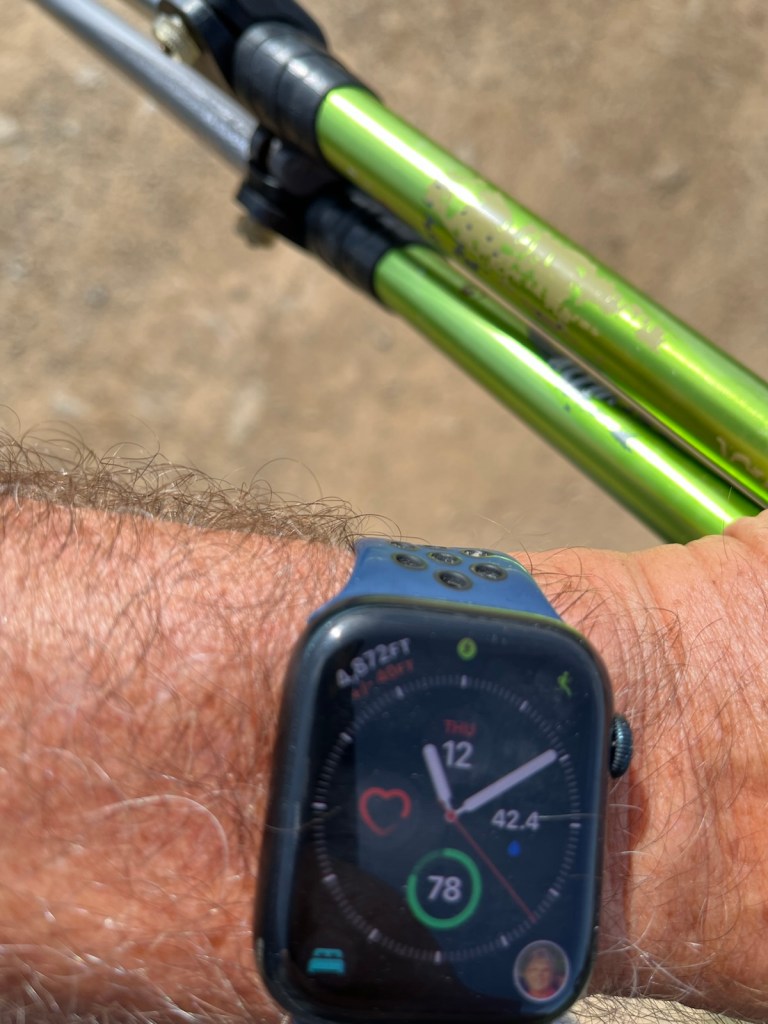
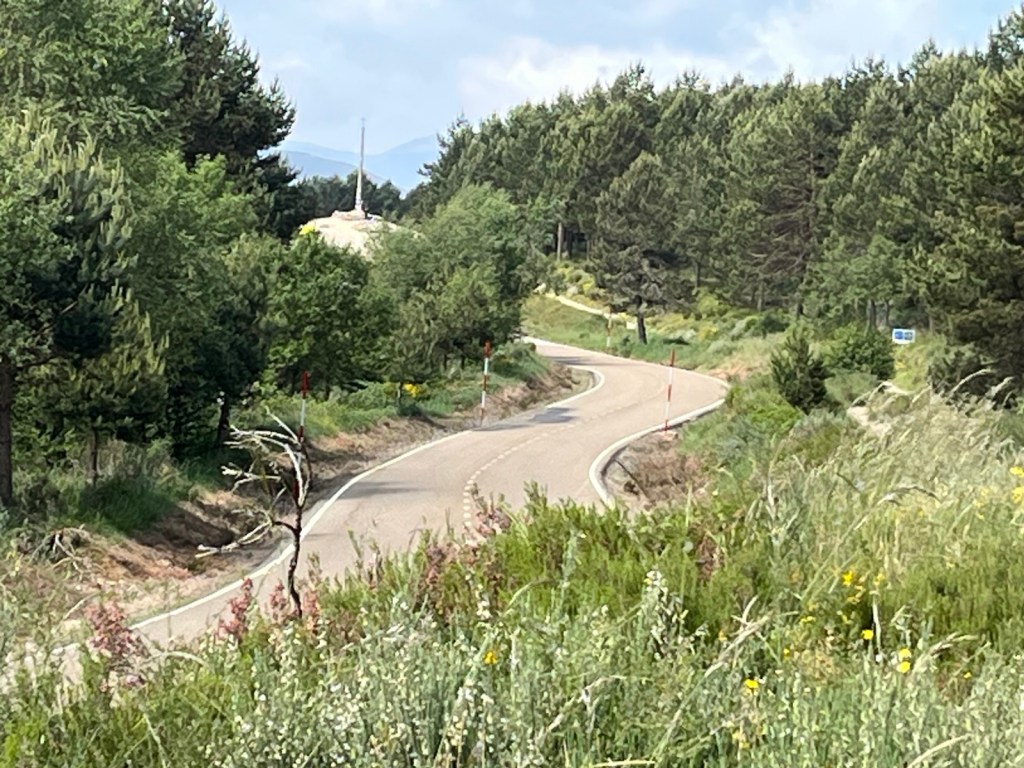
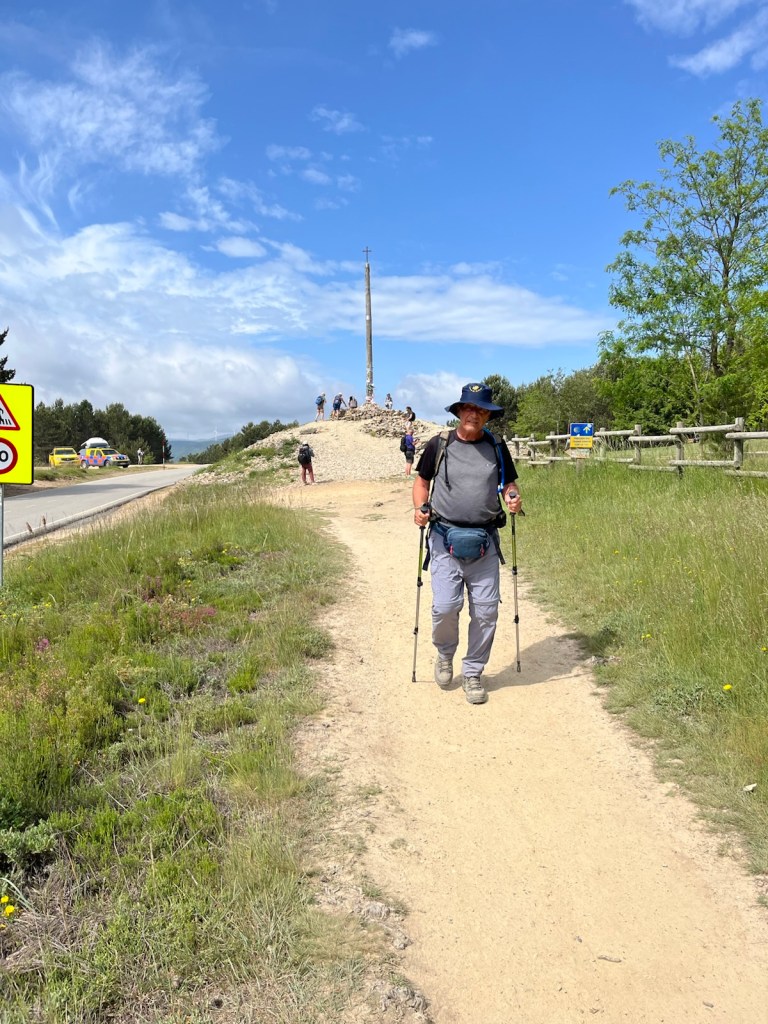
The paved road ends abruptly at the edge of the recently developed part of the village and reverts to the eroded dirt path.The steep path leading up the mountain can be seen as we passed the ruins of church.Looking back on Foncebadon as we continue up the mountain.…. still climbing…… near the high point.,.Jim checking elevation on watch : 4872 ftOur first view of the Cruz de Ferro.The Cruz de Ferro, elevation: 4934 ft.
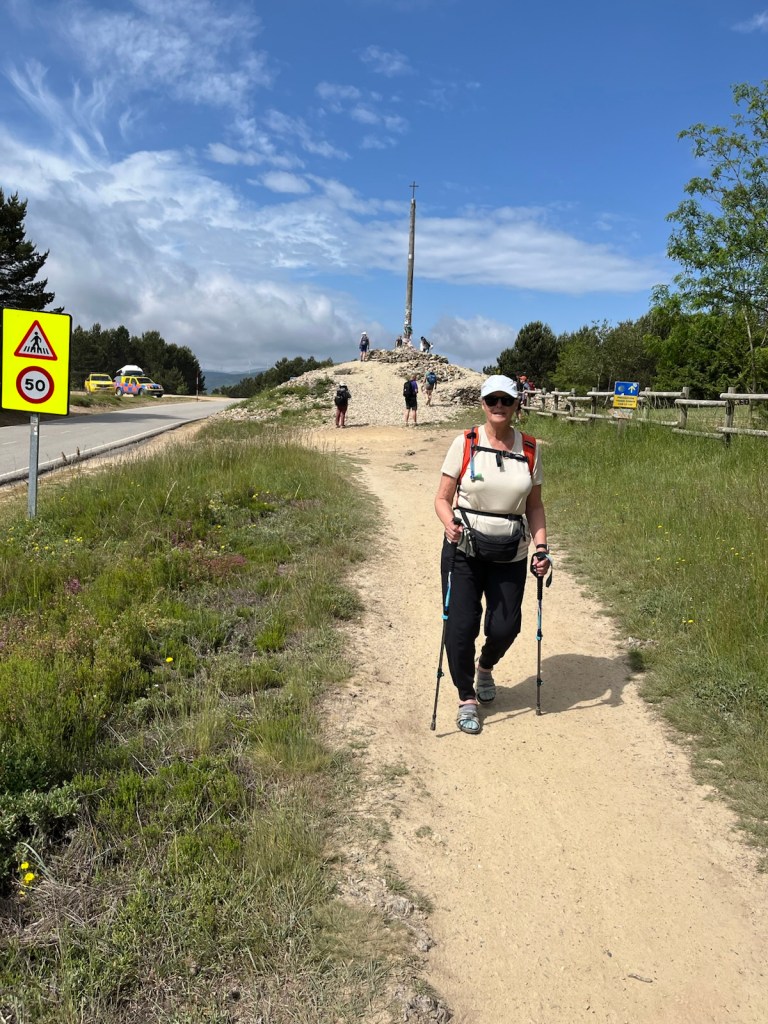
We arrived at the Cruz de Ferro (Iron Cross) after walking 1.4 miles from Foncebadon. After taking a few photos for ourselves and a nice couple from Norway walking their first Camino, we began the walk back down to Foncebadon.
Jim heading back to Foncebadon.Linda on the return to Foncebadon.
The walk back took about 30 minutes, getting us back to El Trasgu for lunch in plenty of time.
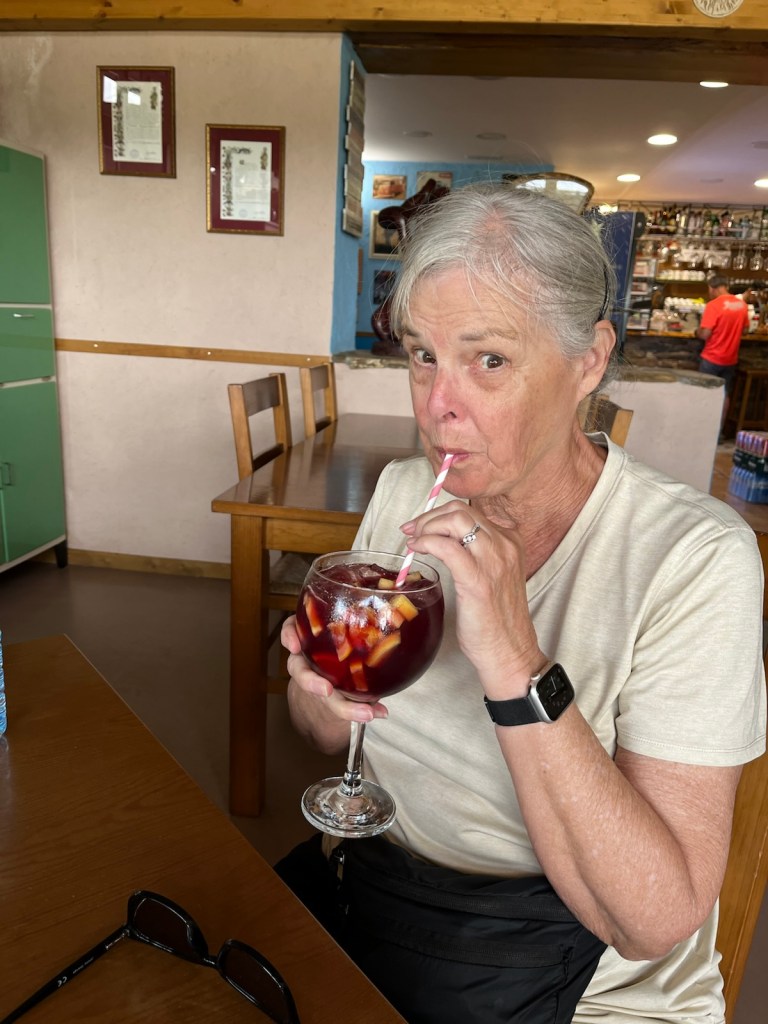
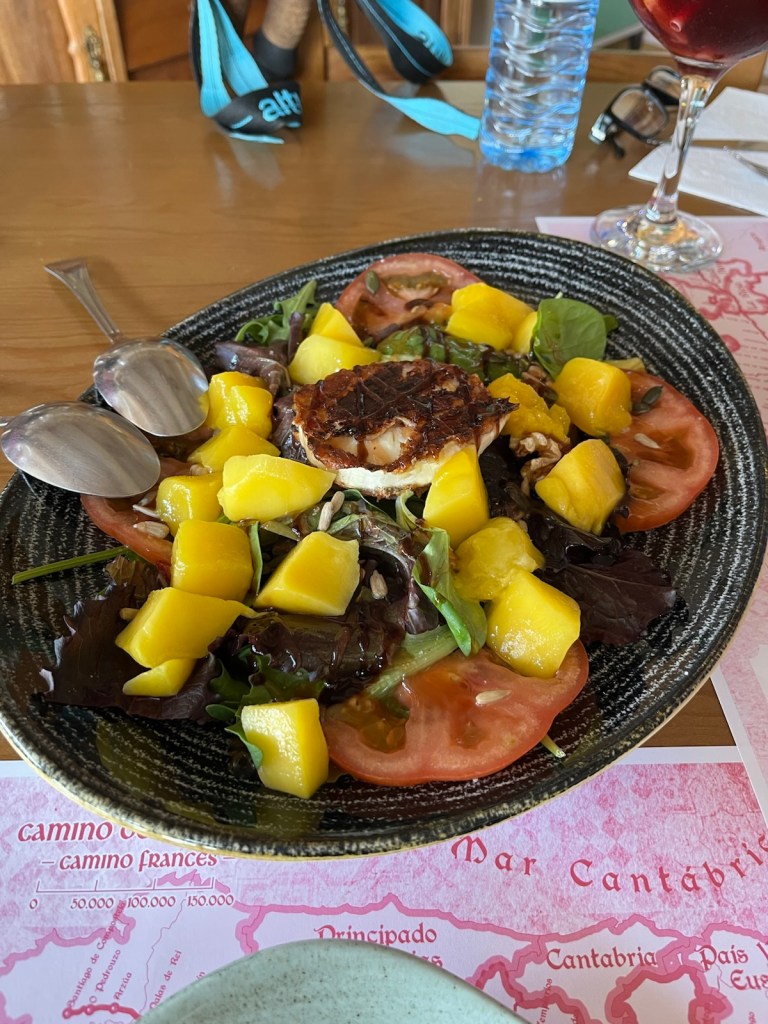
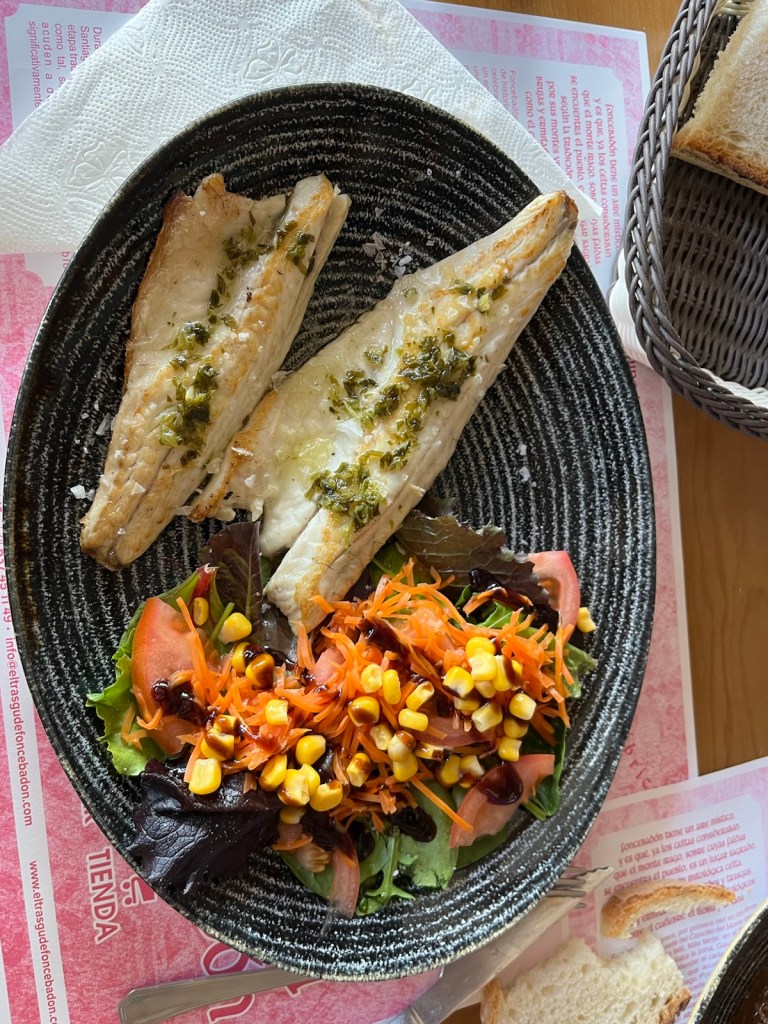
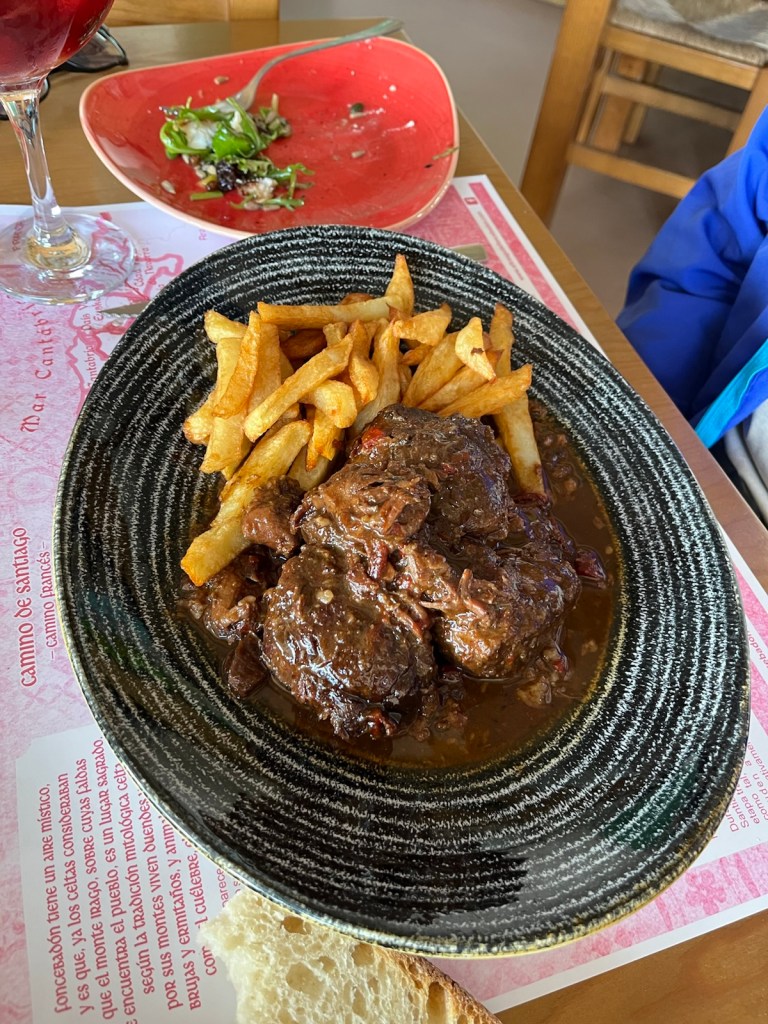
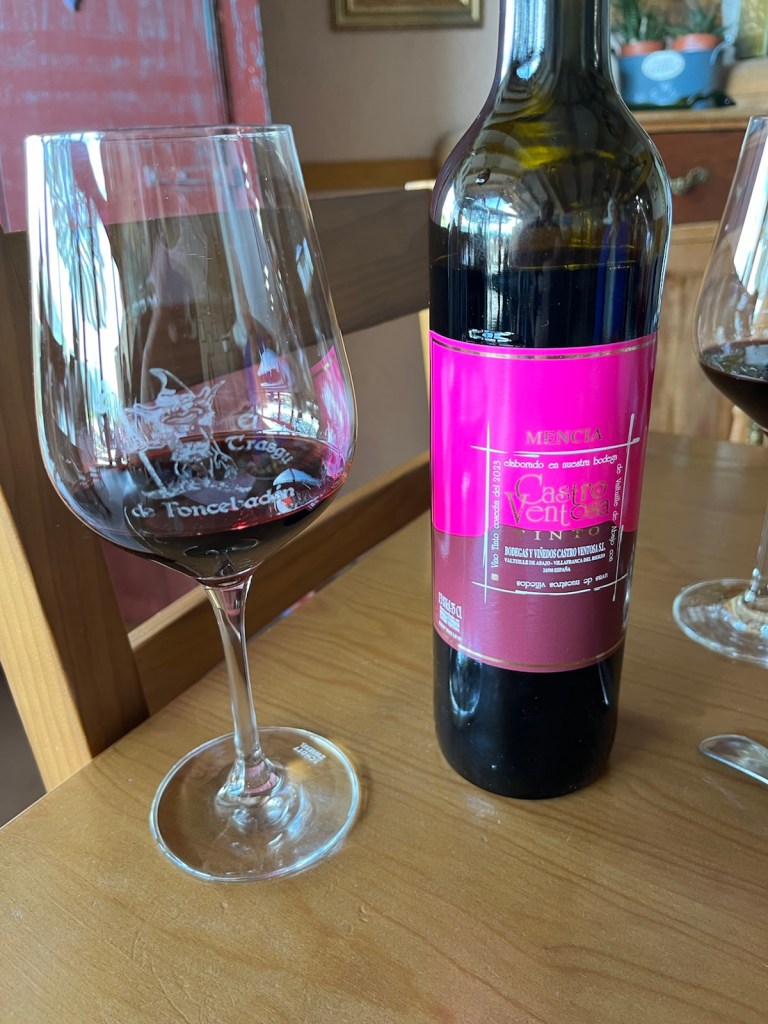
We rewarded ourselves for a tough walk today with a glass of sangria!We shared a delicious salad.We also shared a perfectly prepared (no bones) and savory sea bass fillet.And, we shared a melt-in-your-mouth slow cooked pork cheeks in a wine sauce,Our wine is a Mencía from a vineyard we will walk through a couple days from now. It paired perfectly with the salad, sea bass and the pork cheeks!
After lunch, we walked across the street to La Posada del Druida, checked in, and took the rest of the day off!!
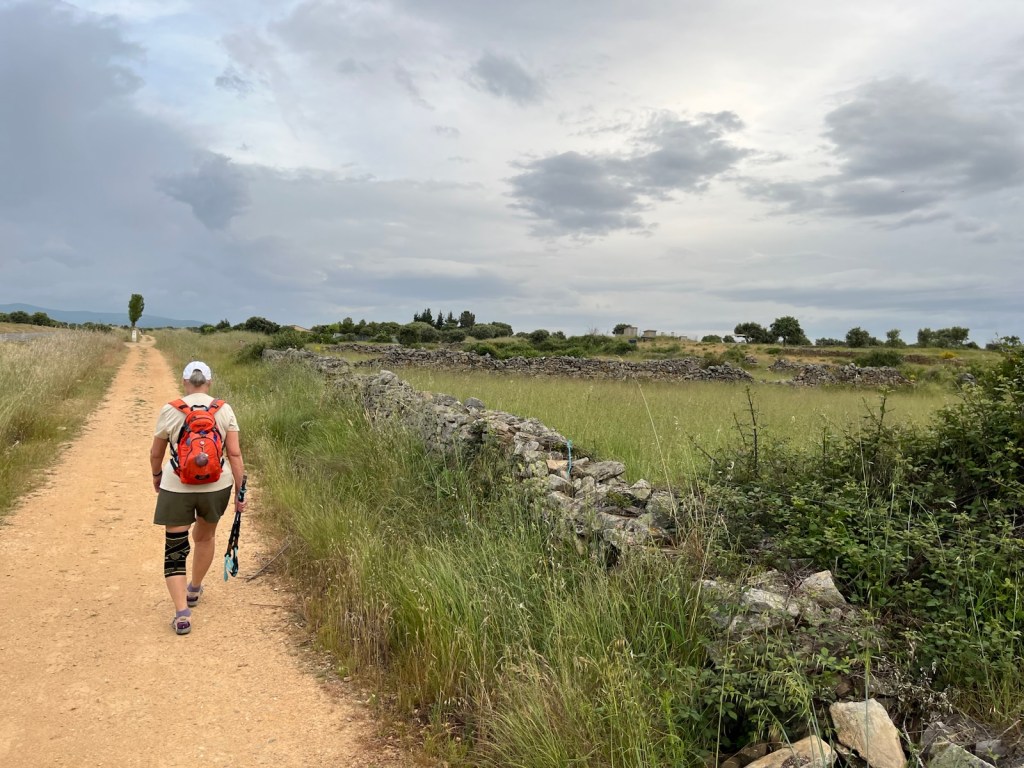
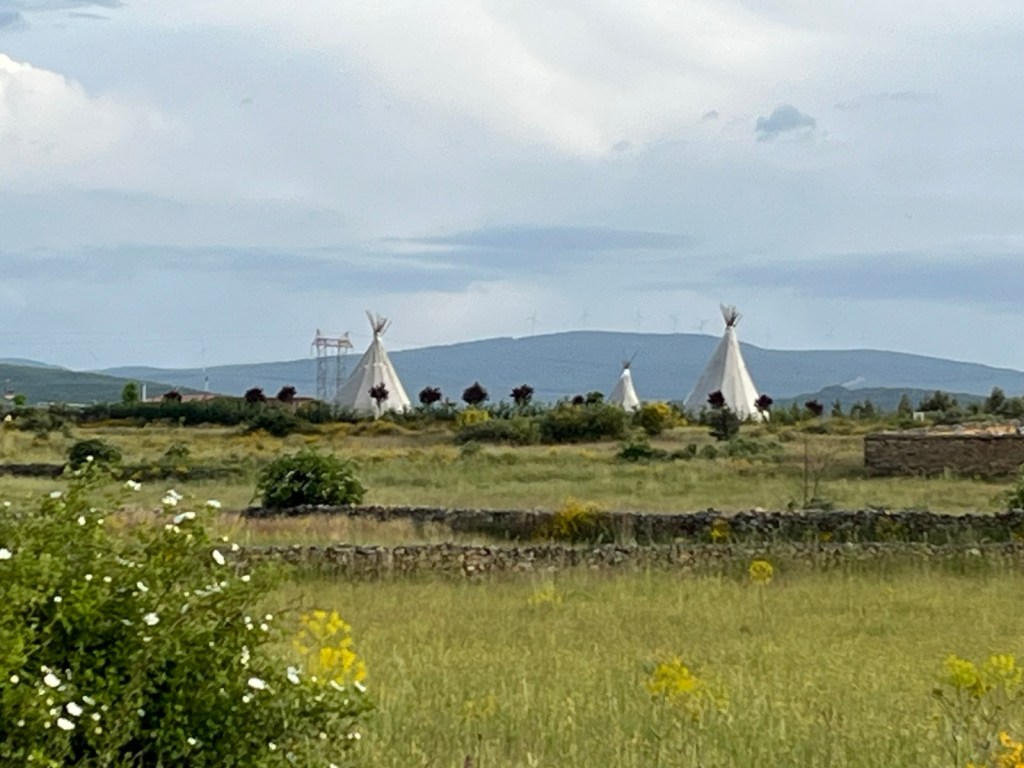
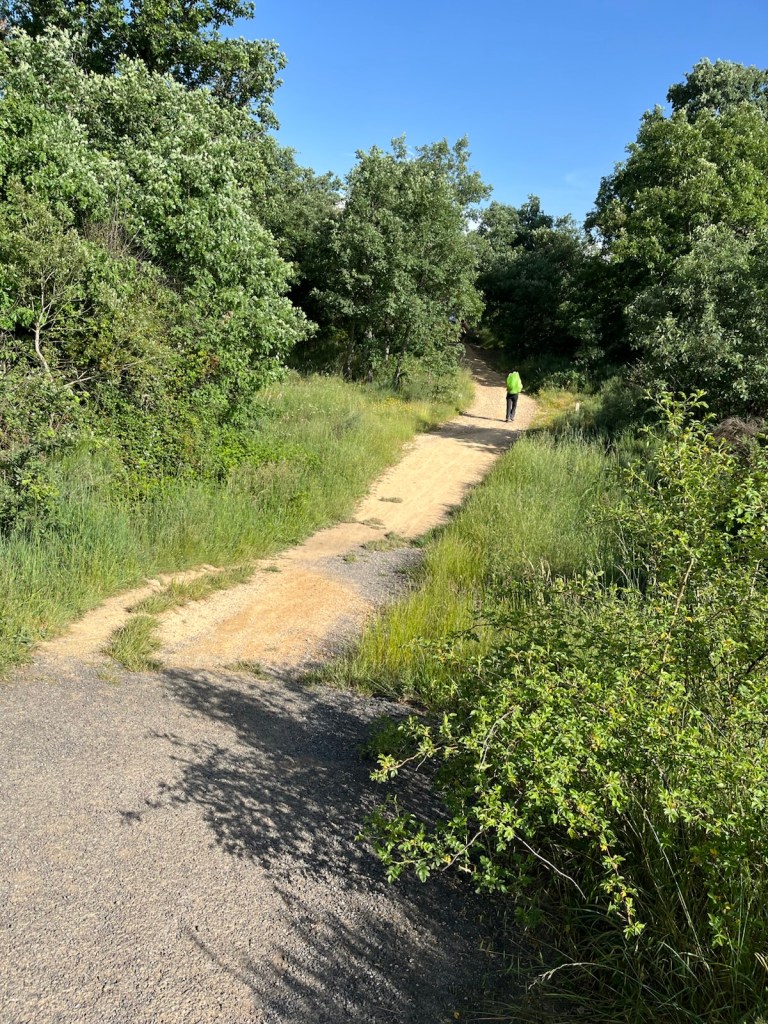
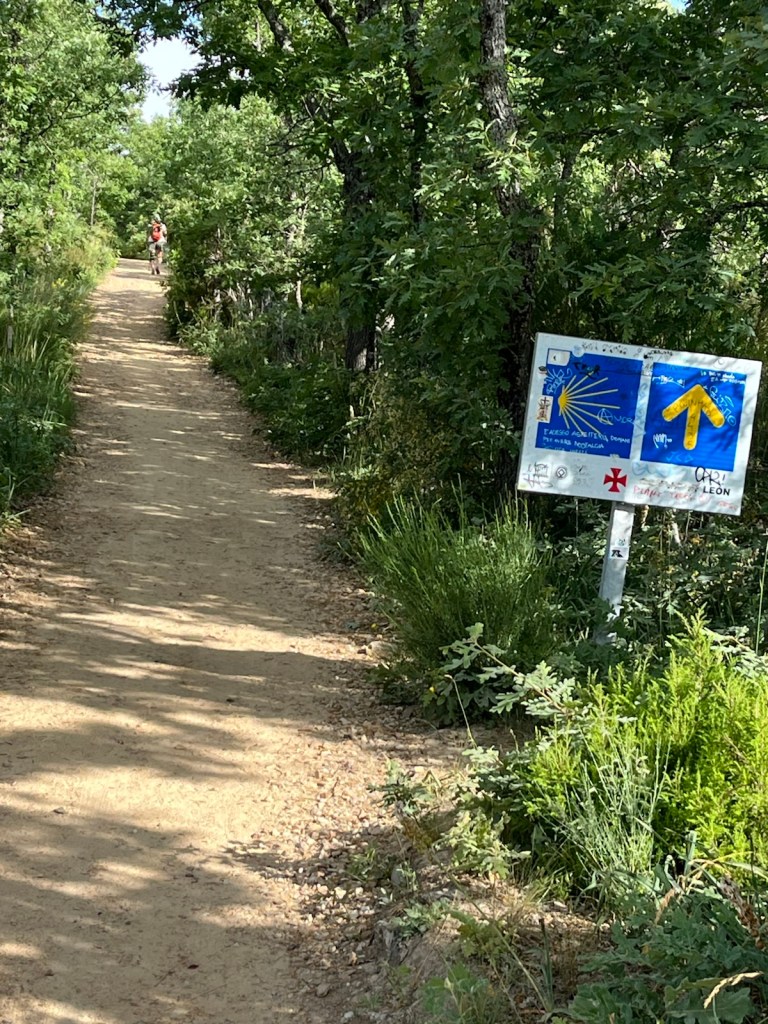
Daina prepared a breakfast for us (before the normal time) plus gave us several “to go” items to take with us. She then gave us a goodbye and “see you next year” hug and sent us on our way.As we left the village we also left the pavement and rejoined the dirt path.El Ganso, (pop.30) our first and only stop along today’s walk came at the 2+ mile mark. The Meson Cowboy albergue appeared to still be operational with its huge Teepee bungalows.The only sign of life in the village was the small shop that serves coffee & tea and other pilgrim essentials and offers restroom facilities. We bought a few items to add to the local economy and continued on.Leaving the main road as we left Ganso, we rejoined the dirt path.The walk looked pretty much the same most of the way to Rabanal.Still walking along the road.Rabanal in the distance and the road on our left, barely hidden by the brush.Finally a change of scenery as the path heads into the forest for a mile or so.We usually take the road at this point, but today, to gain a little shade, we stayed on the path until it returned to the roadside just outside of Rabanal.Rabanal is just around the corner.
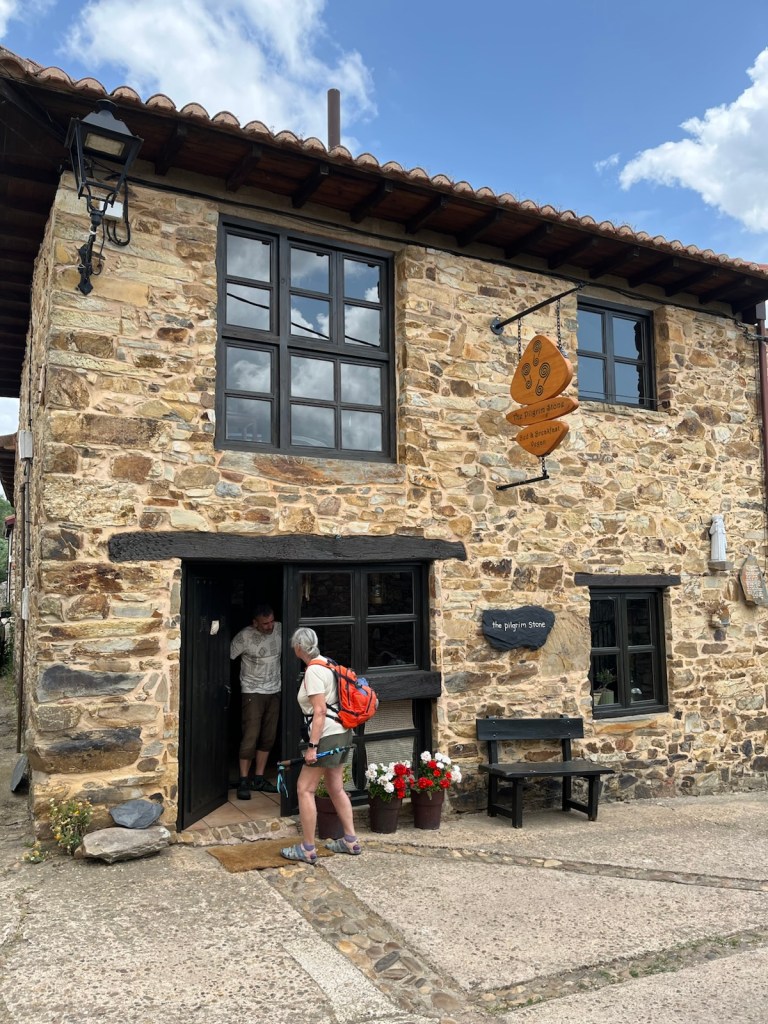
We arrived at 10:30, stopped by Pilgrim Stone and confirmed our checkin time of 1:00. With very limited options to fill the time, we walked to the end of the village, adding another 1/4 mile to our walk and perched outside a familiar hotel/restaurant until they opened their dining room for lunch.
We chatted with a young lady who was also waiting nearby. She was on an electric bike and was waiting for her partner to catch up. She was from Barcelona and said that her trip from SJPDP to Santiago by bike would only take 2 weeks!
We also chatted with a couple from Monterey, California. It was their first Camino, they both were 60 had just recently retired and had an open ended date for their return home after reaching Santiago. The conversation carried over into having lunch together and sharing Camino experiences. We said our goodbyes and will likely cross paths again between here and Santiago.
Linda entering the front door of our B&B accommodation for the night.Getting settled in our room at Pilgrim Stone B&B.
We checked in at 2:00 p.m. and spent a relaxing afternoon and evening.
The walk between Santa Catalina and Rabanal, especially in the summer, has typically been a grueling one for us. But today, partially because of the cooler weather, it seemed much easier for us than before. Go figure. Each day on the Camino is always different, to one degree or another for different reasons.
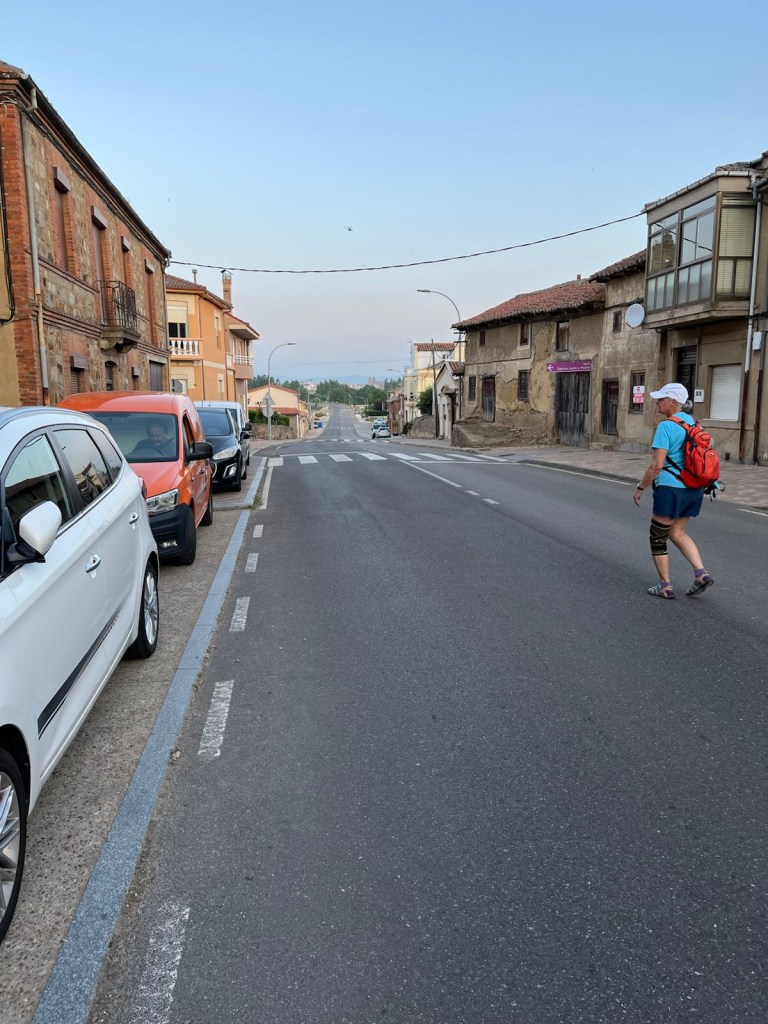
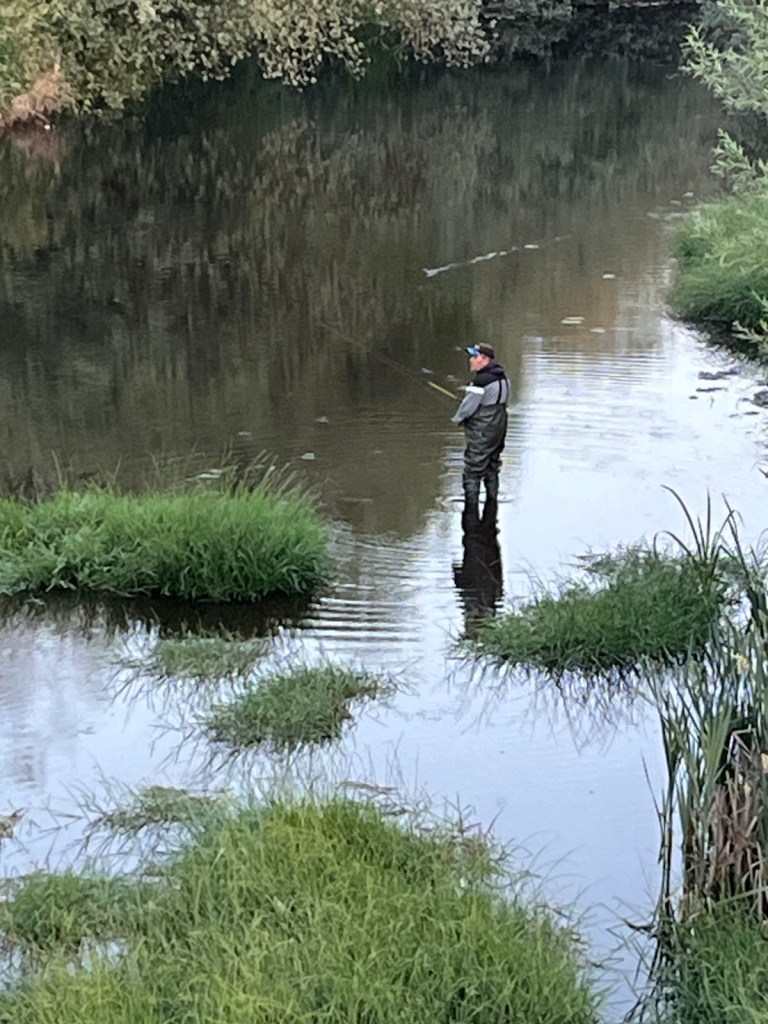
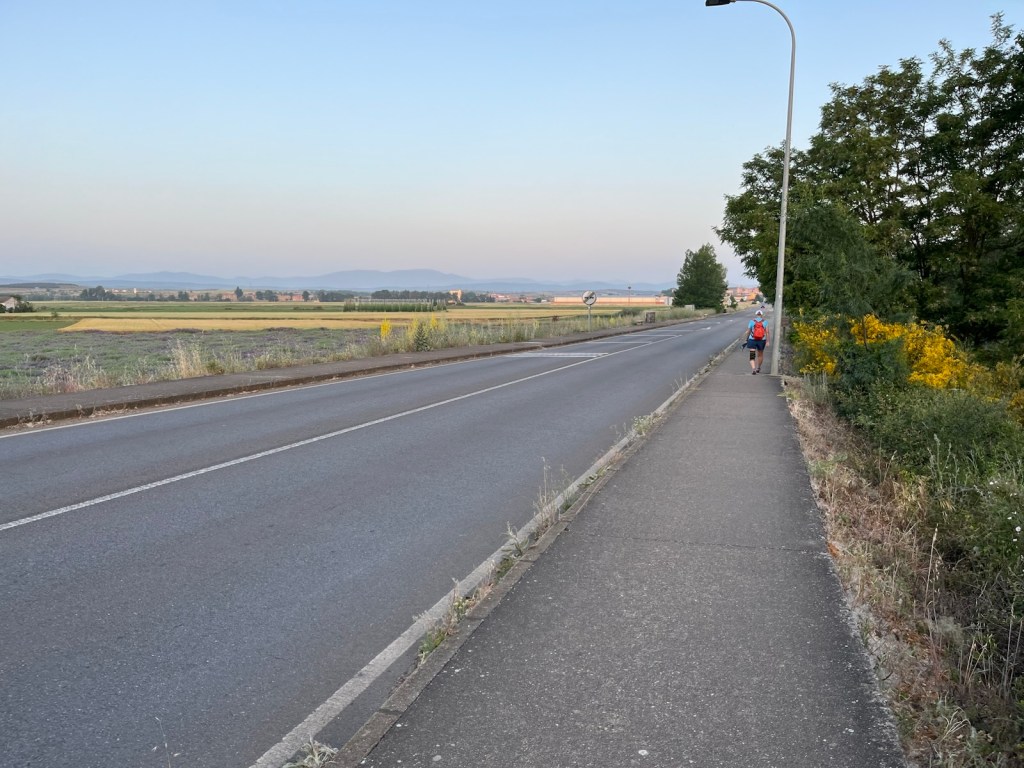
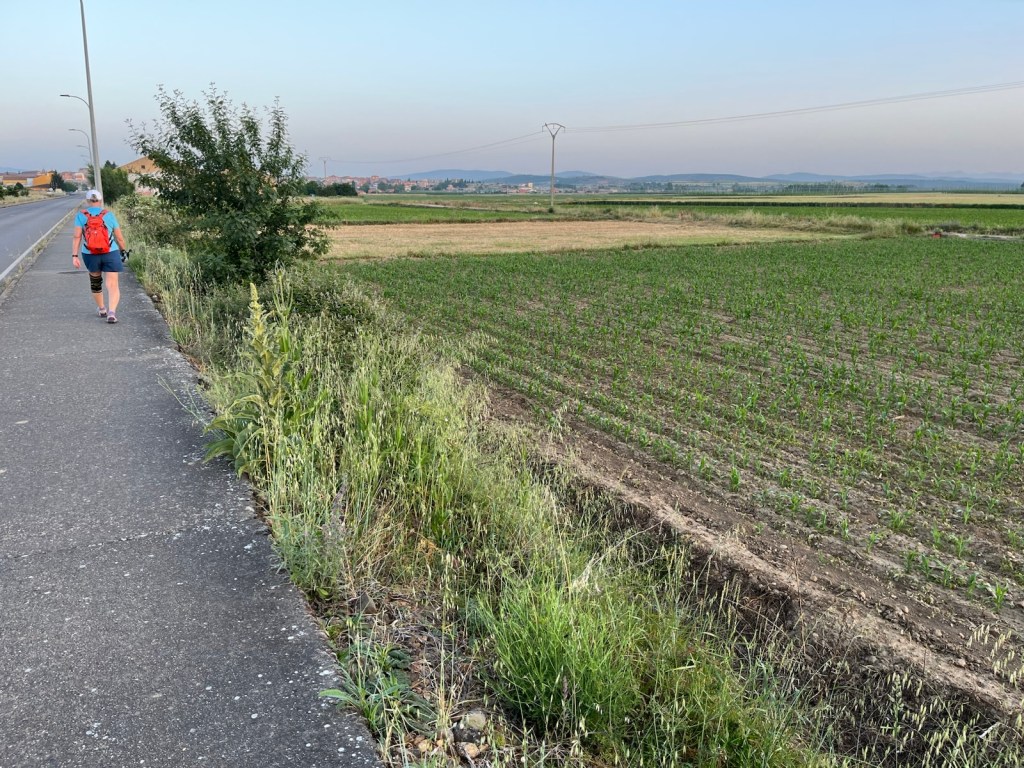
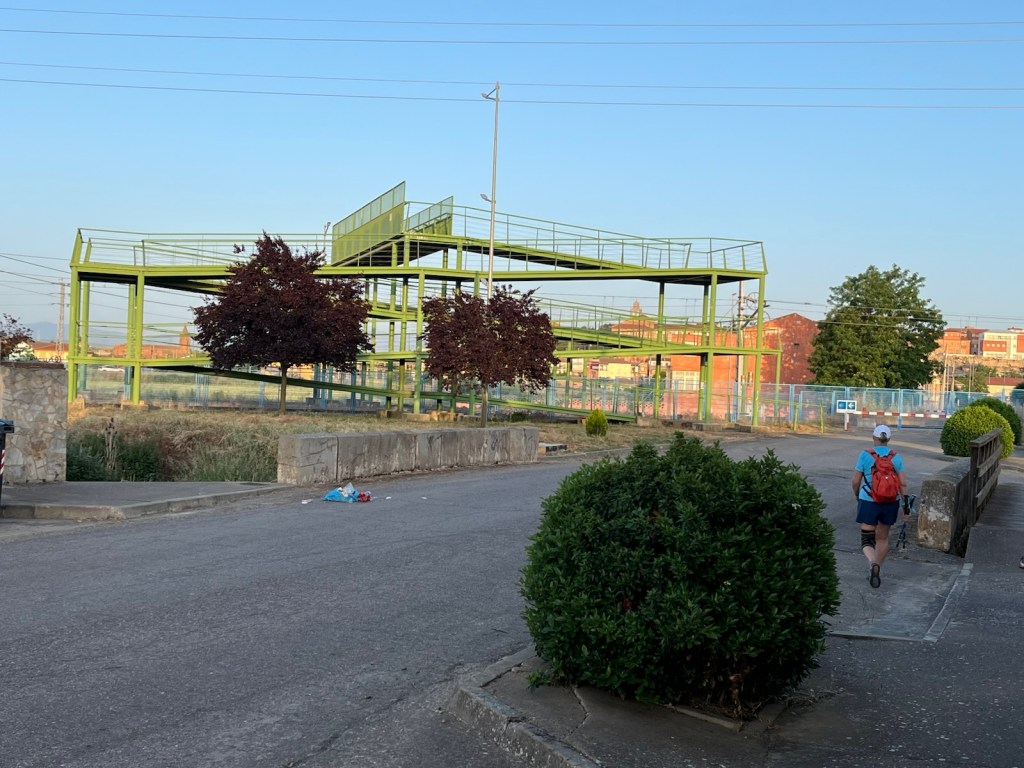
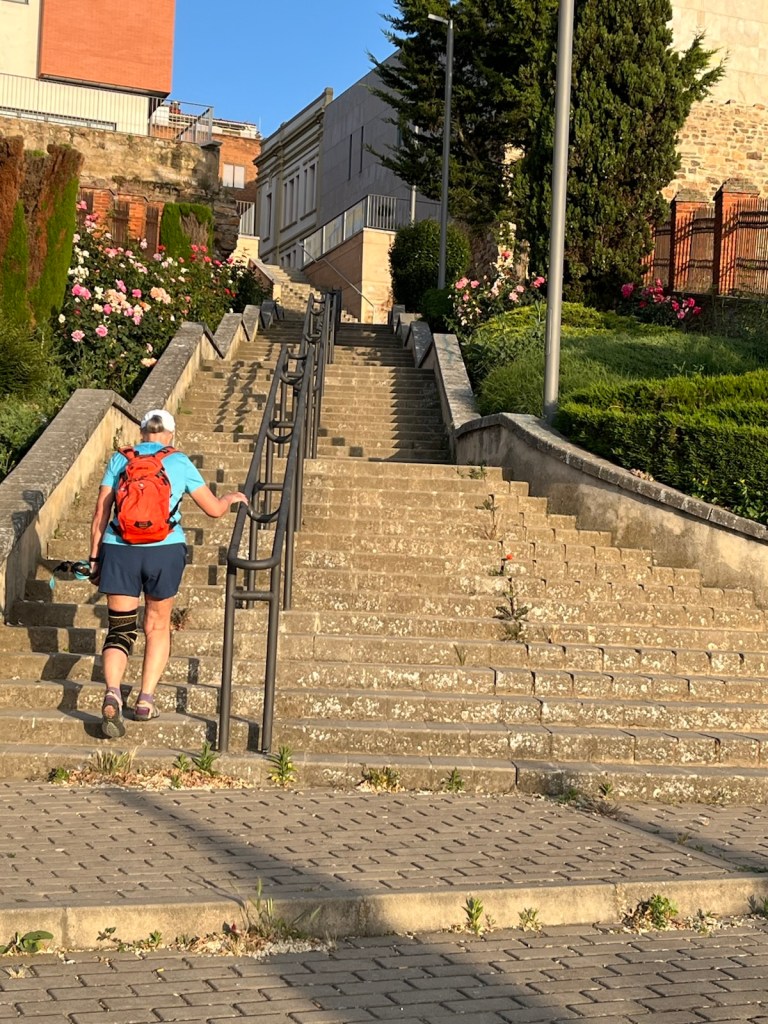
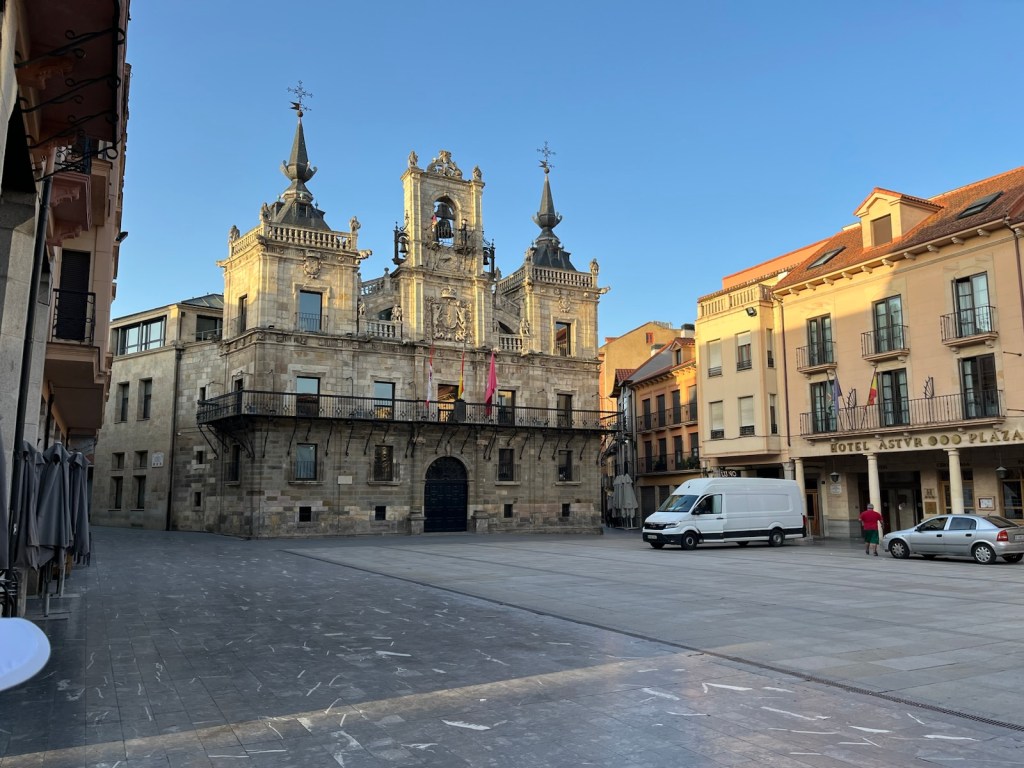
We left San Justo this morning at 6:50a.m.Trout fisherman waiting for a bite as we crossed over the Rio Tuerte.The sidewalk version of the Camino between San Justo de las Vega and Astorga.This field was filled with 5-6 ft high corn when we walked by last year in September.Up ahead is structure for pilgrims and others to get safely over the train tracks.A steep road or steps are the two options for entering the old city of Astorga… we chose the steps.Astorga town hall in the Plaza Espana
Astorga is a pleasant city with interesting and varied historical buildings, just the right size to not be too overwhelming with main sites confined to the small Old City. First a Celtic settlement, Astorga developed into an important Roman city at the crossroads of the Via Trajana and the Vía de la Plata, as well as an important center for Christianity. According to legend, both St. James and St. Paul preached here. The bishopric of Astorga was one of the earliest Christian titles. The city passed to the Visigoths in the 5th century and was destroyed by the Muslims in 714, then reconquered by Ordoño I in the mid-9th century. After León was destroyed by Al-Mansur’s army, Astorga acted as the capital of the kingdom.
The city flourished with the pilgrim trade and housed 21 pilgrim hospitals, the second most on the Camino Francés (after Burgos). One of these hosted Saint Francis of Assisi on his pilgrimage in 1214.
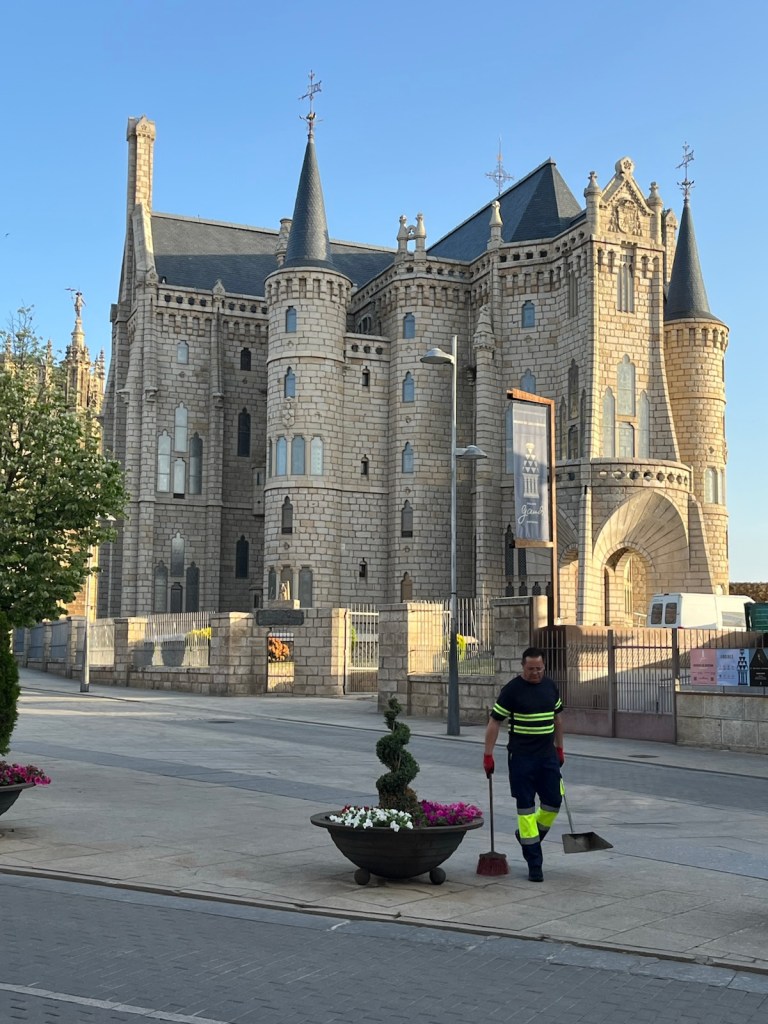
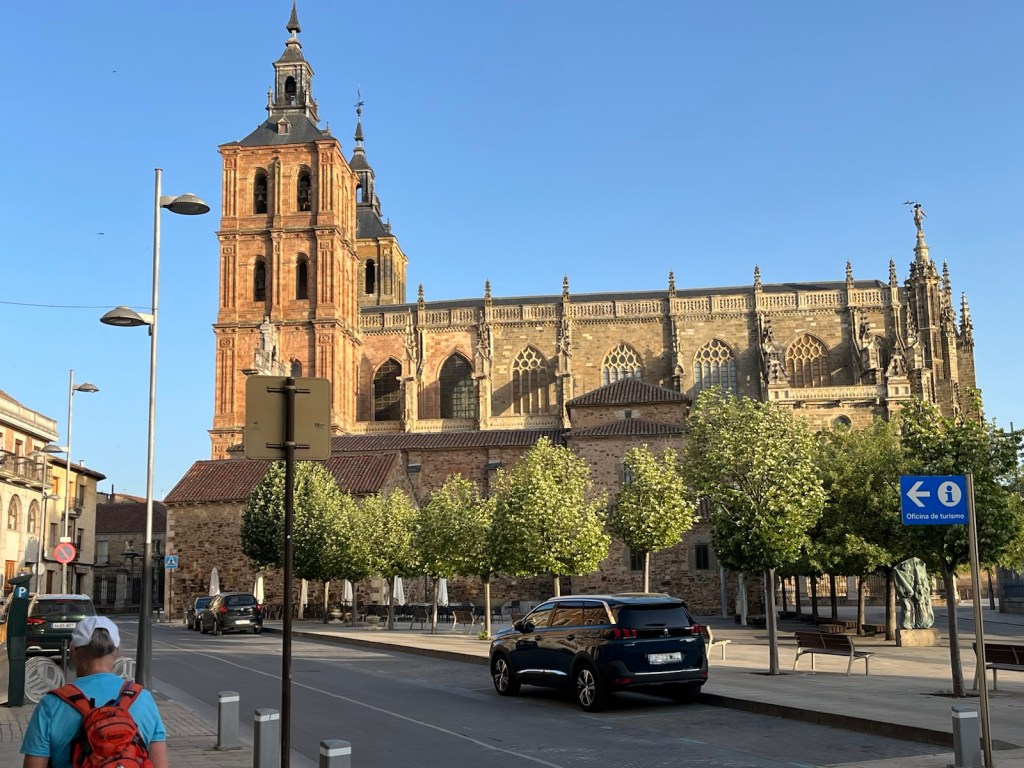
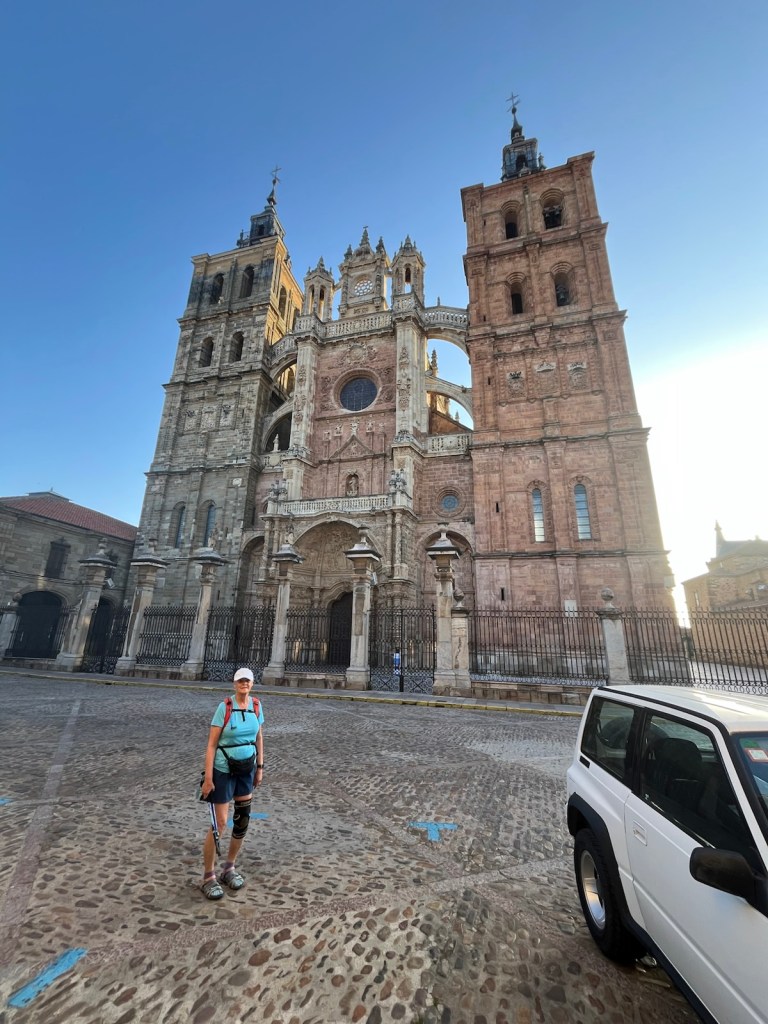
Wall mural in AstorgaPalacio Episcopal de Astorga (designed by Antoni Gaudi)Catedral de Santa María de AstorgaMain entrance of Catedral of AstorgaOur breakfast stop before completing our walk through Astorga.Leaving Astorga on a sidewalk.The sidewalk became a familiar dirt path.Walking through the Maragato community of Murias de Rechivaldo, (pop. 108).
The Maragato culture, centralized in about 40 villages around Astorga is rumored to be descended from the Berbers of North Africa, who arrived with the Muslim conquest in the 8th century and later converted to Christianity. Maragato men traditionally worked as muleteers, mule drivers who transported goods (especially fish and gold) around the peninsula.
After a short break, we left the Maragato village, rejoined the dirt path and continued for several miles as we climbed toward the Irago Mountains.Arriving at the entrance of Santa Catalina de Somoza with the Iglesia de Santa María in the background.
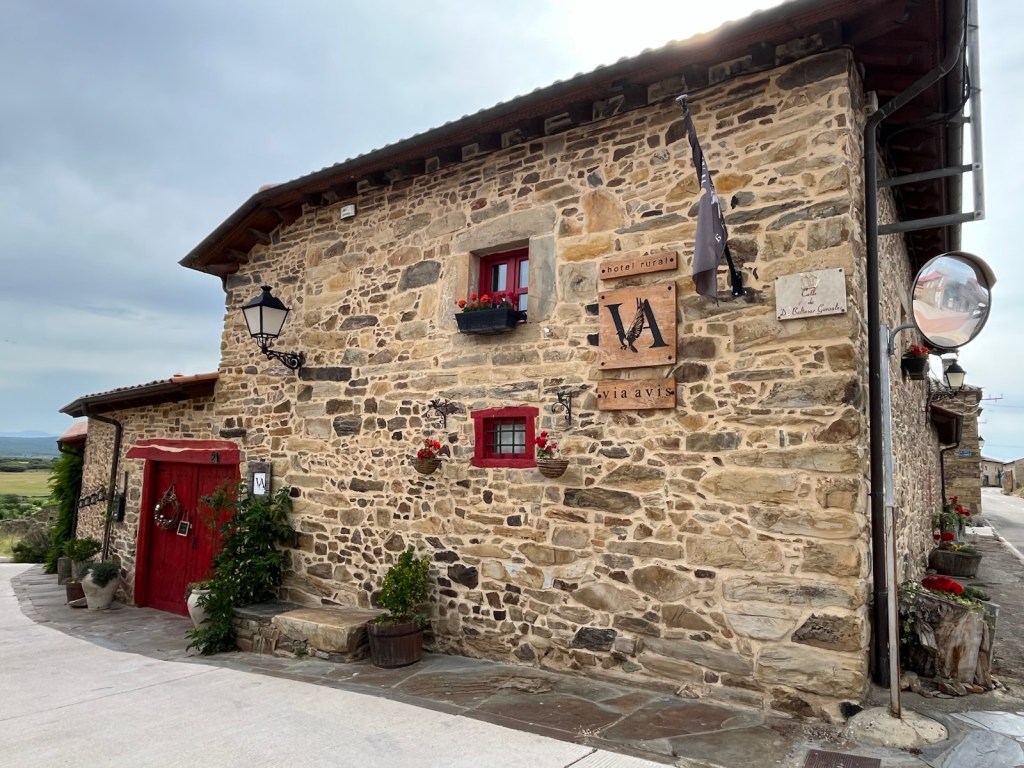
This is our 7th visit to Santa Catalina and our 3rd to Via Avis. Translated, ” the Birds’ Way” it refers to the belief that the birds were the guide for souls on the way into Paradise.
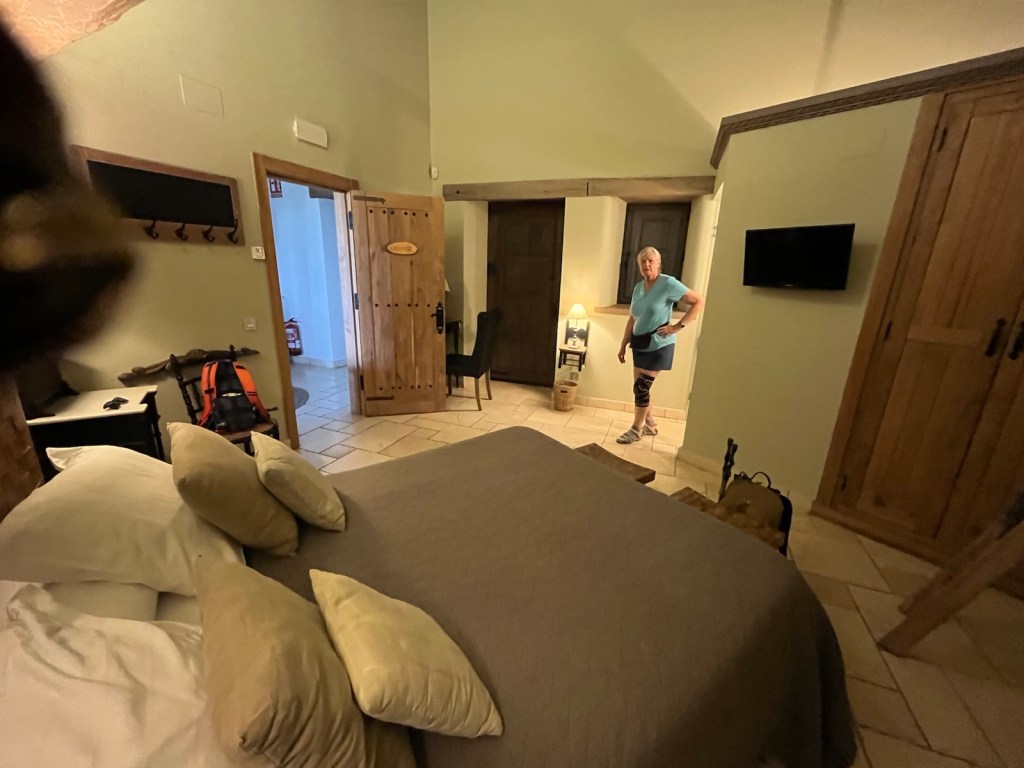
The house is restored from the original 1776 structure. It’s a very upscale B&B with 6 double bedrooms, each with its own personality, but always related to birds and their mythology.
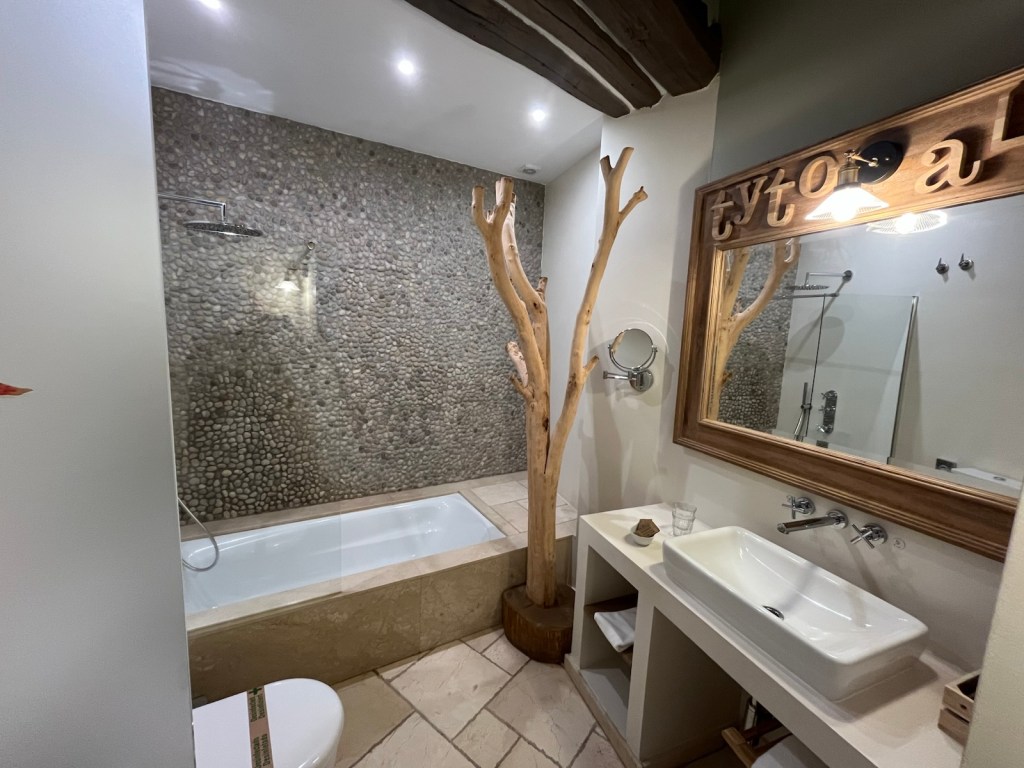
Our bedroom located just off the house living room, bar/kitchenette and large windows, which provide inpressive views of the surrounding Maragateria region.Our unique bathroom. In our opinion, Via Avis is among the top accommodations on the Camino Frances.Via Avis- Santa Catalina de Somoza
After a having pizzas for our main meal in one of the two bars in the village (pop.60), we spent the afternoon chatting with a young man from Toulouse, France who started the Camino in León just a day ago, with his father, riding bikes. We also chatted with a lady from the Netherlands who had recenty moved to Santa Catalina and was working part time with Carlos and Dainia, our Hosts. As the day wound down, we reverted to our routines and prepared for tomorrow’s walk on the Camino Frances.
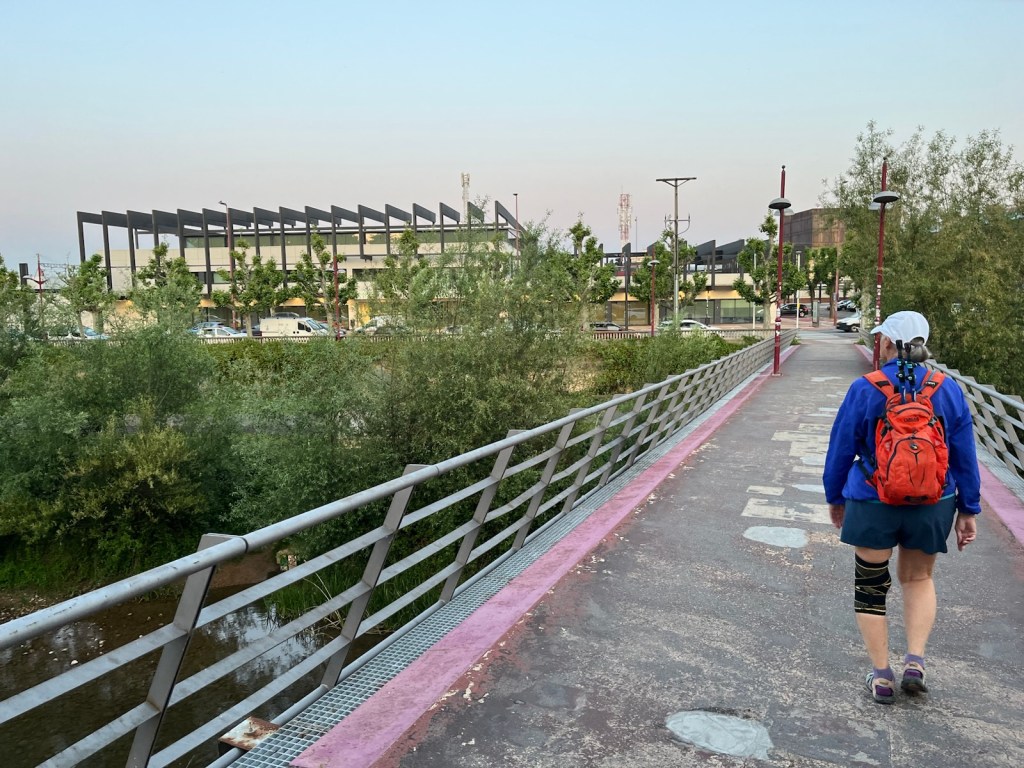
So, as planned, we walked the 20 minutes from our apartment to the León bus station, at 6:30 this morning. Unplanned was our wait until 7:30 for the bus station cafeteria to open.
Our early morning walk to the bus station, crossing the pedestrian bridge… Bus station is the modern structure to the left.
We had a tiny cafe con leche and croissant for breakfast and then boarded the 8:00 bus to Hospital de Orbigo, as planned, to skip the industrial and boring 22 miles west of León.
After a brief rest stop at Hospital, we began the 7 miles west walk to San Justo de la Vega.
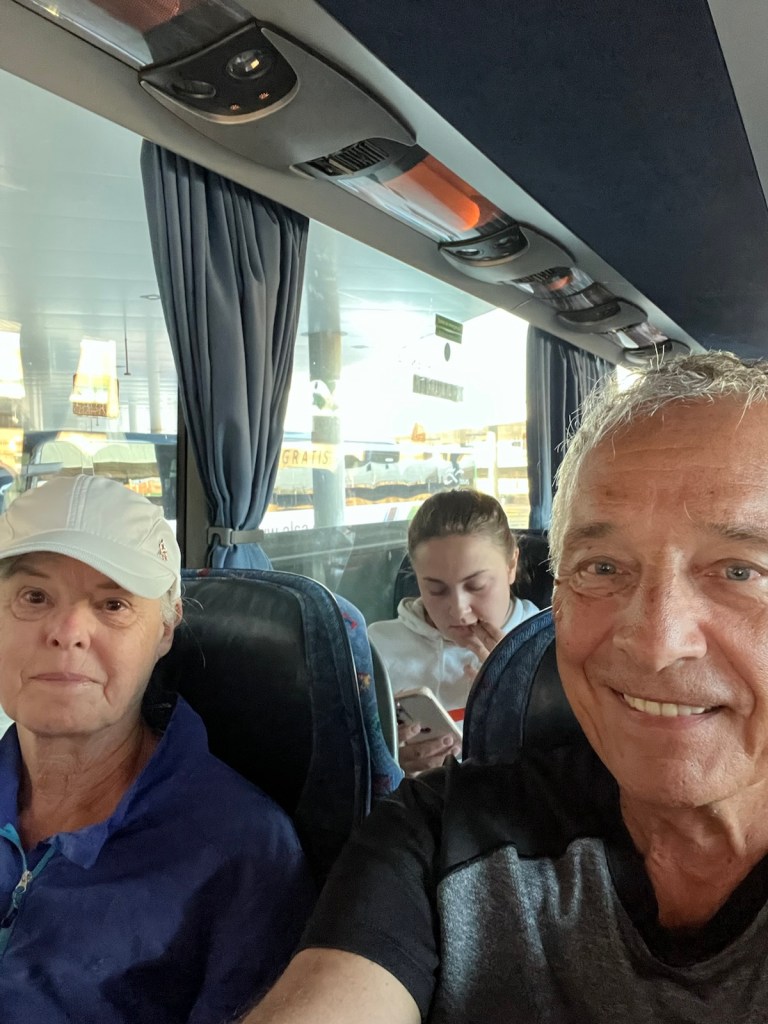
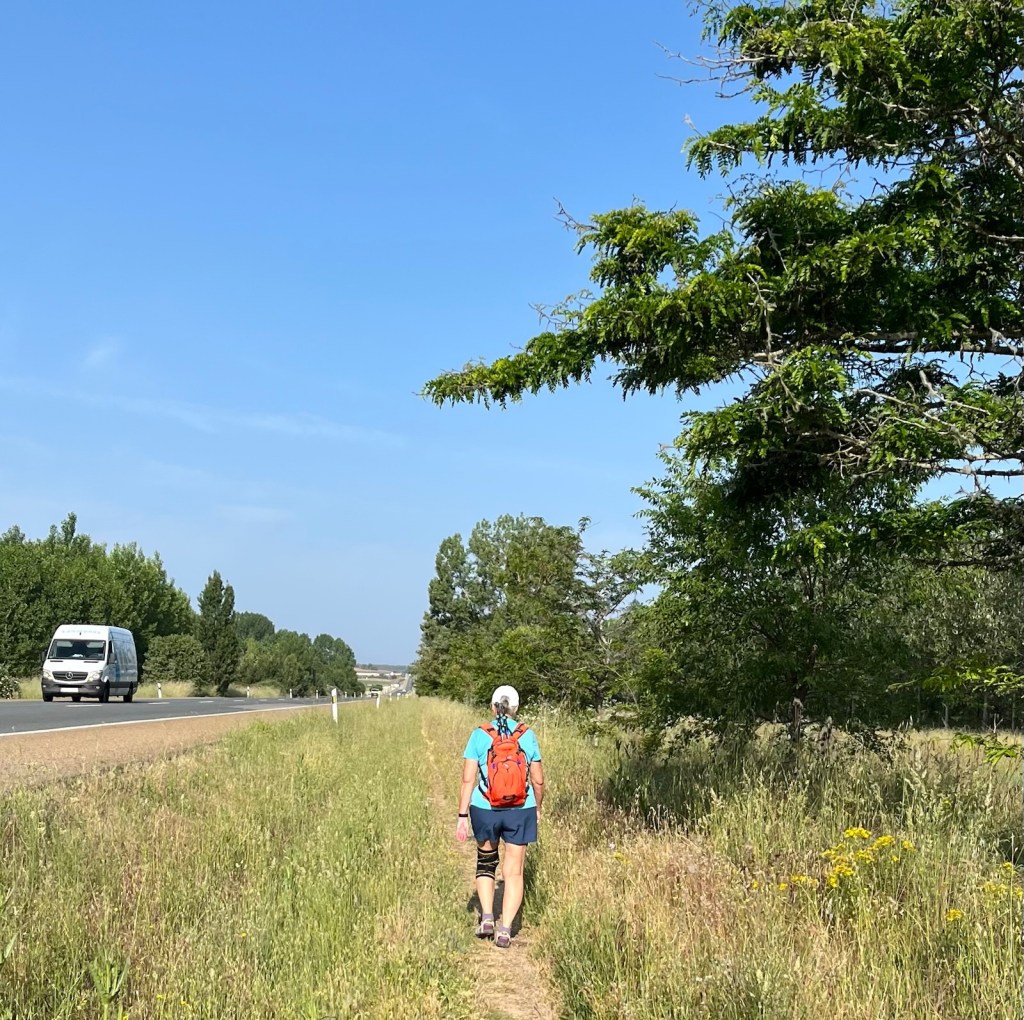
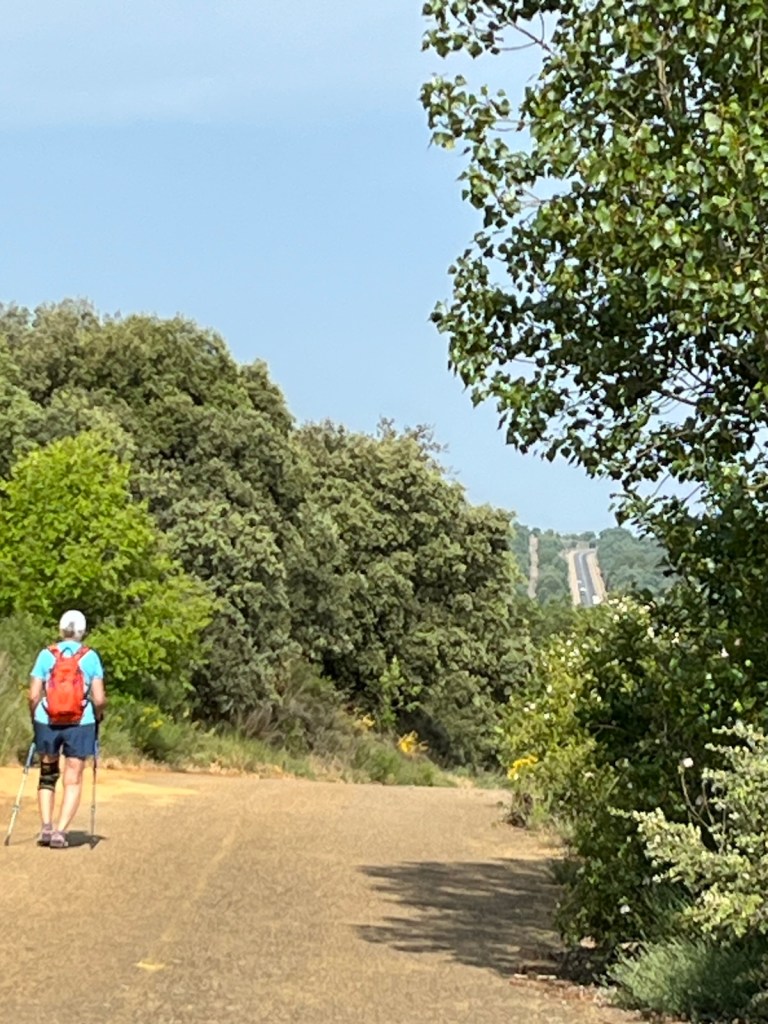
On board the ALSA bus and on our way to Hospital de Orbigo.Shortly after leaving Hospital de Orbigo.Switching from the edge of the highway to a path ( “less traveled”).Our path was obviously the one less traveled as indicated by the bridge dis-repair and the overgrowth.A nice wide paved path on the right side if the road.A nice wide, paved path to the left of the highway. In the distance (shown here in telephoto x3) is the hill leading into San Justo and our stimulus to call it quits at the service station.
As planned, we stopped at the service station a few miles short of San Justo for a much needed break from the 72 degree sun.
We realized that too much of a good thing, like a 3, rather than a 2 day break in León must have adversely affected our stamina, so we made an unplanned call for a taxi to take us the remaining distance into San Justo to our hotel.
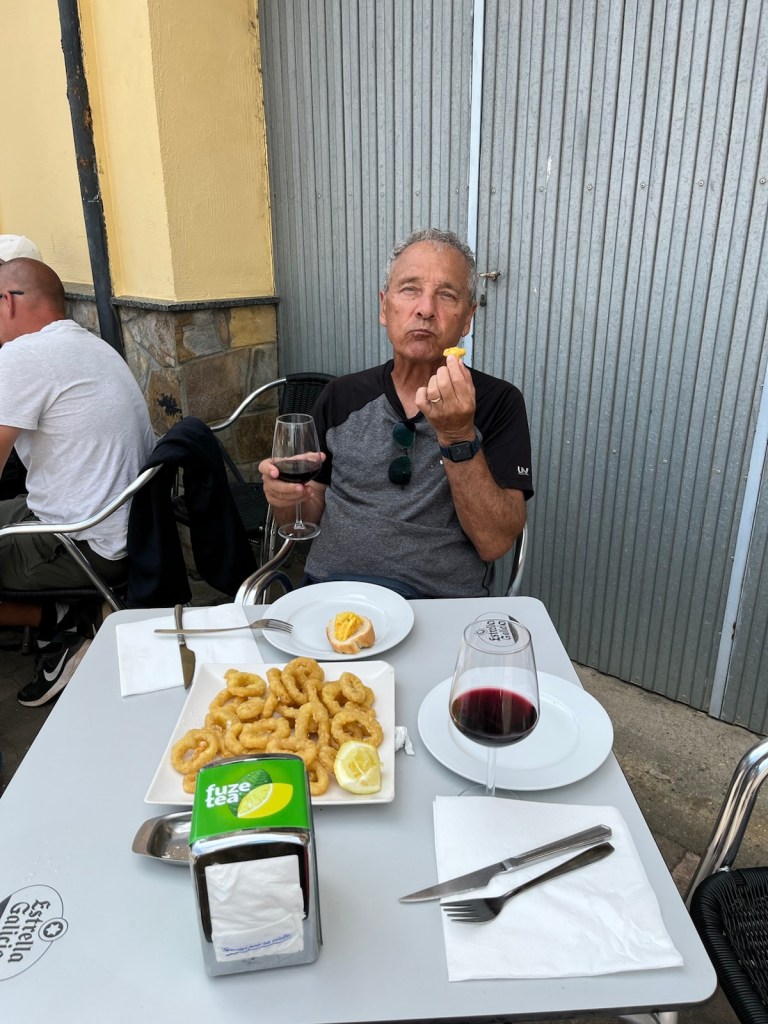
Our hotel was not ready for us, nor did they offer food before 1:30, so we retraced our steps to the Oasis Bar and had a glass of Mencía wine to go with a racione of calamari to fill our tummies and the time gap between our planned Camino and the actual circumstances facing us.
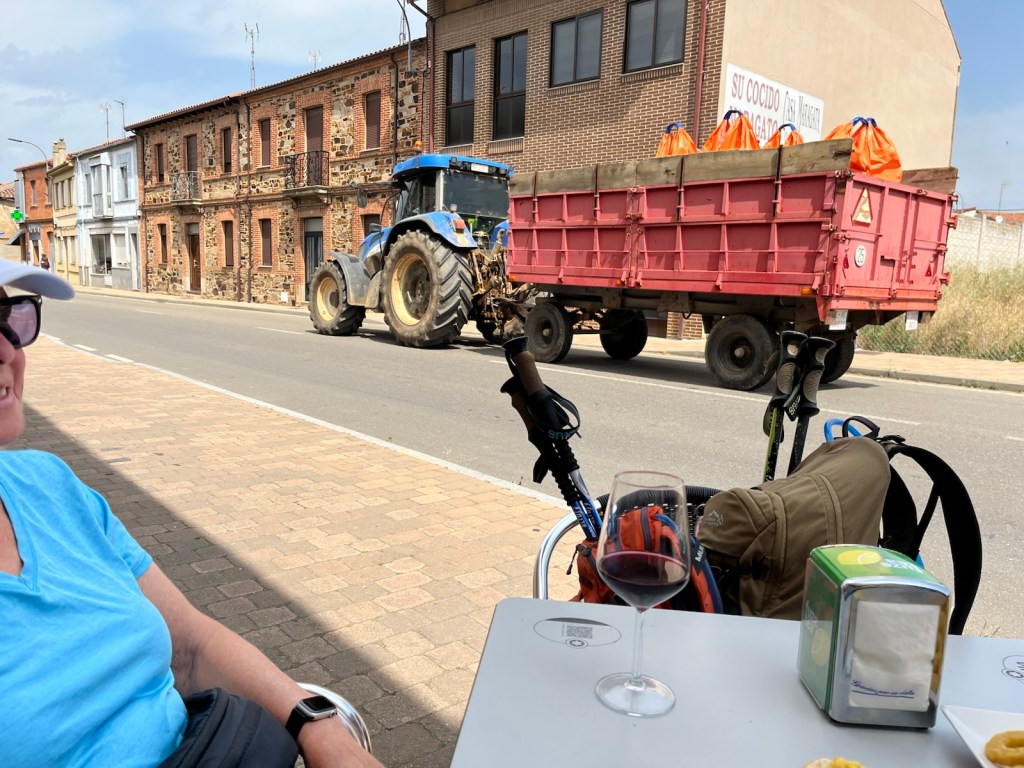
The best event of the day…. shared calamari and Mencía wine.Tractor Ambiance, San Justo de la Vega style!
We checked in to Hostal Juli at 1:00, had a so-so main meal at 3:00 and hung out in and around our room for the remainder of the day.




















 Jimandi