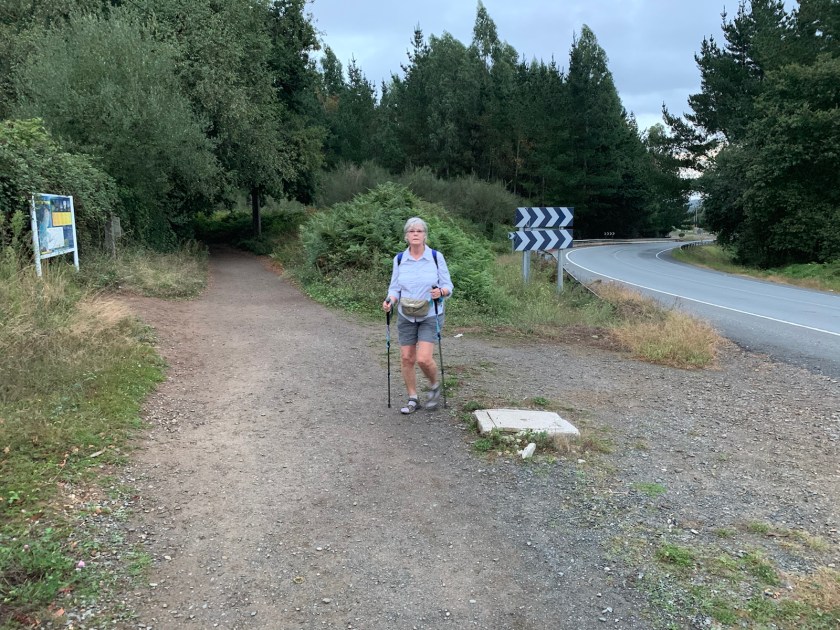
It rained a lot last night but appeared to be over when we left Pension CHE this morning. We walked about a quarter mile on the roadside, then took a gravel farm road, that after another quarter mile,
rejoining the Camino near Pension CHE
joined the Camino. We chose this route, rather than walk 4 km back into Arca to pick up the Camino there. This cut our planned walk today by about 1.5 miles.
Even though the rain had stopped we dodged puddles all the way.
We did a lot of uphill’s today, mostly of short duration but totaling 65 floors according to Linda’s FitBit. About half was through forest and half on narrow, lightly traveled paved road.
We walked around the Santiago airport, hearing only 3 aircraft over a span of a half hour. Half-way around the airport we broke out of the forest enough to see a stone marker for Santiago, beside a major highway heading into the city. We also got a brief glimpse of Santiago, some 11 km in the distance before going back into the woods at one end of the runway.
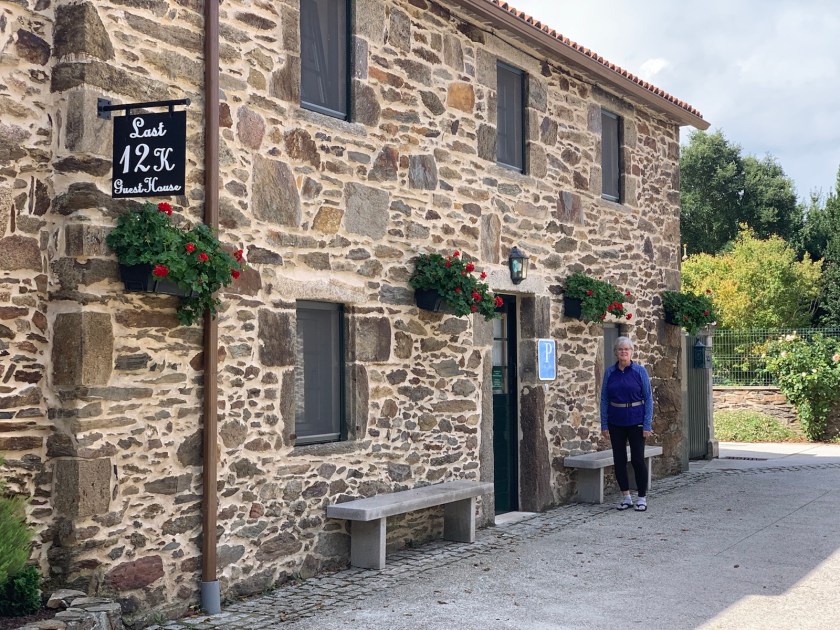
Switching back onto a paved surface we entered the hamlet of San Paio (pop.25) and stopped for breakfast. Our casa rural, “The Last 12 km” (65€), is our reserved destination for the day, but after finishing breakfast, we decided to keep walking.
We walked to Lavacolla (pop. 171) which literally means “wash private parts.”
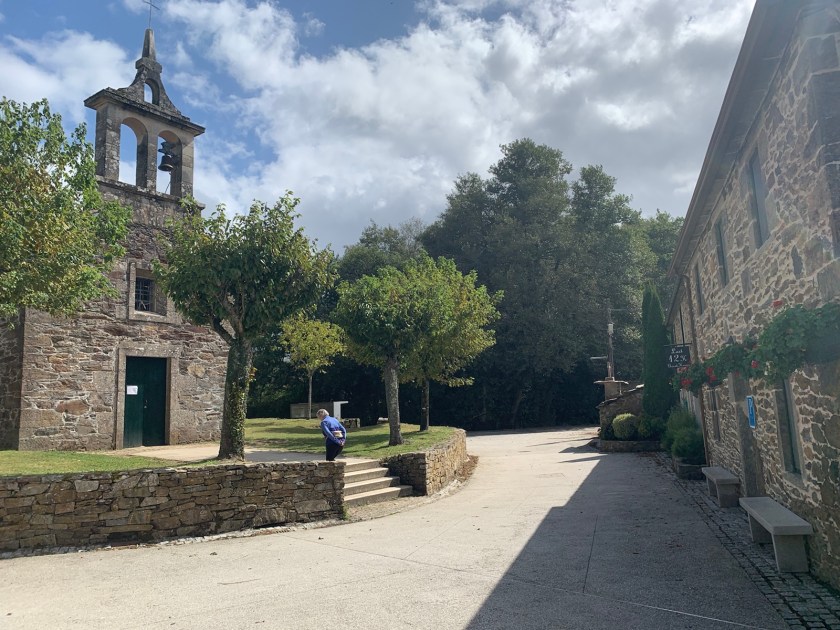
Iglesia de Benaval/San Pelayo in Lavacolla
Medieval pilgrims seldom if ever bathed along the journey and even “ridiculed Muslim and Jewish enthusiasms for personal hygiene,” but apparently took advantage of the small stream on the edge of Lavacolla
these pilgrims, apparently “clean” skipped a dousing in the stream this morning
to finally cleanse themselves just prior to arrival in Santiago. Also, Laffi recorded in the 17th century: “There is a river in a wooded place two miles from Santiago called Lavacolla, in which French pilgrims, out of respect for the Apostle, wash not only their private parts but, stripping off their clothes, clean all the dirt from their bodies.”
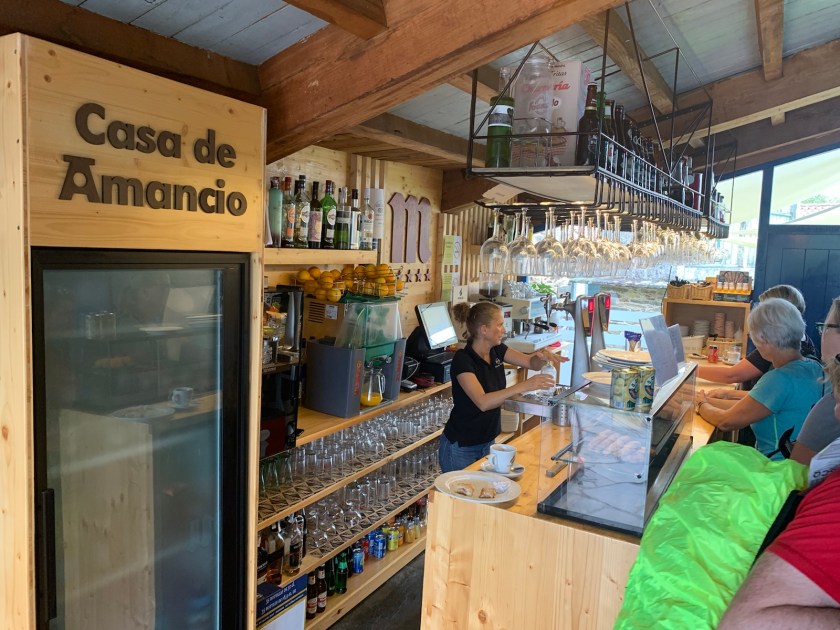
We walked on past Lavacolla for a mile or so and finally stopped in Vilamaior (pop.<25) at Casa de Amancio for OJ and Santiago cake, before calling a taxi (13€) to take us back to San Paio.
San Paio and the small Iglesia in the hamlet is dedicated to San Paio (Payo) a Christian child that was martyred for refusing to convert to Islam.
inside Iglesia de San Paio
She was 14 when kidnapped by the invading Muslim troops and taken to Sevilla and tortured, body cut into pieces and thrown into the Guadalquivir River.
Our home for the afternoon and evening is located facing the iglesia.
The owner let us check in over an hour before normal. We believe she owns both the bar/restaurant where we had breakfast and lunch plus the guest house where we are staying.
our room
She speaks excellent English and personally
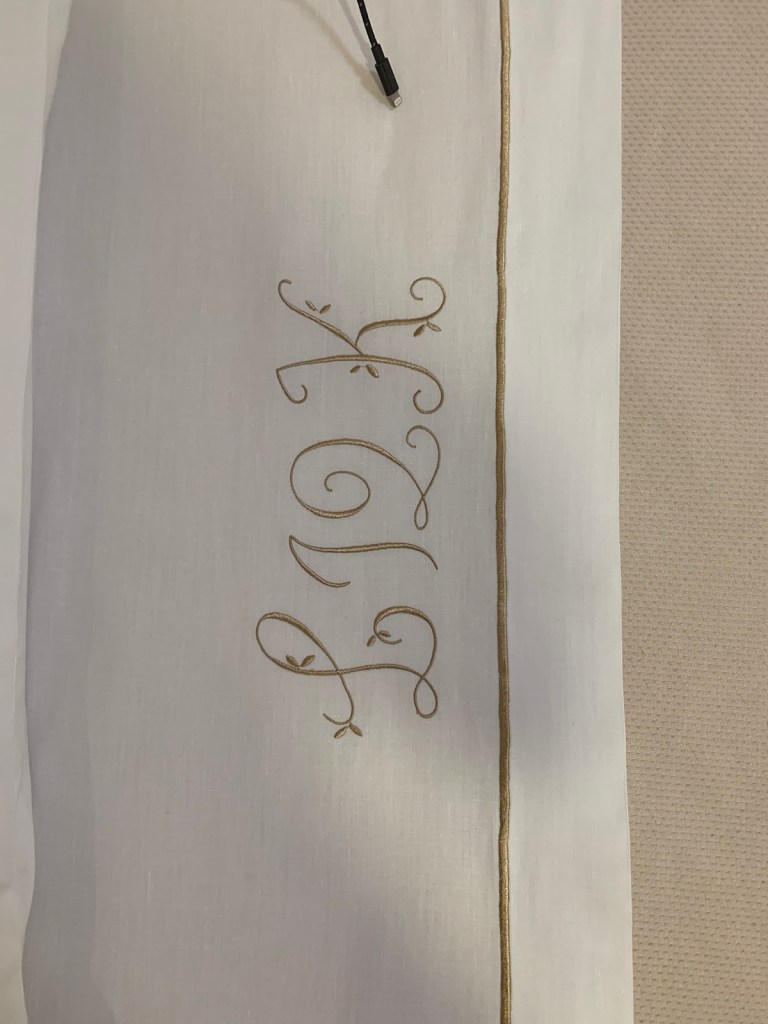
monogrammed sheets, towels and pillowcases
decorated her charming/upscale property. Our late lunch was also enough to suffice for dinner, but we took two slices of Santiago cake and the remains of our lunch wine back to the room for later, just in case.
After checking out this morning we sought out the owner, Miguel Santiago,
Linda with our Camino friend, Miguel Santiago
who was serving guests in the breakfast dining area.
We have a delightful history with Miguel. He observed some spider bites Linda had gotten several days before we arrived at Albergue Tourista Salceda in 2015 and called a pharmacist friend who advised that Linda go to the clinic in the next town as a precaution. Miguel shared this information with us and told us where to find the clinic and a shortcut to cut our 4 miles walk to less than 3. The next morning a doctor at the clinic saw Linda immediately, gave her a shot and a prescription for followup medication. We filled the prescription at a nearby pharmacy for 5€ and were on our way. Linda subsequently recovered from the bites by the time we got to Santiago, several days later.
In 2017 we stayed at the same place and Miguel was delighted to see Linda was ok and he and his family welcomed us again. When we left the next morning, taking the same shortcut, Miguel was returning in his car to the albergue by the same route and stopped, shook our hands and wished us “buen Camino” with his voice and kind eyes. That moment was one of the highlights of the Camino for us.
This morning in tribute to Miguel Santiago (approximately named) and
the shortcut back to the Camino
because it is indeed a shortcut, we began our walk taking the shortcut to
rejoining the Camino
rejoin the Camino for the day.
About an hour later we stopped at a new cafe, which had not been there in 2017. It turns out, the owner had just finished celebrating their first anniversary. We thought it was interesting to see the contrast in this modern rest stops external design and the more typically new, but renovated multi-hundred year old structures one sees on the Camino. And the toastadas were very nice, too.
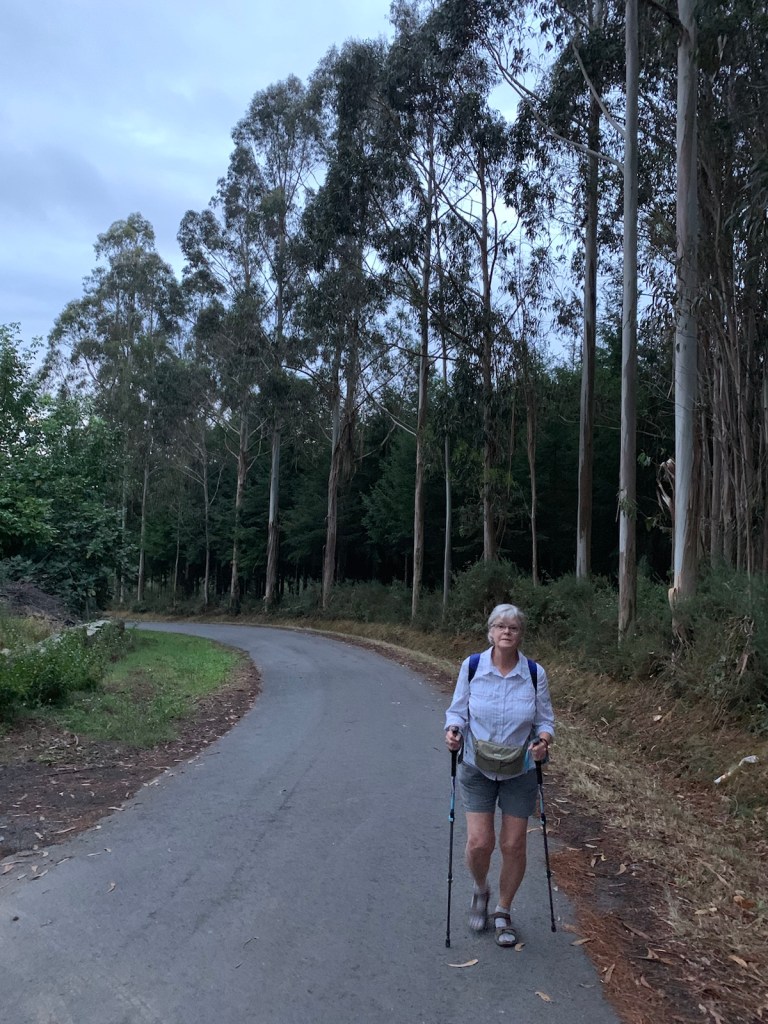
The path alternated between eucalyptus forests and
walk on the right side for a whilethen walk on the left for a while
roadside paths. The weather threatened rain, but it was only a threat.
At one point we stopped for a photo in a forest and a couple from Brisbane, Australia stopped and offered to take our photo. We accepted and then walked awhile with them.
They were celebrating her 40th birthday by walking the Camino from Sarria and following with a short trip to Santorini and several other Greek islands. They owned a recruiting business together and spent most of their vacations on the nearby Australia Gold Coast and in SE Asia. They had numerous questions about the Camino and we tried to answer as best we could.
our Australian friends moving on
We parted shortly after as we were walking considerably slower than they.
Our walk to Arca (pop. 5,050 )/O Pino,/O Pedrouzo, was relatively easy until we got to O Pedrouzo and began looking for our place to stay, Pension CHE. The Booking.com map and the Google Maps took us to the wrong place, two baggage transport employees said it was 4-5 km out of town, and finally, in a residential neighborhood where CHE was supposed to be, a helpful gentleman working in his yard, explained in beautiful Galícian (which is not Spanish or Portuguese or a blend of the two, but a unique Romance language of its own) what the situation was. Jim and Linda listened intently, after several “repita por favors” and after thanking the helpful gentleman, we walked back into town and still guessing what the guy was telling us, made a few more inquiries along the way and ultimately we figured it out.
It seems that Pension CHE is an extension of a place in Arca called Pension Platas. We actually stayed in Pension Platas in 2017, a several story hotel in Arca. The way it works is, after 12:00 noon you can go to the receptionist at Pension Platas, give her your name and she will summon a driver who will transport you to Pension CHE some 5 km out in the countryside. He then escourts you into a bar/lobby and calls the receptionist, who apparently lives nearby, because she appears in less than 5 minutes.
We discovered later once arriving at CHE that the receptionist copies your passport, accepts payment for the room, advises you that no food is available at the site, but you can order takeout for delivery to the pension or be transported back to Arca for dinner between the hours of 6-8 pm. She points out that tomorrow morning they would transport us back to Arca to pick up the Camino or we could walk a few hundred meters from the Pension and pick up the Camino in the direction of Santiago, saving us probably 2-3 miles of walking. We’ll have to think about that one … for about 4 nanoseconds. You can guess which option we’ll choose in the morning.
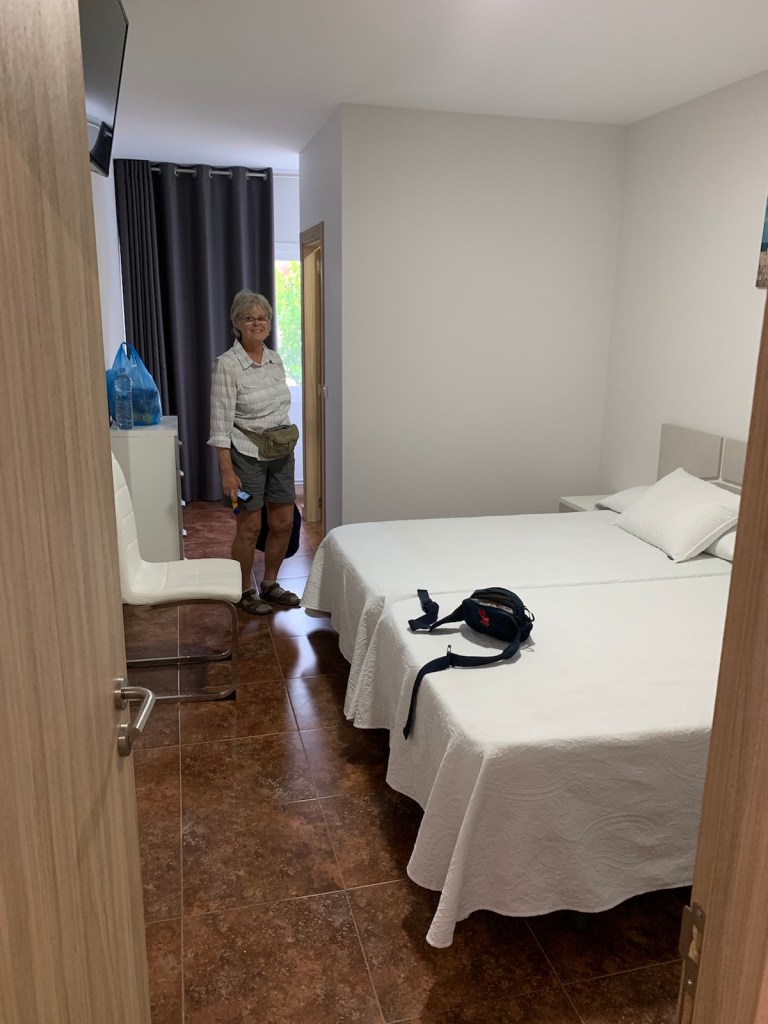
She then gives you the key to your very nice, new, clean room
our 50€ room at Pension CHE
and things get back to “normal” for the rest of the evening.
Now, being the seasoned peregrinos that we are, once we talked with the Pension Platas receptionist at 11:30 and guessed how things might play out, we went into action.
We left Jim’s backpack safely with the receptionist and found a place to have an early lunch, in case lunch might not be available at Pension CHE.
After lunch we found a grocery store and bought the fixin’s for dinner, should we have limited or poor options at Pension CHE.
Below is a list if our purchases in euros with notations where a translation might be needed for you.
we picked up a small loaf of fresh bread at a paneria for 1€
We then headed back to Pension Platas at 12:15 to summon our driver to Pension CHE.
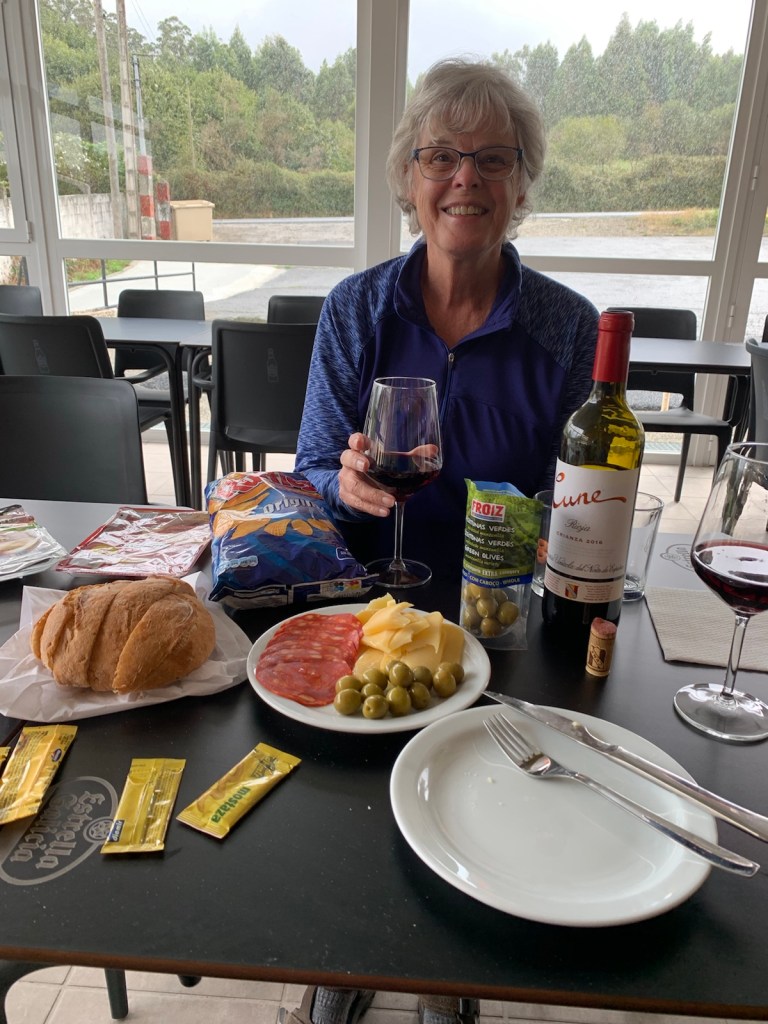
We were taken to CHE and followed the sequence outlined above, got into our chore mode, took a short nap and then gathered our purchases and went to the open, but no services, dining area and had dinner.
We need to add that while shopping in the grocery store for wine to go with our dinner, Jim came across a wine that we have purchased at Total Wine for $12-15 a bottle and in restaurants or cruises have paid $20-30 and more. The price for the same wine was €6.75!!!
After a tasty 17€ dinner including wine we rested and blogged for the remainder of the day.
At 7:30, both Accuweather and Weatherbug apps said no rain for 120 minutes, so we left our hotel and stopped for breakfast briefly, before leaving town without our rain gear, but had it easily accessible if we needed it.
Just as we left town and began our first steps on the dirt path, the heavens opened up and delivered some serious rain in our direction (Good work, weather apps!). We quickly got into our rain gear and waited in a relatively dry spot under a tree until the shower let up a bit before proceeding. It continued to rain for a half hour or so, then evolved into a light drizzle, then stopped for the rest of our walk.
Like yesterday, we walked on some narrow paved farm roads
A very large hórreo
but mostly through forests.
Pilgrims were very much in abundance the entire way. Resting places were nicely spaced and frequent enough to prevent excessively long waits for services.
We had a short chat at one stop with Paul and his wife from Holland that continued later when they passed us. They started their Camino from home and expected to get to Santiago sometime tomorrow after walking over 2600 kms (1600 miles) since late June!
Jim had another interesting conversation with Eddie, another guy from Holland. Jim mentioned that his father had visited Holland in 1942 when his bomber crashed landed on a beach near Vlissingen, Holland and was quickly taken captive by the nazis. Eddie said that his father was a member of the resistance forces in Holland during the same period, trying to disrupt nazi efforts in his country. Eddie said he never knew about his dad’s activities because they were classified and only discovered them after his father died. Jim shared that he had a very similar experience with his dad and related Jim Sr’s roll in the Great Escape. At that point in the conversation Jim realized he was walking faster with Eddie and bid farewell to his new Dutch friend and walked backwards to let Linda catch up.
We also walked briefly with a lady from Sidney, Australia who had started in SJPDP, like us, and had been walking alone. She was curious as to why we had walked the Camino more than once.
When we got to Salceda, our room was not ready. We waited in the Albergue Tourista Salceda dining area until our room was ready and chatted with a young lady from Hanover, Germany, who had walked from SJPDP and we enjoyed sharing our experiences and impressions of the Camino Frances, until our respective rooms were ready just before 1:00.
Both lunch and dinner
another Mencía wine we drank at lunch
were had in the albergue’s modern dining room.
We renewed our acquaintance with the owner and his wife who remembered us from our visits in 2015 and 2017.
We’re both nursing mosquito bites which we received at our hotel in Arzúa last night. We didn’t sleep well last night as a result. We brought a high powered steroid salve from our doc in Greenville that helps the itching. We’ve used it with some success earlier in Camino 2019 and hope it will help us sleep better tonight.
When we awoke this morning there was no rain, but all the weather forecasts and weather maps showed it was raining, or would be in 18 minutes. So we put on our rain gear and departed for Arzúa, a mere 4 miles away.
When we realized we were going to arrive in Santiago a week early, we tried to change our airline tickets accordingly. But we only had two openings, one on the Sept 27, which was too early and the other was Oct 2, sooner than our original ticket by 5 days, so we rebooked it.
We preferred to have two days in Santiago after finishing Camino 2019, a day for the train trip from Santiago to Madrid and two days in Madrid before boarding our flight back home. The two day buffers were in case there were unforeseen delays in getting to Santiago and/or Madrid. With our new schedule, we still had four extra days to burn, so we decided to burn two of them on the Camino and two in Santiago, since Madrid hotels were running about twice the cost of Santiago.
Our method of burning two days on the Camino was to have several very short days leading up to Santiago. Today was one of them at 4 miles and the other two will be 3 and 3.2 miles respectively. In addition to making our final few days physically easier, this will also let us experience three new properties and two new villages on our way to completing Camino 2019.
Getting back to today’s walk, it was threatening rain the entire way with slight drizzles but nothing to justify serious rain gear. Linda was first to take off her poncho, but Jim hung on for a little longer feeling that if we both took off our gear we would lose it’s deterrent effect.
The path took us through alternating corn fields, holstein pastures, open unplanted fields and eucalyptus forests, not necessarily in that order.
We did pass through the 16th century village, Ribadiso da Baixo, where we stopped for breakfast and a credential stamp.
In order to validate our pilgrim credential to qualify for a compostela, we must have at least two stamps per day during the final 100 km into Santiago. Our second stamp today will be at our Arzúa hotel.
The final mile was along the road or on city sidewalks into Arzúa.
We arrived at Pencion Domus Gallery in Arzúa at 10:15 and were able to check-in shortly thereafter. As soon as we sat down in the pencion lobby, waiting for our room, it began to rain seriously… boy, did we dodge a bullet this morning.
our room in Pencion Domus Gallery
Arzúa (pop. 6,238) was previously known as Villanova, as it is called in the Codex Calixtinus. Ample evidence exists of both pre-Roman and Roman settlement nearby. When the area was reconquered, Arzúa was repopulated with Basque people. It was the principle stopping point for medieval pilgrims before Santiago.
Arzúa today is known for its cheese, made from cow’s milk from the municipalities of the Ulloa, raw or pasteurized. It is also known as Ulloa cheese, Ulla, “Paleta cheese” or other more generic names as “Galician cheese” or “cheese of the country “.
The cheese is creamy, rich and smooth. Its crust is thin waxy of yellow and elastic texture, while the paste is white or yellow, very soft and buttery. The flavor is mild, somewhat acidic, varying from a slightly bitter to a slightly sour taste, depending on whether its development has been in winter or summer.
We’ve eaten Arzúa cheeses several times during our walk throughGalícia and like its smooth creamy texture and taste.
For lunch/dinner we walked to a small hotel/restaurant on a plaza a block from our hotel. It was a delicious combination of pizza, roasted padrón peppers and ensalad Rusa.
Afterwards we retired to our room for the day for naps, reading and blogging.
Since Melide is a major stop on the Camino, lots of pilgrims stayed there last night. We purposely got a later start (7:30) and stopped for breakfast in town, to help the crowd get ahead of us. Surely, our delay helped some, but not enough.
Walking out of town, we passed Iglesia de Santa María de Melide, a 13th century church and considered a national monument. It was locked but it was still impressive from the outside.
Later in the walk we passed a house with a very small hórreo, that we assumed was ornamental, but upon closer inspection had a small door for each of two separate compartments, carta (mail) and pan (fresh bread delivery).
Most of today’s walk was through forests of predominantly eucalyptus trees that are harvested for wood products, a major contributor to the area economy.
We encountered a group of 16 pilgrim men of different ages all dressed in similar outfits. Jim chatted with three different guys as they passed us along the way and discovered they were from Germany, near Kaiserslautern. They all worked for Zimmermann, a roofing company. Herr Zimmermann was also apparently walking with the group. Their outfits were sharp looking and we got a closer look as a number of them stopped at the same bar for a break. Each of the guys had a special pocket on their pants leg that was holding their carpenter “wooden, folding rule”.
After climbing a couple of steep hills, and one gradual hill at the end, we arrived at Cafe/Bar/Albergue Tourista “Santiago”, in Castañeda.
It’s an interesting little place. We stayed here in 2015 and had lunch here in 2017 and decided to give it one more go in 2019.
On the upper level, it has one
our room
habitacion con baño privado, one room with either 3 or 4 sets of bunk beds with a shared bathroom. The shared bathroom also has a washer and dryer for use by all guests.
Below us is the cafe/bar/restaurant which in right on the Camino so that every pilgrim on the Camino Frances had to walk by us in easy view from our bathroom window or the outside sitting area.
We had dinner in the restaurant below. We had a first course of cold cuts and cheese and main course of grilled chicken breast and fries. Yum.
Tummies full, we headed back to our room, read and blogged until falling asleep… a little after 8!!
When the taxi took us back to O Coto, our finish point from yesterday, it was still dark, so out came the headlamps.
The first village we walked through was Leboreiro, a busy pilgrim stopover during the 11-13th centuries. It was still dark and we almost ran into a small version of a hórreo, typical of Galícia. If we haven’t already mentioned, hórroes are for storing grain and corn safely from unwanted critters and weather.
Next to the unlighted hórreo was the somewhat lighted Iglesia de Santa María de Leboreiro.
Legend has it that a statue of the virgin was found at a nearby fountain and the locals moved it to this church. But the virgin kept going back to the fountain until the locals added a more fitting artwork (tympanum) above the church door and officially dedicated the church to the virgin. Then she decided to stay put in the church.
Still in the dark we crossed over a medieval bridge in the hamlet of Disicabo.
The path came away from the medieval hamlets and we walked along the back of a large shopping center, then back into some forests as it got lighter between dawn and sunrise.
We had planned to stop for breakfast at the medieval village of Furelos (pop.135)
Medieval bridge going into Furelos.
but we kept on walking because at 8:35 in the morning all their bars/restaurants were closed with no signs of life, inspite of the hoards of pilgrims surely coming up behind us.
We walked on past A Lúa do Camiño a few hundred yards and had breakfast at the take-out pizza place. We then walked back to our room, gathered Linda’s backpack and checked out at 9:25, beating the 10:00 checkout time, then walked another half mile to Carlos 96, our hotel for today and tonight.
So why would our next hotel be so close to our last hotel? If you remember, we had a logistics problem in that yesterday would have been a 12 mile day which for us is a no-no and there were no places for us to stay to ‘naturally’ break it up. Also, both locations that were available either today or yesterday in Melide did not have both nights available. So we took a 12 plus mile day and made it an 8 and a 4, and used two hotels in the same town and 2 taxi rides to make it all happen.
Fortunately, we’re now booked all the way to Santiago with each day less than 6.5 miles.
Melide (pop.7,824) and the surrounding area was well settled in prehistoric times. The town became a transportation and commerce hub in the Middle Ages.  Iglesia de San Roque features 14th-century tombs with local coats of arms, and the stone cross outside depicts the crucifixion.
Today Melide is well known for its Pulpo á la Gallega, boiled octopus served with olive oil, paprika, a hunk of bread and a ceramic bowl of cold, refreshing Ribeiro wine.
The Camino provided our first exposure to octopus in 2017. Since then, we have sampled it in a variety of places both on the Camino and elsewhere, and we think Melide’s version is the best, and more specifically, Pulperia el Garancha. This was the source of our takeout dinner last night. Garancha also has the best roasted Padrón Pimentos we have ever tasted.
Today, for simplicity, we had a mid- afternoon lunch/dinner in the Hotel Carlos96 dining room.
Linda had homemade chicken noodle soup and Jim has a Galícian version of macaroni and cheese. Second course was curry chicken and rice for Linda and roasted turkey with Padrón peppers for Jim. Dessert was rice pudding for Linda and ice cream for Jim. A local (no label) wine was included.
We coasted the rest of the day, mainly in our room, relaxing and realizing that seven more days and Camino 2019 will be history.

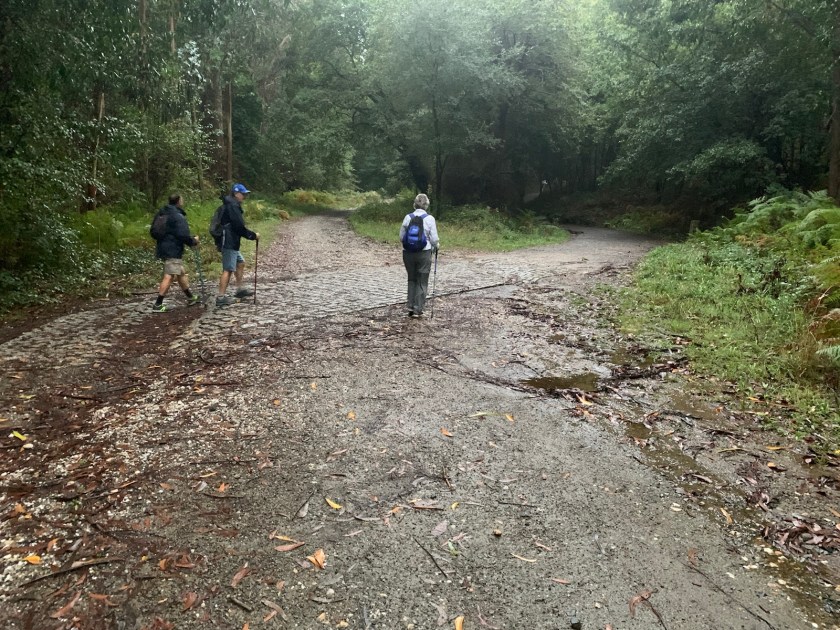
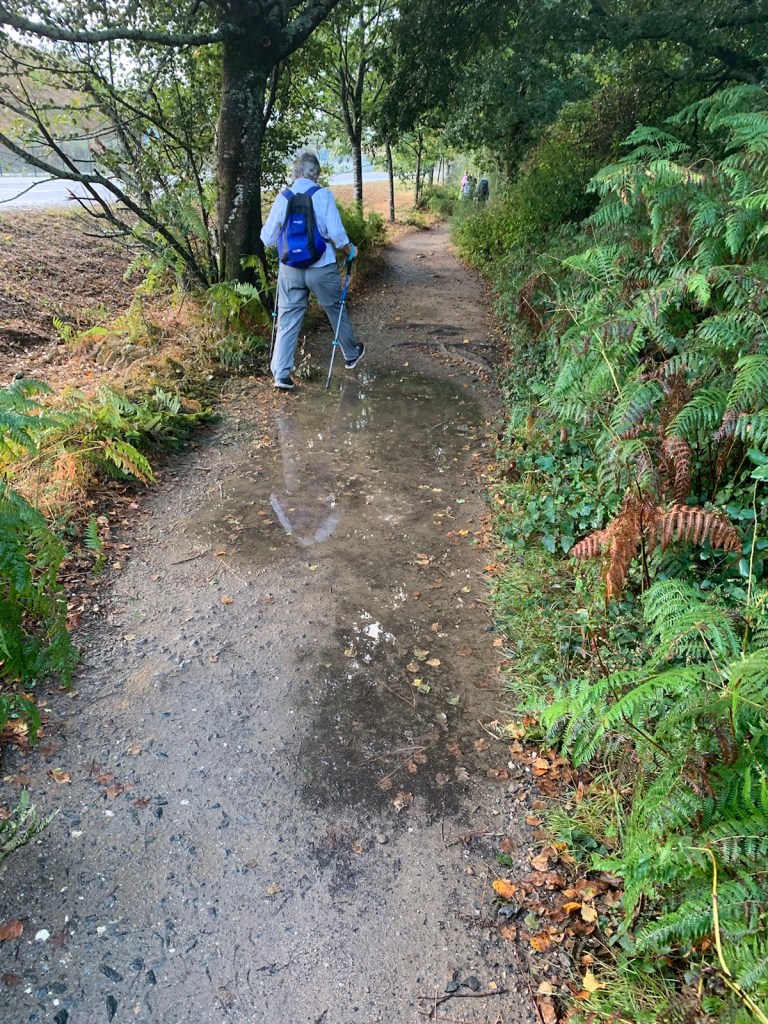 had stopped we dodged puddles all the way.
 and half on narrow,
 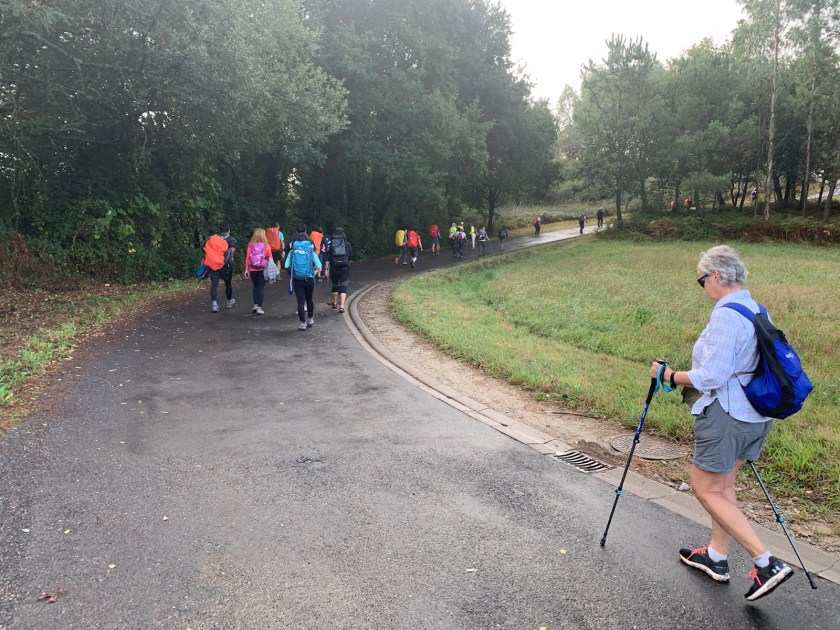 lightly traveled paved road.
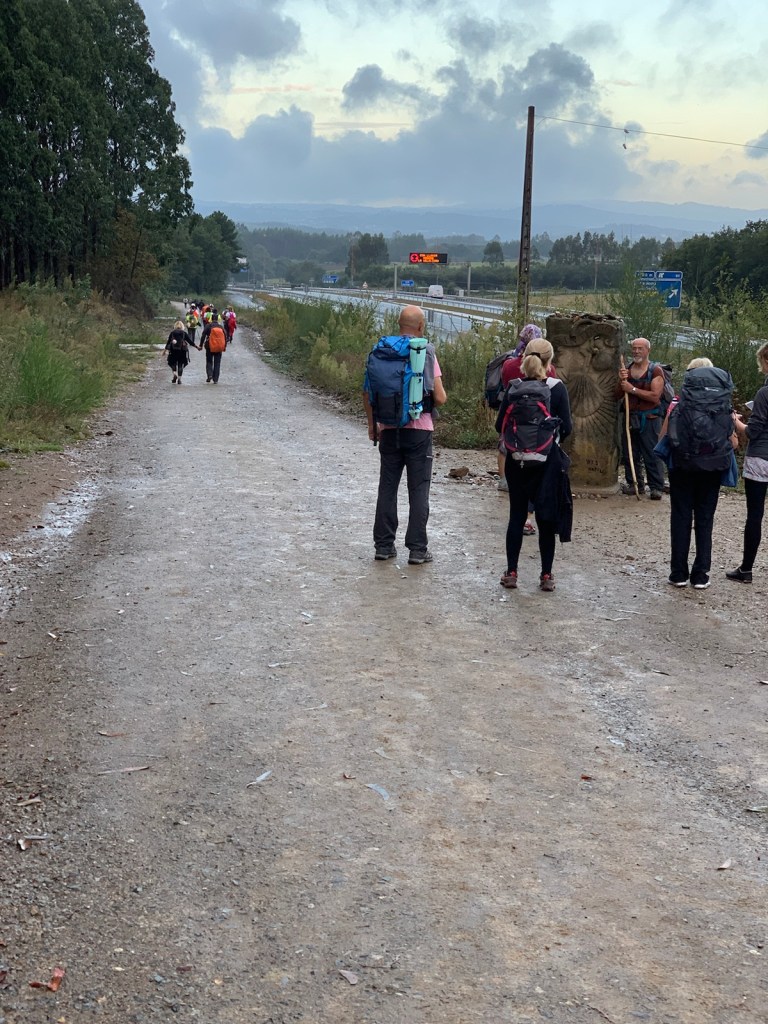 Half-way around the airport we broke out of the forest enough to see a stone marker for Santiago, beside a major highway heading into the city. We also got a brief glimpse of Santiago, some 11 km in the distance
  before going back into the woods at one end of the runway.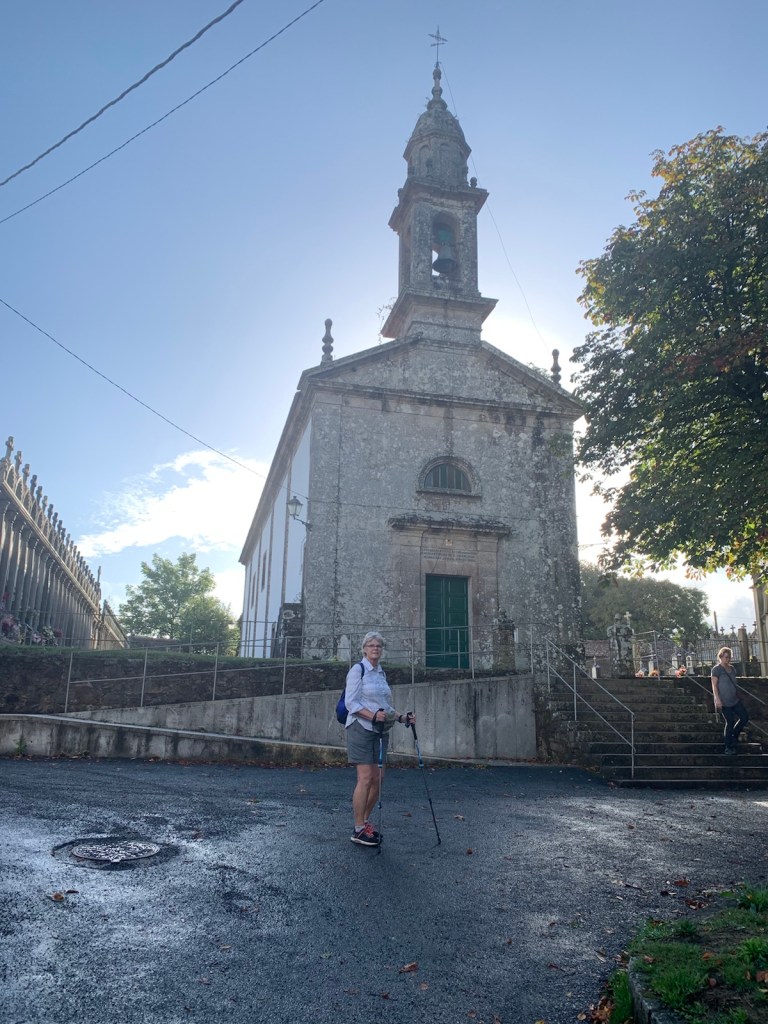

 for OJ and Santiago cake, before calling a taxi (13€) to take us back to San Paio.
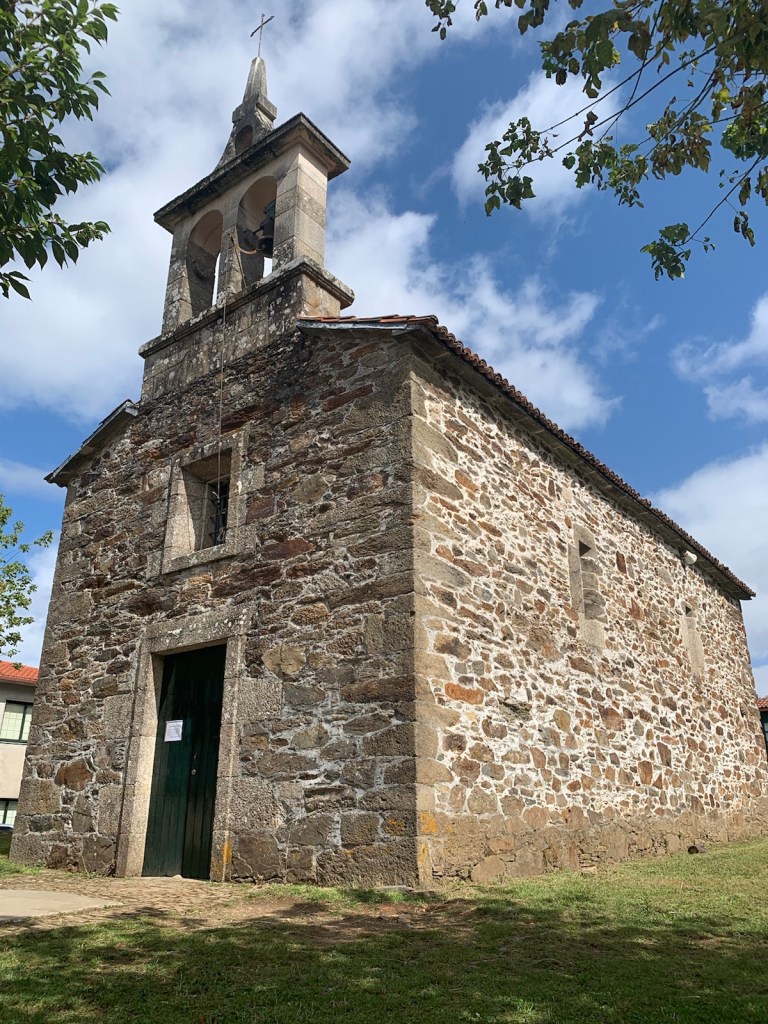 small Iglesia in the hamlet is dedicated to San Paio (Payo) a Christian child that was martyred for refusing to convert to Islam.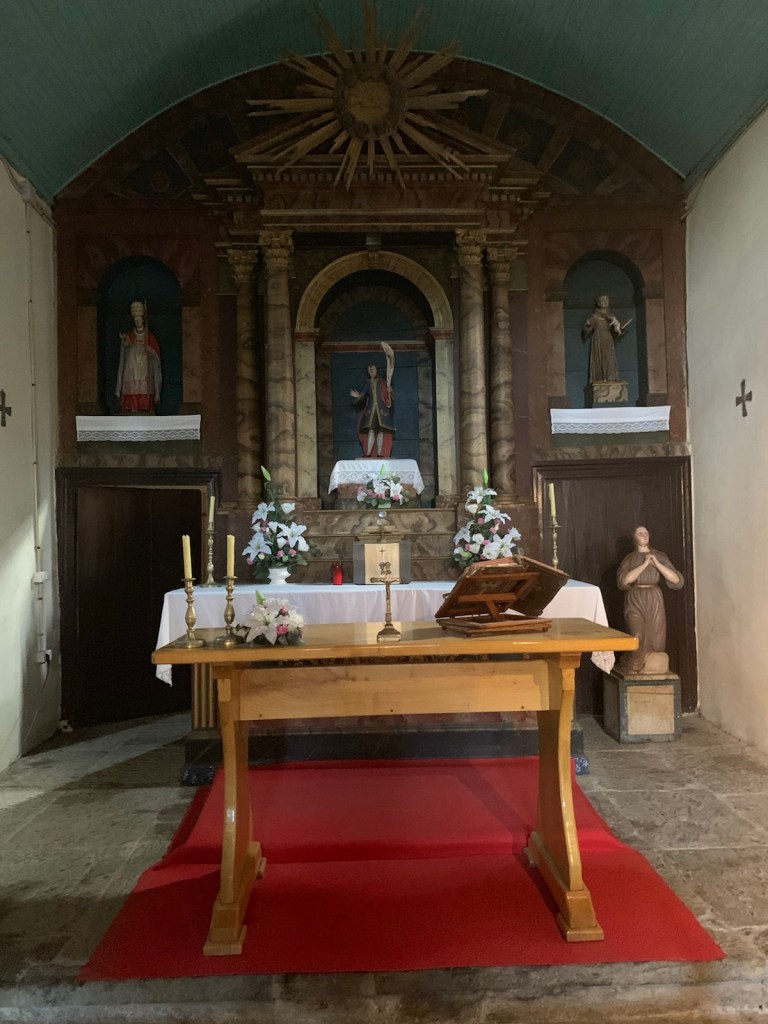
 We believe she owns both the bar/restaurant where we had breakfast and lunch plus the guest house where we are staying.

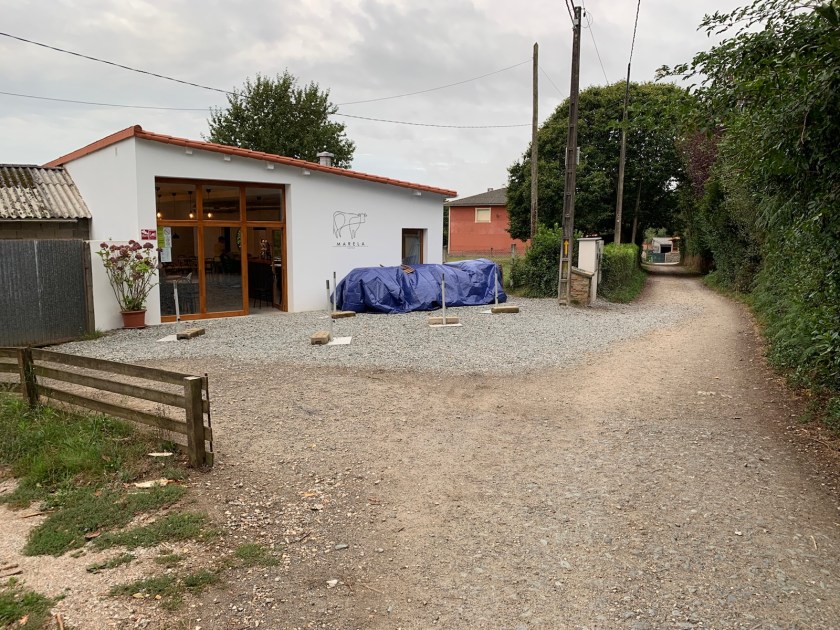 We thought it was interesting to see the contrast in this modern rest stops external design and the more typically new, but renovated multi-hundred year old structures one sees on the Camino. And the toastadas were very nice, too.
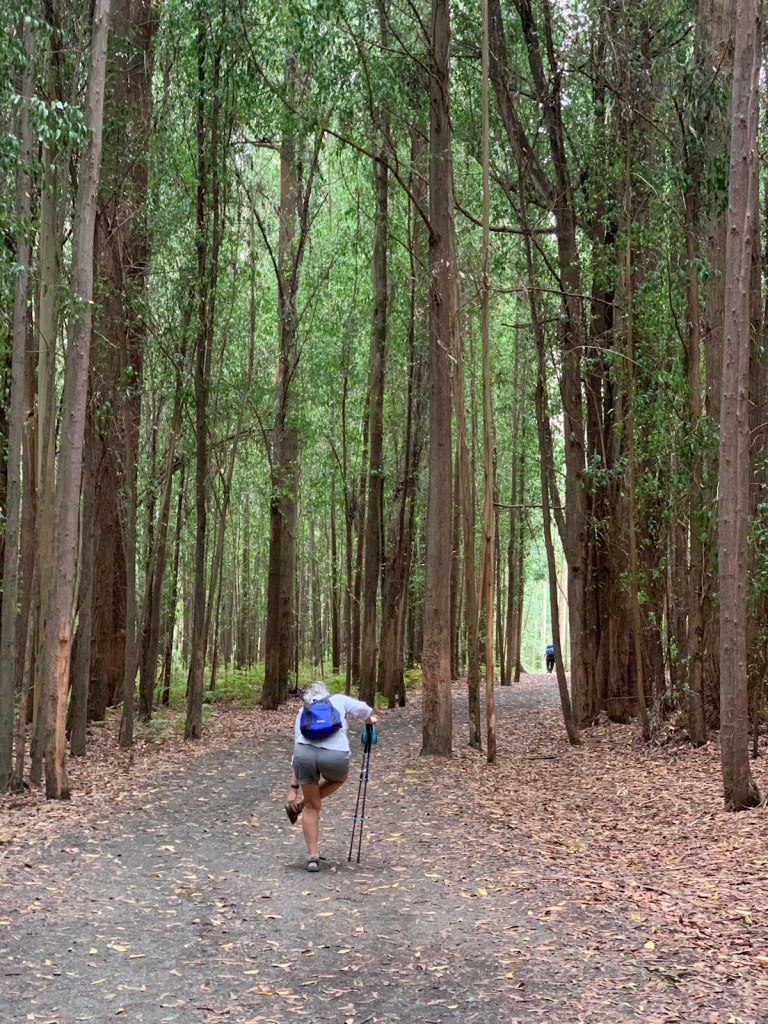 and
and 
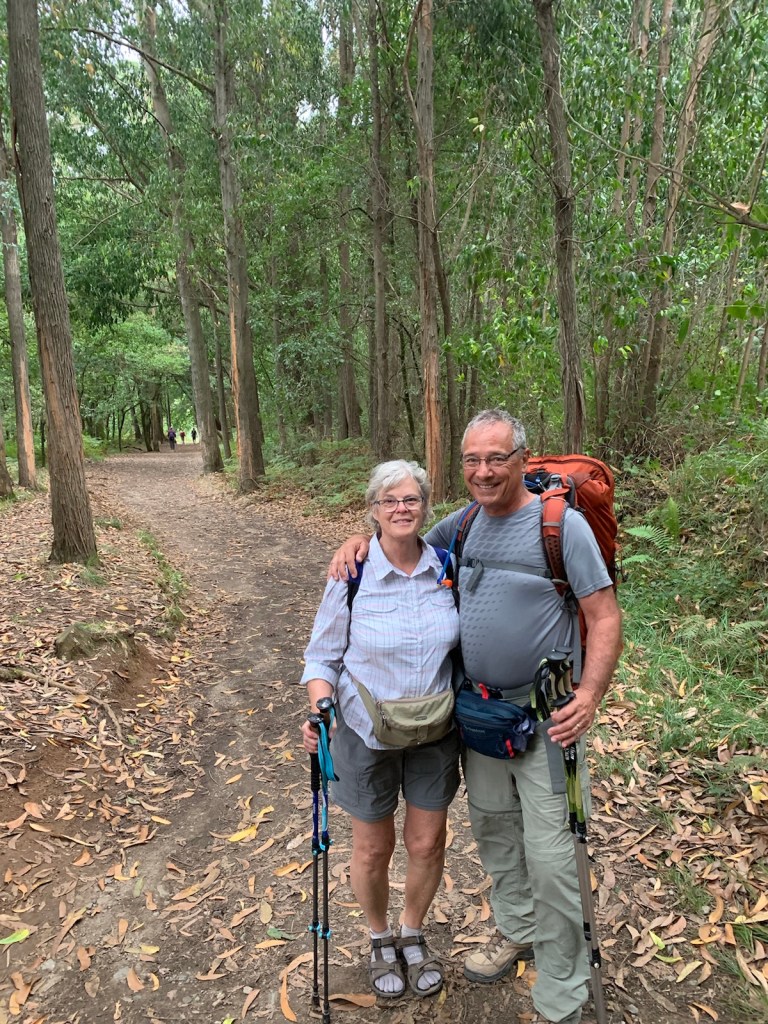 We accepted and then walked awhile with them.
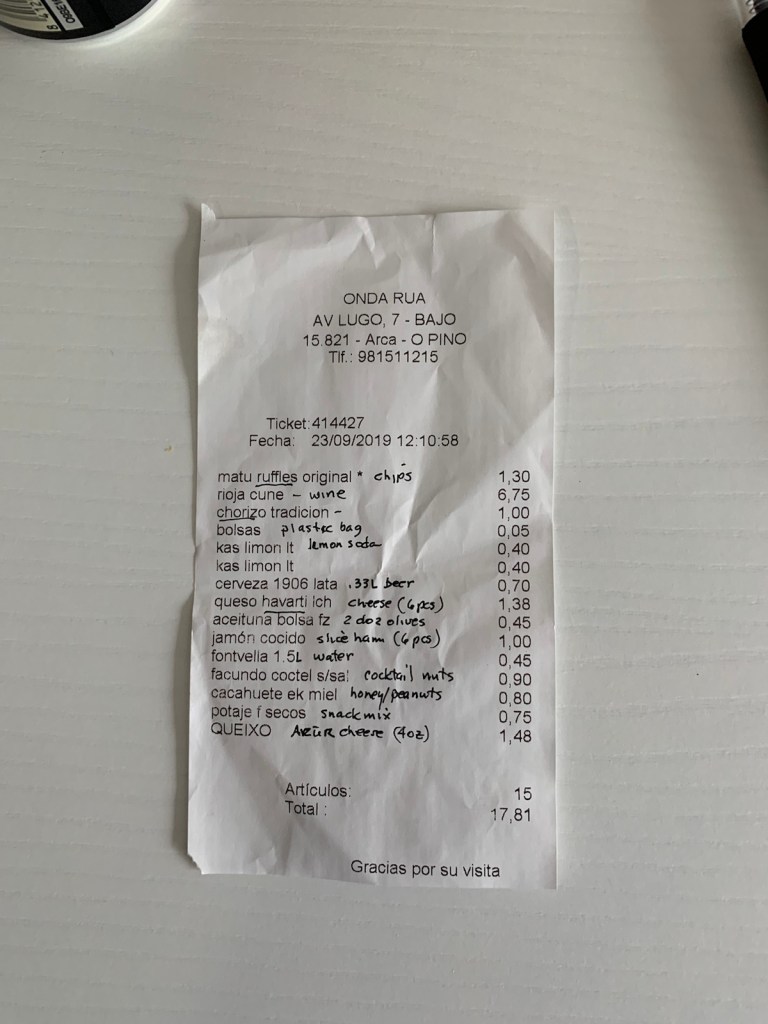
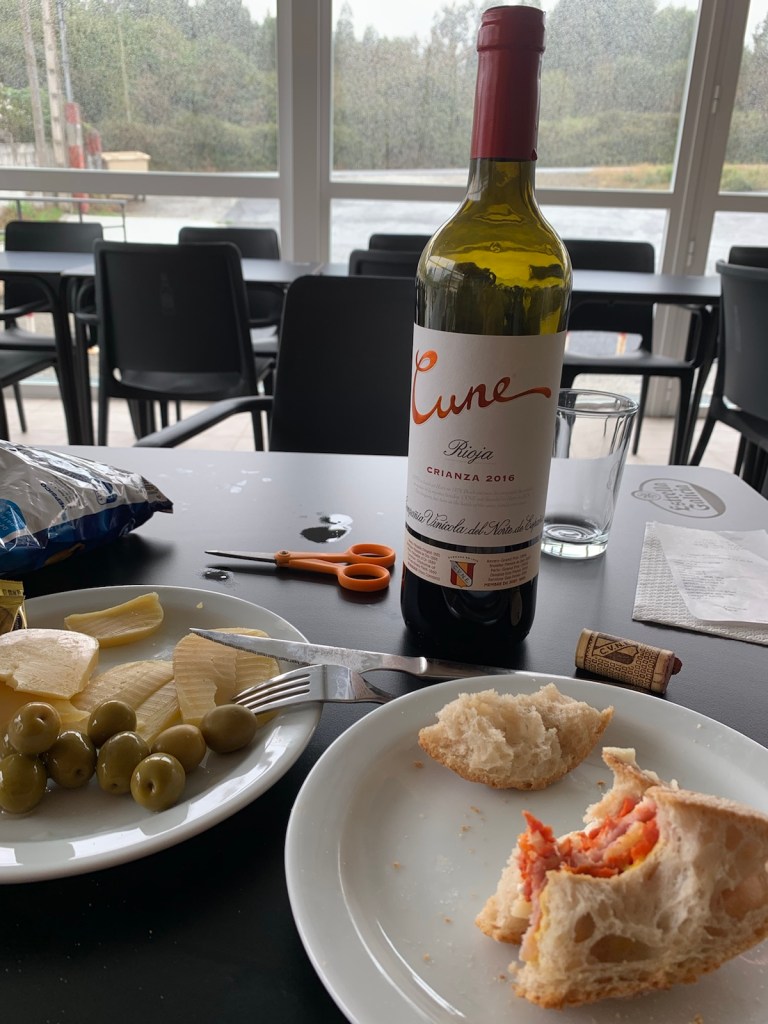 that we have purchased at Total Wine for $12-15 a bottle and in restaurants or cruises have paid $20-30 and more. The price for the same wine was €6.75!!!
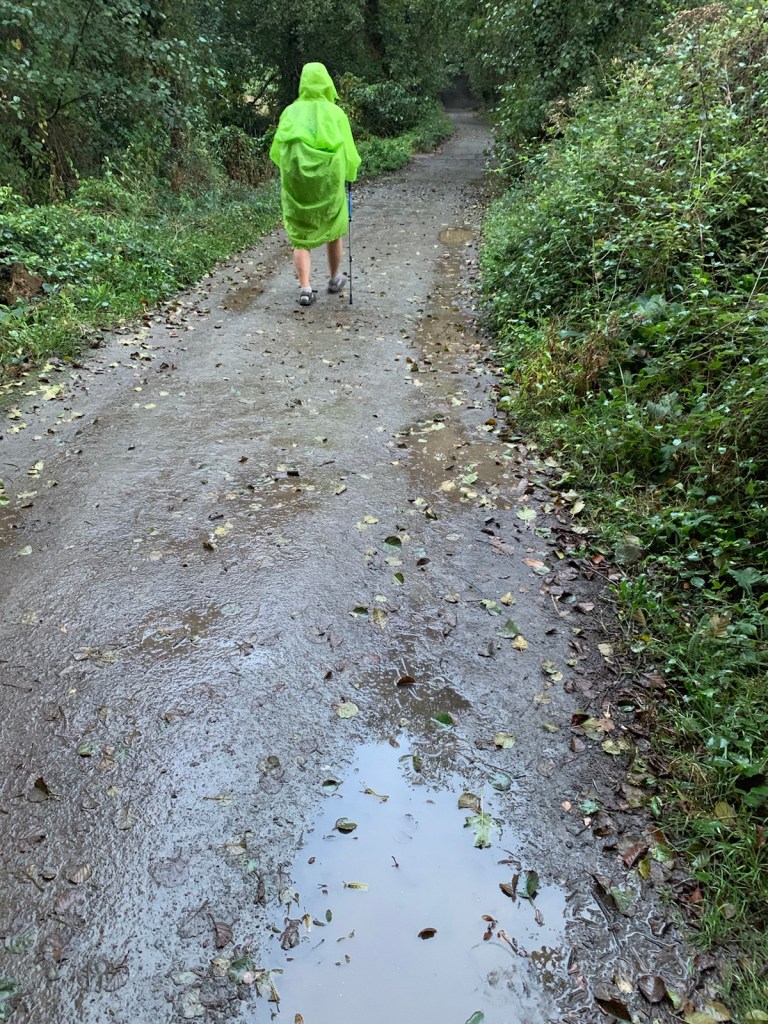 It continued to rain for a half hour or so, then evolved into a light drizzle,
 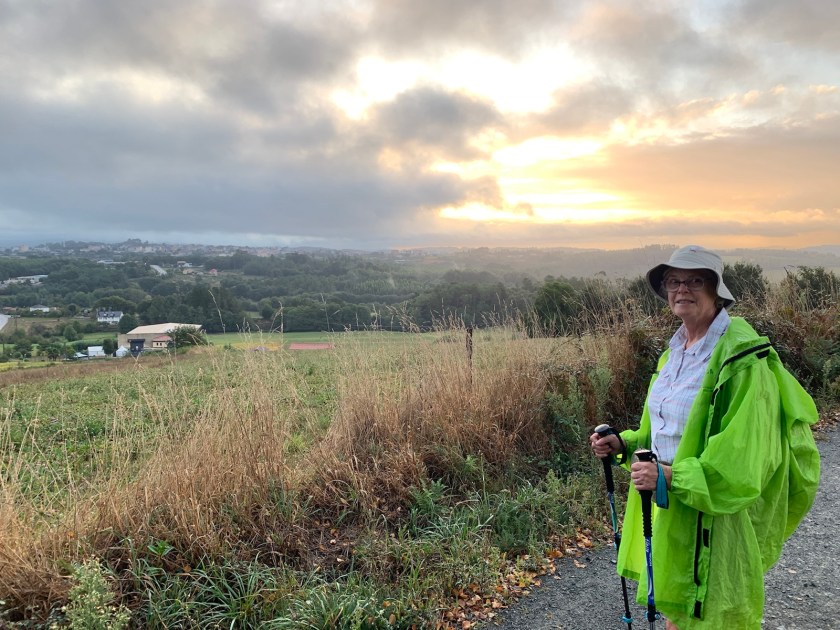 then stopped for the rest of our walk.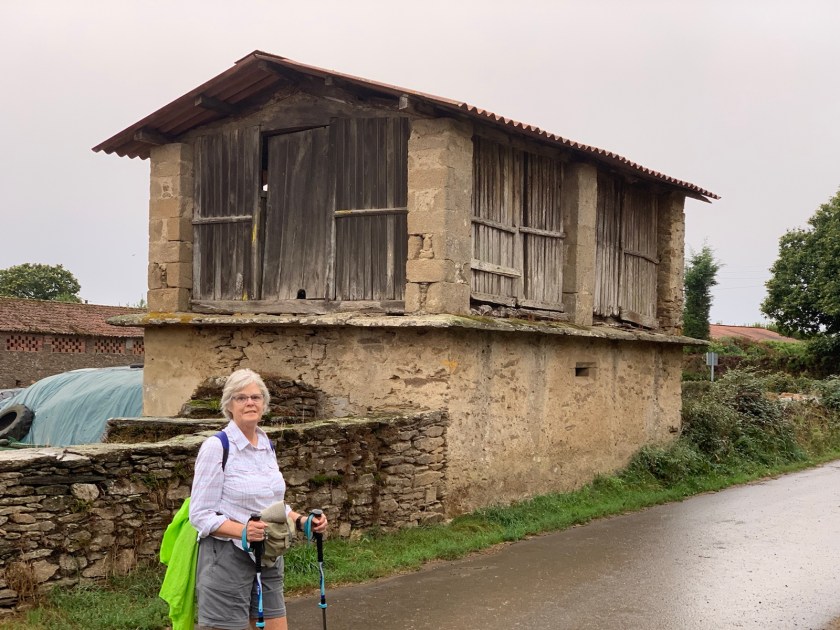
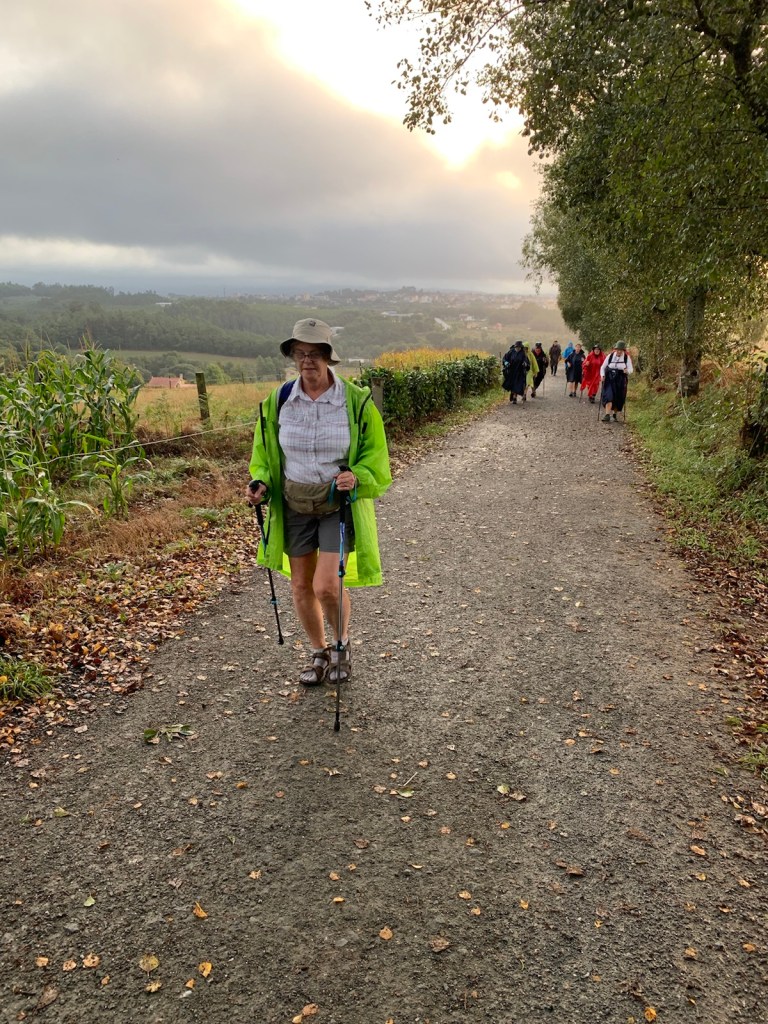 Resting places were nicely spaced and
 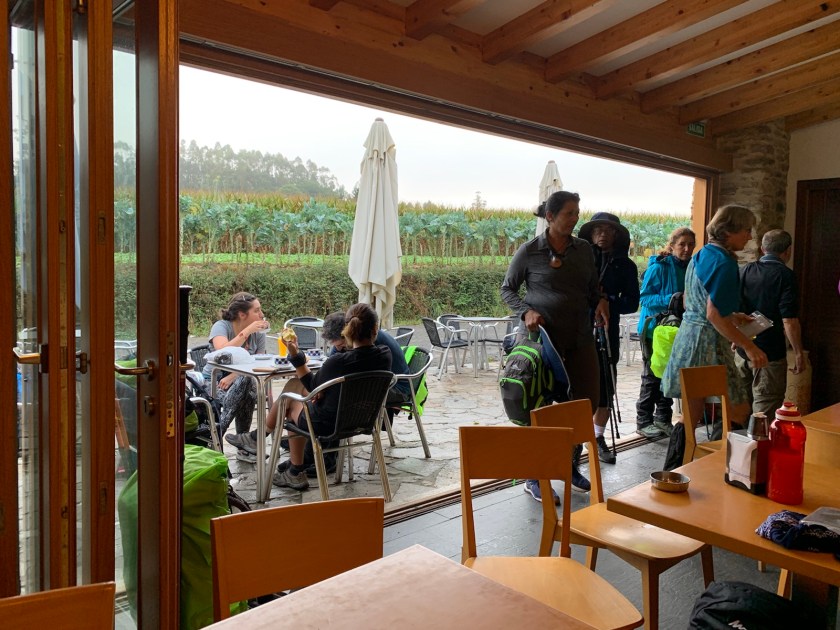 frequent enough to prevent excessively long waits for services.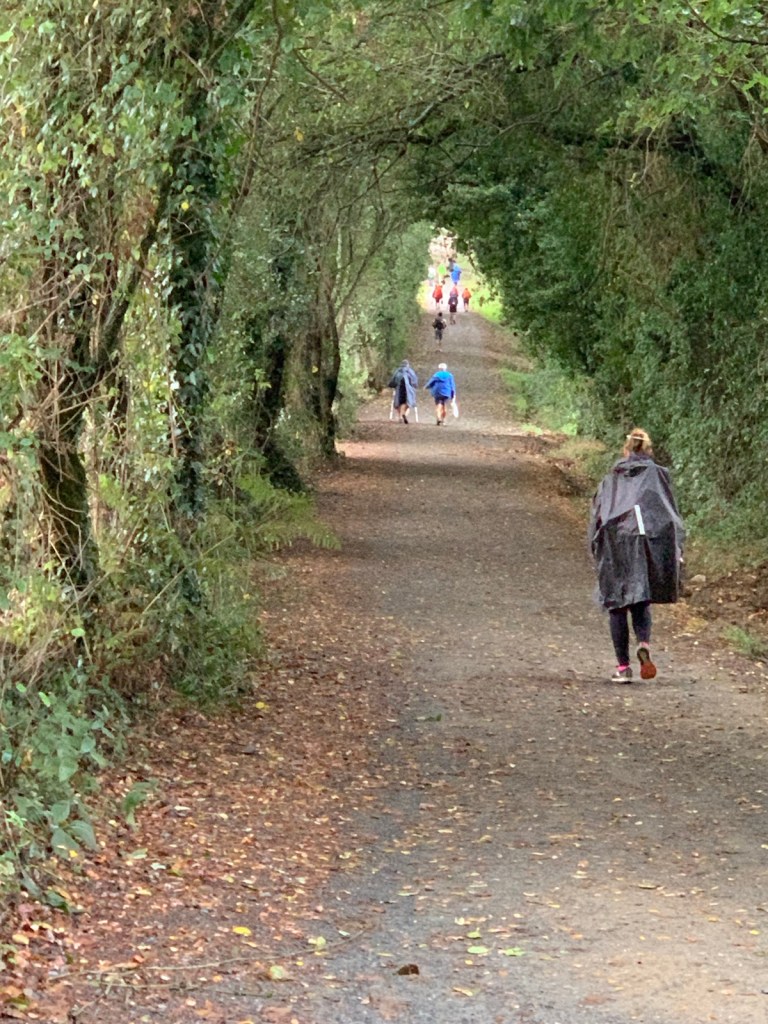
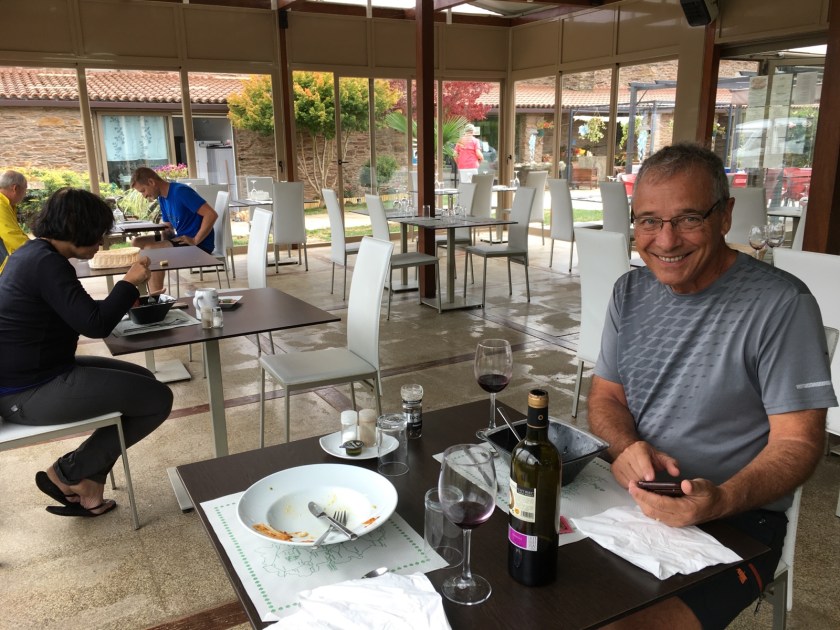 until our room was ready and chatted with a young lady from Hanover, Germany, who had walked from SJPDP and we enjoyed sharing our experiences and impressions of the Camino Frances, until our respective rooms were ready just before 1:00.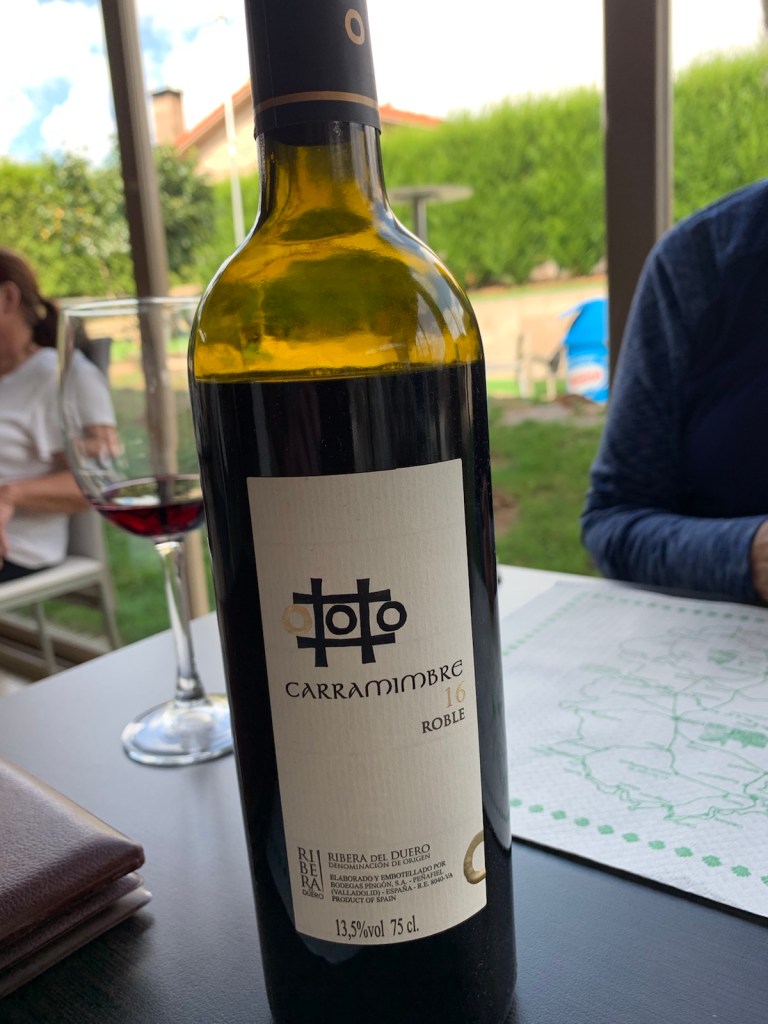
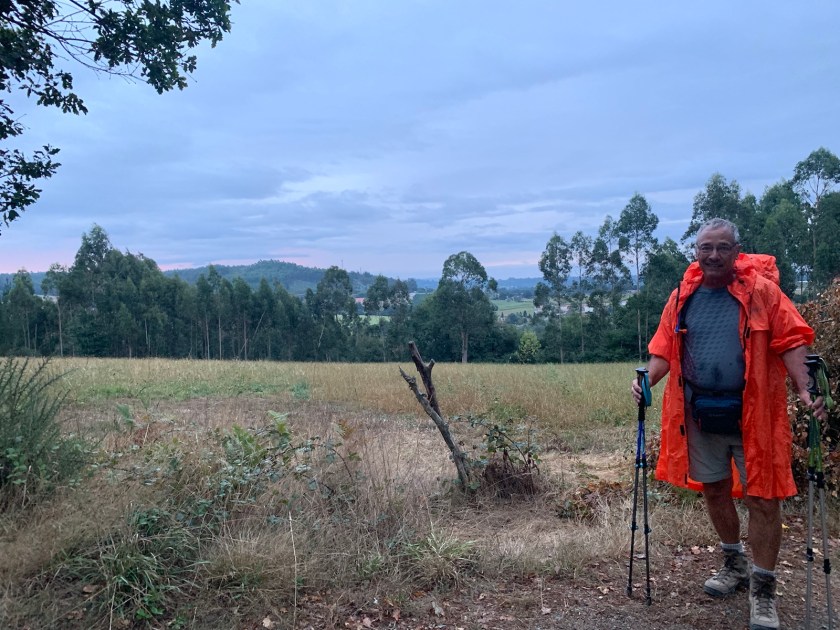 holstein pastures, open unplanted fields
 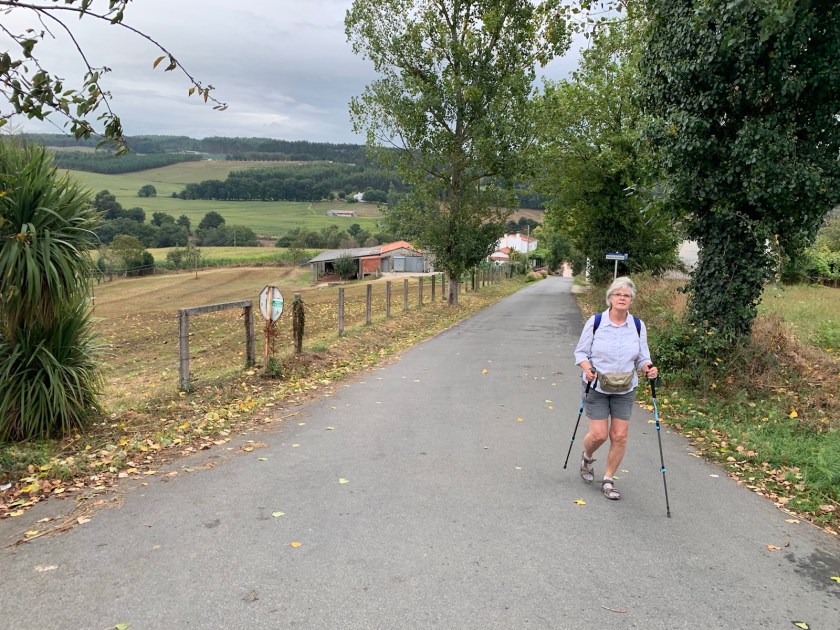 and eucalyptus forests,
 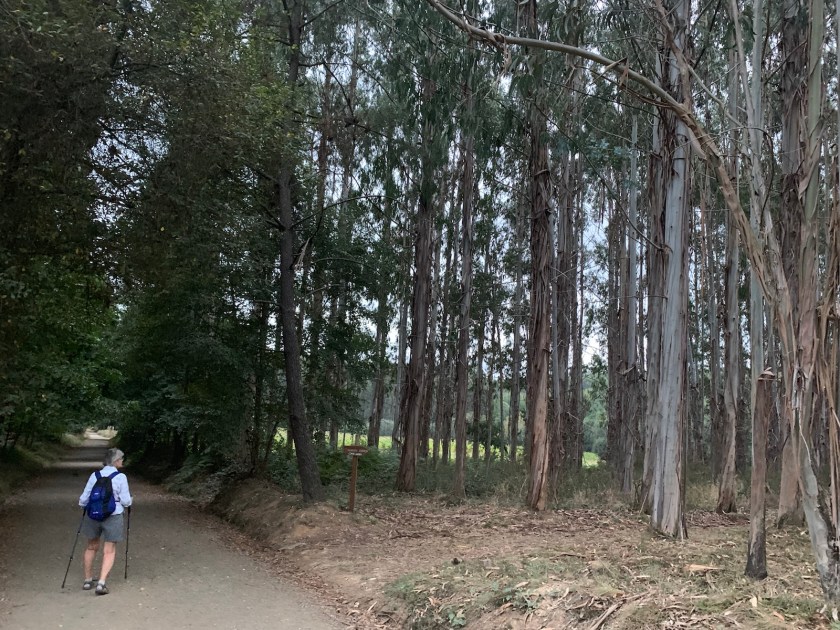 not necessarily in that order.
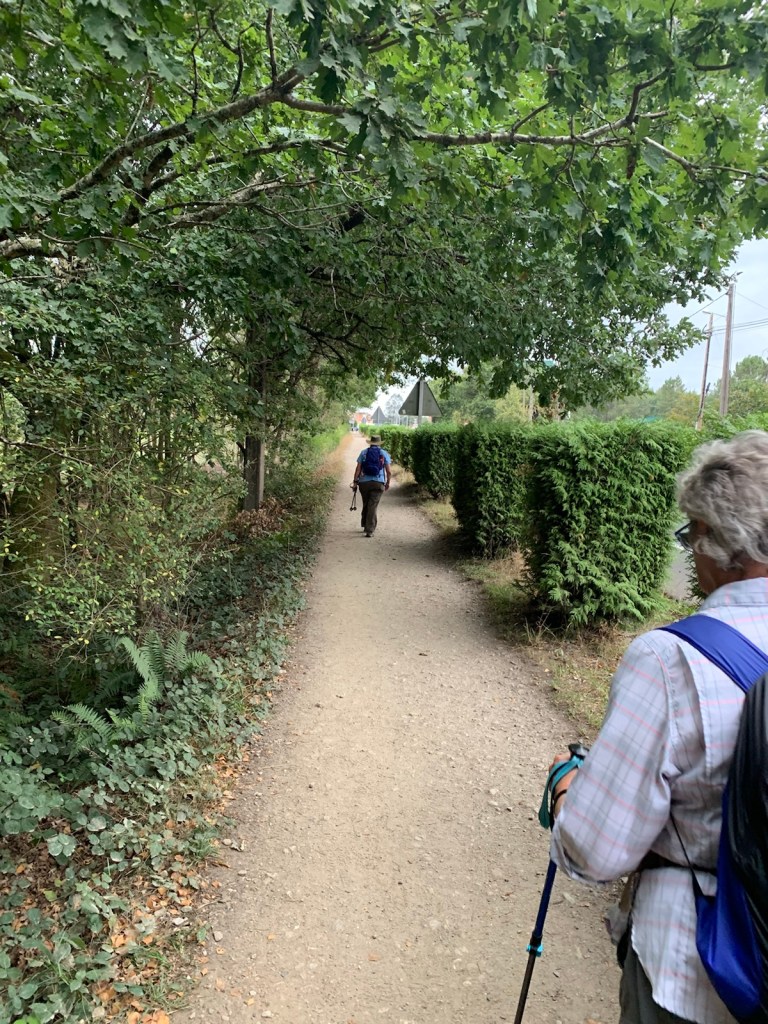 road or on
 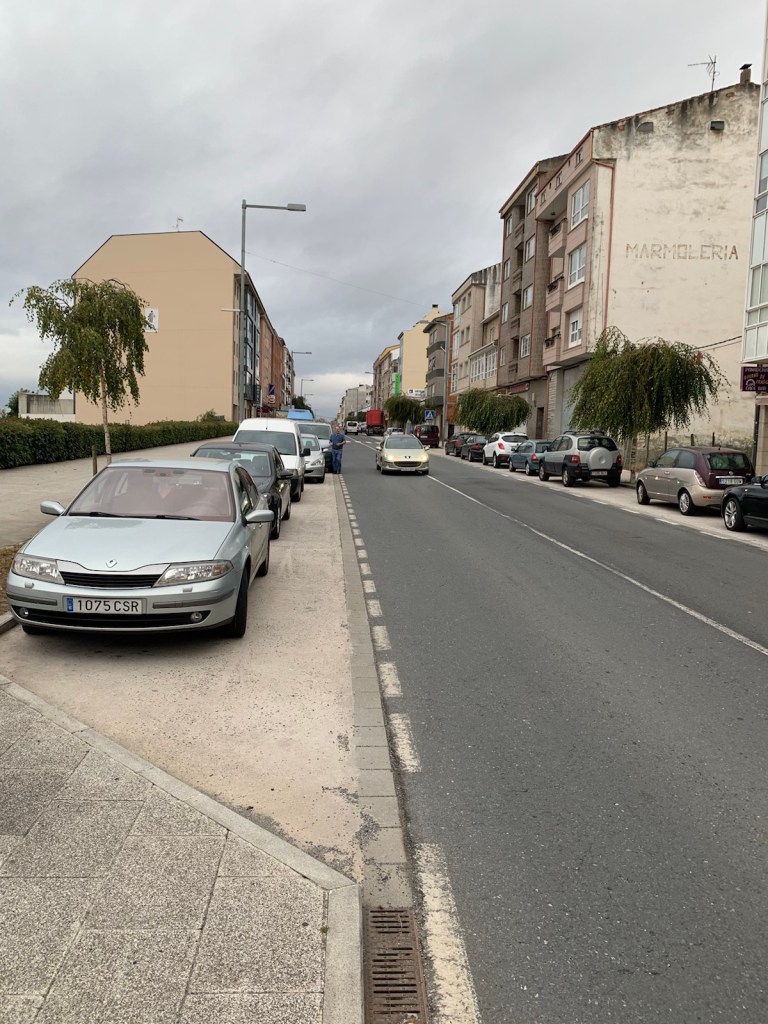 city sidewalks into Arzúa.
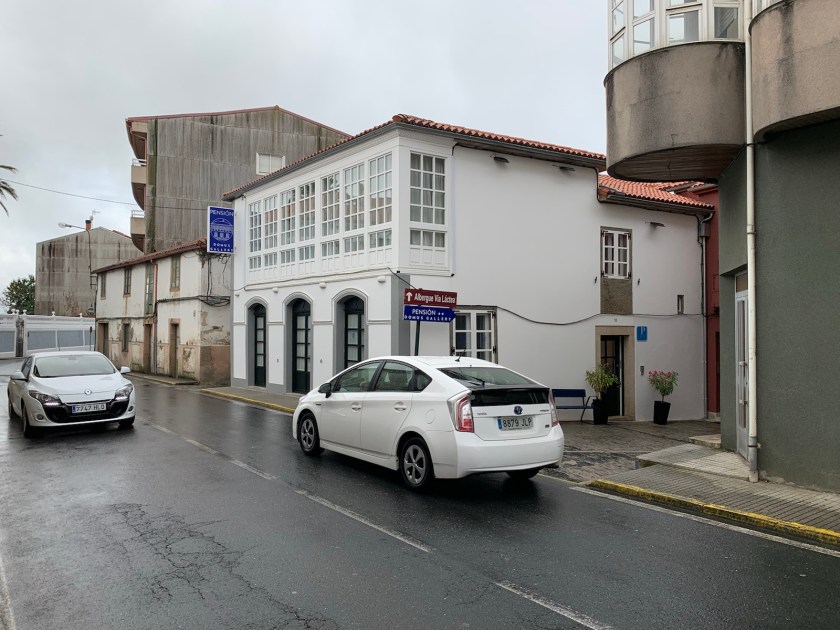 in Arzúa at 10:15 and were able to check-in shortly thereafter. As soon as we sat down in the pencion lobby, waiting for our room, it began to rain seriously… boy, did we dodge a bullet this morning.
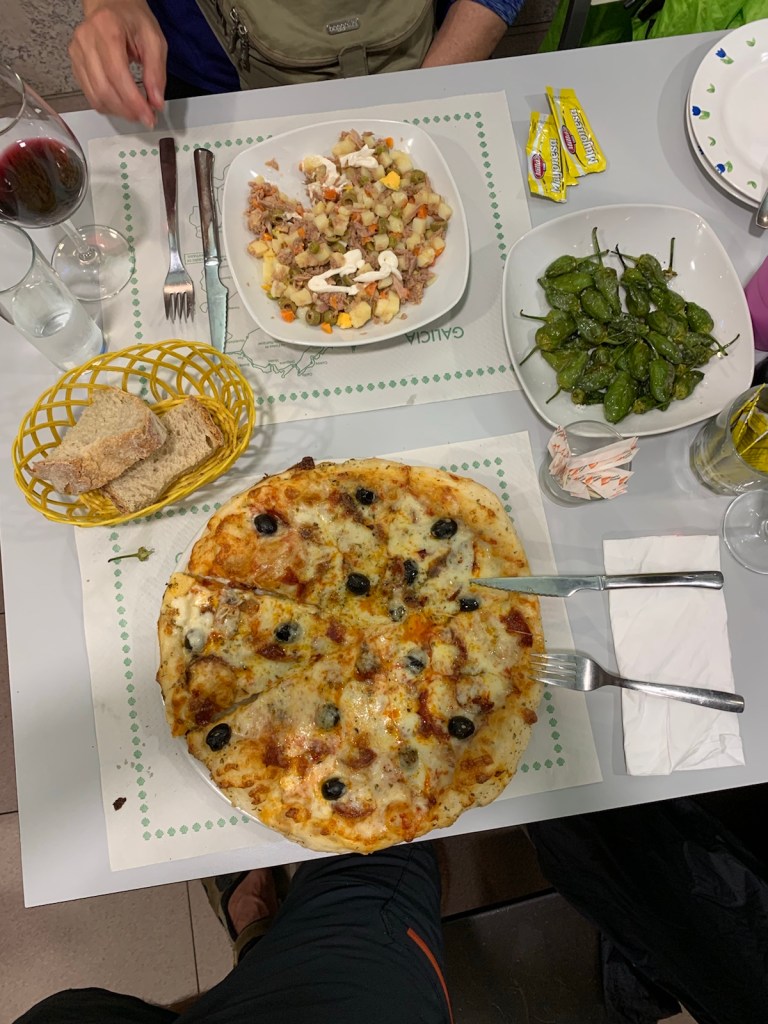 It was a delicious combination of pizza, roasted padrón peppers and ensalad Rusa.
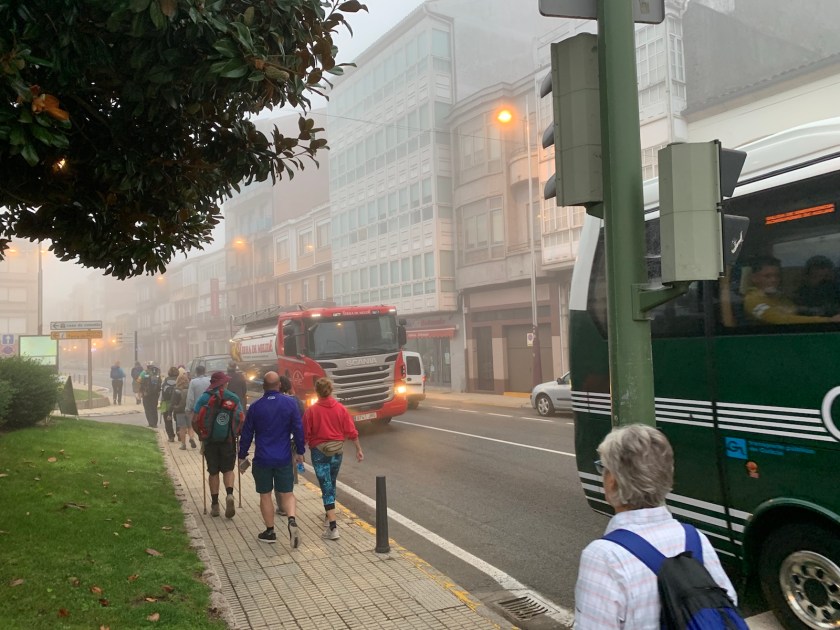 but not enough.
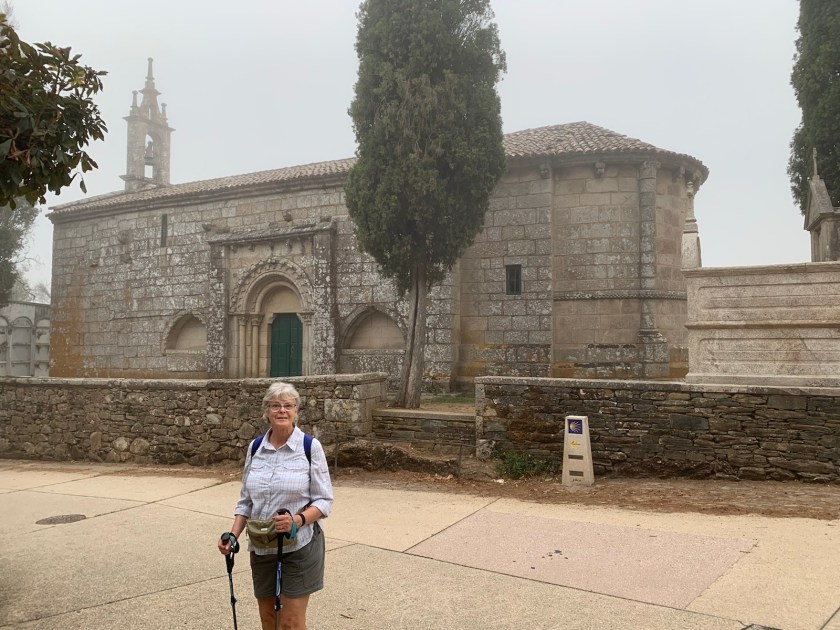 a 13th century church and considered a national monument. It was locked but it was still impressive from the outside.
 but upon closer inspection had a small door for each of two separate compartments,
  carta (mail) and pan (fresh bread delivery).
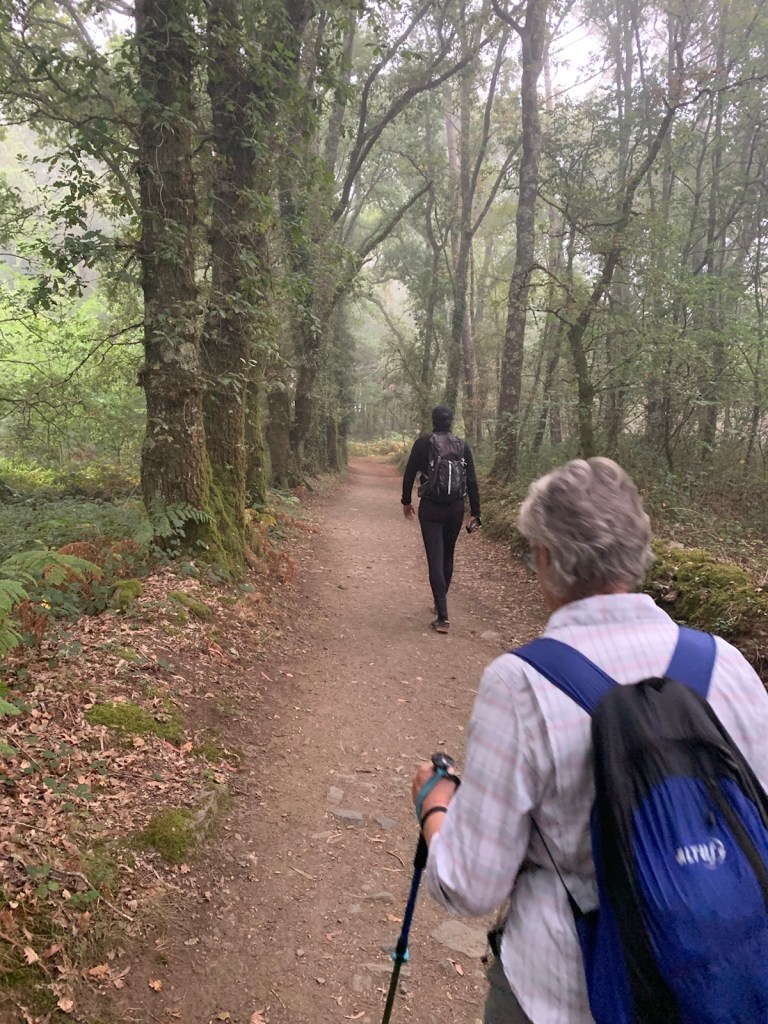 of predominantly eucalyptus trees that are harvested for wood products, a major contributor to the area economy.
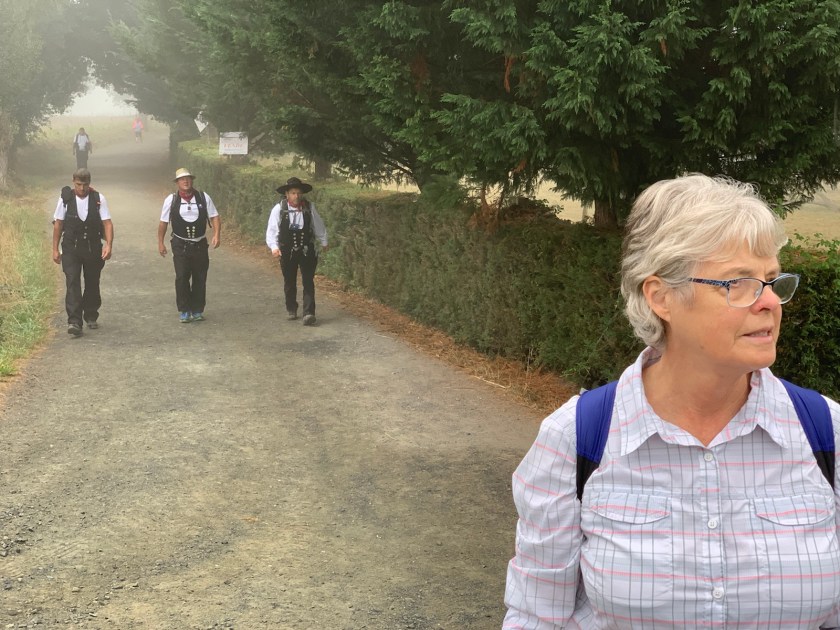 Jim chatted with three different guys as they passed us along the way and discovered they were from Germany, near Kaiserslautern. They all worked for Zimmermann, a roofing company. Herr Zimmermann was also apparently walking with the group. Their outfits were sharp looking and we got a closer look
 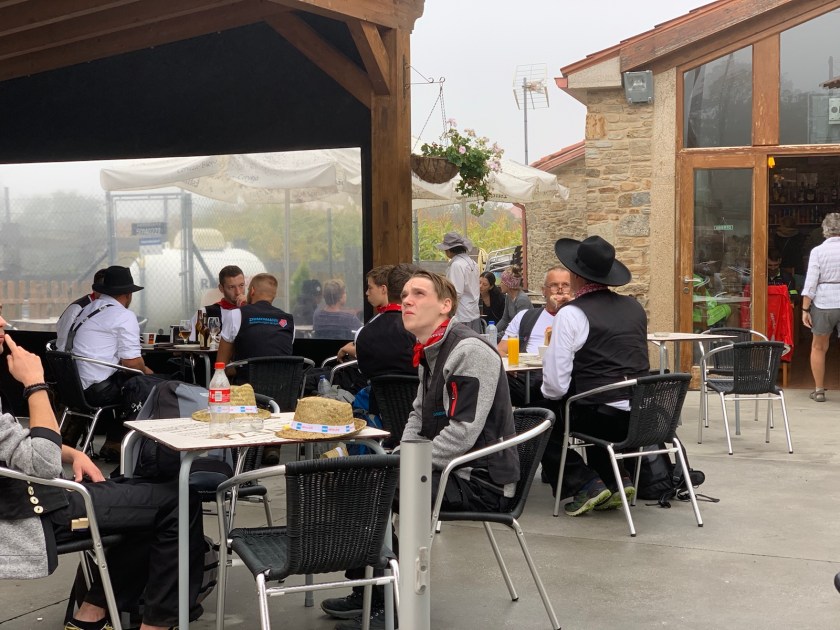 as a number of them stopped at the same bar for a break. Each of the guys had a special pocket on their pants leg
 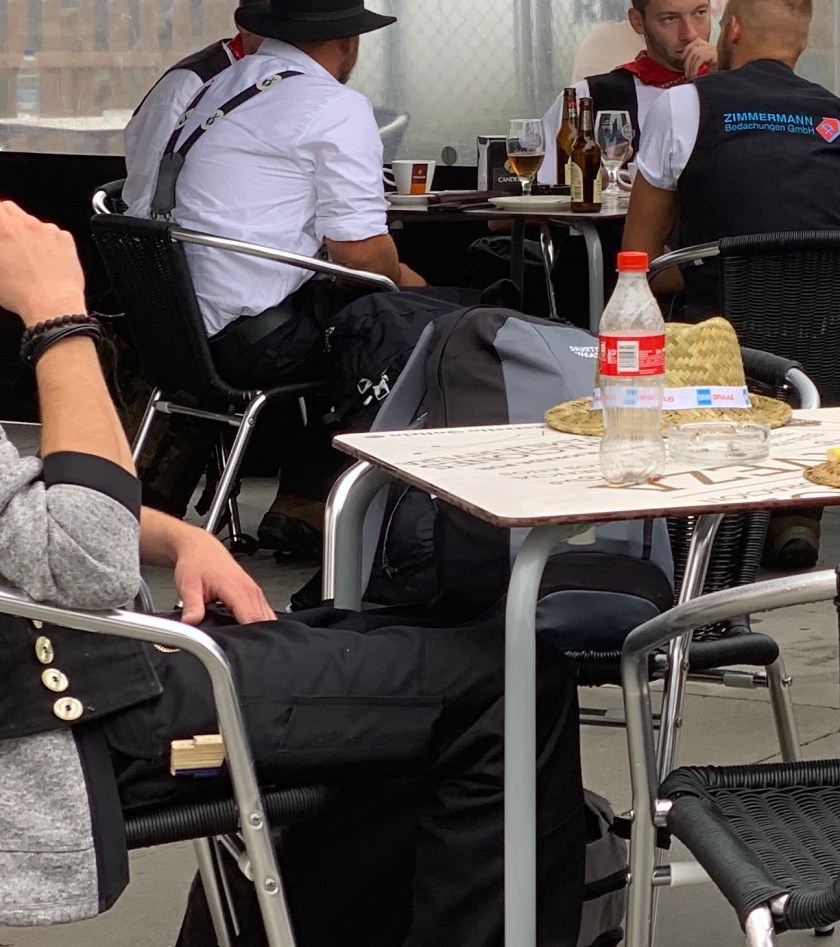 that was holding their carpenter “wooden, folding rule”.
 Cafe/Bar/Albergue Tourista “Santiago”, in Castañeda.
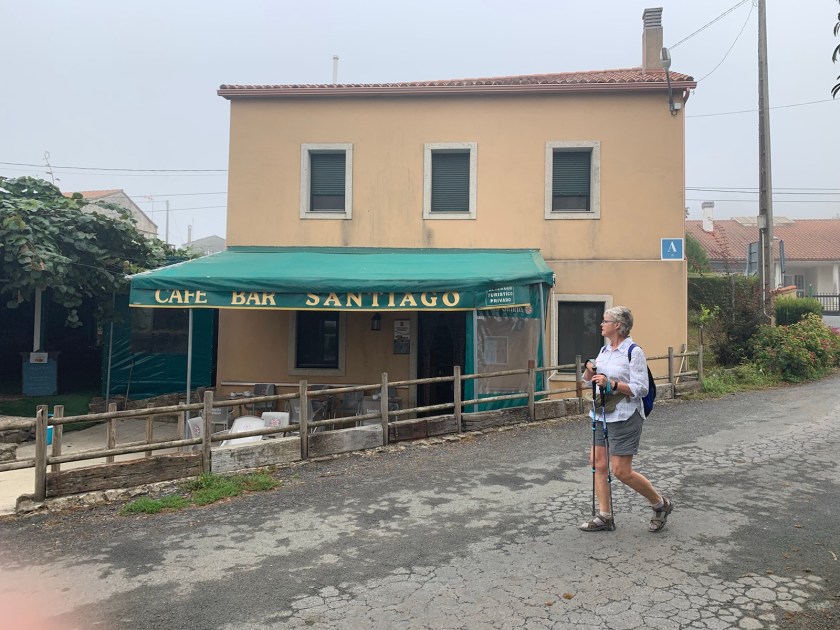 and decided to give it one more go in 2019.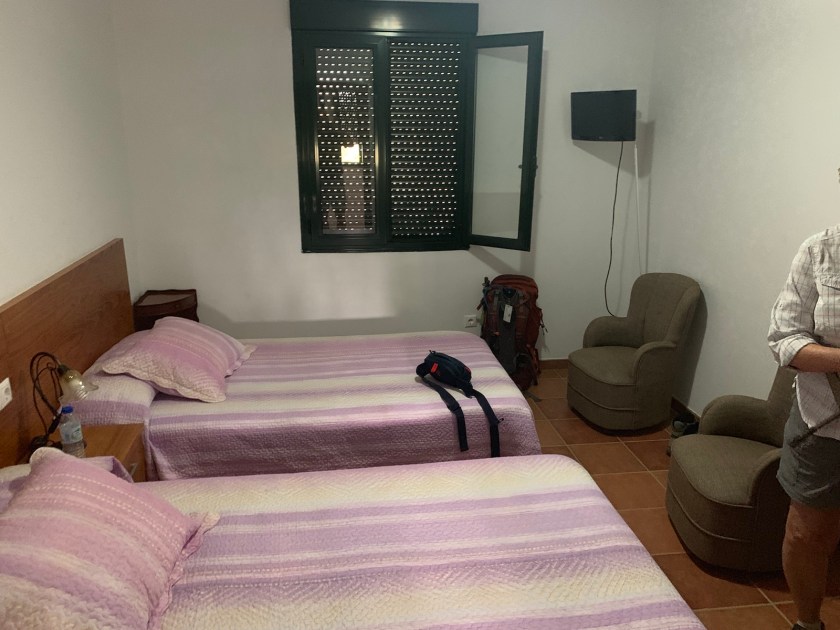
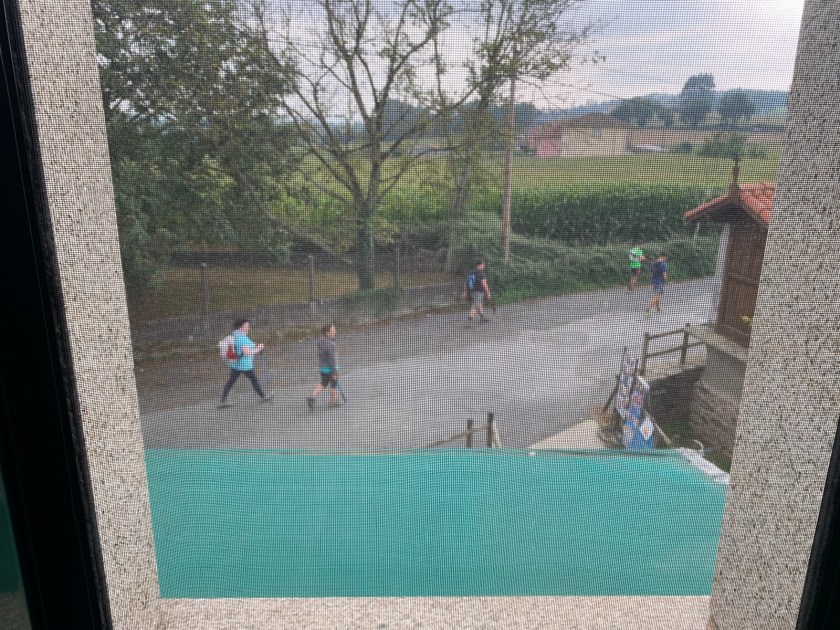 from our bathroom window or the outside sitting area.
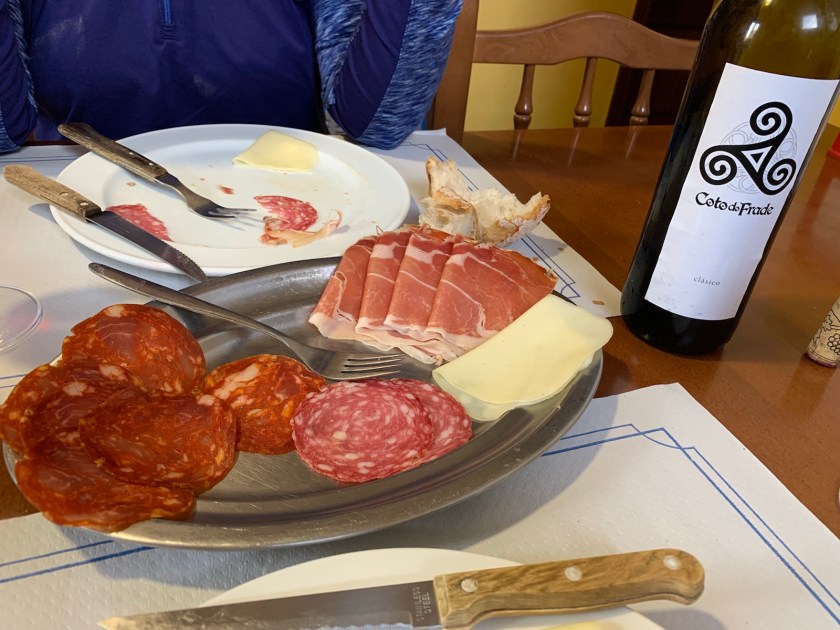 We had a first course of cold cuts and cheese and
 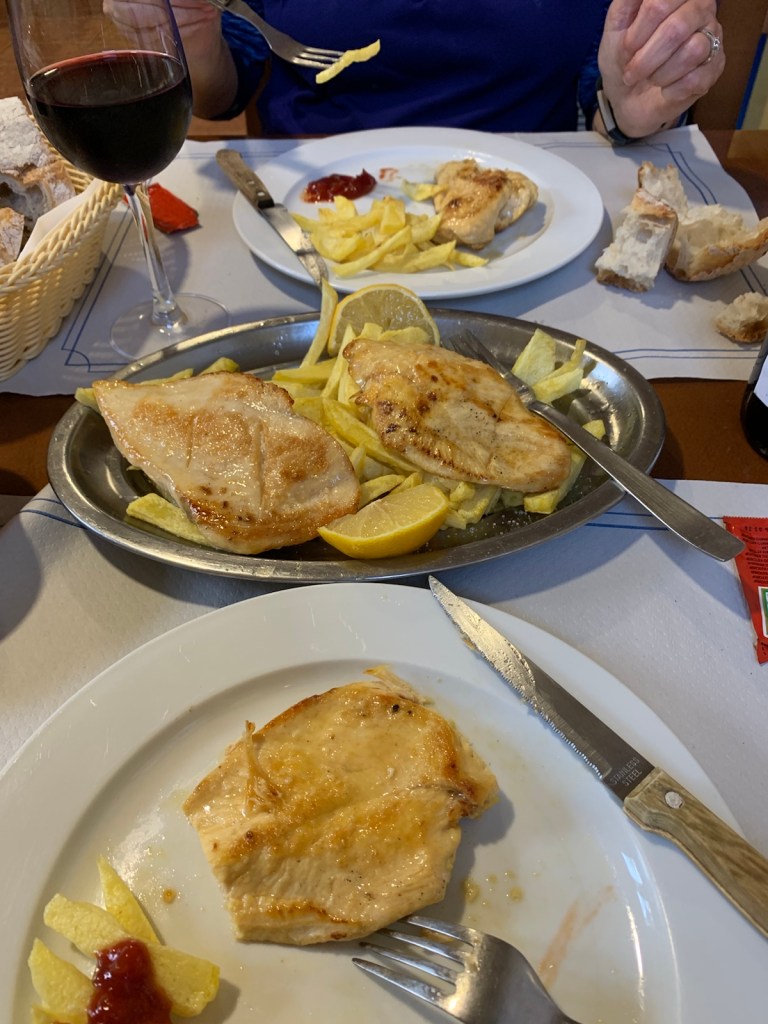 main course of grilled chicken breast and fries. Yum.
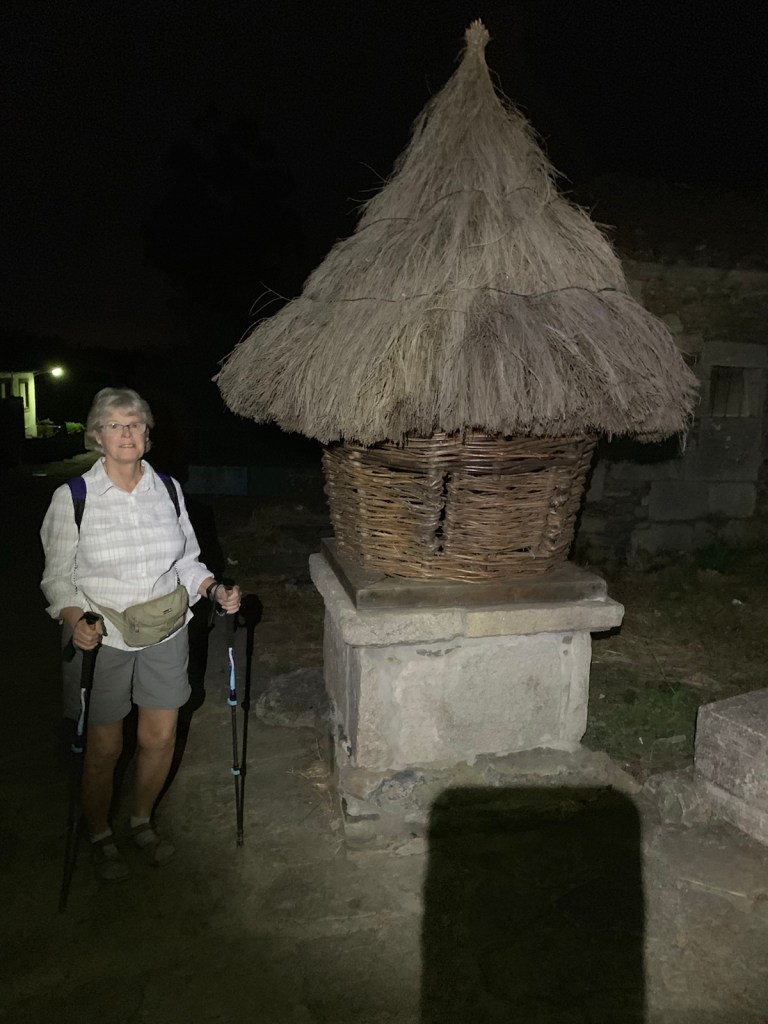 If we haven’t already mentioned, hórroes are for storing grain and corn safely from unwanted critters and weather.
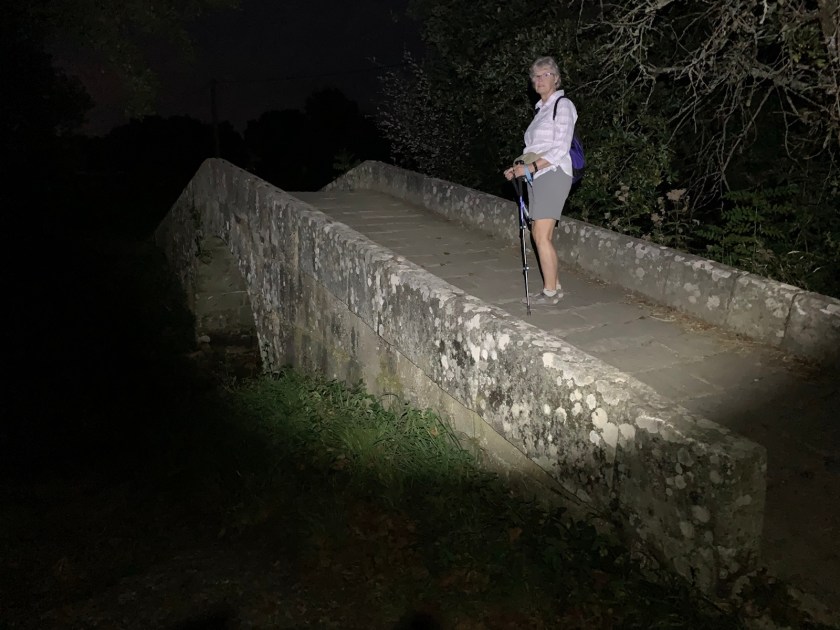 a medieval bridge in the hamlet of Disicabo.
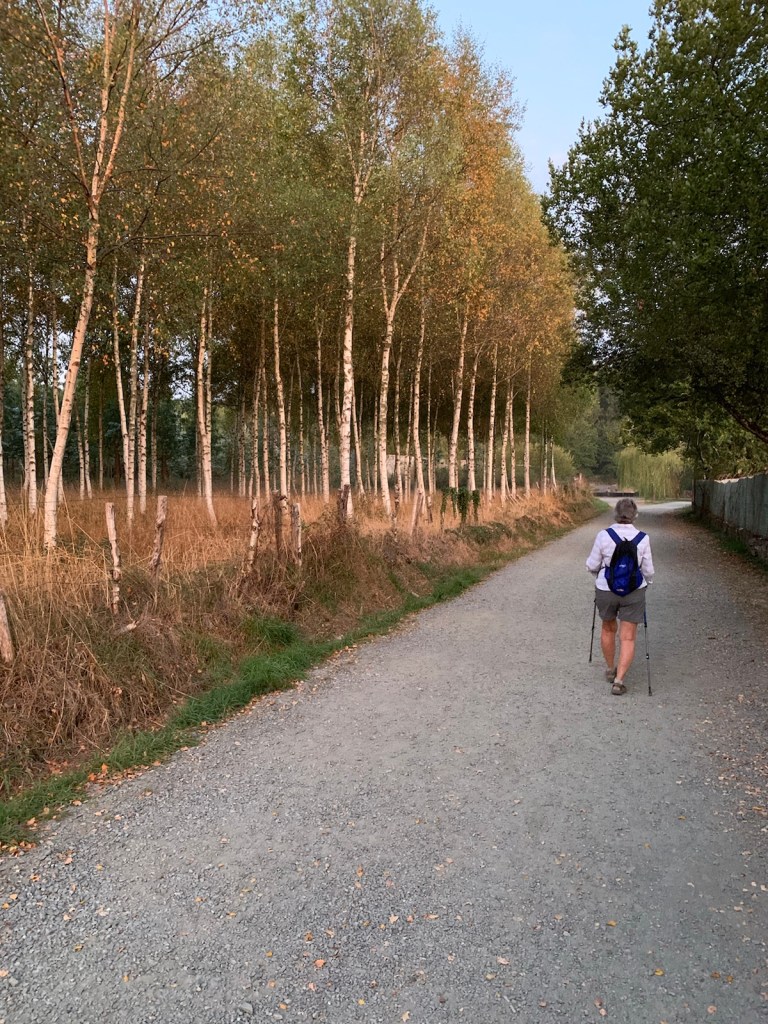 then back into some forests
 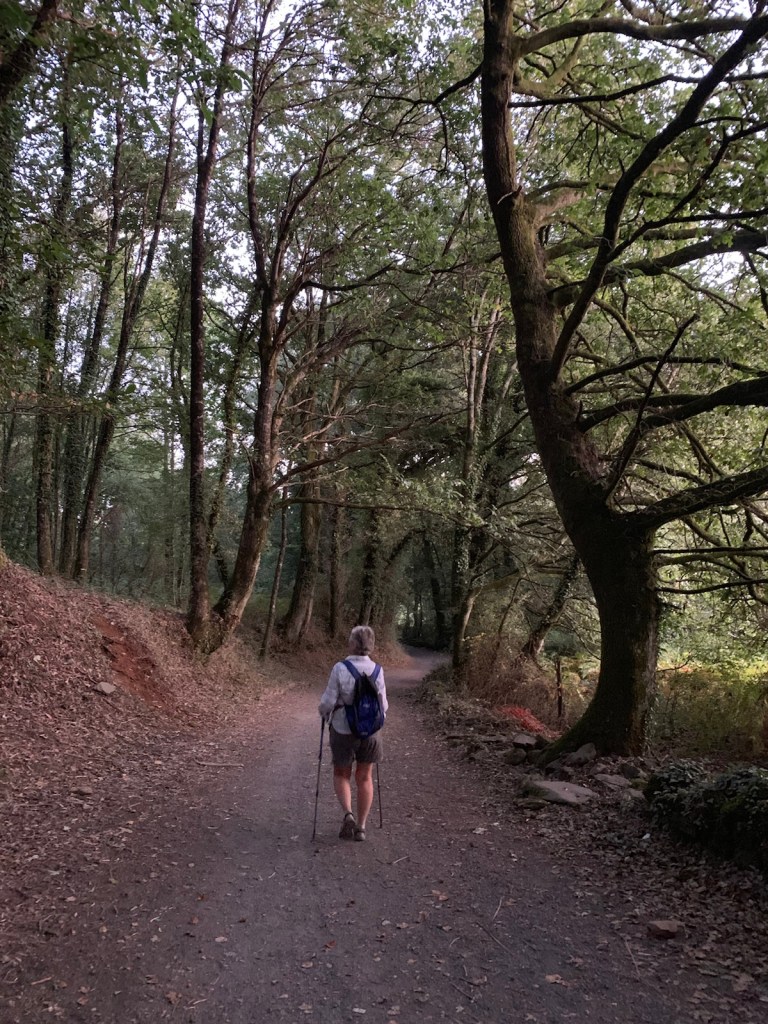 as it got lighter between dawn and sunrise.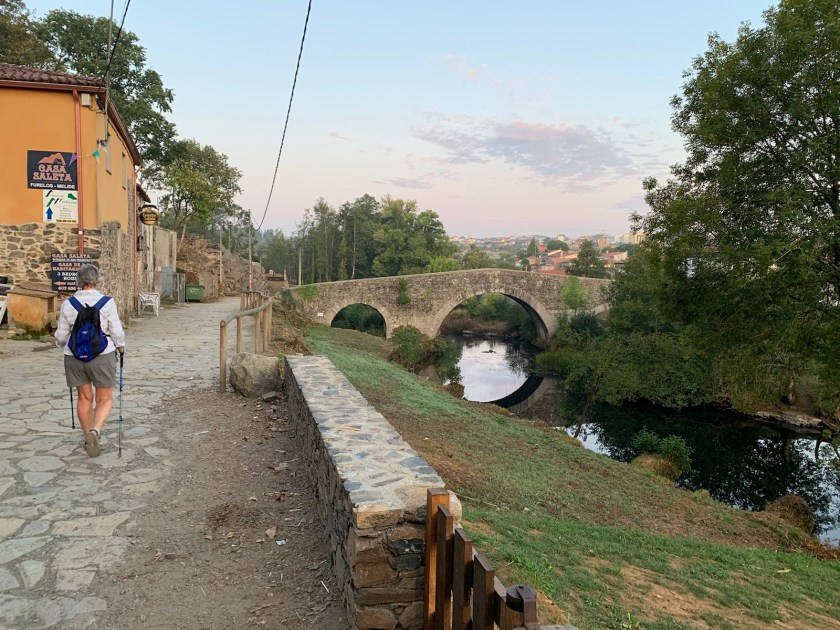
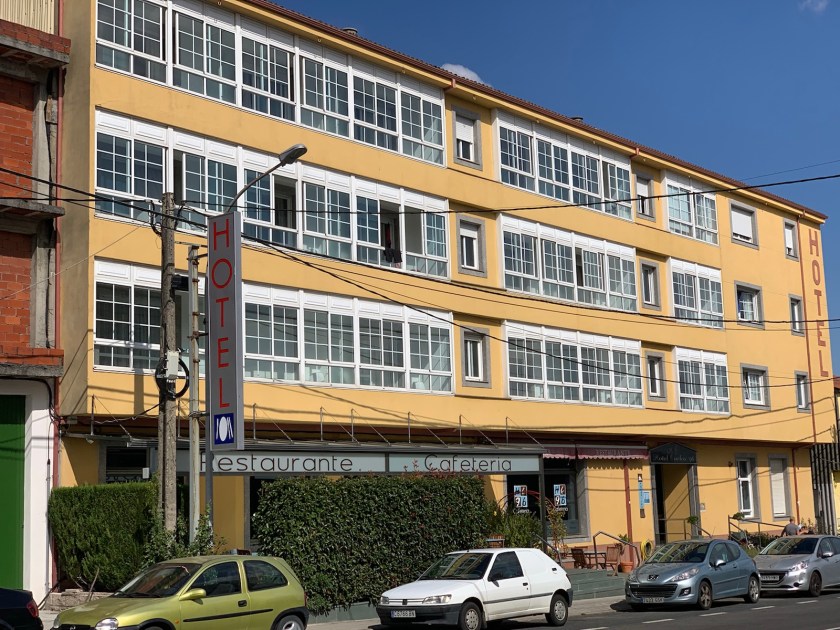 our hotel for today and tonight.
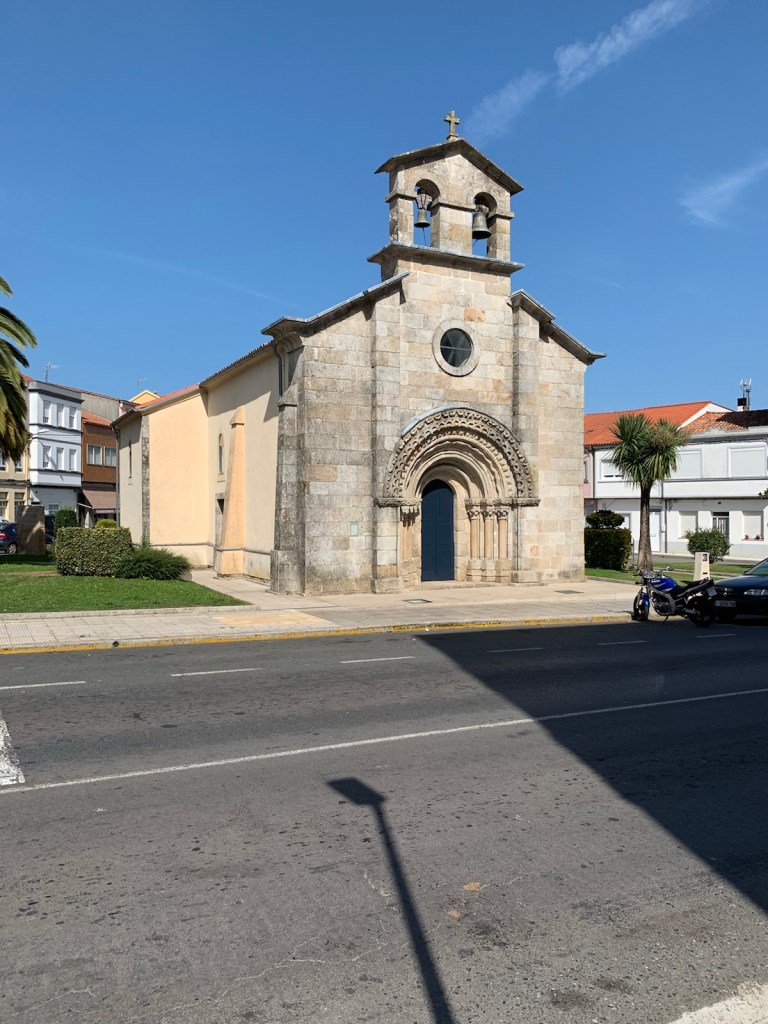 features 14th-century tombs with local coats of arms, and the
 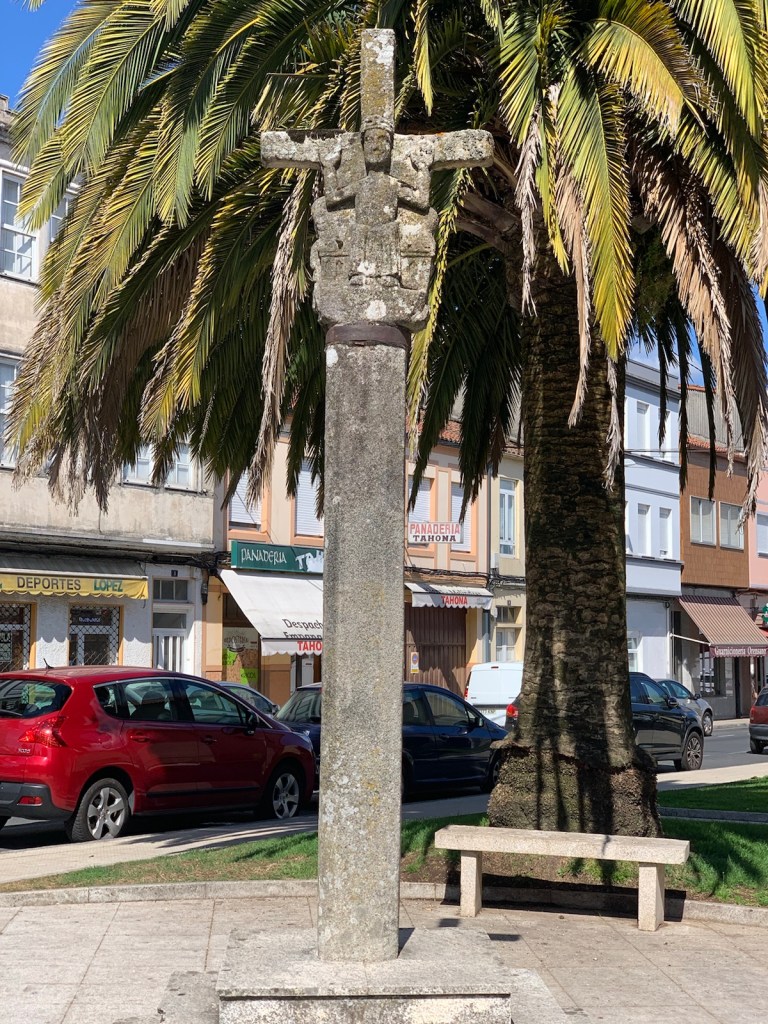 stone cross outside depicts the crucifixion.
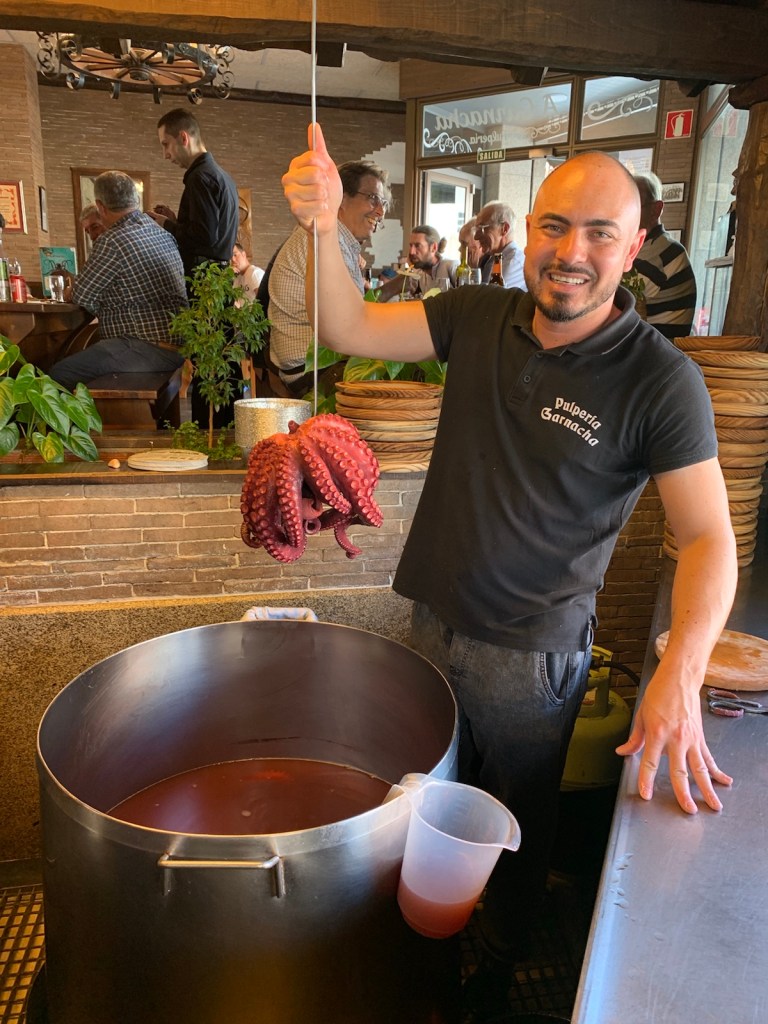 Since then, we have sampled it in a variety of places both on the Camino and elsewhere, and we think Melide’s version is the best, and more specifically, Pulperia el Garancha.
 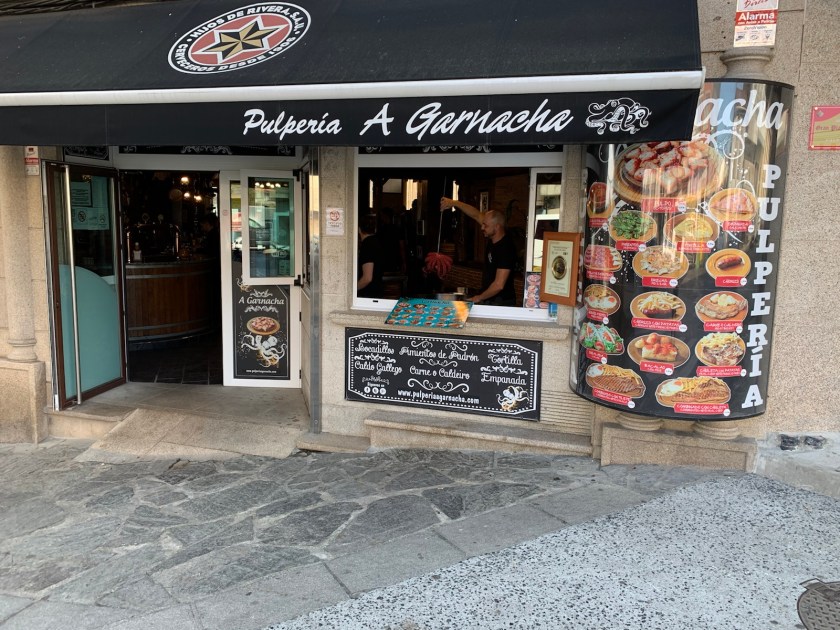 This was the source of our takeout dinner last night. Garancha also has the best roasted Padrón Pimentos we have ever tasted.
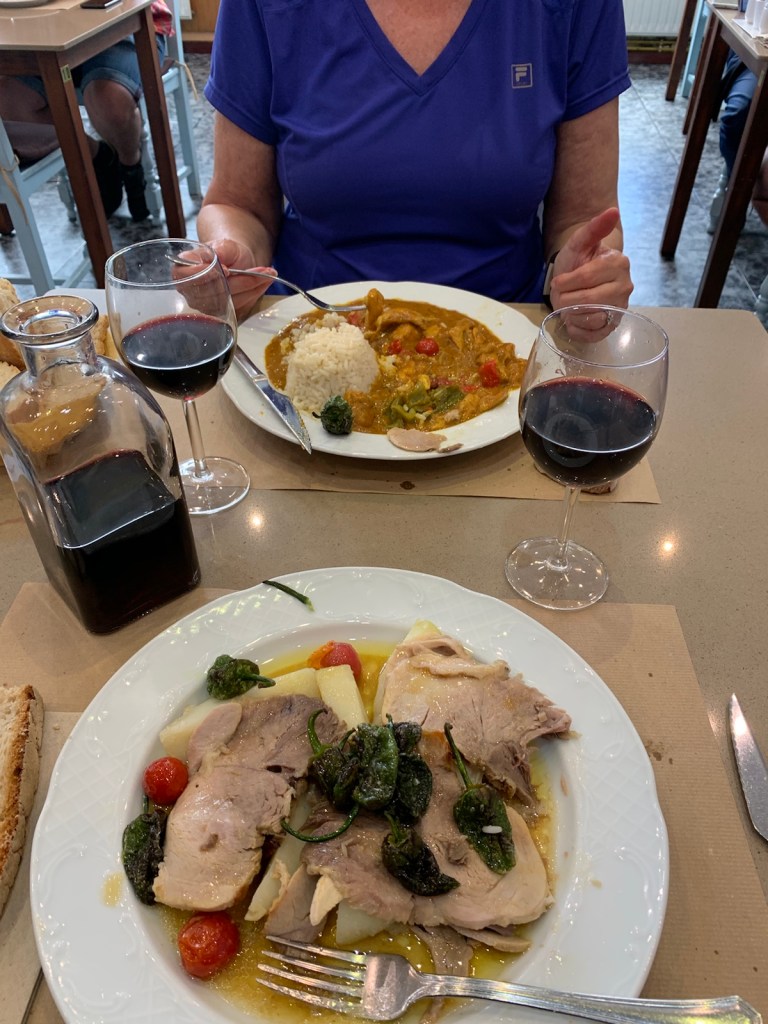 and roasted turkey with Padrón peppers for Jim. Dessert was rice pudding for Linda and ice cream for Jim. A local (no label) wine was included.
 Jimandi