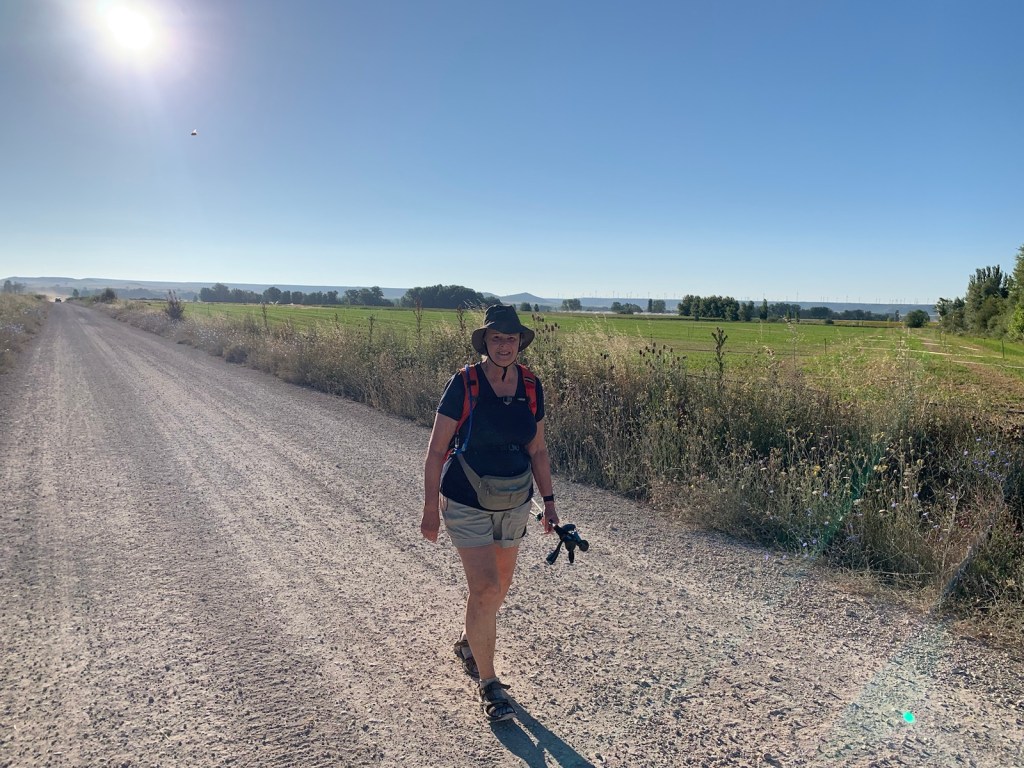
This morning was another nice one for walking at a cool 50F, with an occasional breeze. The sun was bright and strong by 9:00 but was mostly mitigated by the cool, dry air.
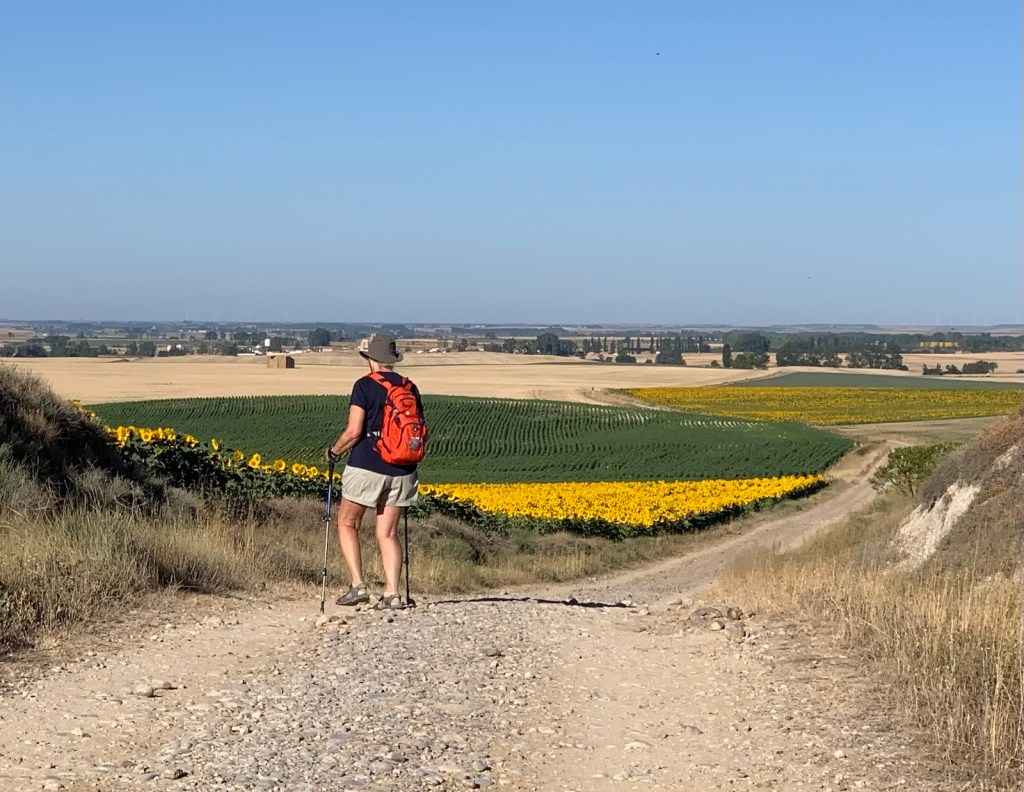
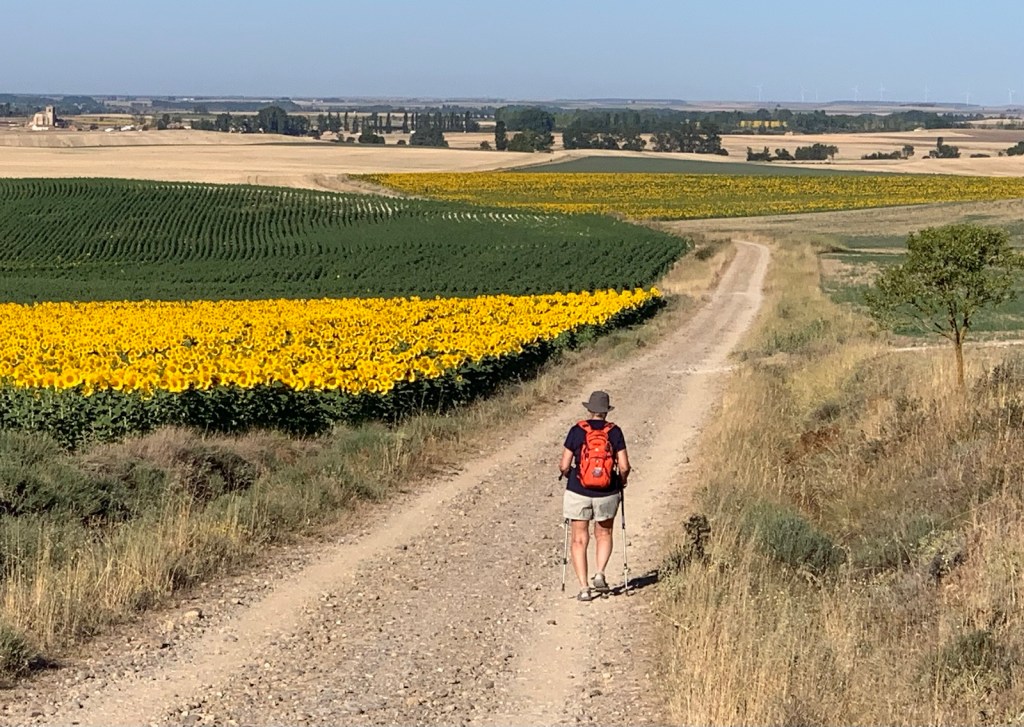
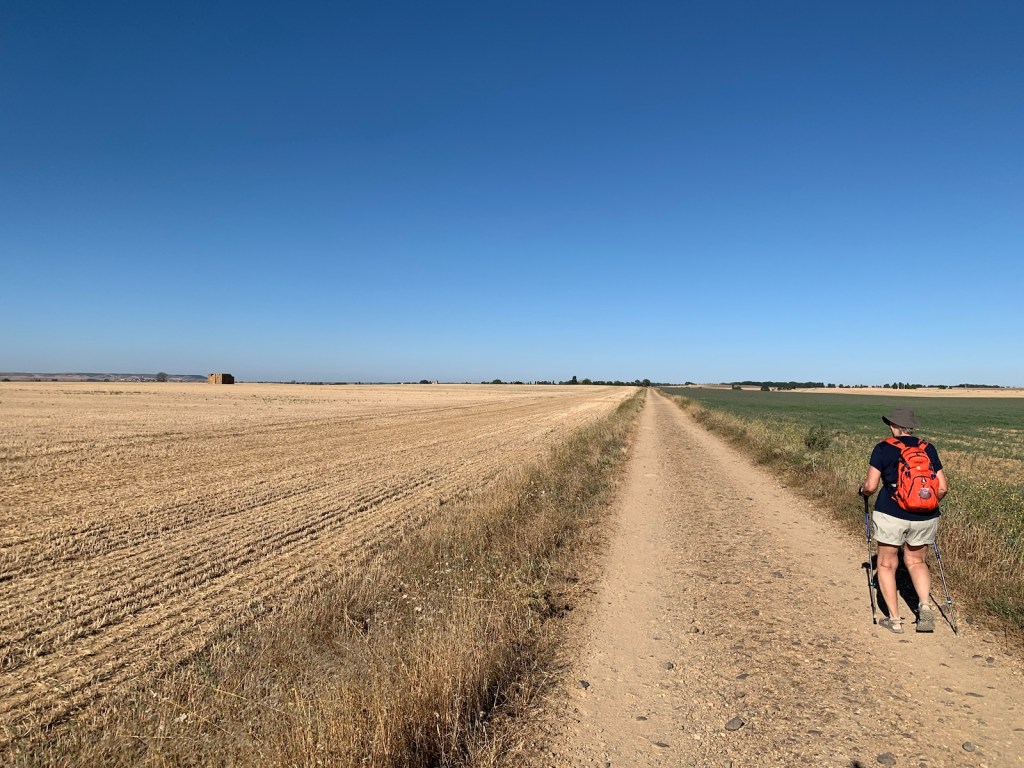
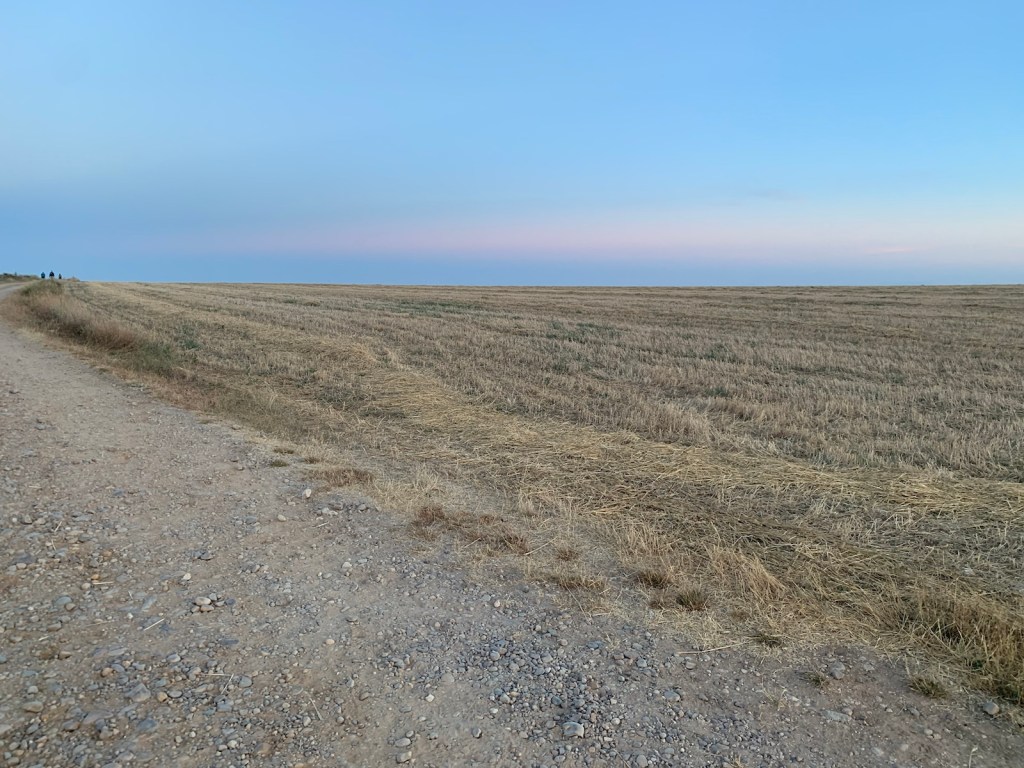
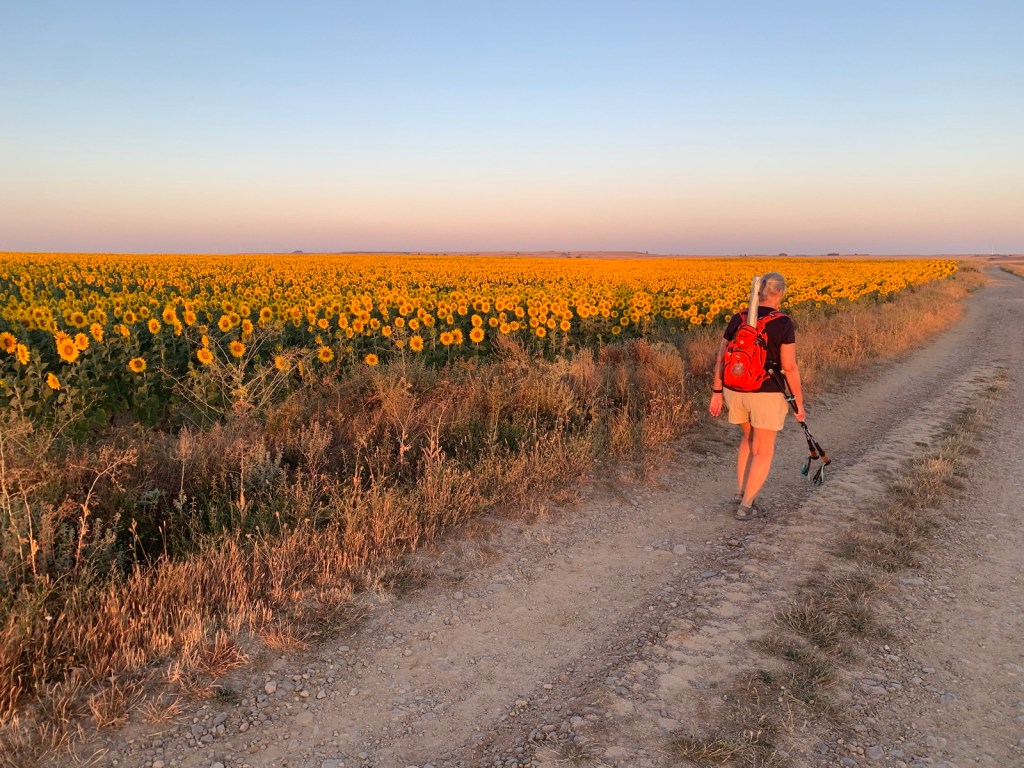
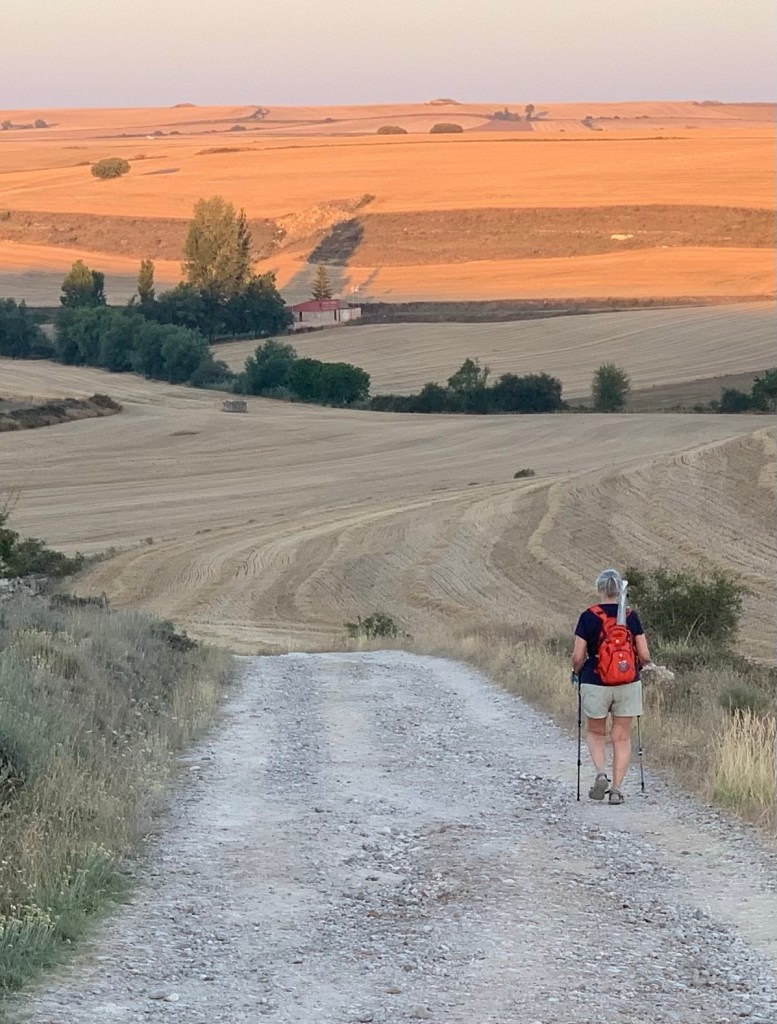
While we are still on the Meseta, we see more structures and clumps of trees, dotting the fields of grain and sunflowers. Small villages/settlements are more frequent but the horizon is still very flat with no mountains to be seen.
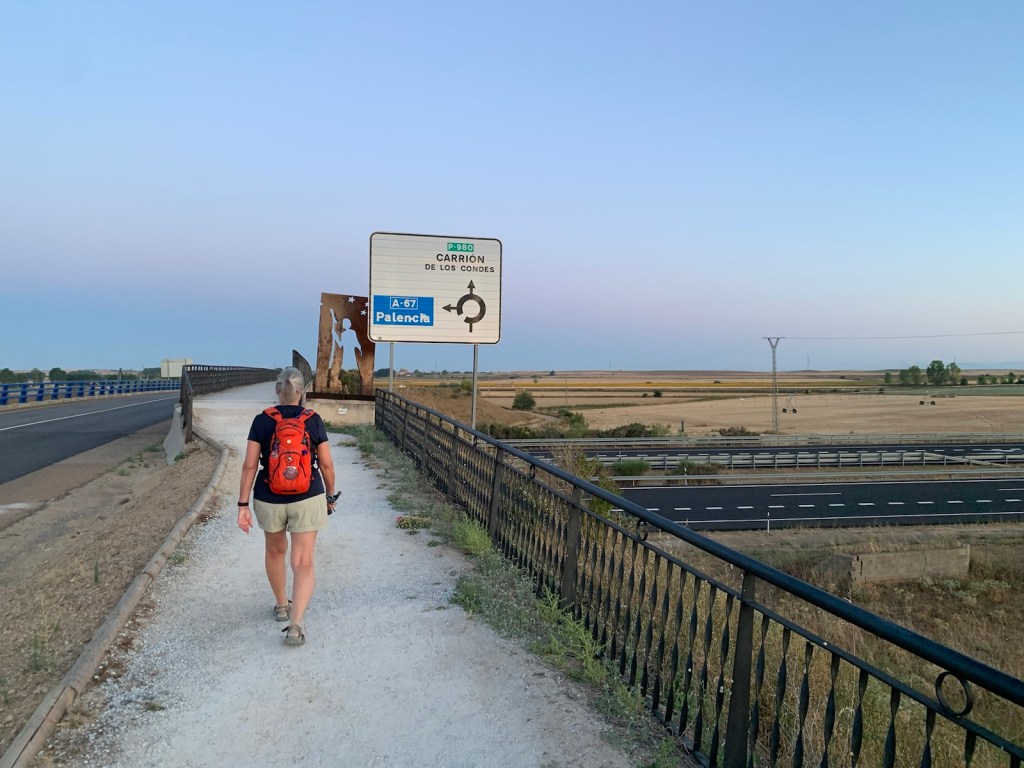
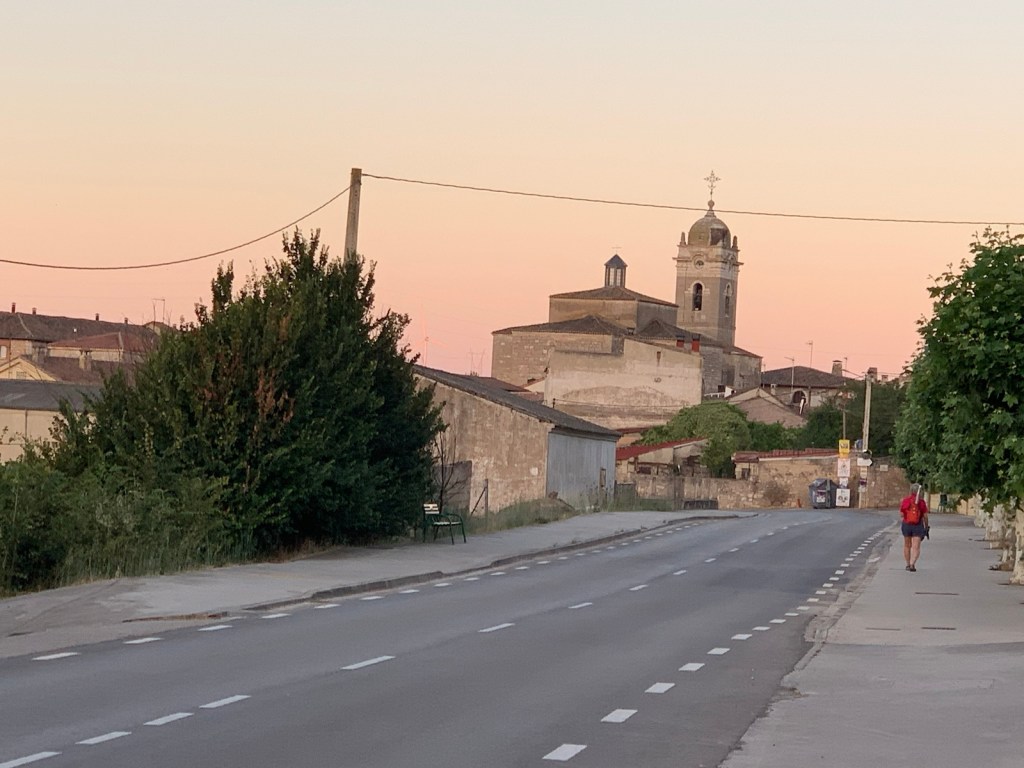
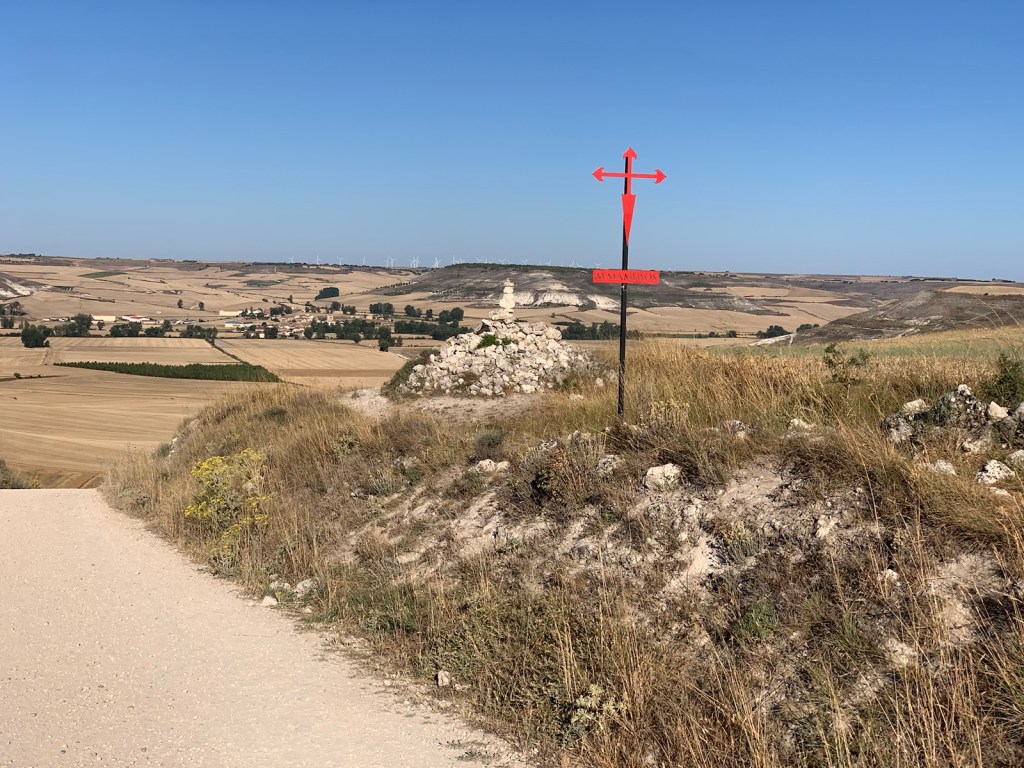
crossing a major expressway as we left Frómista this morning the path along the secondary road leading to the first village of Poblacion de Campos, where we have stayed 3 times before but was already booked this time.An initially confusing sign for which way to go unless you read the fine print. We chose left, which is shorter and has potential rest/breakfast stops.
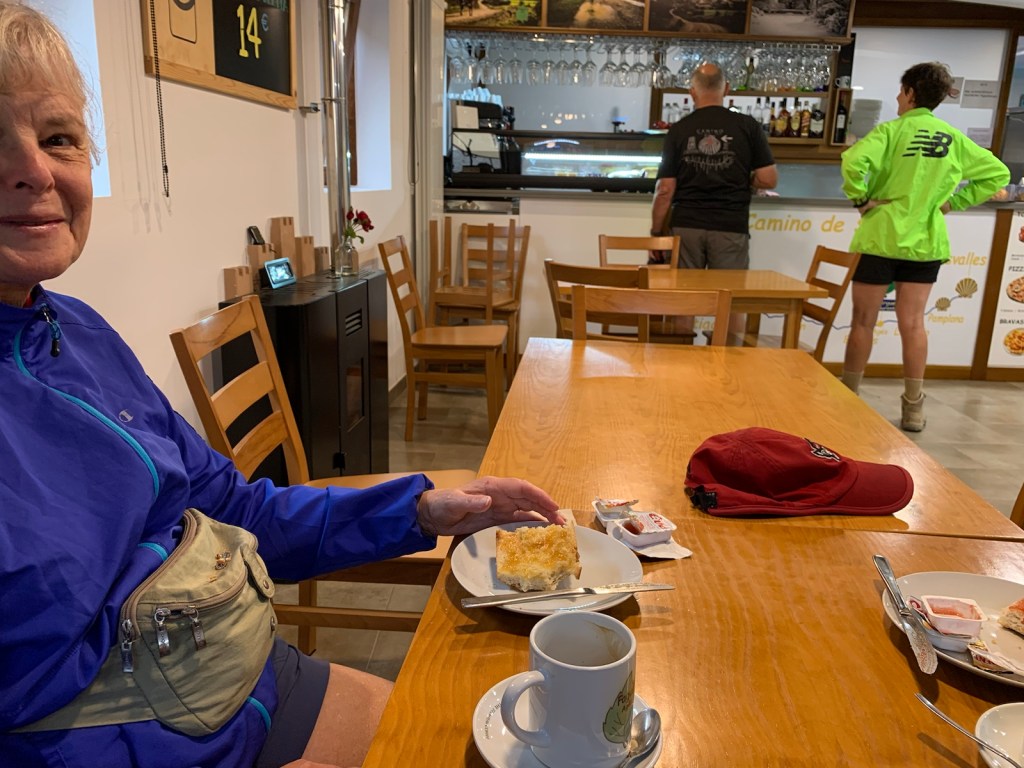
Shortly after we reached today’s half-way point (~4.5 miles) we spotted a sign while walking through Revenga de Campos. It advertised a bar just 50 meters into the village, something that has never happened in our experience. So we took a chance and ended up having a nice breakfast/rest/bathroom break. We also renewed a brief acquaintance we had back in Belorado with a nice South Korean family of 5.
Some 40 minutes later and “Buen Caminos” exchanged, we were once again, on our way.
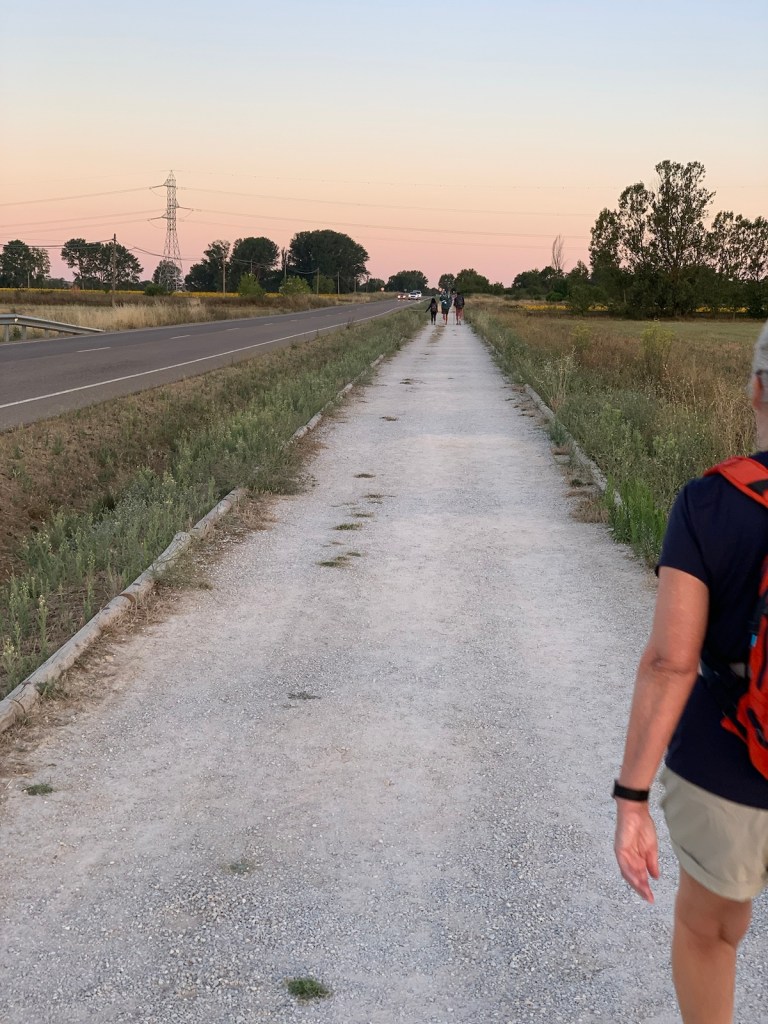
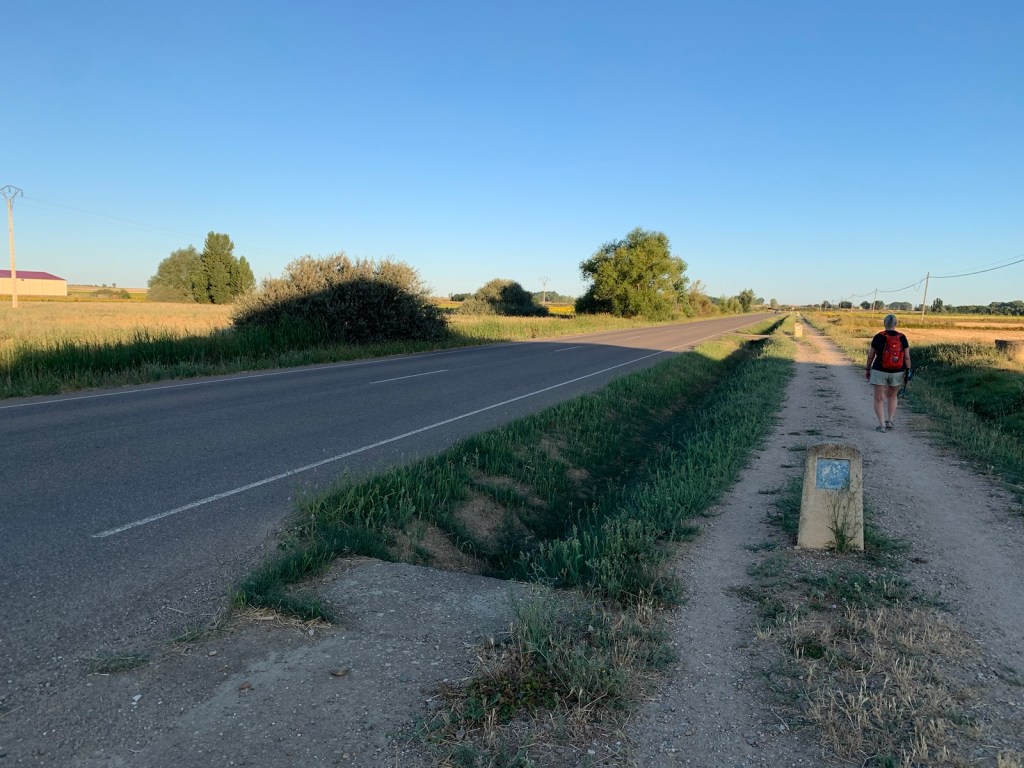
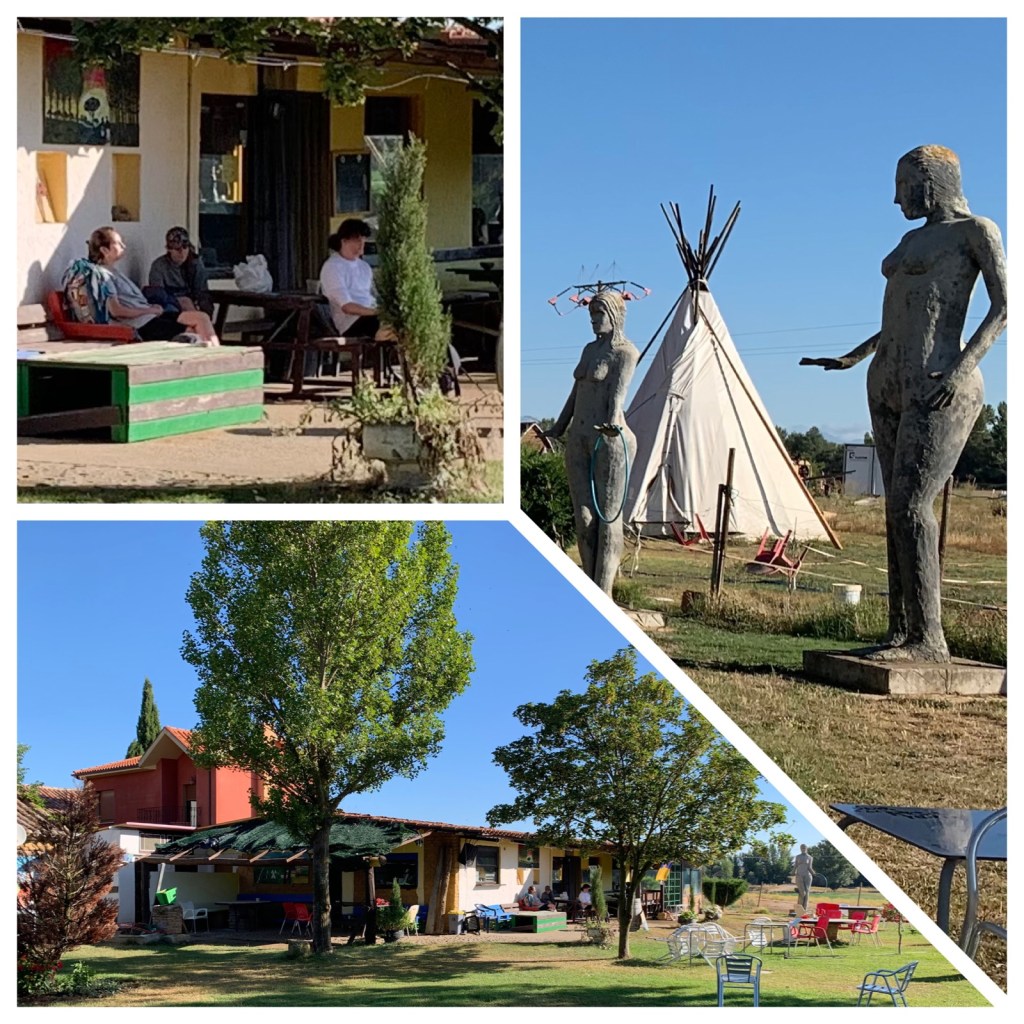
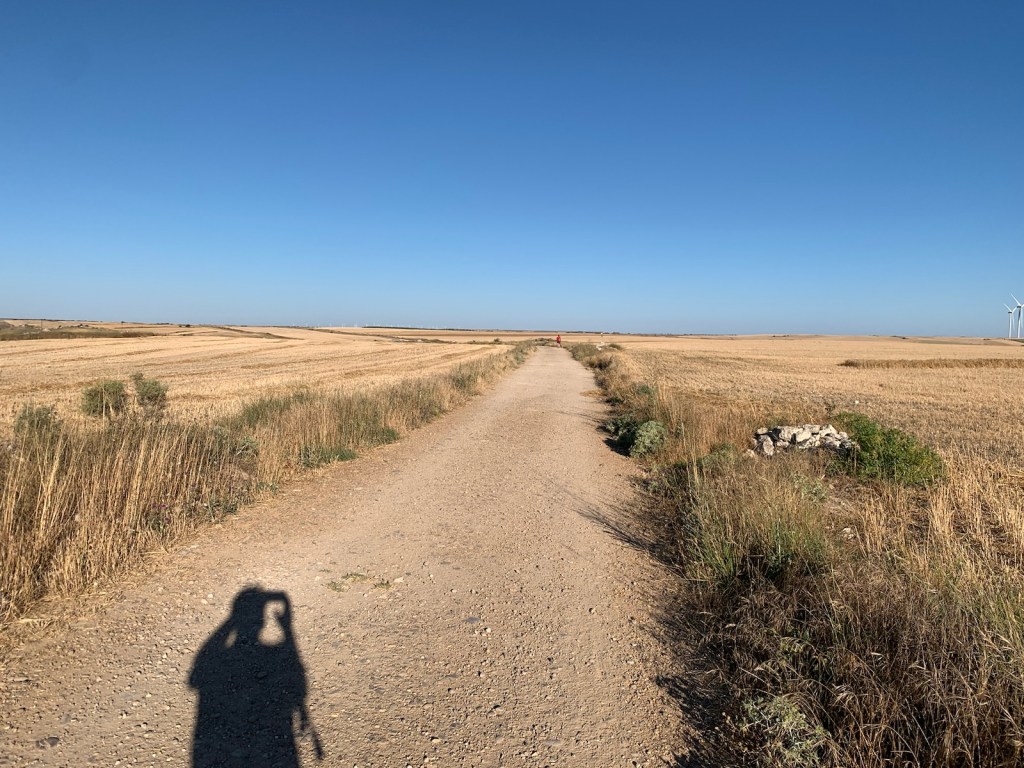
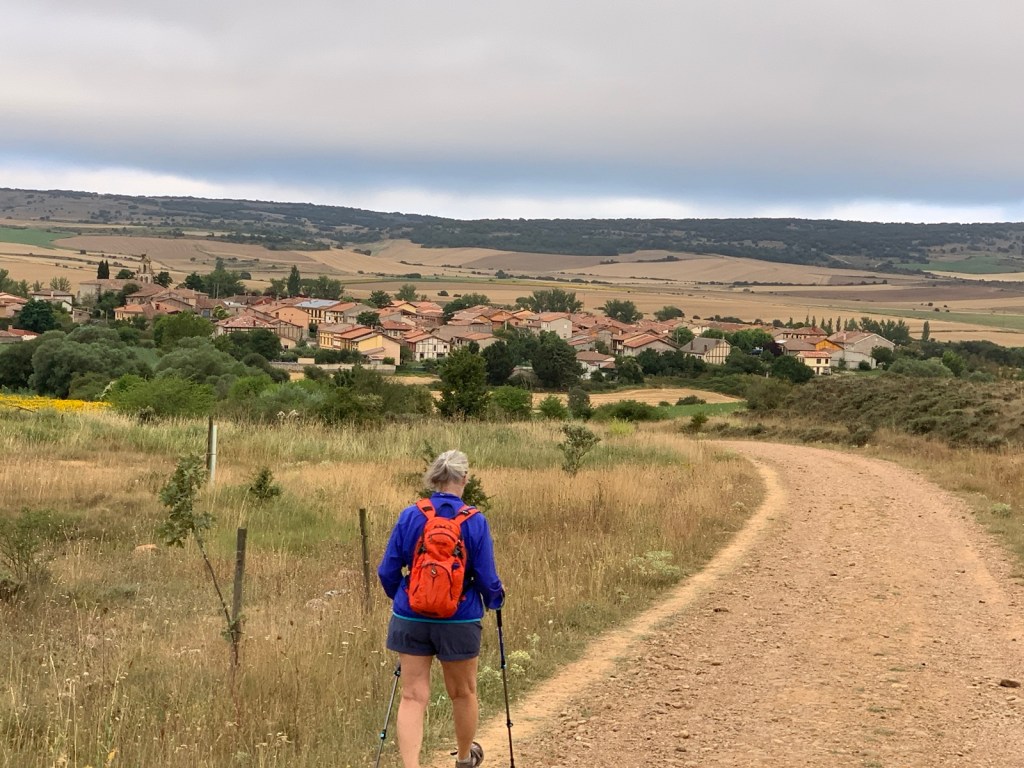
Moving on to the next village, along the secondary road and on the straight, flat, gravel path.The next village we encountered was Vallarmentero de Campos. We usually stop here, at Albergue Amanecer, for breakfast, but today, it was closed… not opening until 10:00!!! And it was only 9:20, so we took advantage of the open outdoor restrooms and moved on.Albergue Amanecer is an unusual, somewhat primative albergue. Above left: Pilgrims patiently waiting for the bar to open bottom left: overview of the outdoor spaces of the albergue right: interesting artwork and some of the habitacions available for a donative fee, such as teepees, culvert (on or above ground), makeshift shacks, tents, small cottages? etc.Moving on after a brief stop at Villarmentero de Campos
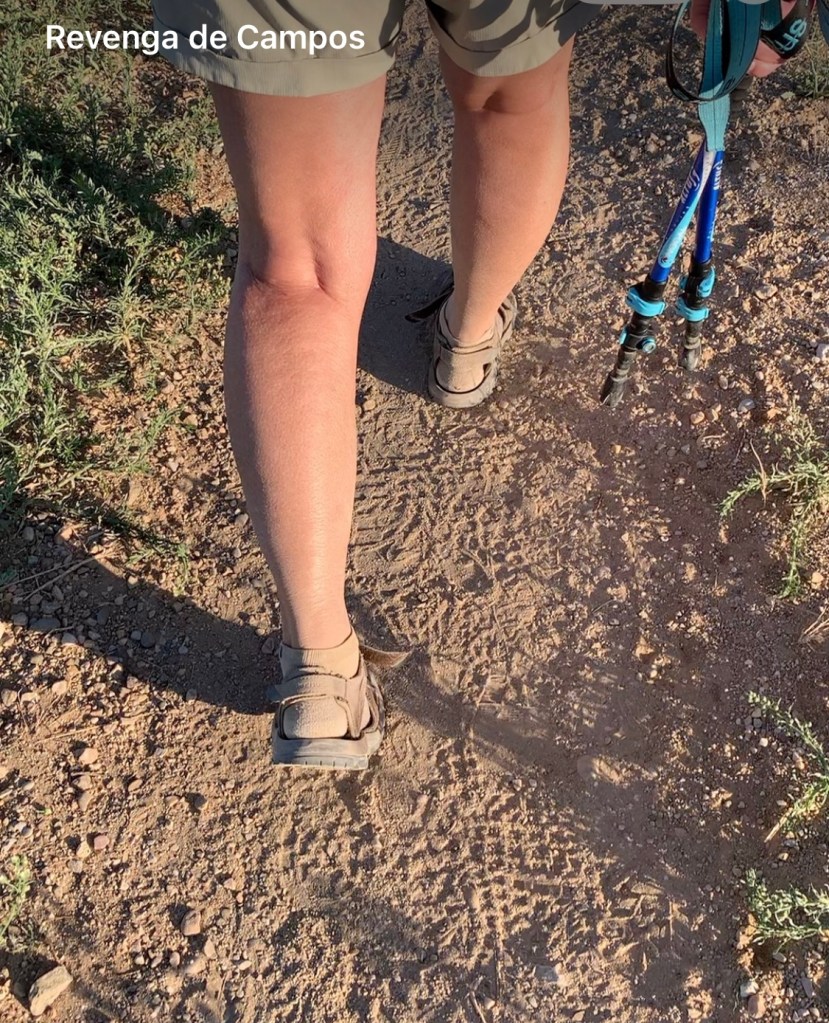
Linda is frequently approached by other pilgrims about her choice to wear sandals rather than traditional hiking/running shoes or boots. She wears them because all other footwear she has tried have generated blisters. And she has over 2000 miles of experience to validate it.
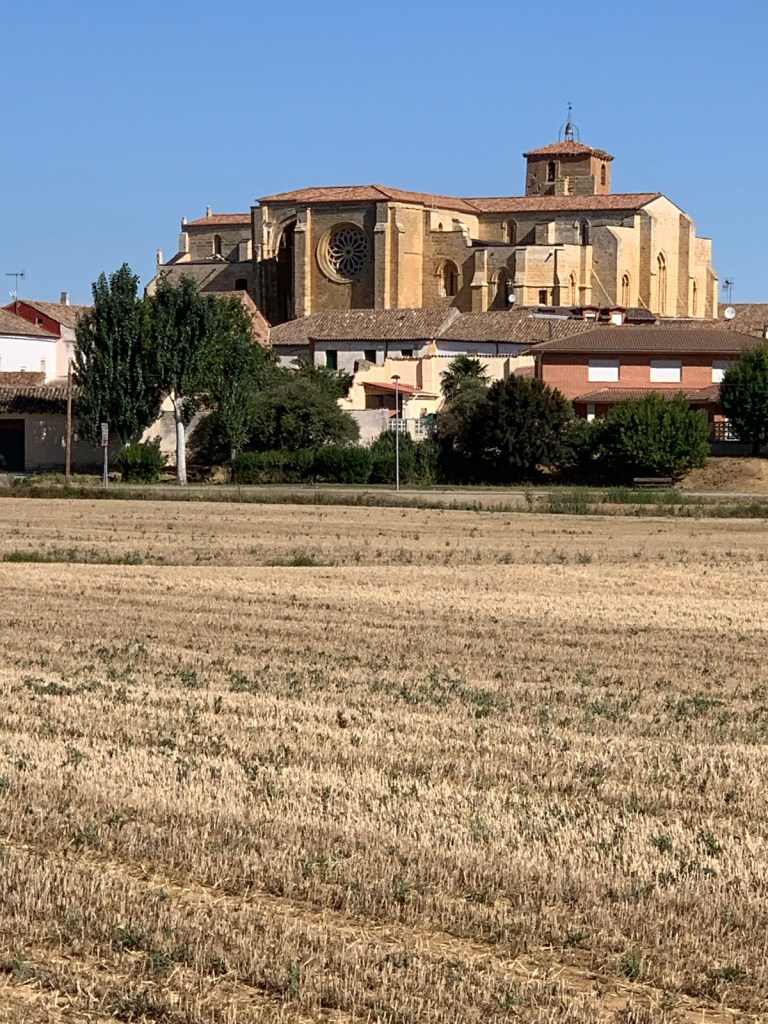
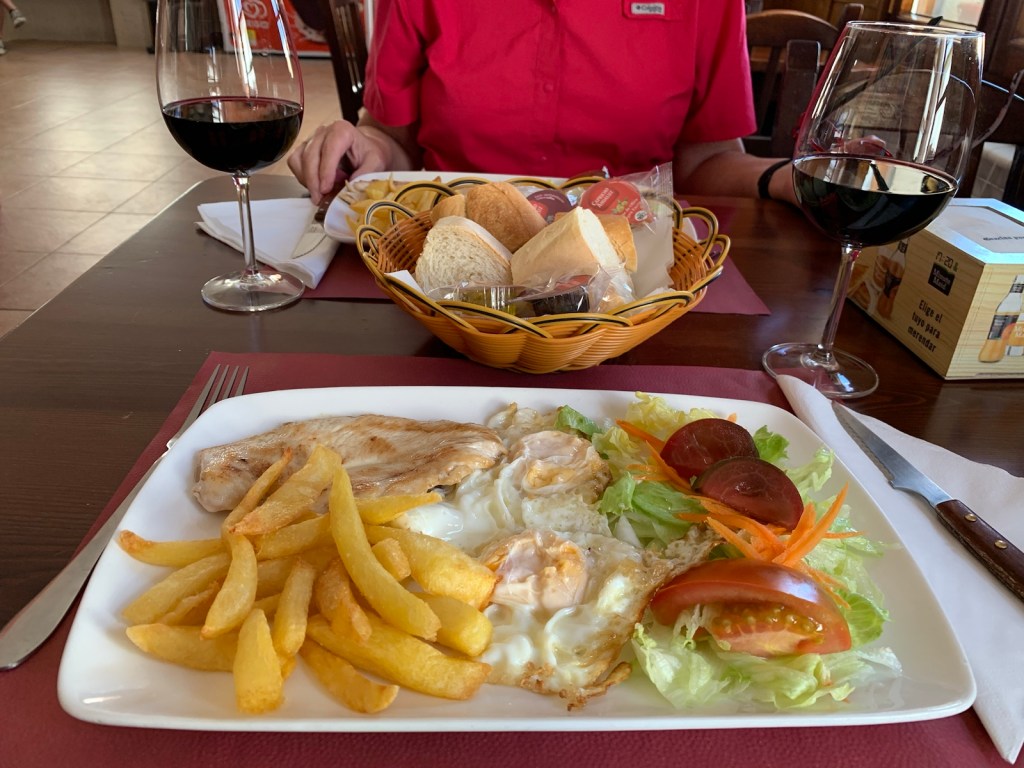
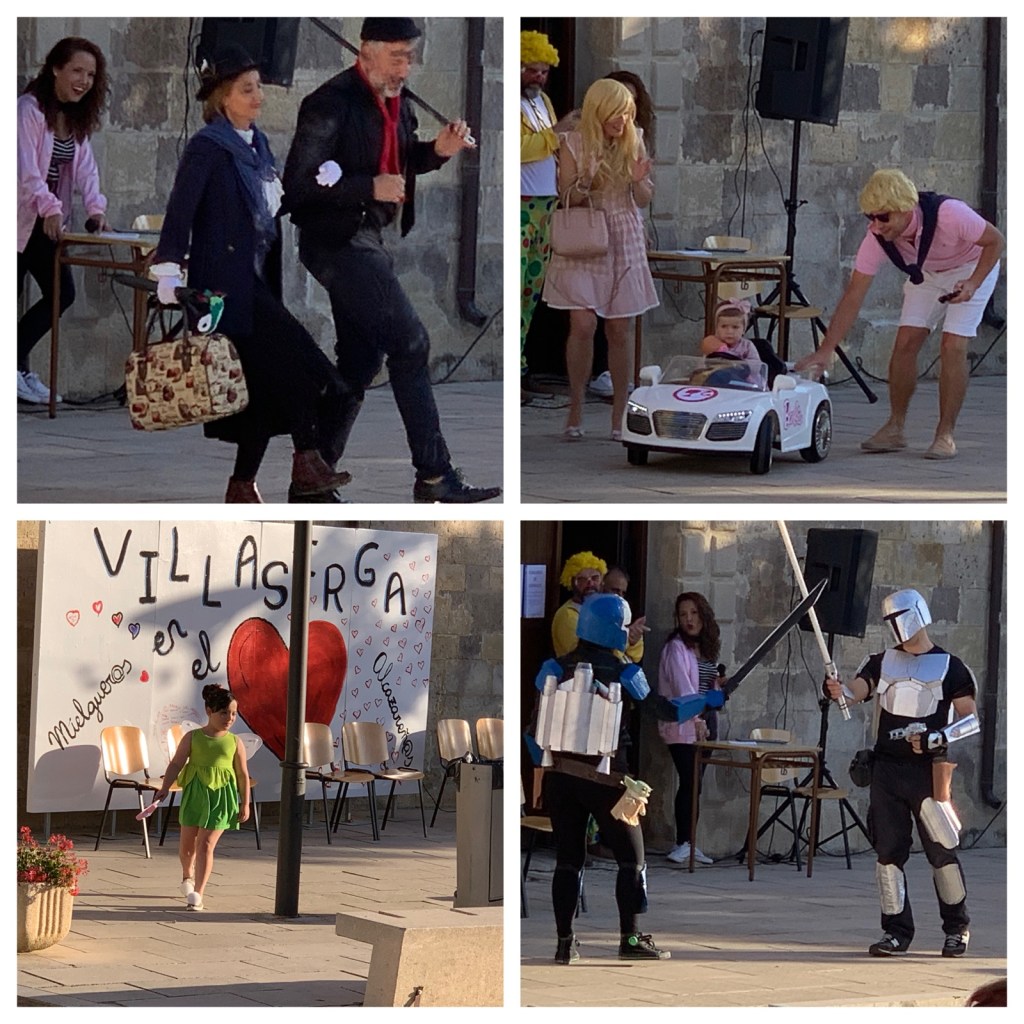
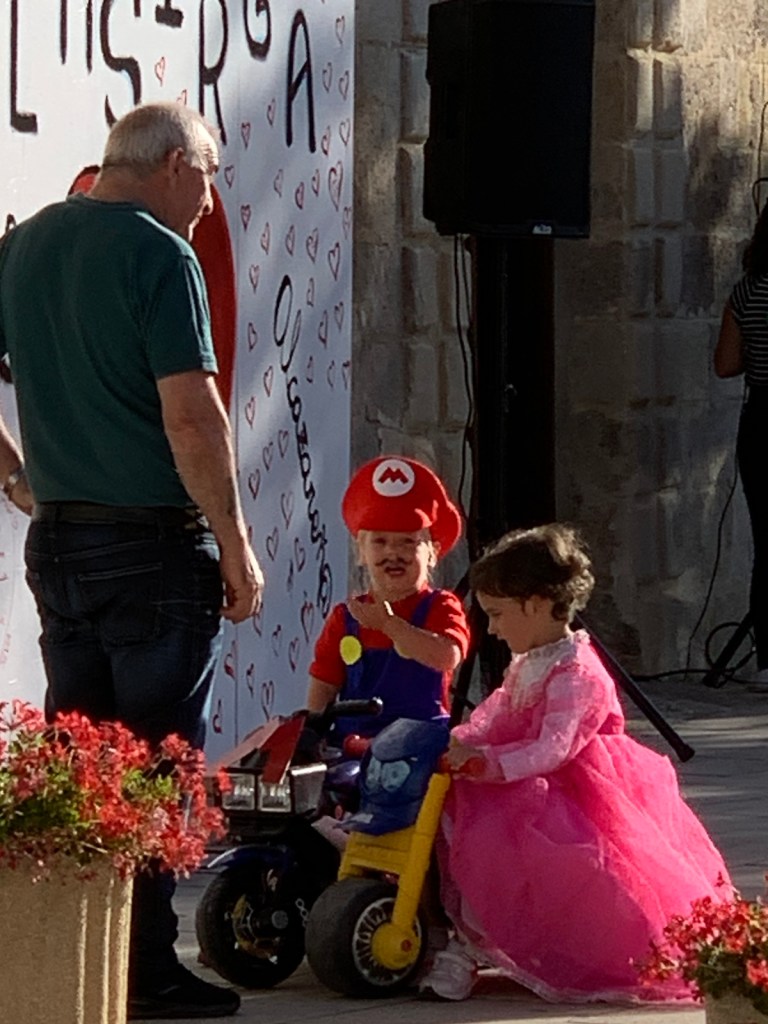
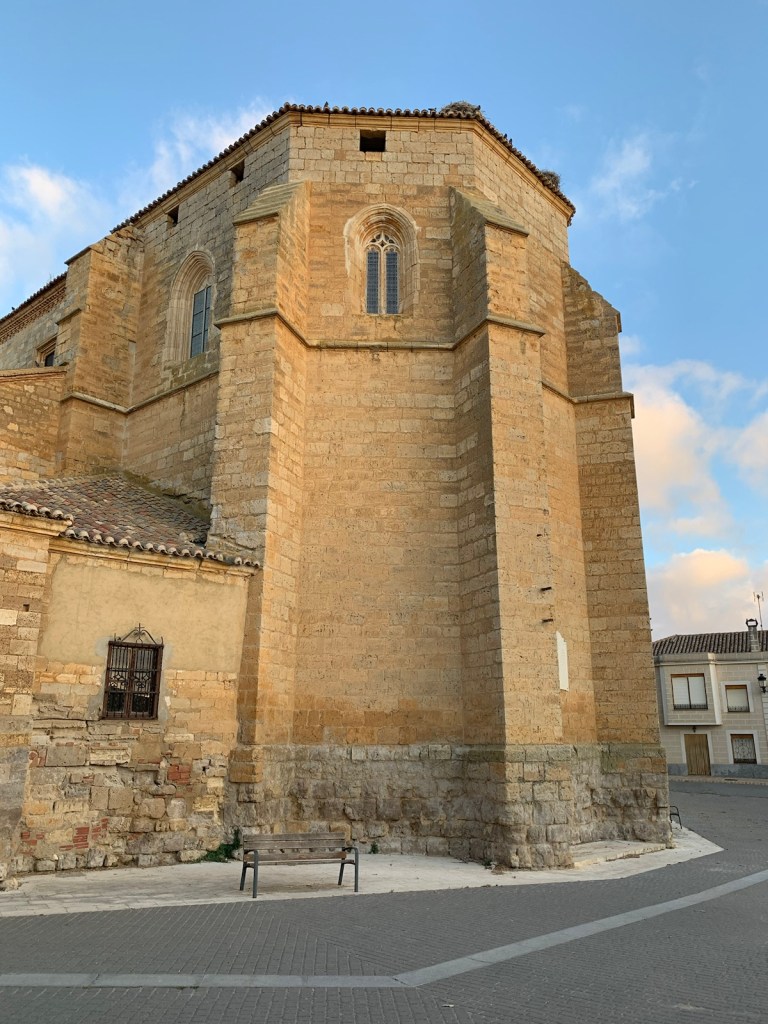
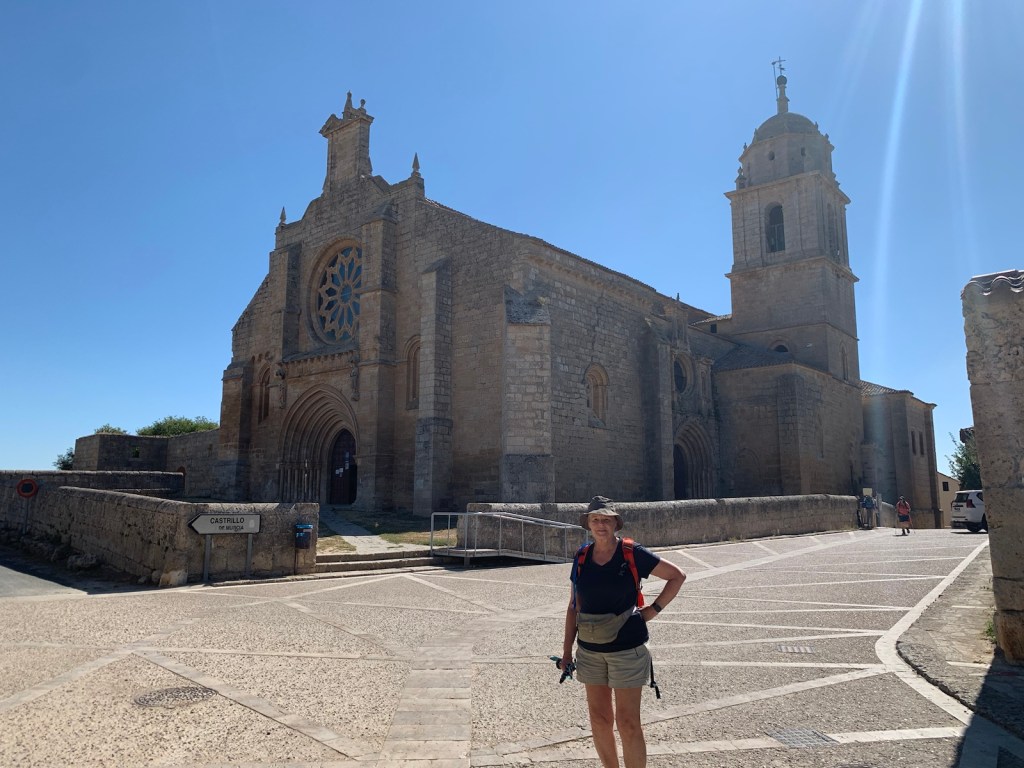
The price Linda pays for walking in sandals is very filthy socks.Almost there…. approaching our destination of Villalcázar de SirgaThe dominating Iglesia de Santa María de Blanca of Villalcázar de SirgaToday’s main meal was our first “typical pilgrim meal” on Camino 2023. (Fries, two fried eggs, chicken, green salad)Villalcázar de Sirga (pop. 215) locals were preparing this mural for the village square for the festival starting tonight and through the weekend.The festival began after dinner in the square outside our hotel. Young and old alike wore costumes of all types.the owner of our hotel had two cute grandchildren who participated.
We watched the festivities from the terrace just outside the hotel bar until 9:00, then called it a day.
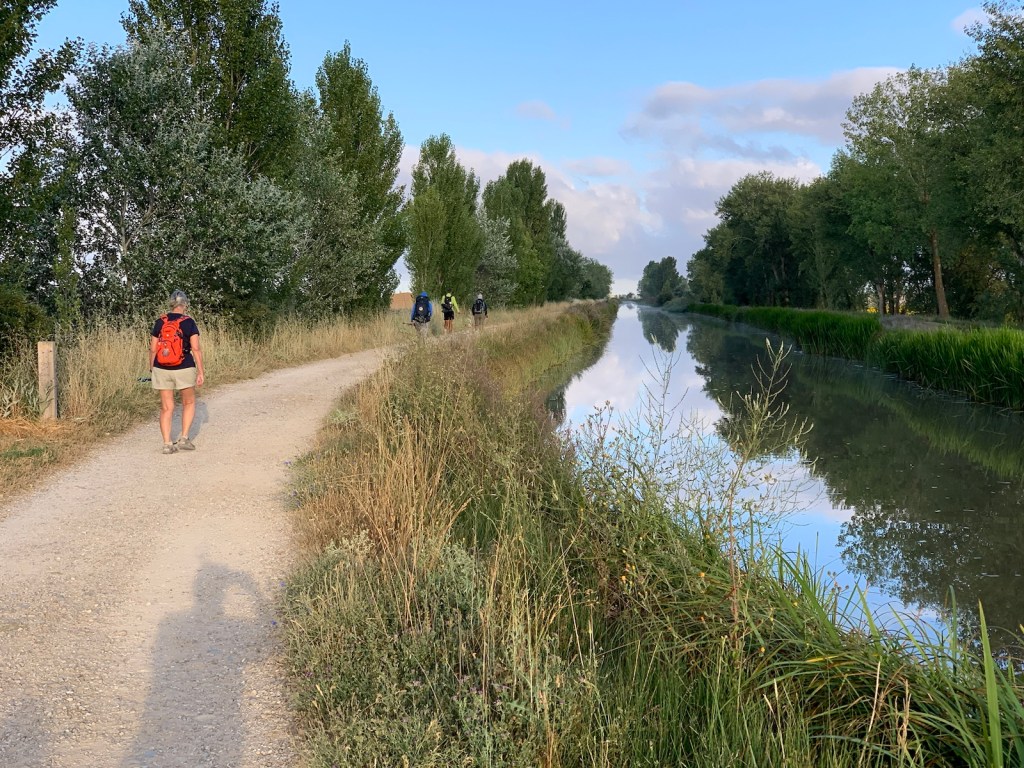
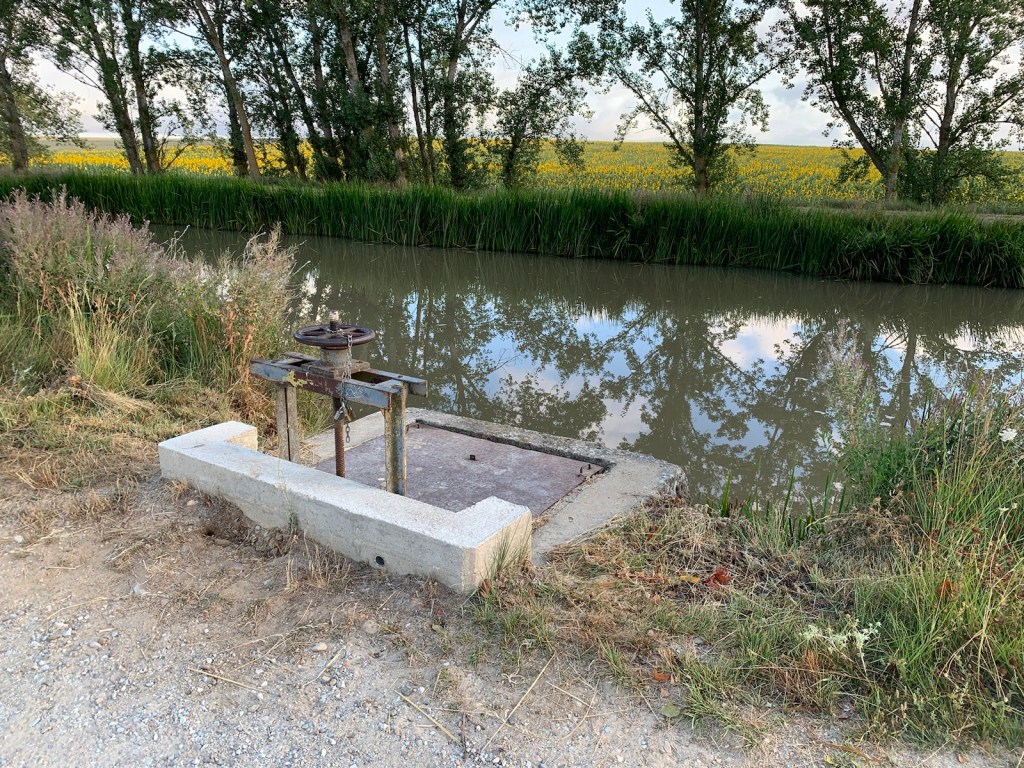
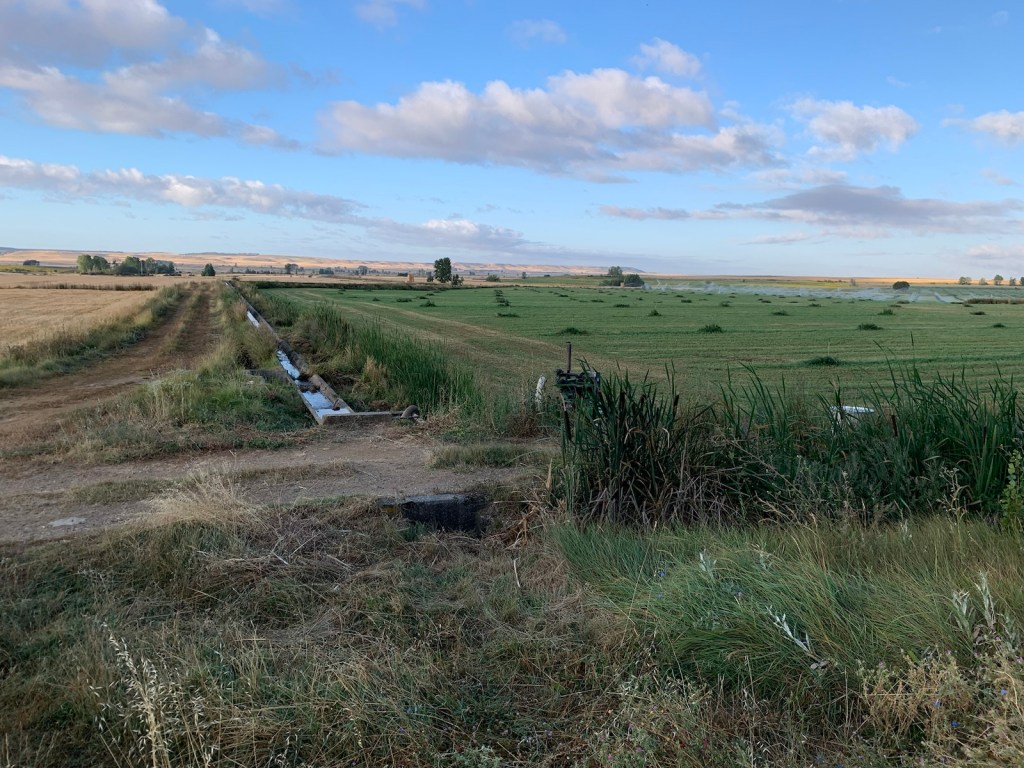
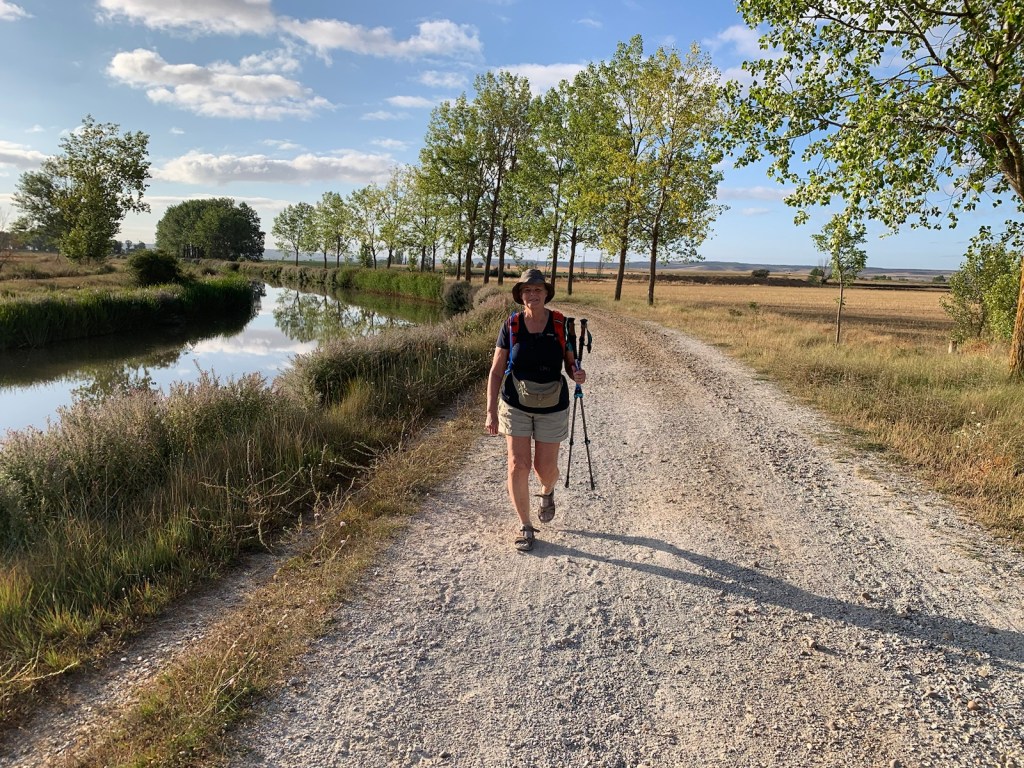
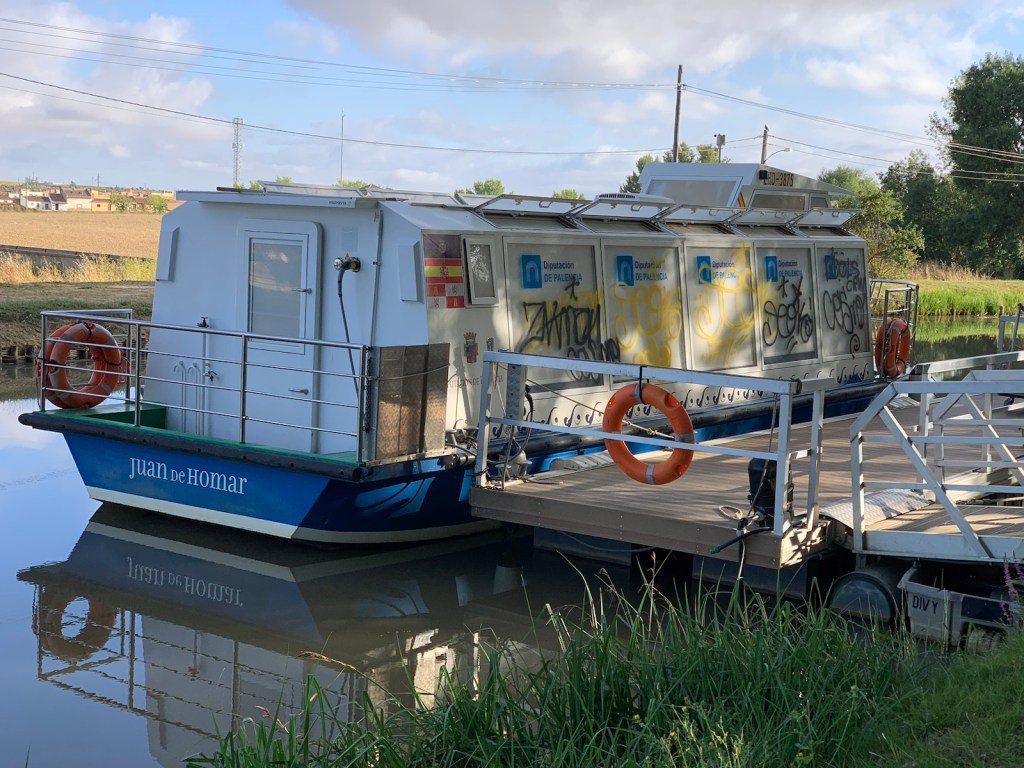
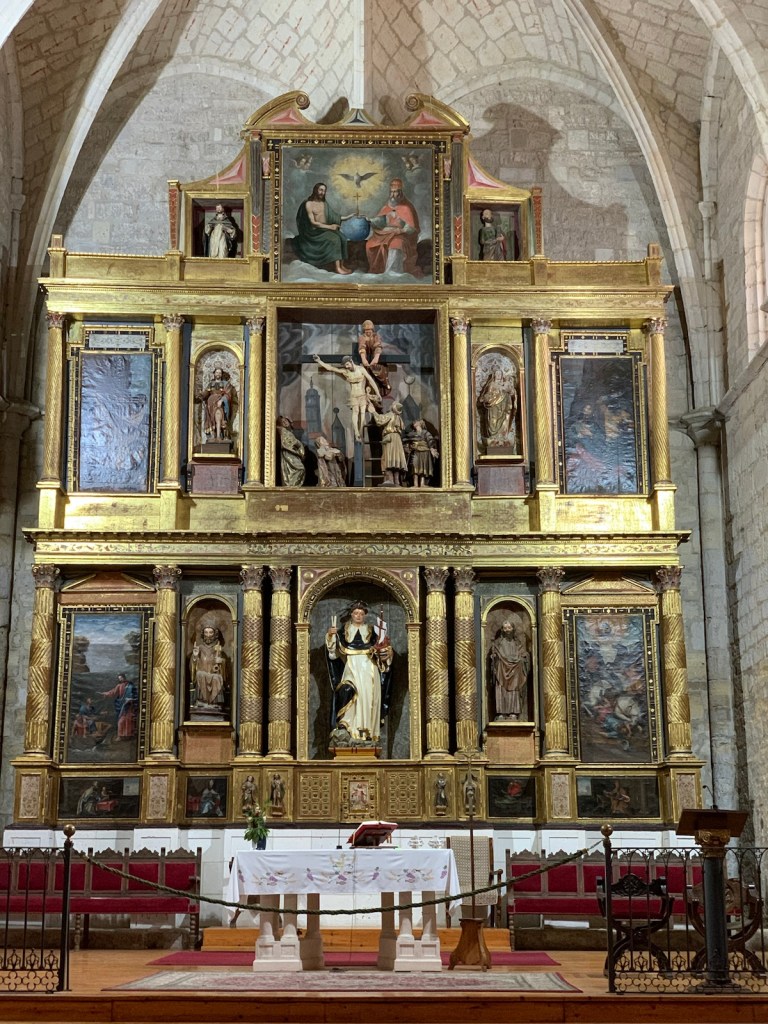
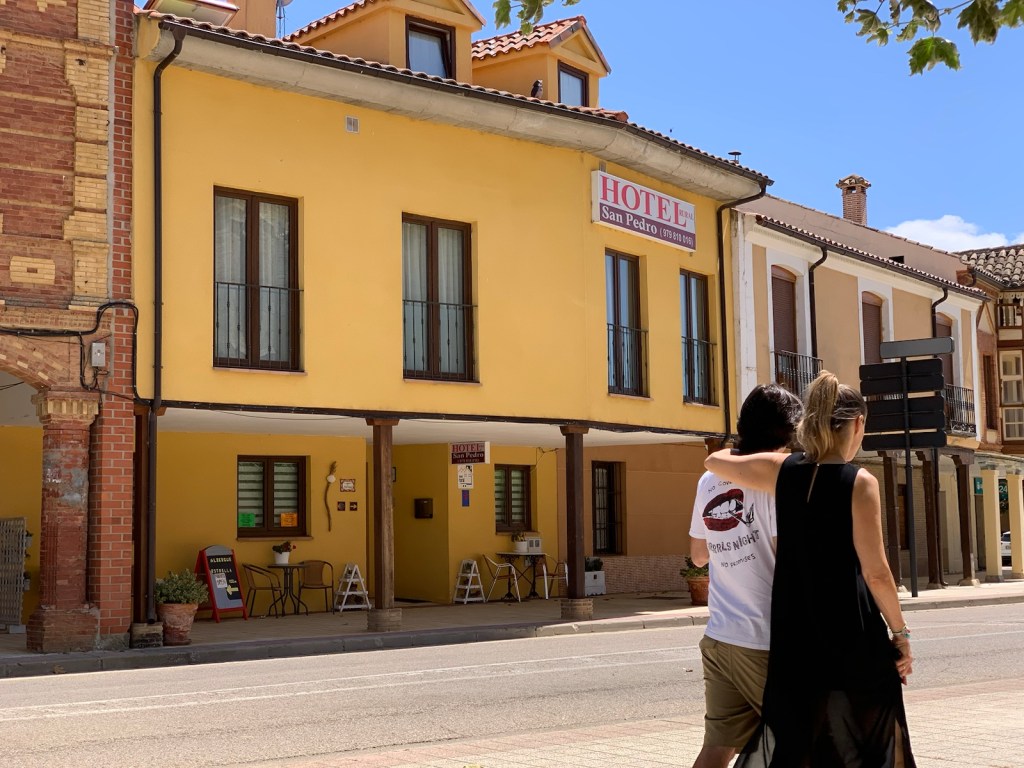
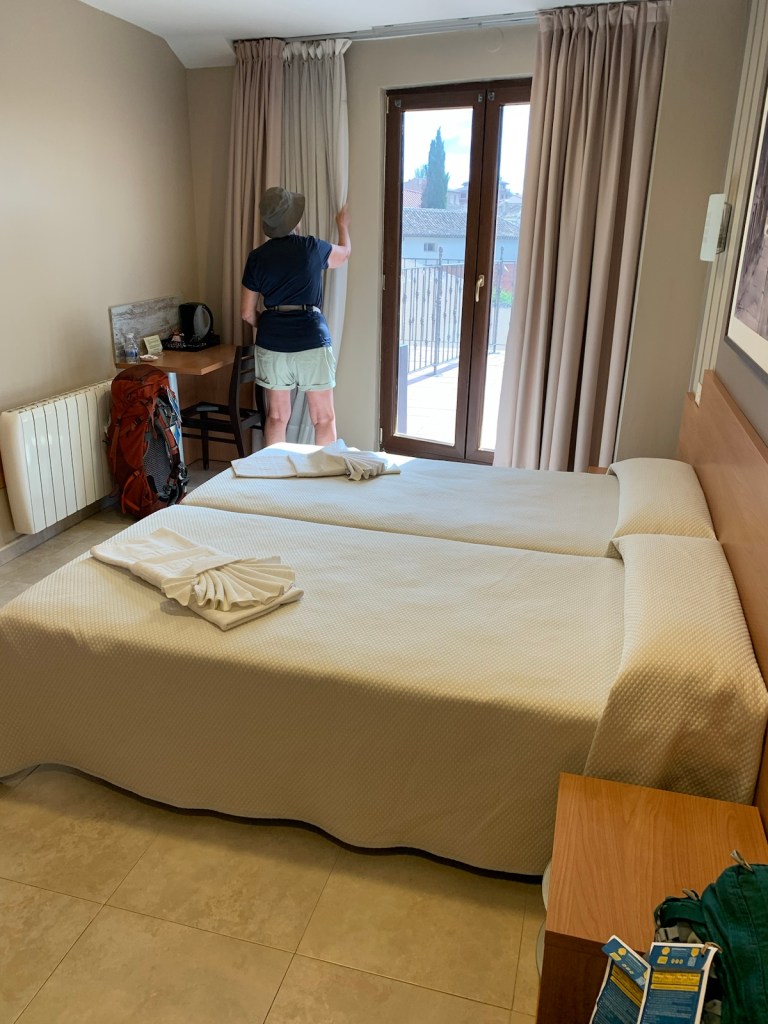
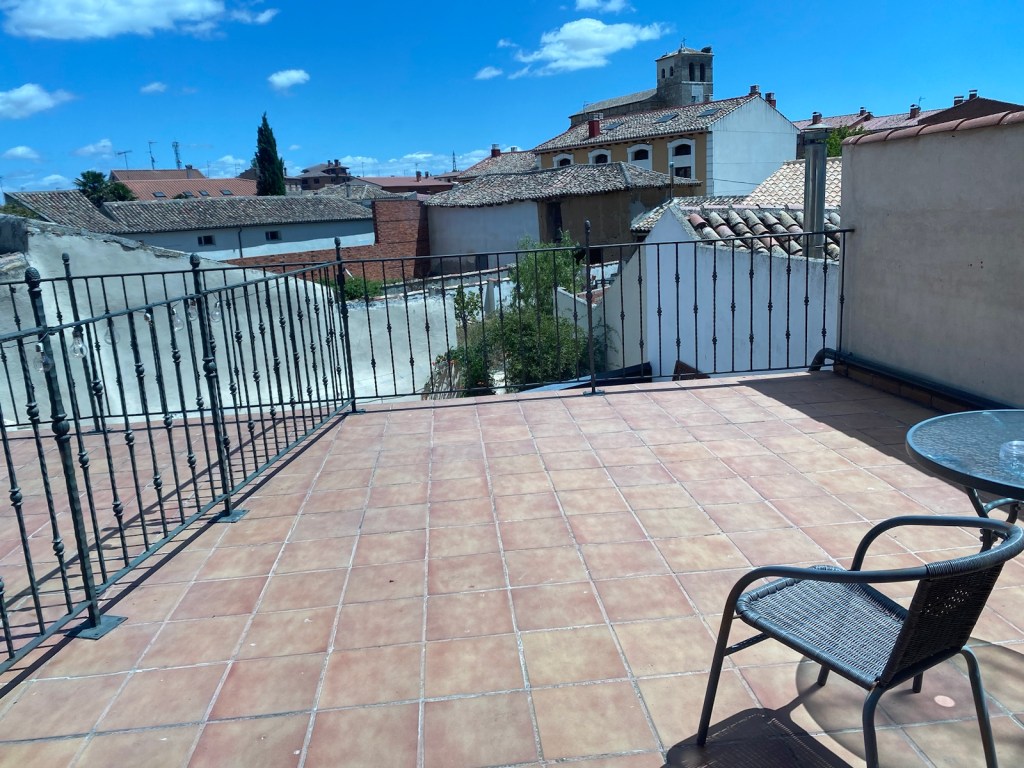
a better look, with better lighting this morning, of the Iglesia de las Asunción also better lighting for the “Rollo” this morning as we left Boadilla del Camino.a short distance out of Boadilla we began walking along the Canal Castile.huge water valves line the canal and are used to divert critically need water to feed the above ground aqueduct irrigation system.the Canal Castile supplies water to the aqueduct irrigation system for the varied crops of the regiona delightful walk along the canal this morninga ferry boat ride is available twice daily (most days) to give riders a cruise on the canal and along a 3 mile section of the Camino.The locks of the Canal Castile at Frómista, were used by boats transporting commercial goods mostly during the period of 1850-1870. The Canal took nearly 100 years to build and was replaced in the early 20th century by the railroads.The interior of San Pedro church… across the street from our hotel in Frómista.the exterior of Hostal San Pedroour room in Hostal San Pedrothe deck outside our room
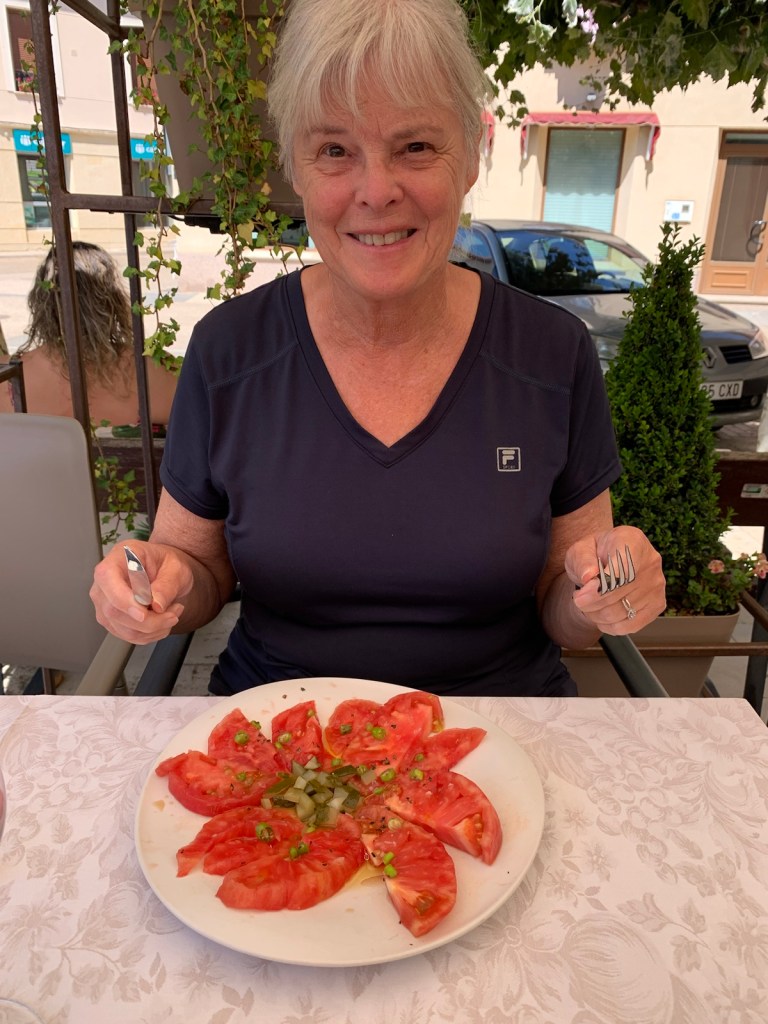
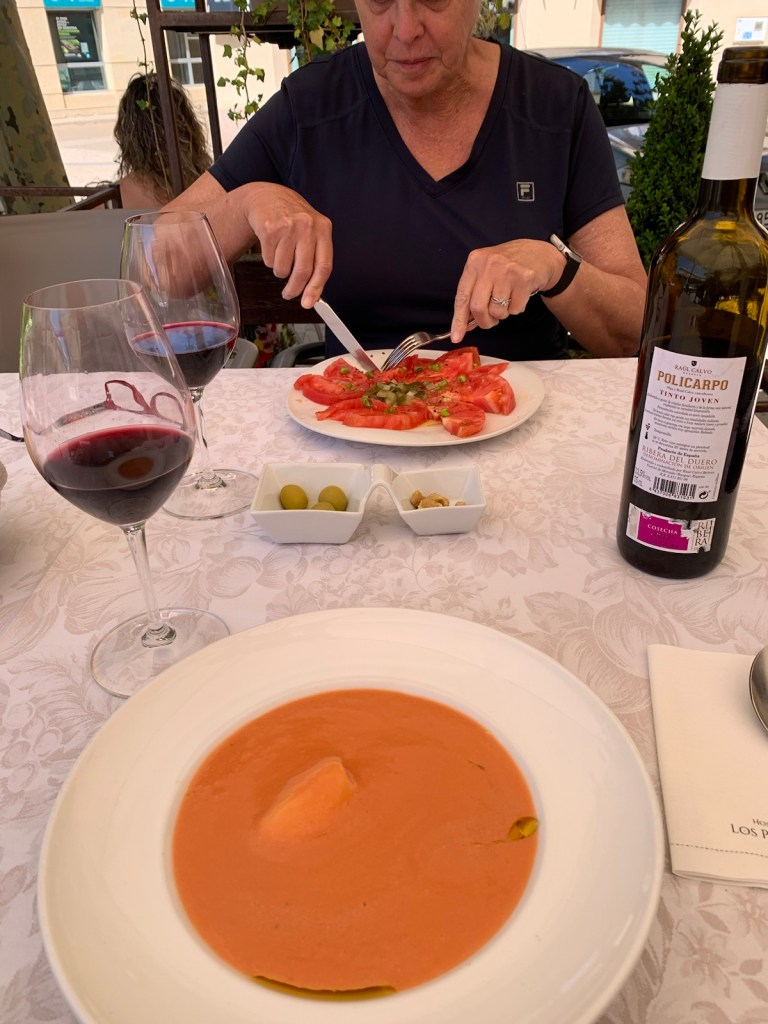
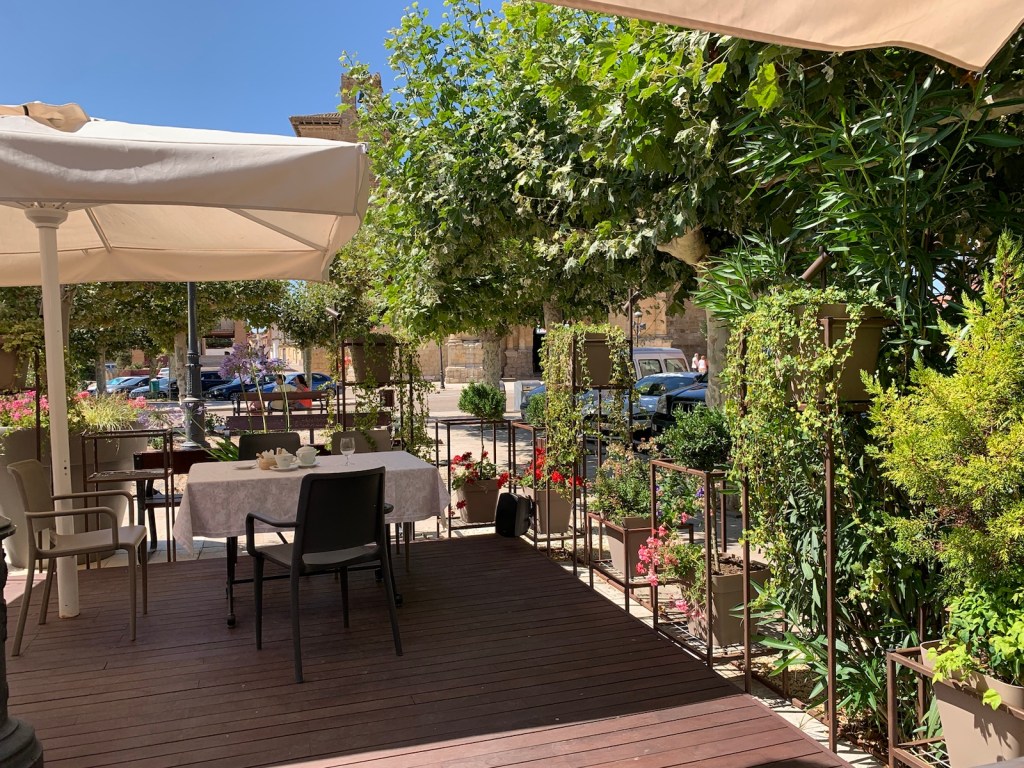
We decided to have a late, 2-3ish lunch for our main meal at a nearby restaurant that was mentioned in a couple of pilgrim forum comments. It is called Los Palmeros and is right across the street from Iglesia de San Pedro. It was pretty busy on a Thursday afternoon with mostly local patrons.
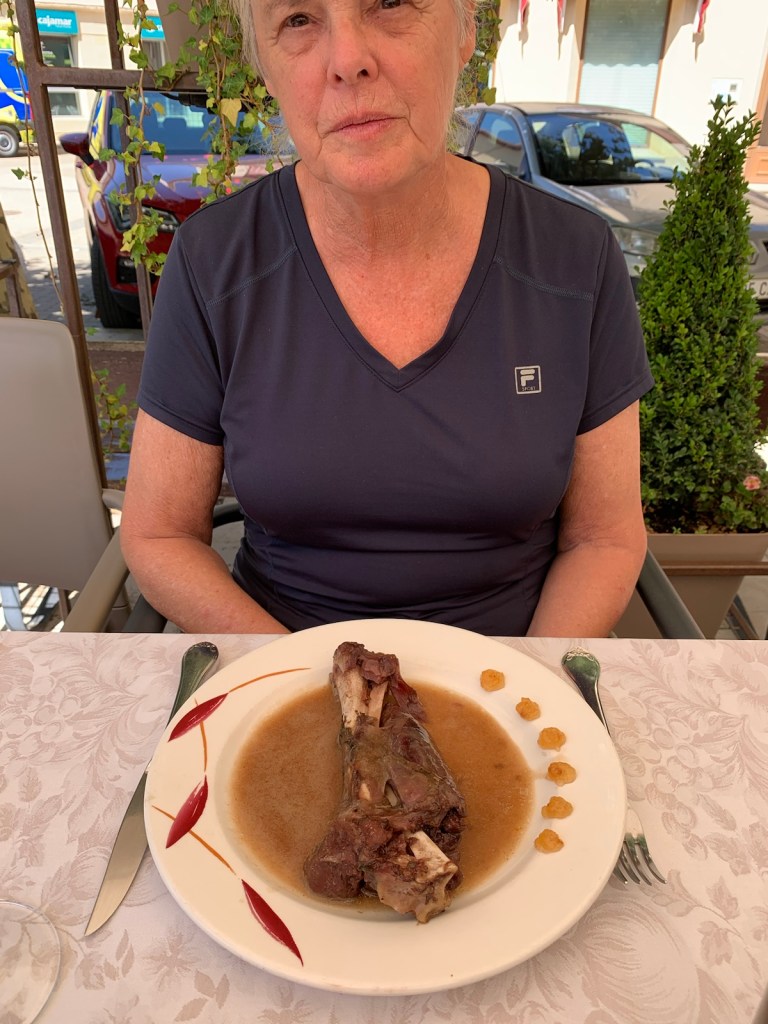
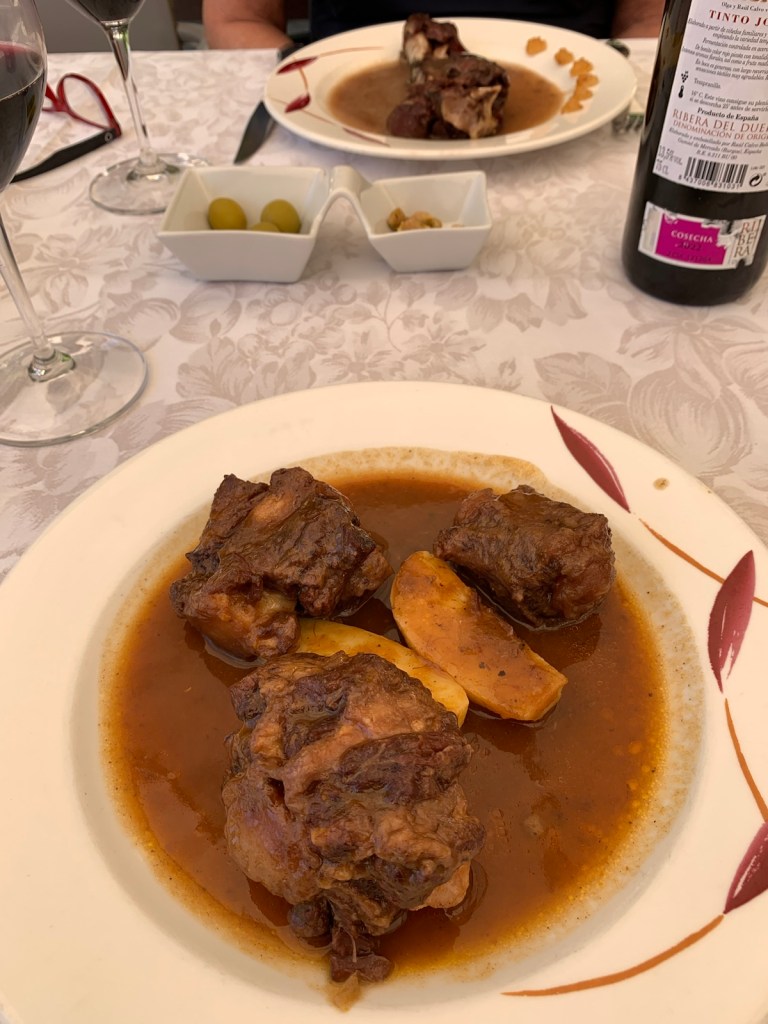
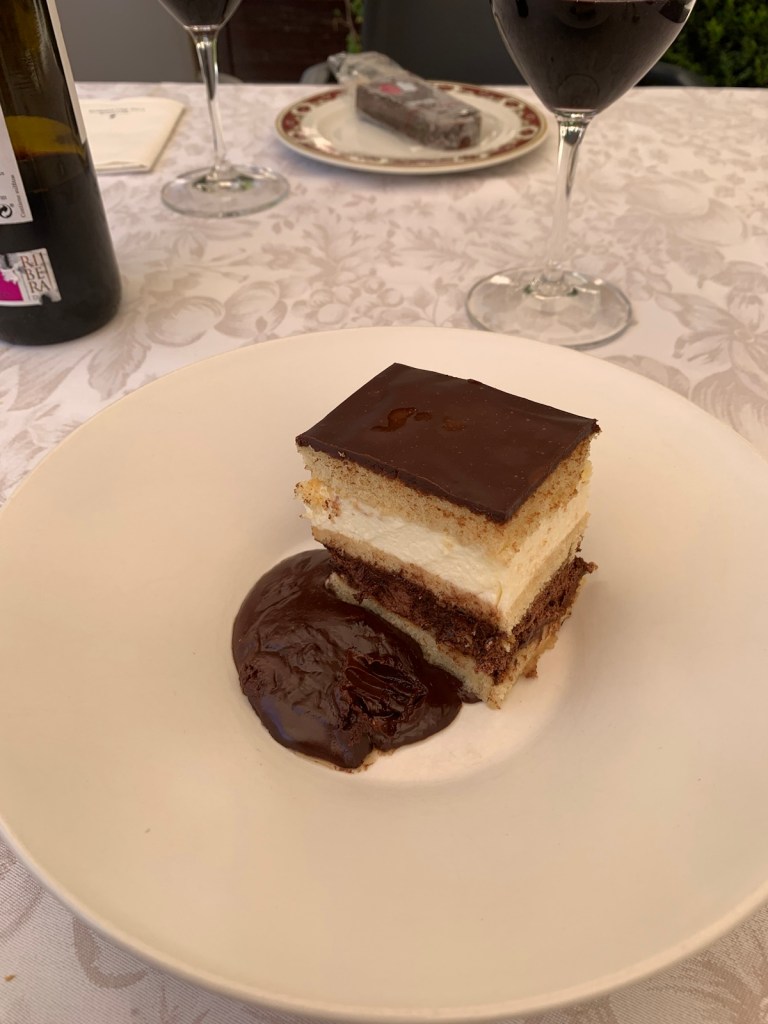
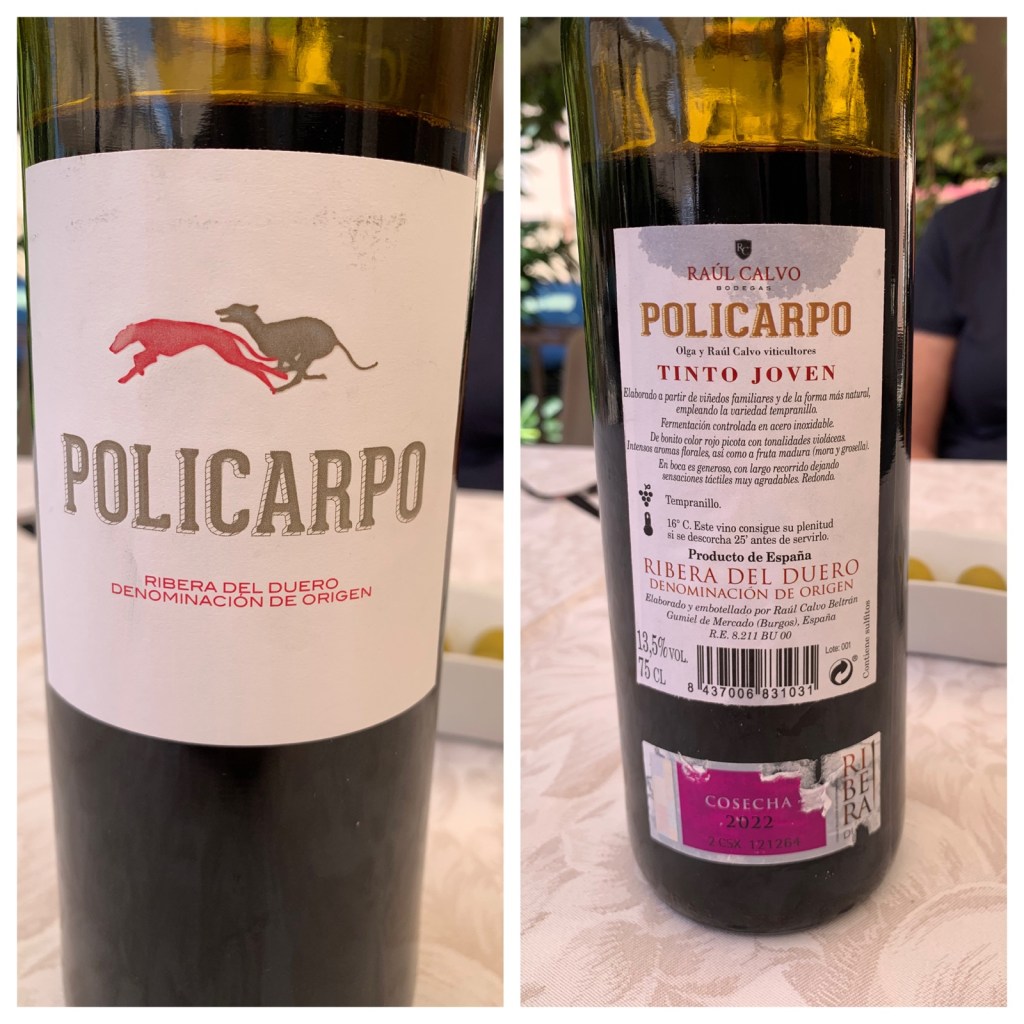
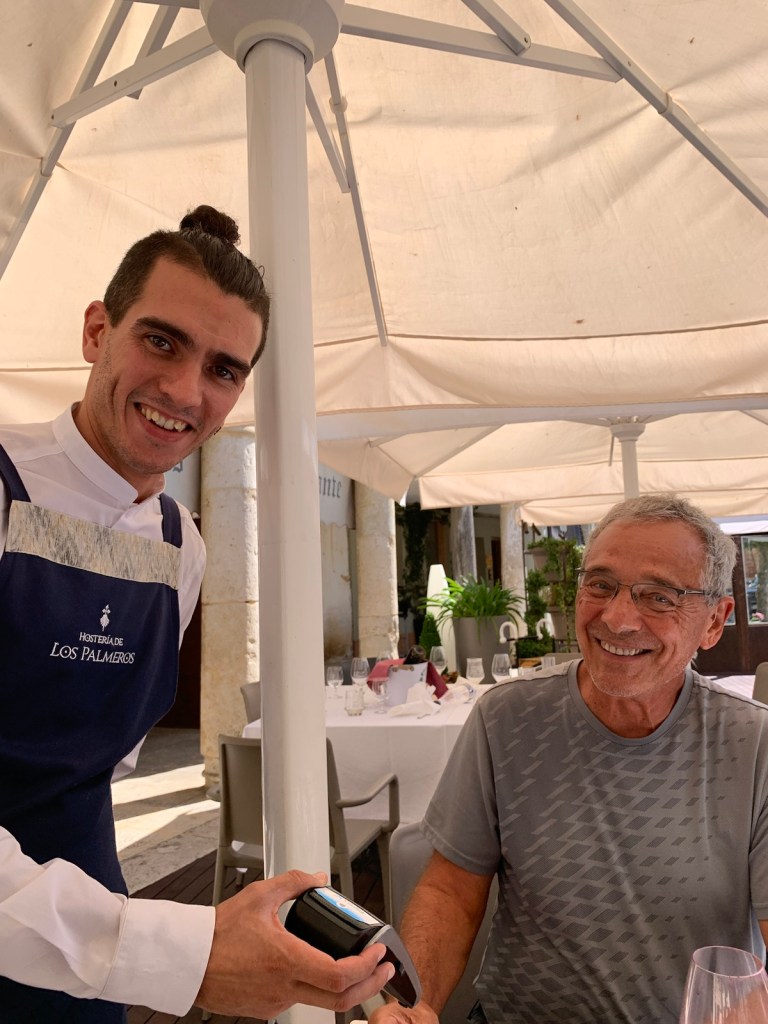
Linds’s first course was a plate of freshly sliced large tomatoes garnished with lightly pickled cucumbers and baby peppers. The tomatoes were grown in a garden directly behind the restaurant.Jim had a delicious gazpacho soup with a tomato and cucumber gelato which when stirred, chilled the gazpacho to a perfect temperature and was then drizzled with olive oil,Linda’s main course was veal that melted in your mouth.Jim, similarly had oxtail, that literally melted in your mouth and the brown sauce was so delicious, we asked for extra bread to sop up anything left on the plate.Jim’s dessert was a so-called chocolate tarte but was several layers of dark chocolate with a rich chocolate ganache.Linda’s dessert was a chocolate popsicle like no other popsicle you’ve ever had… 70% frozen pure dark chocolate.Our wine was unknown to us, a young, Tempranilla wine bottled in 2022! It was an unusually tasty and totally satisfying wine from Burgos and is not exported, so only locals get to experience it…. and thankfully, us, too.Nicolas, our waiter and a very nice, comforting and helpful, English speaking food connoisseur himself, guided us though this truly culinary experience in an extraordinarily professional manner.
Our truly unexpected experience today with Nicolas at Los Palmeros in the small town of Frómista on the Meseta in Spain is perhaps the best culinary experience we have ever had. It’s another reason we keep coming back to the Camino Frances, now for the 5th time.
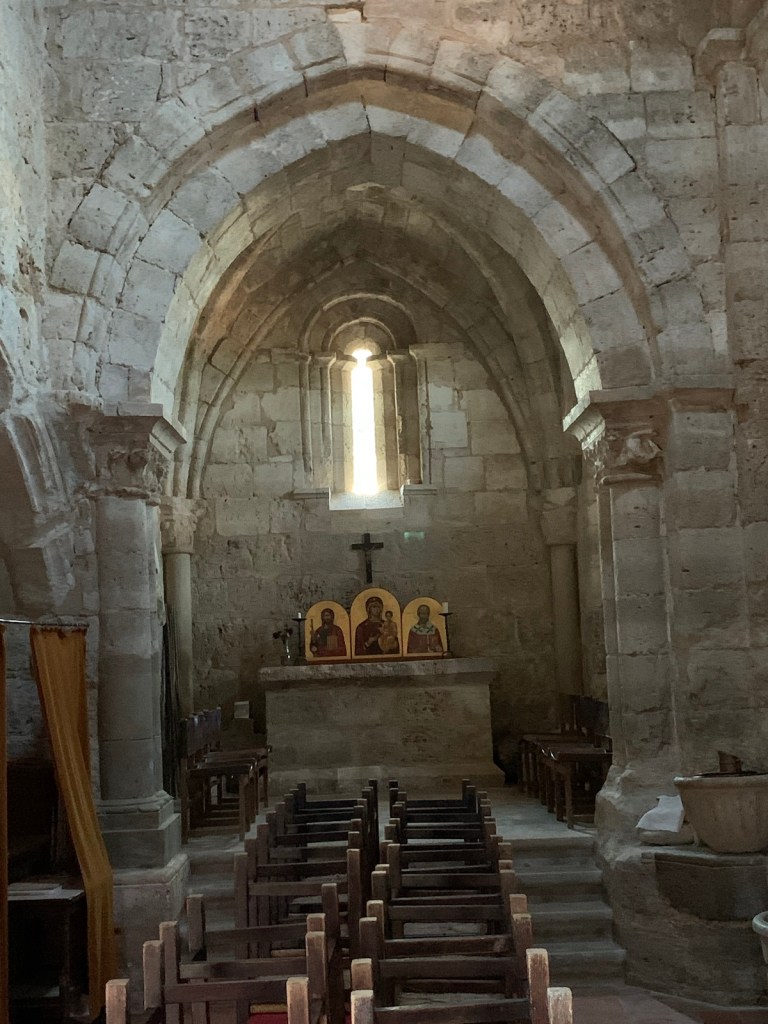
Our prearranged taxi met us at Albergue Orion at 7:30 and took us to Ermita de San Nicolas where we began today’s walk.
Ermita de San Nicolas (not St Nicolas de Bari- Santa Claus)
St Nicolas is a restored 13th century chapel that is also a primative (no electricity) albergue run by an Italian Confraternity.
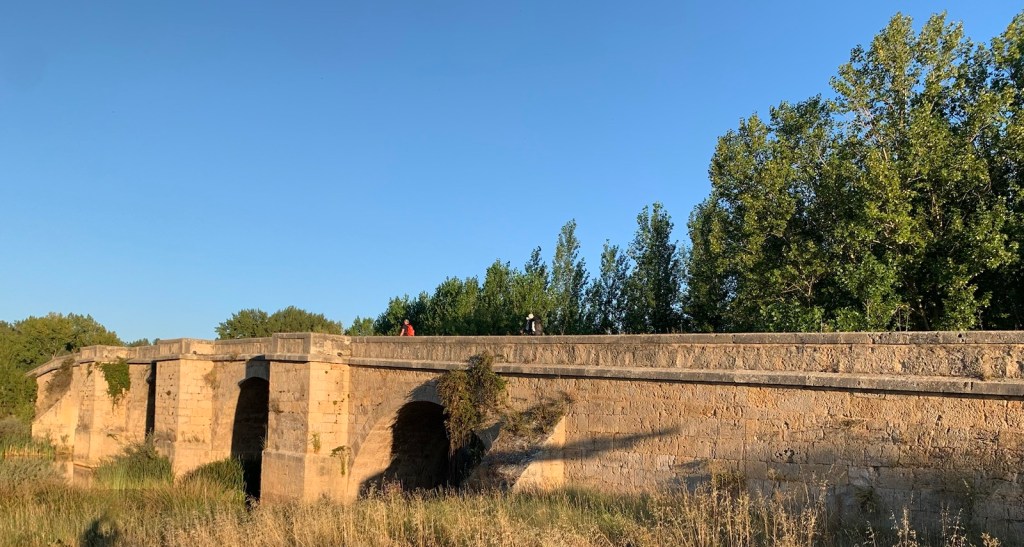
Just a few steps from the Ermita is the Puente Fitero, one of the longest bridges on the Camino. It was commissioned in the 11th century by Alfonso VI to unify the territories of Castile and Leon. It also crosses the Pisuega Canal which serves as the border between Burgos and Palencia provinces.
Puente FiteroWalking along the path extending from the Puente Fitero bridge, along the canal into Itero de la Vega. The now closed Puenta de Fitero Albergue as we entered Itero de la Vega. We stayed in the conveniently located albergue three times and were disappointed when the owner passed away during the pandemic and it apparently does not plan to reopen.leaving Itero de la Vega, a sadly becoming ghost town with scant services and places to stay.just after rejoining the path out of Itero de la Vega we passed a field with a crop we don’t usually see. It looks like collards.We are still on the Meseta, but in a much shallower “bowl” than yesterday… a depth of roughly 100 ft vs 300 feet of the bowls we walked into and out of yesterday. Note the flattop of the Meseta in photo in the background.We were passed by a baler that then entered the grain field and began baling the cuttings that had dried over recent days. These huge bales are 5ft x 5ft x 10 feet and today we saw some stacked 8 bales high.
Normally a clear sky and bright August sun would normally make our walk difficult, but, today that was not the case. To mitigate these conditions, Mother Nature cranked up a prevailing headwind of 15-20 mph with gusts up to 50 mph. The winds kept us cool all during the walk but extra effort was required to keep moving forward.
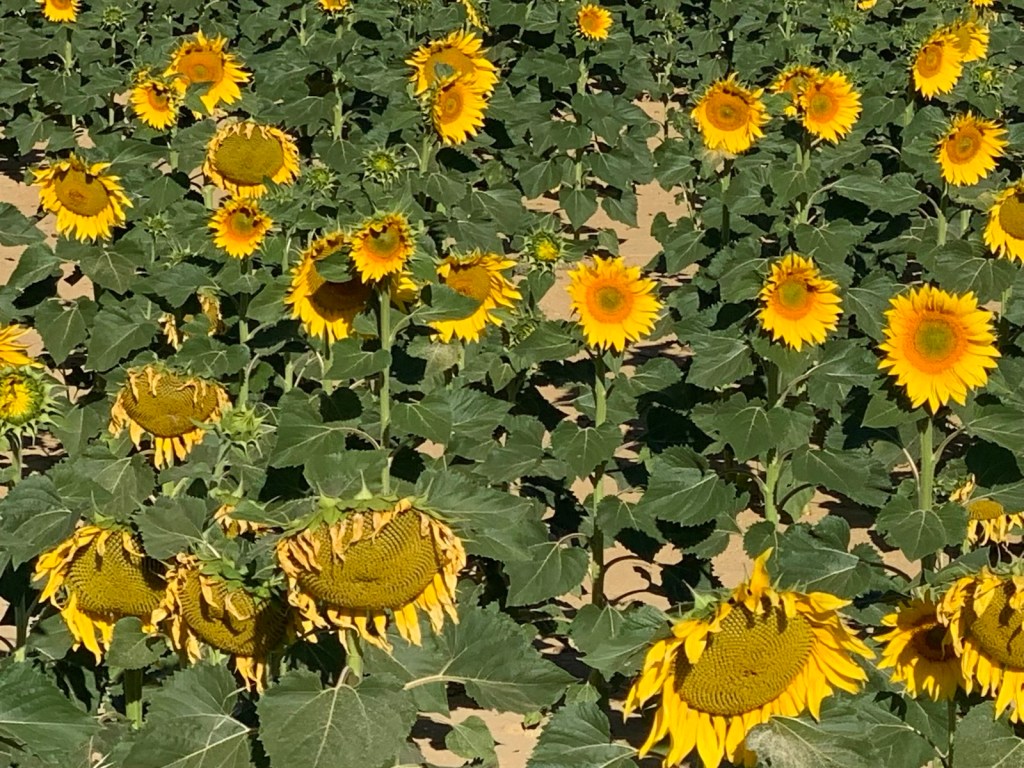
gradually climbing out of the shallow bowl to the Meseta top…. into a strong wind.Arriving at the top and immediately beginning the long descent into the village of Boadilla del Camino.more sunflowers… Iglesia in the village seen in upper left corner of photo, some 3 miles to go.sunflower closeup showing the variable maturity of different plants seemingly planted at same time in the same section of the field. it seemed like we would never reach Boadilla del Camino.Boadilla del Camino, finally.
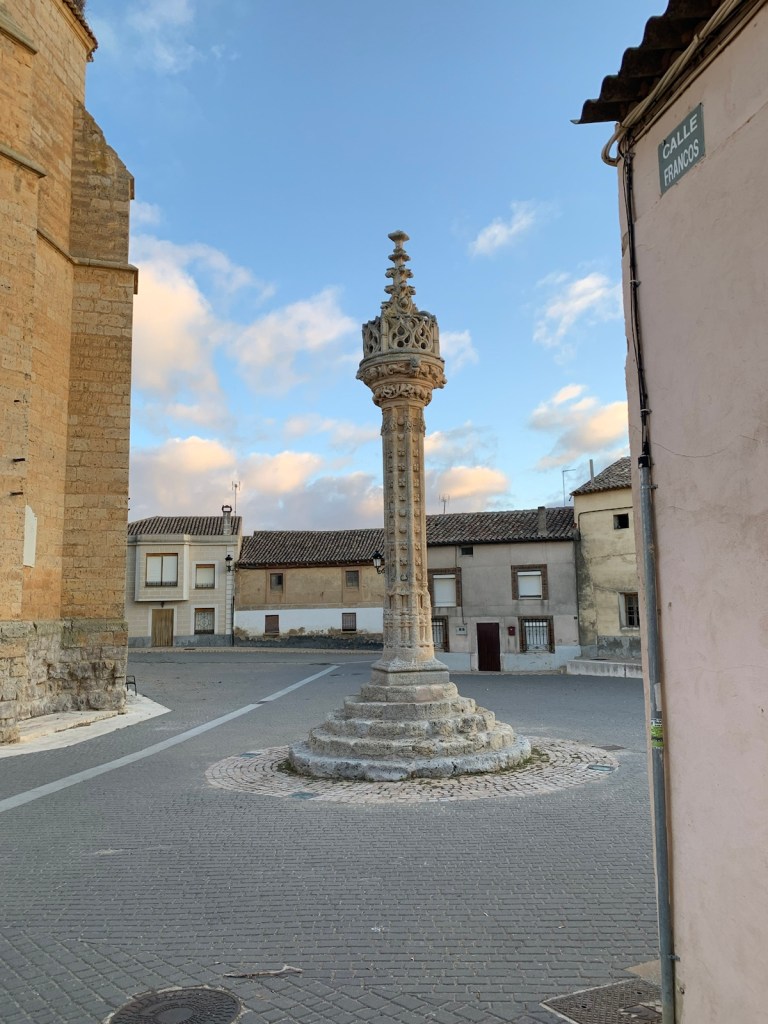
This is our second time to stay in the Hotel Rural Boadilla En El Camino shown above in the village square. Also note the adjacent Rollo de la Justicia. The Gothic Rollo symbolizes the independence granted to Boadilla in the 15th century, as they were then permitted to publicly torture and hang their own criminals. Criminals were chained to the Rollo awaiting their punishment.
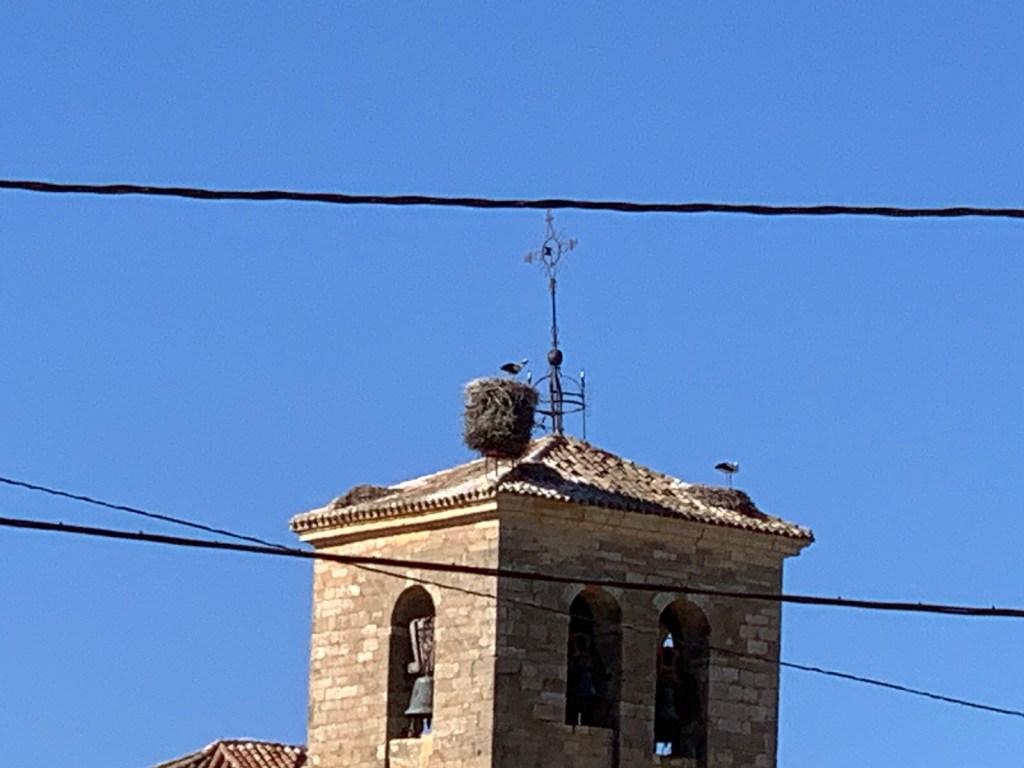
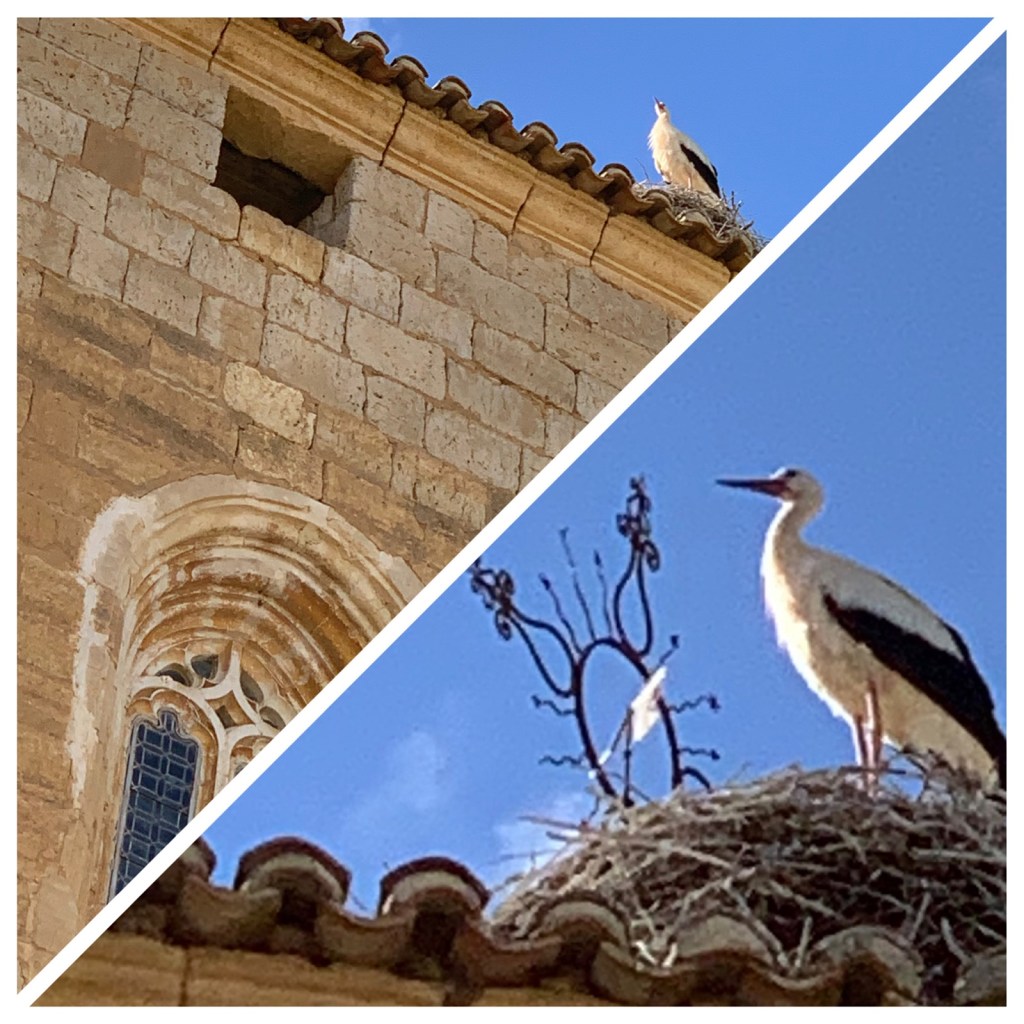
As we walked by the Iglesia de Santa María de la Asunción, we noticed several stork nests on the church steeple, but they were too far up to capture on film.Later in the day, Jim got a closer glimpse and photo of another stork in a previously empty nest .
We had breakfast and a main meal in our hotel. We chatted with a pilgrim from California, one from Texas, another from Lille, France and a group of friends doing their annual week-long walk on the Camino. They were from Hospital, a small village in the south of Ireland.
leaving Hornillos del Camino at 6:10, before “first light”
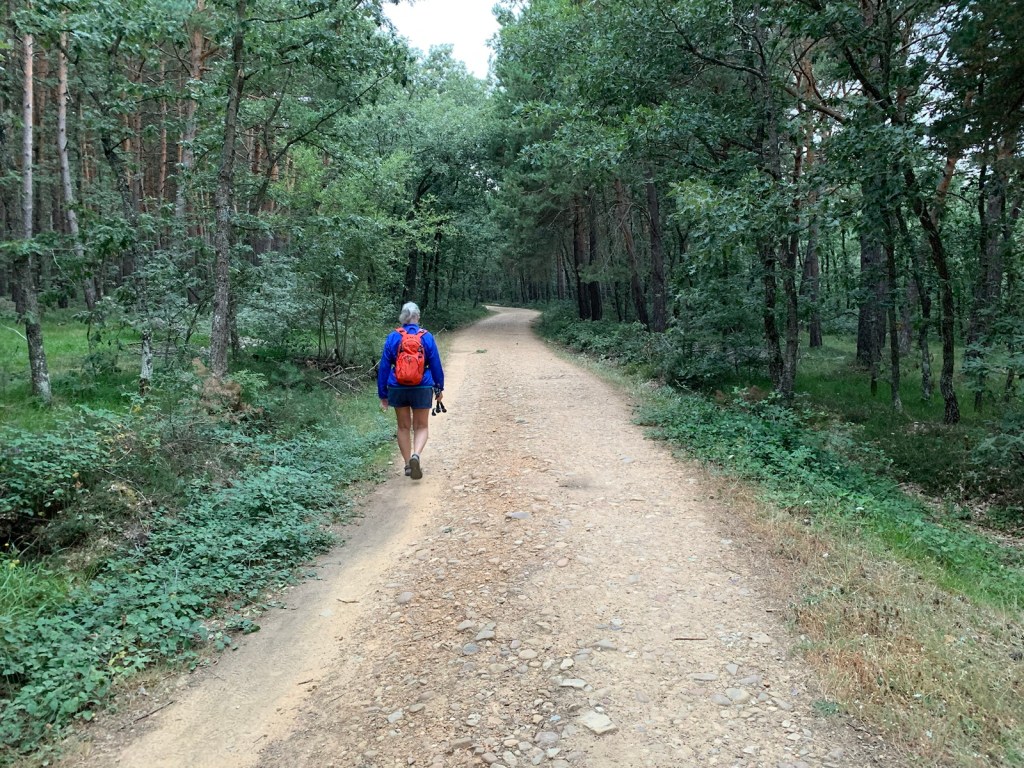
Today was a typical walk on the Meseta. We walked for 2 miles from our albergue in Hornillas back up to the Meseta, continued on the flat gravel path for a mile or so, then descended into San Bol, only to climb back up to the Meseta, walked another 2-3 miles then back down into the village of Hontanas.
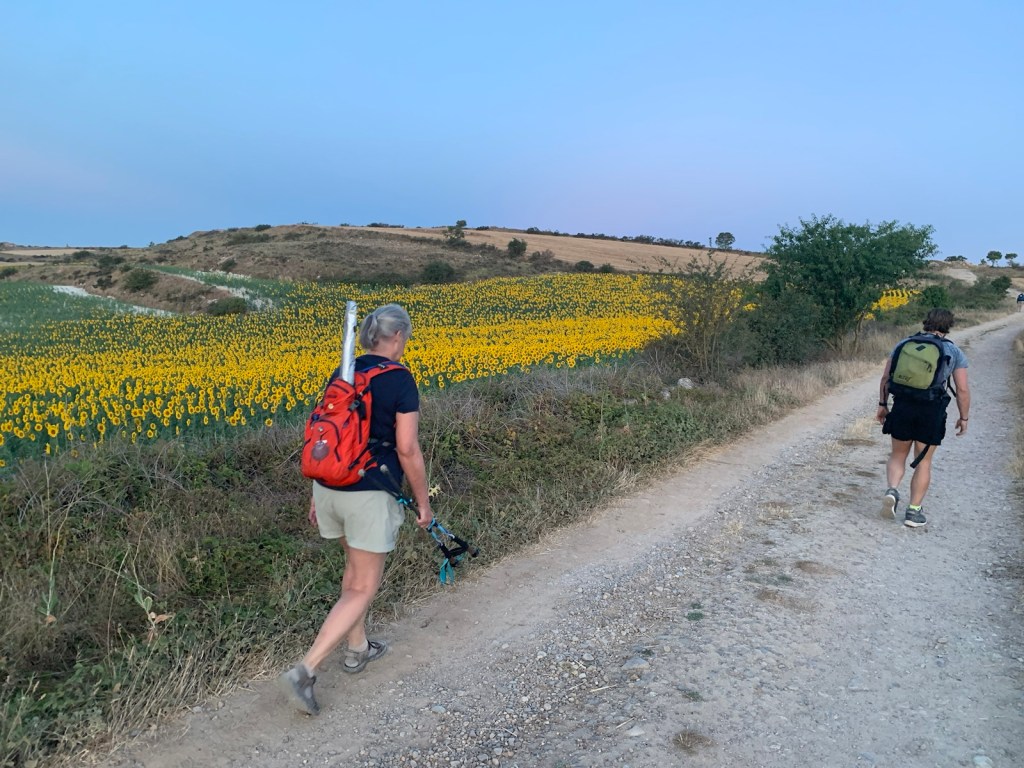
walking out of Hornillos up to the Mesetanear the Meseta after a two mile walkfinally back on the Meseta.looking back at a typical sunrise on the Mesetaa huge field of sunflowers on the Meseta at sunrisedescending into San Bol, a primative albergue.zoom photo of San Bol alberguethis bird chirped at us as we were nearing the Meseta on the way out of San Bol, as if she wanted her photo taken, so we complied.back on the Mesetafirst sighting of Hontanas“main street” of Hontanas our breakfast stop
We called a taxi then had breakfast, chatting with other pilgrims, including several we had seen in days prior. As a result, the 90 minute wait for the taxi passed quickly. The 10 minute taxi ride, saved us an additional two hour walk, in the sun, along the same road. We were dropped off at Albergue Orion, our home for this afternoon and evening, in Castrojeriz.
Linda waiting for out taxi
As expected, the albergue didn’t open until noon, so we walked about a hundred yards to the Iglesia de Santa María Manzano to view the beautiful interior. We then walked across the path to a familiar bar/albergue where we stayed in 2014 and had drinks to fill the remaining wait time until checkin.
Iglesia de Santa María del Manzanodramatic Gothic structure of Santa María del ManzanoSantiago statue to the right of the altarhaving a break at the bar/albergue across from the Iglesia. Under new ownership since the pandemic… we stayed here in 2014.the bar has been redone by the new owners
The door to Orion was open when we returned at noon. We were the first pilgrims to checkin. We got into our room and went into chores routine then got a light lunch in the dining room then spent the remaining afternoon napping and blogging and reading.
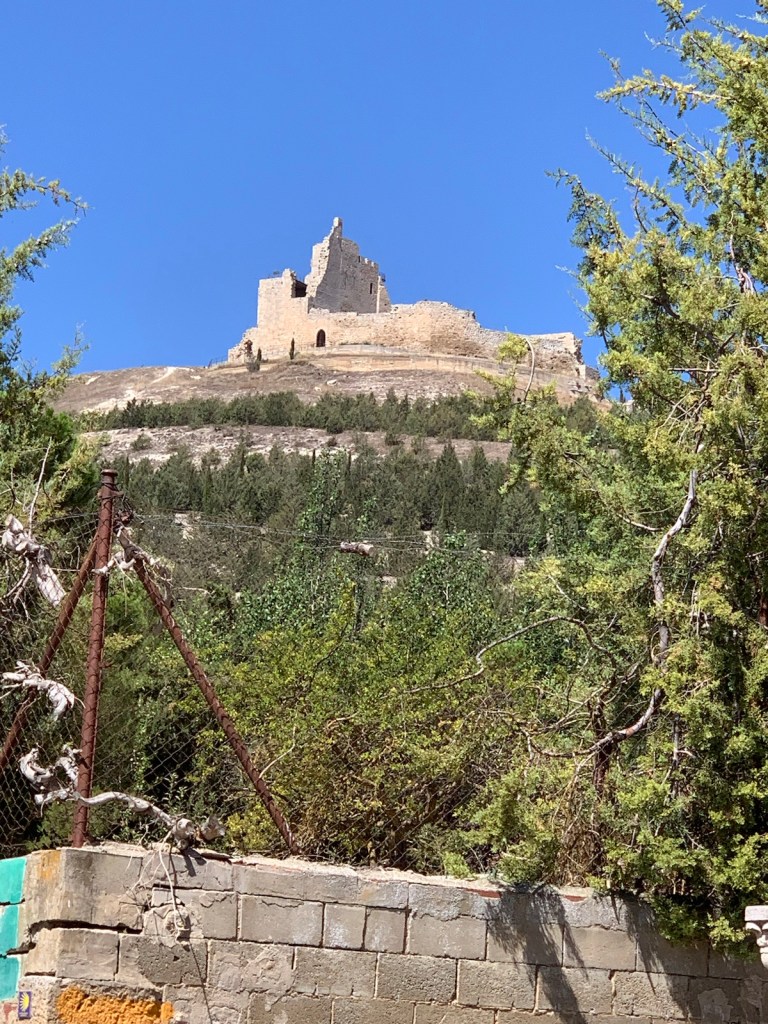
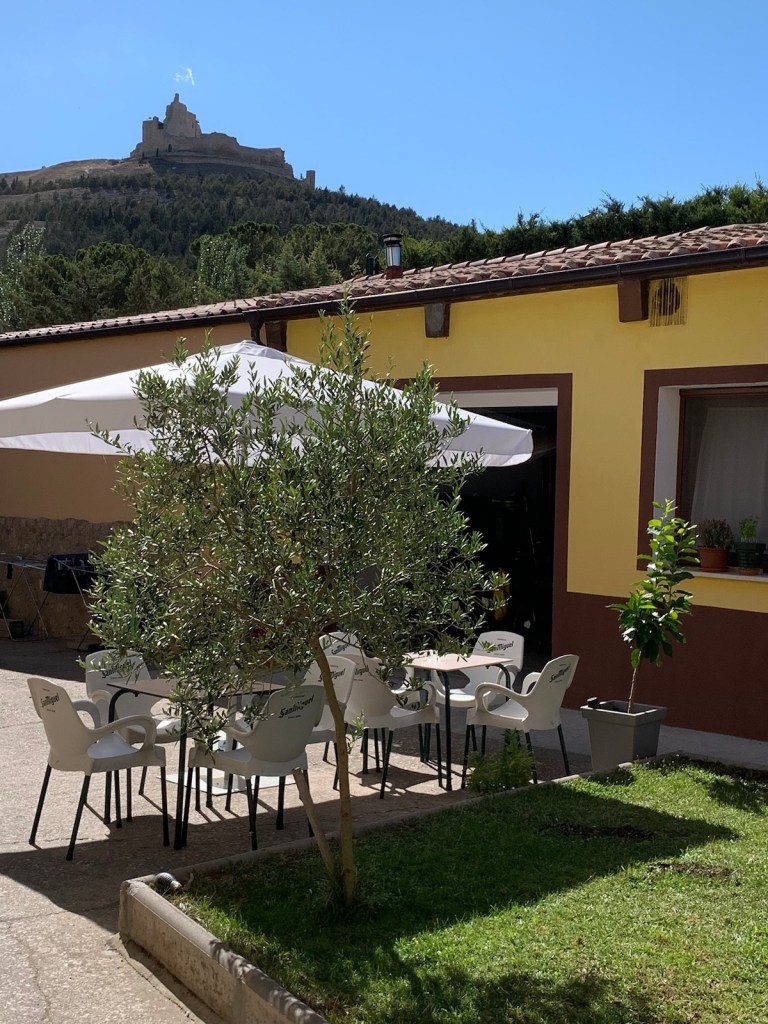
Entrance to Albergue Orionnice garden area of Orion.view of Castile which defended the Roman gold convoys returning from Galícian mines. Occupied subsequently by Visigoths, Moors and Christians.the view from our room at Albergue Orion
Dinner was at 7:00 and consisted of Korean cuisine prepared by our Korean cook. It was very tasty.
Our dinner mates were two guys from the Loire Valley in France and a couple from northern Holland. The Holland couple were doing the Camino on bikes and camping frequently. They had earlier done a trip across the U.S. on bicycles. Conversation was interesting and Jim got to practice some French.
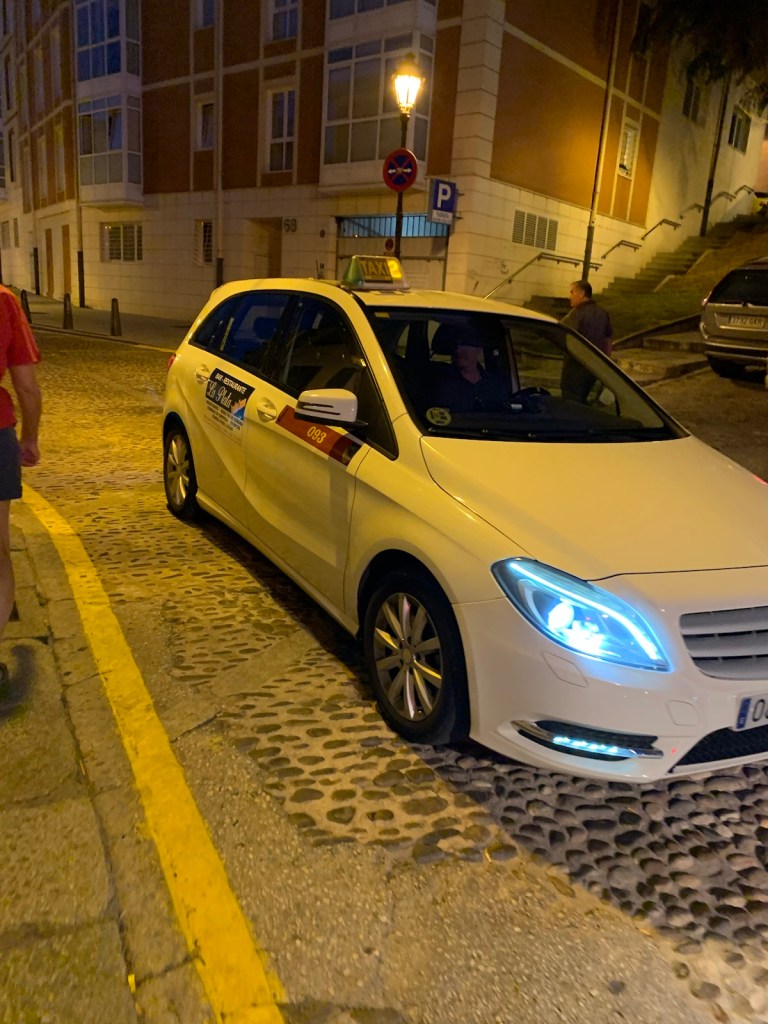
Here’s our taxi to pick us up at El Cid and take us to Tarjados
The 15 minute taxi ride through the not-so-Camino like residential areas of Burgos and crossing several major highway interchanges, took us to an Albergue at the entrance of Tardajos, where we have stayed before. We were expecting a nice breakfast to begin our walk. However, it was closed at 6:30 with no signs if opening any time soon, so we continued on.
The walk through the village of Tardajos is always amazing, because it is literally a maze. If you are not careful looking for insidiously placed Camino arrows, you may never find your way through the town. We did it once, in the dark, and almost never made it to the end!
This morning we made it without any deviations … Linda, leading the way, could possibly have been a factor. It was also broad daylight, not dark, at 6:30 a.m.
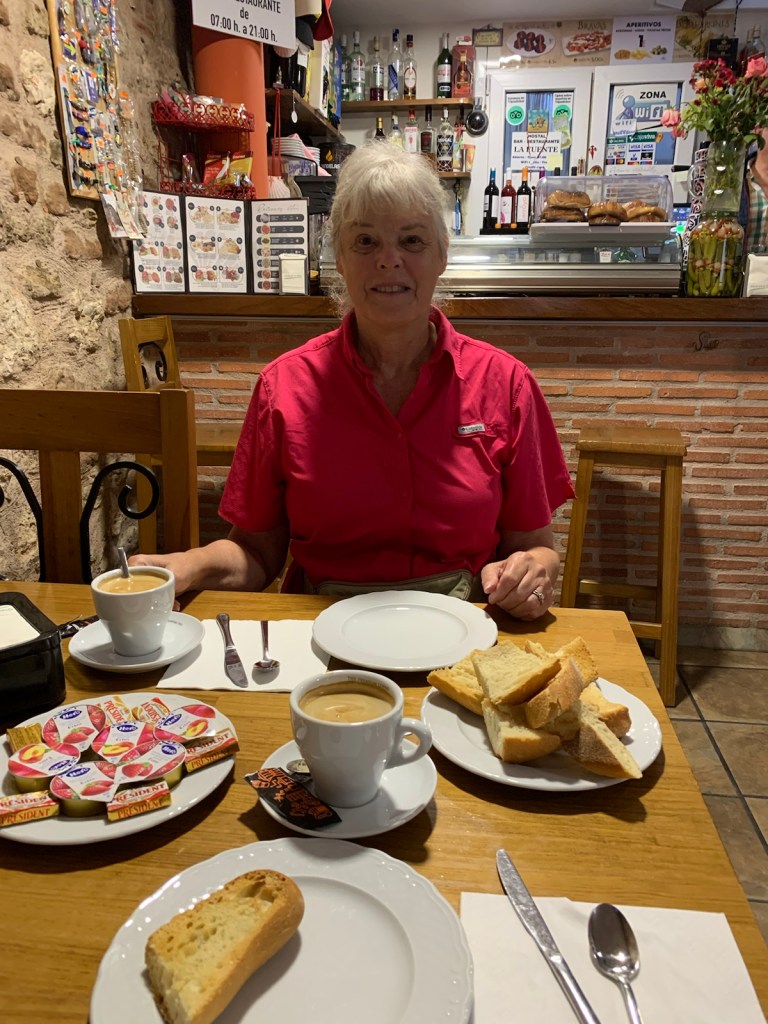
Entering “Rabe”, about a mile beyond Tardajos.Rabé de las Calzadas: Convent off to the left and church in center of village.We stopped at La Fuente Bar/Albergue for a nice breakfast. Owner and wife were very friendly and gave us plenty of butter and jelly for our toast without being asked!
At breakfast we chatted briefly with a couple from Hong Kong. They had walked several different Caminos before and had done the Camino Frances before in 29 days. They were doing it for the second time but in 41 days instead. They weren’t walking especially fast, as they didn’t pass us all the way to Hornillos and we saw them pass through the village some 30 minutes after us. They apparently didn’t walk faster, just longer, each day.
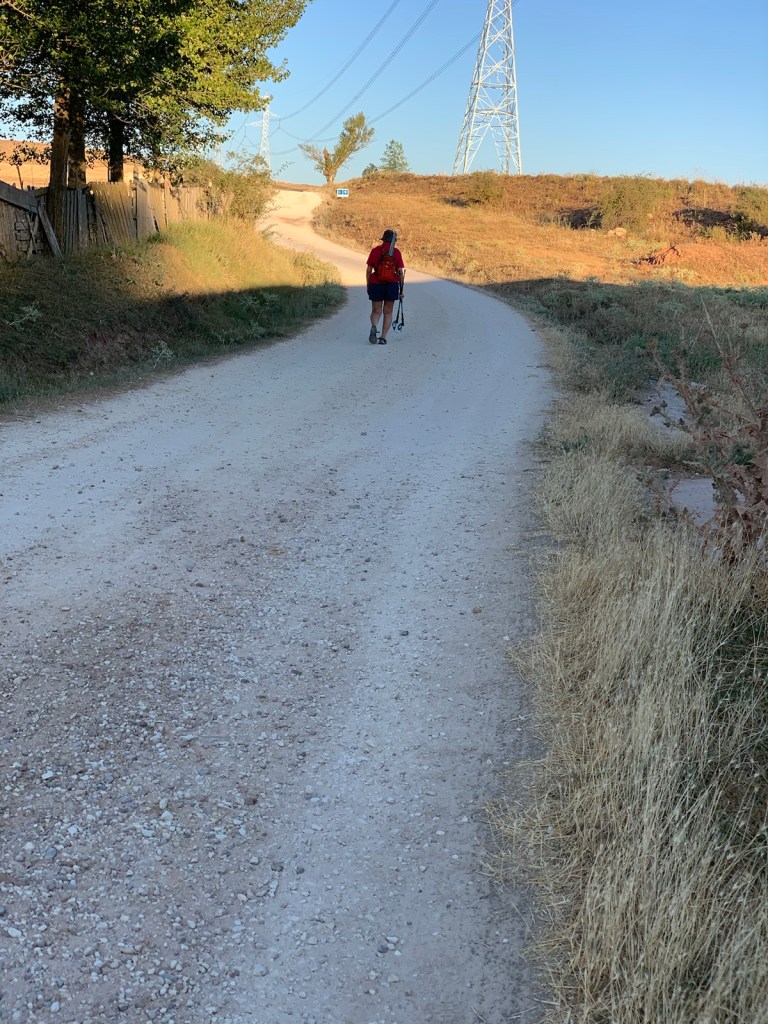
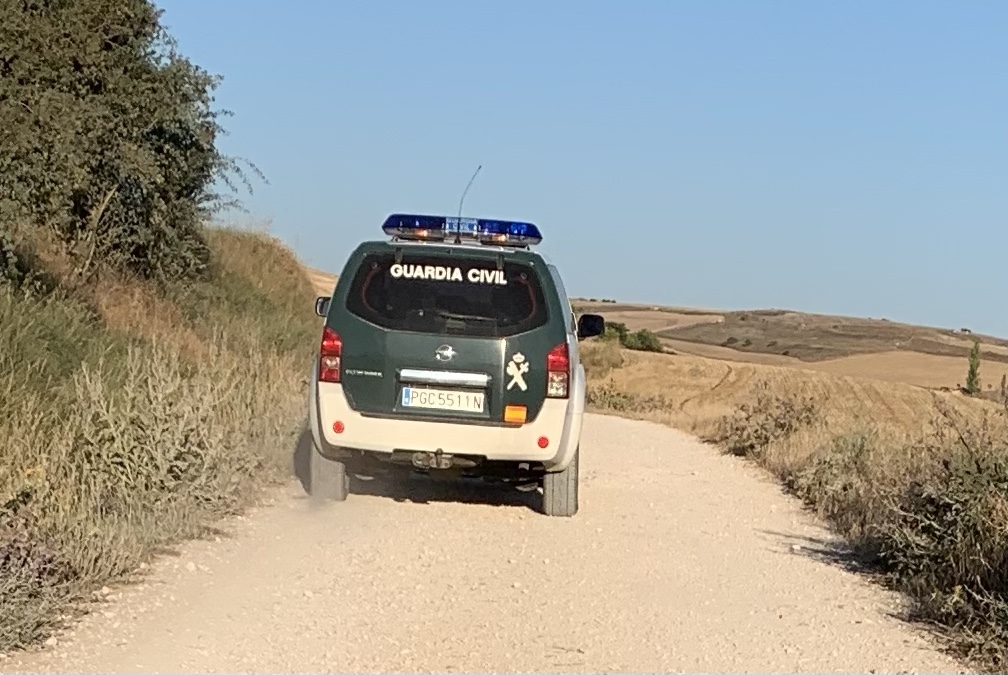
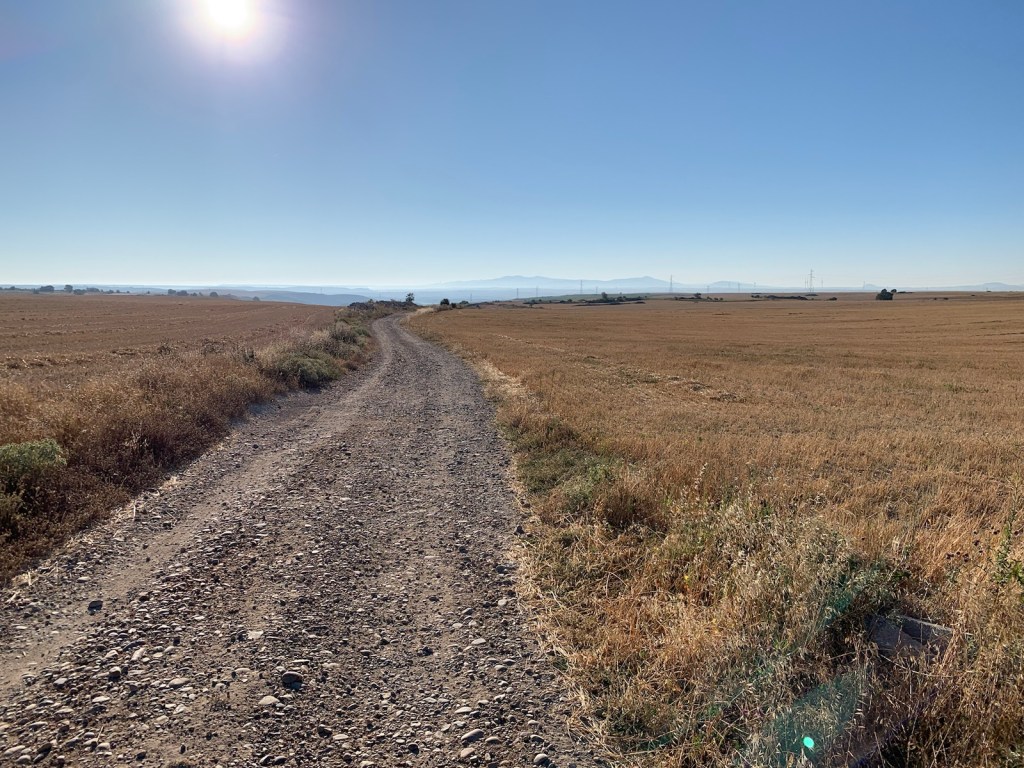
wall art seen on buildings as we exited Rabéfinally back on the familiar gravel path of the Camino on our way out of Rabé de las Calzadas.A reassuring Guardia Civil vehicle passed us on the way up to the meseta.on our way up to the meseta we saw this field of “baby” sunflower” plantswe finally reached the meseta for the first time for Camino2023. Burgos off in the distance as we look backahead of us, the expanse of the meseta.
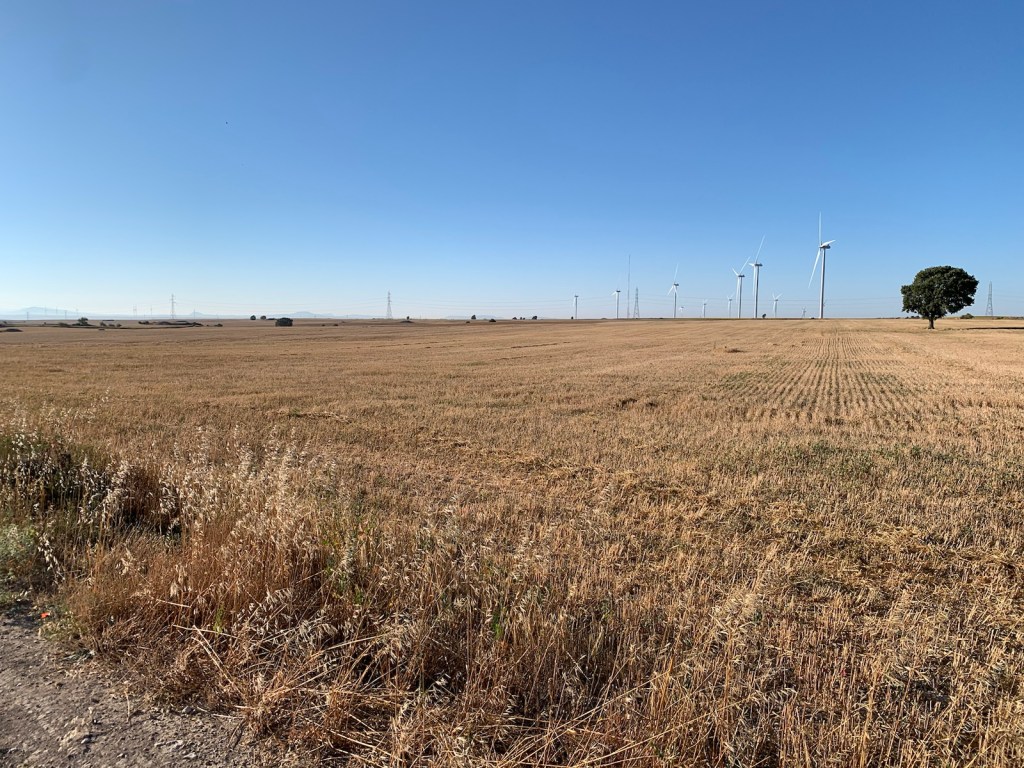
Once on the meseta, we saw several hundred wind powered turbines while walking the initial 3 miles, taking advantage of the terrain to generate power for the area.
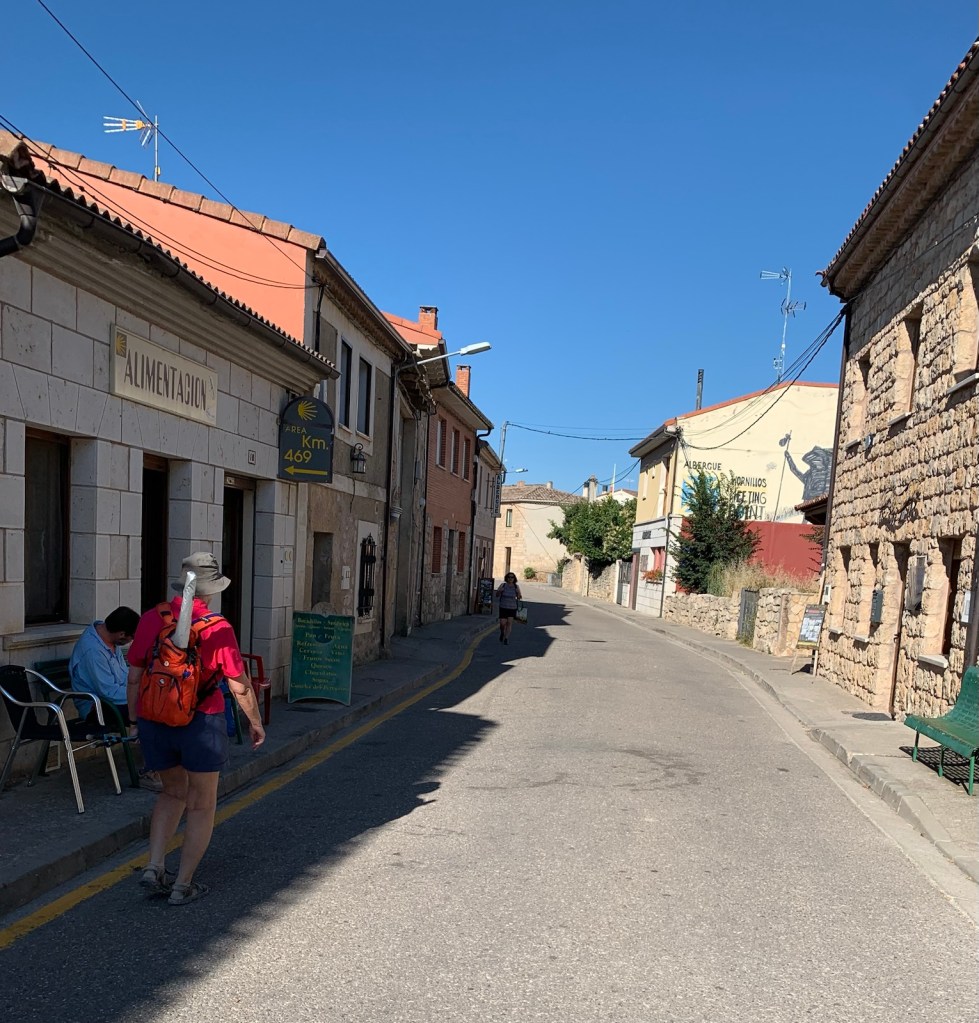
the beautiful simplicity of the meseta.the warning sign for “Mule Killer” hill which goes down from the meseta into the village of Hornillos del Camino.Linda getting up her nerve to take on the descent of Mule Killer hillon the way down“main street”, the only street, through Hornillos del Camino ( pop.61 )
Meeting Point Albergue was not open when we arrived at around 10 a.m. so we got fresh squeezed orange juice at the only open bar in the village and killed a couple of hours chatting with passing by pilgrims and partaking of the restroom facilities, while we waited.
Finally at 11:45, the door opened at the albergue and we were the first to check in. Once in our room, we grabbed our basque shopping bag and headed for the small, but fruitful market a few steps from Meeting Point and shopped, with the help of the friendly proprietor of the market, for our lunch. (this albergue and most albergues serve only dinner and breakfast, if that).
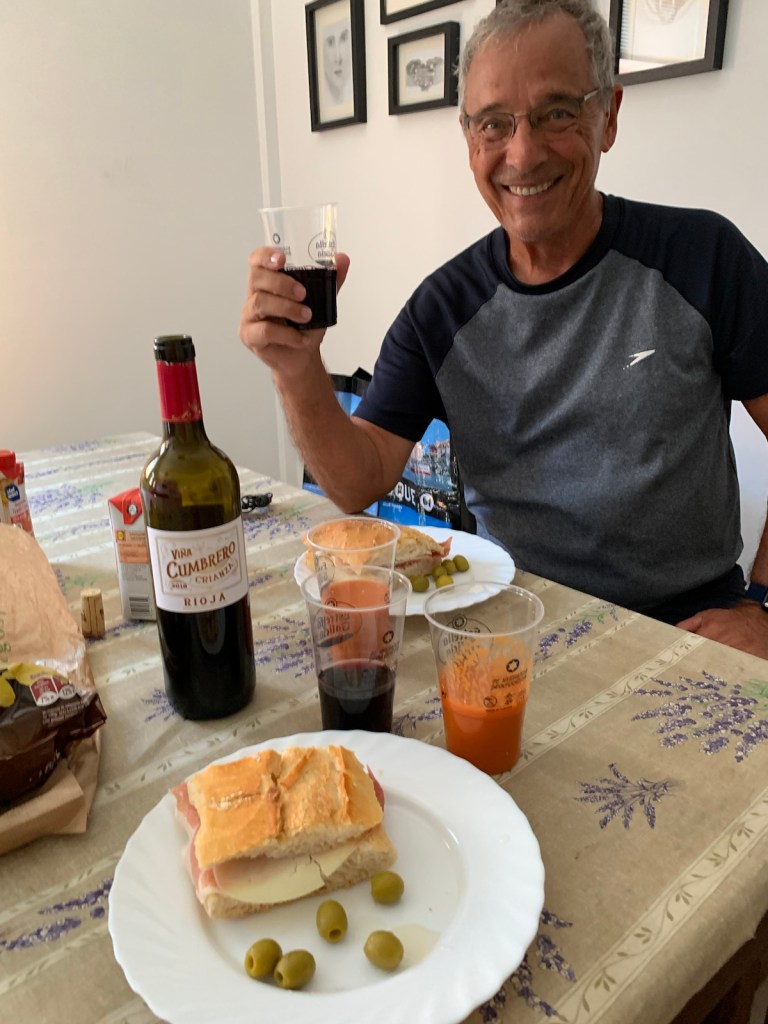
Our self-catered lunch: Bocadillos of fresh bread, ham and cheese, olives, chips, gazpacho, Rioja crianza wine.
After a delicious, satisfying lunch, we performed our afternoon chores, then blogged and read and napped the rest of the afternoon until the 7:00 pilgrims dinner.
Fourteen pilgrims attended the dinner tonight, featuring the albergue’s traditional menu of paella, green salad, local wine and a lemon yogurt for dessert. Most of our conversation was with nearby pilgrims: a couple from California doing their first Camino after postponing it due to the pandemic, a young lady from Germany who originally planned to walk the Camino to contemplate her future after graduating from college, but received a job offer in June and accepted it contingent on her being able to walk the Camino first (her new employer agreed), and a gentleman of 80 years from Leon, France who is on his first Camino, which he began in La Puy en Velay, France, making his Camino nearly 1000 miles when he gets to Santiago.
As with all our Caminos, we meet interesting people from all over the planet and share stories and experiences and motivations for being here. Pilgrim dinners are an excellent forum to do this and tonight was no exception.
At 7:00 a taxi met us at the hotel entrance and took us to the hamlet of San Juan de Ortega, where we began our walk for the day.
The Iglesia de San Juan de Ortega
San Juan de Ortega, or Juan Velásquez, was a young priest and disciple of Santo Domingo. Juan was born near Burgos. San Juan helped Santo Domingo in the construction of bridges in Logroño, Santo Domingo and Nájera. After Domingo’s death, Juan went on pilgrimage to Jerusalem. On the journey, he was caught up in a shipwreck and prayed to San Nicolás de Bari to save him. When he survived, he returned to the Burgos area determined to serve pilgrims in the notoriously dangerous and difficult Oca mountains. He is attributed with developing the road from Villafranca to Burgos (from which he took his name de Ortega, “of the nettles”) as well as a hospice and monastery in the wilderness. Along with being considered the patron saint of innkeepers, San Juan also became known as the saint of fertility. Legend says that when his tomb was opened, the air was fragrant and a swarm of white bees flew out. Queen Isabel la Católica was perhaps the most famous barren woman to pray at his tomb. She visited twice and conceived two children, named Juan and Juana. San Juan de Ortega is buried in the church with his name.
the path between San Juan …. and Agés was mostly like this … a walk through the forest.leaving the forest and heading down into the hamlet of Agés ( pop 65).
We stopped for breakfast in Agés at Bar/Alberge Fagus, a familiar breakfast stop. We also stayed here in 2014.
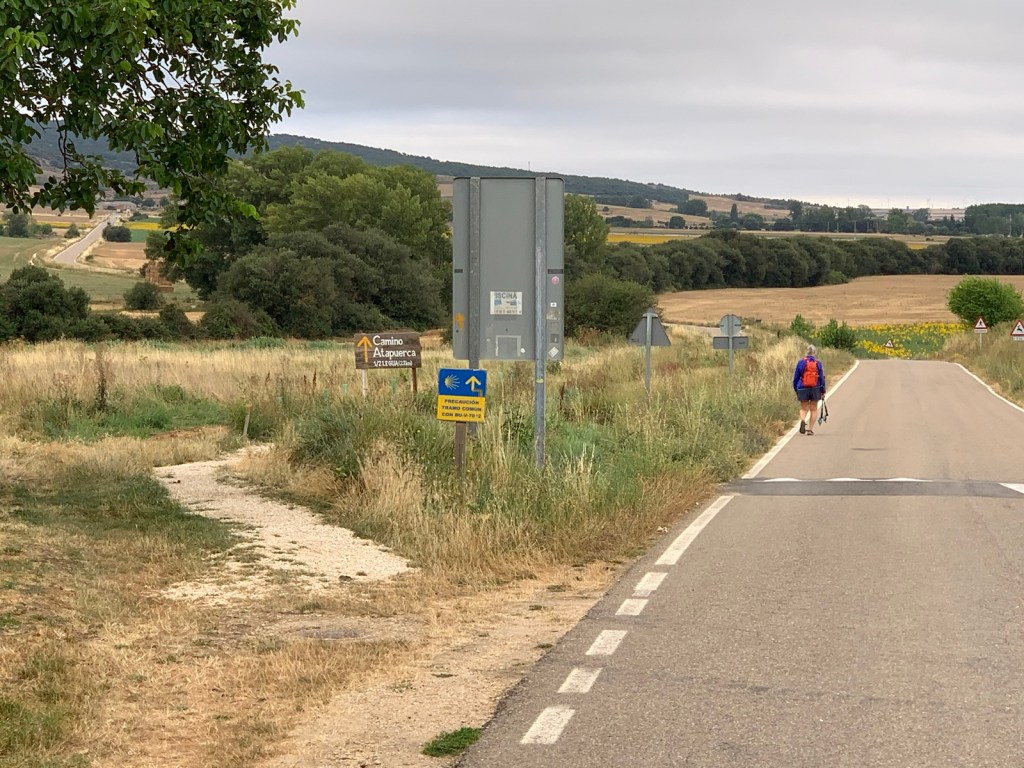
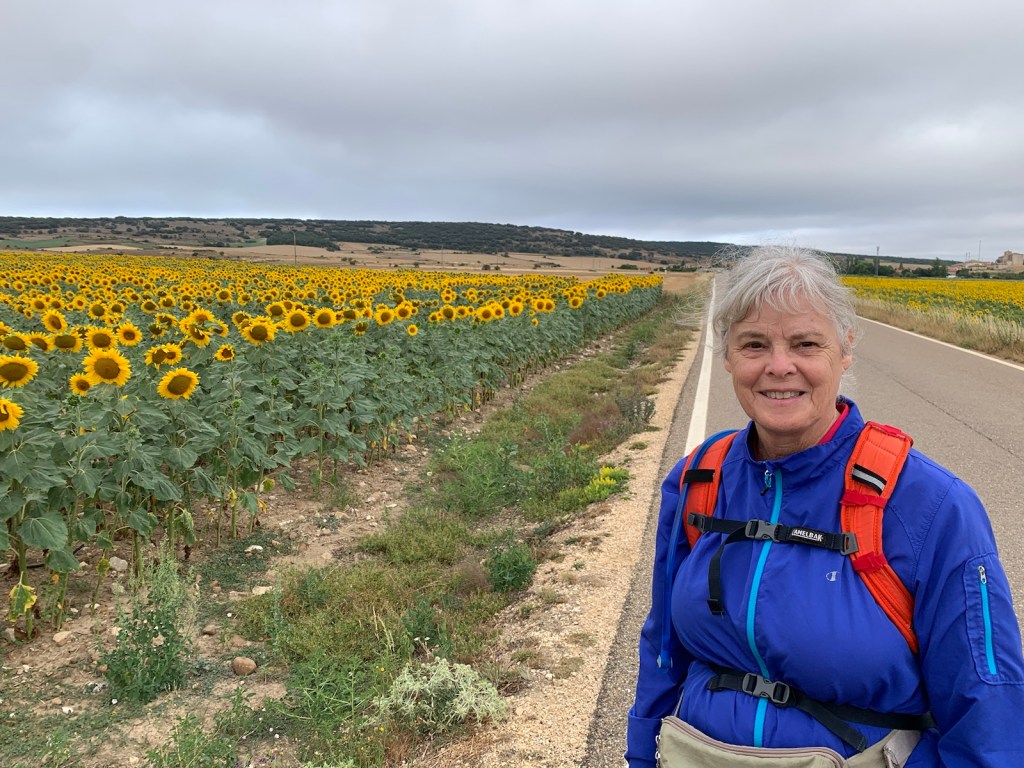
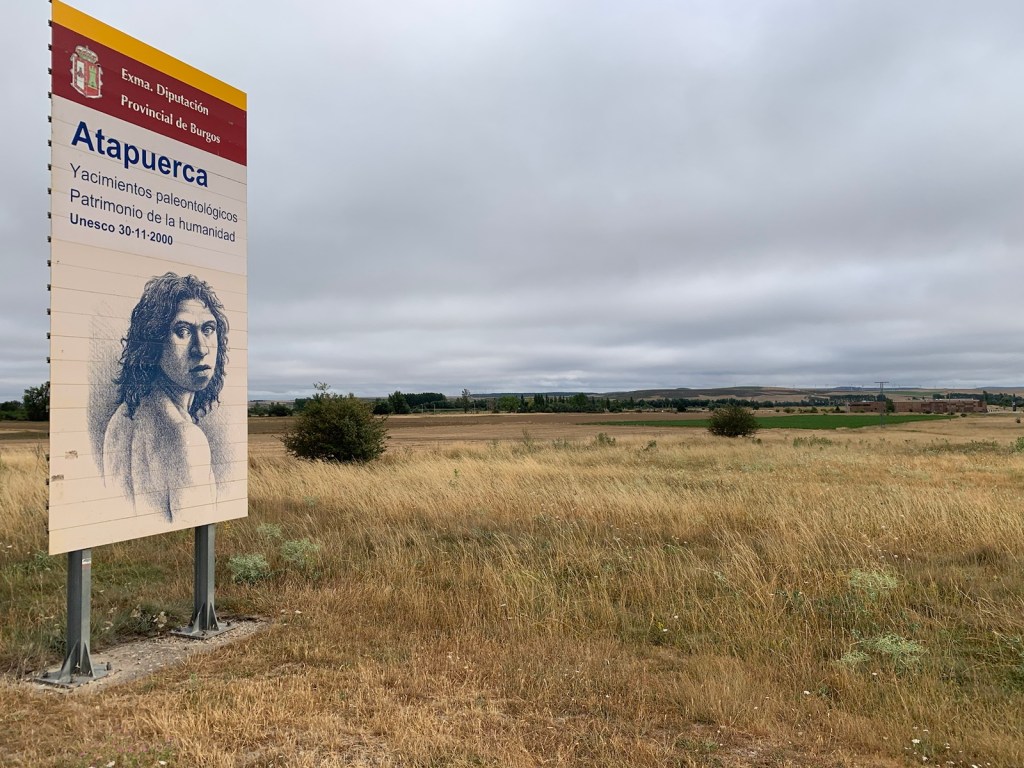
finishing with breakfast at Bar Fagusleaving Bar Fagus and Agésmore wall art seen on the way out of Agésleaving Agés and walking toward Atapuerca more sunflowers (looking for the sun this overcast morning)walking past the entrance of the park where the remains of early humans, some 800,000 years old have been found in caves where excavations have been ongoing for over 30 years.
We stopped at a bar in Atapuerca (pop. 206) and called a taxi to give us a lift to Burgos… our destination for the day.
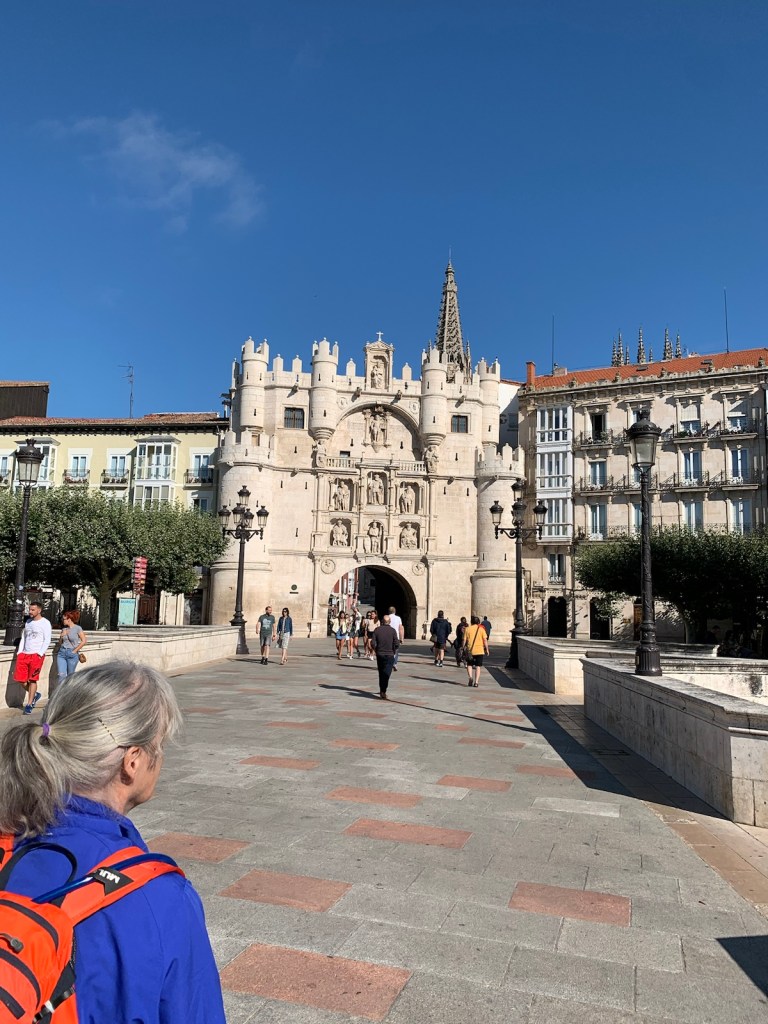
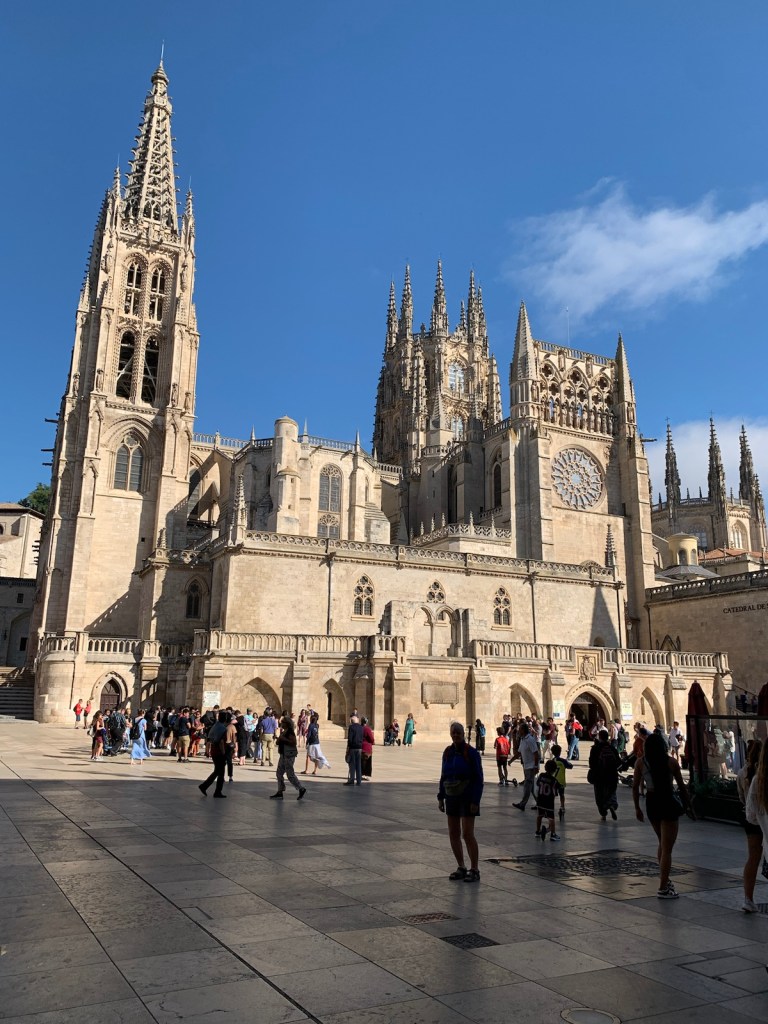
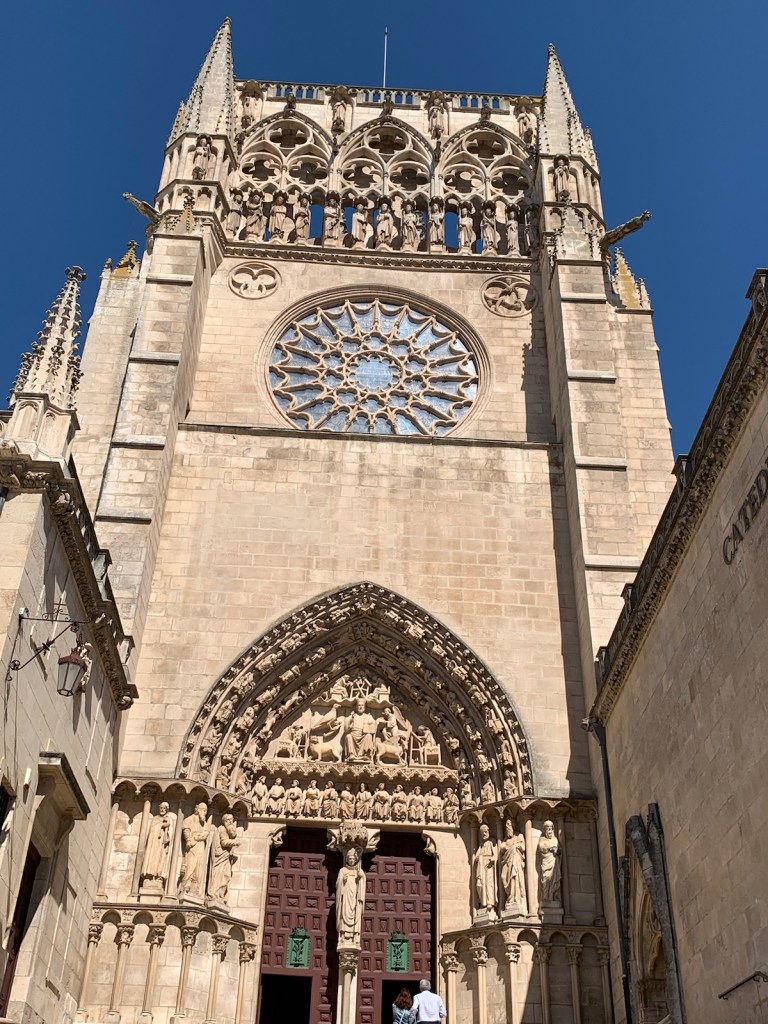
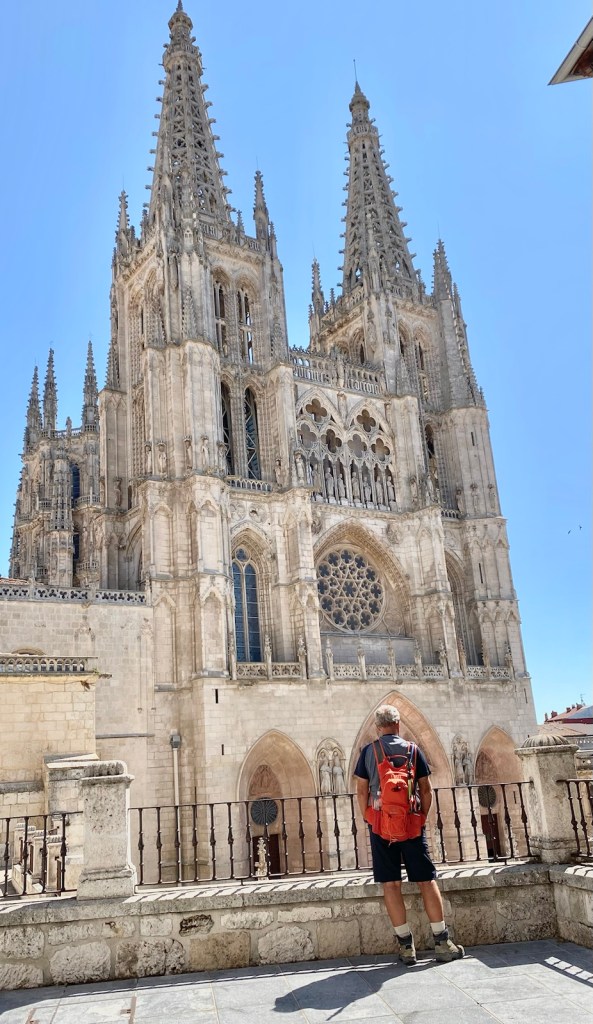
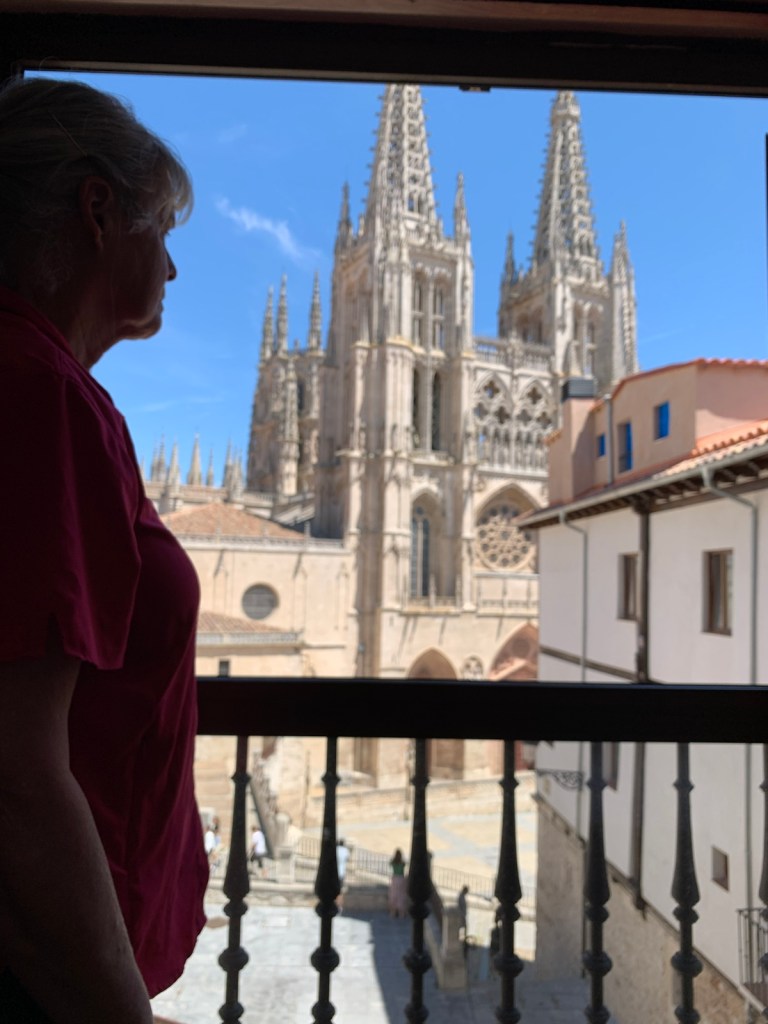
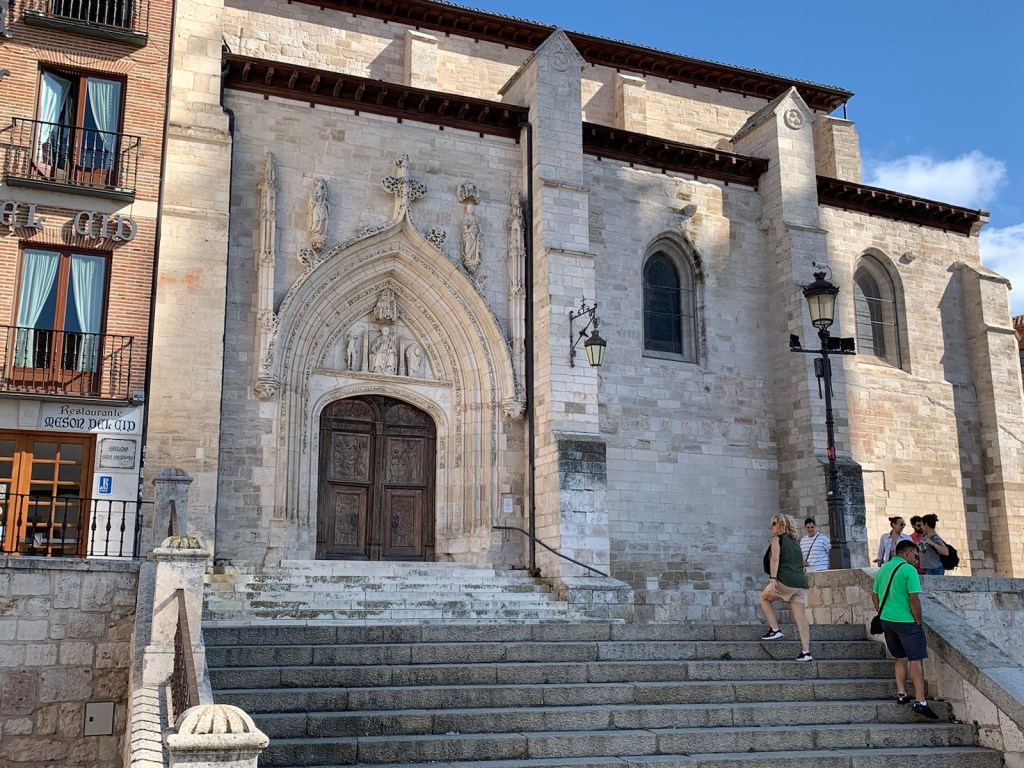
Our taxi dropped us off near the Catedral de Santa María on the center of Burgos. Here we are crossing the bridge then through the magnificent arch leading into the Catedral Plaza.the extraordinary Burgos Catedral the entrance to the Catedralour hotel, Meson del CidJim waiting for our room to be readythe view from our room in Meson del Cidthe Iglesia de San Nicolas de Bari is adjacent to our hotel
We finished our main meal at 2:00 just before checking into the hotel. The rest of the afternoon was devoted to chores, naps and blog. We also had a great view in and out of our room of groups of revelers from Costa Rica among others.
Jim had a short reunion/drink later in the day with our friend, Francois who is spending the next couple of days in Burgos. They were joined by Vincent, a nurse from Strasburg, France, who is working along the French Camino. They chatted about just about everything. We may meet up with Francois again, as we are moving ahead of him tomorrow and may cross paths again on the meseta.





























 Jimandi