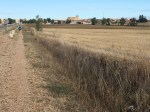
In a lot of ways, today’s walk was like yesterday’s. It was what we consider a long walk (>16km or 10 miles). The path was mostly flat with only gentle ups and downs. The weather was perfect: temperature in 50-60 range, slight breeze behind us, no precipitation.
Even though today we walked a mile less than yesterday, what made today more difficult was: the first 3.5 miles were paved rather than dirt, there were no villages or bars or restrooms for the entire 10.6 miles and it occurred a day after walking nearly twelve miles.
Nevertheless, it was on balance, a good day, a satisfying day for both of us.
Unlike most of our walks, there’s not a lot to share about our day.
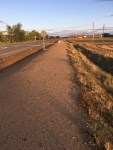
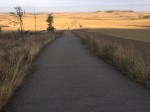
In summary, we left Carrión at 6:45 in the dark and walked for the first 3.5 miles on a very
straight Roman road that had been restored by paving it with asphalt.
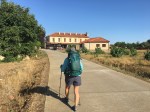
Beginning our walk on upgraded? Roman road
Looking back at Carrión before sunrise
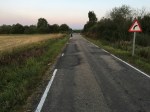
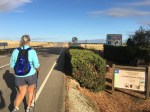
First and only curve on paved Roman road at 3 miles
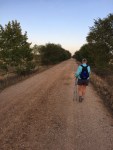
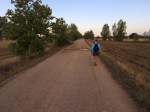
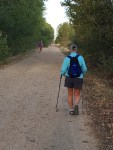
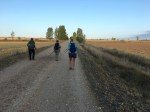
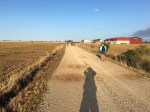
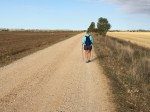
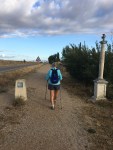
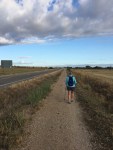
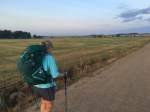
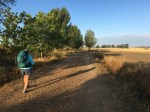
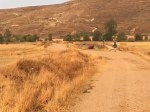
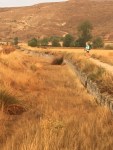
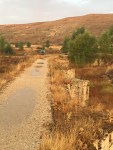
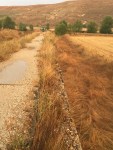
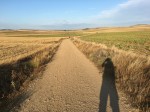
The next 7 miles were also on a straight Roman road that had been covered with a mixture of gravel and dirt and packed down by farm equipment and pilgrims for many years.
Asphalt stopped, but continued on what was originally a Roman road
After 4 miles
Around 5 miles walked
2 French ladies passed us at 6 miles
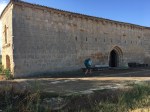
Just a barn, no rest stop here
Between 6 and 7 miles
After 7 miles
After 8 miles
First and only hill at between 8 and 9 miles.
Getting close to Calzadilla de la Cueza
Calzadilla emerging from a hole on the meseta
Finally approaching Calzadilla de la Cueza
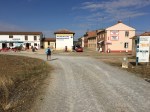
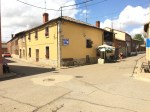
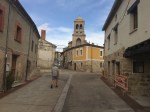
Entering pueblo of Calzadilla de la Cueza
Our hotel
We arrived in Calzadilla de la Cueza (pop. 54) at 10:45 and were allowed to check-in to our room at the Camino Real hostel (40€) right away and did so as soon as we ate a late breakfast.
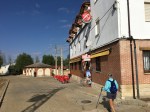
This small village of 54 inhabitants has a church but it was locked. Main Street is at best 100 yards long with a few crossing streets with maybe 4-5 houses deep. Other than 2 albergues, our hotel, and a tiny grocery store (which was also closed) there isn’t anything else here but houses and buildings housing farm equipment.
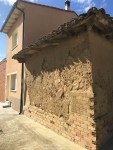
Exposed stucco with straw and stone reinforcement on main street house
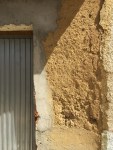
Another stucco building used as is.
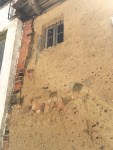
Plaster and concrete broken away exposing stocco from local clay, straw and stones,
Owner still using adobe with brick facing as his house with modern stucco addition.
Because of lack of stone, most of the houses are made of brick and stucco. The bricks appear to be very crude but have been around for a long time. You can see the straw mixed in with the clay and several houses have very old brick that has been maintained and retained with newer brick add-ons.
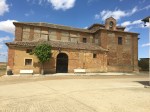
San Martin Iglesia (16th century) exterior
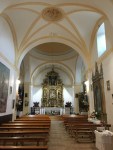
Interior of 16th century San Martin of Tours Iglesia
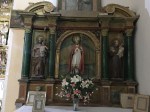
That’s San Martin in the center
13th century icon in San Martin.
After a pizza dinner we took a walk and found the 16th century church, Iglesia de San Martin, open and an 87 year old, lifetime resident took us on a tour. We understood a little of what she said, enough to keep her from being as frustrated as we. Several of the wood icons in the church were from the 13th century and her describing them to us made it extra special. She wouldn’t let us take her photo because she wasn’t dressed up for it. It created another wonderful memory for Camino 2017.
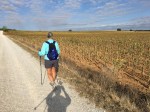
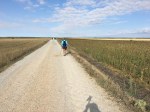
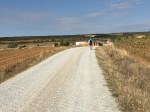
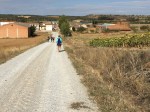
Today almost all of our walk was on a gravel/dirt path parallel to a two lane, lightly traveled highway.
We walked through the villages of Población de Campo (pop. 140):
Entering Poblocíon del Campos
Leaving Poblocíon del Campos
Revenga de Campos (pop.179):
Before Revenga de Campos
Revenga de Campos
Leaving Revenga de Campos
Villarmentero de Campos (pop. 11)):
Before Villarmentero
Villarmentero
Leaving Villarmentero
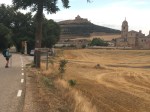
and Villalcazar de Sirga (pop.174):
Approaching Villalcazar
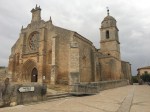
13th-century  Iglesia de Santa María la Blanca
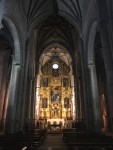
Entrance to Iglesia of the White Virgin in Villalcazar
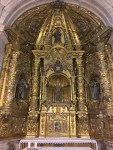
The Camino did not originally pass through this town, but later detoured when the fame of the Virgen Blanca (” white virgin”) and her many miracles spread. She is on display in the 13th-century  Iglesia de Santa María la Blanca.
A pilgrim having his cafe con leche
Leaving Villalcazar
They were all spaced 2-3 miles apart and few if any services were available in each village. It usually took less than 5 minutes to pass through each village. In between the villages were flat, fields as far as you could see in all directions.
This is the meseta. Many guidebooks and other writings describe the meseta as dull, monotonous, repetitive, bleak, hot, cold, uninteresting, etc. We’ve known many pilgrims who skip it altogether by taking a bus. Many walk to Burgos and stop. Others begin in Leon and walk to Santiago.
We love the meseta. The endless fields and frontier-like villages scattered along the Way, because of their simplicity, are actually soothing, proving time for reflective thinking or non-thinking (meditation) while you walk without distraction or stimulus, other than the breeze, the sun, the sky, the endless fields and what you are feeling physically and/emotionally.
Today was a great day. We felt good both during and after what was our longest and fastest walk so far…averaging 3 miles an hour for almost 12 miles!
We walked straight to our Hotel Santiago in Carrión de Los Condes (pop.2221) and were warmly received by the owner who happens to be the grandson of the owner of the hotel we stayed in two nights ago.
Just before Carrión
Hotel Santiago
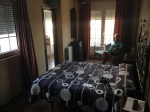
Our room
Today was market day in Carrión and it was in Santa María Plaza, just outside our hotel
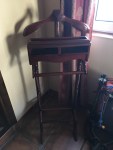
Even a place for Jim to hang sports coat, trousers and for cuff links!
Our habitacion con bano (40€) is one of the nicest, spacious we have occupied so far.
After completing our chores we had lunch at a nice restaurant a few blocks away. We had two delicious meals and will definitely snack for dinner.
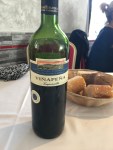
A nice local wine
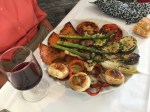
Linda’s roasted vegetables
Jim’s salmon
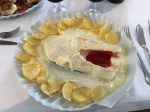
Dessert was half gone before Jim remembered to take photo
Tonight we attended a mass at the Iglesia de Santa María del Camino for Peregrinos, which we attended passively as it was all in Spanish and we didn’t recognize any of the songs, ritual or responsive readings. At the end of the service the 50-60 pilgrims attending came down to the front of the church to be recognized by country (we were the only Americans). The priest gave a personal blessing to each of us. Also we were each presented a handmade star to carry with us, representing the blessing for a good Camino and a good life afterwards.
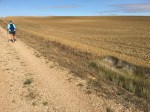
The first 5 miles this morning from Itero de la Vega to Boadilla del Camino was an uneventful walk on a dirt path surrounded by fields of recently cut wheat and an occasional smaller field of unrecognized green leafy plants and some field corn (not to eat).
Nice mural on house as we left Itero de la Vega
Typical Camino exit from small town or village: town paved road, across local road onto dirt path.
Typical scenery for first 5 miles
Trees on the meseta… Boadilla del Camino must be coming up
Our walk between Itero and Boadilla – typical scenery
More typical scenery for first 5 miles
Two pilgrims walked about 500 yards ahead us most of the way with no other pilgrims in sight.
Iglesia de Santa María de la Asunción at Boadilla del Camino (stork nest in belfry)
Breakfast at Boadilla del Camino and not a pilgrim in sight, except us.
We stopped for breakfast in Boadilla at an albergue and again, the only person besides us was the owner.
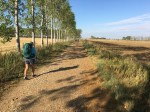
Just outside of Boadilla del Camino the path was lined with tall trees, providing shade to go along with a light breeze and low 60’s temperature… perfect for walking.
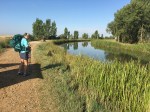
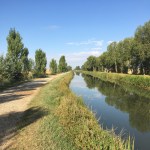
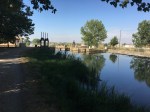
A mile later the path made a sharp right turn and soon after we began walking along the Canal de Castilla for the remainder of the morning into Frómista.
Beginning our walk along the canal
Typical view as we walked along the Canal de Castillo for 2 miles.
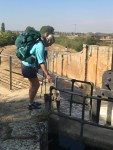
Canal gate valve on right, irrigation aqueduct on left
Canal gates at Fórmista town limits
Linda crossing canal
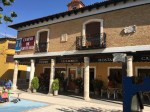
We zig-zagged through town and at 11:20 found (uniquely named), Hotel Camino de Santiago(48€), a very nice “Top Rural” hotel.
The hotel didn’t open until 1:30, but we rang the doorbell anyway and the owner acknowledged our reservation and hustled us up to our room, indicating we could do the checkin later.
Hotel Camino de Santiago
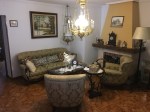
Our room
Parlor just outside our room
By 1:00 we had settled in and completed our routine tasks, so we ventured out into the neighborhood to scout out anything we wanted to see later, had lunch and returned shortly after 2 to check-in.
The rest of the afternoon was devoted to reading and naps (Jim procrastinated on the blog) and visiting a church or two and making sure we knew the way from our hotel back to the Camino for tomorrow morning.
Iglesia de San Pedro
Iglesia de San Pedro
Entrance to San Pedro
Interior of San Pedro
Close-up of Retablo of San Pedro
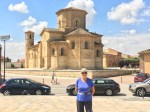
Iglesia de San Martín
Iglesia de San Martín
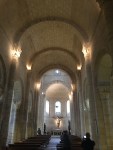
Interior of San Martin
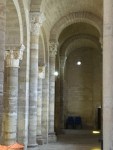
Romanesque nave of San Martín
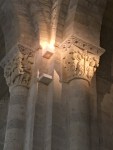
Romanesque columns inside San Martín
A thunderstorm threatened our normal plans for supper at a nearby restaurant, so we grabbed sandwiches and returned to the hotel and had dinner in our parlor. We’ve only seen one other occupant in our hotel, a couple from Ireland who is doing the Camino a week at a time, starting this time in Burgos and going as far as they can by Friday.
Tomorrow will be a long one, so we got to bed early.
Day was just breaking as we left Meson de Castrojeriz at 7:15 and walked the remaining 0.7 mile through the town. We crossed the main road and onto a Roman road.
We walked past the 13th-century Iglesia de San Juan de los Caballeros on the way out of Castrojeriz this morning
First view of Alto de Mostelares at day break
Ancient Camino marker at beginning of Roman road
Looking back at Castrojeriz, the emerging sun silhouetted the strategically placed town and San Esteban Castillo, and in mere minutes evolved into a magnificently blazing sky.
Sun silhouetting Castrojeriz
Evolving sunrise display
Blazing sky
The road continued as we looked apprehensively at the imposing mountain in front of us and the barely visible pathway that worked its way up to the pinnacle .
The 2000 year old road became a Roman causeway made from thousands of tons of stone brought here by the Romans to cross a swampy area with their chariots and wagons, transporting gold and other minerals over 2000 years ago. The remains of Roman mines could also be seen to the right as well as a seam of mica running up the hill.
Starting to walk over Roman causeway
Side view of Roman causeway
Ruins of Roman bridge at end of causeway
Walking on Roman causeway
Winding path heading to the base of the mountain
Evidence of Roman mines to right of Camino
The path then climbed steeply up a 12% grade over 500 ft to the Alto de Mostelares. At the top we paused a few minutes to catch our breath in a small shelter created for shade. 
A mountain ahead of us
Just beginning the 12% grade incline
Linda pausing to monitor our progress (and to catch her breath).
View below is about half-way up the mountain
Linda just arriving at top of Alto de Mostelares
Sun hiding behind top of mountain marker ( and blocking my shot of Castrojeriz
Castrojeriz and surrounding valley
Pausing after a tough climb
Looking back at Castrojeriz into the sun
We walked on the flat mountain top, viewing other mesas around us for a few hundred yards then plunged downhill another 500 ft over a path that had been paved in cement and reached a grade of 18%! The going down was about as slow as the climbing up.
On top of the mountain and meseta, but not for long
Linda starting down the 18% grade concrete path
Concrete path begins as we head down off the mountain
Walking down the 18% grade on concrete path
Concrete path ends and dirt/gravel path begins
At the bottom, the path became dirt/gravel again and continued through shadeless wheat fields. We paused a few minutes more after 4.5 miles into our walk at Fuente al Pioja (flea’s fountain) where local fellows regularly offer coffee, fruit and other snacks along a shady picnic area. A natural spring offers untreated water, though locals say it is safe to drink. No locals were there this morning and we didn’t want to test the water and we’re no fan of fleas, so we moved on and joined a paved road for a few minutes then followed the Camino marker onto a dirt path that took us past San Nicolás Chapel.
What it looked like when we got off of the mountain
Only section of paved road on Camino today.
The friendly San Nicolás chapel, a 13th century church restored and run by an Italian Confraternity, is a primitive albergue with communal meals and no electricity and practices footwashing for pilgrims that stay overnight.
After San Nicolás we crossed over the Río Pisuerga on a paved bridge and passed the welcome sign to Palencia (river is the border between Burgos and Palencia provinces). A pilgrim bridge was first commissioned here in the 11th century by Alfonso VI to unify the territories of Castile and León.
Puente de Fitero crossing Rio Pisuerga
Crossing the bridge into Palencia province. Original bridge was built in 11th century to join Castillo and Leon
The “border” between Provinces of Burgos and Palencia
We walked along the river for just under a mile before entering Itero de la Vega (pop. 177), our destination for the day.
Along river approaching Itero de la Vega
Walking into Itero de la Vega, albergue Puente de Fitero straight ahead
Albergue Puente de Fitero (40€) has a bar and pilgrim type meals so it’s a very convenient stop. We have a habitacion con bano which is comfortable, clean and has plenty of space to put our stuff.
Our room
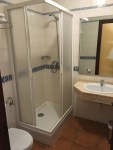
Our “bano”
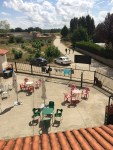
Our room overlooks the Camino and a large patio with plenty of seating, so if we choose, we can watch Pilgrim’s stop for a rest and then walk on, as most do. The albergue also has plenty of
View out our room window
closeslines and clothespins for drying clothes and a washing machine and dryer, if needed.
We almost have the albergue to ourselves today, perhaps because many pilgrims are in a hurry to get to Santiago before summer’s end and Itero is not a typical stopping point.
Arriving this morning at 10:30 and being able to check in immediately after a late breakfast has given us plenty of time to complete our routine chores, rest, shop for bottled water and snacks and relax.
Part of this building housed the “supermarket” we visited this afternoon for snacks & water
Itero de la Vega town square
One valuable aspect of the Camino is the time it allows for reflection. Today we were apprehensive about crossing the mountain. Once we began climbing, it didn’t help to have 20-30 something pilgrims pass us one by one on the way up. But we put one foot in front of the other, trying to avoid negative thoughts, being thankful that we are here and able to take on this and other Camino challenges and pausing to both catch our breath, rest our legs and knees and look back and around us to register and revel in our progress. When we reached the top and also when we reached the bottom, the satisfaction was priceless and gave us renewed strength and courage to continue this wonderful journey.
We “slept-in” this morning, not leaving El Pundito albergue until 7:30. Rain is expected so we decided to try to miss it by using our hour-by-hour forecast app.
In 2014 when we walked this section of Camino we had walked over 12 miles the previous day in extreme heat and were exhausted when we got to Hontanas. The next morning we got up very early, still recoverying from the day before. As we left the village in the dark we followed a road which we assumed was the Camino. After about a half-mile, six pilgrims were walking toward us, visible only by their headlamps. They stopped us and after overcoming typical language barriers, we realized they thought they had missed the Camino. Jim consulted his guidebook in more detail and found that for a 4km section there were actually two Camino routes, one that went partially back up to the meseta and the other which continued along the road we were on, both merging after 4 km (2.5 miles)… since the next town was in the same valley as Hontanas. We decided, after our previous day experience and 3 nano-seconds of consideration, we would continue on the road. Four of the six pilgrims took the dirt path route, the other two came with us.
Camino alt-1 to right … Camino alt-2 to the left.. we took the left (notice no sign/marker)
Typical scenery for first 2.5 miles
So today as we left Hontanas, to commemorate our good fortunes in 2014 and since, we once again took the easier section of Camino.
After about 3 miles we passed the ruins of San Antón church complex, started by the Order of St. Anthony, a 11th-century order devoted to the 3rd-century Egyptian hermit, whose relics it held and dedicated to helping pilgrims.
Approaching San Antón convent ruins
Niches in arch wall for food for poor
You can see here how large it was
In the Middle Ages, a pilgrim brought his stricken daughter to the relics and she was healed of a particularly pernicious disease reminiscent of leprosy. This disease spread in the Middle Ages and became known as St. Anthony’s Fire, which caused a terrible burning feeling, loss of circulation and eventually gangrene. This disease was in fact likely ergotism, caused by a fungus that grows on rye bread.
The order developed a reputation for healing this disease, though serendipitously, pilgrimage was an excellent antidote to the disease as vigorous exercise and plenty of wine helped to overcome it. Also, St. Antón is the patron saint of animals, and across Spain people bring their pets to be blessed on his saint’s day.
Linda taking a photo of Jim taking a photo
An unusual but beloved albergue has existed since 2002 in the ruins of convent, consisting of communal meals by candlelight, no electricity or hot water: a very basic, but unique experience for some.
Shortly after we cleared the bend in the road at San Antón, the road straightened again and we could see Castrojeriz (pop.873) in the distance.
Rounding bend after San Antón, Castrojeriz in distance
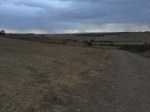
Even on a dreary morning the surrounding hillsides rolling up to the meseta provided a nice view.
Closing in on Castrojeriz
First view of Castrojeriz, Castillo
Just entering town limits
Closer view of pre-Roman castle
Towering above the town is Castillo de San Esteban. The Romans used the castle, said to be founded by Julius Caesar, to protect the roads to Galicia’s lucrative gold mines. The city changed hands frequently until coming under Christian rule in the 10th century. The charter for the city was progressive for its day—the punishment for killing a Jew was the same as for killing a Christian. Franks and Jews settled in the town, which became a way station on the pilgrimage road with five churches and seven pilgrim hospitals along the “long road” through the city.
Iglesia de Santa María de Manzano
Sanctuary of Iglesia
Retablo in chapel of Iglesia de Santa María de Manzano with S. M d Manzano in center
Also prominent upon entering the town is the 14th century Iglesia de Santa María del Manzano (“apple tree”). Legend has it that Mary appeared to St. James from an apple tree and he was so startled that his horse reared up and came down heavily, leaving hoofprints in the stone outside the entrance.
We stopped at Bar Manzano for breakfast, then walked hurriedly another mile to the other side of town as the inevitable rain closed in.
Continuing our walk to our hotel
View of valley & meseta from Castrojeriz
Meson de Castrojeriz
Arriving at Meson de Castrojeriz (36€), at 10:30, we were warmly received and the housekeeper quickly prepared our room & home for the afternoon and evening.
Jim checking in at Meson de Castrojeriz
Waiting in hotel living area for our room to be ready
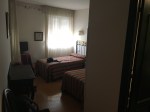
Our room
We were very pleasantly surprised at the general ambiance, hospitality and relative elegance of this Hotel Rural (HR).
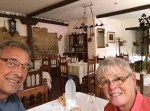
Lunch selfie
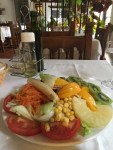
We shared this delicious Ensalada Mixta (fruit, tuna & veggies). Jim’s favorite culinary discovery so far.
Better view of homey living area
After we got settled in our room we had a nice salad for lunch in the hotel restaurant, sat a while in the cozy living area, then returned to the our room, where we spent a pleasant, relaxing afternoon while the windy, gray, rain continued outside.
At 7:00, our hotel restaurant opened for cena (dinner) and we had a routine pilgrim dinner. We asked if they could prepare us one ham and cheese bocadillo (sandwich) to take with us and share for tomorrow morning as there will be no place to get food for the entire walk. When we had completed our meal the waitress brought us a bag with a ham & cheese baguette sandwich as requested plus a small bottle of orange juice, a small bottle of water, a yogurt, a plastic spoon, a banana and four packaged cookies for 5€!!!
We paid the remainder of our dinner bill including a bottle of wine (20€) and retired to our room to complete day #30 for Camino 2017. We love Spain and we love the Camino!
At 6:10 we walked out the door into the dark. A few steps after the pavement stopped and we began walking on dirt, the wind picked up and we saw lightning on the horizon up ahead. It was actually kind of spooky, especially in the dark.
We stopped and checked the weather and discovered the forecast was 80% precipitation for the next 3 hours. We paused, but then decided to go on. But we also put on our back pack covers and ponchos so we would be prepared for a storm and as a deterrent in much the way we sometimes carry an umbrella to keep it from raining.
Our walk back up to the meseta was 2 miles compared to the 1.5 mile walk down to Hornillos yesterday. The difference was the walk out incline was much more gradual and there wasn’t a mule killing hill going up, thankfully.
Day breaking and Hornillos behind us
Finally back on the meseta after Hornillos del Camino. Lights are windmills.
We were on the meseta less than a mile when we headed down into a shallow valley (150 ft deep) and passed San Bol, a very primitive albergue located near the ruins of an 11th century Monastery, named after San Boadilla, a local saint.
San Bol in the trees
Coming back up to meseta from San Bol
Back on meseta after San Bol
A not-so-steep incline brought us back up to the meseta and we began the remaining 3 mile walk to Hontanas. A few minutes on the meseta and the wind picked up dramatically. The sky ahead looked brighter and Linda commented that it looked like the rain had moved on and Jim, observing the fast moving dark clouds moving to where we had been, agreed.
But the Camino, like Mother Nature does not like to be fooled (with). So within minutes, the drizzles we had weathered all morning became larger rain drops and with the ever increasing wind driving against us, we walked into a cold, stinging, horizontal, in-your-face gale for the next 15-20 minutes.
Finally the rain once again became a light, intermittent drizzle and the wind died down to a nice breeze, to which Linda commented,
“This is great, sure beats walking in the sun!”
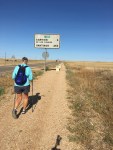
When we thought we’d never get to Hontanas, several signs appeared along the path, advertising Hontanas albergues being less than a half-mile away, but all we could see was the just the meseta.
Signs for Hontanas, but no Hontanas.
Domed church steeple is first thing you see in Hontanas
Hontanas coming into view
Entering Hontanas
Ready to get some breakfast
A few hundred yards later, we saw the domed steeple of the Iglesia de la Inmaculata Concepcíon emerging and then more village appeared as we got closer to the point where the Camino descended into Hontanas (pop.70).
View of town plaza and our albergue
Entrance of El Puntido
Our room was on upper level, left in photo
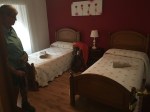
Our double room
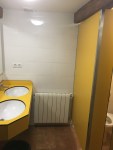
Sinks and WC’s in shared bathroom
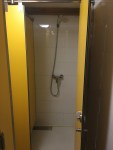
Shower stall in common bathroom
We’re staying at the El Puntido (28€) albergue with a habitacion doble con bano compartido (private double room with shared bathroom).
It’s been raining off and on since we arrived at Hontanas. We washed and hung out clothes in an area designated for such things with a covered area that lets sun in while keeping water out (no clothes dryers available). At 3:00 with only short periods of sunlight, it will be interesting to see what happens.
We had a light lunch at 2:00 in the albergue dining room and reserved two places for the pilgrim dinner tonight at 7:00.
View of Iglesia and dome steeple
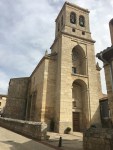
Iglesia de Inmaculada Concepcíon-Hontanas
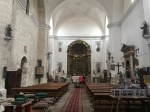
Sanctuary of Iglesia
Retablo of Hontanas Iglesia
Later this afternoon it cleared up a bit and we took a walk around this very small village. We visited the 14th century Iglesia de la Inmaculada Concepción in Hontanas.
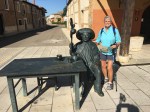
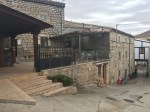
We also saw an interesting home on the edge of town with an equally interesting yard art/fountain.
The sun let us down on clothes drying today so we brought the socks that were still damp into the room and hung them in different places and they will probably be dry by morning.
Pilgrims dinner at El Pundito
There were 35 pilgrims at dinner tonight. Our main conversation was with two guys from the states, one from D.C., the other from Virginia Beach. They had walked 97 miles in last 4 days. We got tired just listening to them!










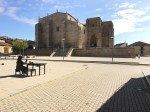
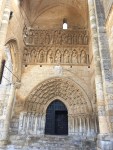
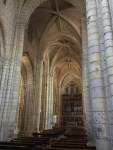


 which we attended passively as it was all in Spanish and we didn’t recognize any of the songs, ritual or responsive readings. At the end of the service the 50-60 pilgrims attending came down to the front of the church to be recognized by country (we were the only Americans). The priest gave a personal blessing to each of us.
  Also we were each presented a handmade star to carry with us, representing the blessing for a good Camino and a good life afterwards.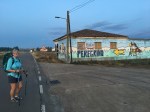






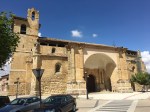

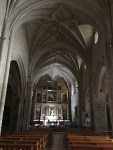
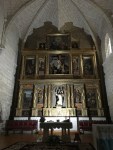













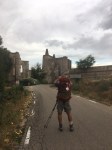
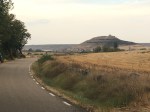
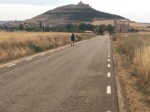


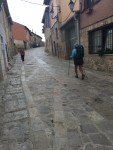
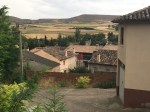
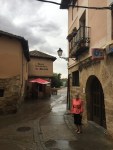

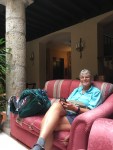






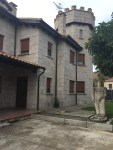 We also saw an interesting home on the edge of town with an equally interesting yard art/fountain.
 Jimandi