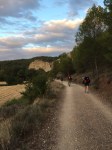
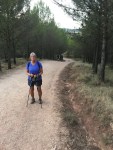
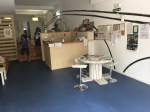
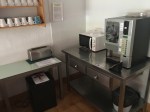
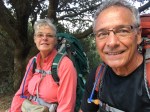
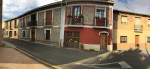
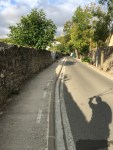
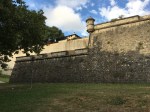
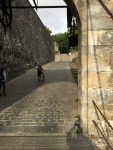
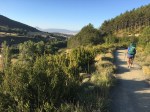
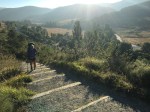
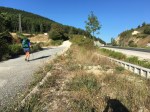
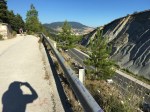
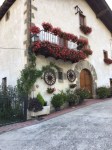
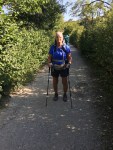
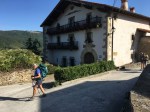
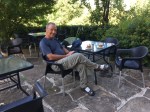
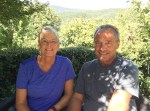
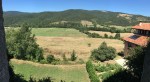
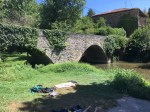
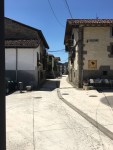
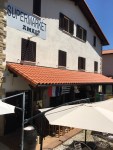
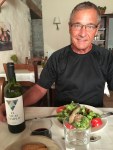
We prepared our own breakfast in the albergue before leaving at 6:45 a.m.
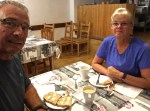
Having our “self-service” breakfast at Albergue Puente
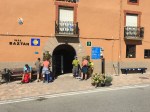
Leaving our albergue to began the walk to Lorca
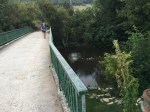
We crossed the Rio Arga via the Puente la Reina, without fear of expensive ferrymen or treacherous boat rides (thanks, Queen).
Leaving Puente la Reina on the “Queen’s Bridge”
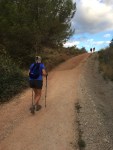
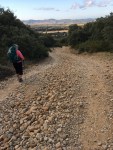
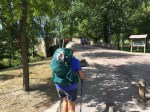
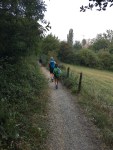
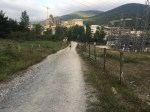
The level, dirt path leaving town eased alongside the river for about 2 miles before taking a sharp turn up the side of a small mountain.
Walking along Arga River
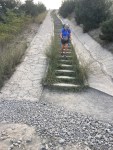
Just before the Camino took a sharp right turn and up the mountain.
Very steep but manageable.
Almost to the top.
The footing was secure so we just took our time and a km (0.62 miles) later we were at the top. Two 20 something pilgrims passed us on the way up the mountain. Jim recognized the lady’s hat as identical to his favorite, “Drover” hat he purchased in Sydney, Australia in 2014. The young couple stopped to adjust their packs and as we caught them, Jim said “where are you from?”. The young man said, “Italia” and the young lady, “Australia”. Jim then said, “Are you from Sydney?” and when she said yes, he said I have the same hat as you, I bought it in Sydney! She laughed and agreed when seeing Jim’s hat attached to his pack. Another great Camino memory!
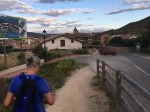
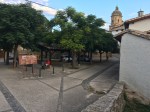
Entering Mañeru
Mañeru village square
Houses of many Spanish nobles displayed their family crest.
Shortly after cresting the mountain, we entered the village of Mañeru, well placed for a brief rest stop.
Jim’s first look at Cirauqui just after leaving Mañeru.
Cirauqui, vineyards, olive orchards
The picturesque approach to Cirauqui
About to enter Cirauqui
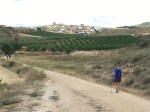
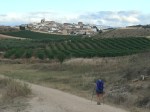
Just a few minutes past Mañeru, we got our first view of Cirauqui, a medieval village, pop. 505, whose Basque name means “nest of vipers”. What impressed us the most was the constant, enlarging view of the village, located on the crest of a large hill and the colorful vineyards and olive trees as we wound through in the approaching valley.
The Camino passed straight through the village which meant we went steeply up and then steeply down on the narrow paved village streets/steps.
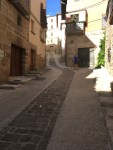
Climbing through Cirauqui
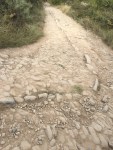
We exited Cirauqui on the remains of a surprisingly well defined Roman road which led to an also surviving Roman bridge. Shortly past the bridge we crossed the A-12 expressway and it was ironic to view a 2000 year old Roman road still existing beside a less than 50 year old highway that would probably not survive the next 50.
Roman road exiting Cirauqui
Still intact Roman bridge across deep gully/stream.
Roman road alongside autovia A-12
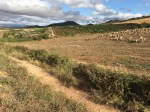
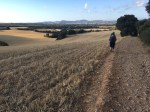
Grazing sheep, olive trees, vineyards added to colorful scenery along Roman road/Camino
Well preserved Roman bridge along Camino today.
A sharp turn downhill on the Roman road. The stones in center probably prevented wheels from slipping off road on banking turn.
We walked parallel to A-12 on and off the Roman road for the next mile or two, passing another well preserved small Roman bridge, passing under A-12 and beginning our climb up to the 12th century village of Lorca, our destination for today.
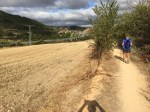
The Camino followed along autovia A-12 And off and on the Roman road
Linda making final climb into village of Lorca
The entrance to Bodega del Camino in Lorca
Our room in Lorca
Our double room with ensuite bathroom (40€) was ready about 30 minutes after we checked-in at La Bodega del Camino. By 5:30 some of our clothes are still damp due to the party cloudy, low 60 degree weather today: great for walking, not so good for drying clothes.
We stayed off our feet most of the afternoon, reading and blogging.
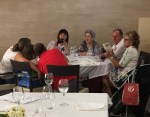
We had a pilgrim dinner tonight in the albergue dining area. We ate with a young man from Italia, a construction worker, a young lady who taught school in Los Angeles, and another young man from Cambridge, England, who worked as a supervisor in a Titlelist golf ball warehouse. They were all in their 20’s.
Today was one of our longer walks so far, but not too difficult, the weather being a big factor. We might actually be adapting and/or already getting stronger.
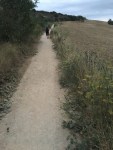
We decided to go easy on our knees and feet today allowing extra recovery time following our trek up and down the Alto de Perdon yesterday. The terrain today was relatively flat with equal amounts of dirt path and pavement. The temperature stayed in low 60’s with cloudy sky’s.
We walked through Muruzabal and Obanos on the way to our destination, Puente la Reina.
Muruzabal (pop.250) is mostly a residential village surrounding an old church, Iglesia de San Esteban, which was locked when we passed.
Along the Camino from Uterga to Muruzabal
Approaching Muruzabal
Obanos (pop. 900) is an historic Camino town known for a murderous 14th century pilgrim legend. Duke William (Guillermo) of Aquitane and his sister Felicia undertook the Camino de Santiago. On the return journey, Felicia was overwhelmed with piety and went to become a hermit in Amocain rather than returning to her life of luxury. Her brother tracked her down and tried to convince her to return to her court duties. When she refused, he became enraged and stabbed her to death. He was then overcome by remorse and walked to Santiago again and returned to Óbanos to mourn his sister for the rest of his life. He built a hermitage on Arnotegui (a southern hilltop) to serve pilgrims and the poor. Guillermo’s silver-covered skull is kept in Iglesia San Juan Bautista.”
Iglesia del San Juan Bautista
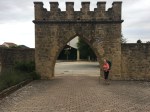
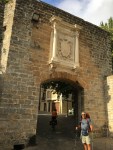
Obanos gate
We stopped in Òbanos to share an orange and check on a blister. We sat on a wall in the town square facing the imposing Iglesia San Juan Bautista (Church of Saint John the Baptist), but didn’t go inside because the doors were locked. Leaving the square we walked through the town gates and past a large pelota court (pelota is a Basque version of Jai alai which is like our “hand ball” on steroids!)
We continued on to Puente la Reina. On the outskirts of town, we stopped for cafe con leche and tostadas and took a longer than usual time for breakfast, as our albergue won’t open until noon.
Small, commercial garden we passed between Obanos & Puenta la Reina…snap beans, hot green peppers,tomatoes, lettuce, etc.
Our breakfast spot just outside Puente la Reina
The first indication we were nearing the old town was the 12th century Iglesia del Crucifijo which was adjacent to a seminary. A few steps later we crossed a modern street, then began our walk through the old town.
Iglesia del Crucifijo
Calle Mayor (Main Street) in old Puente la Reina
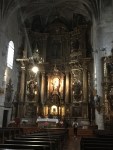
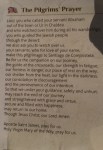
We spotted a large gothic church belfry ahead to our right and when we got to it, entered the Iglesia de Santiago. It was beautiful but not overwhelming, actually comforting. It had a massive Romanesque doorway and inside, a Baroque retablo depicting scenes in the life of Santiago (St James), also a famous gothic statue of the “beltza Santiago” ( Basque for “black Santiago”) dressed as a pilgrim. A pilgrim’s prayer was posted in several different languages to assist prayerful pilgrims.
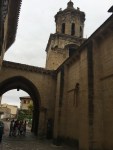
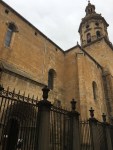
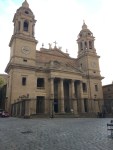
Door and Belfry of Iglesia de Santiago
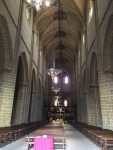
Baroque Retablo of Iglesia de Santiago
Gothic statue of Santiago dressed as a pilgrim
Pilgrim’s Prayer
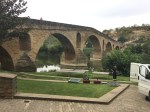
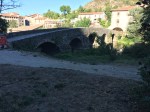
The medieval Puente la Reina (Queen’s Bridge)
We then left the church and continued straight ahead until we reached the “Queen’s Bridge” and took some photos. Then, Linda guarded the bridge and our packs as Jim set off to locate our albergue.
Puente la Reina (the Queen’s Bridge) got it’s name when, in the 11th century, Sancho el Fuerte’s wife (or perhaps his successor’s wife) financed a beautiful 6-arched Romanesque bridge over the Río Arga, so pilgrims and other travelers on the Roman route could avoid expensive ferrymen and treacherous boat rides. The town of Puente la Reina grew up around the queen’s bridge, providing services and commerce for the pilgrims.
A few minutes later Jim returned, having found our albergue, and we gathered our stuff and walked to a bar a few steps from Albergue Puente and camped out until noon, checked in, got our credentials stamped and proceeded to our habitacion doble (34€).
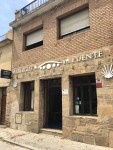
Entrance to our albergue in Puente la Reina
Albergue reception
Common area for relaxing
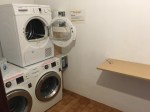
Laundry area to wash (2€) or dry (3€) clothes
Hallways and doors to private or dormitory sleep areas
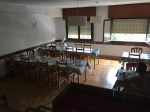
Breakfast eating area
Breakfast self service appliances (included in room rate)
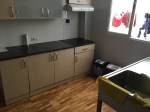
Kitchen (if you want to prepare your own meal vs eat in restaurant)
Multiple shared toilet/sink rooms but also private.
Multiple shower facilities but with privacy including small change area and hook to hang clothes & shower gear
Outdoor, rooftop terrace for relaxing
This is one of the nicest and best organized albergue’s we have stayed in and at a very good price.
After completing our routine activities we had a snack lunch and a snack dinner (sandwiches) and read & blogged in between.
Oreo ice cream bar to finish off a great birthday celebration ! Thanks to everyone for the birthday wishes. It’s been one great 71st Camino party!
Shortly after leaving our hotel we arrived at Zariquiguie as the wind picked up considerably. The temperature was 55 degrees making it quite chilly as dark clouds partially blocked the sun. We took some quick photos of the church featured in the film “The Way” mentioned earlier.
Iglesia de San Andres – 13th century Romanesque church featured in “The Way”.
Leaving Zariquiguie,Pamplona and Pyrennes behind
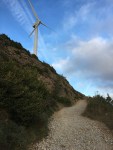
The Camino today took us up the steep incline to the Alto del Perdon and then back down.
Beginning our climb to the top
Camino marker on the way up Alto de Perdon
The valley below as the sun peeked through the clouds.
About halfway up
Getting close… clouds seem to point to our destination (top right)
One last spurt and we’ll be there!
The walk up was slow, giving us multiple excuses to stop and look back at the beautiful fields and small villages between us and Pamplona and look forward at the ridge above us, lined with windmills.
The winds of 30-40 mph, fortunately at our backs, continued to increase as we climbed upward. When we reached the top the near gale force winds forced us to struggle to maintain our footing. Our Backpacks acted as sails, making matters even worse.
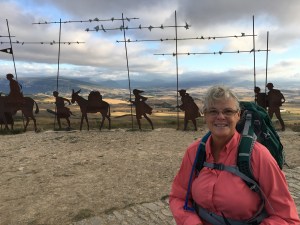
Alto de Perdon with iconic sculptures in background
We took some quick photos of the metal silhouettes of medieval pilgrims, an icon of the Camino Frances, then got some welcome relief from the gale as we began our descent.
The descent was also a struggle, even as the wind subsided a bit, due to the steepness and the fist size, loose pebbles filling the path which was more like a wash. This was a real knee killer… an accident waiting to happen. We finally made it down the slope as the path became more manageable and we walked the final distance to Uterga, our destination for the day.
The walk down was difficult- steep with very unstable footing.
Stones covered the path all the way to the bottom
At the bottom, FINALLY!
Almost to the bottom we found a big rock to sit on and gave our knees a break
Virgin shrine to the right, Uterga straight ahead
Our albergue for the night was easy to find, right on the Camino path through the small village (pop. 205).
Our albergue in Uterga
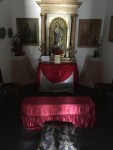
A simple chapel in the albergue
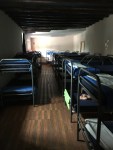
Barracks style sleeping for 10€
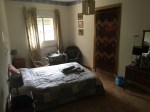
Double room w/bath (habitacion doble con baño) – 40€
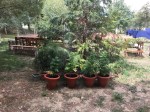
Interesting potted plants outside our room window
Directly across the street was a nice bar where we had breakfast, lunch and dinner, and drinks during the day if not doing our routine chores in our room. Wifi was stronger in the bar so we did our internet activity and blogging there.
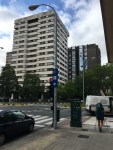
We left Villava at 7:45 a.m. and rejoined the Camino in about 5 minutes and walked through the city streets until stopping at a small bar to have cafe con leche. A few minutes later we continued on into Pamplona, toward the old city.
Leaving our hotel in Villava to rejoin the Camino a few blocks away.
Camino passing from Villava to Pamplona proper
Camino markers guided us thru Pamplona streets
Walking thru Pamplona
Santiago shell designs decorating house exteriors.
Nearing old Pamplona- St Mary’s Catedral spires in background above the trees
Linda crossing over Rio Arre on the medieval Magdalena Bridge
Pamplona had been a fortress for centuries, providing a base and protection for Navarre against both foreign and domestic foes. The old city inside the fortress is interesting, easy to get around and inviting and one of Jim’s most favorite places on the planet.
First view of Pamplona Fortress after crossing Magdalena Bridge
Imposing Pamplona Fortress wall- that’s Linda standing at corner.
The Camino entrance to old Pamplona
Over the drawbridge and through more fortifications to enter the Puerto del Camino
The Puerto del Camino (gate where pilgrims have entered for nearly 1000 years.)
Entering old Pamplona
St Mary’s Catedral of Pamplona
Inside of St Mary’s Catedral of Pamplona
A frequently visited market for snacks, etc.
Panorama of Castile Plaza- a favorite hangout
The Kiosk in the center of Castile Plaza
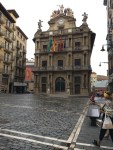
Town Hall in the old city
Leaving “old” Pamplona
The Camino passes along a beautiful green park which surrounds the Citadel.
From medieval forts and cities to modern upscale apartments
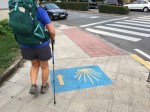
Camino markers embedded in sidewalk are common in the cities.
The Camino passed through the Navarre University campus.
This being our third 3rd and perhaps last visit, we were a bit nostalgic as we walked through the familiar streets in our old “neighborhood” between the Hotel Catedral, also called the “Hotel Puerto del Camino” and the Plaza Castile.
We stopped in the Castile Plaza and Linda kept watch over our packs on a comfortable bench, while Jim took several “surplus” items from our packs to the post office only a block away from the Plaza. We sent these items to our reserved hotel in Leon along with items sent as we passed through Pamplona a week ago on our way to SJPDP. This will reduce our pack weights an additional collective 4-5 lbs, which be much appreciated during our month of walking from Pamplona to Leon (270 miles).
Jim returned shortly, we donned our packs and began the walk through the old city, then out past the Citadel, modern residential areas, Navarre University and out into the countryside, continuing our Camino.
Leaving Navarre University via a medieval bridge to get back into the primitive Camino mood.
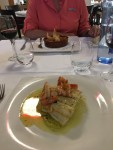
Shrimp tempura in fish stew for Linda, shrimp and hake for Jim and of course, Navarre wine for lunch/dinner (4:00p.m.)
Four generations of local family celebrating 3 year old’s Birthday at dinner tonight.
Our hotel in Cizur Mayor
Up and over the Alto del Perdon tomorrow
Panorama of Pamplona w/ Pyrenees in background now behind us.
After a gradual climb, we struggled somewhat as the hot morning sun beat down, even though the temperature was only in the mid 70’s, quickly rising from the low 50’s when we left Villava only 3 hours earlier.
We checked in to Casa Ancona just before noon. After a brief rest we did our routine chores then had “dinner” at 4:00 and chilled in our room until bedtime reading, resting and working on the blog.
It was still dark when we left Akerreta at 6:05 a.m., with Linda and her headlamp leading the way. A half-hour later it was light enough to see as we began walking along the Rio Arre (Arre river).
For the rest of the morning we walked on both sides of the Arre, crossing over a number of different bridges: some new, some old, some very old.
Crossing the Arre one of several times today
Trinidad del la Arre bridge we crossed to enter suburban Pamplona
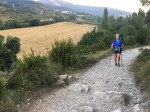
The walking surfaces and undulations were typical of recent days but the duration of the difficult sections was manageable.
Short section of tough walking surface
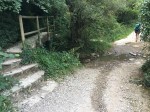
Leaving Irotz we saw two Camino markers to keep us on track
Nice wide sidewalk for about 1/4 mile
Tight quarters on this section of Camino
Approaching Pamplona
Steps help Peregrino’s with this steep climb
Just after passing under the expressway we walked along it for a while.
Dramatic scenery along express way
Walking along cliff through farms as sun rises
Not until 8:00 did the sun appear as it rose above the mountains. We’ve only got a couple or three more hours before it gets miserably hot for walking in the open. And there are no bars until we reach the suburbs of Pamplona.
We crossed over the Romanesque Trinidad del Arre bridge and began looking for the Hotel Pamplona-Villava. The Booking.com app directions took us over a mile away from the bridge which we knew could not be correct. After several misdirections of our own, trying to figure out the app (it seemed to be giving us driving rather than walking directions) and three well-meaning but clueless Pamplonians, we finally arrived at our hotel at 10:45 a.m. and thankfully, our room (62€) was ready for us and were allowed to check in very early (normal check-in is 2 pm).
After a brief rest and completing our routine “chores” we selected additional items we feel we won’t need until we get to Leon a month from now, based on our experience this first week. We’ll drop them off at the Pamplona post office, Correos, as we walk through tomorrow morning. Now is the time to lighten our packs as much as we can for the next few weeks.
Linda got her first significant blister today. So guided by Linda’s close scrutiny, Jim administered the treatment procedure we learned in 2014 to hopefully minimize any pain and accelerate the healing process.
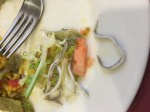
Jim couldn’t resist the baby eels on one of the salads at the hotel lunch buffet
We’re in for the evening at 5:30 after a late lunch/early dinner at the hotel restaurant. The hours for the restaurant were 1:30-4:00 for lunch and 8:00-11:00 for dinner!
We didn’t set an alarm today but were up by 6:30, got gear together, Jim paid for our room (38€) and we had breakfast at our lunch, dinner and now breakfast bar. The staff seems to know us by now but our side of the communication is limited to scattered Spanish nouns and verbs and we wish we had a better clue to what they were saying to us! That will improve, hopefully, as we assimilate over the next two months.
Breakfast completed, we left Zubiri and rejoined the Camino around 7:45.
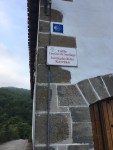
Sign as we left Zubiri. Spanish (top)vs Basque
Easy way around a stream for pilgrims (Peregrinos)
Today is a short walk by design. We will be spending tonight in the hamlet of Akerreta and staying in the hotel by the same name which is located in a restored 1723 Basque farm house. It’s only 3.6 miles from Zubiri. Several of the scenes in the 2010 film, “The Way”, starring Martin Sheen and Emilio Estevez, which tells a story centered around the Camino Frances, were filmed at the Hotel Akerreta. It’s a little pricey (82€), but having stopped here in 2013 for a break, we decided to include it as a stopover during Camino 2017.
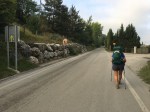
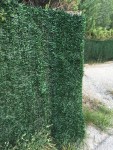
Shortly after leaving Zubiri, we skirted a large Magna magnesium quarry and ore processing facility. We followed the paved road incline and afterward some steep steps down in order to go around the facility. Northern Spain seems to have a reasonable amount of heavy and light industry, but normally it is not visible from the Camino. The Magna organization apparently appreciates this, as the fence along the road where pilgrims pass was covered with an artificial dark green grass that was more pleasing to the eye and buffered much of the machine and equipment noise in the facility. Jim was also impressed with the Magna truck drivers moving the magnesium ore into and out of the complex. They were cautiously aware of passing pilgrims and slowed down, giving us the right-of-way.
More easy walking following mother & daughter
Easy walking
Magna magnesium quarry and ore processing plant
Camino markers often on backs of signs – skirting Magna facility on right
Magna fence coverage for better esthetics
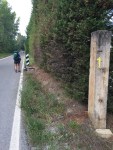
Another type of Camino marker on right
Last section of skirting Magna facility
Another mile or so along the way we entered the hamlet of Ilarratz. Attached to one of the several beautiful homes was a public outdoor drinking-water spigot, sheltered from the sun and with generous seating.
We stopped for a brief rest and chatted with two bicycles pilgrims, Willie & James. James is originally from Korea and now lives in Toronto, Canada. Willie is originally from El Salvador, then Toronto and currently lives with his wife, whose family is Basque, in the Basque Autonomous Community capital of Vitoria/Gasteiz in Northern Spain. James and Willie met while attending the same church in Toronto.
We arrived at Akerreta about 10:30 as the last of the previous night’s guests was checking out. Our room will not be ready until around 1:00. The proprietor said they normally close the hotel until that time to allow for cleaning and because they don’t offer lunch or non-guest services, they keep the front door locked. Ironically they don’t cater to pilgrims, because as an upscale B&B they are too expensive for 90+% of pilgrims.
A breath-catching moment just before Akerreta
Linda arriving at Hotel Akerreta
Jim relaxing on hotel patio with cafe con leche
Using our selfie gadget while waiting for our room
But, the proprietor apologized and gave us the door code and said we were welcome to sit inside or outside to wait and were free to use the restrooms. We opted to sit outside and shortly one of the housekeepers brought us two cafe con leches and gave us the wifi password. We were pleased with their willingness to cater to our basic needs prior to checking in. And it kept us busy until our room was ready.
At 1:05 we were ushered to our very nice room and began our arrival/afternoon routine.
Panorama of our room
Original beans in ceiling of our room
Panoramic view out our room window
Our room window alcove carved into original beam
Restored 2nd story living/dining area
Original “legs” for kitchen table on 2nd floor
Cone shaped ceiling in 2nd story living area to exhaust smoke
Gaps in original wood floors on 2nd floor
Because the hotel has no lunch option for us and the hamlet has no bars or other services, we haven’t decided, if anything, what we will do for lunch. Dinner is at 8:00!
Medieval bridge into Larossona
Entrance into Larossona
Market where Jim procured lunch
Our growling stomachs compelled us to get lunch. The miracle of wifi pointed us to Larrasoaña, just a half mile from Akerreta. So Jim ventured out into the 91 degree heat, a took a relatively short walk, secured some items from a small market and returned with lunch for today and breakfast items for tomorrow morning.
Our hotel has a nice breakfast served between 8:00-10:00, which is not an option as we would like to be up and walking by 6:30. The room rate is 82€ including breakfast, but we will likely end up paying for it and not getting breakfast, as we would rather get an earlier start to avoid walking several extra hours in the mid-day August heat. Such is the Camino, Our Way 2017.
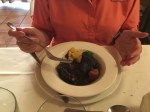
Our dinner tonight (28€) was a dining experience. Everything was fresh, organic and beautiful prepared. The tomatoes were full of flavor, locally grow from seeds of fruit from the previous season. The beef melted in your mouth and the sauce was so good Jim requested extra bread to make sure none made it back to the kitchen. Linda consulted with the proprietor on preparation techniques and we’ll definite try to duplicate it when we return home! The Navarre wine perfectly complemented the meal which concluded with a delicious homemade mango ice cream.
Navarre tinto wine and featured tasty homeground tomatoes in ensalada mixta
Beef stew- the most delicious beef we’ve ever tasted
Homemade mango ice cream for dessert
Sated beyond our wildest expectations, we retired to our room to conclude another extraordinary day on the Camino Frances.