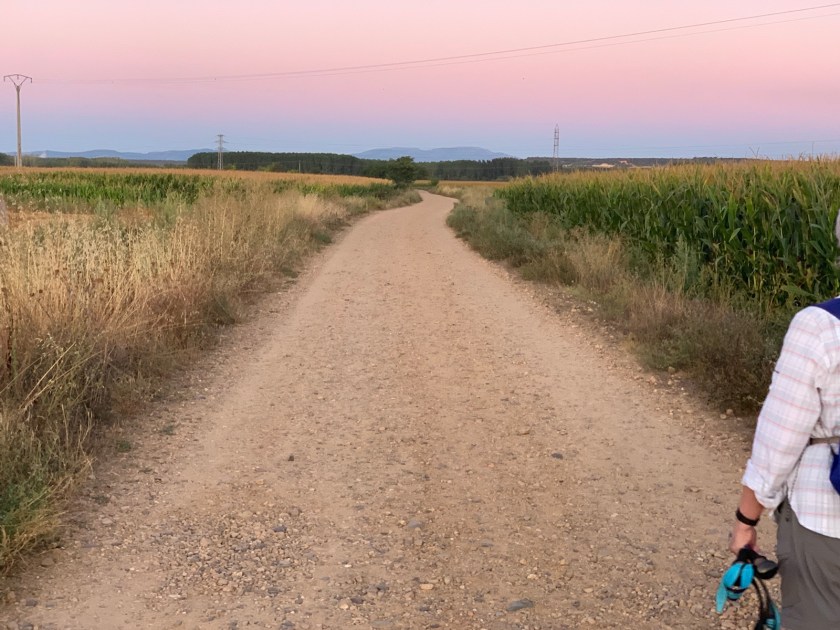
Today we began our walk into the Irago Mountains. The way was flat, dirt for the first couple of miles into
El Ganso, “ goose” in Spanish, on the right
El Ganso, where we planned to have breakfast. At first we were frustrated, because the albergues where we previously had breakfast were locked up tight. And then a mild panic set in as we had at least another 4 mile walk ahead of us without food or restrooms.
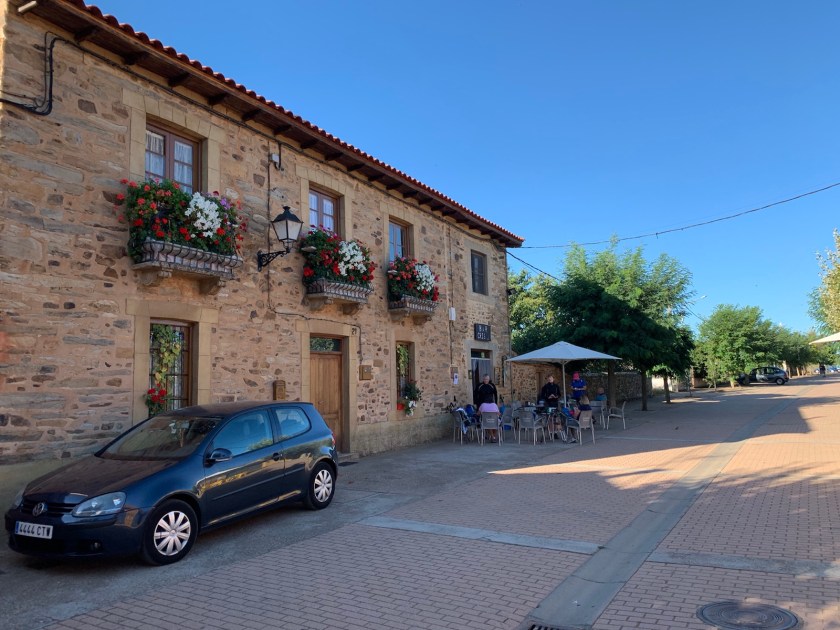
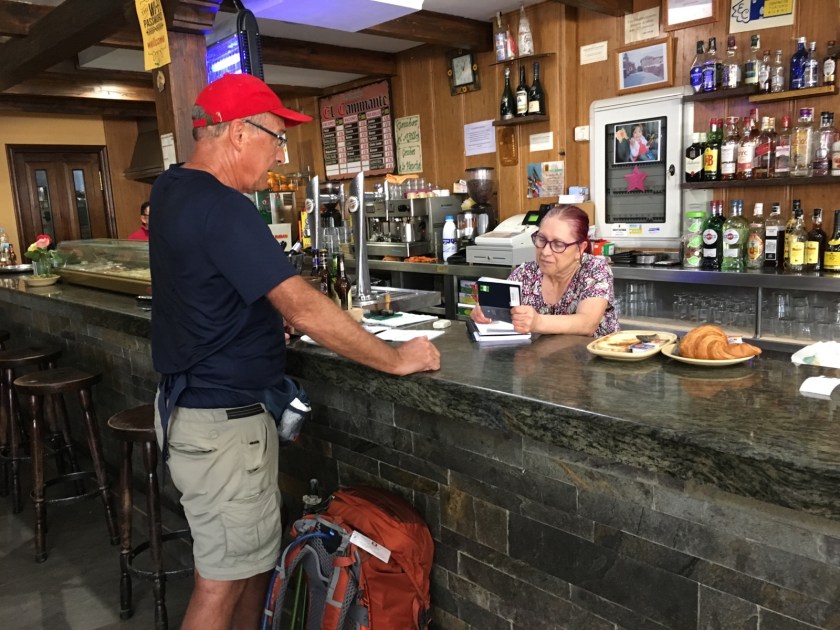
We circled around to the only other street in town and alas, a relatively new (4 years) tienda (store) had the “abierto” sign on the gate. There were three small round tables on the terrace, suggesting food and rest room possibilities, but, no one was around and we were about to give up when a gentleman walked out of one of the shop doors. Linda quickly said, “desayuno”?, “cafe con leche”?, “aseos?”, which all got the affirmative “si” from our new friend and savior, so we took a seat, breathed a sigh of relief and ordered our usual.
Foncebadon (tomorrow) high on left, Rabanal seen above road sign
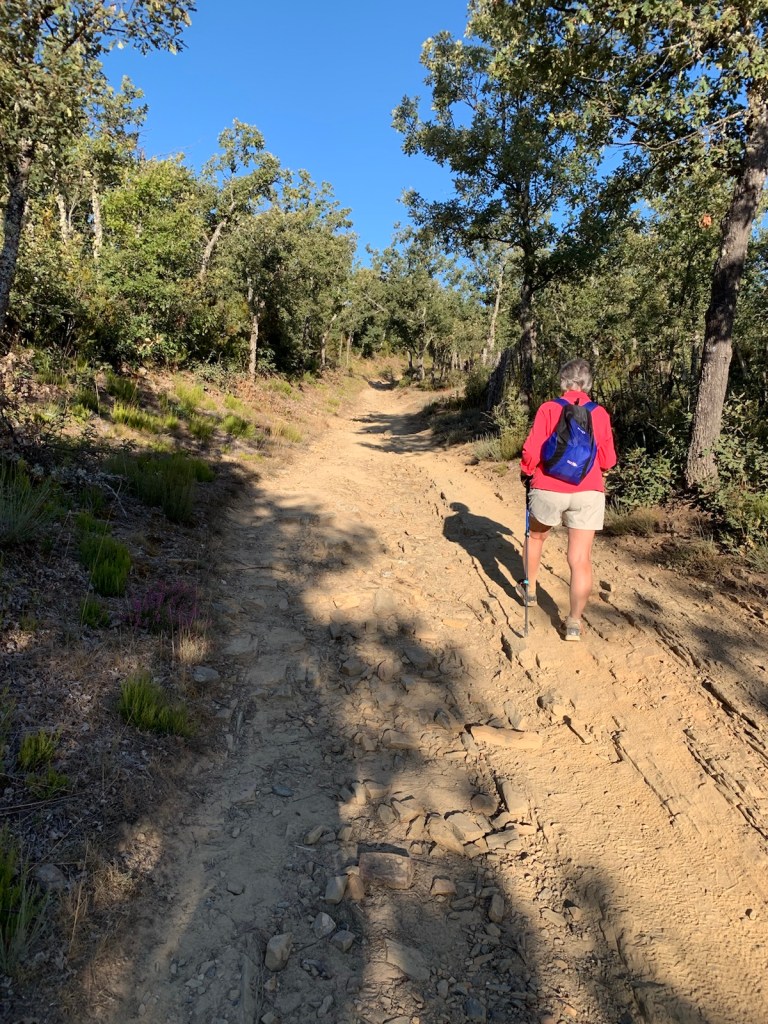
The next 3 miles took us further, but, gradually into the Irago Mountains, with the final 1.5 miles becoming much steeper and we finally walked into Rabanal del Camino (pop.73).
Rabanal del Camino is another beautiful and isolated Maragato village brought back to life by modern pilgrim traffic. This was the end of the 9th stage of the Codex Calixtinus, and many pilgrims stopped to rest from the ascent and find refuge from the wolves and bandits that plagued the León mountains. The Knights Templar ran a fort here to protect passing pilgrims. A legend says that one of Charlemagne’s knights married a Muslim woman in Rabanal.
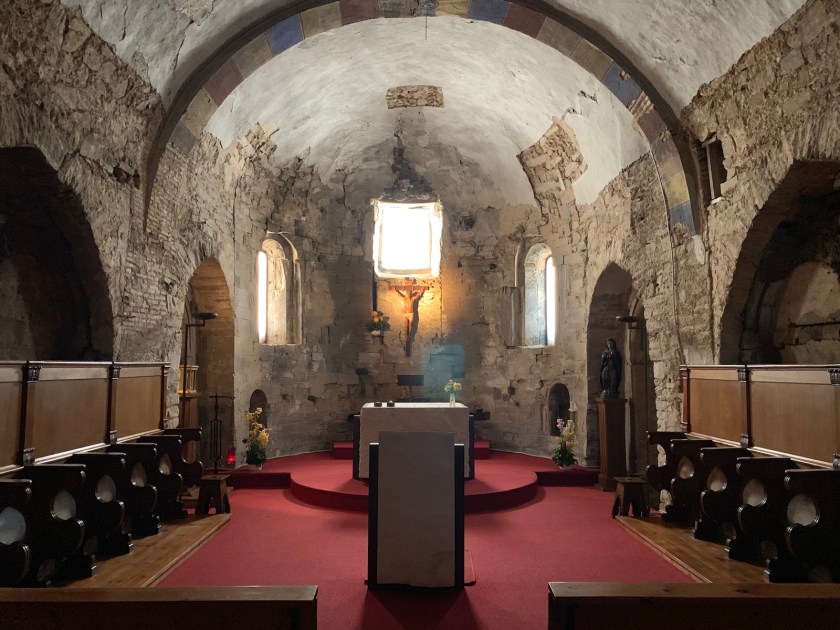
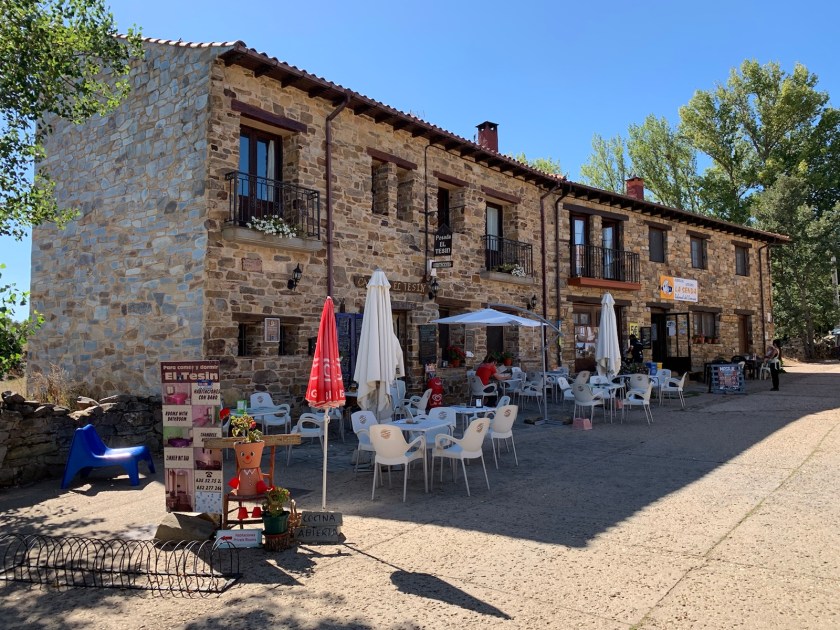
Iglesia de Santa María de la AsunciónInterior of Iglesia Santa María, currently operated bythe Benedictine Abbey of San Salvador del Monte IragoHostal El Tesin (50€)
El Tesin has a warm feeling to it, the owner/manager is very customer oriented and
Cantina El Tesin
unlike most every other establishment of any size in Spain, her kitchen was open from 7am to 9 pm every day!!!
We had the pilgrim menu for lunch which had the usual offerings, was tasty and 11€.
Our clothes were machine washed for us (3€) and we hung them out to dry, which took about 45 minutes in the mid-afternoon sun.
We’re had pasta dinners for supper at 6:00!!
Gary, from Austin, Texas joined us at our table and we shared Camino experiences. It’s his first Camino and he is walking 20-25 miles a day.
We retired early as we walk over and then down the Irago Mountains tomorrow.
It was a chilly 50F when we walked out of San Justo this morning just after 7 a.m.
On the edge of town we noticed two pilgrims, who we recognized were staying in our albergue/hotel last night, seated on a bench and the third walking hurriedly in our direction and passed us, back toward our hotel. We guessed he had forgotten something.
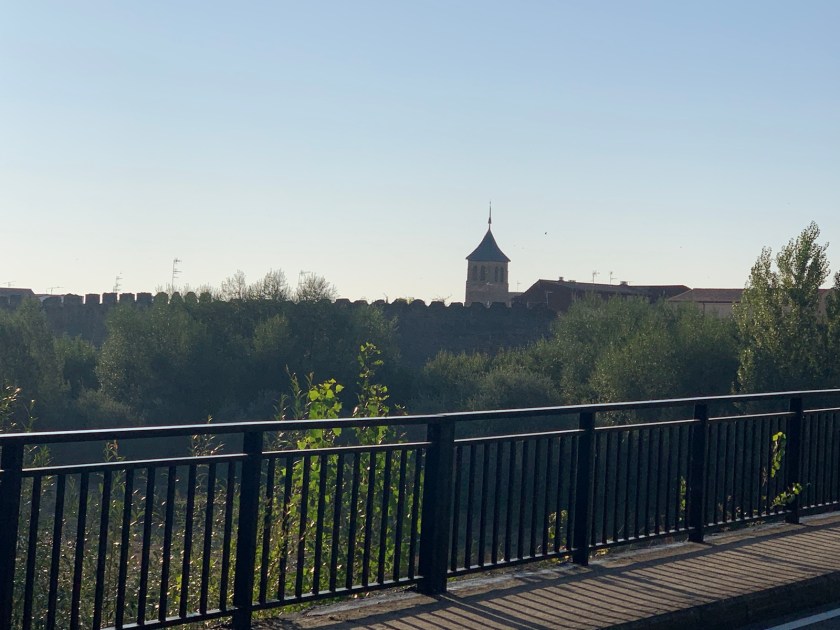
We walked on toward Astorga on sidewalk most of the way, then crossed a small, medieval stone bridge, and shortly after crossed the railroad tracks via a very complex overpass. At the top we got a good view of the city.
Once on the other side of the tracks, we meandered among automobile roundabouts until we began climbing a very steep road up into the 2000 year old city of Astorga.
At the top, immediately on our right, was a church with archeological digs beside it, revealing fairly well preserved remains of a 2nd century Roman home.
At our left was a cafe/chocolate shop which seemed like a perfect spot for breakfast.
A few minutes later, the 3 pilgrims from our hotel also sat down for breakfast and after a brief chat we discovered they were from Ireland and as we guessed, the guy who was hurrying past us earlier, had left is walking poles at the albergue.
Today was market day in Astorga and as we walked thru the main plaza, vendors were busy setting up shop.
Astorga (pop.12,078) began as a Celtic settlement and developed into an important Roman city at the crossroads of the Via Trajana and the Vía de la Plata, as well as an important center for Christianity. According to legend, both St. James and St. Paul preached here. The bishopric of Astorga was one of the earliest Christian titles. The city passed to the Visigoths in the 5th century and was destroyed by the Muslims in 714, then reconquered by Ordoño I in the mid-9th century. After León was destroyed by Al-Mansur’s army, Astorga acted as the capital of the kingdom. The city flourished with the pilgrim trade and housed 21 pilgrim hospitals, the second most on the Camino Francés (after Burgos). One of these hosted Saint Francis of Assisi on his pilgrimage in 1214.
We walked on and stopped to take photos of two main landmarks of Astorga, the Gaudi Palace and the ominous Catedral (not a typo, that’s the way they spell “cathedral” in Spain)
The 15th century catedral occupies a relatively small space in the old city and dwarfs the neaby buildings. It was locked tight this morning, but the external details were impressive.
The Palacio de Gaudí, was a palace for Archbishop Juan Bautista Grau Villespinós until his death, when it sat empty until serving as a military headquarters for the Falange movement.
We continued our walk through the narrow streets and then without warning were out into the countryside and began a gradual ascent toward the Irago Mountains.
We made another brief stop in the charming Maragato village of Murias de Rechivaldo.
The Maragato culture, is centralized in about 40 villages around Astorga. This mysterious group is rumored to be descended from the Berbers of North Africa, who arrived with the Muslim conquest in the 8th century and later converting to Christianity. Maragato men traditionally worked as muleteers, mule drivers who transported goods (especially fish and gold) around the peninsula.
Restaurants in the area offer Cocido Maragato, an extremely filling meal that is served in a kind of “reverse order,” beginning with a hearty meat dish, such as blood sausage, chicken, pork, pig’s ear, pig’s snout, bacon or chorizo, followed by the vegetables (usually chickpeas and cabbage) and finished off with a thick noodle soup and dessert.
It being only 9:30, fortunately, we didn’t partake of the Cocido Maragato today, and instead, began the gradual 3 mile climb into the, all but deserted, Santa Catalina de Somoza (pop. 30), where we stopped for the day at Albergue El Caminante.
Stopping for a photo just outside Santa Catalina
When we attempted to checkin to the El Caminante, the lady at reception said she had no reservation for us. Jim had personally called and was certain that his impeccable command of Catalan could not have contributed to the reservation showing up in her bookings for September 6 and not today.
Jim “assisting” the checkin process
Nevertheless, Jim asked if a room was available, once all agreed that we had no reservation, and the response was yes. We remembered the lady from our stay here in 2017 so we were puzzled as she struggled to transfer the necessary information from our passports to her registry. Jim actually assisted her in distinguishing between first names, last names, birth dates, etc.
When all the formalities were completed, we were escorted to our room, (next door to the one we had in 2017) and given the key, freeing us to began our chores.
We had pizza for lunch at the other albergue/bar/restaurant in this outpost that reminds us of an old western town in the U.S. We stayed at Albergue San Blas in 2015 and wanted to spread our euros around to stimulate the local economy as much as possible.
We had a simple pilgrim dinner, just the two of us in the El Caminante comidor (dining room) with 6 of the 30 village residents playing cards in the adjacent room, while the overhead modern flat screen TV was playing a Jimmy Stewart western. We wondered if it might have been filmed here, years ago.
We checked the small Iglesia de Santa Maria, which is only unlocked for Sunday mass and found the door cracked while an apparent parishioner was preparing for the next service. Finally after prior unsuccessful visits in 2015 and 2017, we entered and sat reverently while she worked, then quietly left her to her duties and returned the few steps to El Caminante.
We paused on the balcony overlooking the courtyard of this diamond-in-the-rough albergue and marveled at the efforts required to nurture the abundant plantings that filled the space, and retired to our room for the night.
Our internet access was weak and sporadic yesterday and we were lucky to upload it and publish what we did.
One omission was an interesting chat we had with two 40 something Spanish brother-in-laws, who were only able to walk the Camino for 6 days per year because that’s all the time they had available, with work schedules, family obligations, etc. We met them between Villadangos and Hospital and they were planning to go beyond Hospital before stopping for the day. At that rate it will probably take them 5 years to earn their Compostela.
Very few pilgrims walk the full Camino from SJPDP to Santiago at one time, actually only around 10%. Most of the pilgrims we have met while walking the Camino are only walking a portion of the Camino at a time.
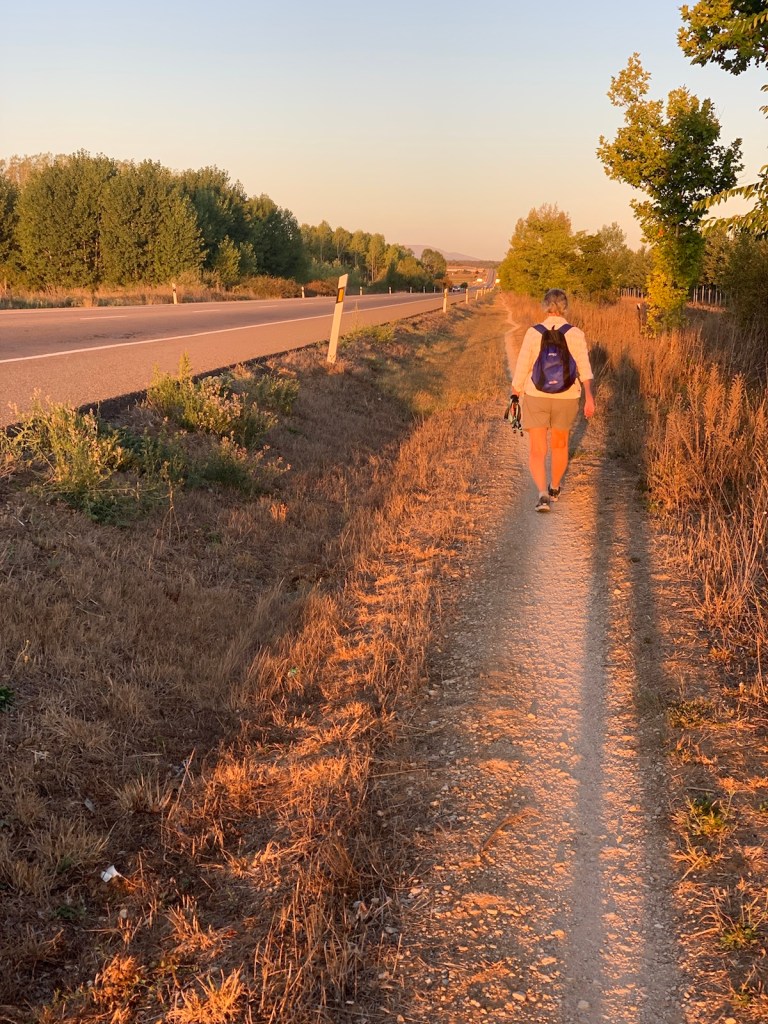
Last night we were looking at our walk for today and Linda discovered that there were two routes to choose from. We’ve have walked the “preferred” route twice before, which will be 10.5 miles. We had never noticed the so called “road route” before. We had already walked along the road a lot the past few days, so Jim was reluctant. Linda said, ” is it any shorter?” After checking the guide and carefully converting the km’s to miles, etc. Jim said ” the road route is nearly 3 miles shorter.” We voted, our bodies voted and 4 to 0 we opted for the road route. (Have you noted a trend developing on Camino 2019?)
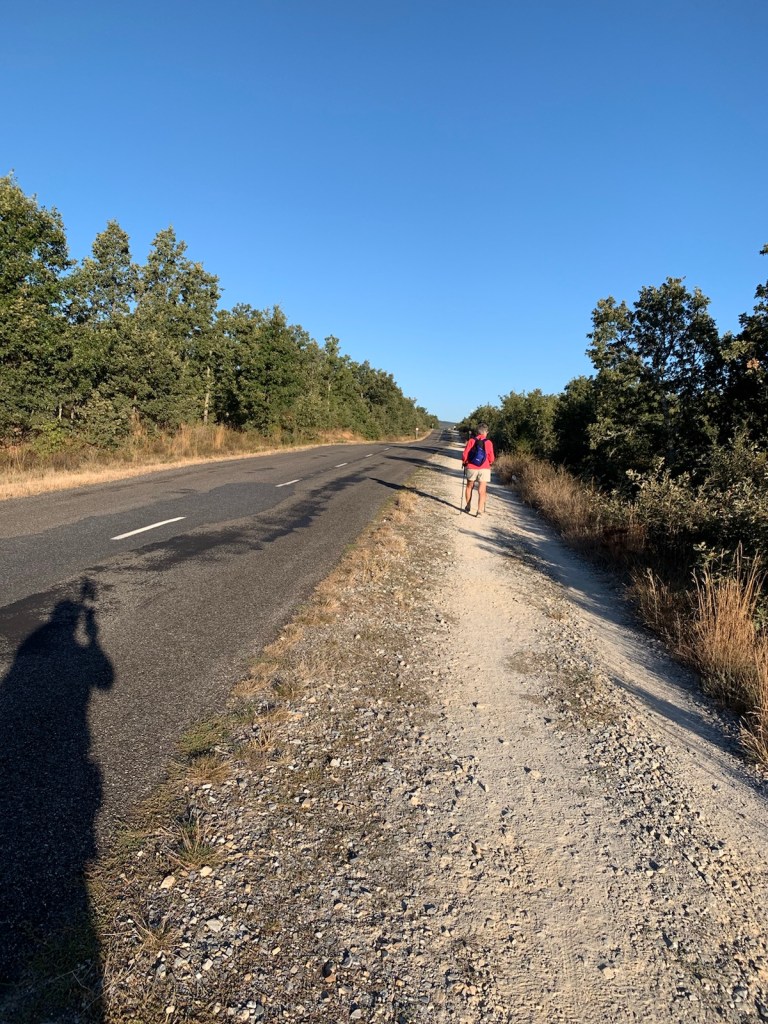
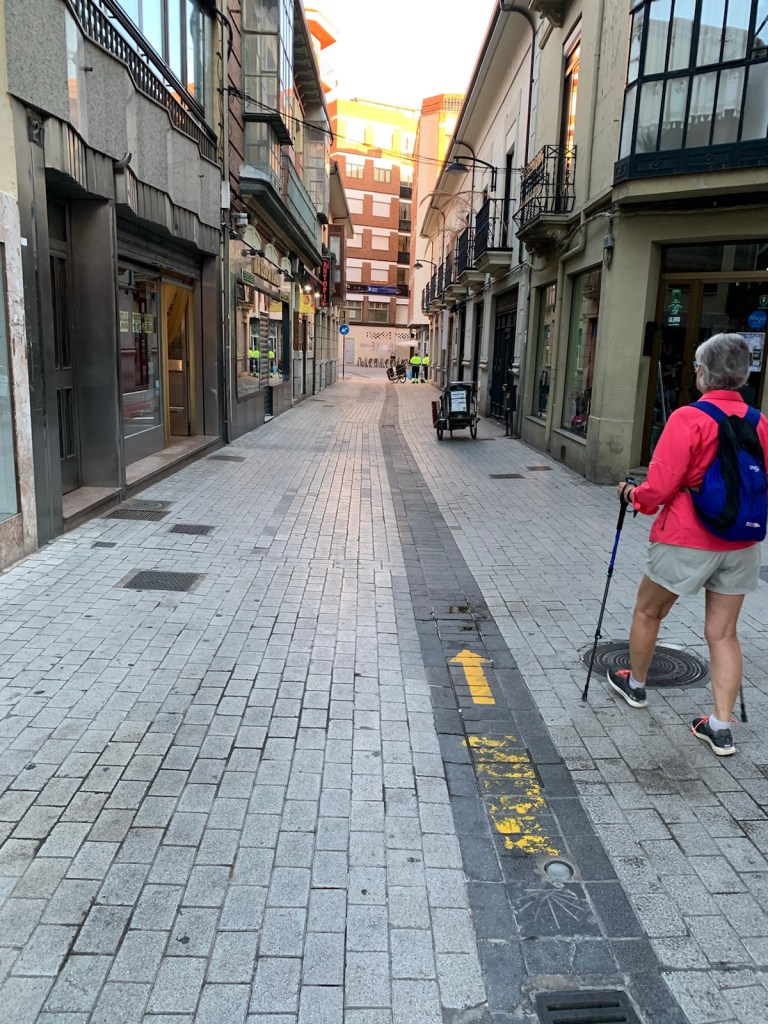
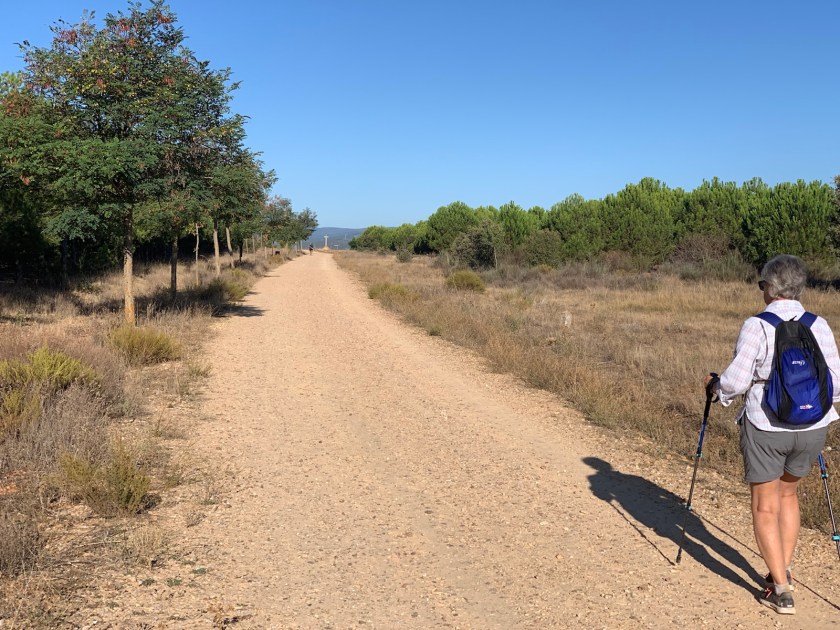
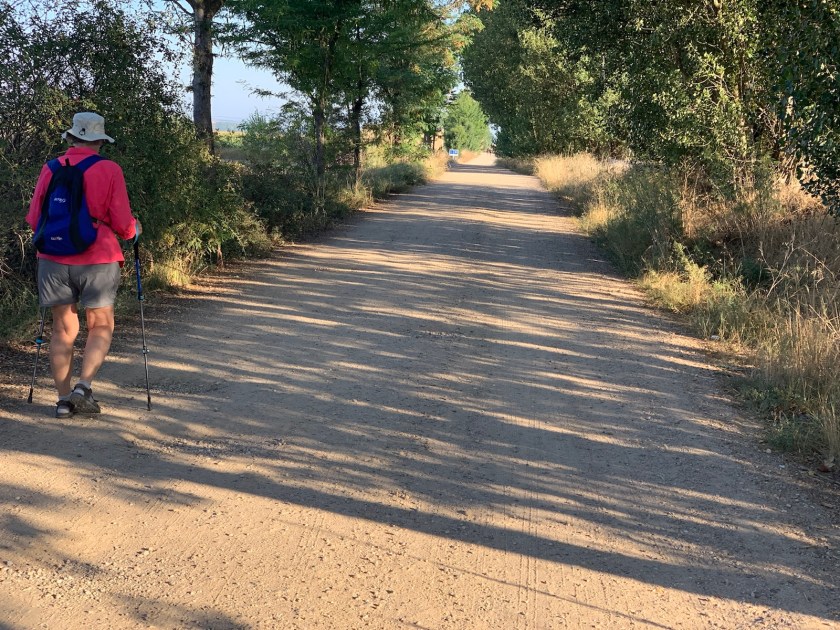
The “road” route started out like this…
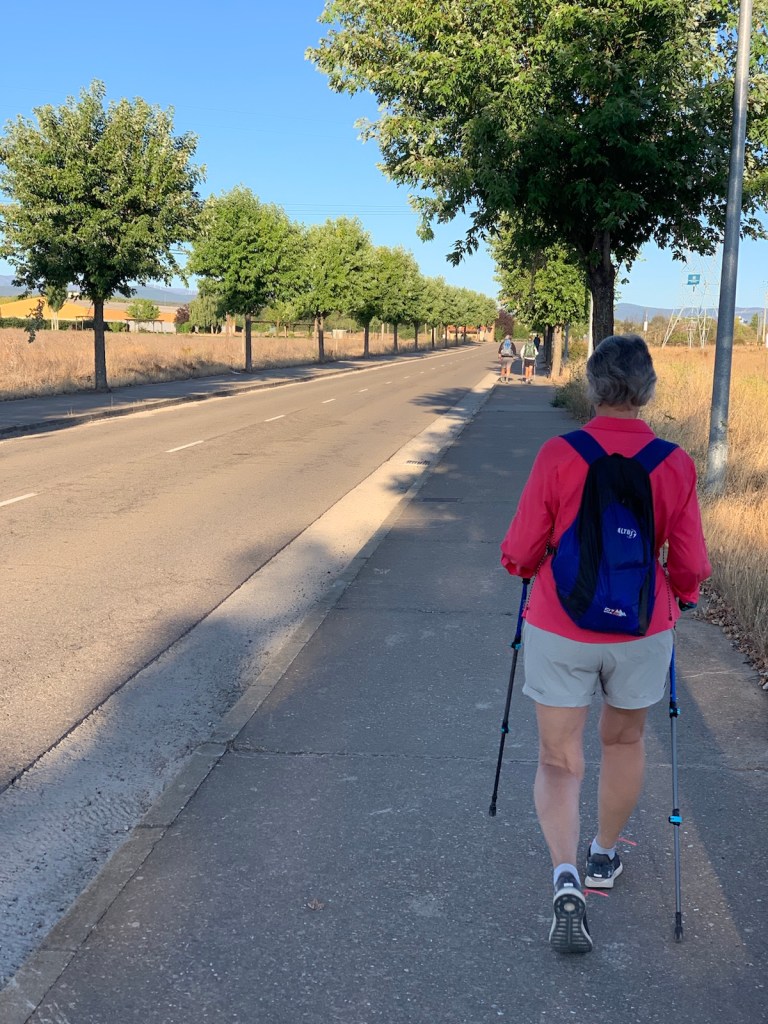
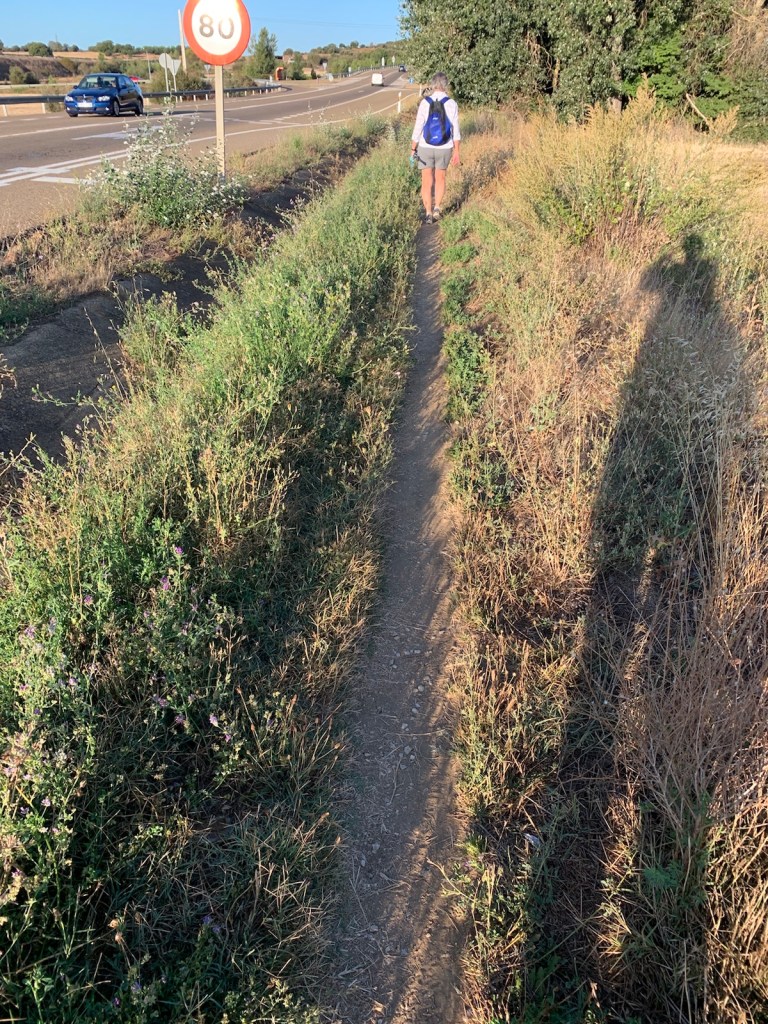
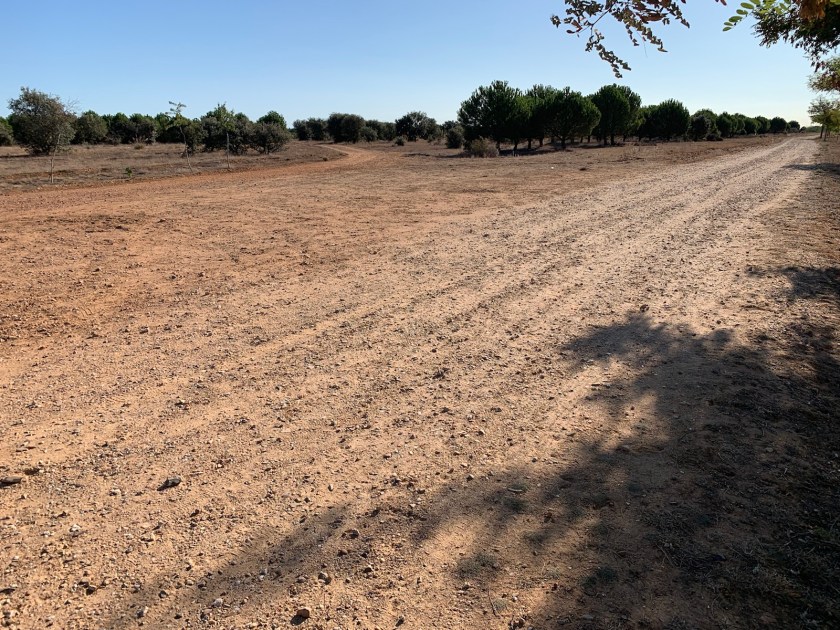
… and soon became this..,
Because this is not the “preferred” route, most of the 300,000 pilgrims each year don’t walk it, resulting in a sometimes overgrown path…
…but it wasn’t all that bad.
It’s funny how car and truck noise just becomes normal and blends into nothingness and becomes less and less annoying and other thoughts, mental songs or just the new unseen sights and feelings overtake you and create another, new Camino experience.
Today’s walk was good because we got to see a “new” part of the Camino Frances.
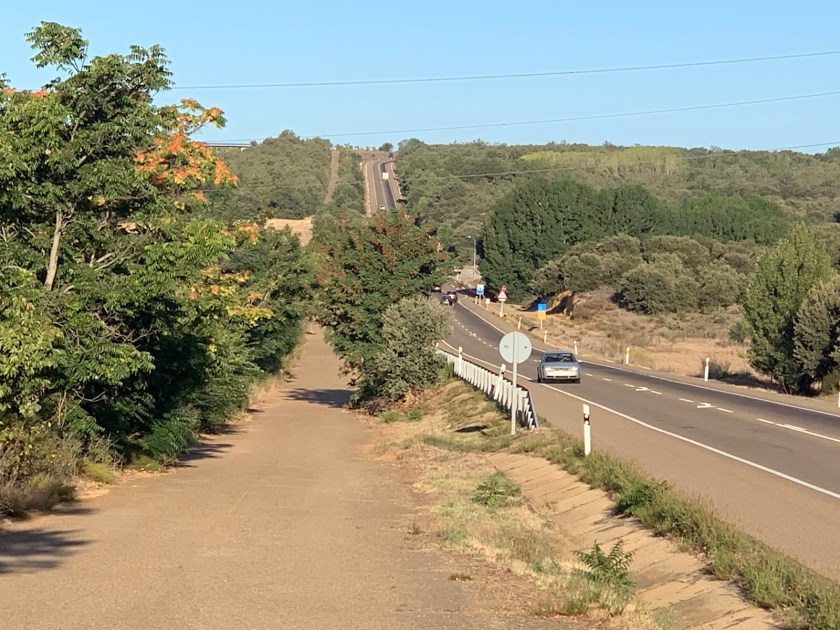
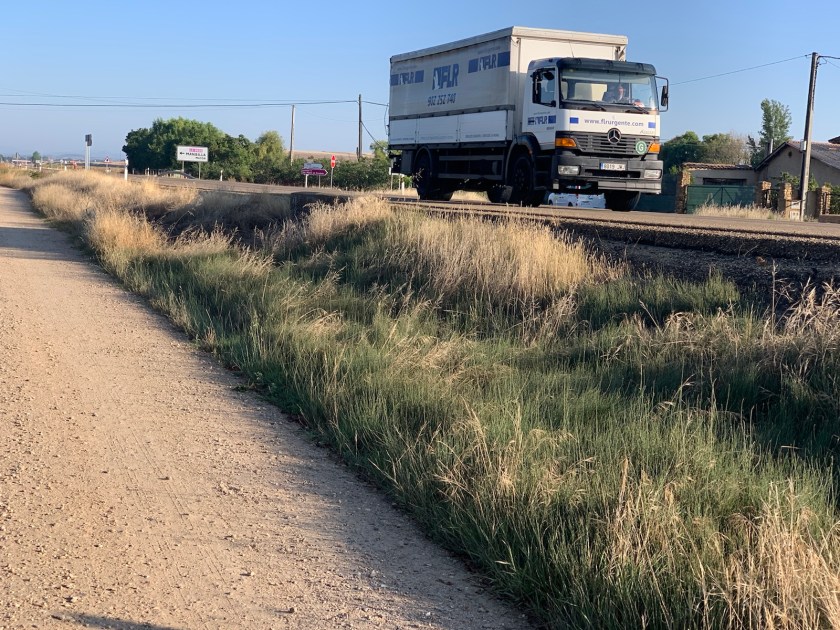
The path to the left of the highway was the Camino
We still had hills to climb, but they were different hills.
And we eventually reached the top..,
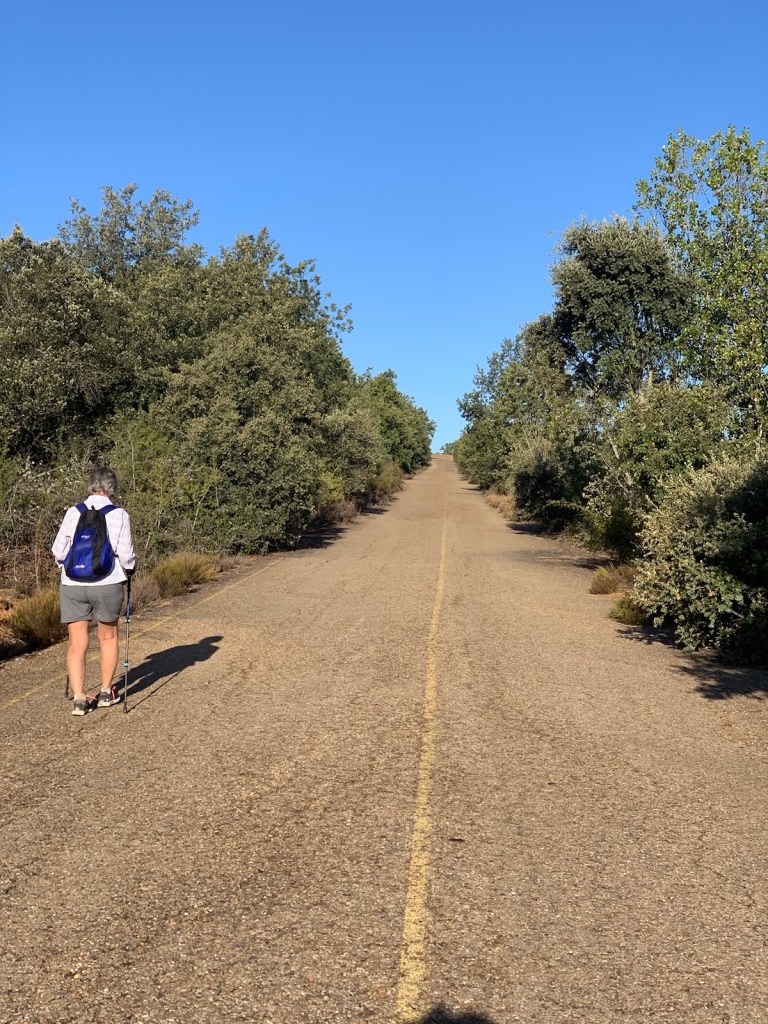
And walked on a different surface.,,
“preferred” route coming in from the center, ours on right
And finally merged with the ” preferred” route at ….
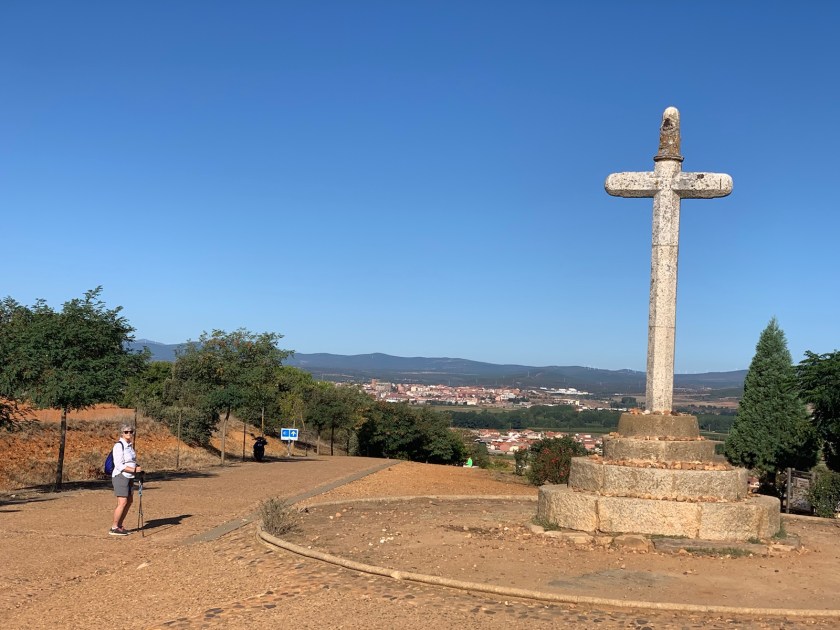
Crucero de Santo Toribio with San Justo in foreground, Astorga in background and mountains beyond
Crucero de Santo Toribio named for the 5th-century bishop of Astorga who was said to have fallen to his knees at this spot when he was banished from his beloved city.
This view of the Irago Mountains confirmed that we are leaving the Meseta after over 150 miles.
We walked down into San Justo de la Vega (pop. 1875) stopped at Bar El Caño and had a mid-morning CCL and a nice break before going on to Hostal/Albergue Juli (50€).
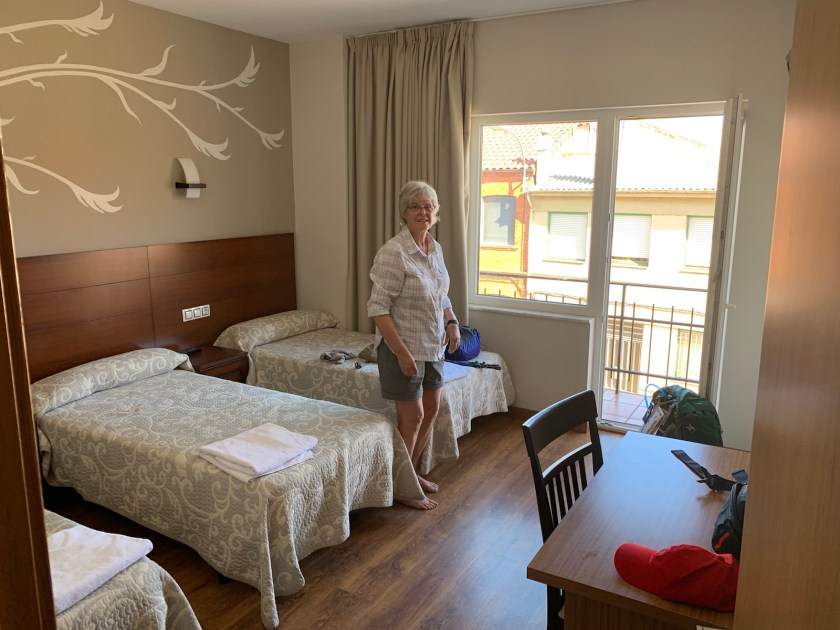
Our very nice room has been recently upgraded, especially the bathroom with a spacious shower. It has a balcony overlooking main street and the continuous pilgrim traffic, mostly headed for Astorga for the night. We stayed here in 2015.
We opened the balcony door to cool off the room with the cool morning breeze, but closed it after an hour when it was apparent that too many of the local flies wanted to join us. Jim then proceeded to escort the unwanted visitors out, peacefully or violently, whatever it took.
We prefer the towns and villages just before or just after the primary pilgrim stops, which are less crowded, less expensive and more like real Spain vs tourist Spain.
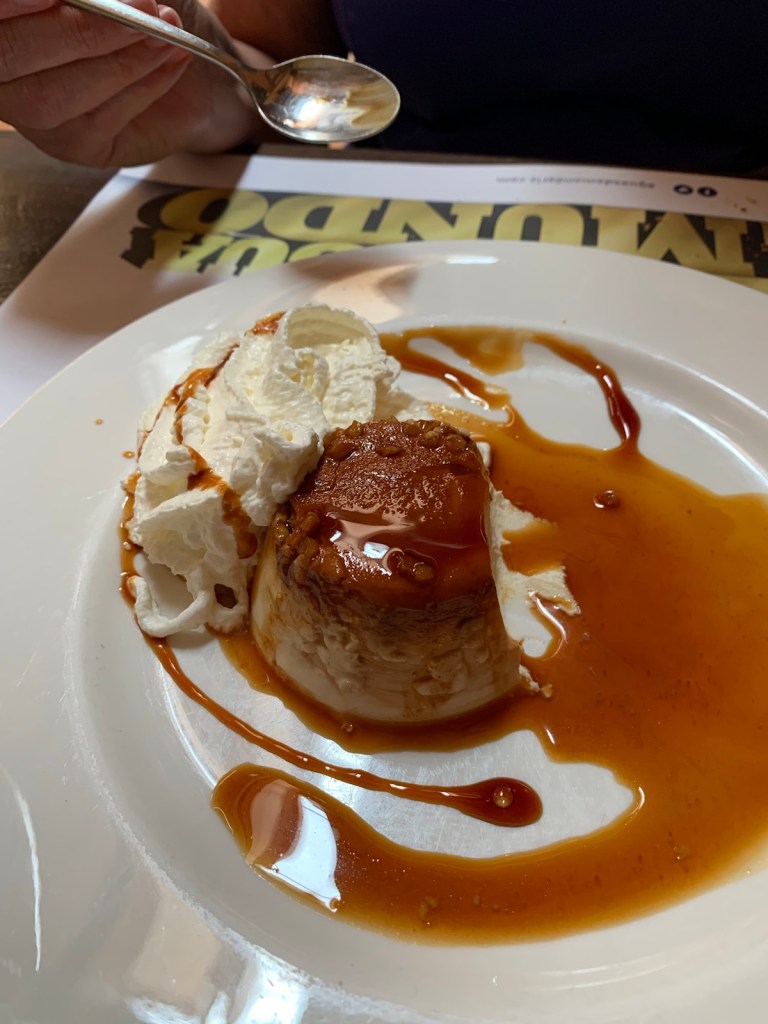
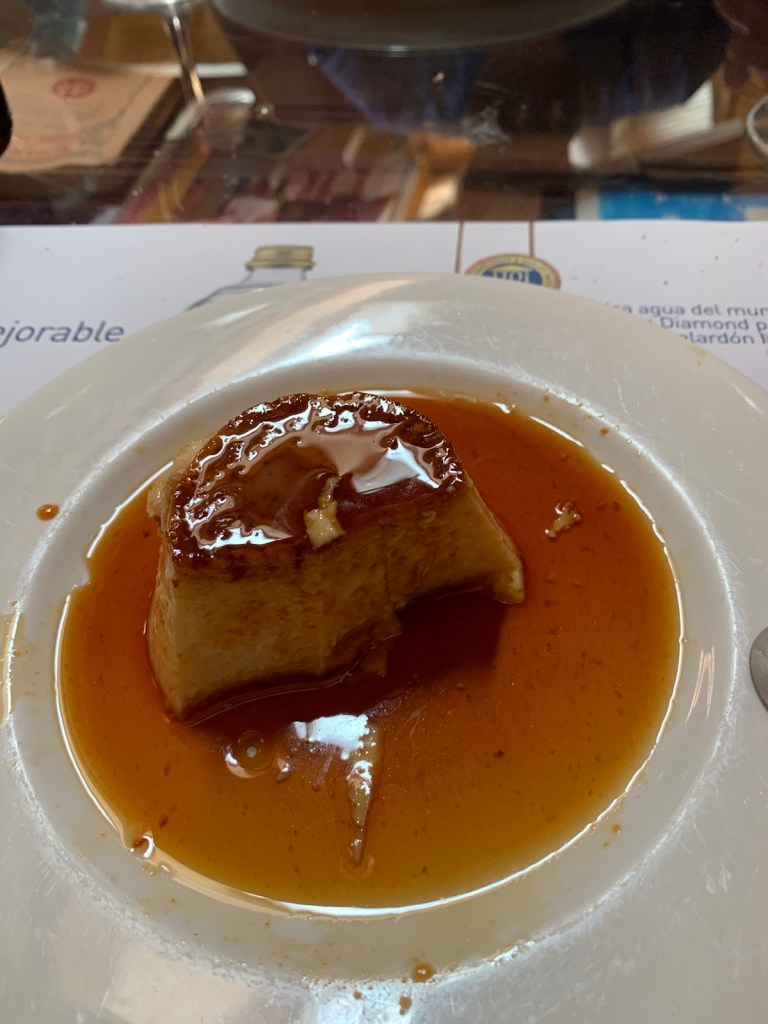
We extended our emerging habit of lunch/dinner at mid-afternoon with typical 1st and 2nd courses but enjoyed delicious new desserts of homemade yogurt and tiramisu, prepared by the young owner/ chef of Hostal Juli.
A restful afternoon, became evening and a nice end to another day on the Camino Frances.
Today was a continuation of walk-along-the-road Camino.
We stopped for breakfast at a familiar albergue in San Martian del Camino, known for frequents visits from extraterrestrials, so we were not concerned when we observed an alien spacecraft hovering over a village building, but walked, hurriedly through the village (pop. constantly changing).
After nearly 7 miles, we walked by an impressive looking water tower (we think) on the outskirts of Hospital de Órbigo (pop. 1031)
A water tower ?
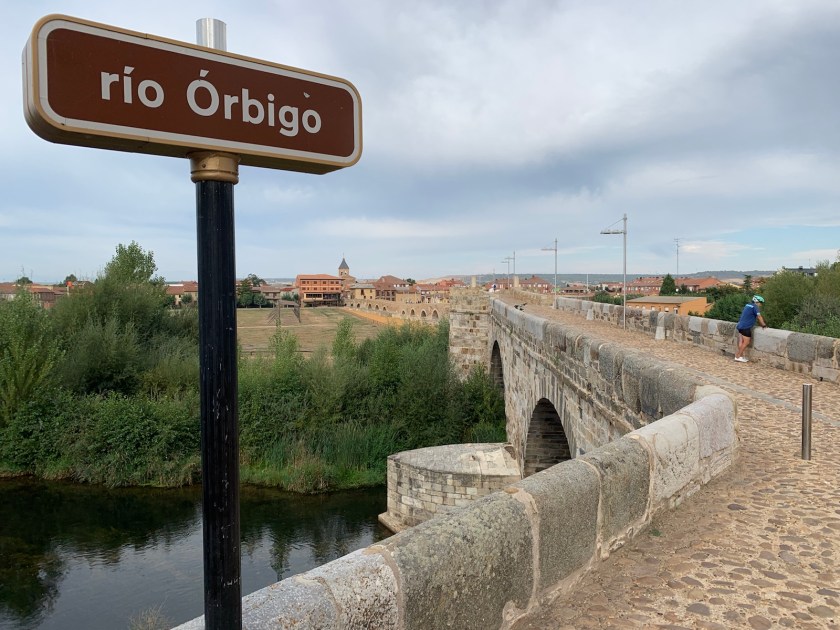
We walked directly onto the landmark bridge for this medieval town.
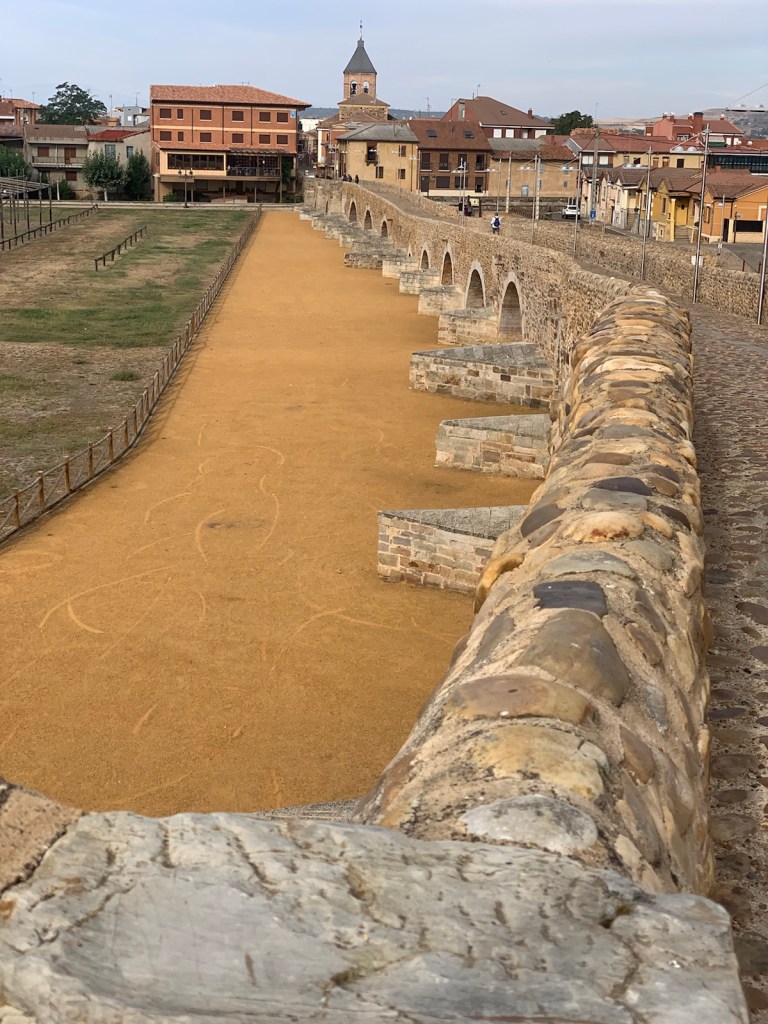
El Paso Honrosa #1El Paso Honroso #2El Paso Honroso #3
El Paso Honroso #4
El Paso Honroso #5
The impressive Gothic bridge over the Río Órbigo is the site of a legendary medieval jousting competition. Don Suero de Quiñones, a wealthy Leonese knight, was rejected by the woman he loved. In his heartbreak, he locked his neck in an iron collar and swore he would not take it off until he had defeated 300 knights in jousting. The call went out, and knights from all over the kingdom came in the Holy Year of 1434. Quiñones succeeded in his quest, freeing him from the torment of love. He took off the collar and made a pilgrimage to Santiago where he left a bejeweled bracelet, which can still be seen in the cathedral museum. The bridge became known as El Paso Honroso “the Honorable Pass.”
We stopped for fresh squeezed orange juice at a restaurant/hostal at the opposite end of the bridge in Hospital de Órbigo before walking a few hundred more yards to our room in Albergue Encina.
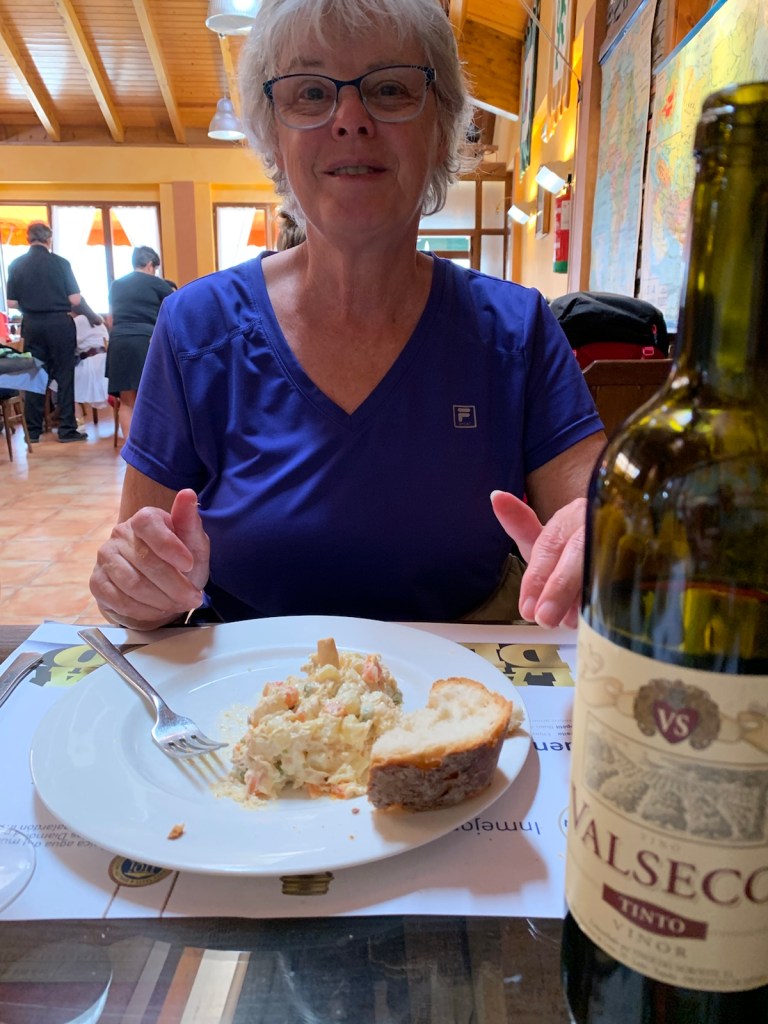
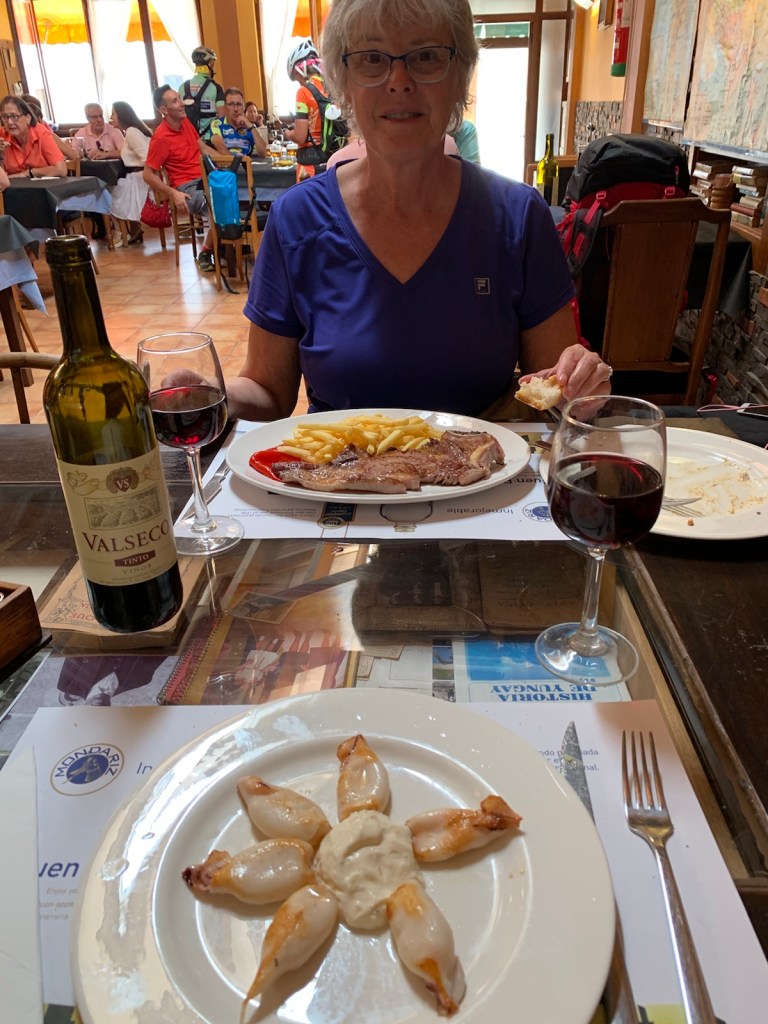
We had lunch today at a nice local restaurant and think its time for you to join our culinary experience.
Here is the menu we were presented with. No one speaks English and none of the items in the menu show up in itranslate.
It was still dark when the taxi dropped us off in Virgen del Camino, a suburb of León.
Basílica de la Virgen del Camino
We figured today would be an uneventful walk along a busy secondary road, fronting the autovia.
Well, it was, if you discount the older (older than us) fellow pilgrim who we encountered leaving Virgen del Camino and was trying to determine which direction to go of three choices. We didn’t understand his language but our version of Spanish/English seemed to help him out and he walked with us for a bit. He had previously done a pilgrimage to Rome and had climbed Mount Kilimanjaro. He was Russian and lives in Moscow. He was walking to Santiago, taking the bus to Finistere, walking back to Santiago, then working his way back home via train/plane. He was walking faster than we were, so we wished each other well and off he went.
So we had an interesting start for what we expected would be an uneventful day walking along the road. A few minutes later, Linda heard a strange noise behind us, said it sounded like the clomp, clomp of a horse. It was still hard to see, but she thought it looked like a horse had stopped in the path behind us. A few steps later a pilgrim walked past us, followed by very handsome looking horse carrying the pilgrim’s gear.
As the guy passed us, he didn’t say anything except, “he keeps following me”, in perfect English.
Interesting pilgrim entourage
The horse walked around us and once he was clear of us moved back into the path behind the guy he was following… much more safely and considerate than many of the cyclists we’ve encountered in the past few hundred miles!
We followed the pair through an underpass, and noticed for the first time, the horse’s flashing tail light, his clog like shoes with buckles and other than periodic piles of equestrian evidence observed along the way, we never saw them again.
We stopped in Valverde del la Virgen at a new store that we don’t remember seeing in 2017. It had a limited selection of items but did offer a small CCL and Santiago tarta (a Camino almond cake), which was homemade by the owner’s wife. Patronizing a new business on the Camino
We stopped for a brief breakfast, asked the owner to pass on our compliments to the “chef”, then moved onward.
We stopped at the next village, San Miguel del Camino and had a normal breakfast at a charming cafe.
The site of our second breakfast today… in San Miguel
We walked on, along the road, then the path took us away from the road a few feet (we could still hear the cars and trucks) to walk among some bodegas ( individually owned, wine cellars) for a few hundred yards …
interesting and some very old wine cellars
Back along the road
… then back along the road again.
We made one last stop at a hotel/truck stop/restaurant a mile from our destination, only to cool our feet a bit and get out of the ever increasing heat of the rising sun.
After the last mile into Villadangos del Páramo we arrived at Hostel Libertad (50€) and at 11:15 were checked in immediately.
Our double room with private bath is comfortable, clean and relatively new (late 20th century).
Chores detail: Since this is not an albergue, there was no clothesline or washing machine, so we washed and rinsed our sweaty/dirty stuff in the bathroom sink, wrung the water out by hand, then laid the wet clothes onto a dry towel and rolled the towel, squeezing it tightly, absorbing and extracting additional moisture, then hung the clothes on any hanger, doorknob, chair, tv, light fixture or window we could find and within a couple hours, everything (shirts, shorts, underwear, socks, etc.) was dry, clean and ready to wear tomorrow.
After doing our chores we had a meal in the hostal at 2:00 to serve as lunch/dinner, which is getting to be a habit.
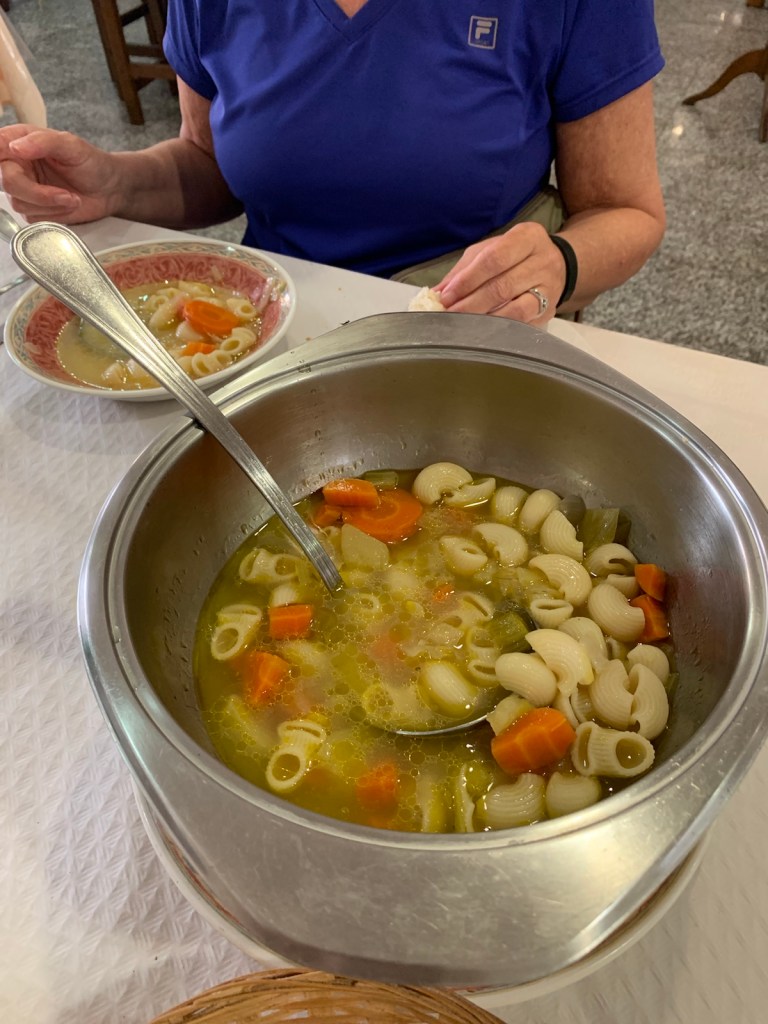
Linda was served an unusual version of “minestrone soup” that was very delicious, but much more than she could possibly consume in a single meal.
leeks were included in this Spanish version of “ minestrone “.
And we sampled a Menćia wine for building a sampling base as we head into the Bierzo wine region over the next few days.
Veal for Linda, fish (Hake) for Jim
Overall, our uneventful day walking along the road turned out pretty well.
The path out of Reliegos reminded us of yesterday.
Just before Manzilla de las Mulas we stopped at a favorite albergue/bar for breakfast.
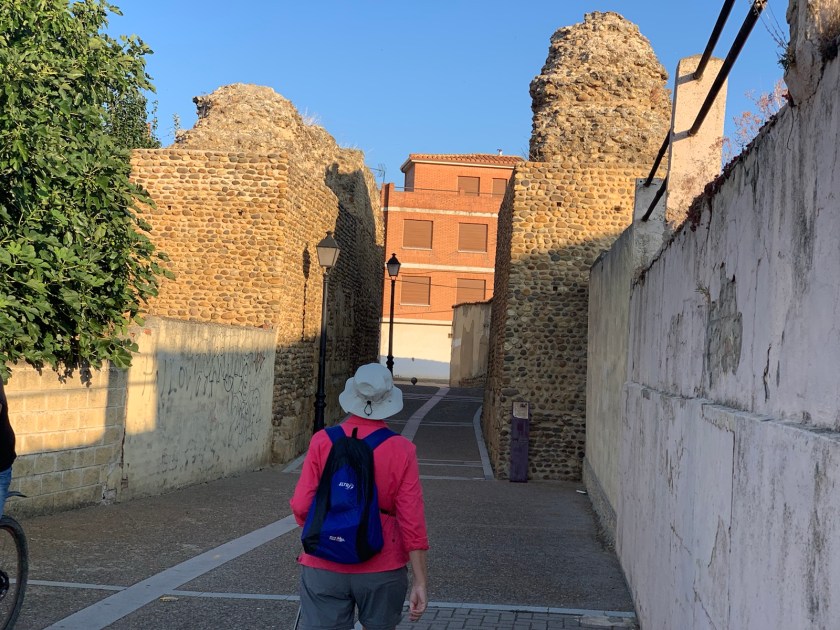
Manzilla was once a Roman town, likely a stopping point on the Via Trajana. The city was fortified with walls in the 12th century and rebuilt in the subsequent two centuries. Today, more than half of the medieval walls remain, some as tall as 14m and as thick as 3m. It is possible to climb the stairway up into the rounded towers, and two of the original gates still stand.
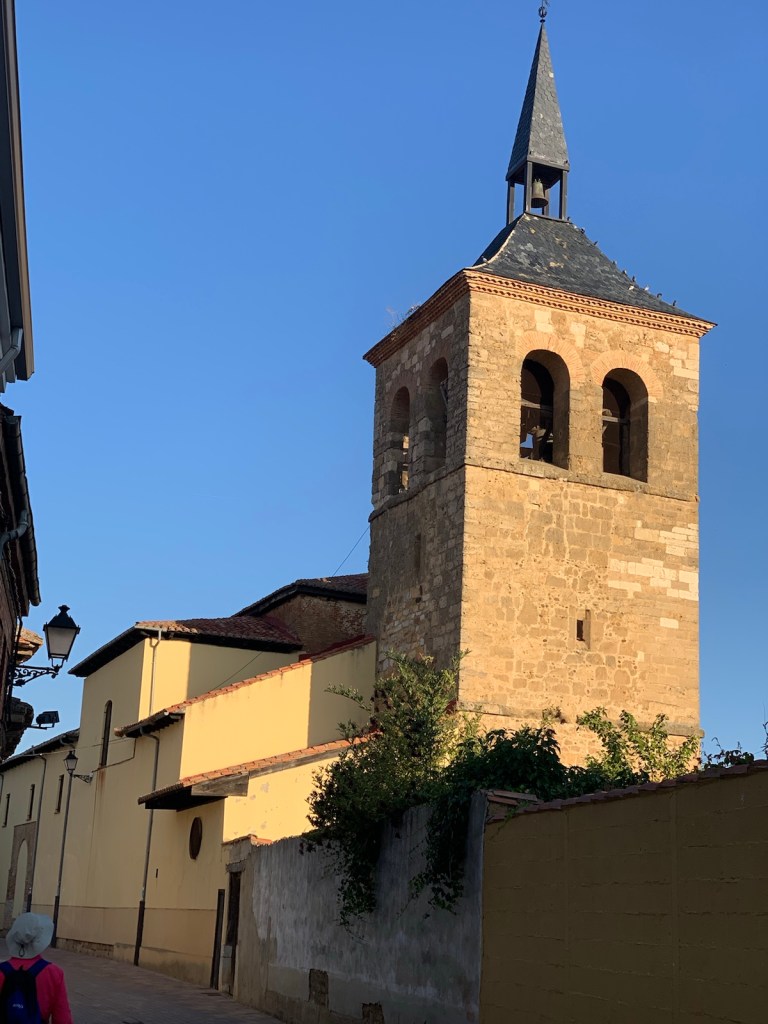
Entering through one of the 12th century gates12th century Iglesia de Santa María still standingSilhouetted 12th century city walls looking into sun
As we left Manzilla the path changed to a much wider dirt road which fronted a secondary road toward León.
a slightly different look from yesterday.
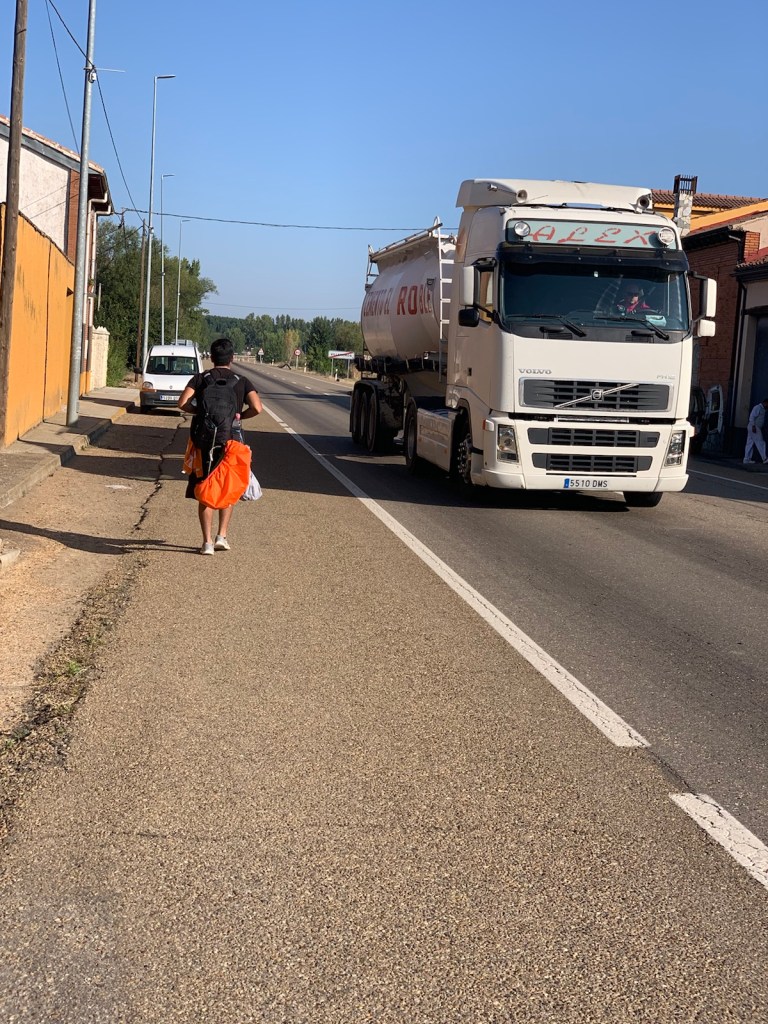
We soon lost our shade and got closer to the road until we finally were actually sharing the road with cars and trucks, some really big trucks.
Path getting closer to the road and no more shadeToo close for comfort
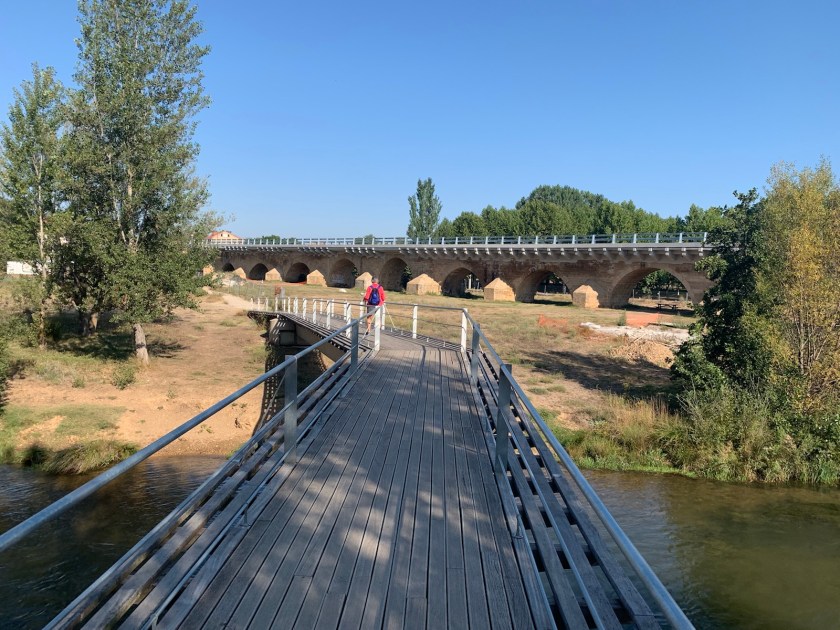
After a brief break, walking through the woods, we crossed the Río Porma on a modern footbridge
Puente de Villarente in background
adjacent to the Puente de Villarente, a bridge originally built by the Romans, and entered the town of Villarente (pop. 342).
In 2014 we spent the night here, in Albergue San Pelayo, and took a taxi to the other side of León to Virgen del Camino the next morning, then walked back into the city, then returned to Virgen del Camino to spend the night. In 2017 we walked into León, spent the night in Leon, then walked on through the city and spent the night in Virgin del Camino.
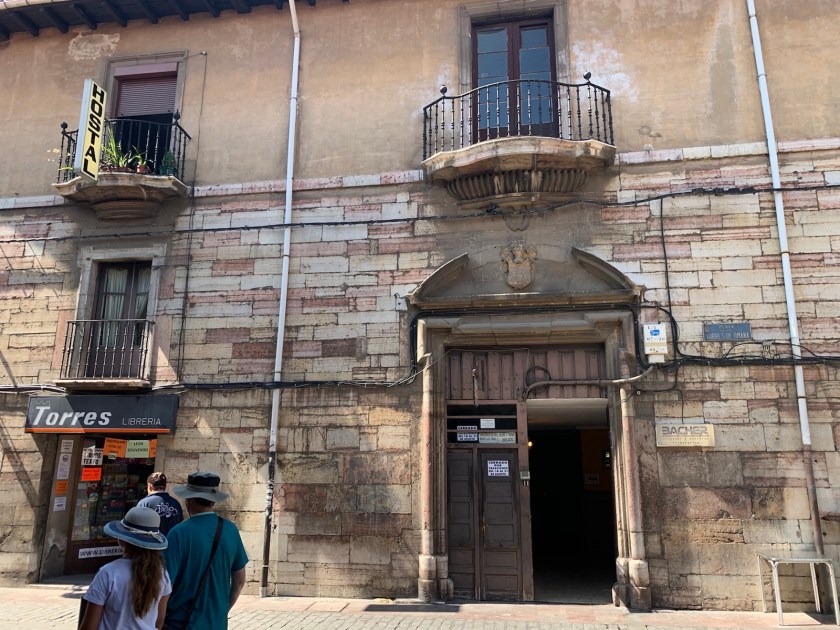
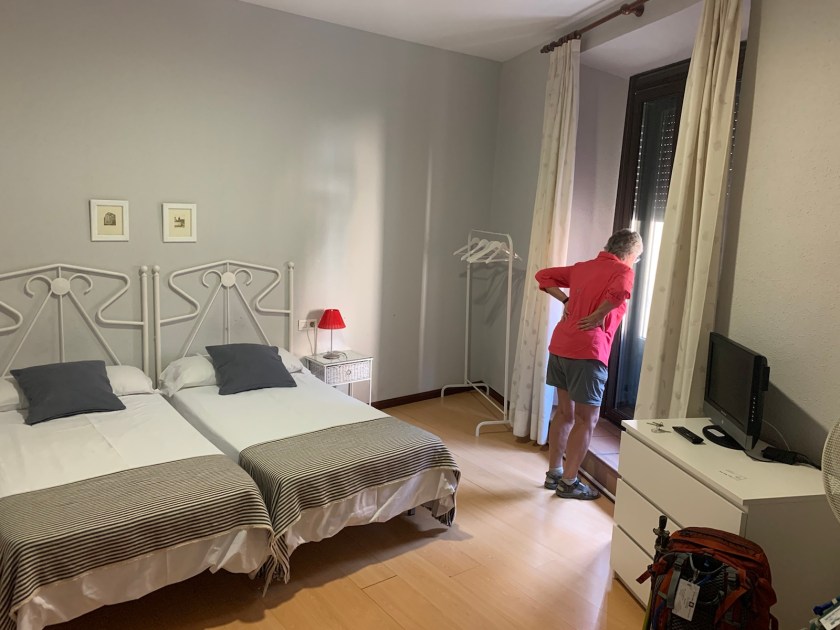
Today we split the difference, we took a taxi from here into León to Hostal San Martin (58€).
Hostal San Martin from the streetOur room with two balconies, looking out to the street
Our hotel is very centrally located just a few steps from the Catedral and other León landmarks.
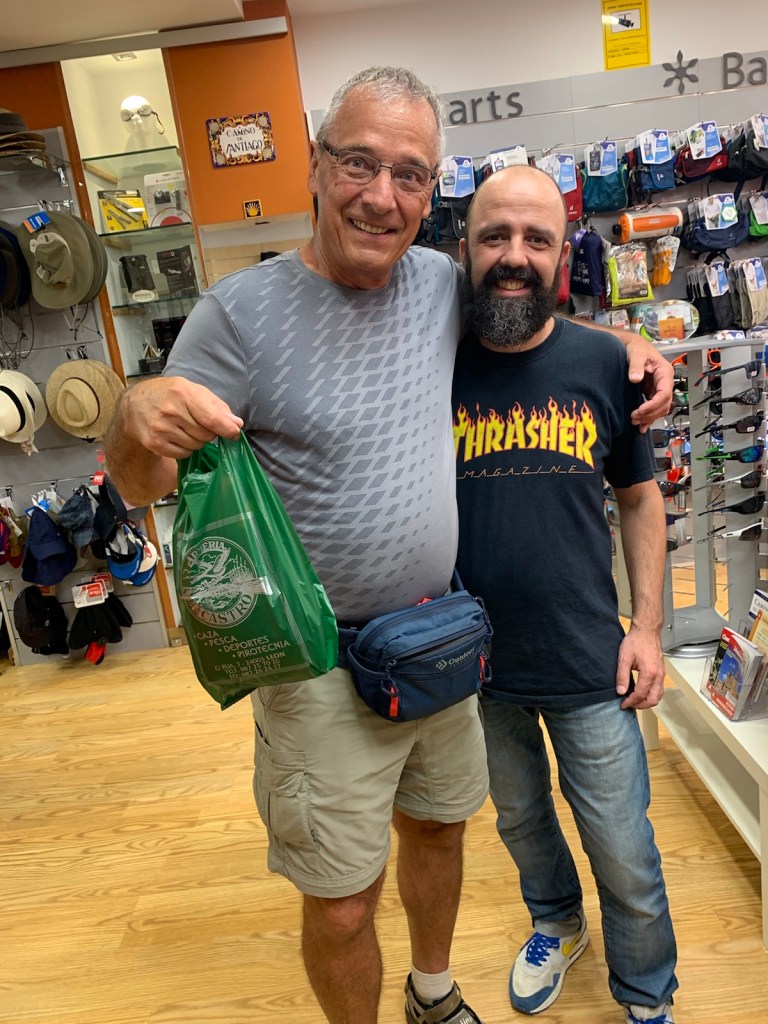
We took a few photos, bought Jim some new walking shorts
Just in case the current ones don’t make it another 500 miles
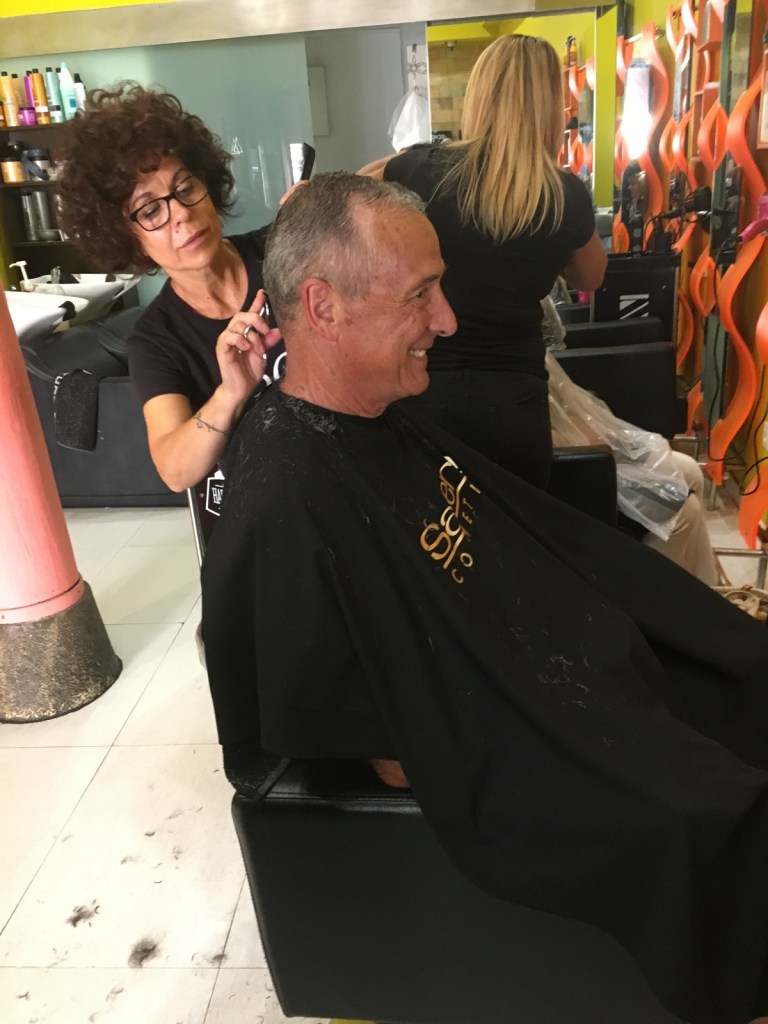
and a haircut.
She didn’t know what I wanted, we couldn’t tell her and she still did a great job for 7€!!
We spent a frustrating few minutes at the Orange mobile phone store trying to extend the time on our prepaid sim cards. We’ve still got service, but for how long is still not clear. Orange (a French company) seems to be trying to establish themselves in Spain by not speaking English or French and sending confusing text messages to prepaid sim card users as if they were regular customers. Their websites and texts are at best, confusing. We’ll struggle along with them until they shut us down again, to avoid paying the very unreasonably high Verizon international options, but next time we’ll definitely go with Movistar.
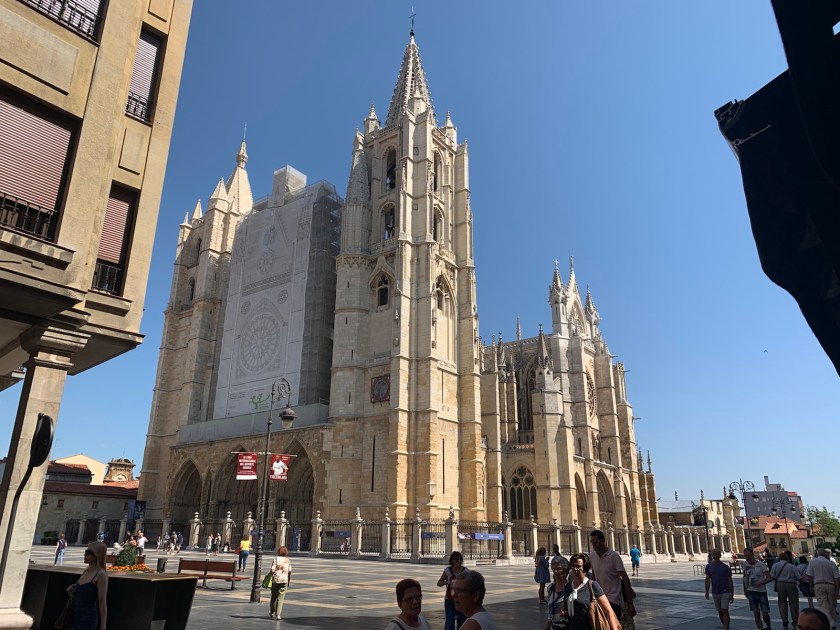
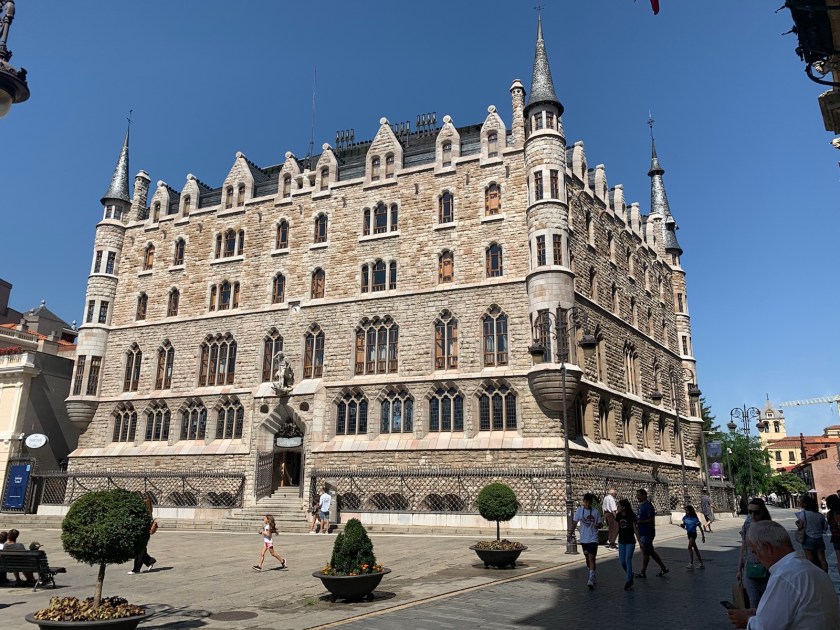
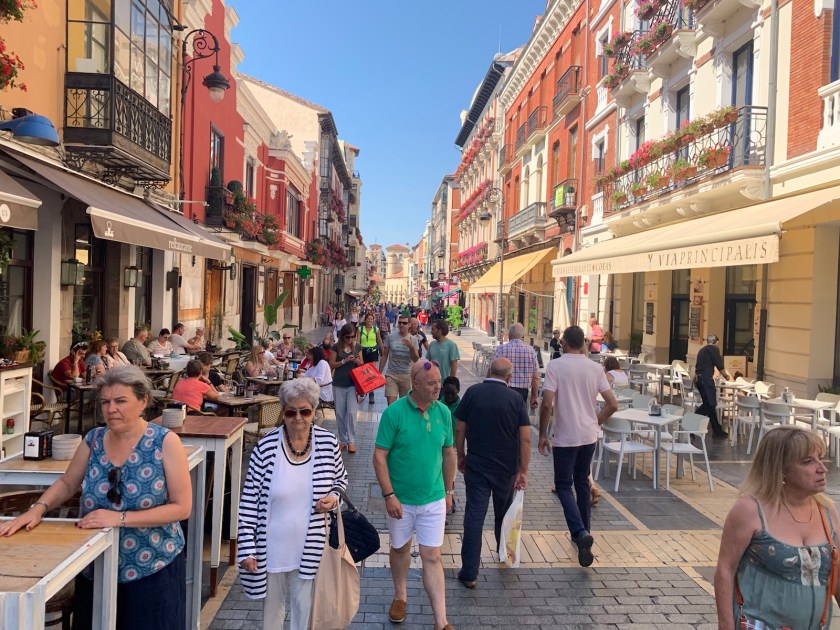
Here are some photos of León today.
León CatedralCasa de Botines by GaudiCalle Ancha, flooded with tourists
Royal Collegiate Church of San Isidoro
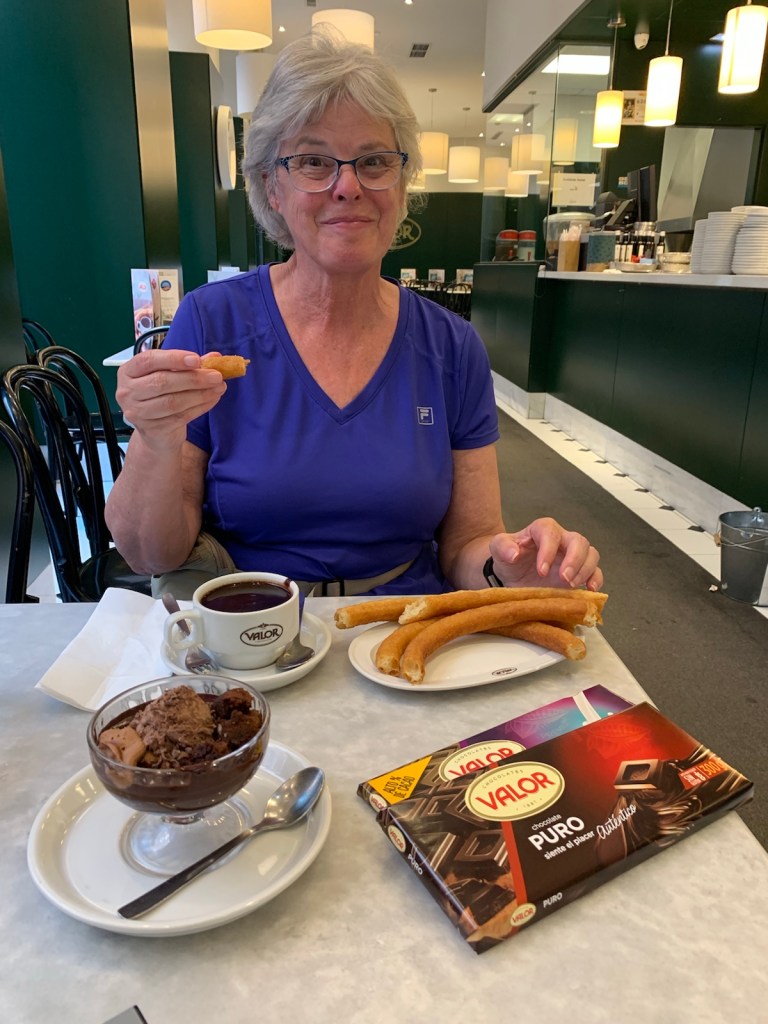
After finally getting a light supper at 6 when no one offers a meal until after 8, we made up for it by overendulging in the Valor chocolate store…
… then returned to our room to sleep it off, or walk it off tomorrow morning,

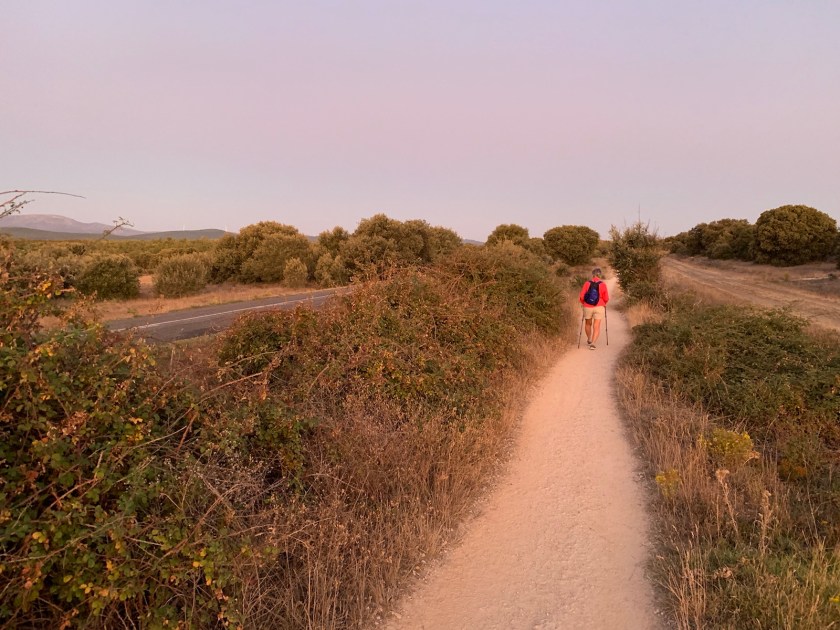 The way was flat, dirt for the first couple of miles into
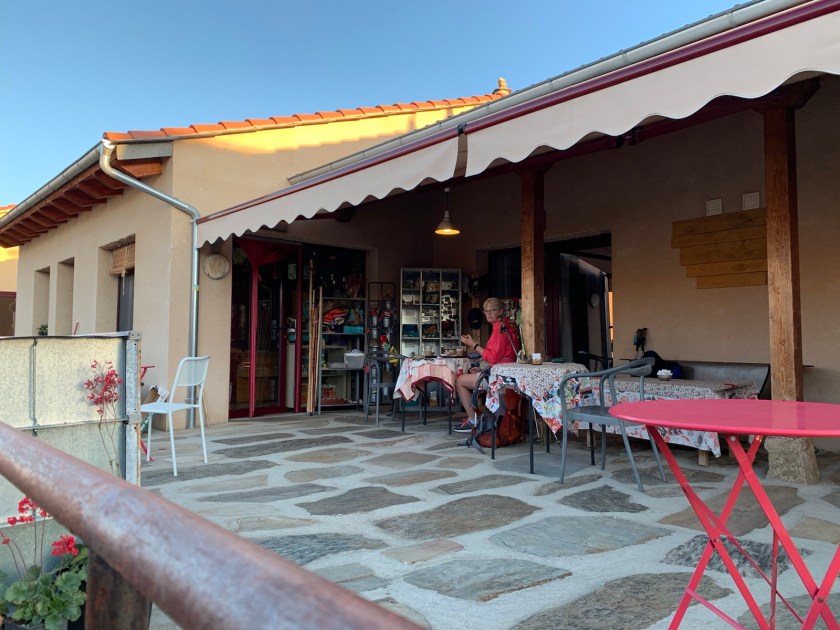 but, no one was around and we were about to give up when a gentleman walked out of one of the shop doors. Linda quickly said, “desayuno”?, “cafe con leche”?, “aseos?”, which all got the affirmative “si” from our new friend and savior, so we took a seat, breathed a sigh of relief and ordered our usual.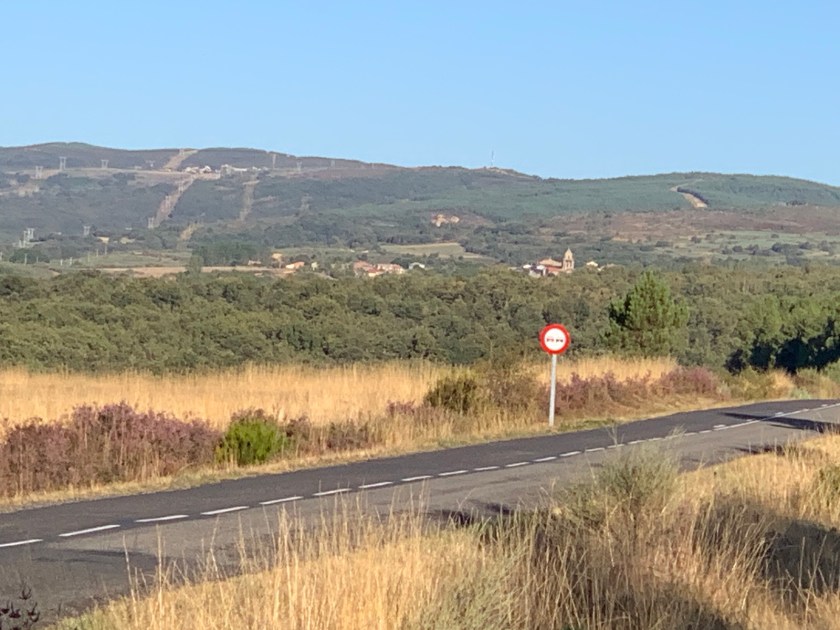
 into the Irago Mountains, with the final 1.5 miles becoming much steeper
  and we finally walked into Rabanal del Camino (pop.73).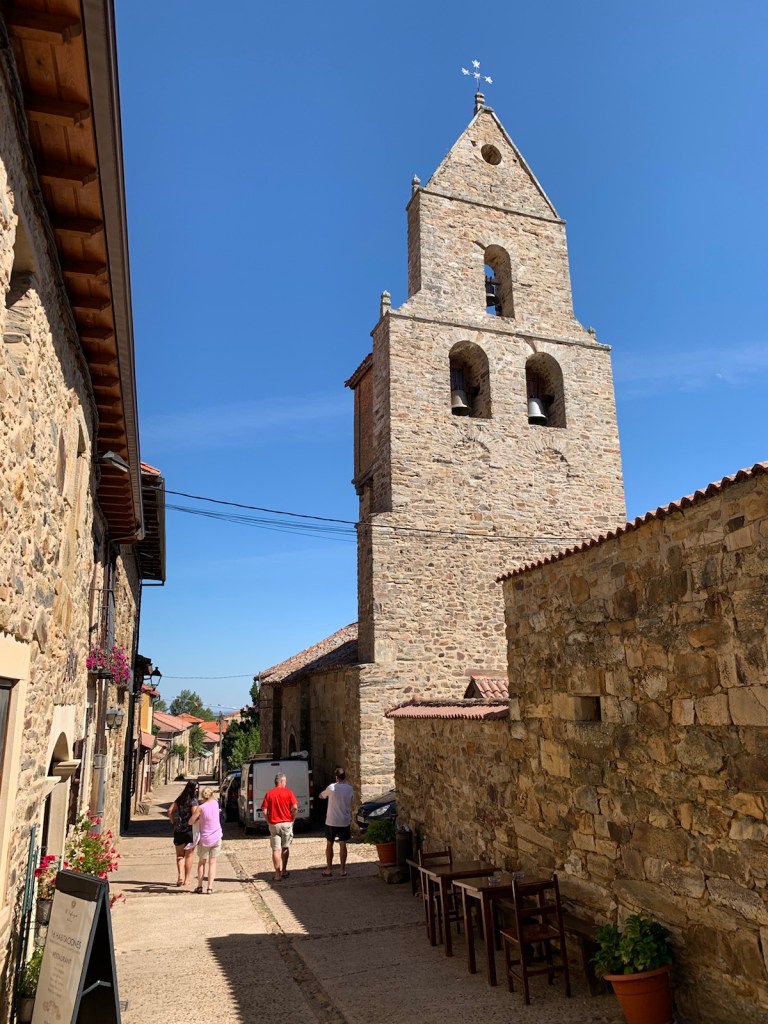
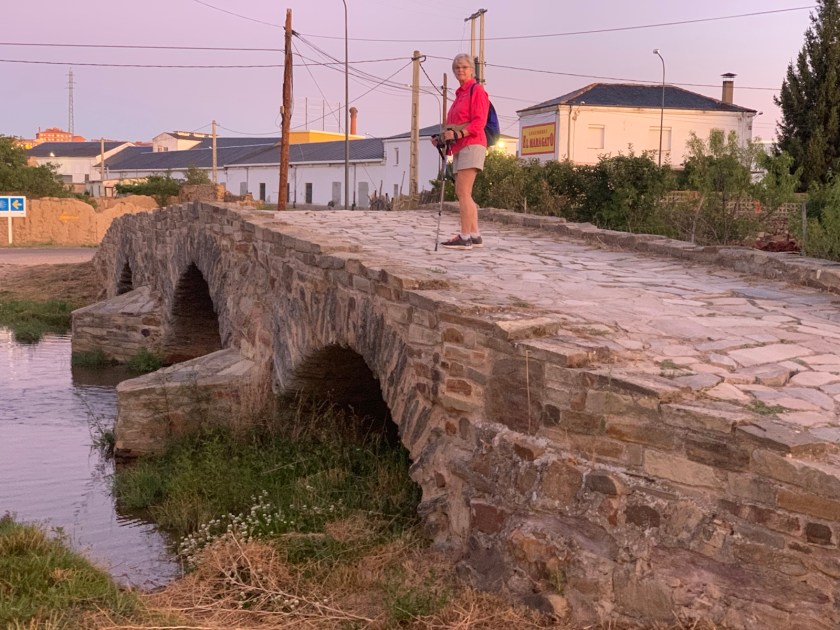 and shortly after crossed the railroad tracks via a very complex overpass.
  At the top we got a good view of the city.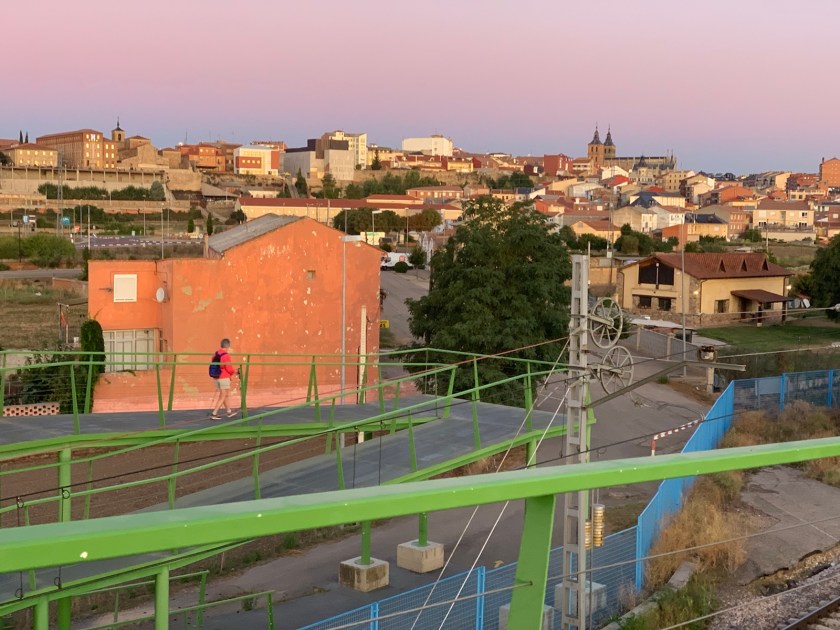
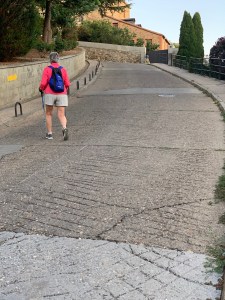 climbing a very steep road up into the 2000 year old city of Astorga.
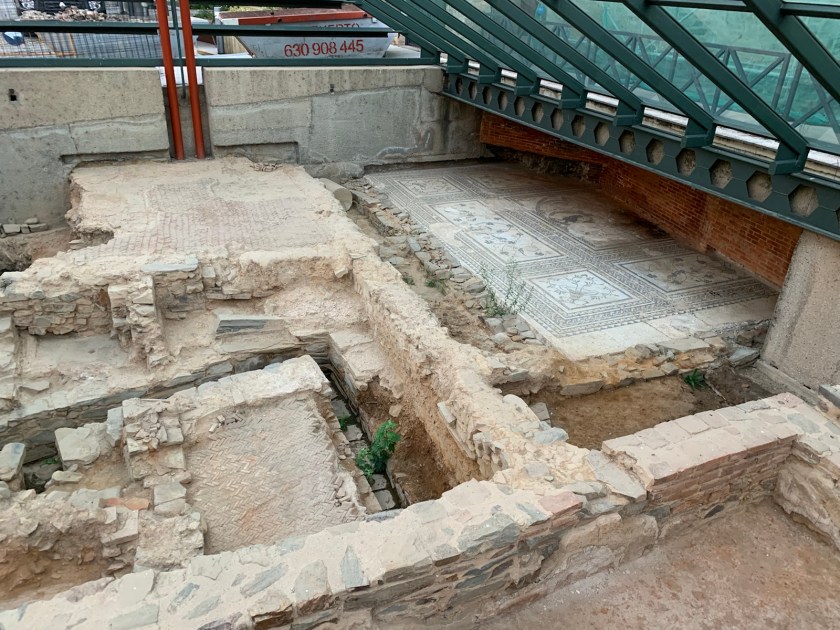 revealing fairly well preserved remains of a 2nd century Roman home.

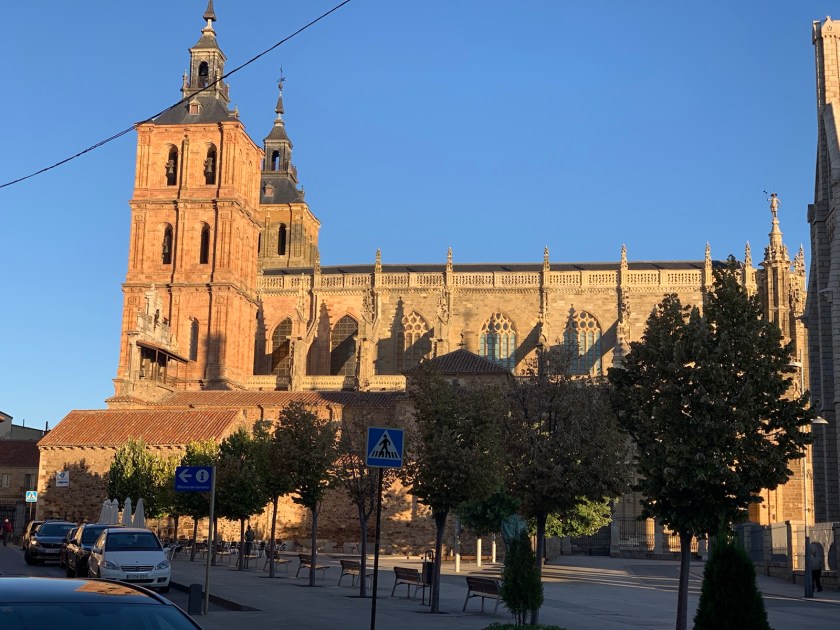 dwarfs the neaby buildings. It was locked tight this morning,
 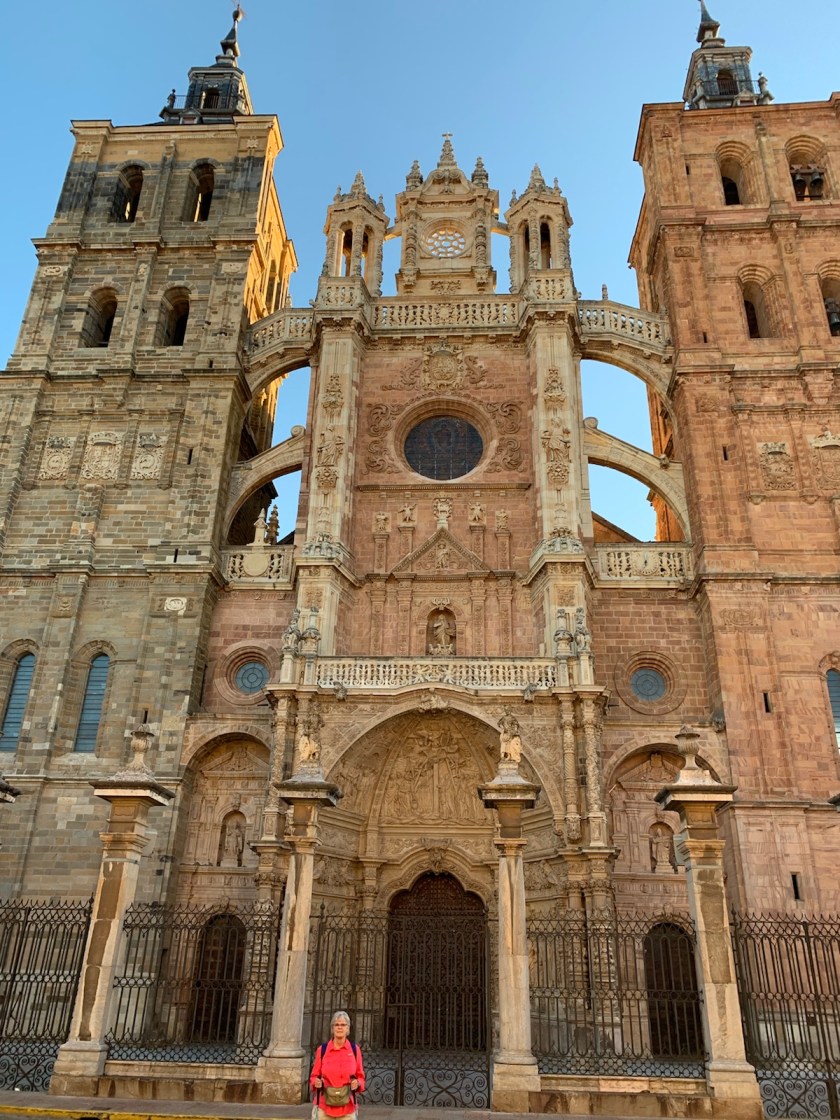 but the external details were impressive.
 The Palacio de Gaudí, was a palace for Archbishop Juan Bautista Grau Villespinós until his death, when it sat empty until serving as a military headquarters for the Falange movement.
 We continued our walk through the narrow streets and then without warning were out into the countryside
  and began a gradual ascent toward the Irago Mountains.
 and instead, began the gradual 3 mile climb into the, all but deserted, Santa Catalina de Somoza (pop. 30), where we stopped for the day at Albergue El Caminante.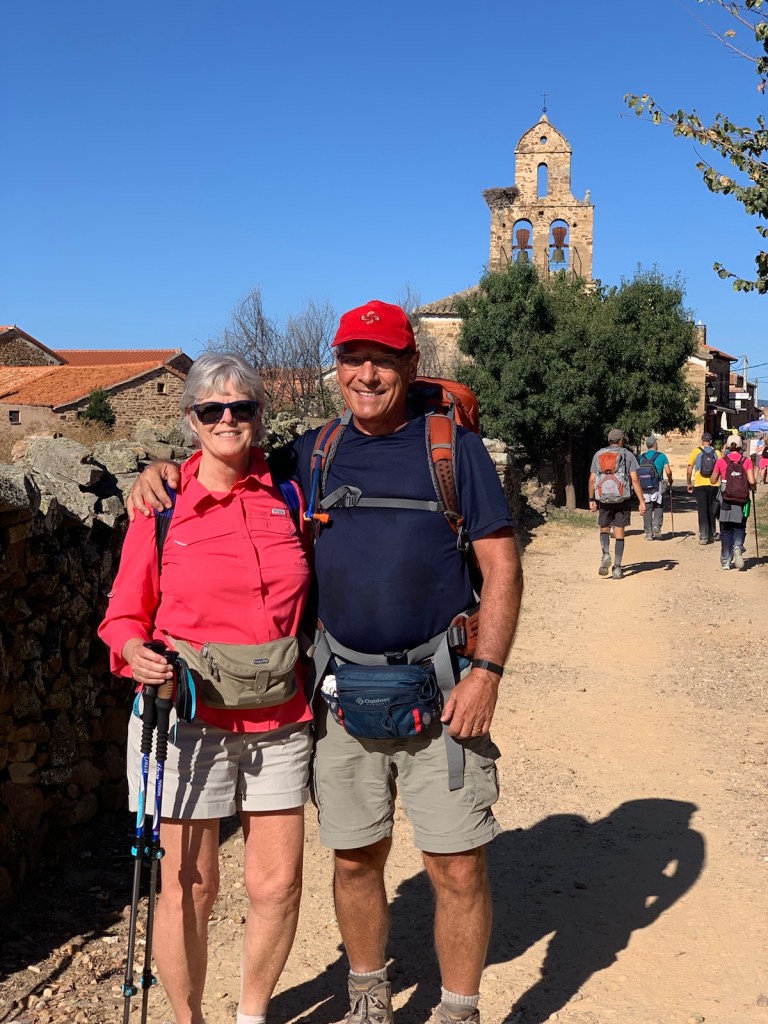
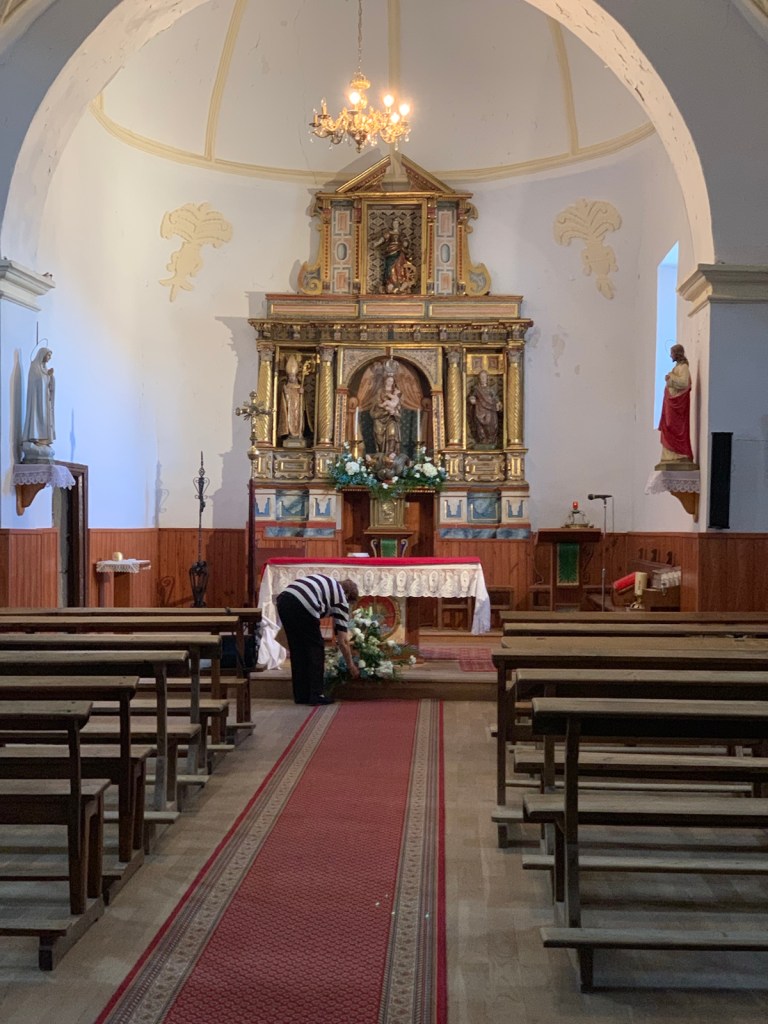 Finally after prior unsuccessful visits in 2015 and 2017, we entered and sat reverently while she worked, then quietly left her to her duties and returned the few steps to El Caminante.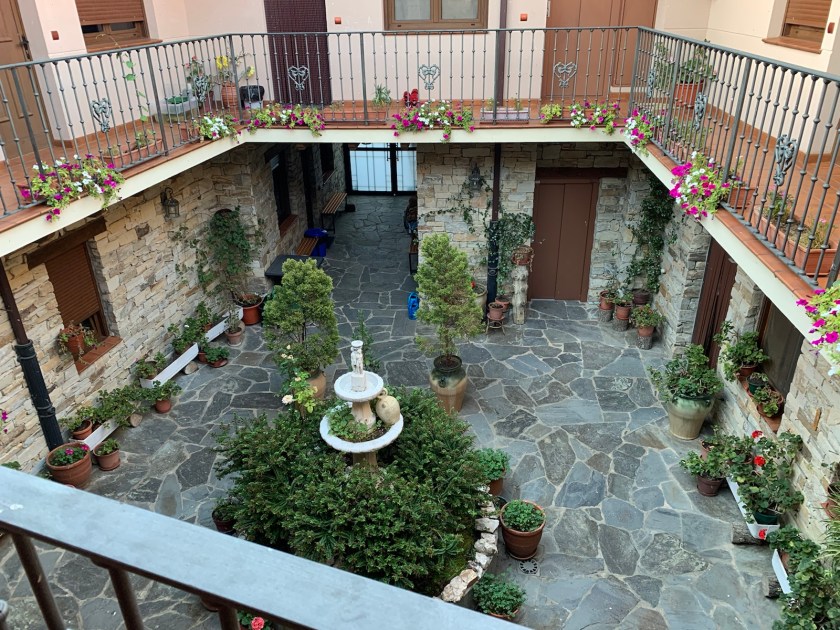
 Jim then proceeded to escort the unwanted visitors out, peacefully or violently, whatever it took.
 when we observed an alien spacecraft hovering over a village building, but walked, hurriedly through the village (pop. constantly changing).
 A water tower ?
 El Paso Honrosa #1
 El Paso Honroso #2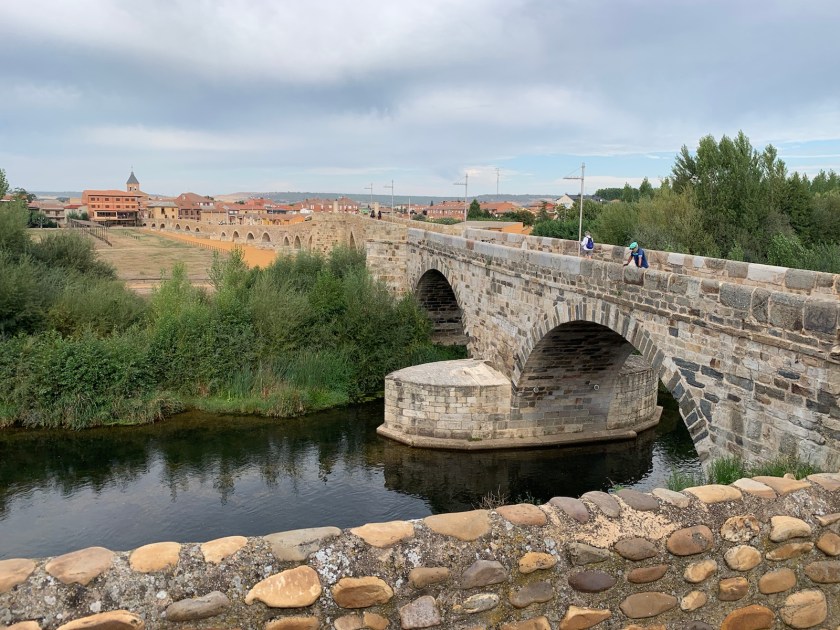

 before walking a few hundred more yards to our room in Albergue Encina.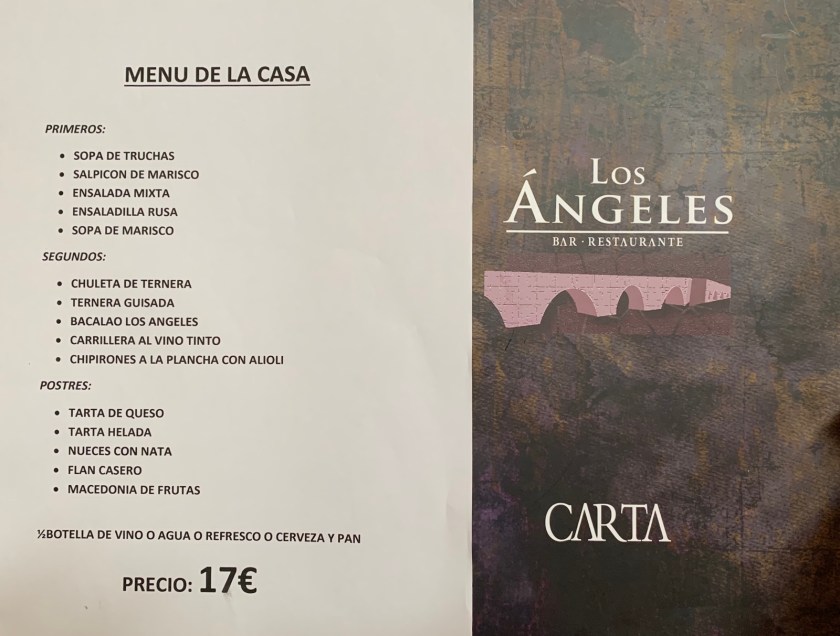
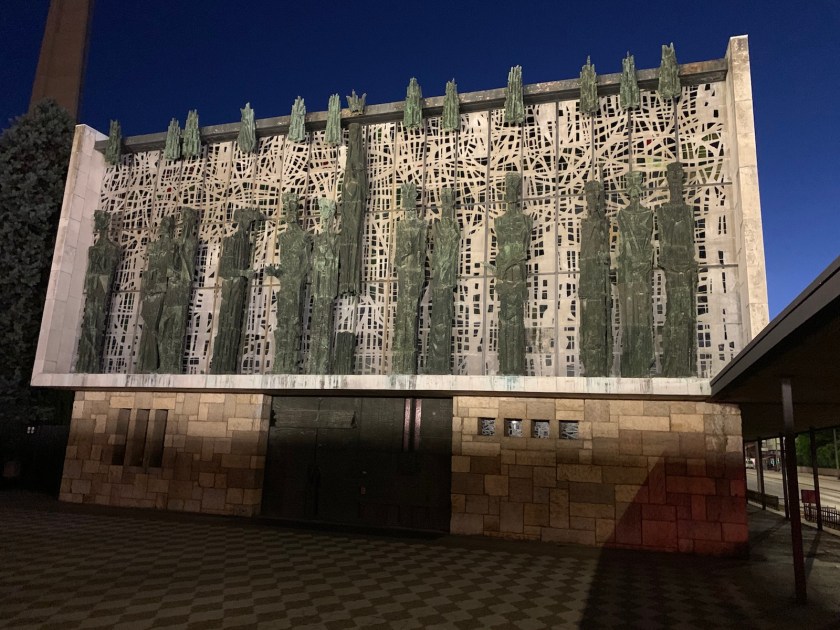 Basílica de la Virgen del Camino
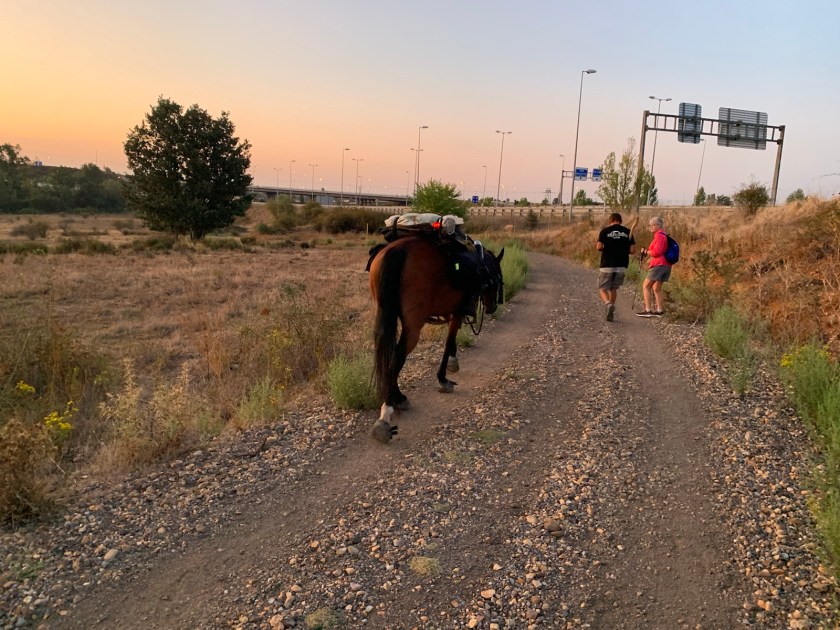 Interesting pilgrim entourage
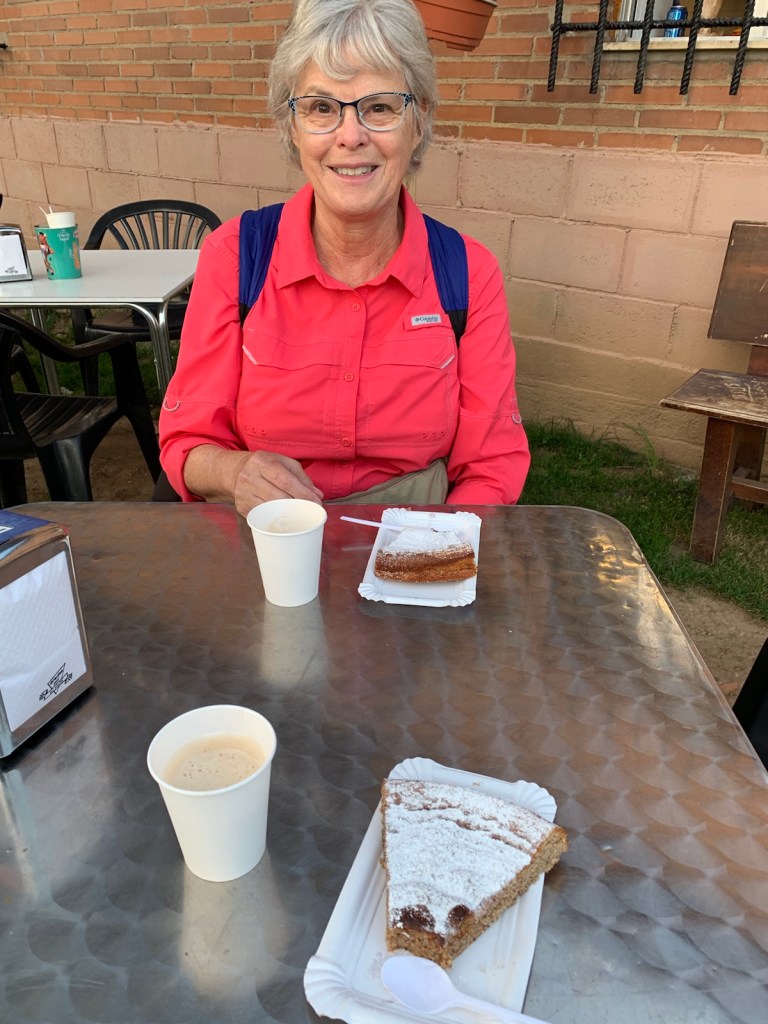 Patronizing a new business on the Camino
 The site of our second breakfast today… in San Miguel
 interesting and some very old wine cellars
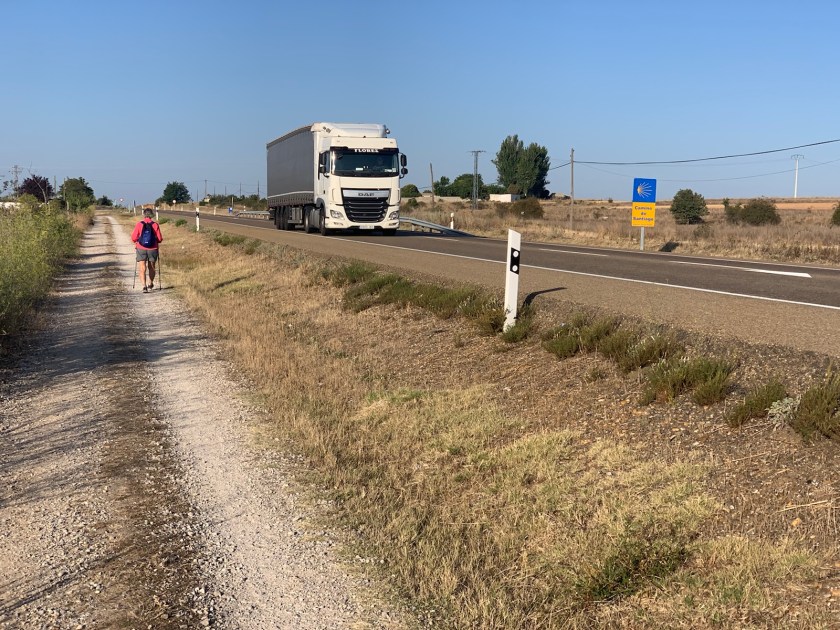 Back along the road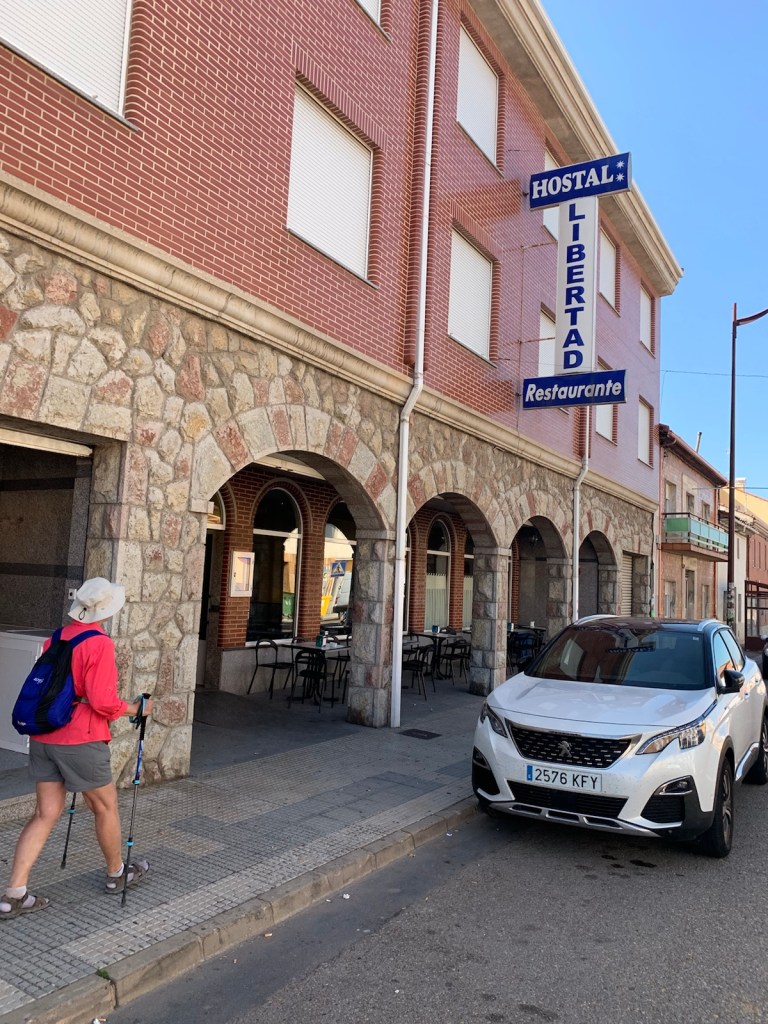



 Jimandi