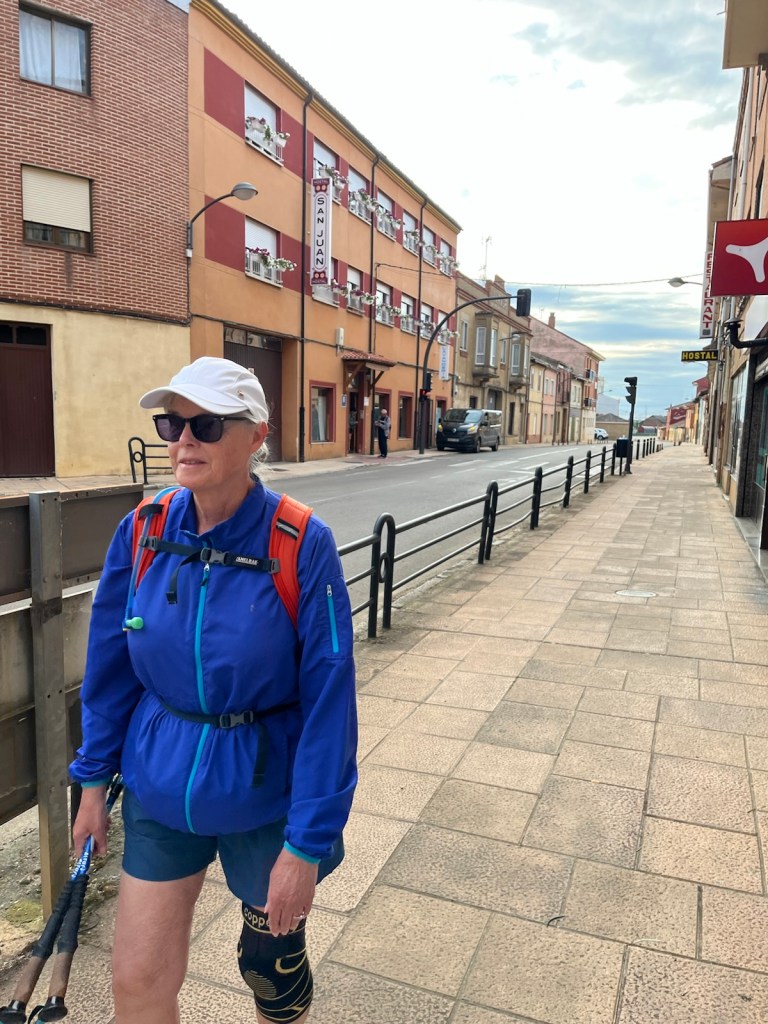
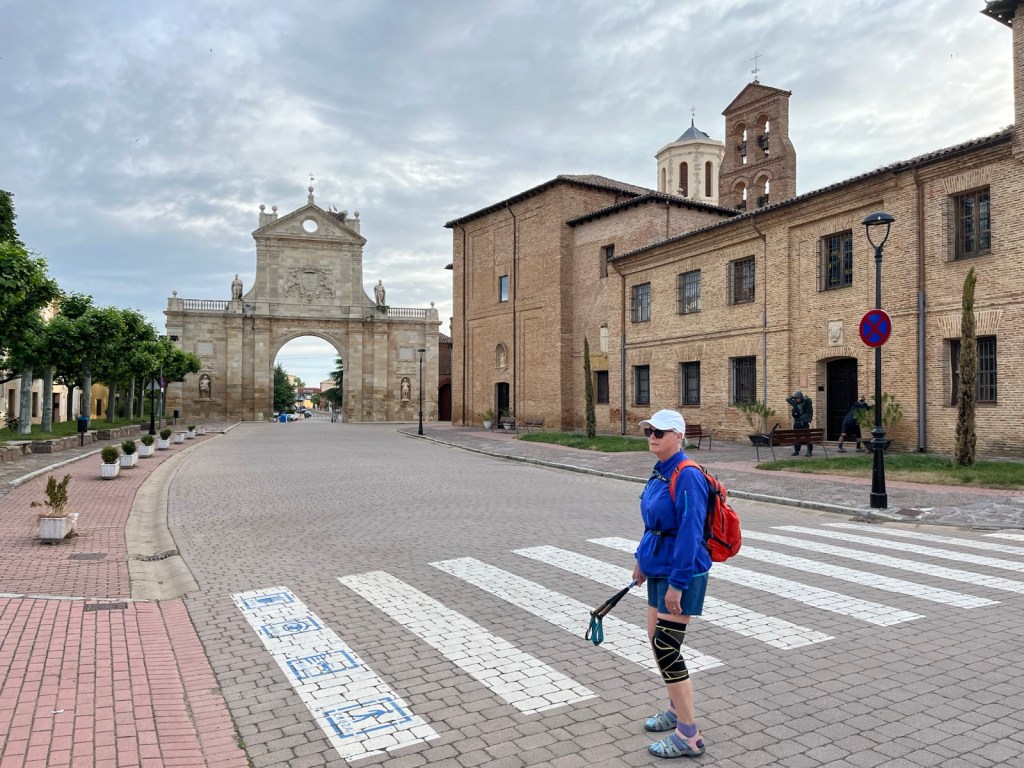
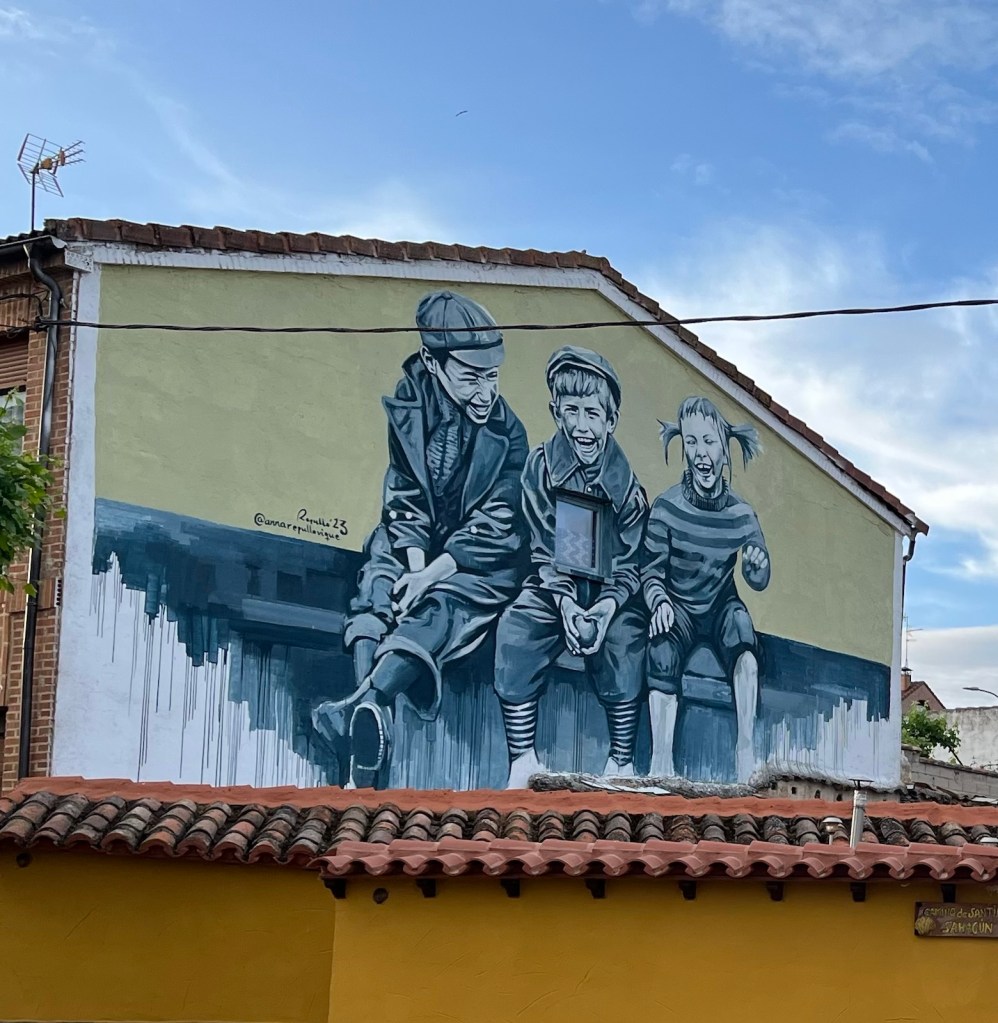
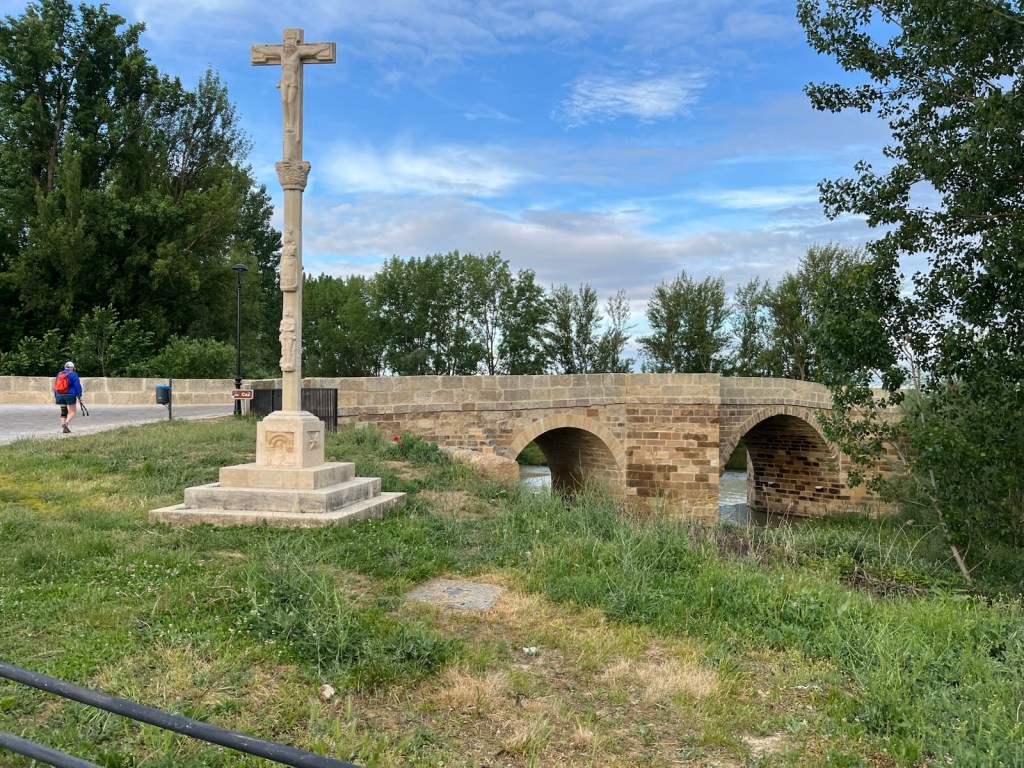
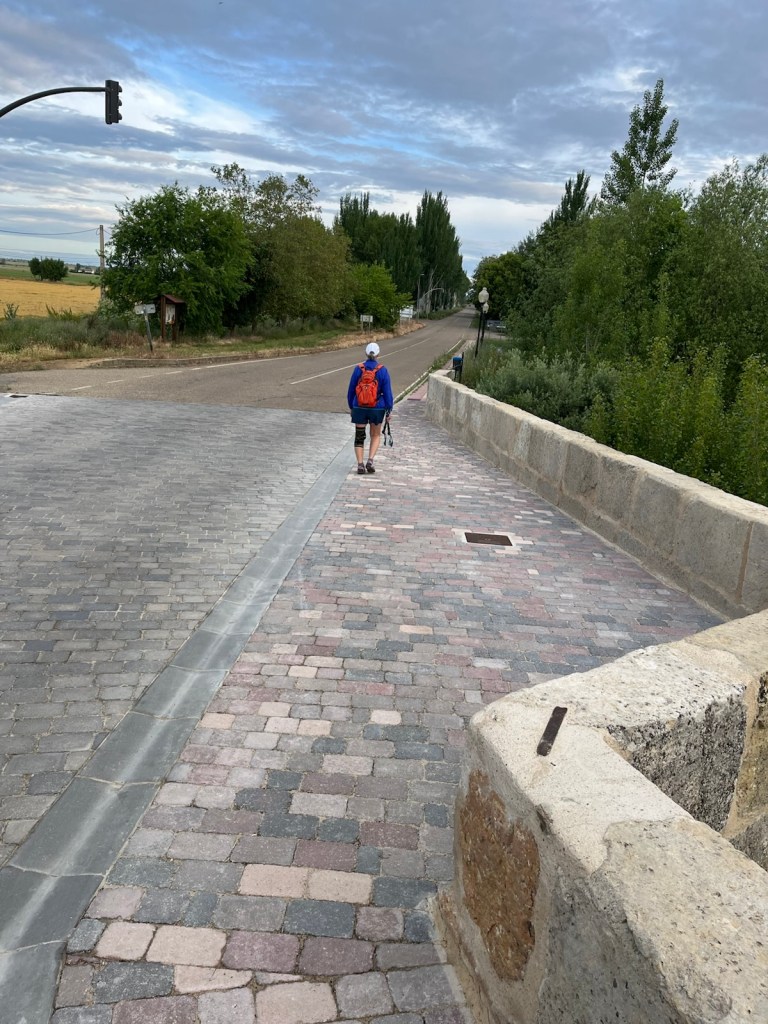
Leaving Sahagún this morning, Hostal San Juan behind us.Walking by the Arco de Dan Benito, Iglesia San Tirso and part of the Cluny municipal albergue.One of the many murals seen throughout the town.Linda about to cross the Puente Canto (originally built by Alfonso VI over the Rio Cea.)Leaving SahagúnRejoining the dirt path as we walked by a large municipal sports facility.Soon after leaving Sahagún the path once again paralleled the local road.Jim working on his selfie technique, which needs a lot of work!We arrived at a decision point on today’s walk… whether or not to take a longer, less shade, less traveled, little or no services or water… or stick with the traditional route lined by shade trees and going directly to Bercianos, our destination for the night. Didn’t even have to vote on this one.
A few minutes after choosing our preferred route, Bob and Cathy from Nevada passed us. We passed them a few minutes later when they found a bench for a brief rest. They soon passed us again and we wished them “buen Camino”.
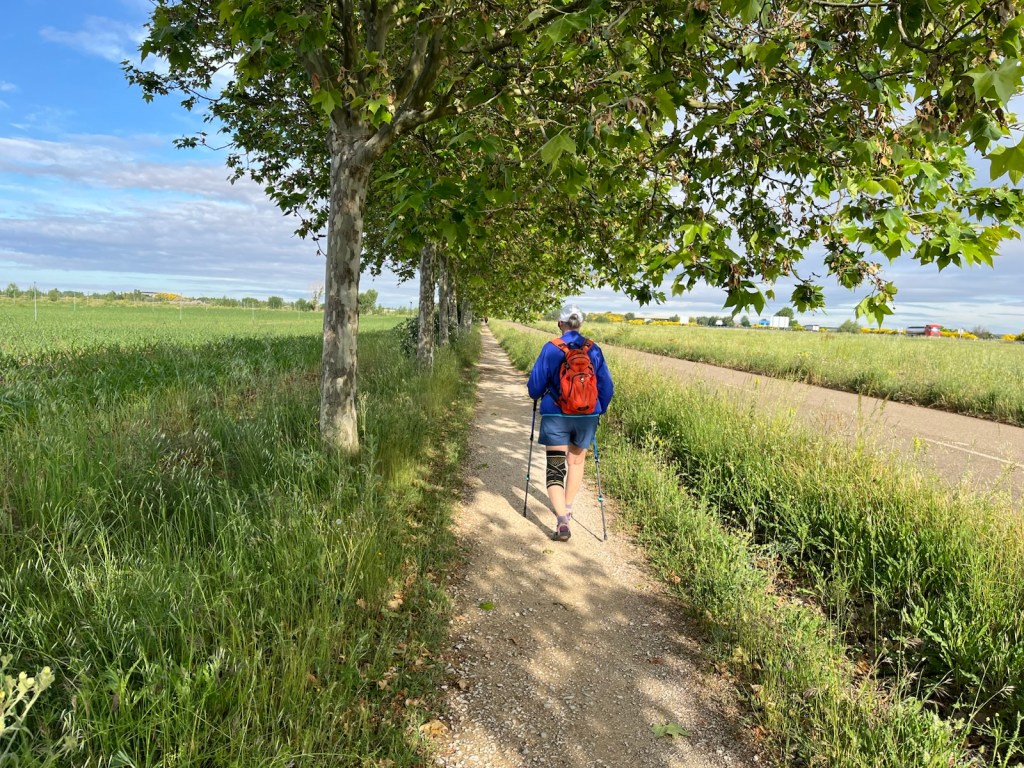
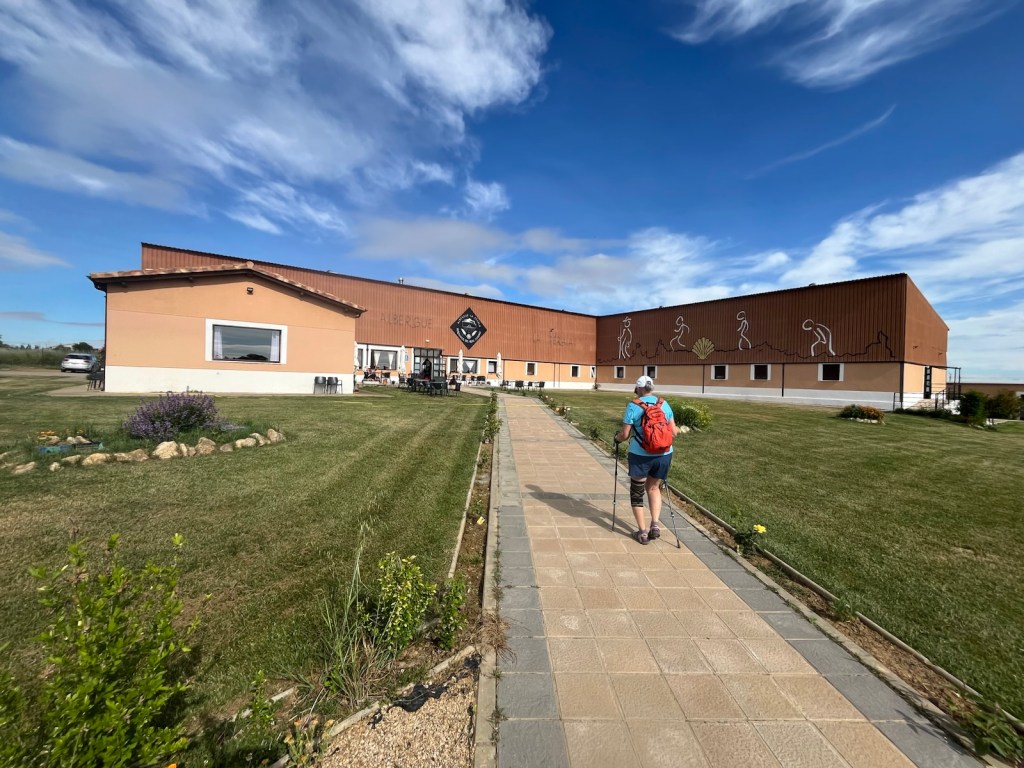
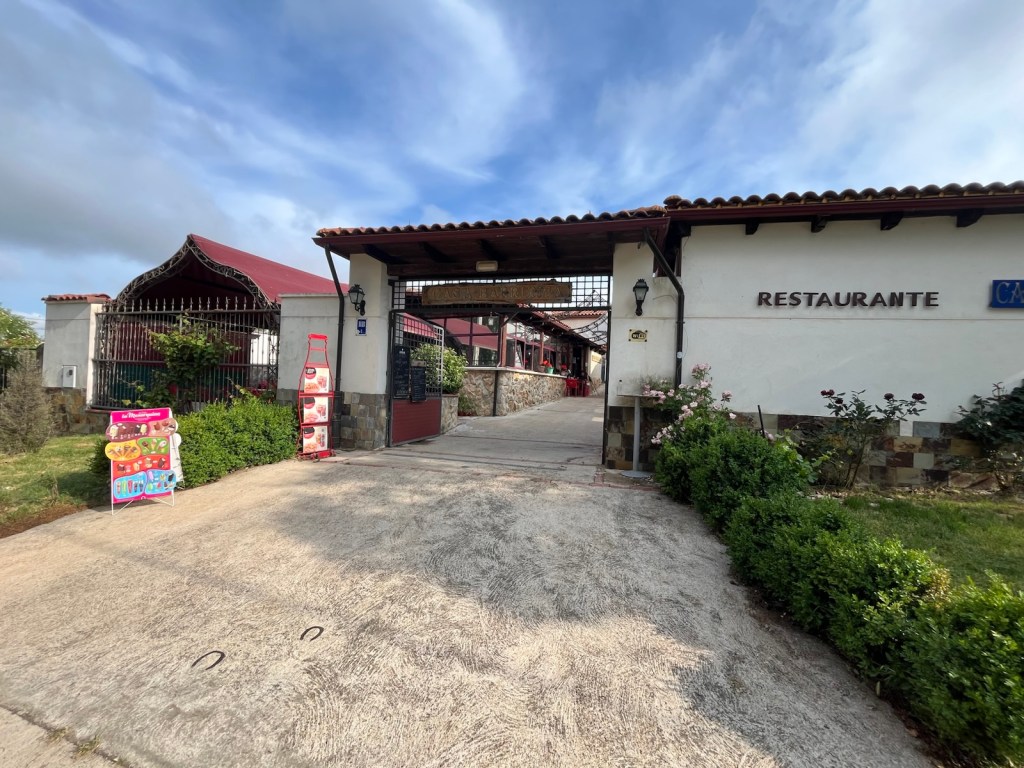
Walking along the pleasant tree-lined path.Arriving at La Perala, our 4th visit and a favorite place to stay since 2022.
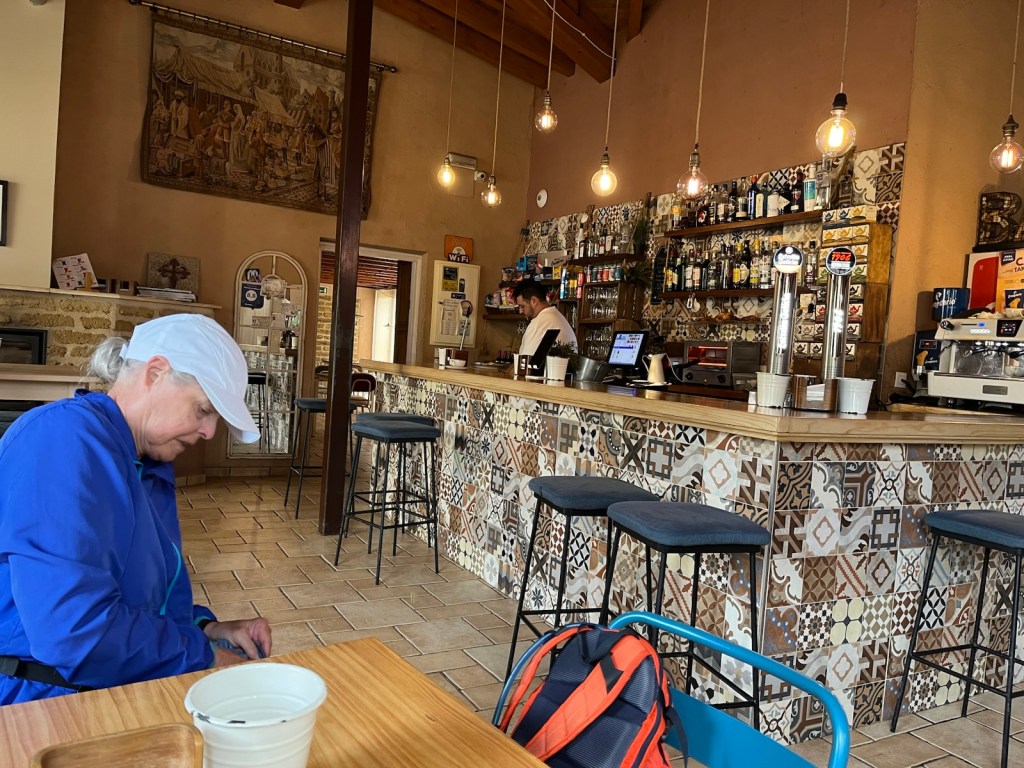
We walked into the La Perala dining area and were greeted by Bob and Cathy once again. This was their first Camino and we shared common experiences so far. They finished their snack, as we began our breakfast and we said our goodbyes once more, as we silently wondered when and where we might see them again.
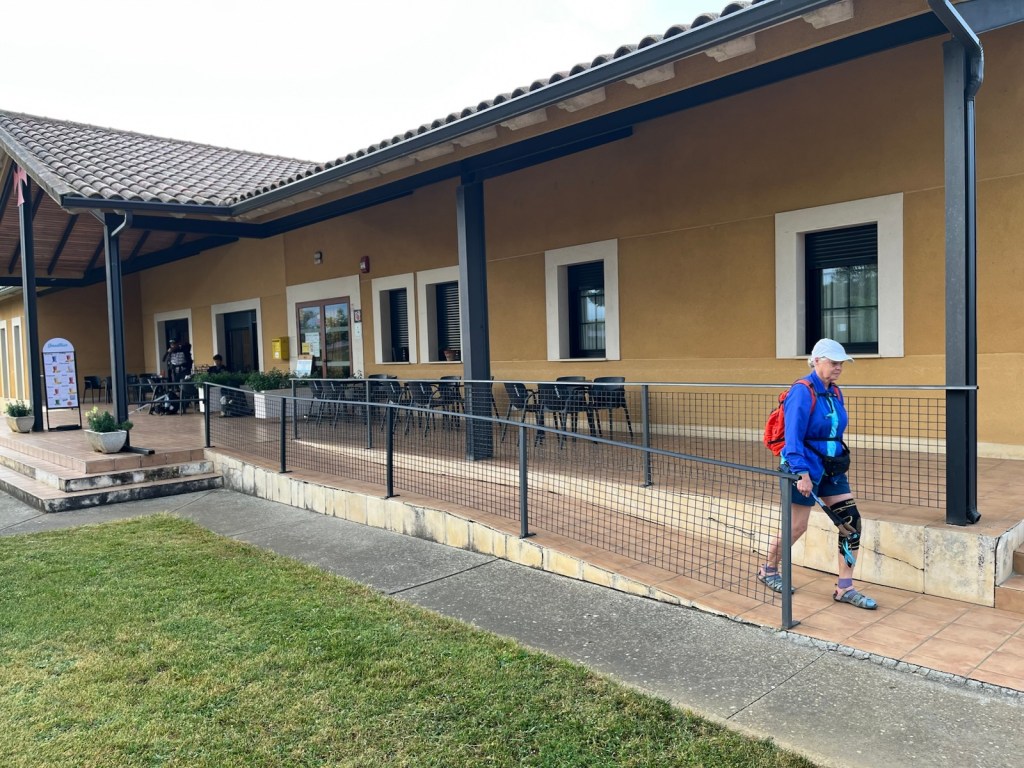
Shortly after finishing breakfast at around 11:00, a kind gentleman, who may or may not be a family member, had just begun to work at La Perala when we visited last September. He recognized Jim today and welcomed us back and began to check us in early.
Being familiar with an albergue’s routine and facilities, makes return visits much easier and La Perala is a good example.
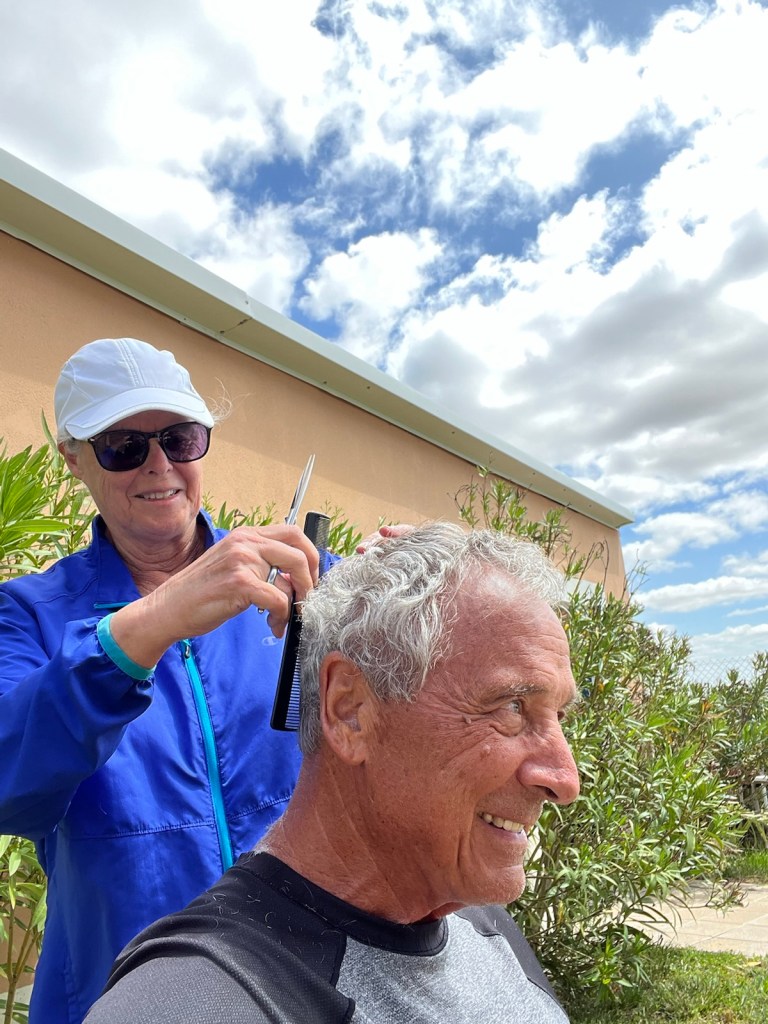
Unlike most pilgrims, Jim brought along his personal barber and took advantage of our knowledge of the La Perala layout. He set up an outdoor chair in the warm sun, inconspicuous to other pilgrims, who might form a line and tie up Linda’s afternoon.
He received a nice trim and the light breeze took care of potentially incriminating grey laced clumps of human hair.
Jim getting a much needed trim. ” Next!”
Otherwise, our afternoon was routine.
Unlike most days, we had early afternoon bocadillos and signed up for a 6:00 p.m. main meal as well.
Roasted chicken with assorted vegetables, soup, spaghetti and a local red wine (vino tinto) made for a nice dinner.
We made preparations for our walk tomorrow and got an early start on a good night’s sleep.
We left Albergue Los Templarios at 7:30 this morning and walked through Terradillos de los Templarios (pop. 78).An interesting piece of artwork adjacent to the 13th century Knights Templar church of Iglesia de San Pedro.
Iglesia de San Pedro contains a Gothic crucifix but is rarely open. The church is built of brick rather than stone, as this area has very little local stone. The Knights Templar were a medieval military order responsible for protecting pilgrims. While the order was popular and successful for almost 200 years, grand master Jacques de Molay was arrested in 1307 (on Friday the 13th, possibly the origin of this superstitious date) and burned at the stake for heresy and a variety of trumped-up charges. The order was disbanded in disgrace, though many think the charges had more to do with politics than any actual wrongdoing.
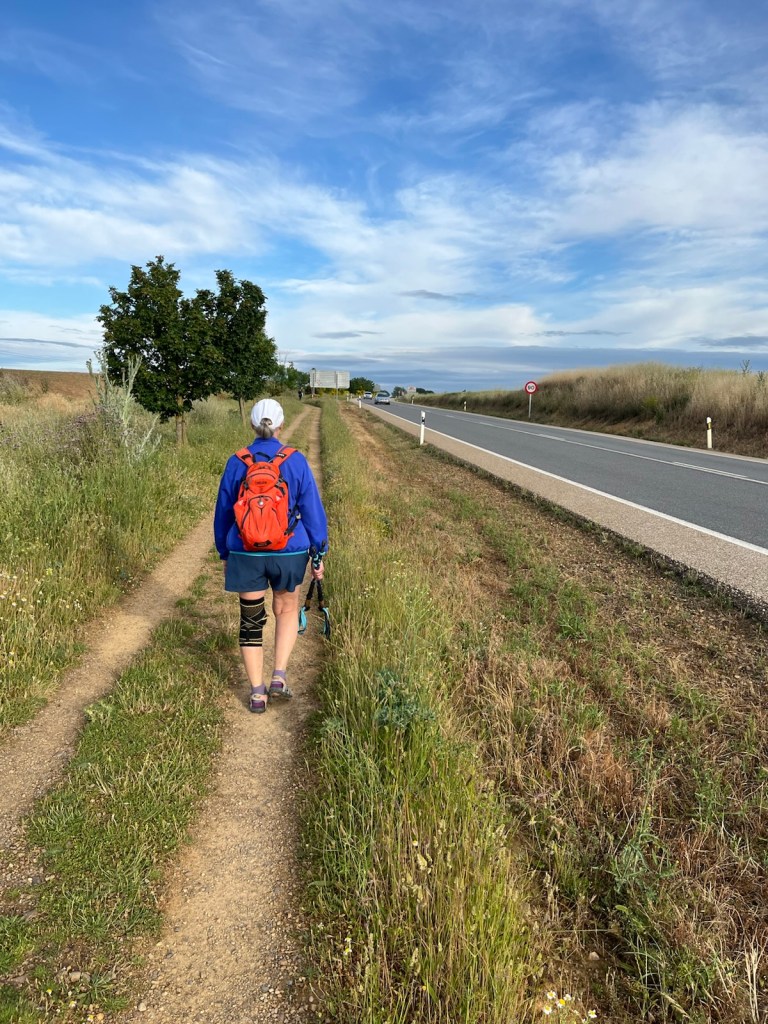
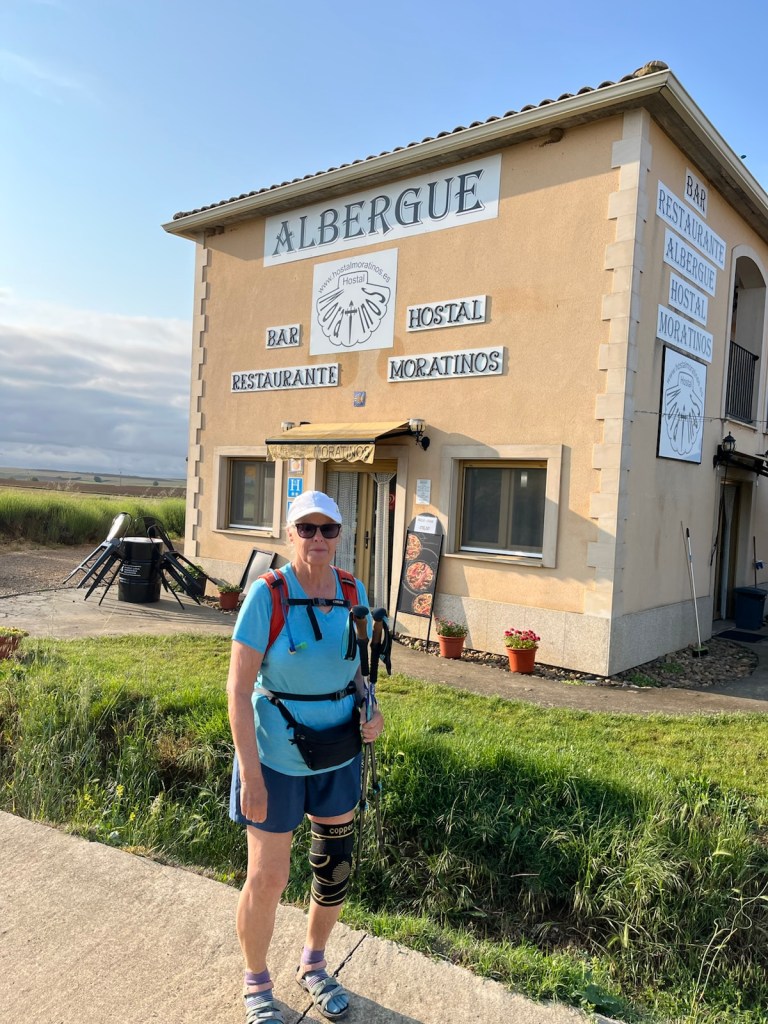
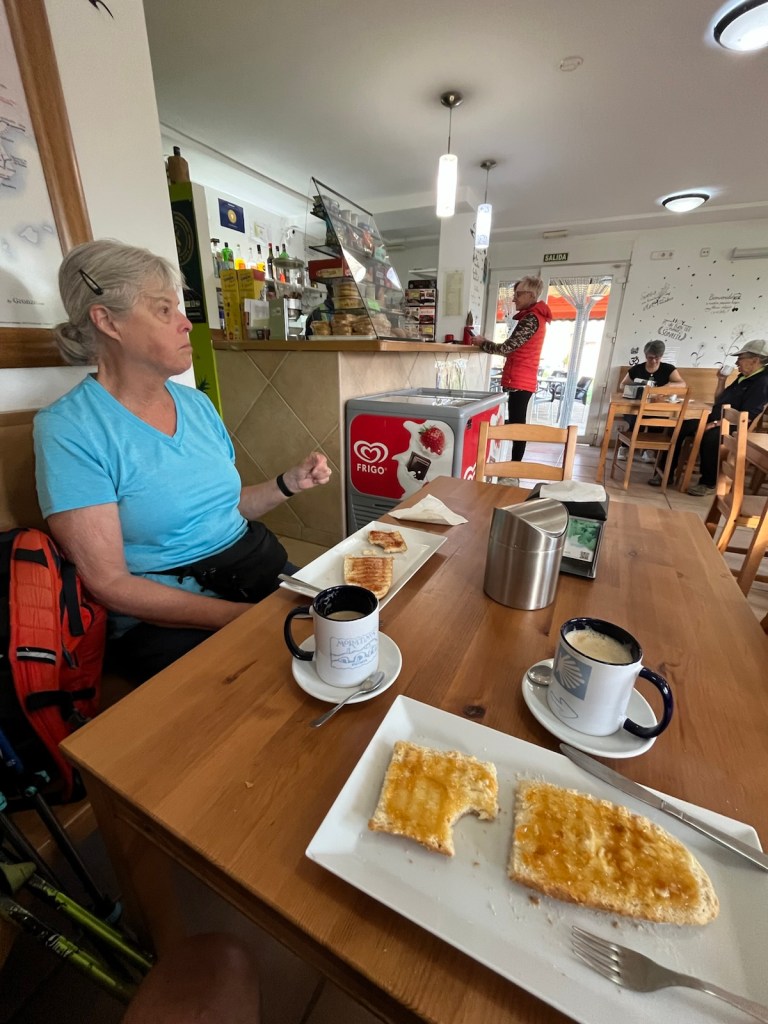
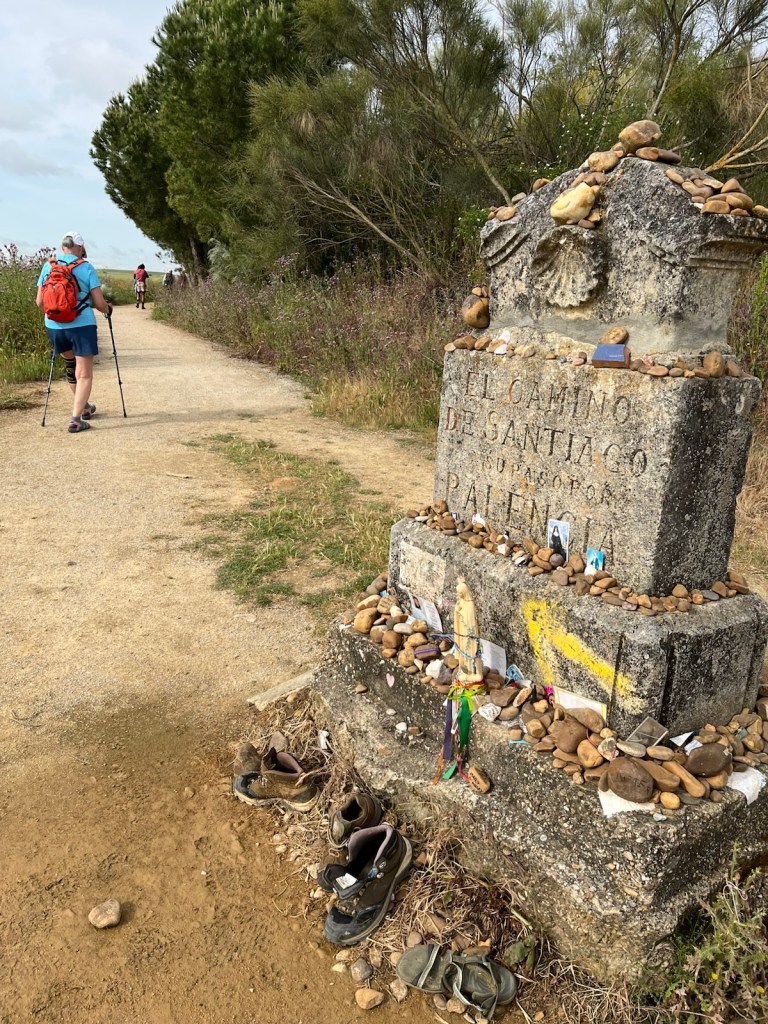
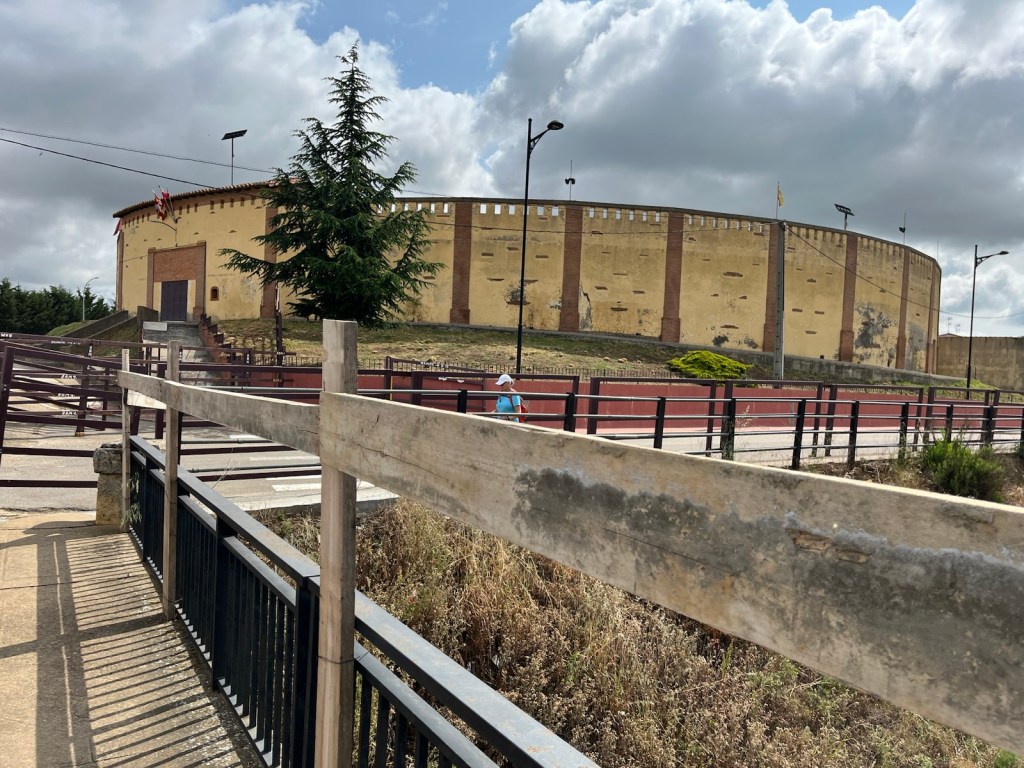
The path initially took us through grain fields, far enough away to not see or hear vehicle traffic.The path joined a small paved road.We walked less than a mile on the paved road, which we shared momentarily with a large truck…… then returned to the dirt path.We made our first stop in Moratinos for breakfast.A favorite stop, when it’s open!We continued walking past the 16th century Iglesia Parroquial de San Tomás, which is also never open to see inside.Pretty scenery on the way to San Nicolás de Real Camino.We stopped here for orange juice and a rest stop.The Iglesia de San Nicolás de Bari was also under Knights Templar control until the late 12th century and is always locked up tight.Adjacent to Iglesia San Nicolás de Bari is Albergue “Laganares” where we stayed on our first Camino in 2014.The Spanish Broom formed an effective barrier from most of busy highway running parallel to the final 4 miles into Sahagún.Walking past the historic monument as we left Palencia and entered Castilla and Leon.The dirt path ran parallel to the highway into SahagúnThe Camino path crossed the highway and continued through a small park including Ermita Virgen del Puente. We continued walking along the highway to cut our walking distance by a half-mile going directly into Sahagún.Going ” our” wayOn “our” shortcut into SahagúnWork was underway to build barriers throughout the town to control the bull runs for the upcoming festival (11-14 June) as we crossed the train tracks into Sahagún.
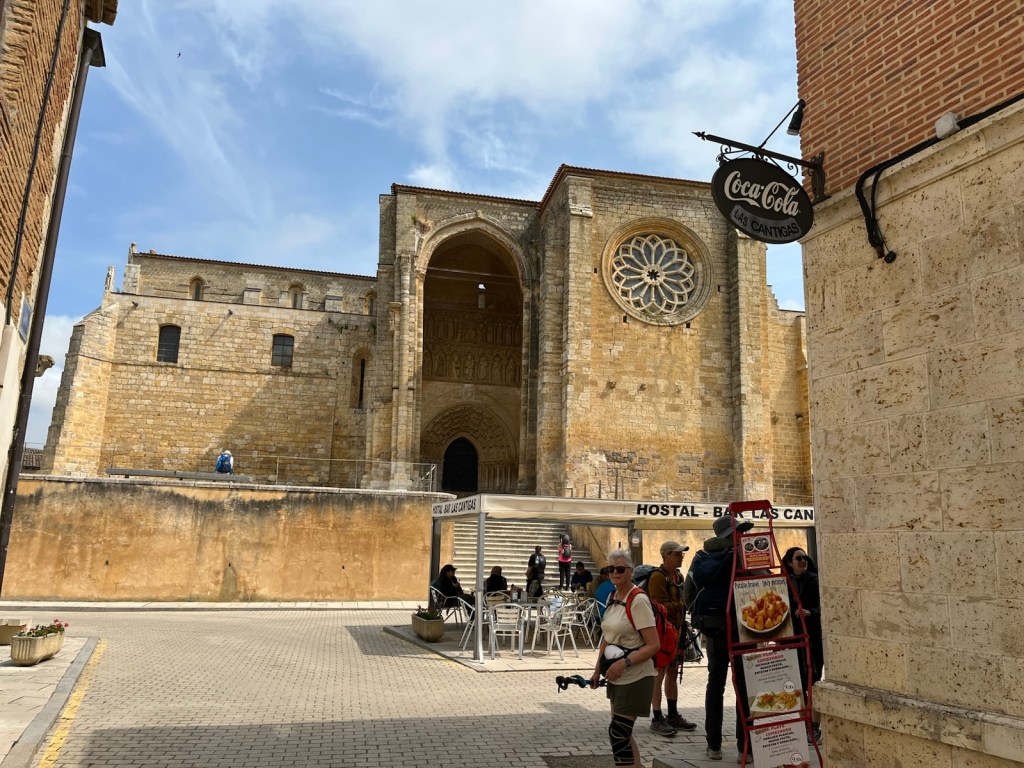
Looking at Sahagún today you would never guess its great significance in medieval times, second in the kingdom of León only to León city. King Alfonso VI was educated in Sahagún and sought refuge there while warring with his brother and richly rewarded the city when he emerged victorious. He invited the Benedictines of Cluny to run the monastery, and the city became a center of Cluniac development. The city thrived with a diverse populace including Muslims and Jews. Sahagún’s historic architecture illustrates the Romanesque-Mudéjar style, which incorporated Islamic decorative motifs and was built primarily out of brick rather than stone.
We were able to checkin immediately upon arrival at Hostal San Juan at 11:30.
After settling in our room, Jim ventured out to restock our snack supply and scout out options for our main meal.
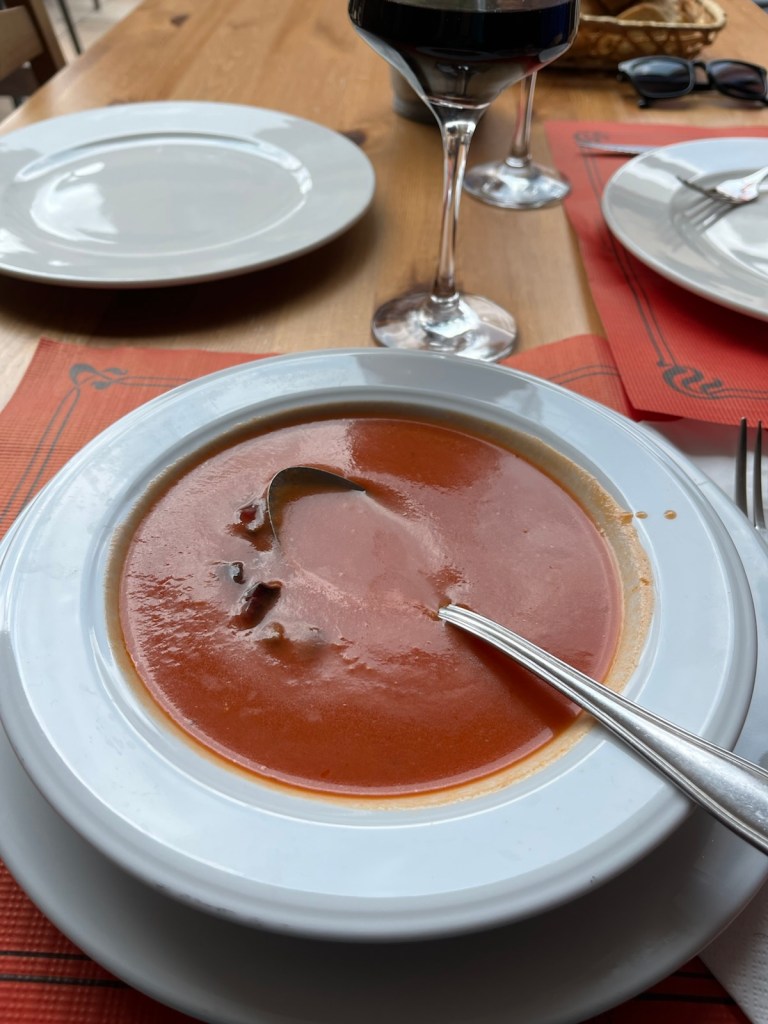
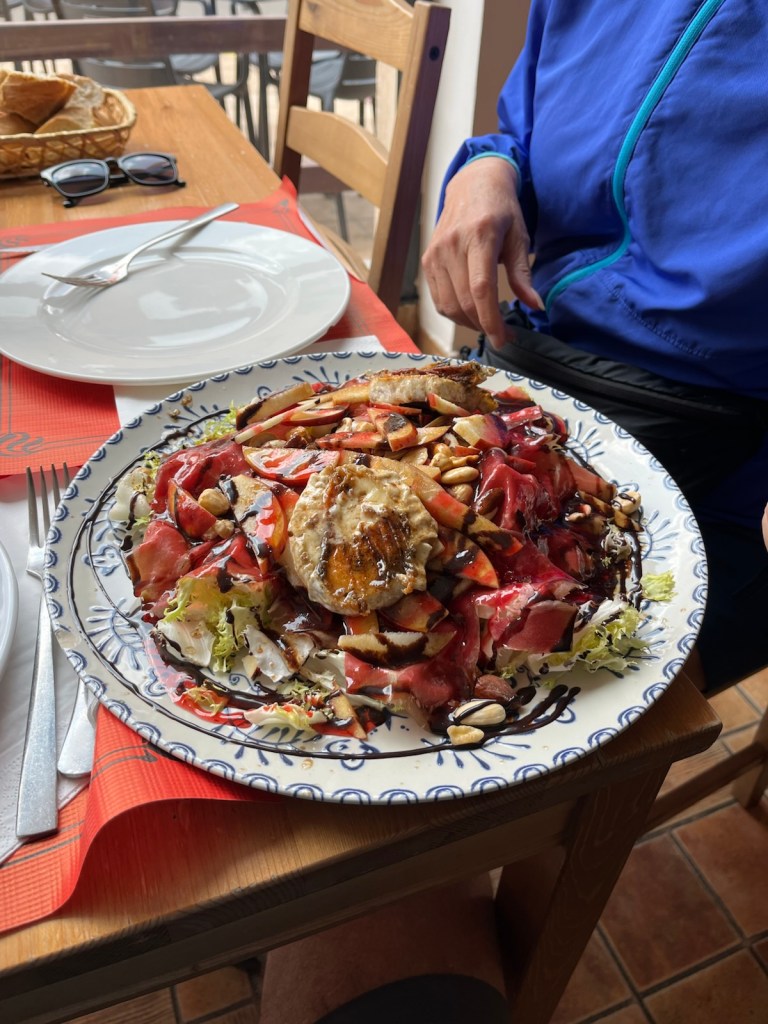
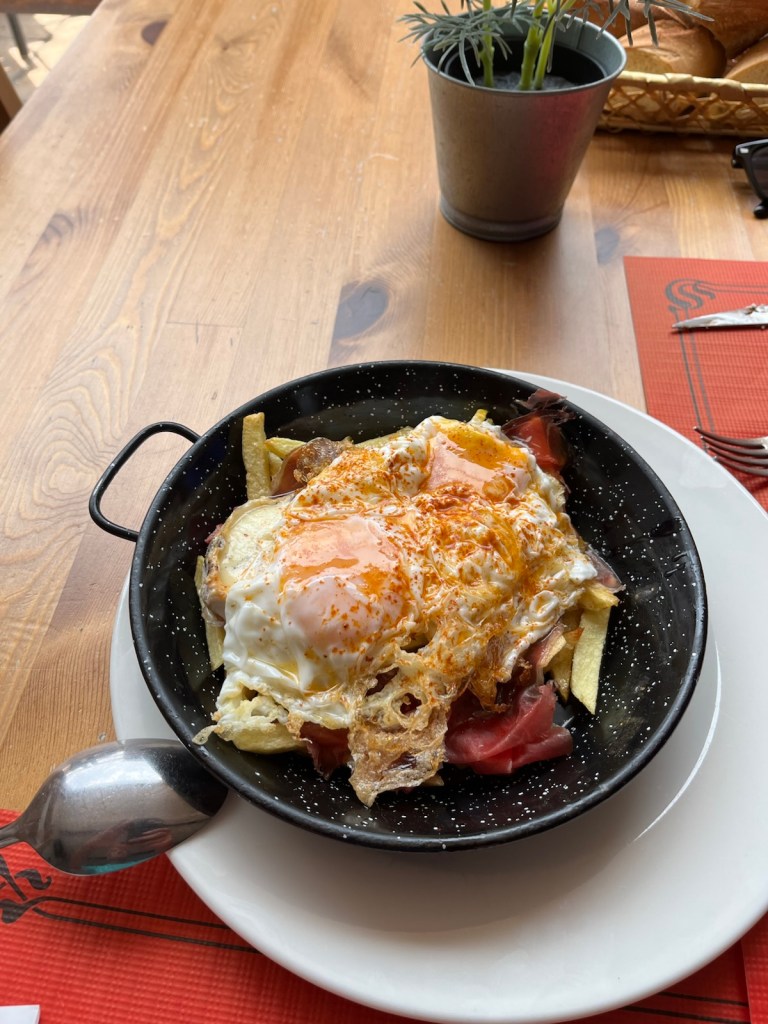
Our choice for lunch turned out to be a good one. Jim had gazpacho and he and Linda selected two different dishes to share.
Jim’s gazpacho was “muy sabroso” (very tasty).We shared this salad of fresh lettuce, assorted nuts, dried fruits, very thin sliced ham, grilled goat cheese generously drizzled with a rich balsamic house dressing.This dish included two fried eggs over easy, over very thin sliced ham over grilled goat cheese and french fries. This is definitely a dish we will make back home.
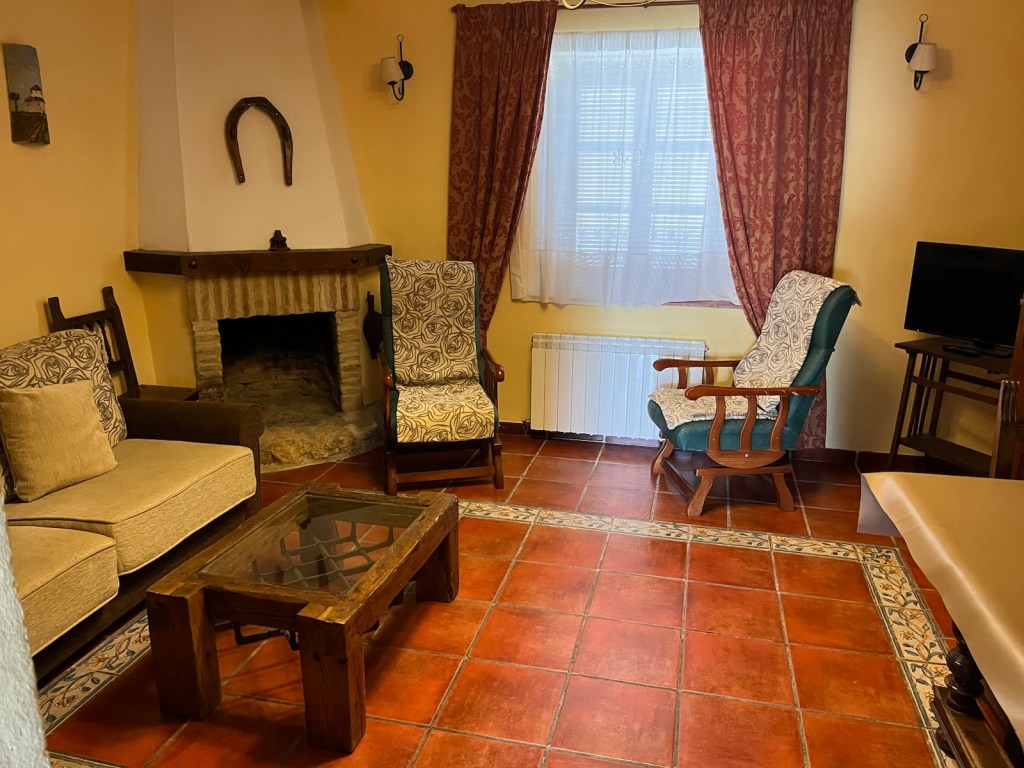
Our room includes a variety of supplies to make breakfast and/or sandwiches and including hot drinks and juices. A shared for guests kitchen includes all the ingredients and appliances to make your own at your convenience throughout the day.
After recovering from our walk, savoring our lunch and completing our “daily duties”, we hung out in our room or the shared kitchen to complete our day in Sahagún.
As in recent Caminos, this morning we rode a taxi to a small village west of Carrion de los Condes. This allowed us to avoid a stretch of 10 miles or so, without services, little or no shade and uninteresting terrain and scenery. Walking it again would not add to our Camino experiences, so we skipped it.
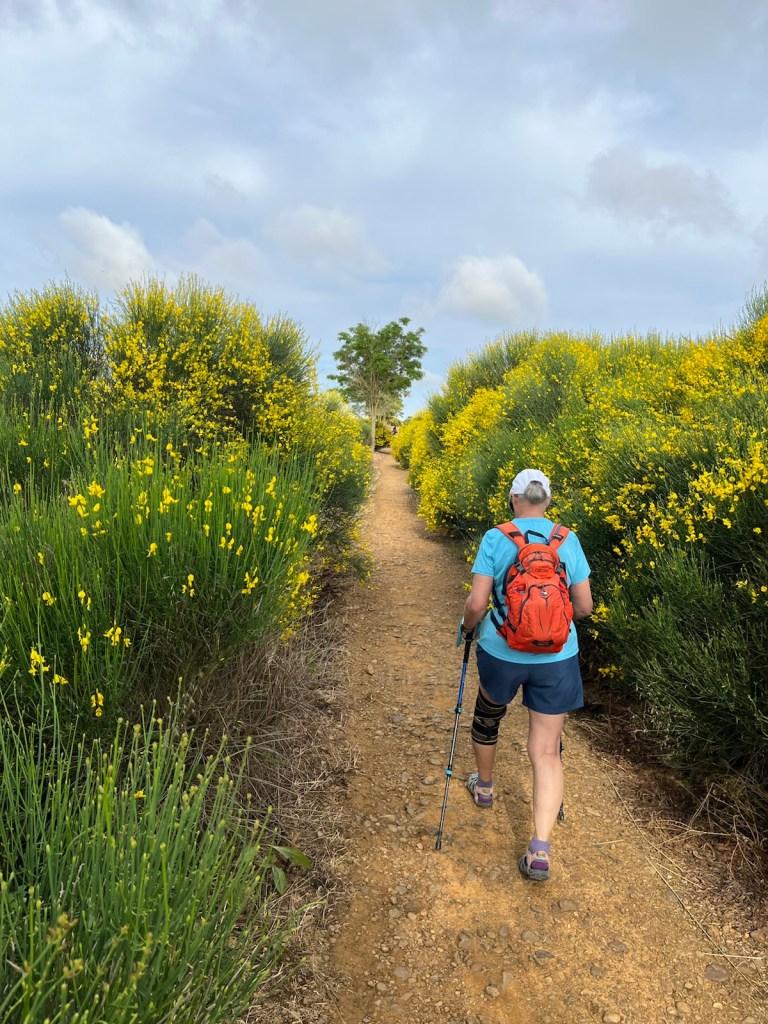
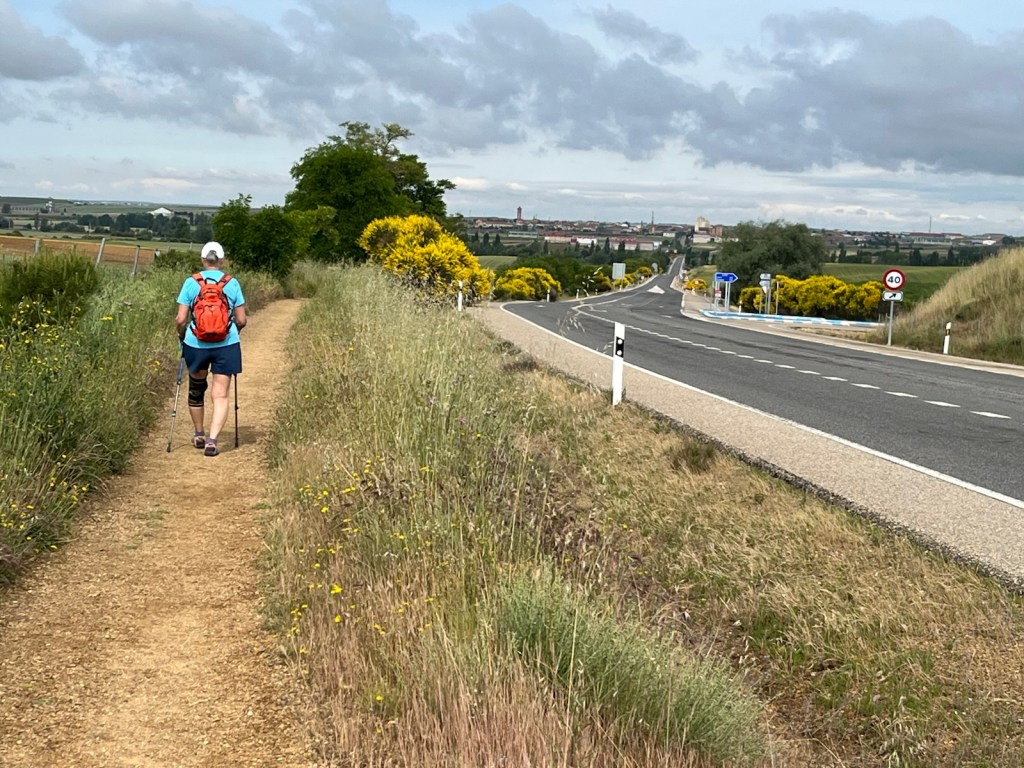
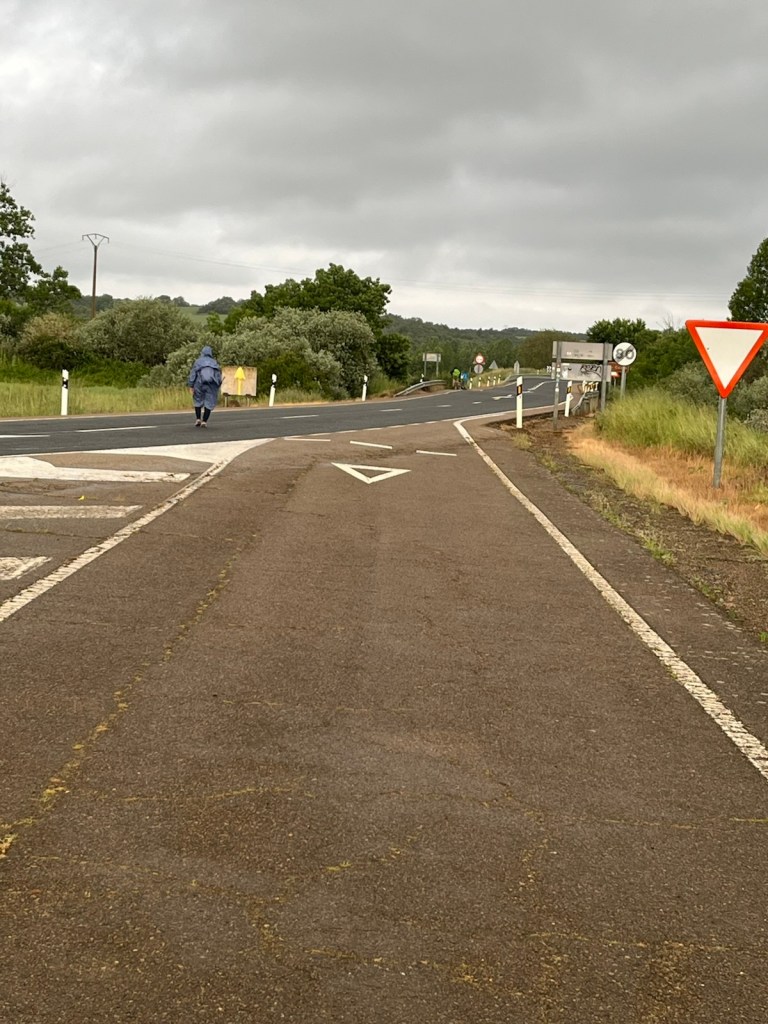
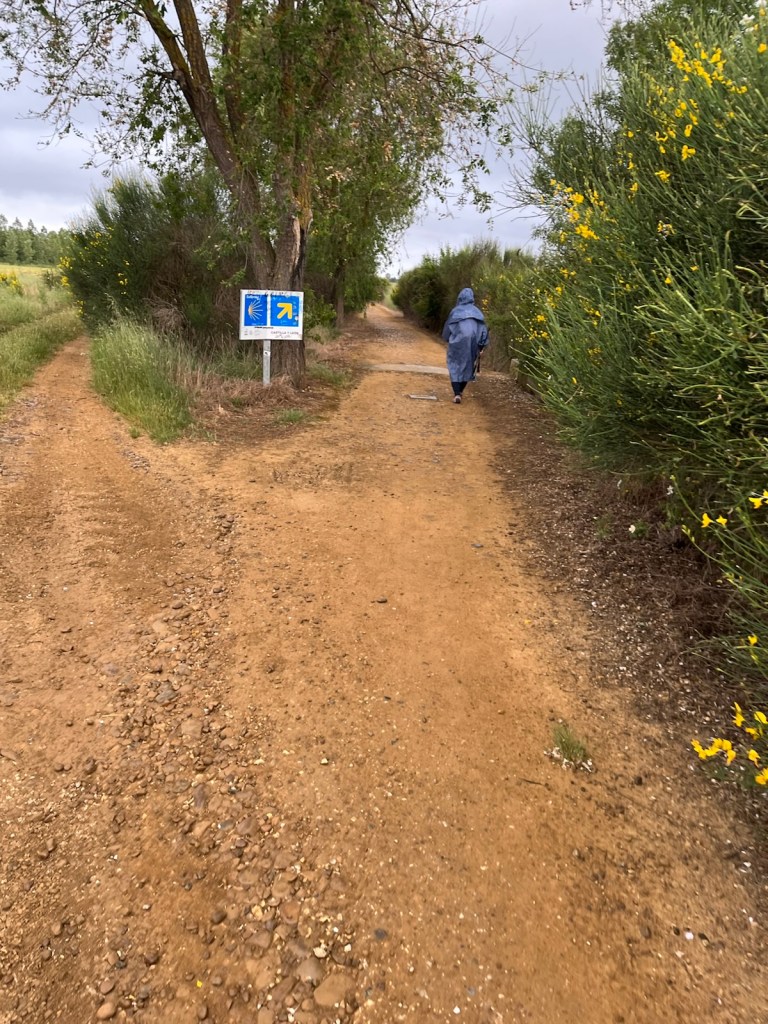
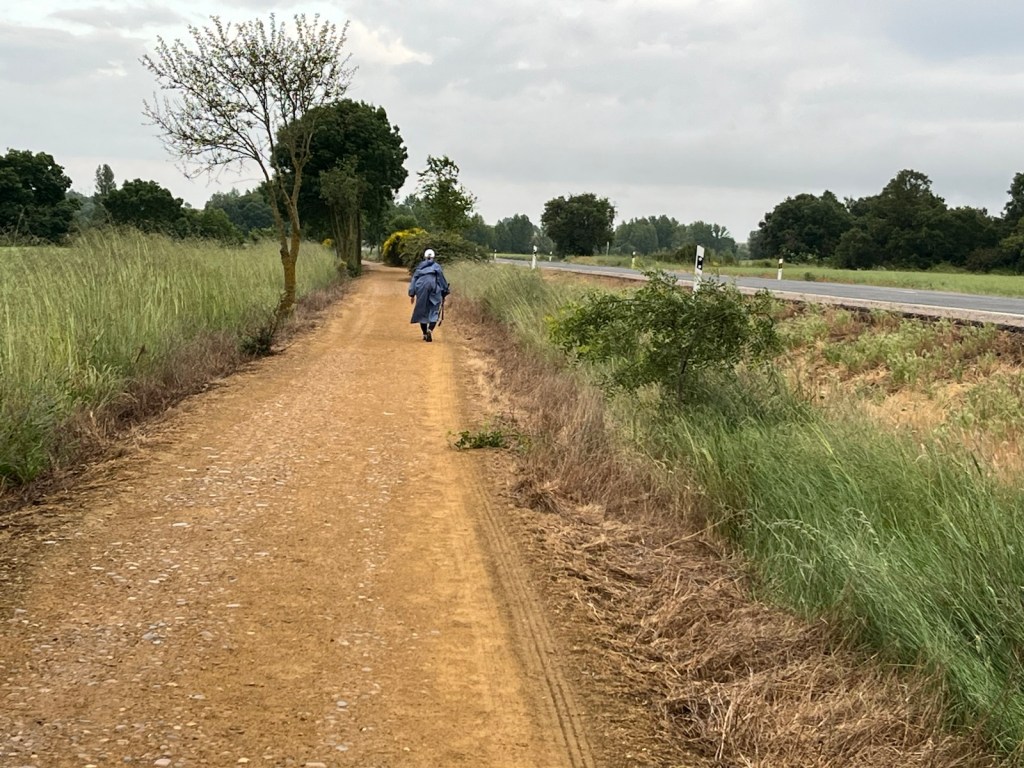
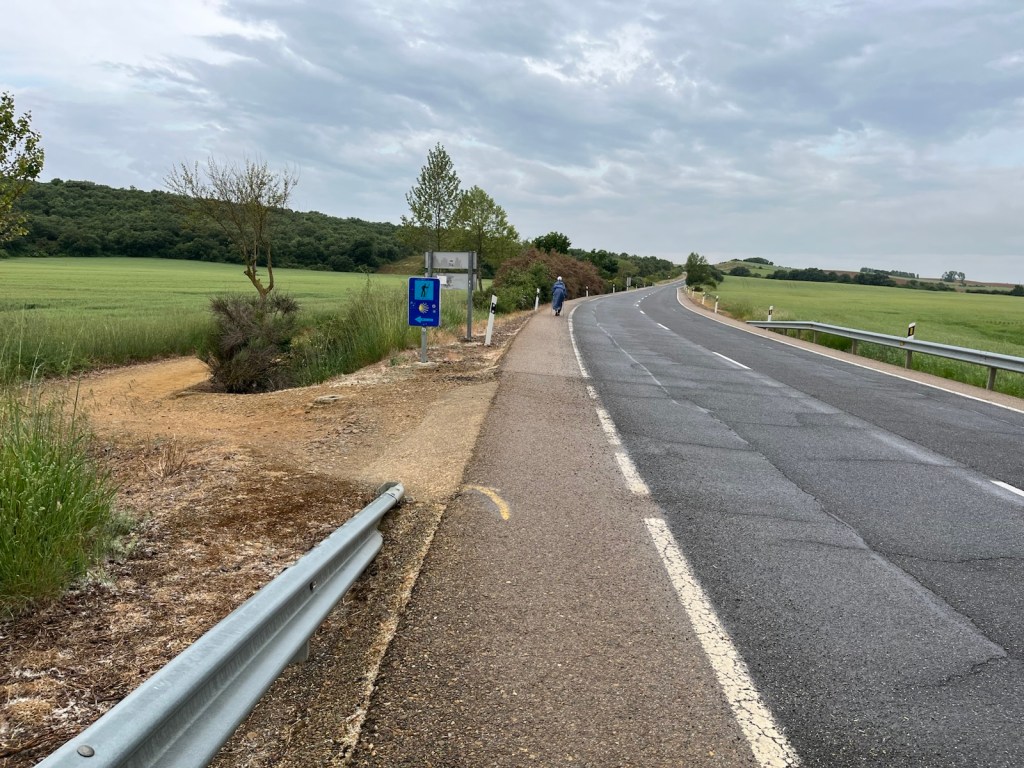
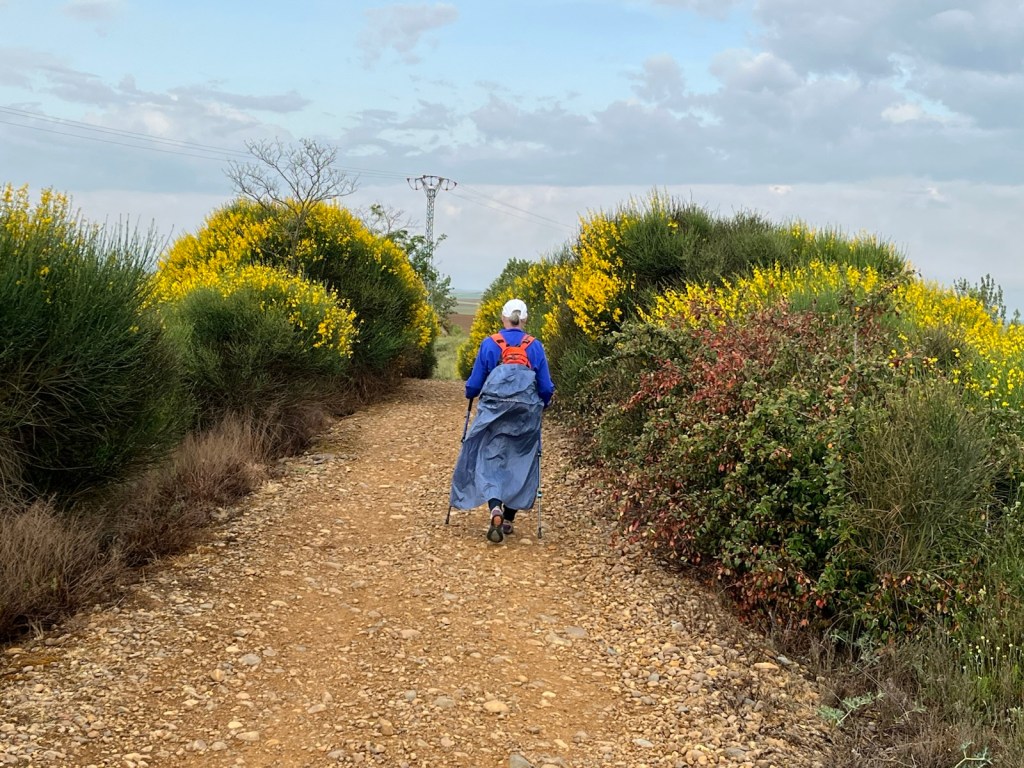
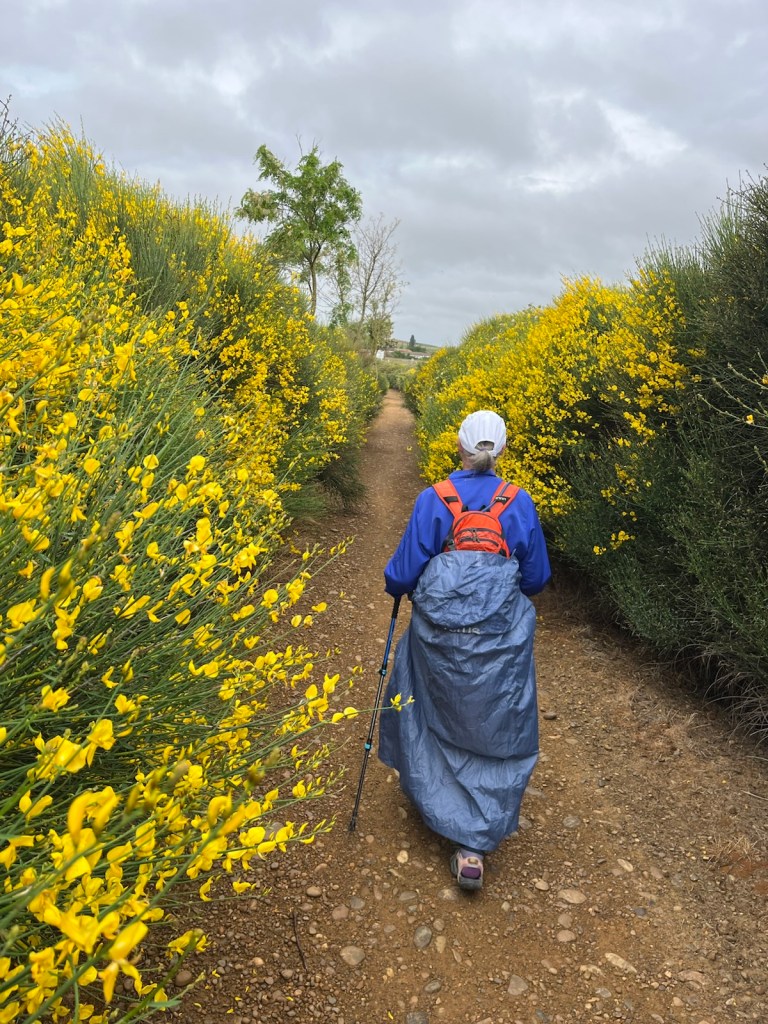
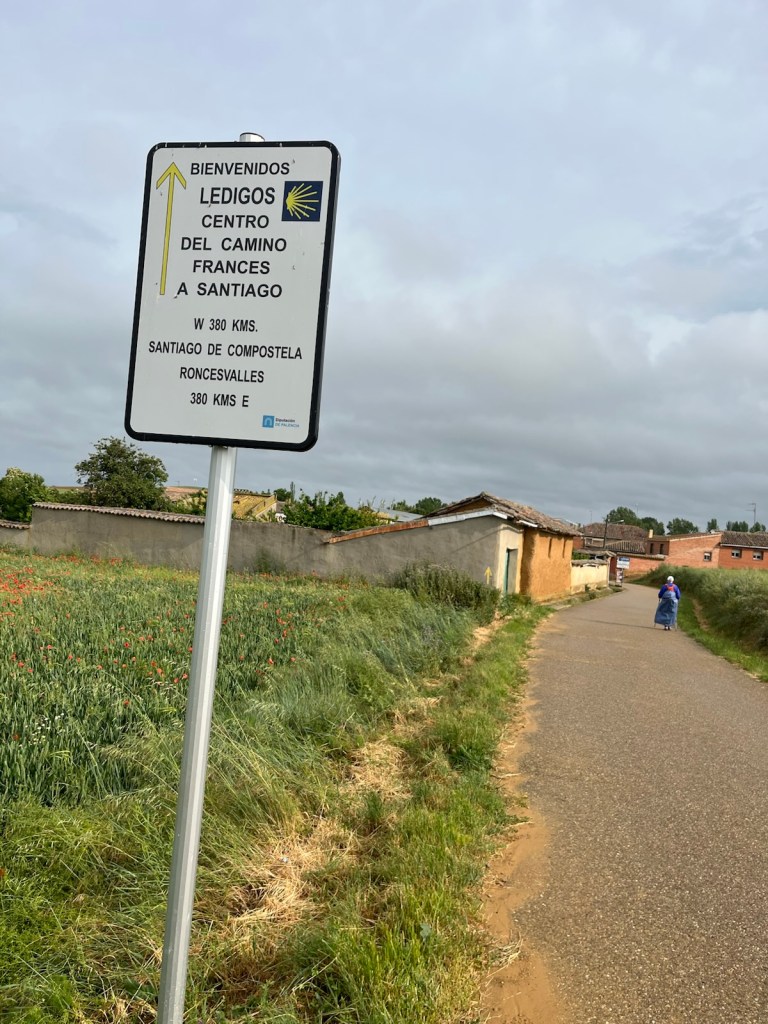
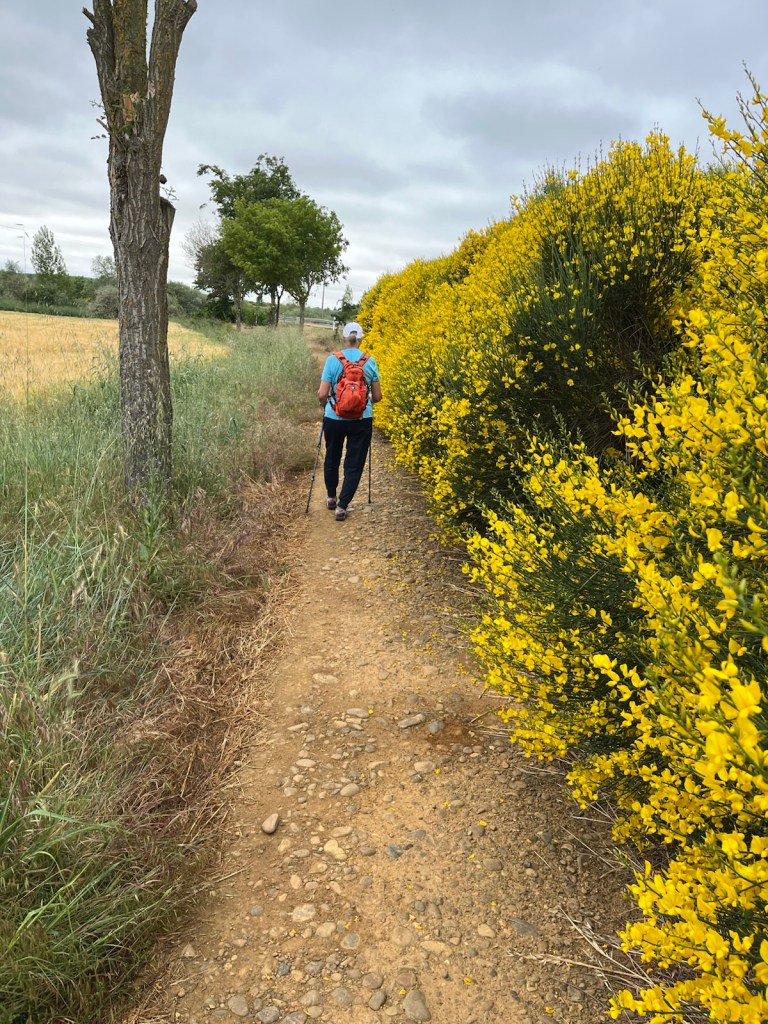
It began to rain just as the taxi dropped us off at the edge of Calzadilla de la CuezaThe light rain only lasted a few minutes allowing us to remove our ponchos for the rest of today’s walk.Today’s walk paralleled the N-120 national highway. Only a handful of cars passed by and we saw fewer bikes and pilgrims.From past experience, for this 2 mile section of today’s walk, the dirt path unnecessarily goes up and down while the paved road has a gradual incline, has a wide shoulder and the auto/truck traffic is minuscule. So we walked most of the way on the shoulder not the dirt path.We got back on the dirt path just before Ledigos. The path was naturally decorated with wildflowers.The Camino path maneuvered around a sharp turn in the paved road and we followed.More flowers. This variety of wildflower is not only a vibrant yellow but it has a delightful fragrance.We crossed the road and walked into Ledigos.Walking into Ledigos (pop. 74) we saw this sign, indicating we were near the halfway point to Santiago.We stopped at Bar/Albergue La Morena for breakfast.Our cafe con leche was also a work of art!The beautiful yellow wildflowers formed a wall between us and the paved road for most of the remaining 2 mile walk to Terradillos de los Templarios.
Blogger’s note:
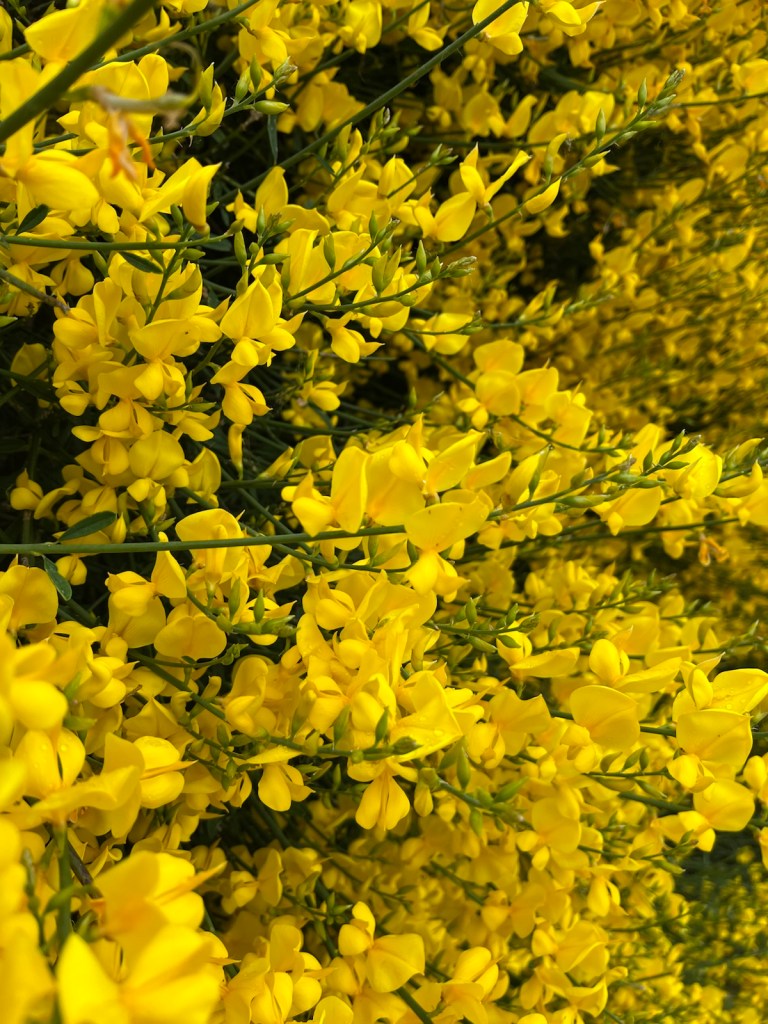
I looked up the yellow species and determined it is called “Spanish Broom”.
Close up of Spanish Bloom
The broom is a small wild shrub that reveals golden yellow flowers… as fragrant as they are poisonous! (TOXIC to humans and pets!!) The plant has hallucinogenic properties that feed many legends. In perfumery, a broom absolute is extracted with deliciously bitter and honeyed notes. This delicate material also evokes the scent of orange blossom, with undertones of tobacco and lime.
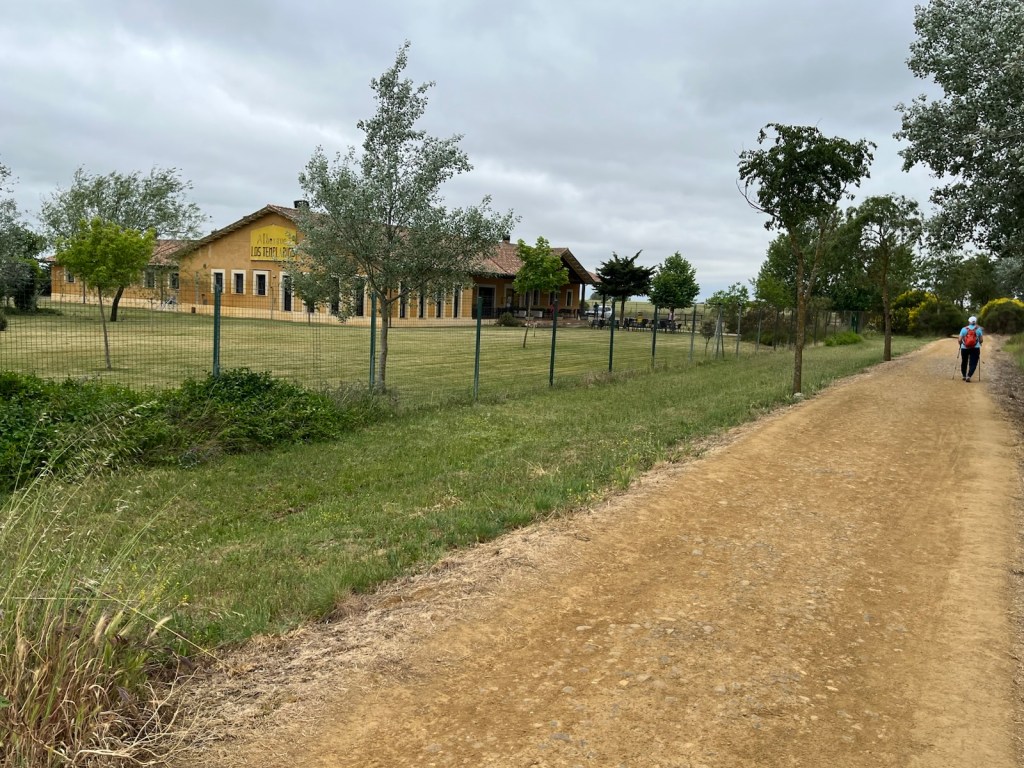
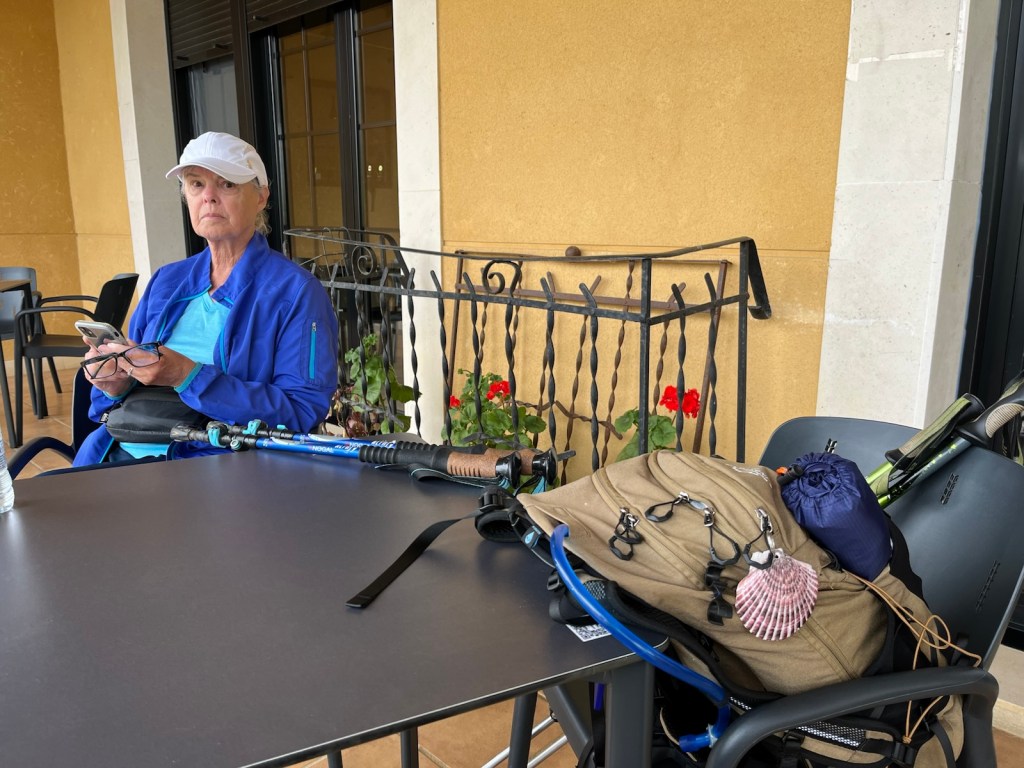
Albergue Los TemplariosHaving arrived too early for the noon check-in, we made ourselves comfortable, on the front porch until 11:45, when Nuria, one of the owners recognized us (this is our 4 consecutive visit) and invited us in!
We love the staff of Los Templarios. Last year we caught a 24 hr GI virus that was running through the Camino. Jim got it first and we thought it might be food poisoning from two days earlier. Linda got sick when we were here. We asked Nuria if we could stay until noon the next day, well past the 8:30 checkout. She said no problem, explained the Camino and the school children were all catching it and she called a taxi to take us to our next destination as Linda needed to rest and not walk. She was genuinely concerned for us and went the extra mile to help.
Today when we arrived, our plan was to wash all our clothing, but rain and no sun was in the forecast. Nuria gave us a small basket and said to put our dirty clothes in it and she would take care if it.
When Jim stopped by the reception before dinner to check on the clothes, Nuria handed him the basket, that had been transformed into clean, dry, nicely folded clothing. And she would not allow Jim to pay for it! This is one of several accommodations on the Camino Frances that treats us like family and makes us want to return year after year.
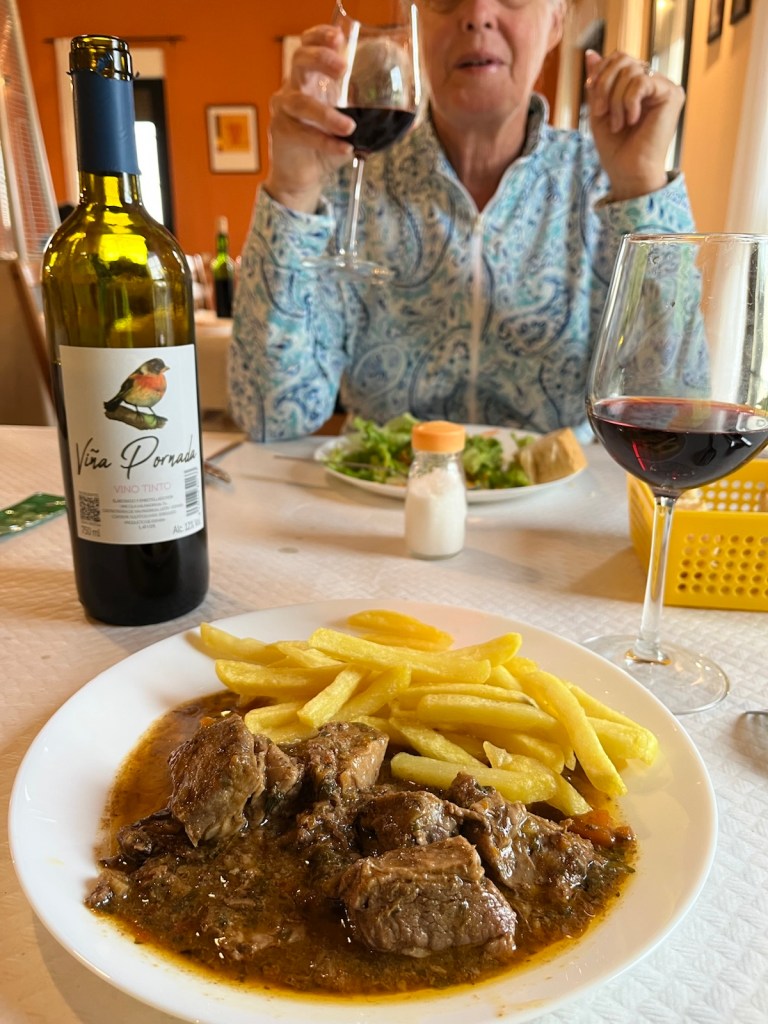
Our wet, dirty clothes transformed into clean, dry, folded garments by our gracious host.Linda opted for an ensalada mixta only for dinner. Jim also had the salad but added Carne Guisada, a slow cooked, tasty beef in gravy. A nice local wine complimented our meal which topped off a delightful day on the Camino.
We settled our bill said our goodbyes to Nuria and retired to our room for the evening.
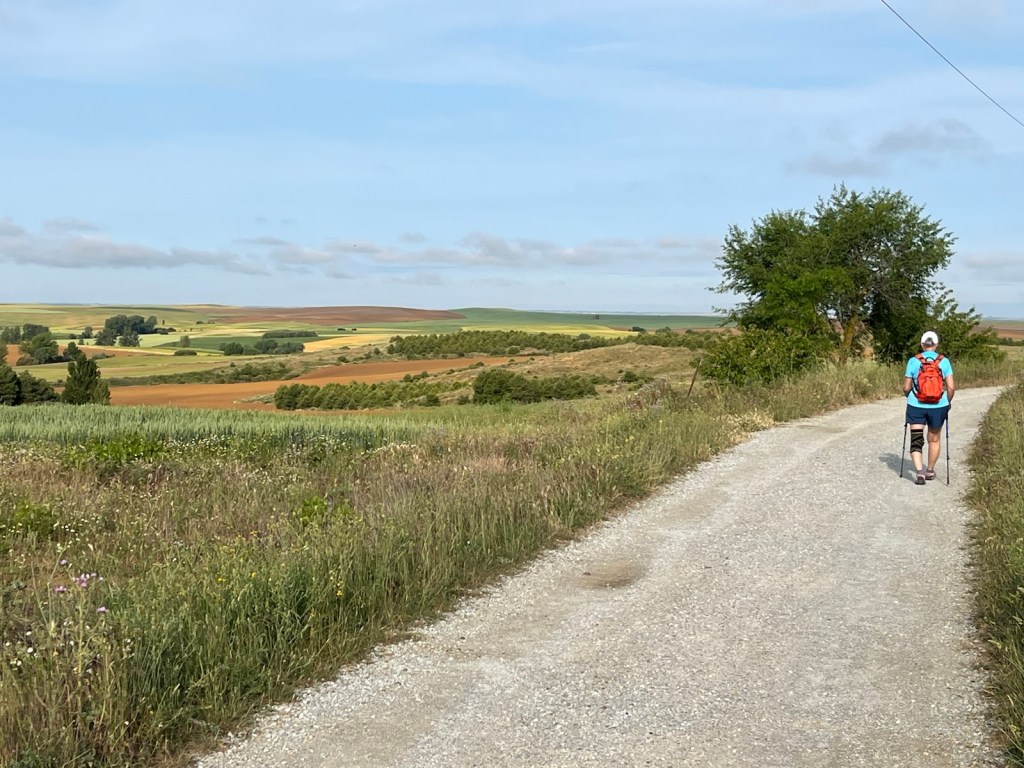
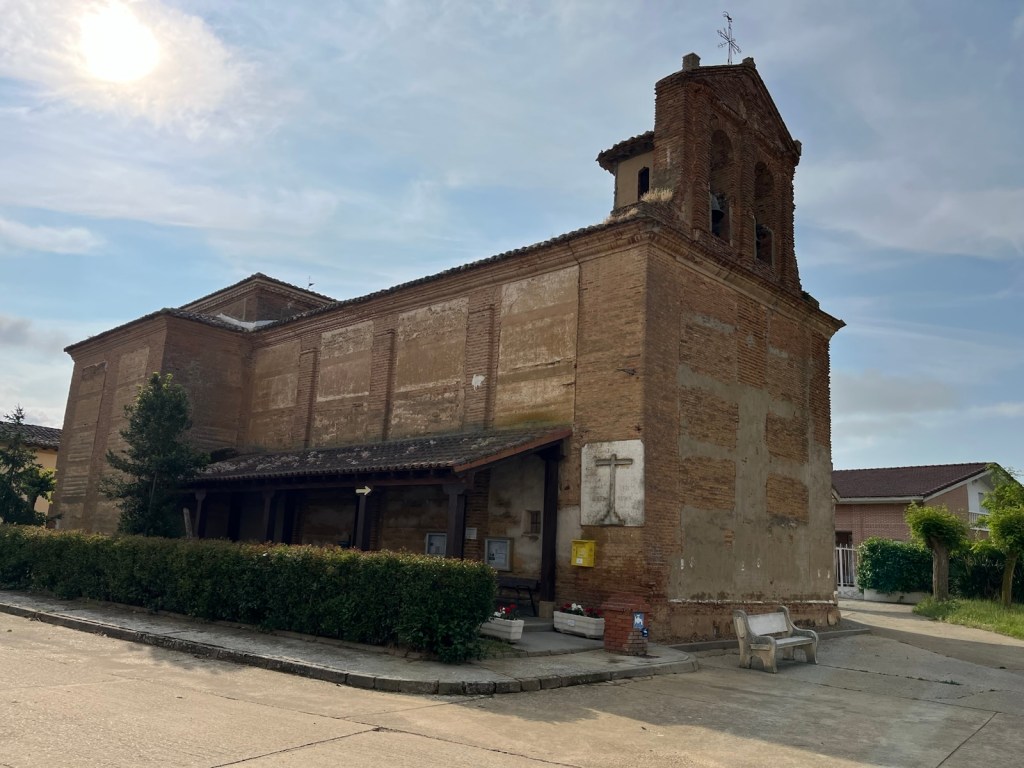
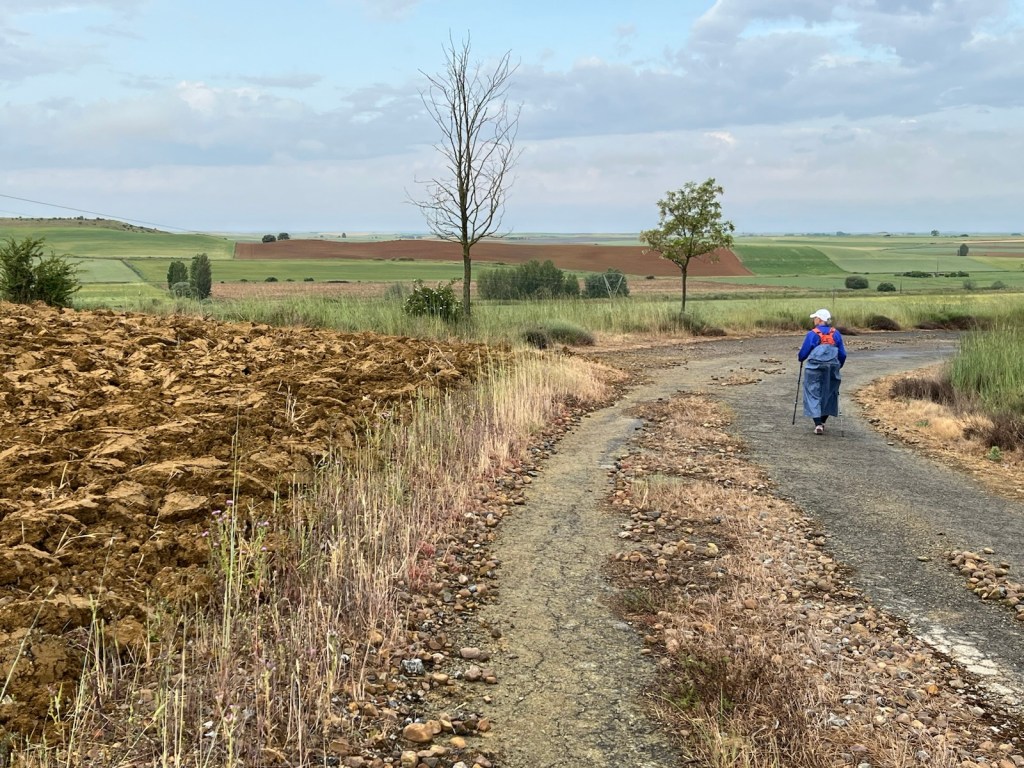
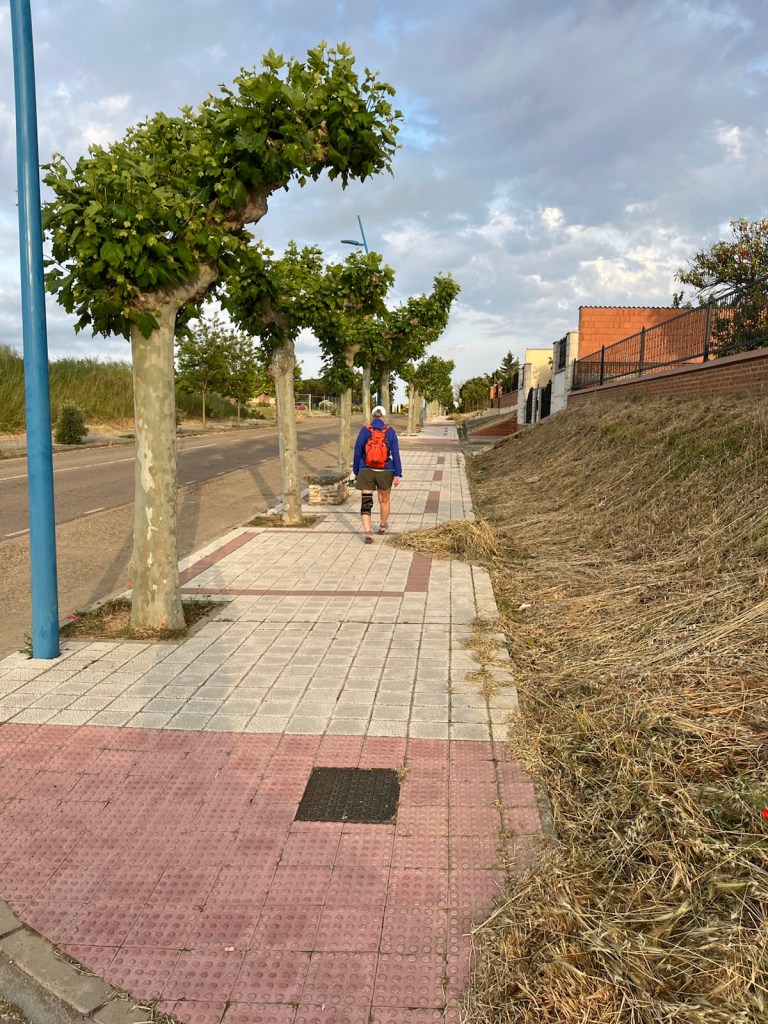
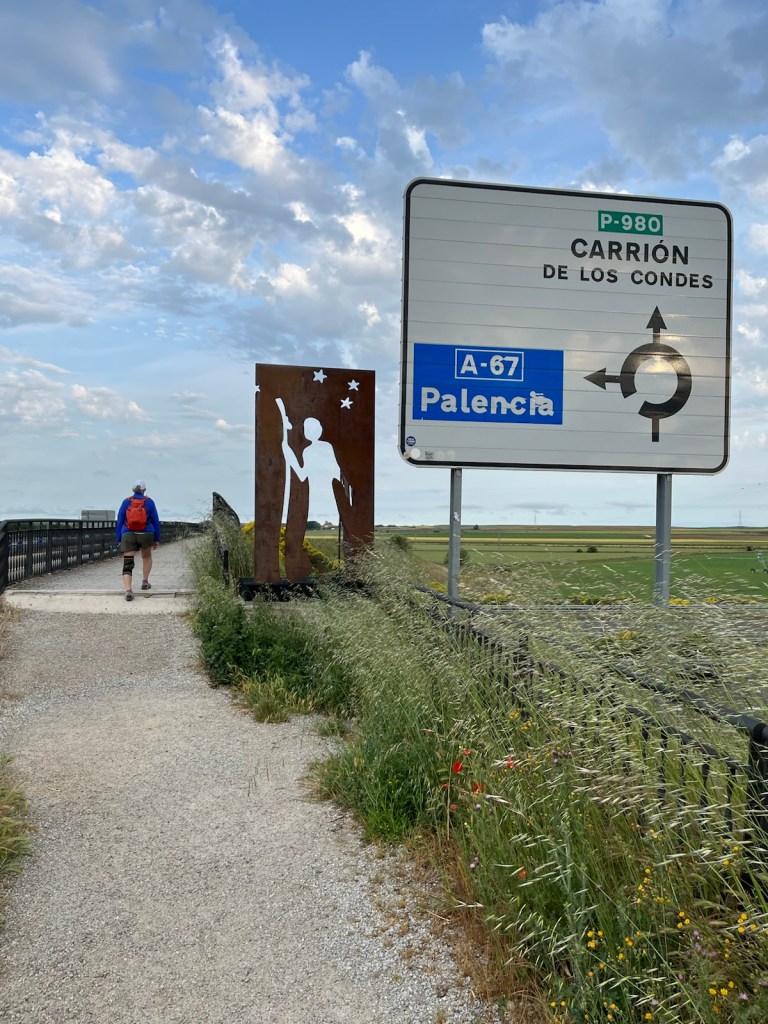
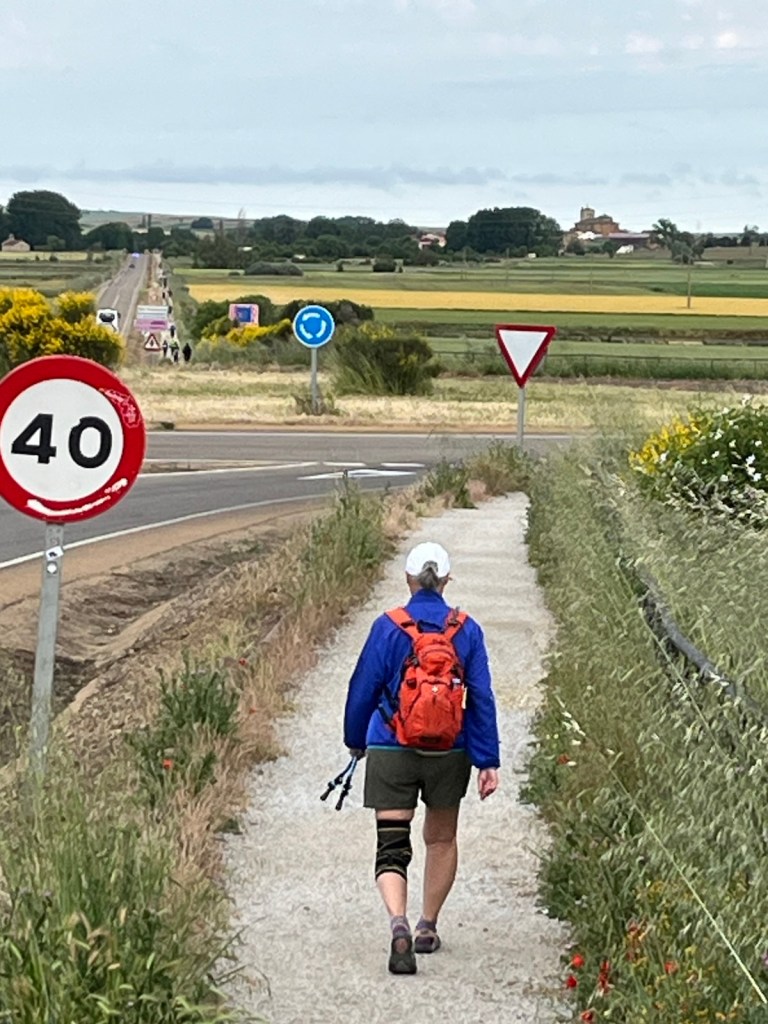
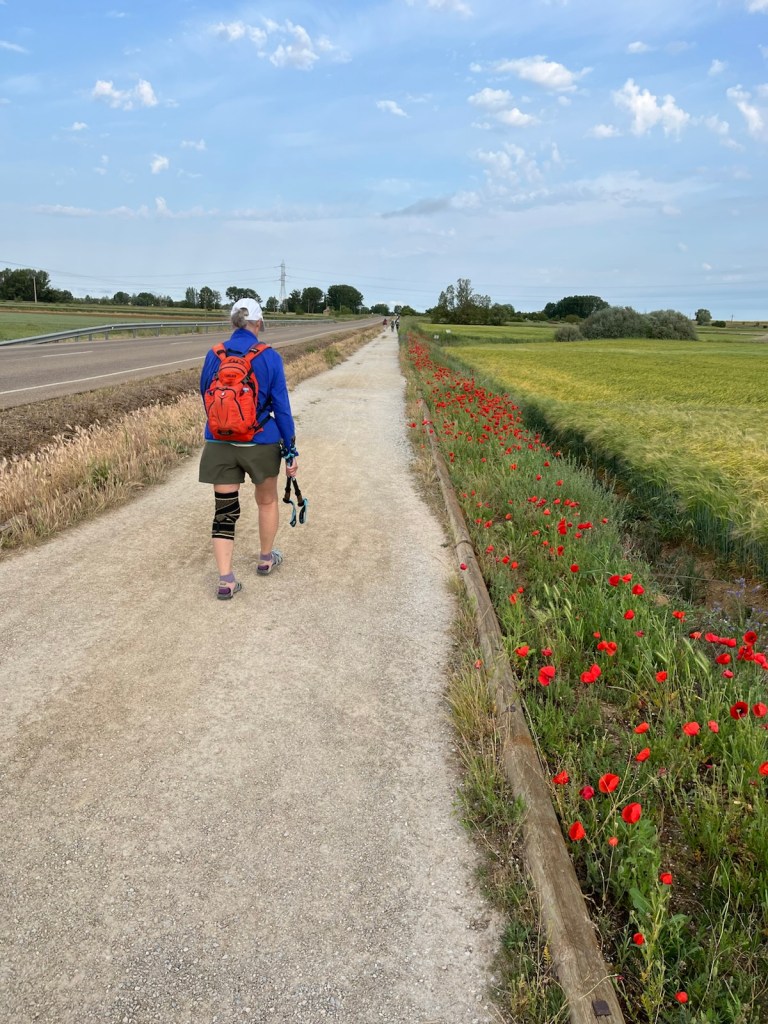
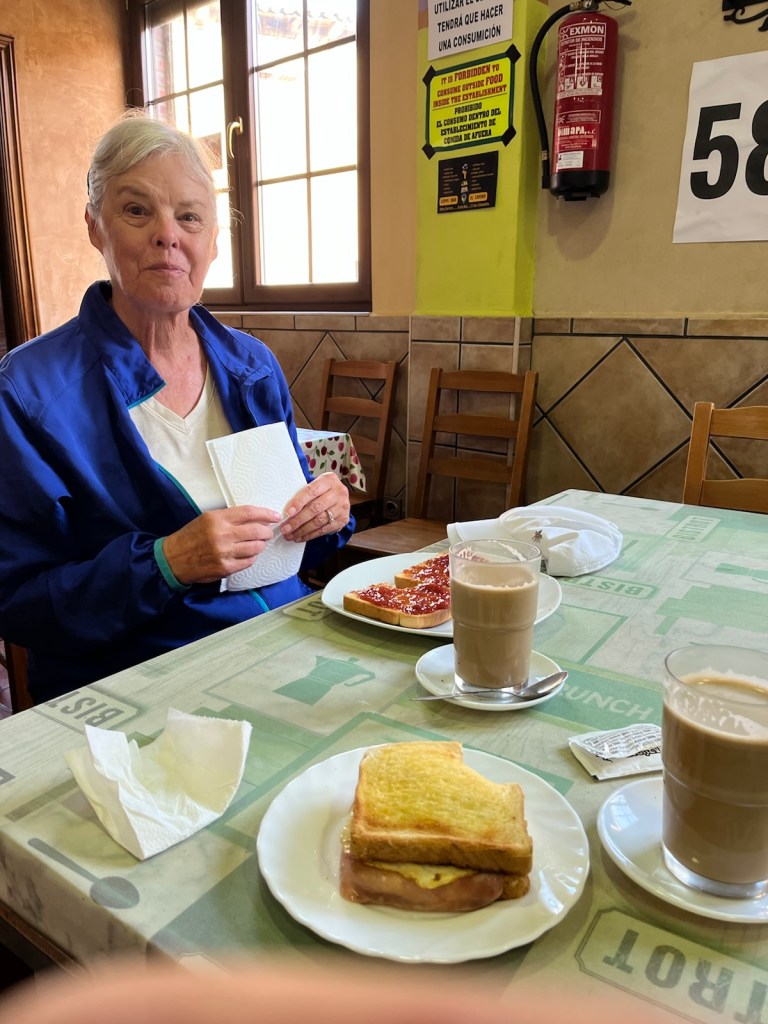
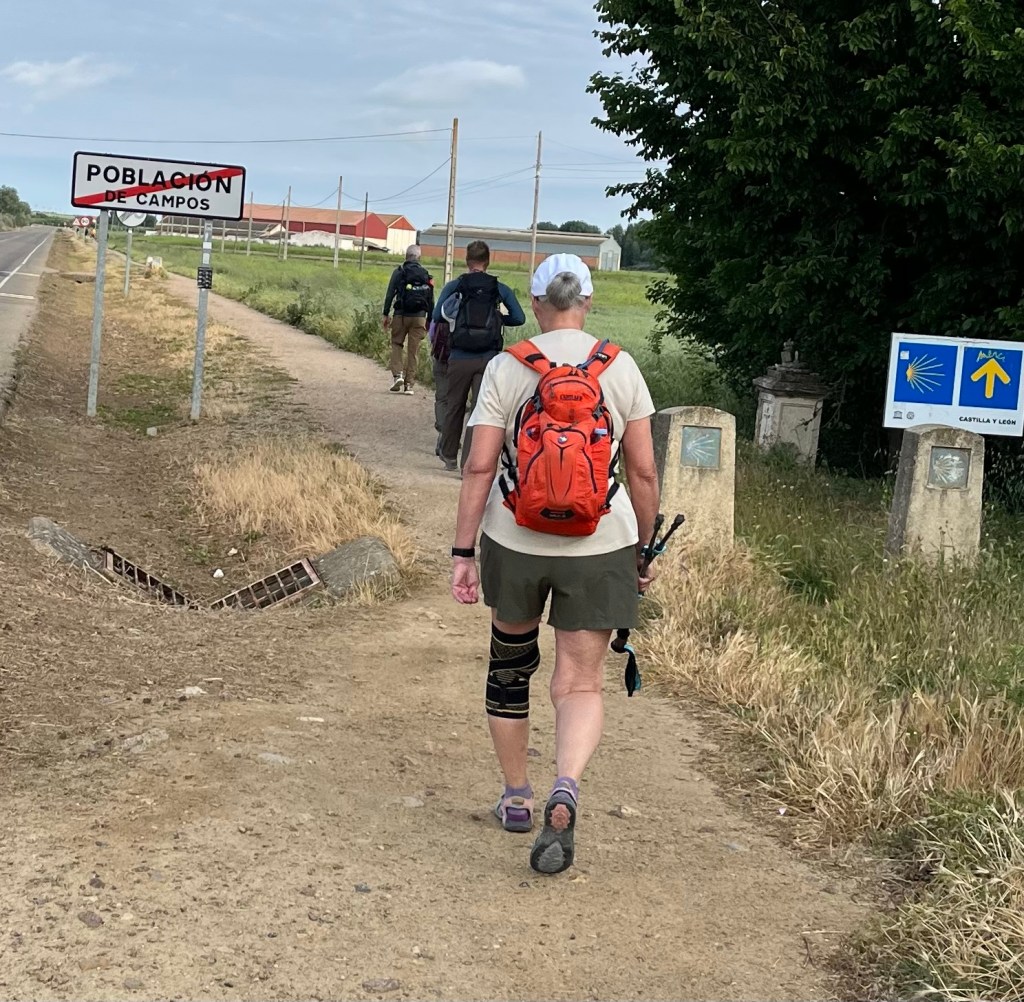
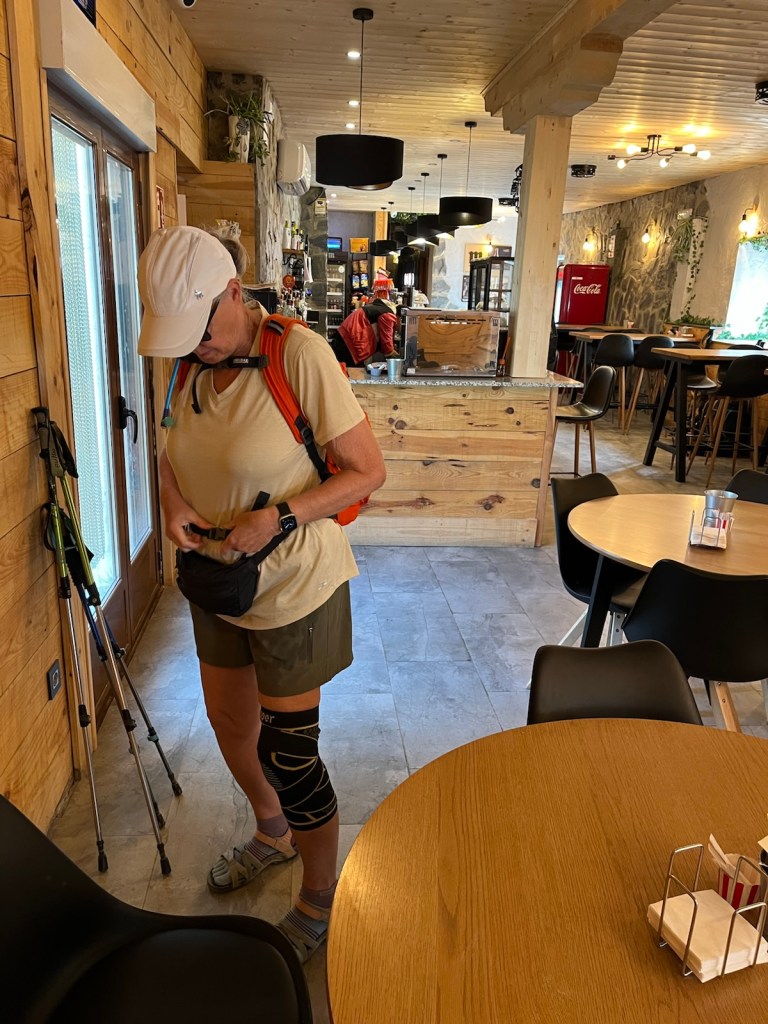
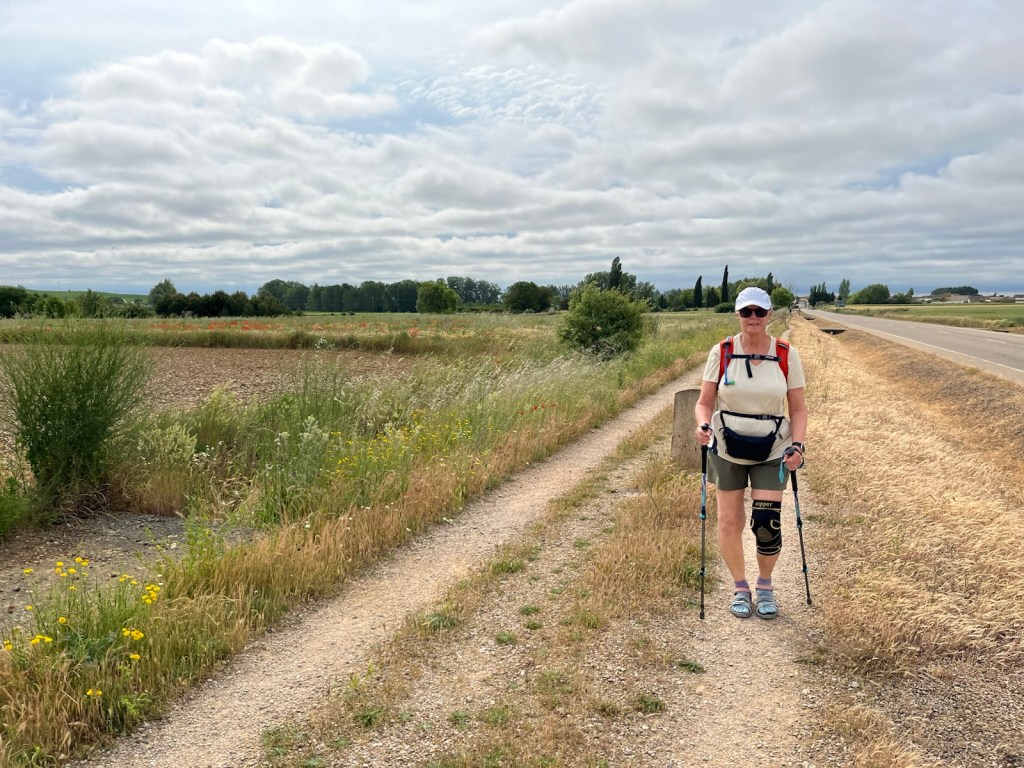
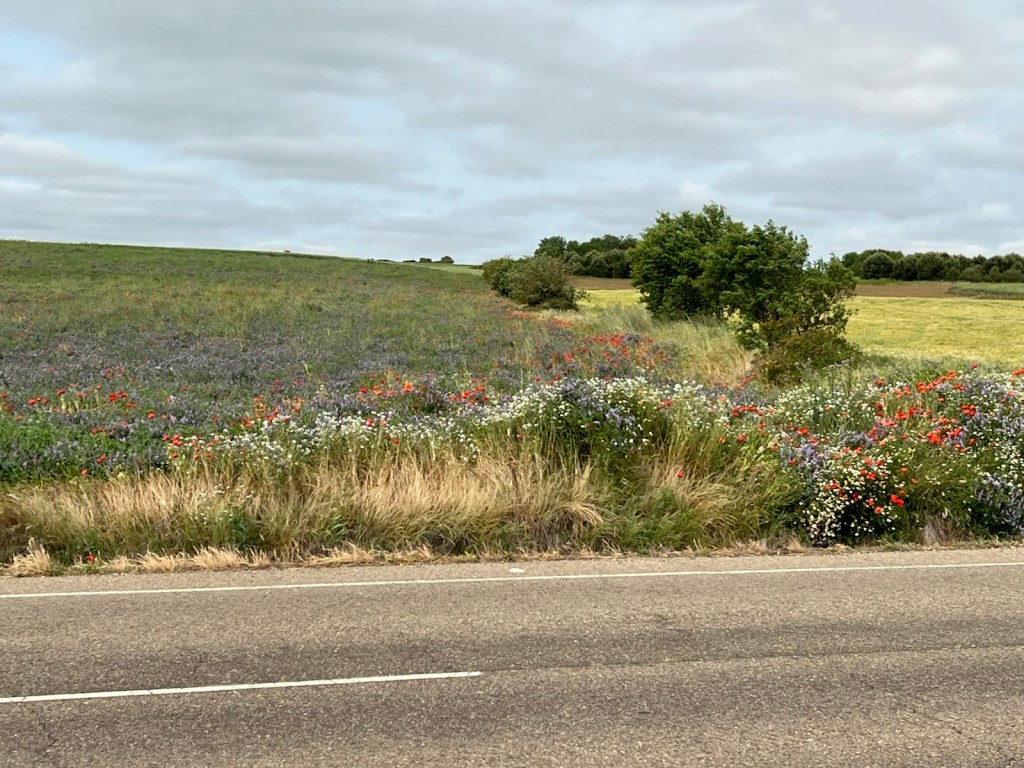
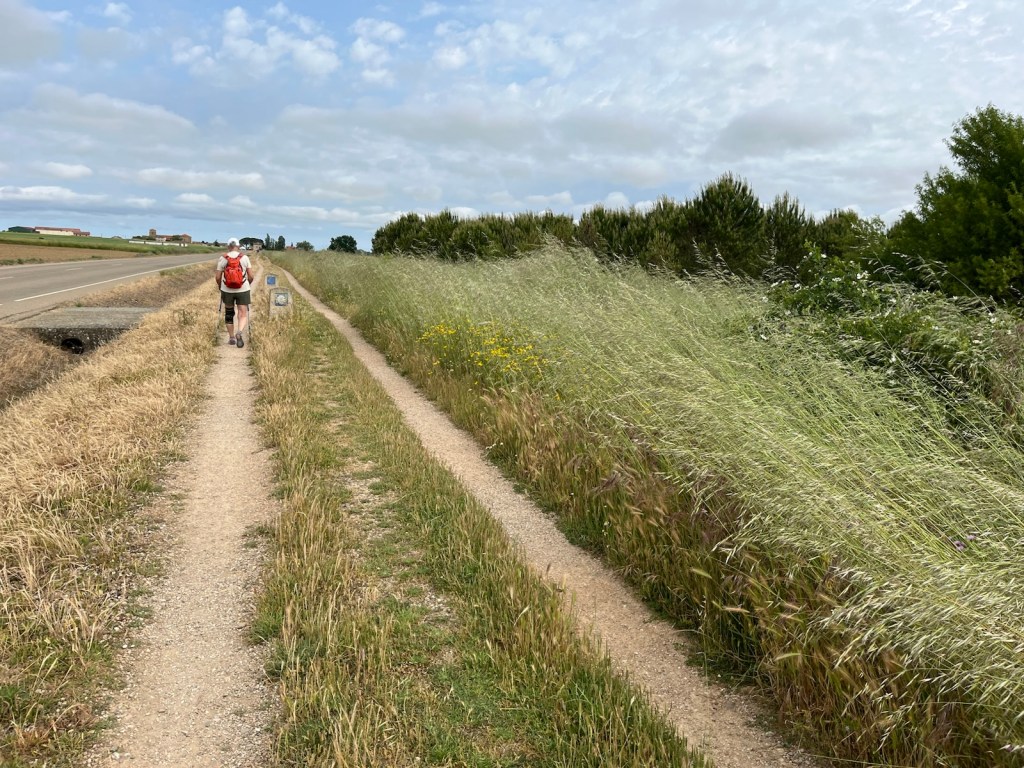
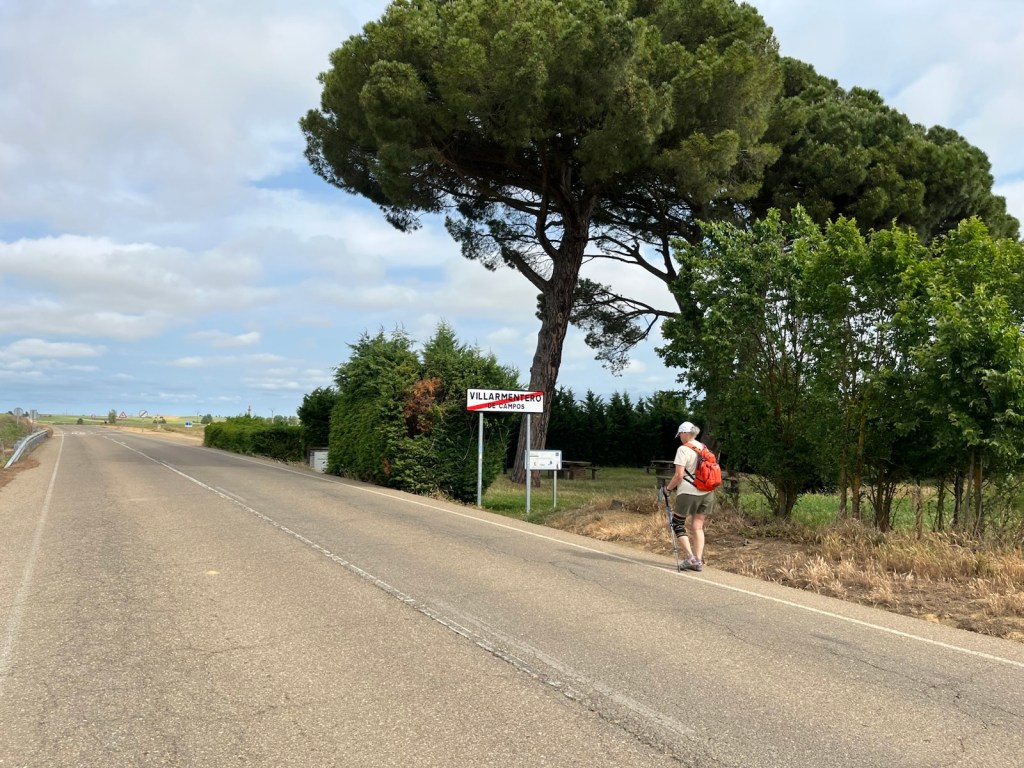
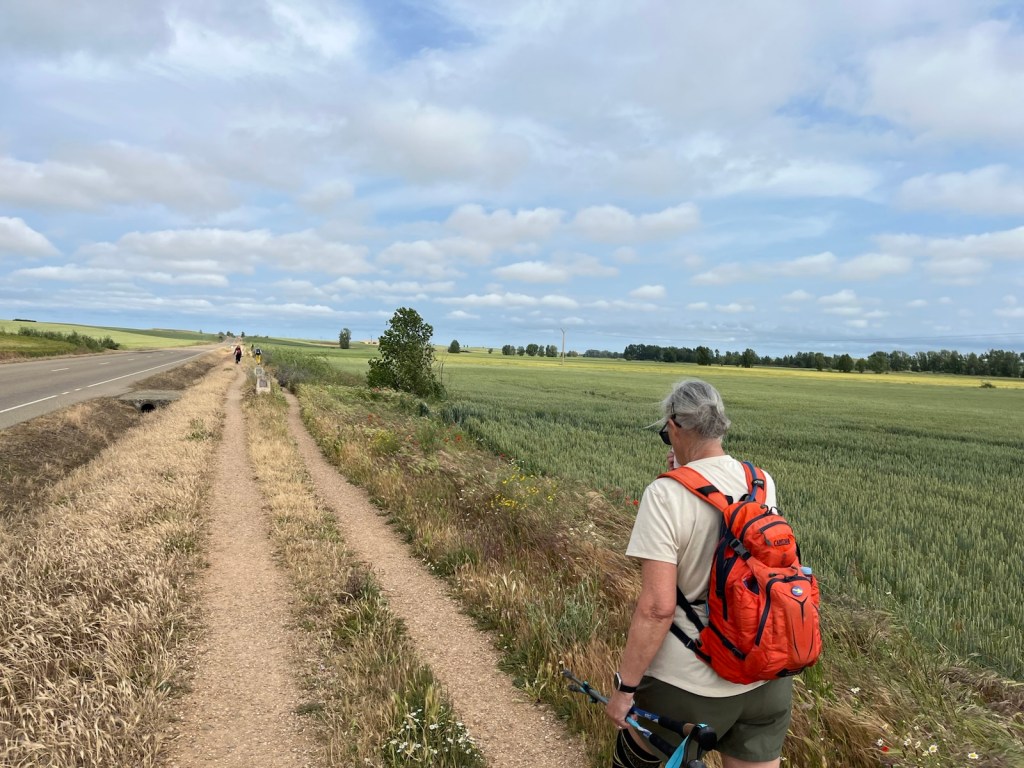
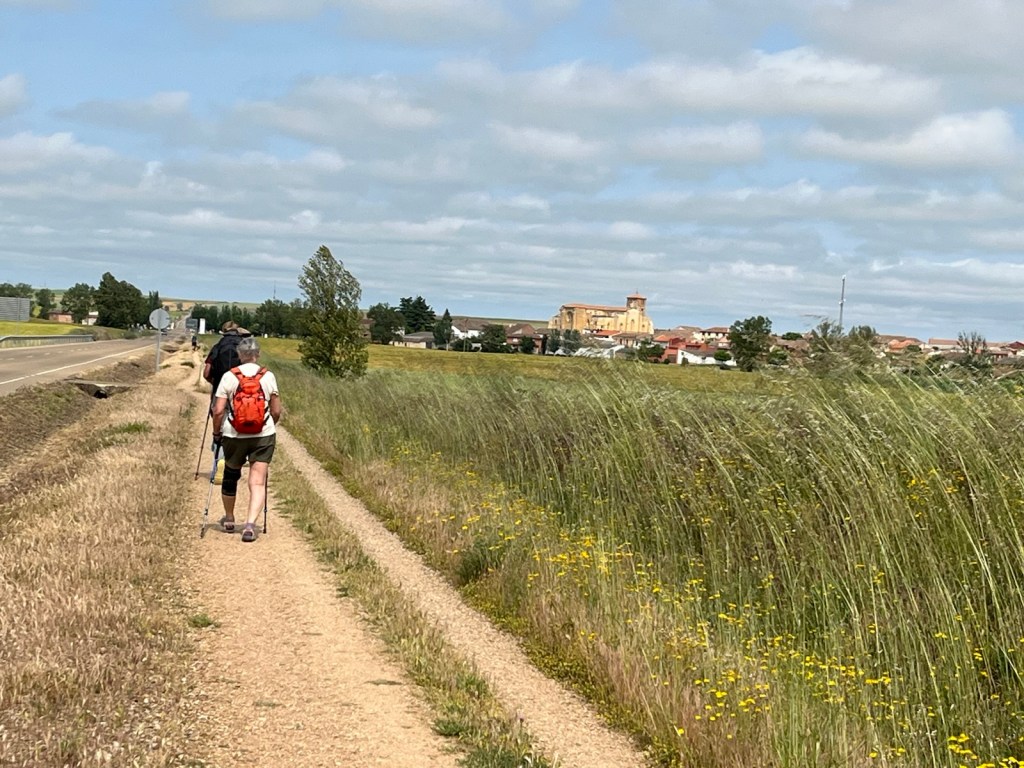
We left Fromista on wide, attractive sidewalks.On the edge of town we were greeted by a pilgrim ironwork as we crossed the autovia and worked our way safely through the traffic circle.Walking off the traffic circle ramp you can see the local straight road on the left with the Camino dirt path running parallel. The church in the right portion of the photo is in Población del Campos, the first stop for the day.The Camino path as we approached Poblacíon de Campos.We stopped at a bar that was open for the first time of all our Caminos. They didn’t have tostadas so Jim ordered the ham, cheese, egg toasted sandwich. Linda saw the toast and asked if they couldn’t just toast two pieces of bread like Jim’s sandwich and add butter and jelly. The owner looked at her and said ok and got to work on her tostadas.We left the Poblacíon de Campos paved streets and rejoined the Camino dirt path.Two miles later, Revenga de Campos became our next stop for Colacao (Spanish hot chocolate). We revisted a nice albergue that had just opened on our last Camino.Linda getting her gear together to move on after our Revenga de Campos stop.Leaving Revenga and rejoining the dirt path, paralleling the local road.As you can see we are still on the Meseta, surrounded by agricultural fields on both sides of the Camino path, only scattered trees and no mountains in the distance.We’ve been amazed by the beautiful wildflowers bordering and sometimes occupying parts of the fields. This is much more prevalent than we have witnessed during prior “summer/fall” Caminos.The Camino looked much the same as we approached Villarmentero de Campos, our last planned stop of today’s longer than usual walk.Amanacer, a primative albergue is the only accommodation with services in Villarmentero de Campos. Today, all was quiet, the bar was locked up tight, but the restroom’s were open. After a brief stop we moved on for the last leg of today’s walk.Beginning the last leg of today’s walk.The road today was long and straight and very similar with the exception of our rests tops in small villages along the way.
Although today’s walk was our longest thus far, it didn’t seem that way. We had cool, breezy weather all the way. The sun was out most of the time, but never reached full intensity thanks to periodic cloud cover. Having evenly spaced places to stop along the way broke the monotony and easy, natural walking breaks.
Our first sighting of Villalacazar de SirgaArriving in Villalcázar de Silva, the village plaza with food services just around the corner and the Iglesia de Santa María la Blanca straight ahead.
We arrived at noon and checkin wasn’t until 1:00, so we decided to have our main meal in the plaza while we waited.
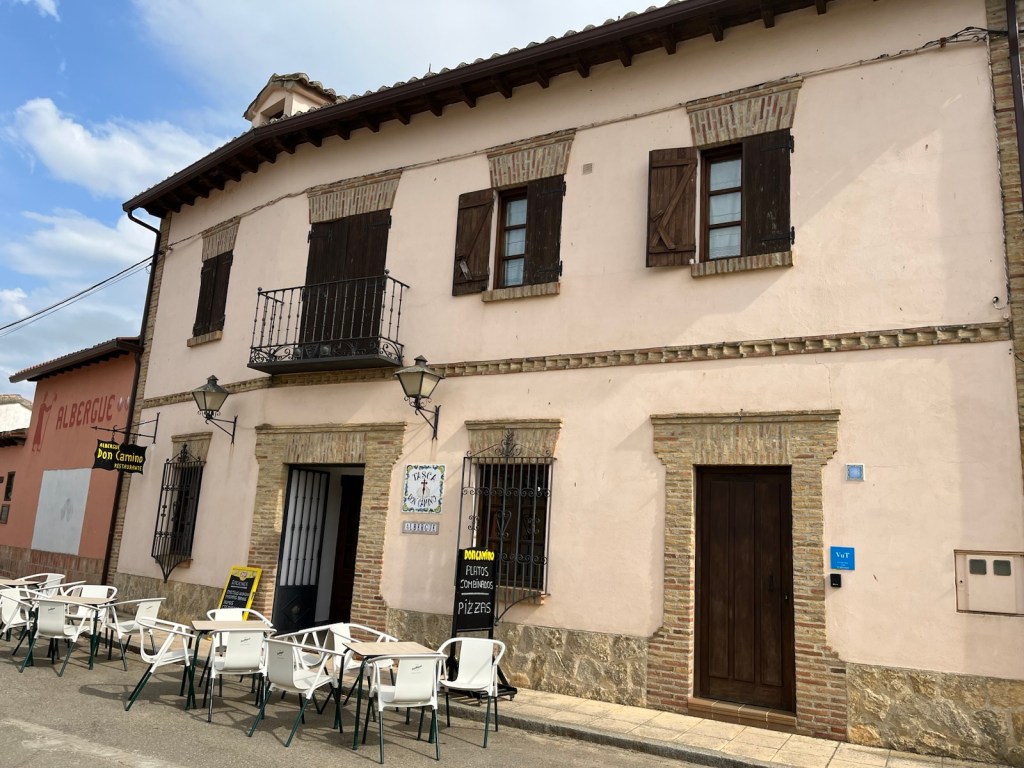
At 1:00, we walked to CR Don Camino and checked in. It’s our first time to stay here as all our usual accommodations were booked by early March.
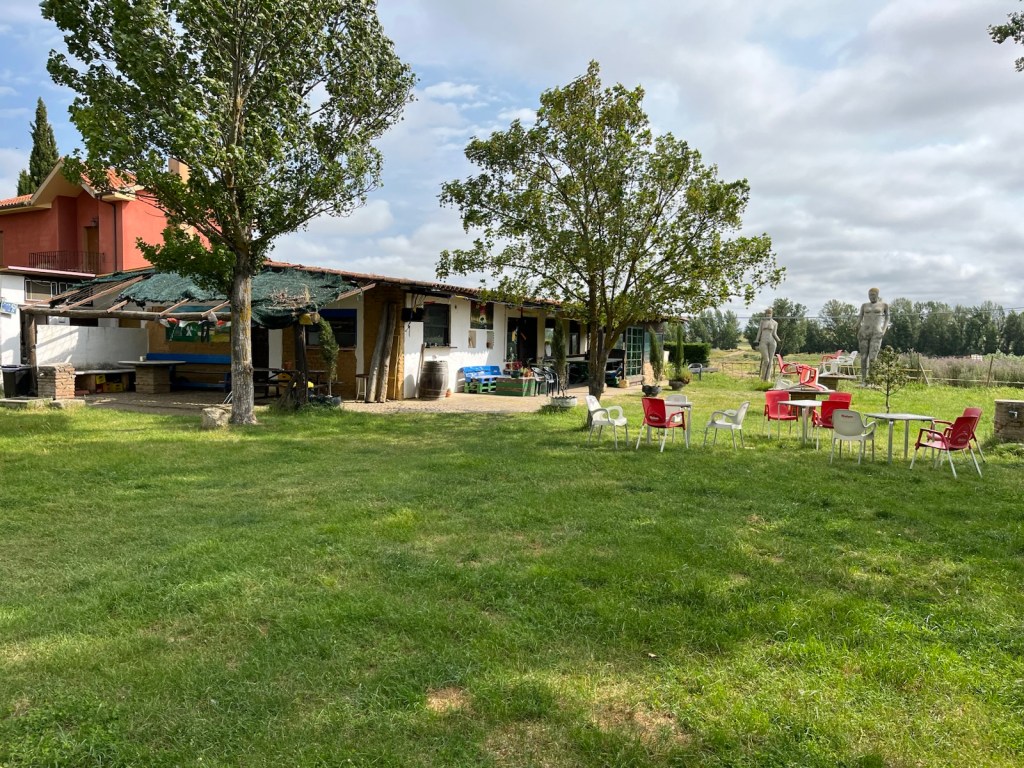
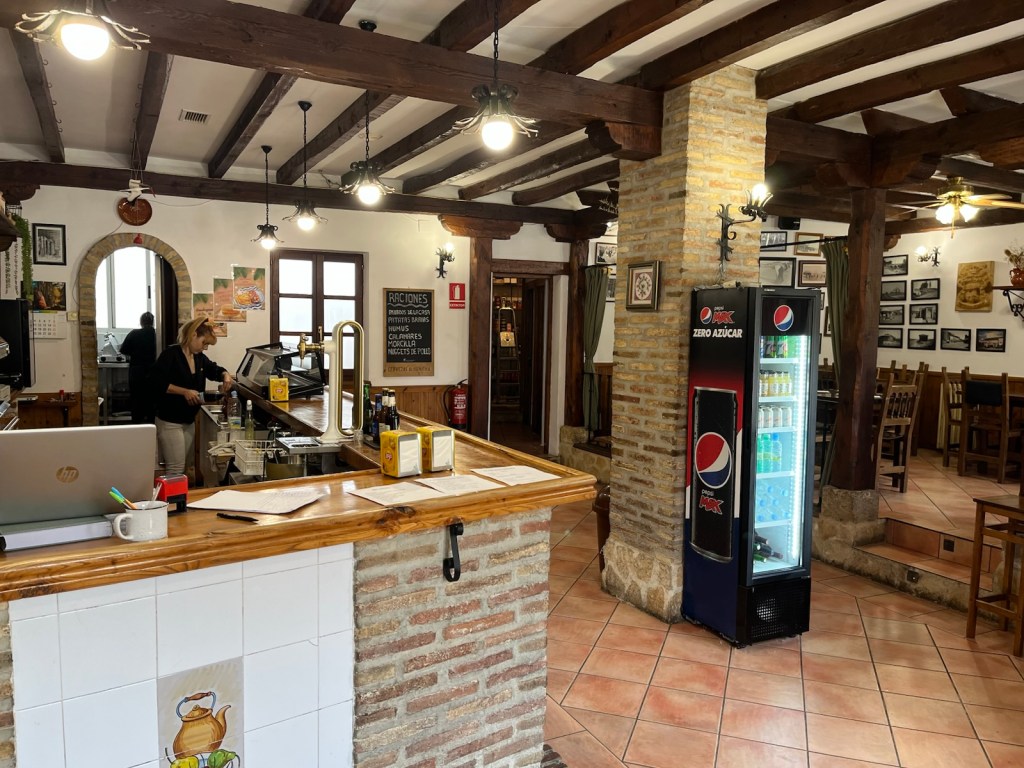
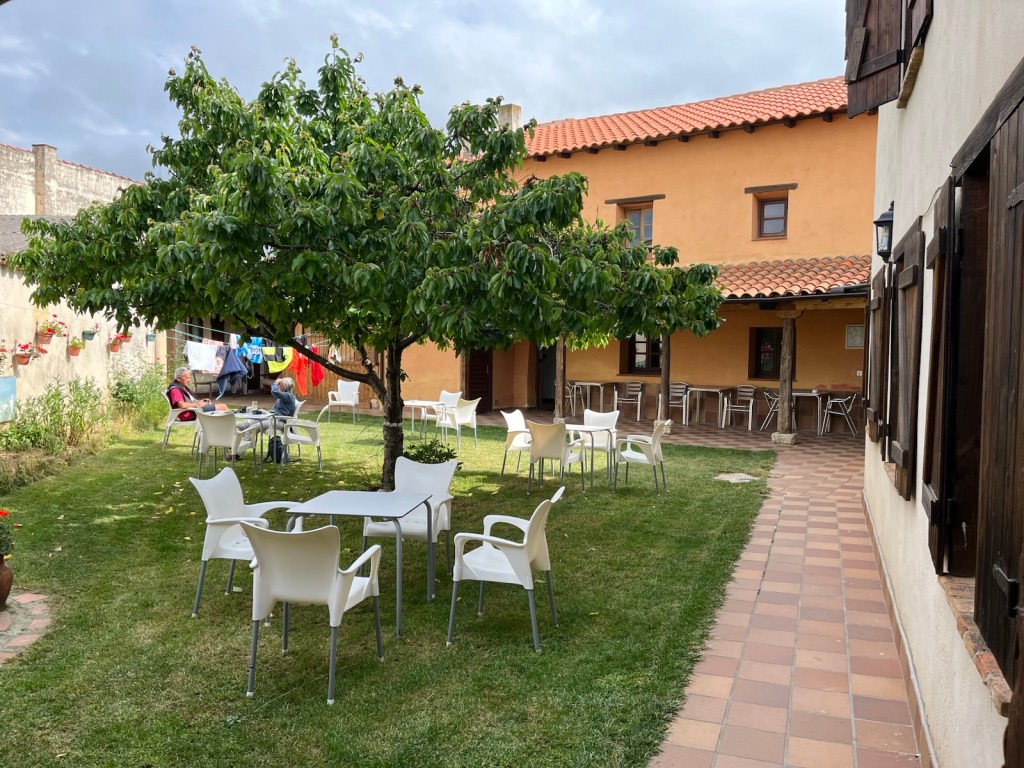
It’s an older property but clean, spacious and has a restaurant on site with food available all day long. If only they had let us in for our main meal!
Outside of Don Camino Casa RuralReception and dining area Common courtyard for guests Shared living area for private room guests.Our double room with ensuite bathroom (60€).
After spending a restful afternoon, we had a light snack of gazpacho for Jim and homemade vegetable soup for Linda before retiring for the evening.
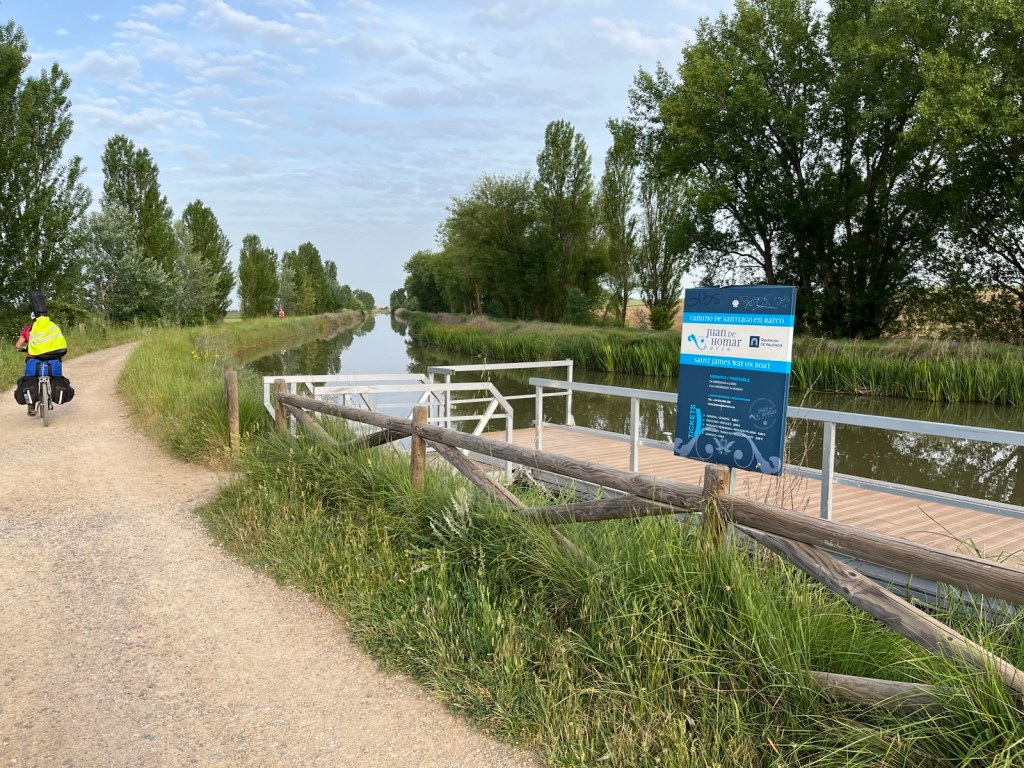
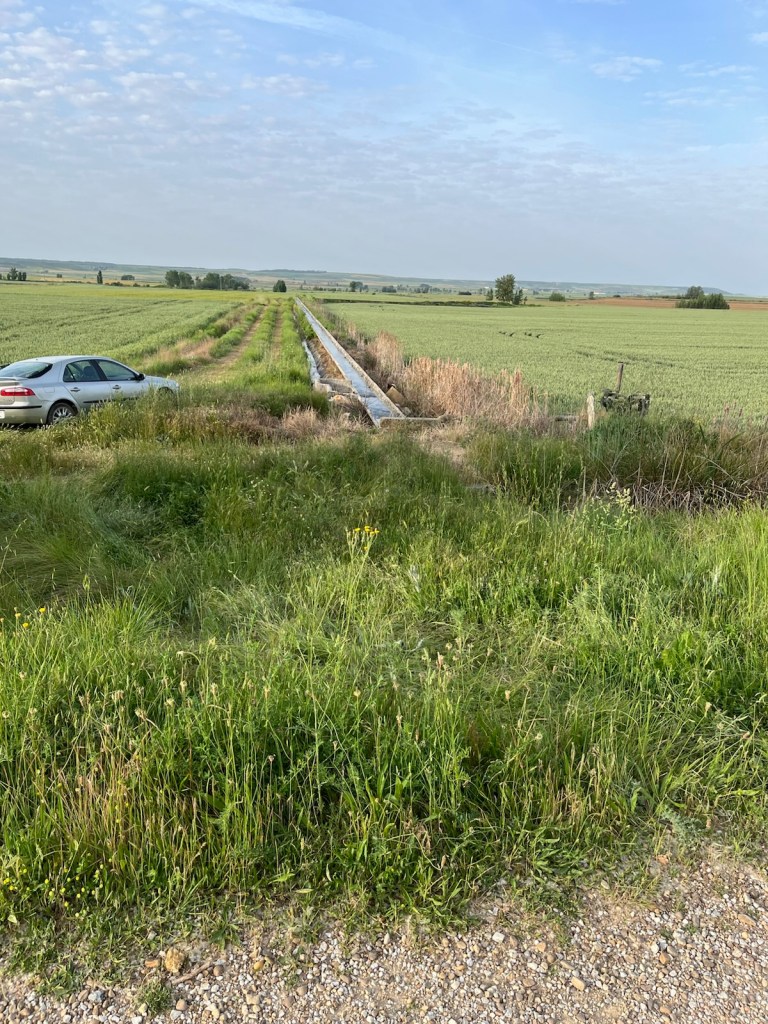
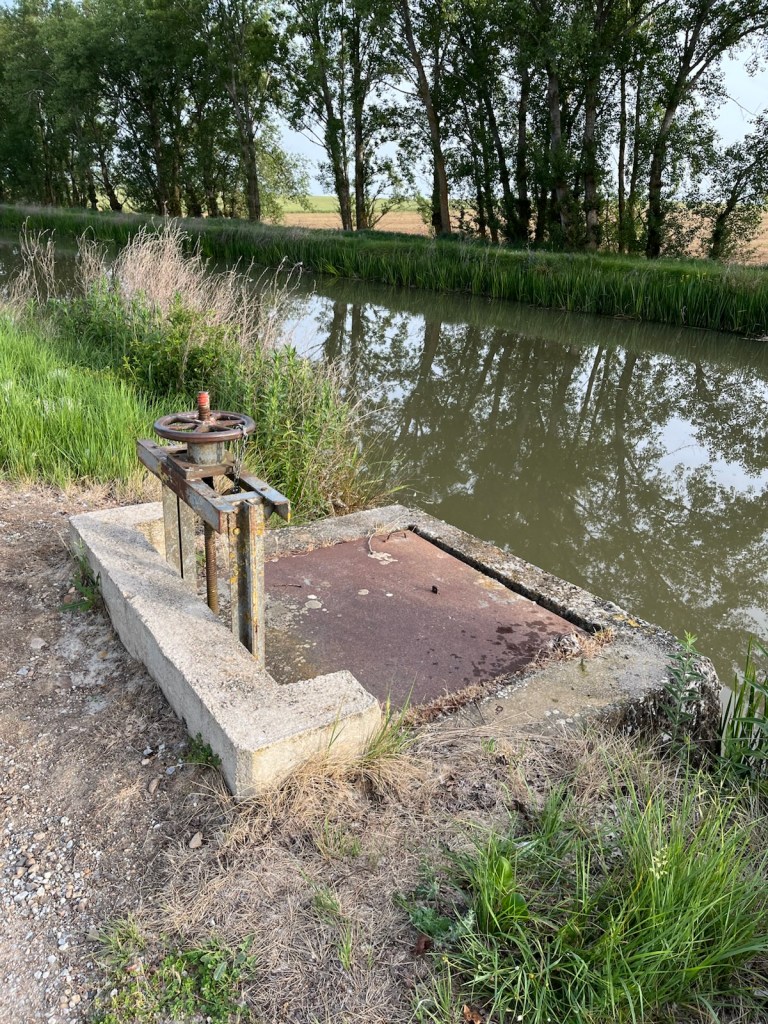
We left Boadilla and walked on a dirt path through the fields for about a mile.The path began to run parallel to the Canal de Castilla (Canal of Castile in English).One of the many aqueducts that irrigate the fields growing various agricultural products.A typical valve with controls the water flow to the fields.Today, we walked past a worker who was making an adjustment to a water flow valve.
The Canal of Castile is a canal in the north of Spain. Constructed between the last half of the 18th century and the first half of the 19th century, it was conceived to facilitate the transportation of wheat via mule pulled barges from Castile to the ports in the Bay of Biscay for export. The canal runs 207 km through the provinces of Burgos, Palencia and Valladolid, in the Autonomous Community of Castile and León. The canal was mostly used between 1850 and 1870 but competition with railways saw its use change to irrigation and for powering mills, in the latter part of the 19th century. Navigation ceased in 1959 with the closure of the locks. Parts of the canal are still in use, and although navigation is limited to tourism, the canal is used to irrigate 23,000 hectares (over 56,000 acres) in 48 municipalities.
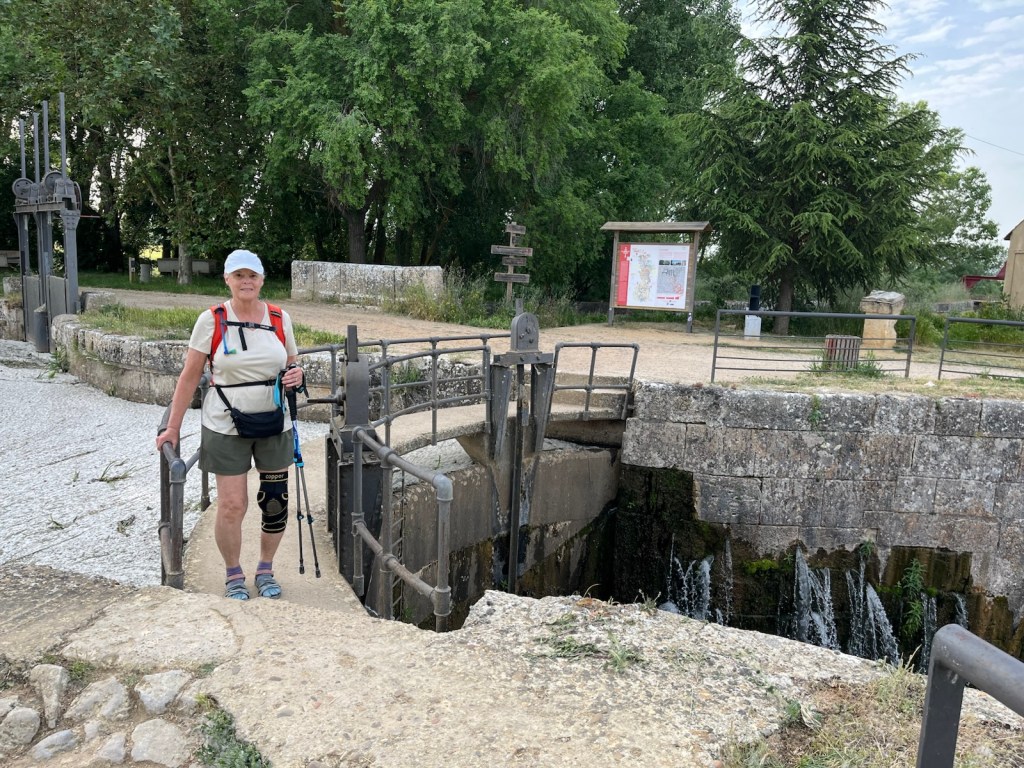
the canal irrigated fieldsTypical picturesque scenery along the last half-mile of our walk along the canal.Linda crossing the now defunct locks outside Fromista.The view down the locks.We walked into Fromista and stopped at the second open bar/bakery for breakfast. The first open bar service has poor and unfriendly in years past so we gave “Pan y Mas” ( Bread and more) our business instead. The owner was very friendly, the pastry and cafe con leche was good and the bathroom was clean!
It was just 10:00, so after stretching out breakfast, we briefly visited Iglesia de San Pedro, then walked to our hostal and found two comfortable seats on the front porch in the shade to hopefully get into our room sometime before the usual 2:00 p.m. checkin.
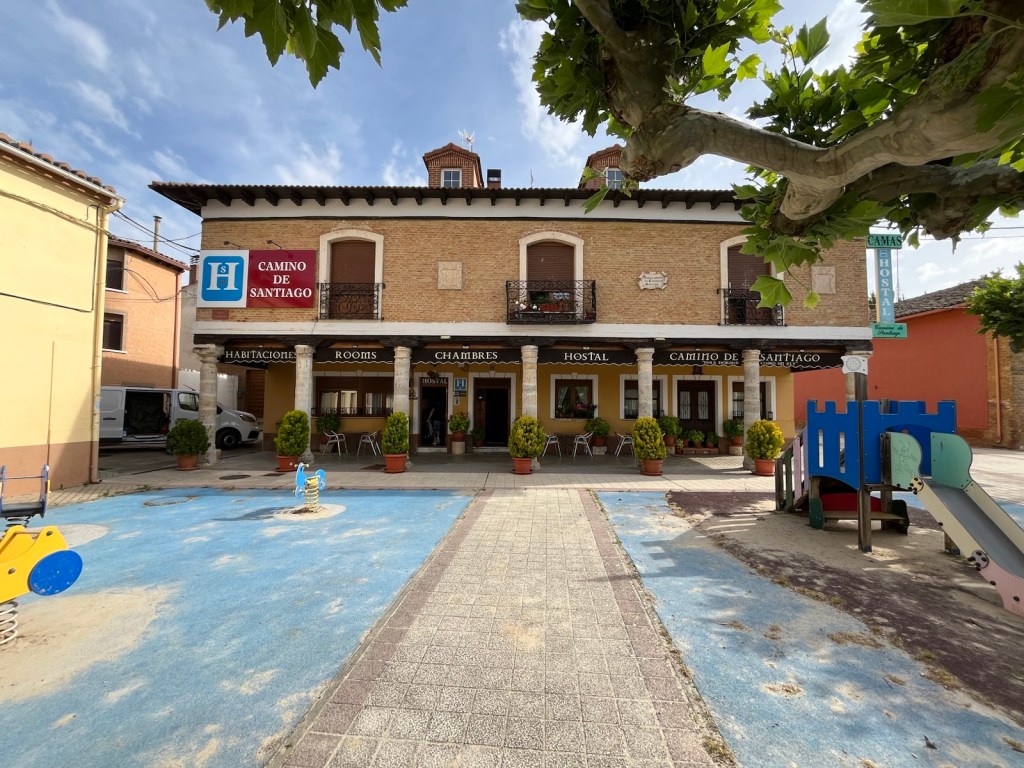
Our Hostal in Fromista, named “Santiago de Compostela”
After a few minutes, Jim became impatient and set out to on a reconnaissance mission to discover main meal options and to get some church photos. for the blog.
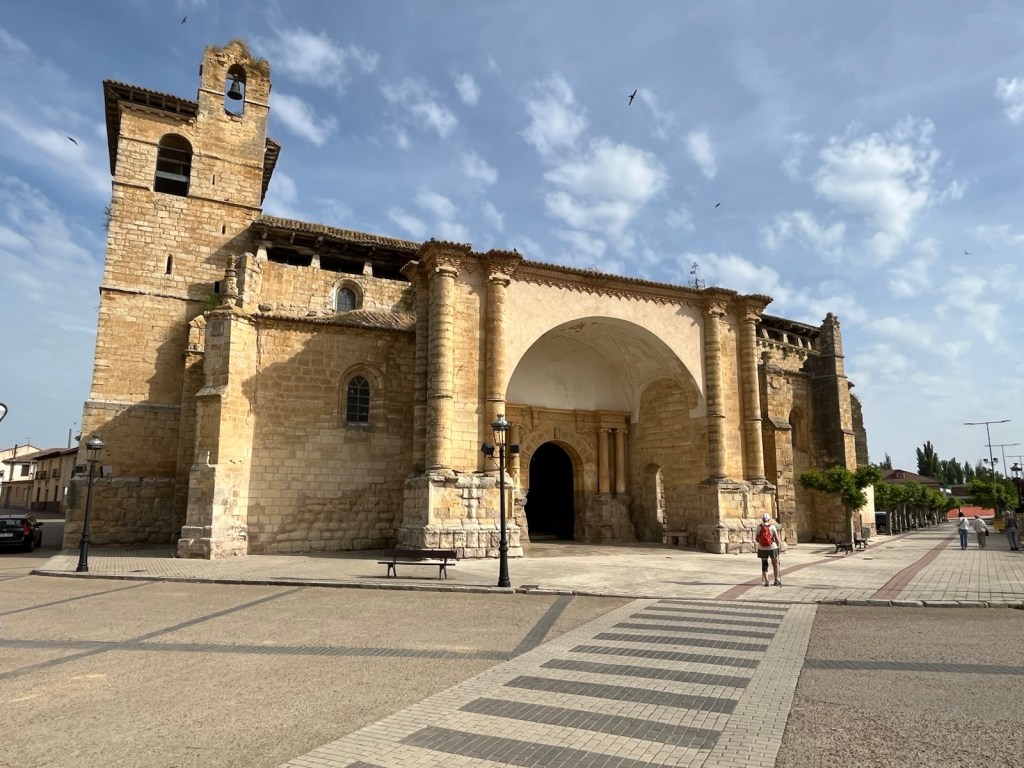
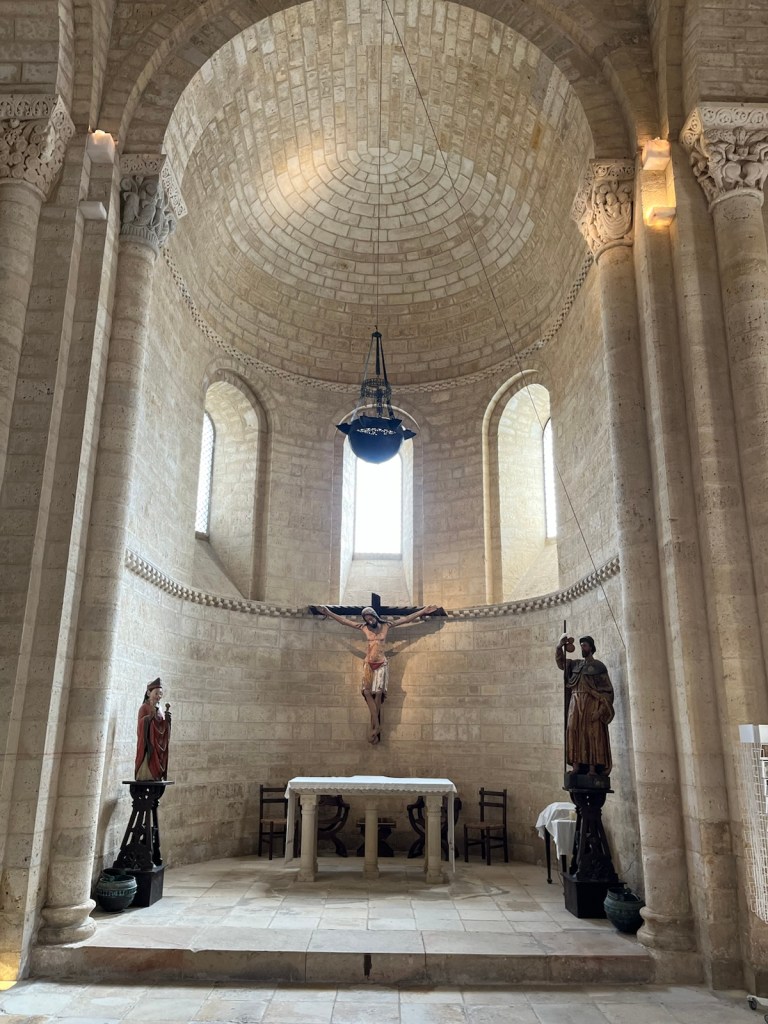
Iglesia de San Pedro (15th century)interior of Iglesia de San Pedro.Iglesia de San Martin seen from the town plazainterior of San Martin, completed in 1066.the simplistic Romanesque altar of Iglesia de San Martin. Dedicated to San Martin of Tours (316-397)
The only statues in San Martin are the three on the altar. Closeup’s are shown below:
St Martin (14th century)Santiago (16th century)Crucified Christ (13th century)
Jim’s search found the choices for our main meal were very limited. Our first choice was Los Palmeros, a Michelin 1star restaurant, which we discovered by accident and enjoyed in 2023. Sadly, it was totally booked today for private parties for both the lunch and evening meals. Only one other restaurant was open (typical of Fromista based on previous visits). We were very lucky in 2023!
At 11:00 a.m., Jim rejoined Linda on the porch and only a few minutes later, the owner, who recognized Linda from our stay here in 2014, said our room was ready and allowed us to checkin immediately.
After a brief rest in our room we ventured out to our sole choice for lunch and had our main meal for the day.
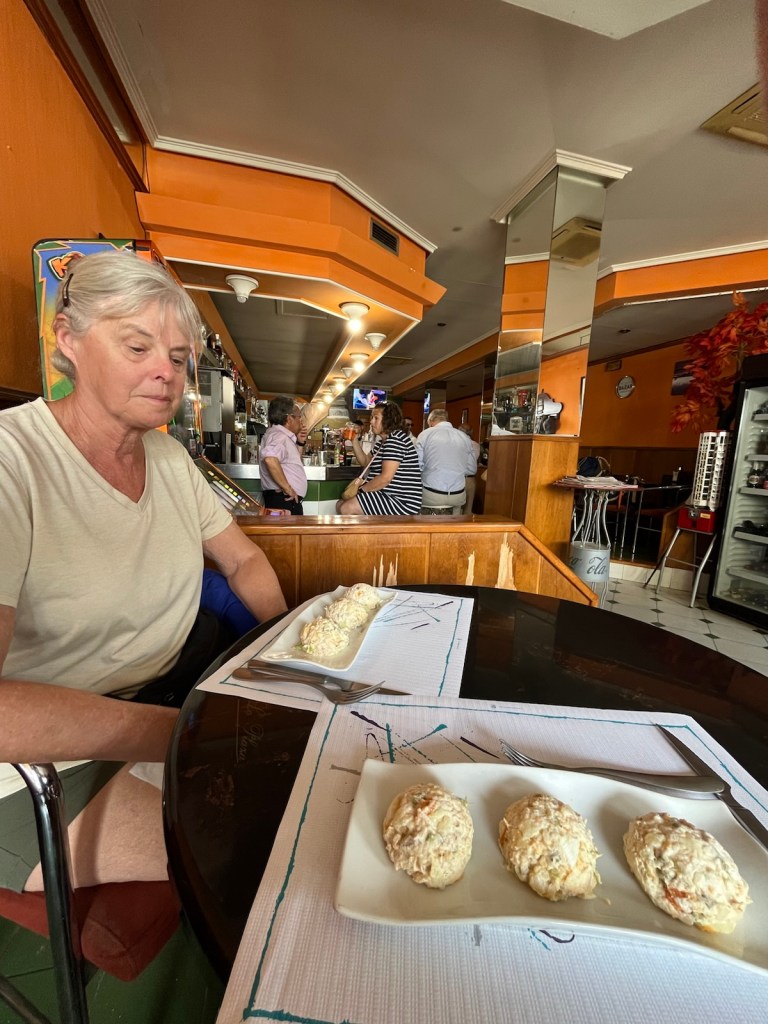
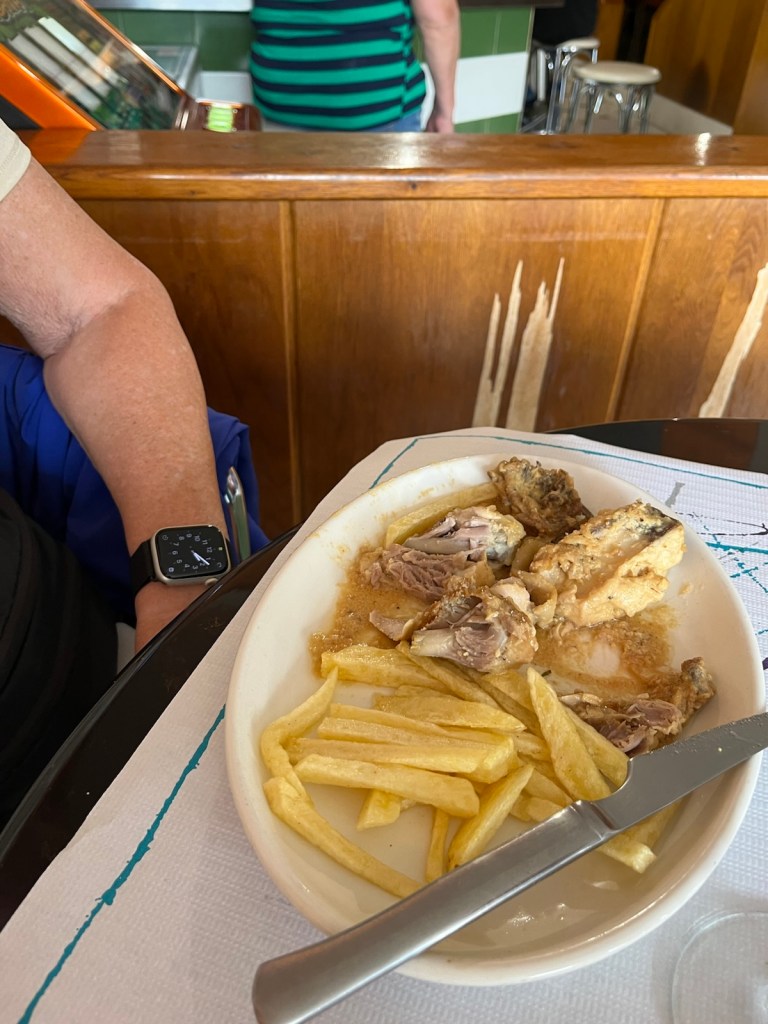
We both had tasty ensalada rusa’s first course.Second course was slow cooked chicken for Linda….… and rabbit, sautéed in wine sauce (conejo a la cazadora) for Jim
Amply sated from our main meal, we walked back to our room and chilled for the rest of the day doing our usuals.























 Jimandi