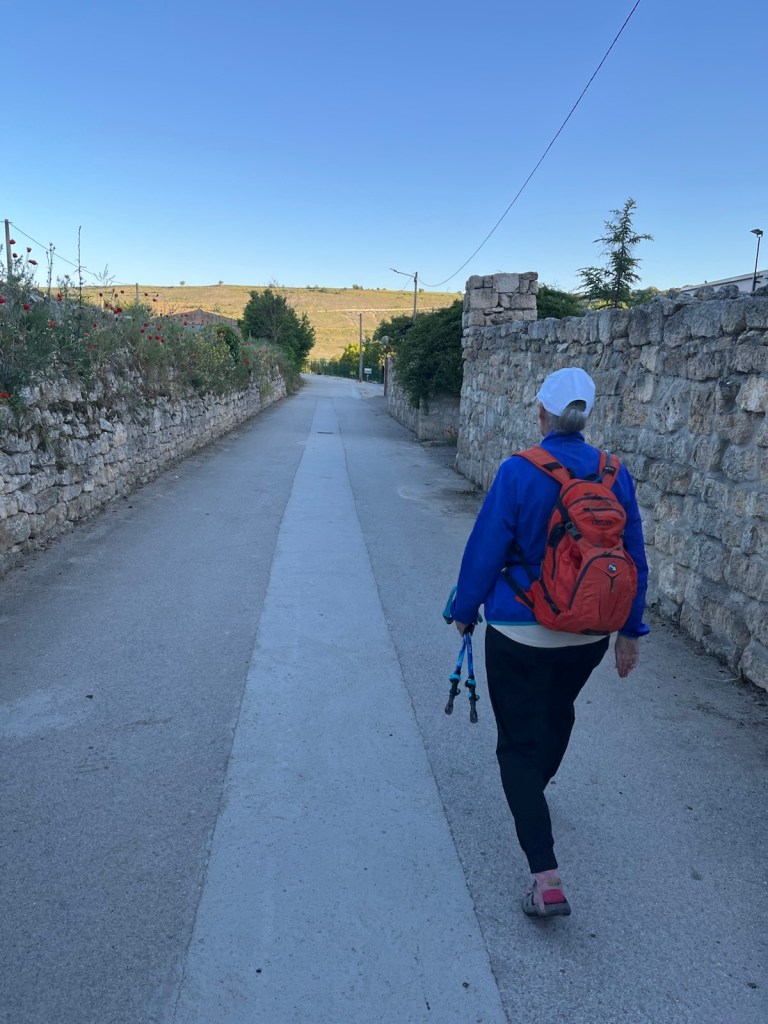
We followed the arrows from our albergue that wound through the village then rejoined the dirt path.
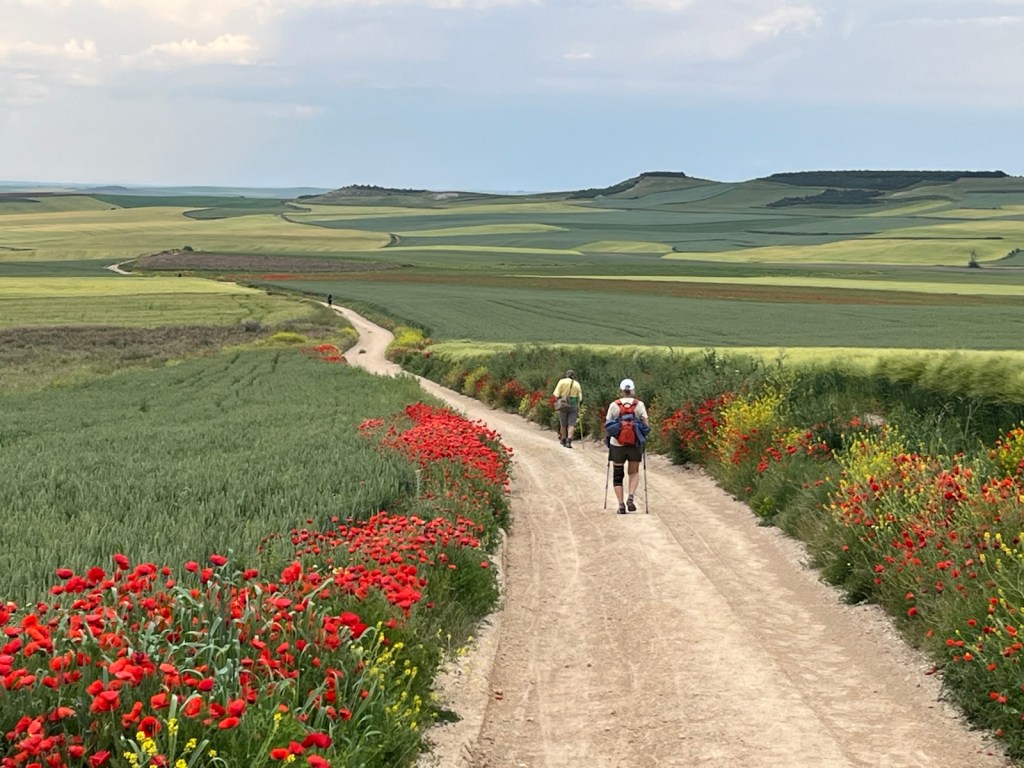
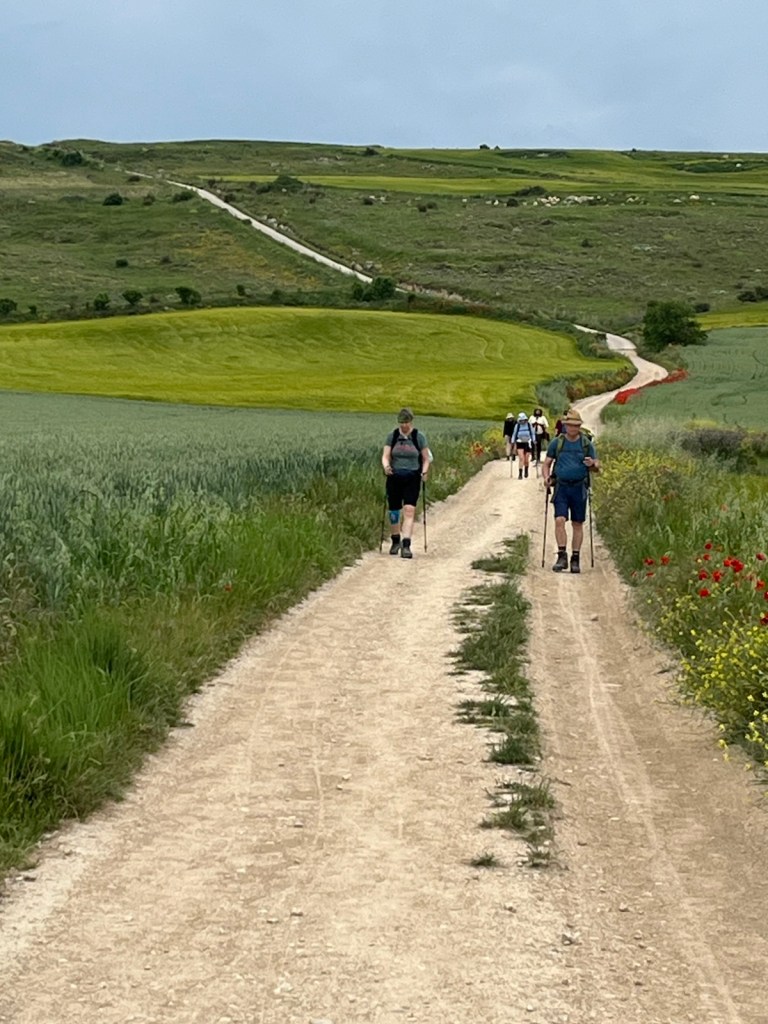
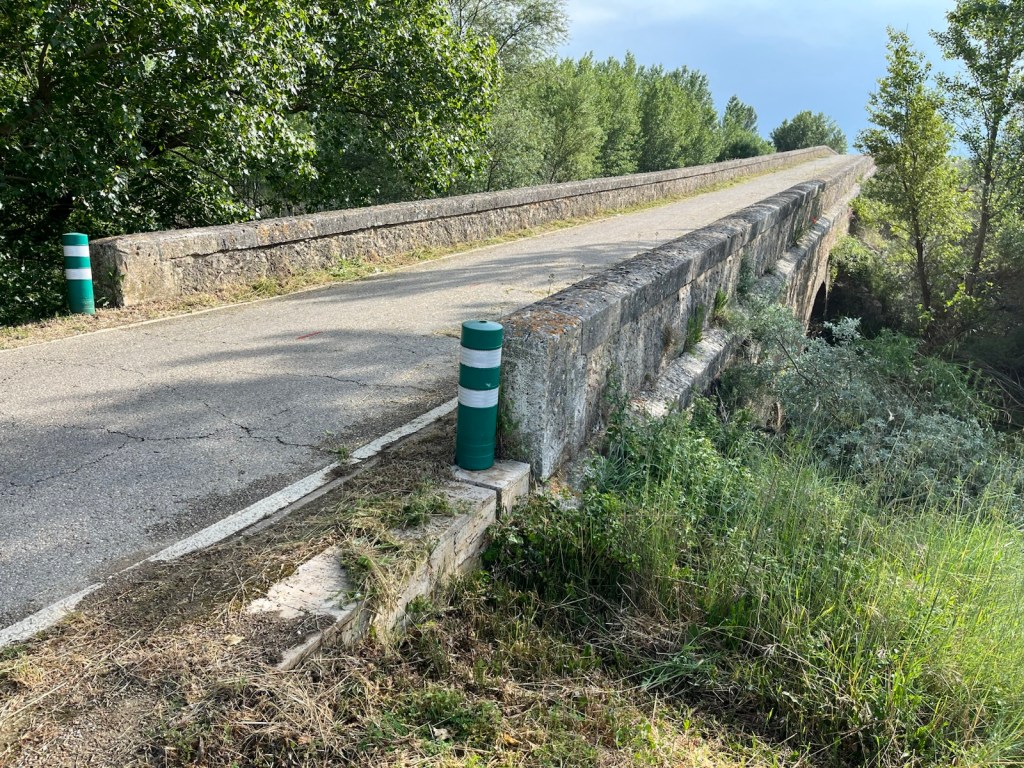
The path to Boadilla is a gentle hill that meanders through the fields, irrigated from the Pisuega Canal, which we cross near the halfway point.
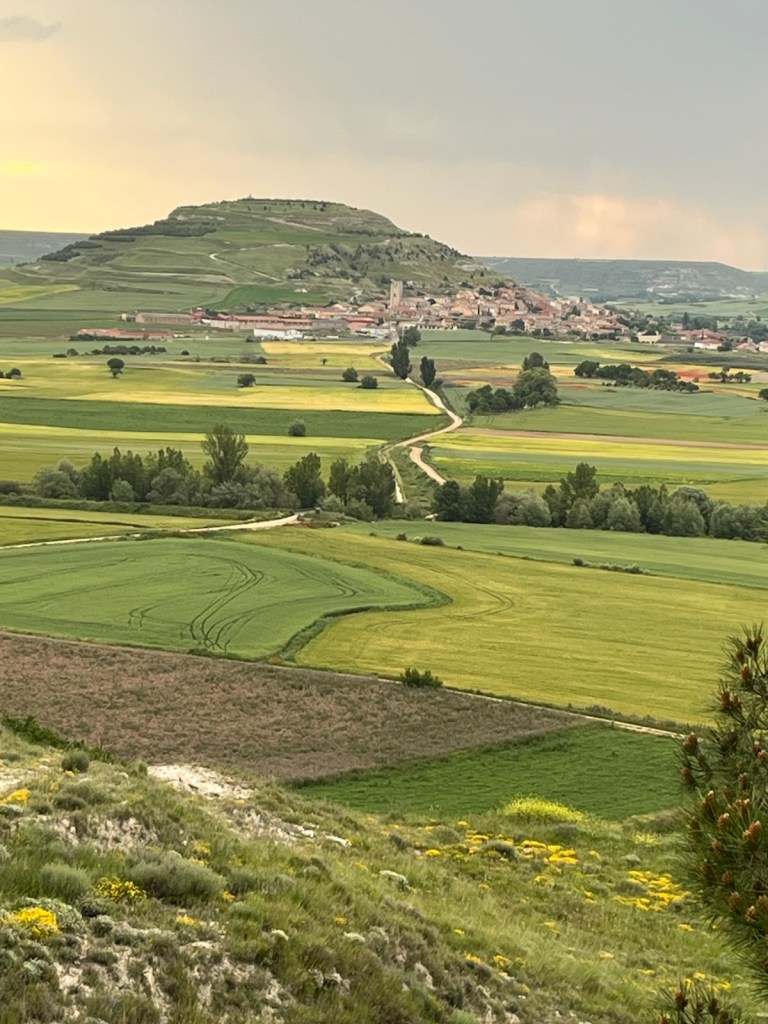
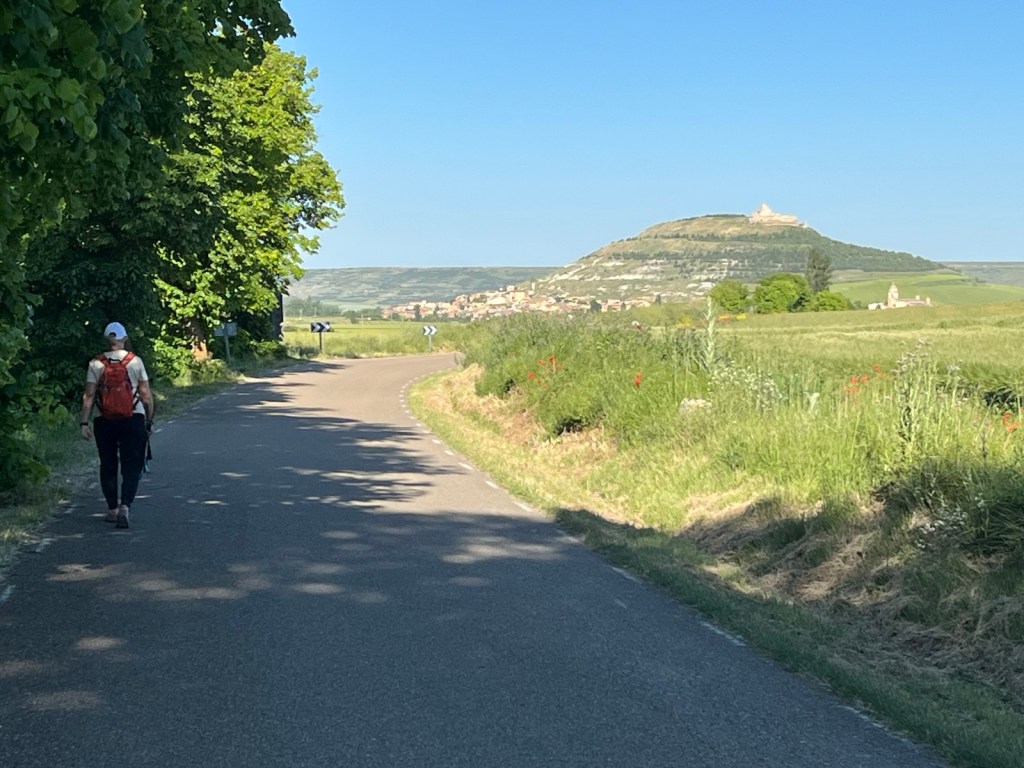
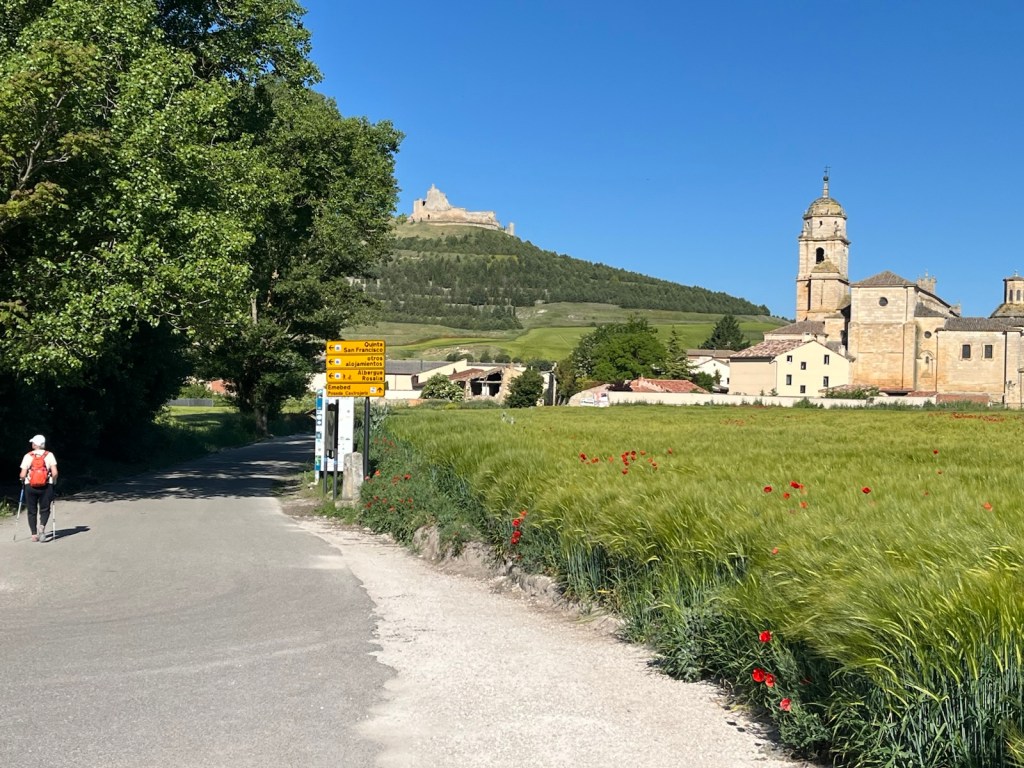
It is not a very interesting walk and when the Iglesia de Santa María de la Asunción is first sighted, one typically thinks he/she is almost there. The illusion though is disheartening since it is actually over 3 miles away!
Today, however, as we approached the sighting point, two French pilgrims whom we met at dinner last night, joined us in our walk and renewed their conversation with Jim.
The interesting exchanges that followed became a distraction for Jim and when the faster walking Frenchmen moved on, we were almost at the entrance of Boadilla.
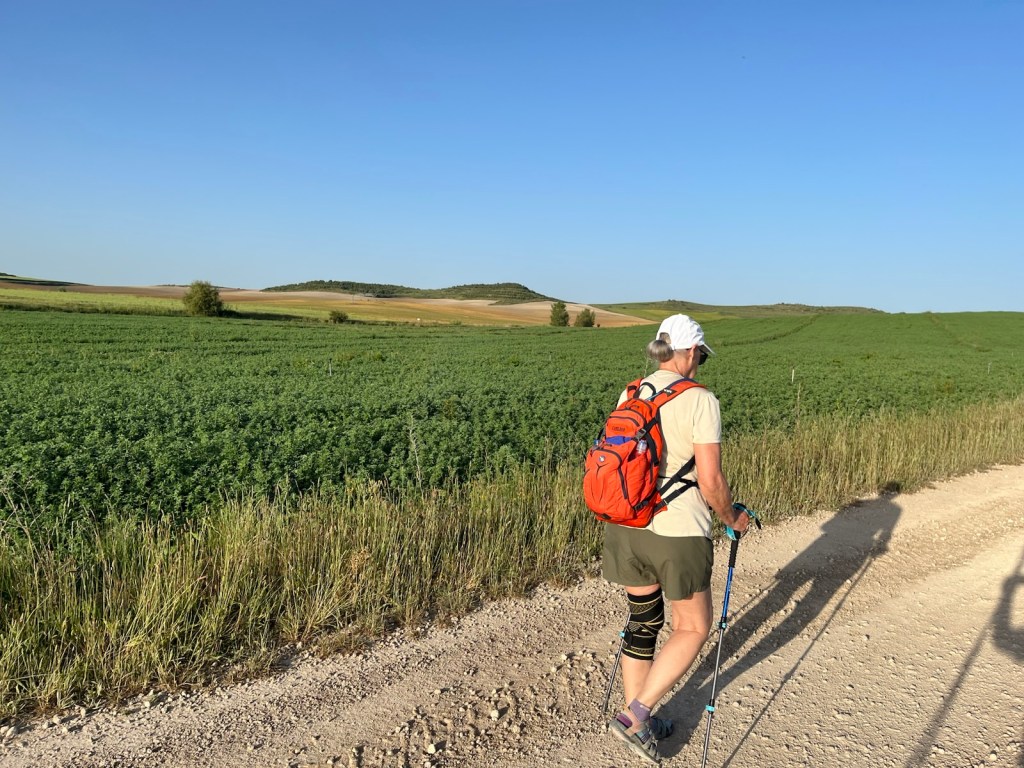
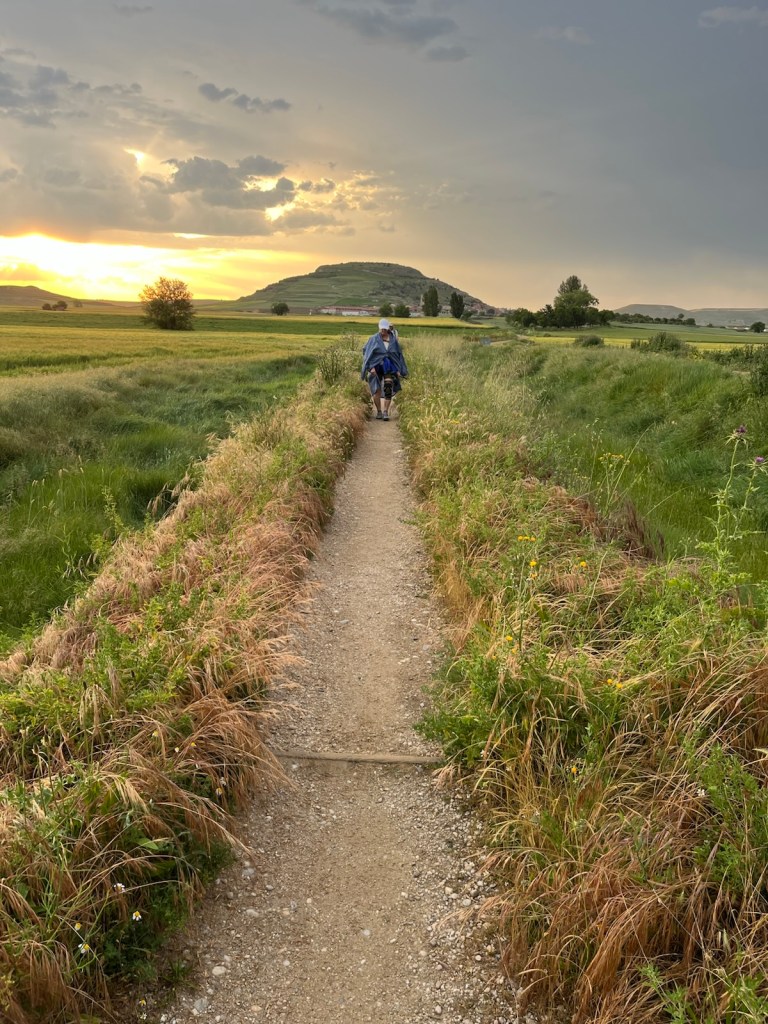
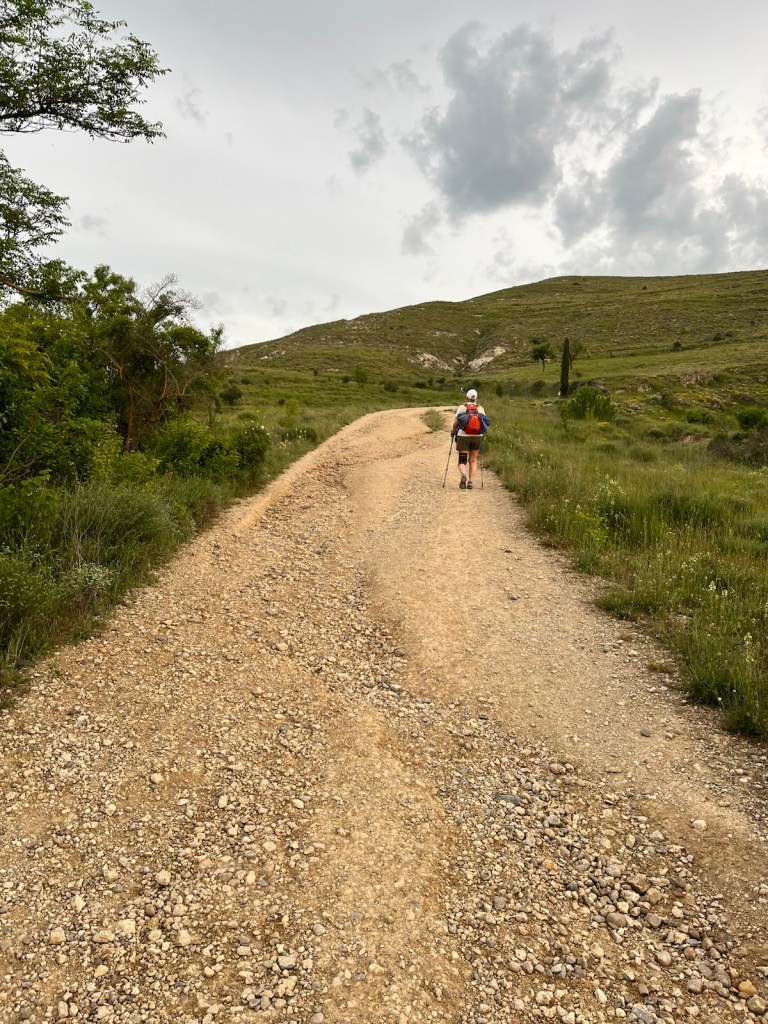
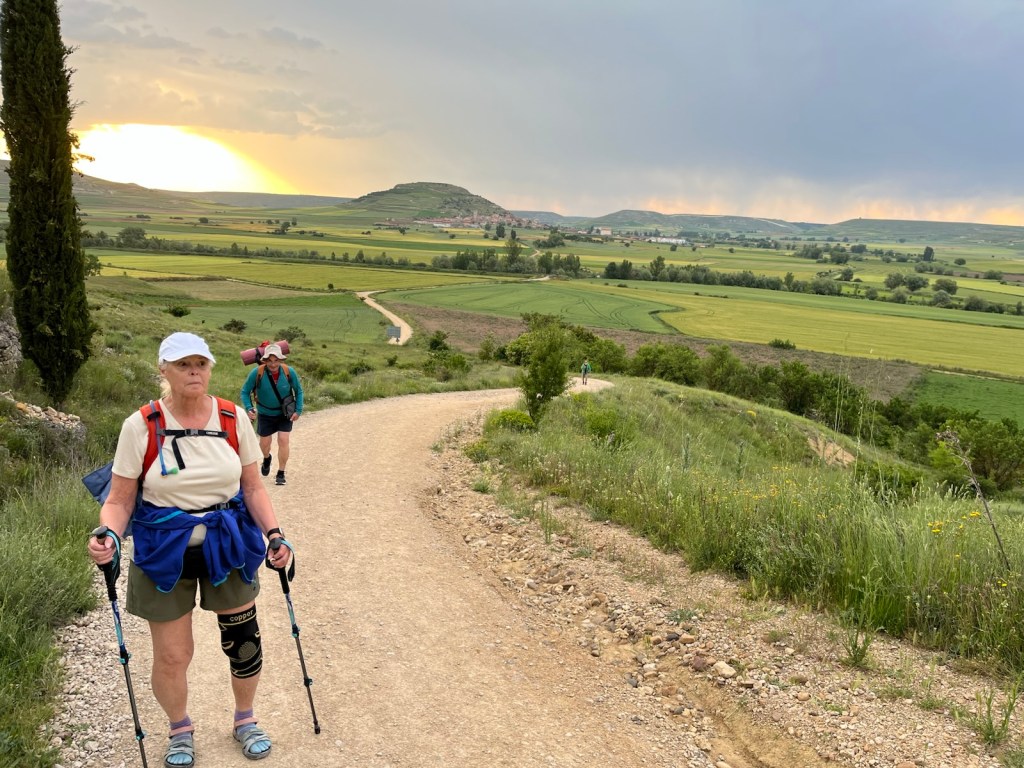
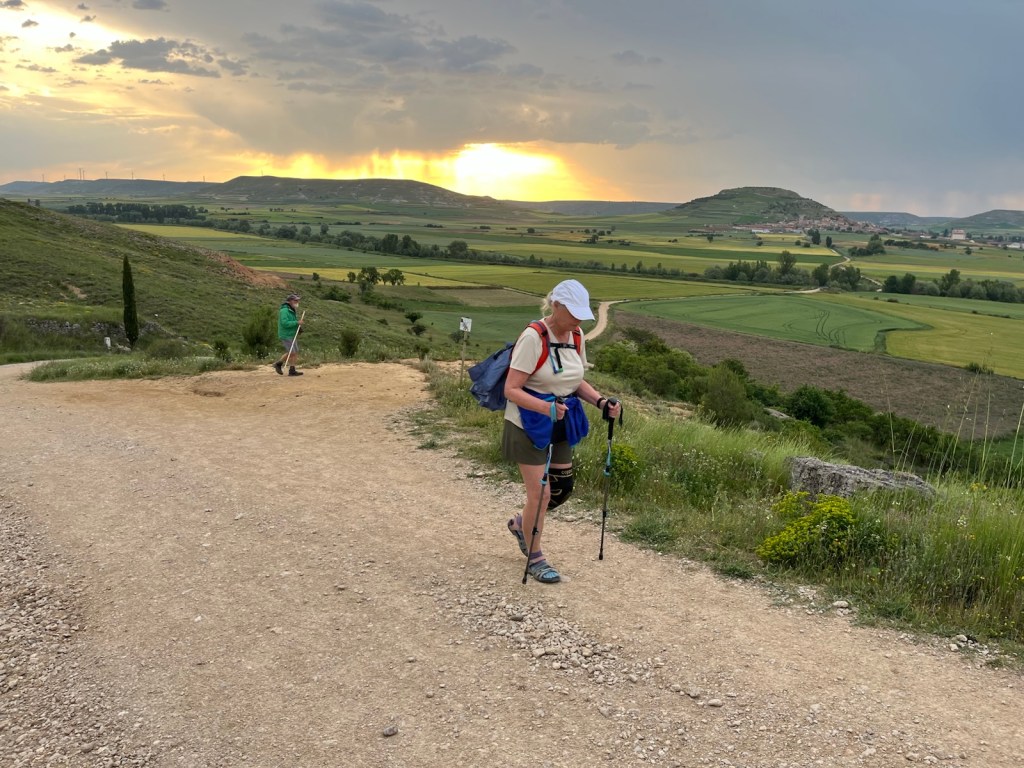
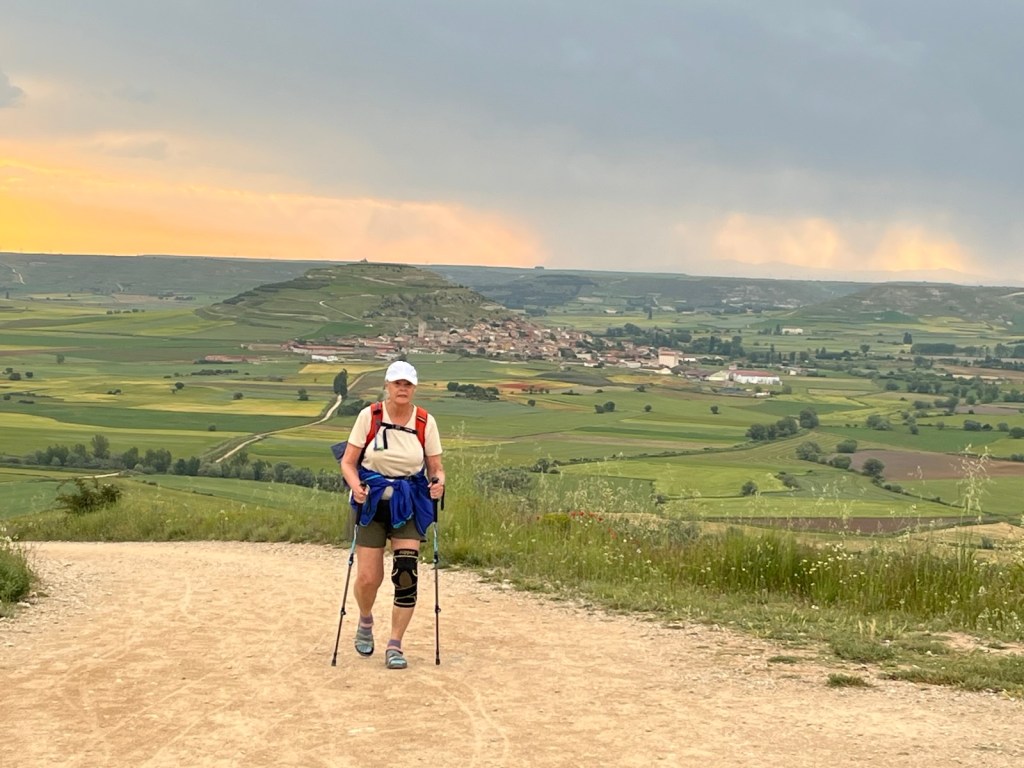
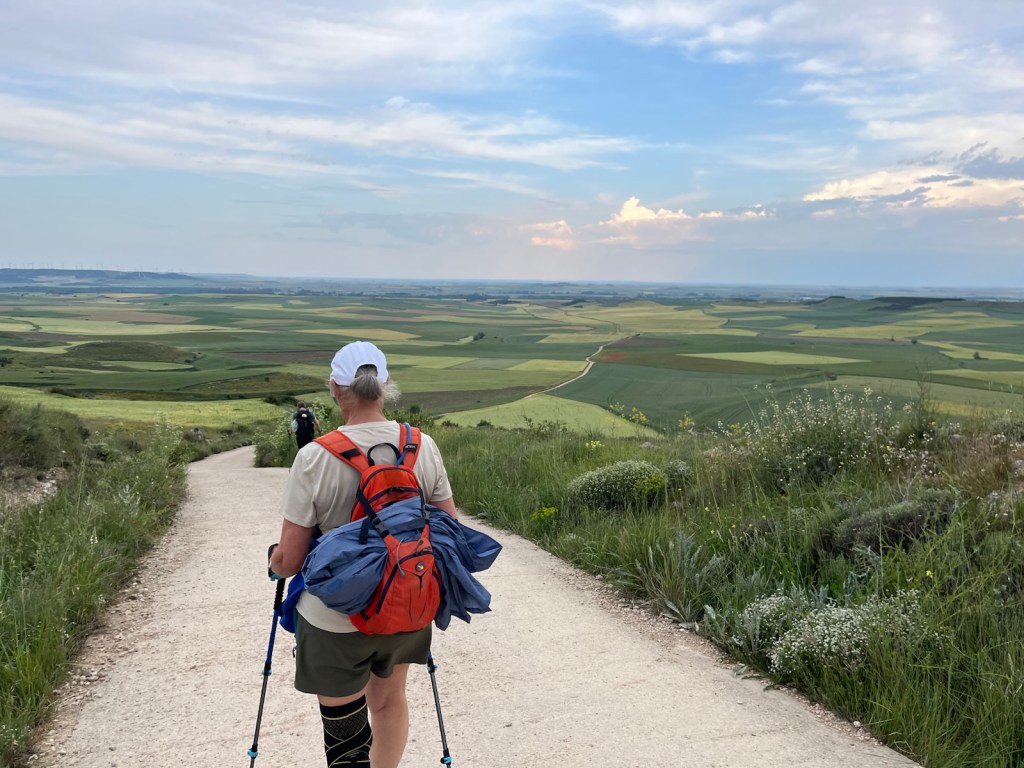
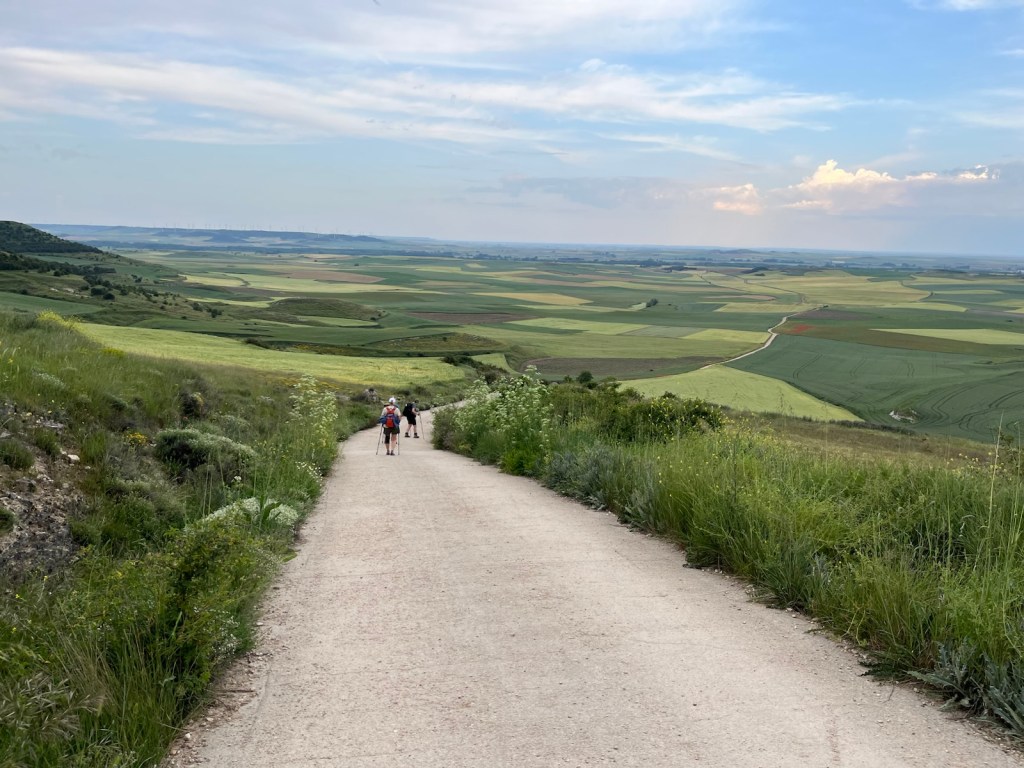
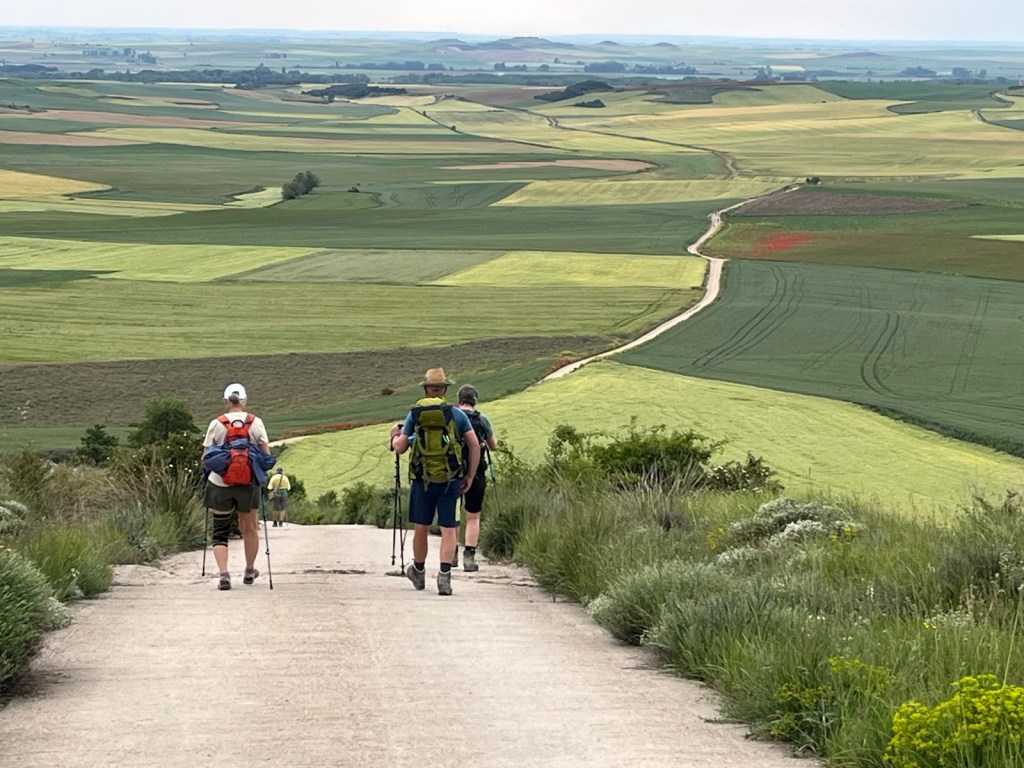
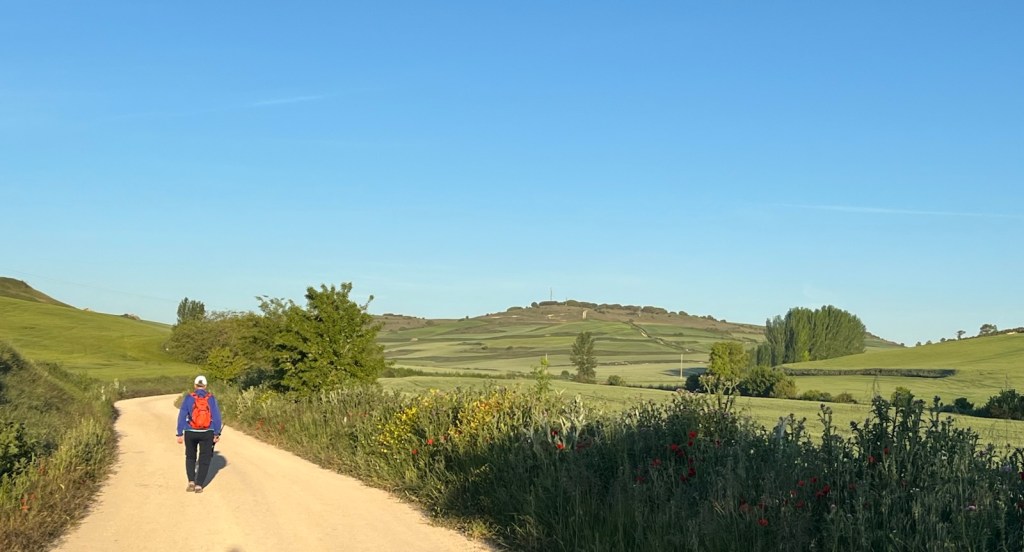
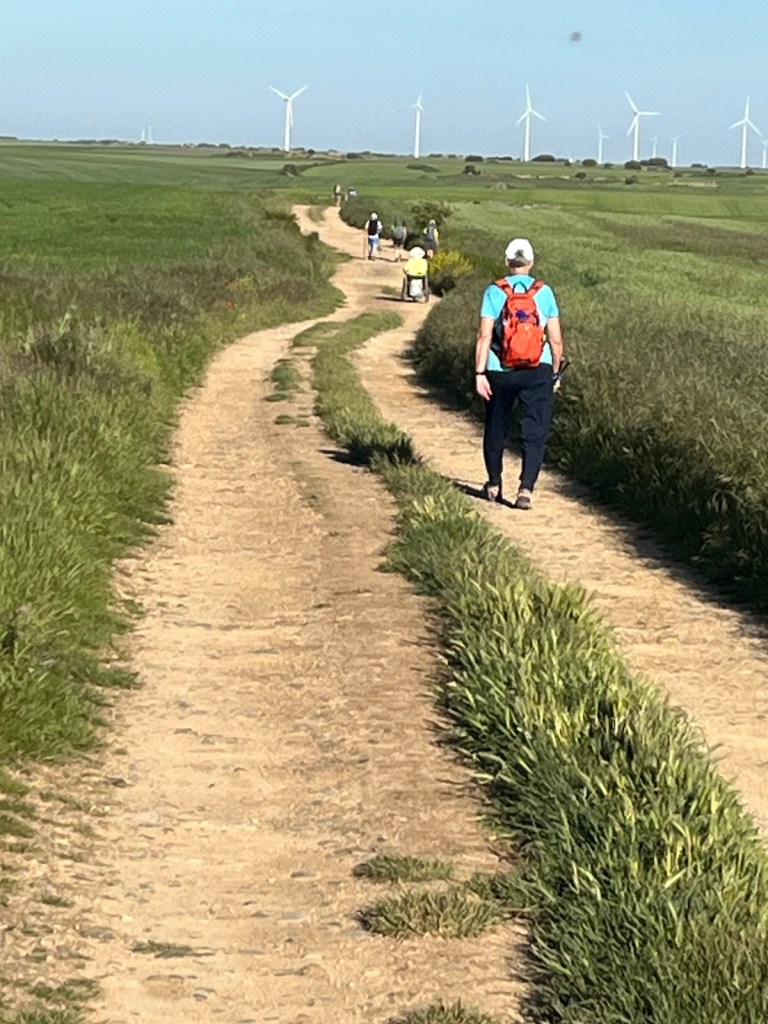
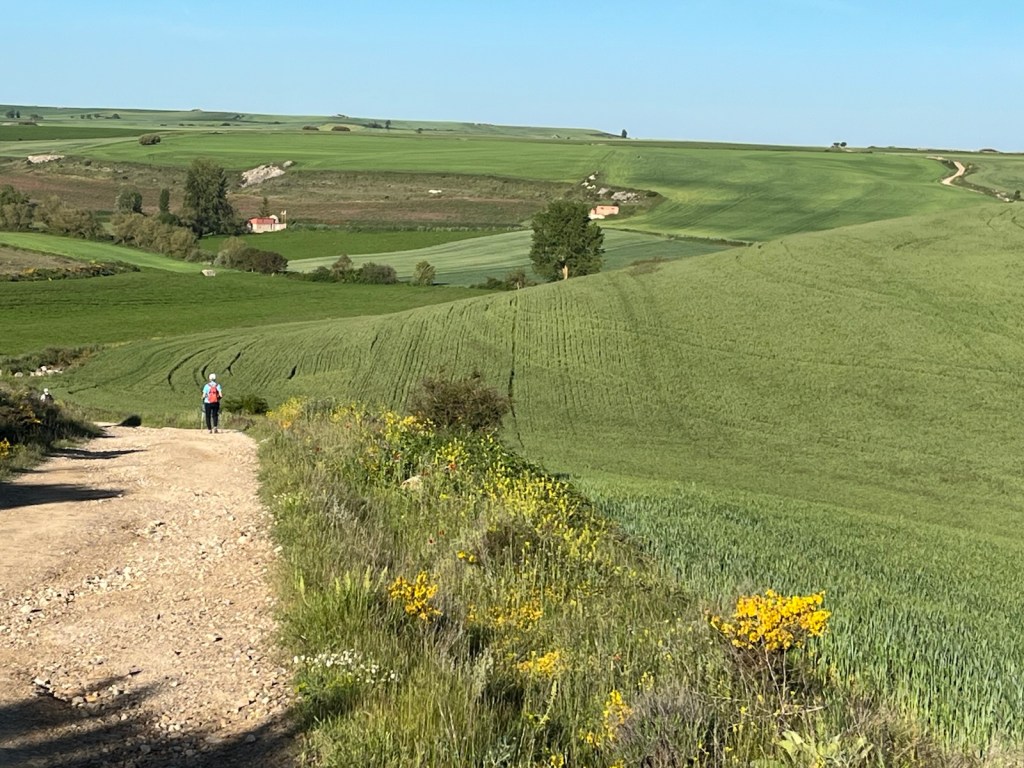
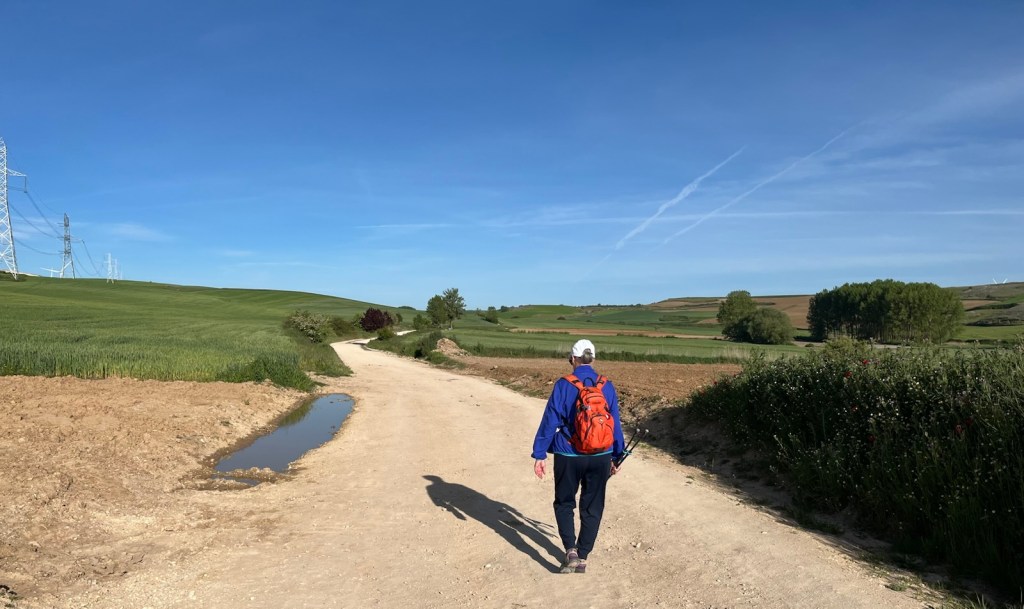
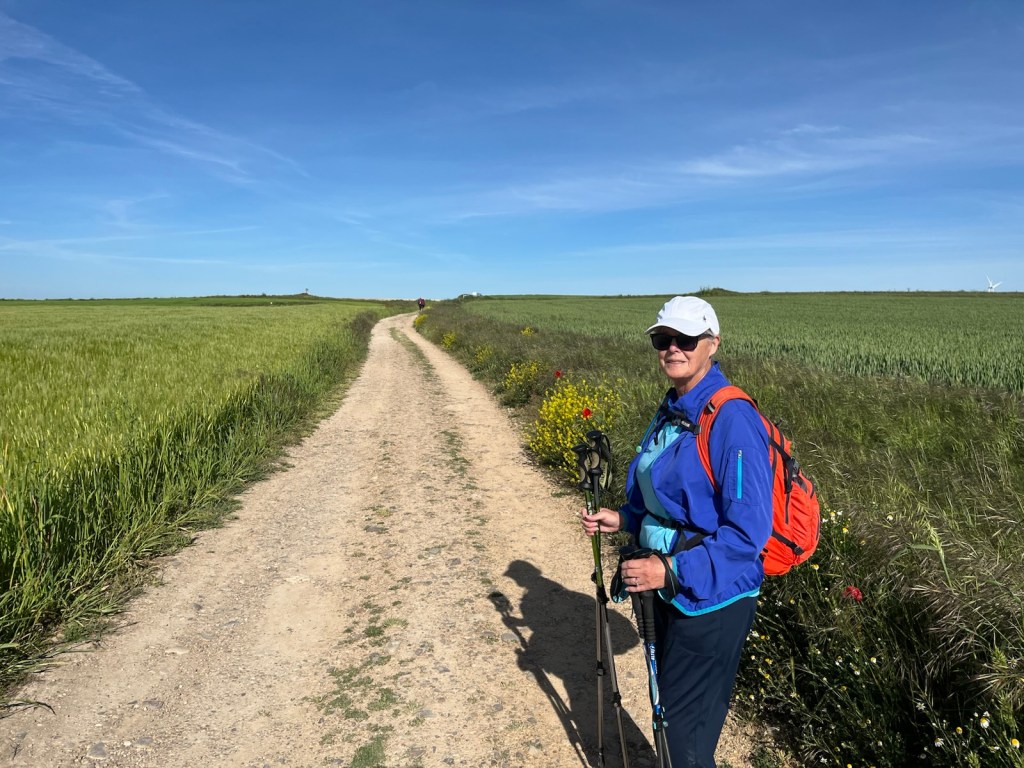
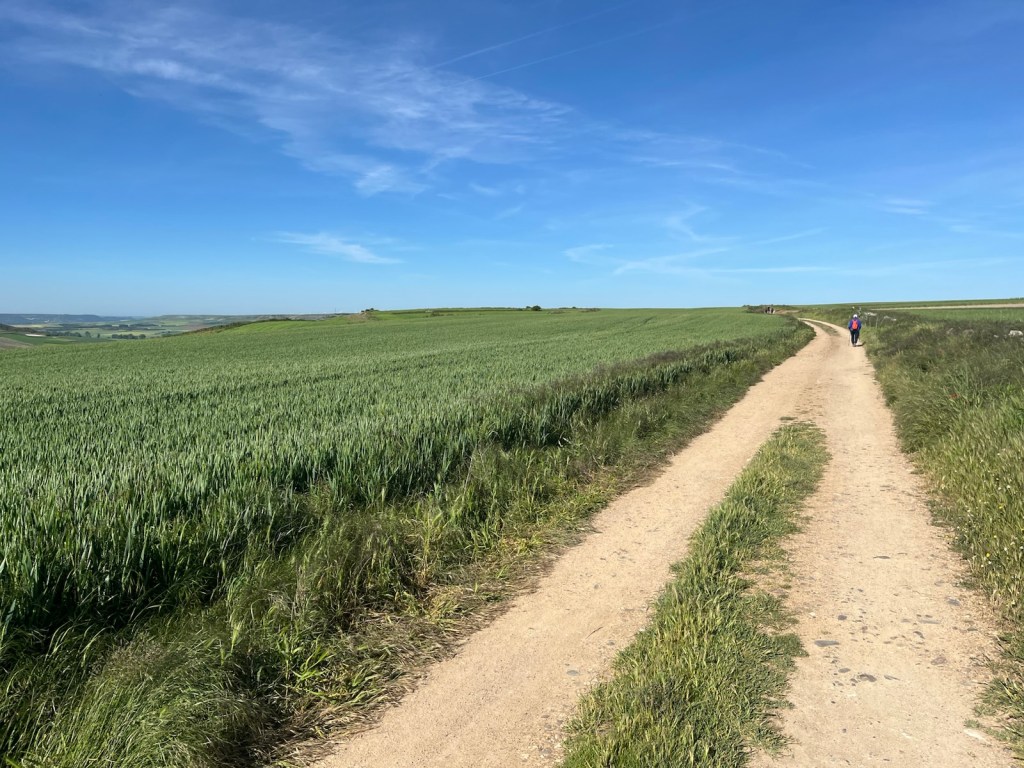
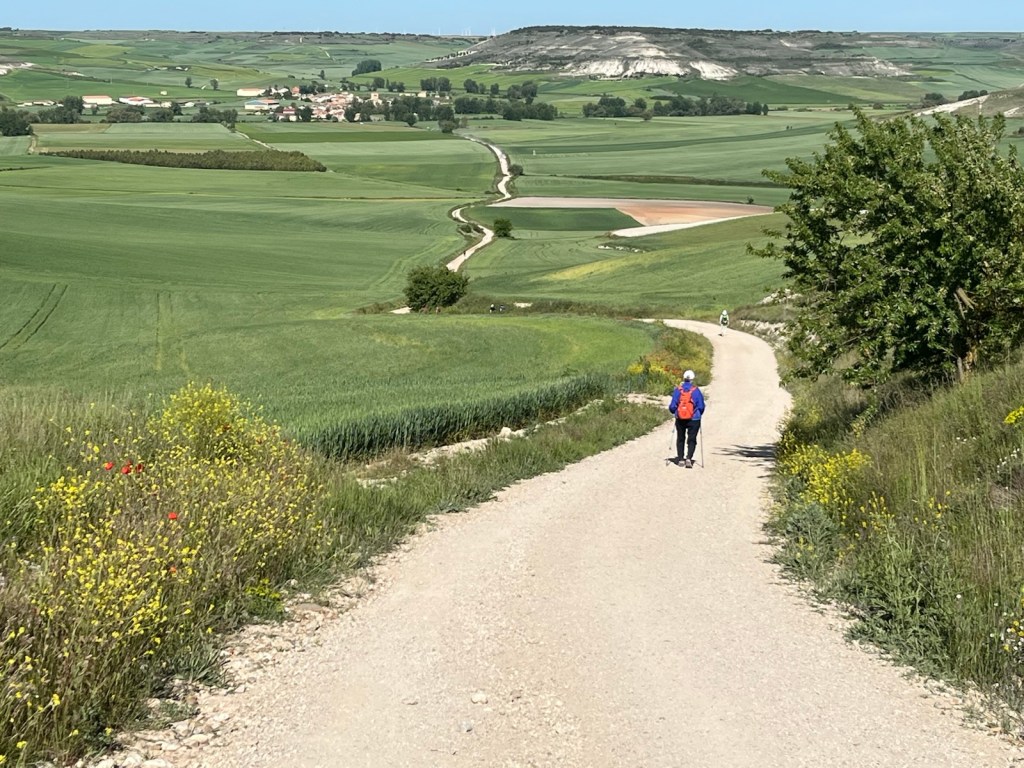
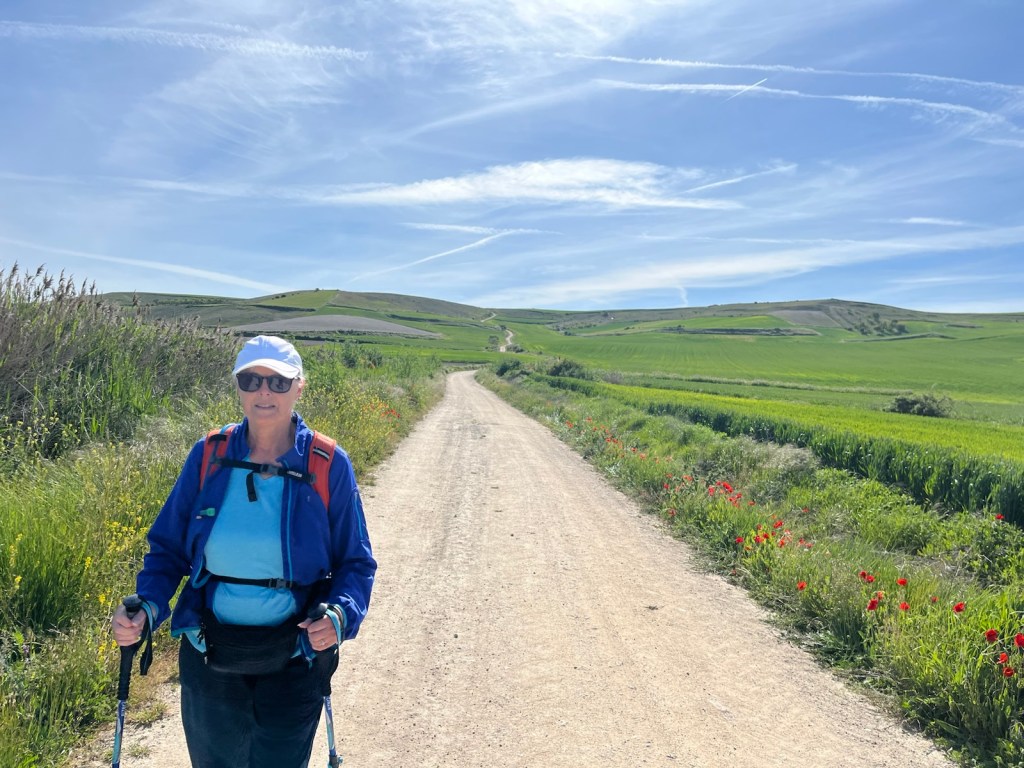
The typical scenery of the walk between Itero de Vega and Boadilla en el Camino.
Jim was so distracted, he failed to take any pictures while focusing on his limited command of French!
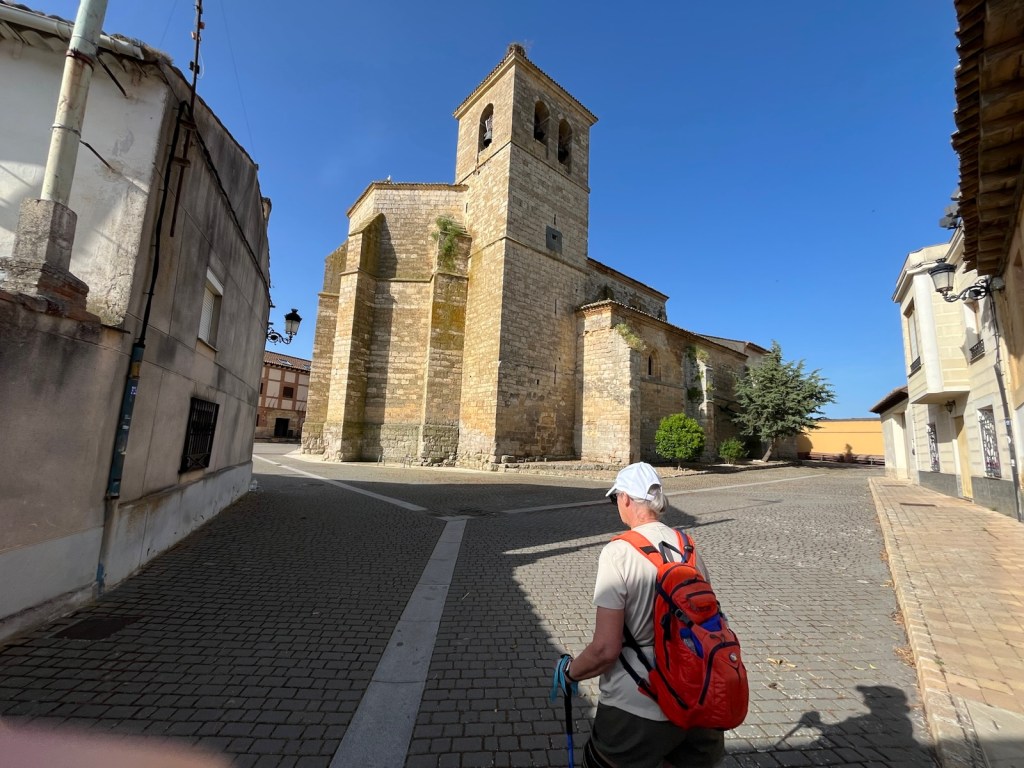
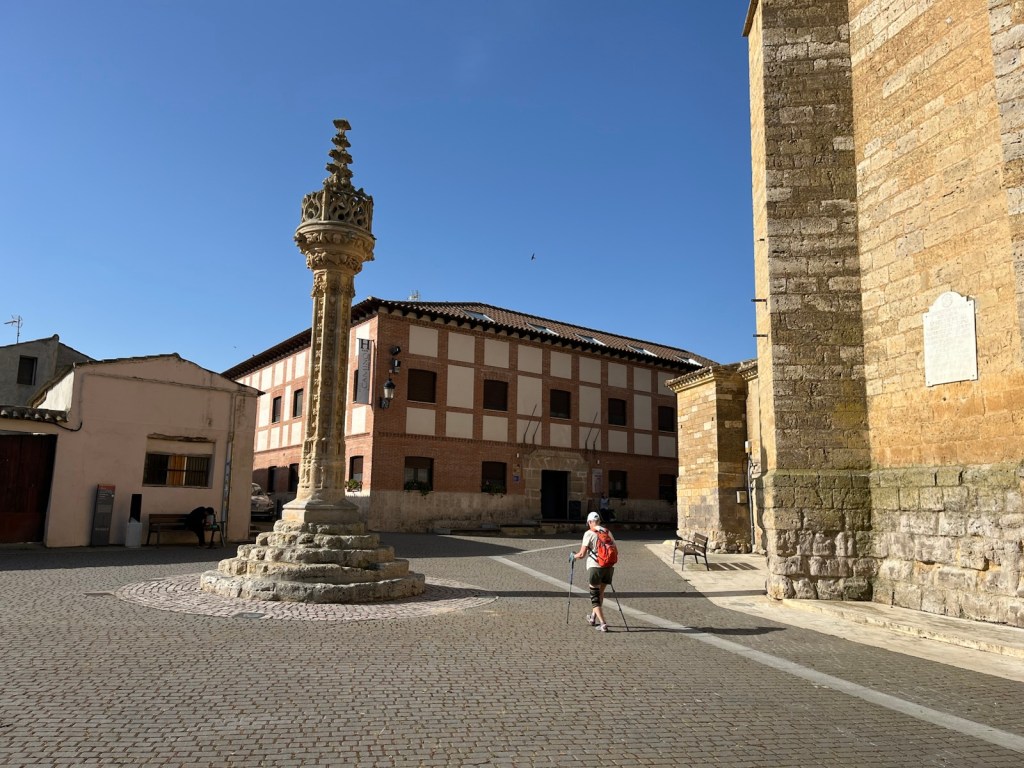
Santa María of Boadilla en el CaminoThe Rollo de la Justice in the village square and Hotel en el Camino behind it,
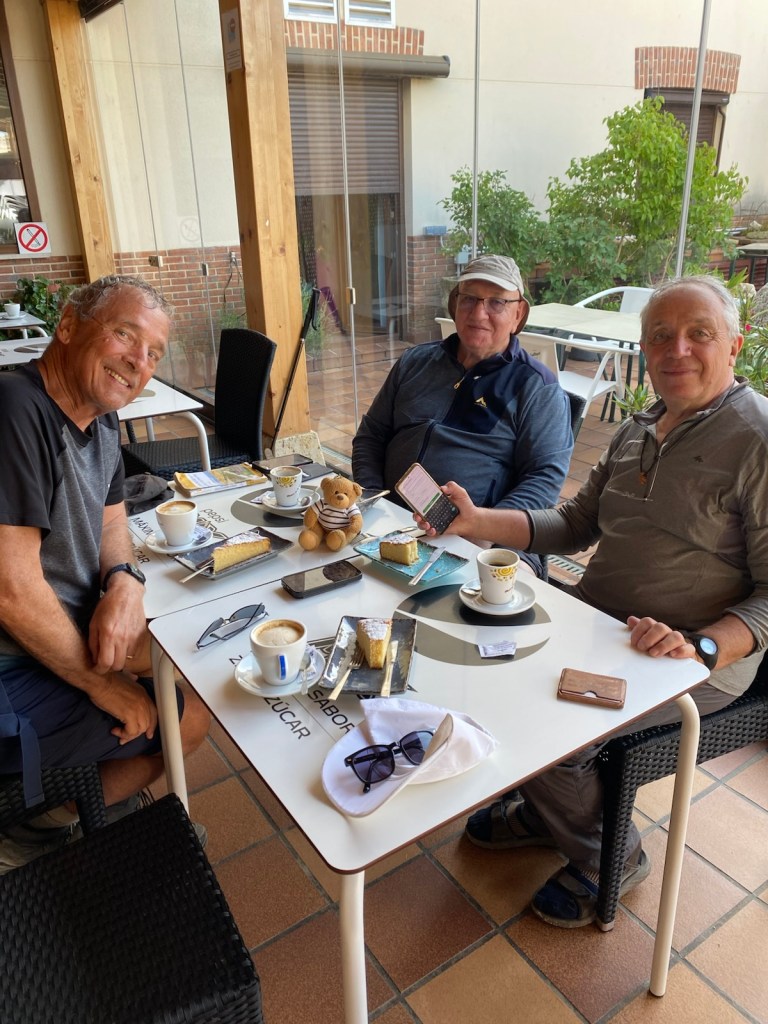
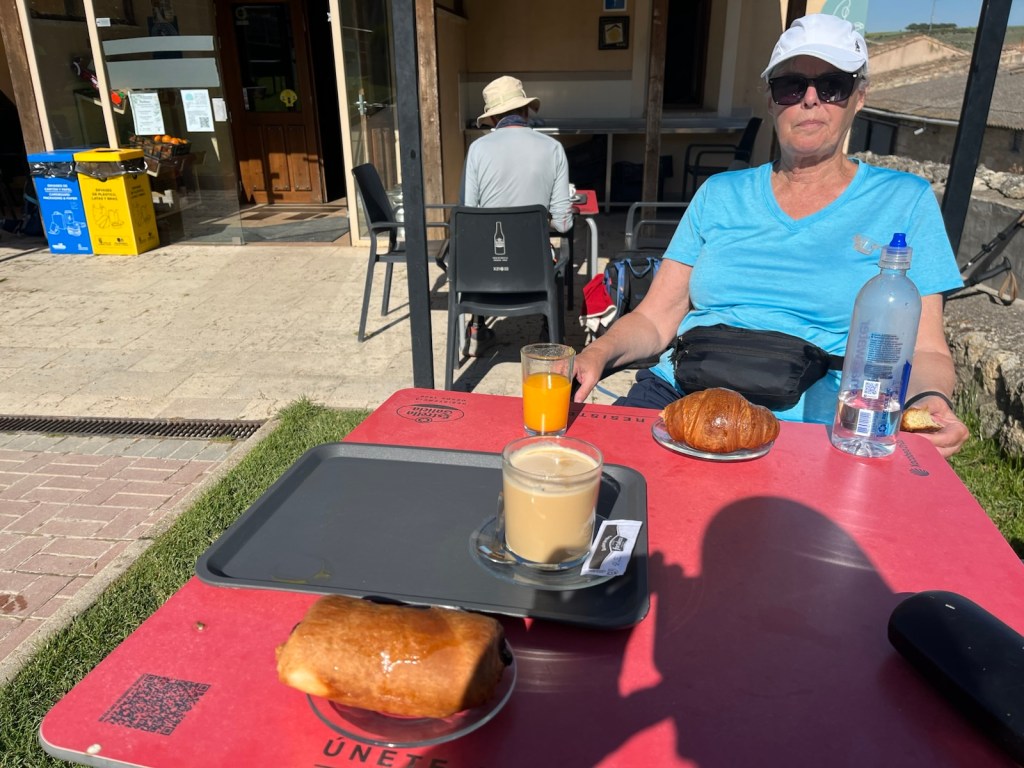
Our French friends, Gilles and Herve were waiting for us when we arrived and we continued our conversations over a breakfast of cafe con leche and Santiago cake.
Herve and Gilles from Bretagne region of France.
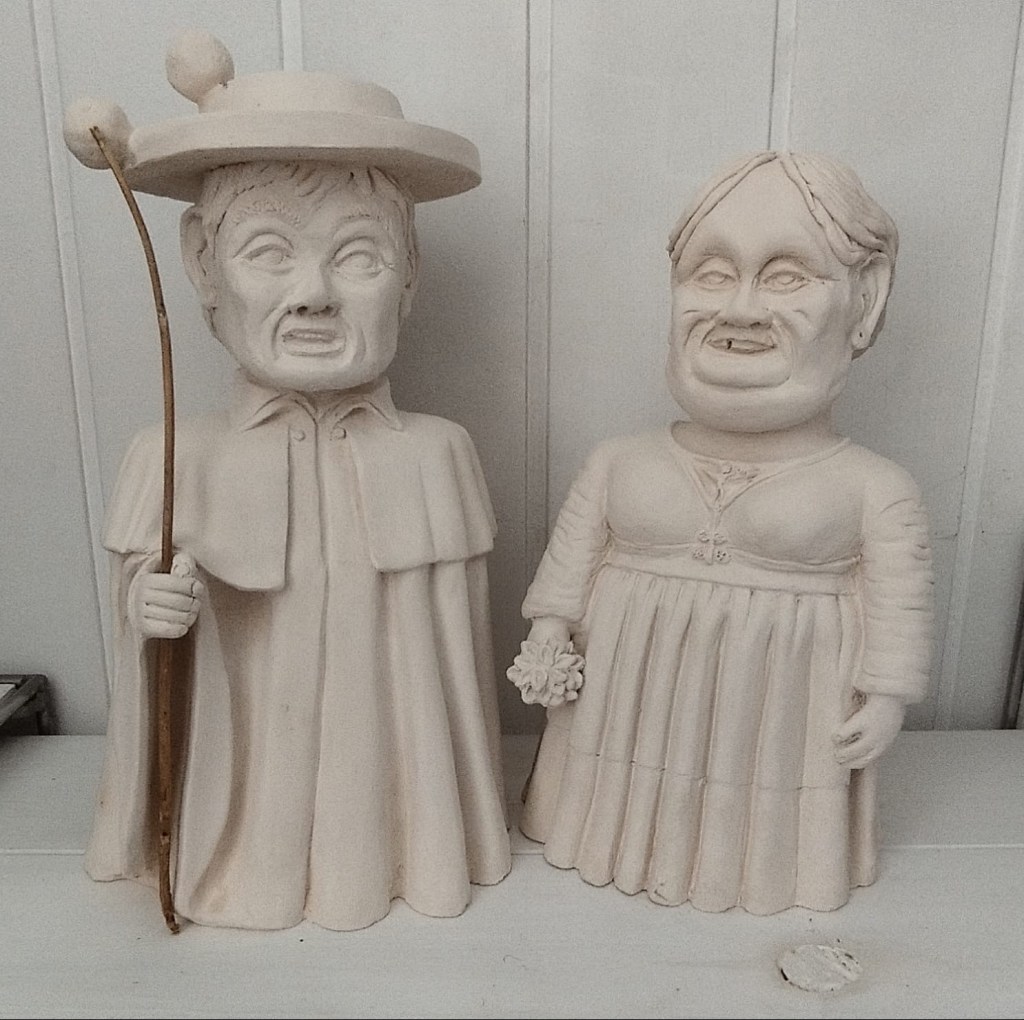
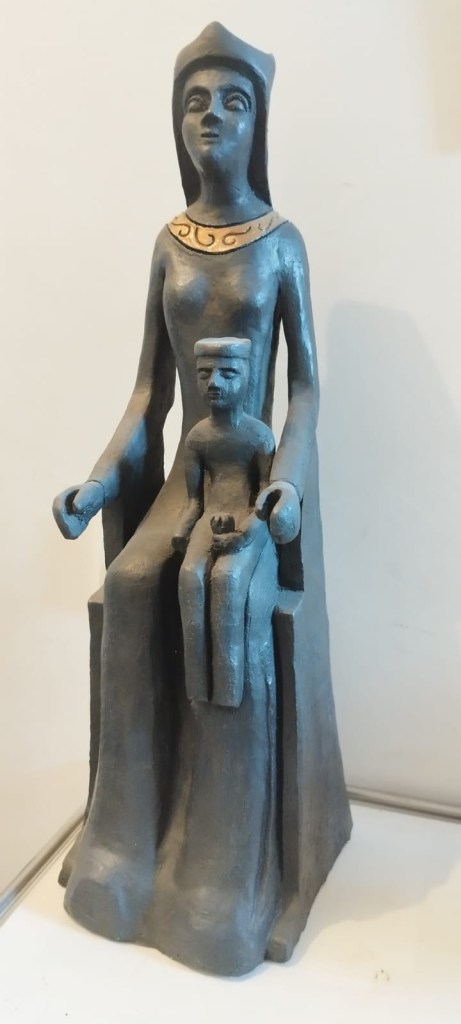
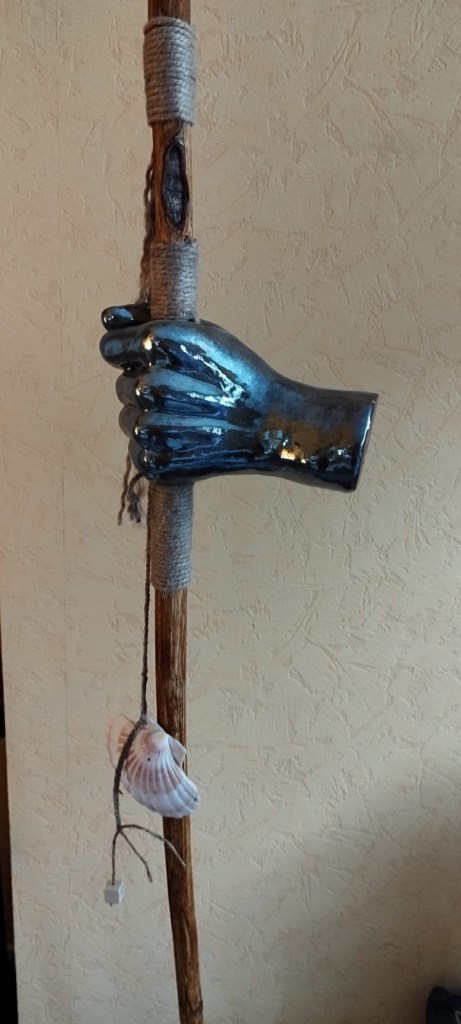
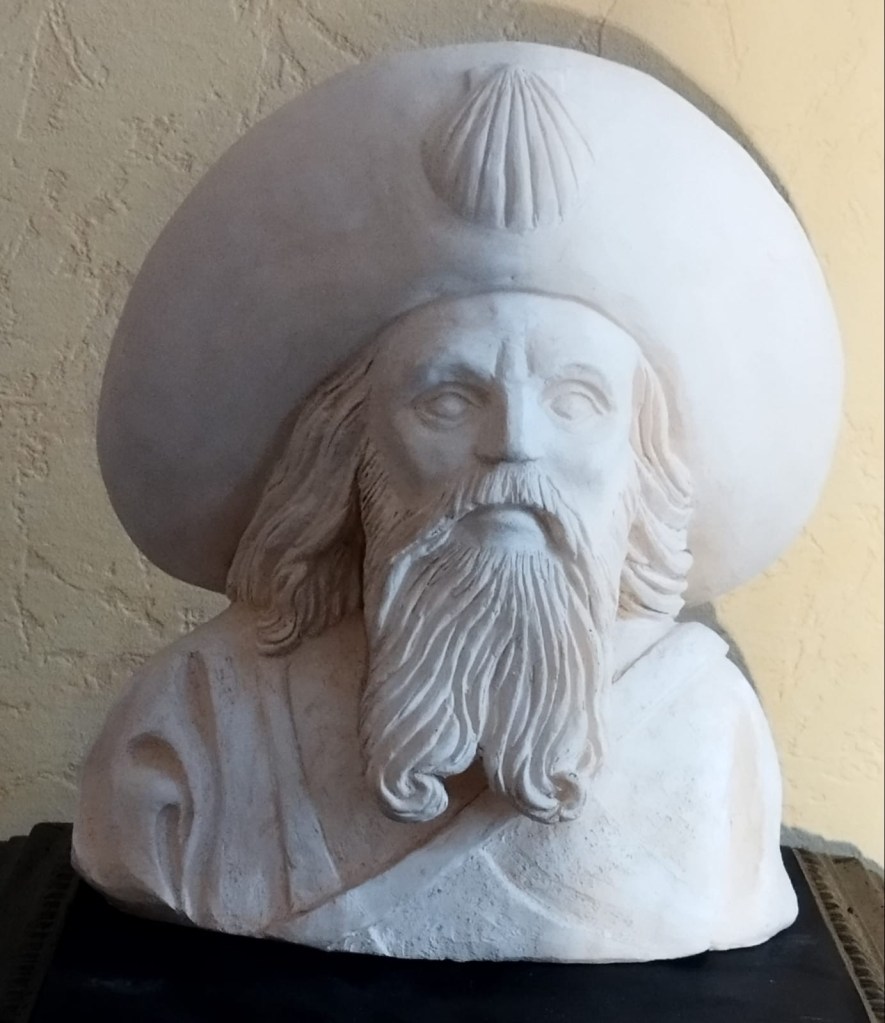
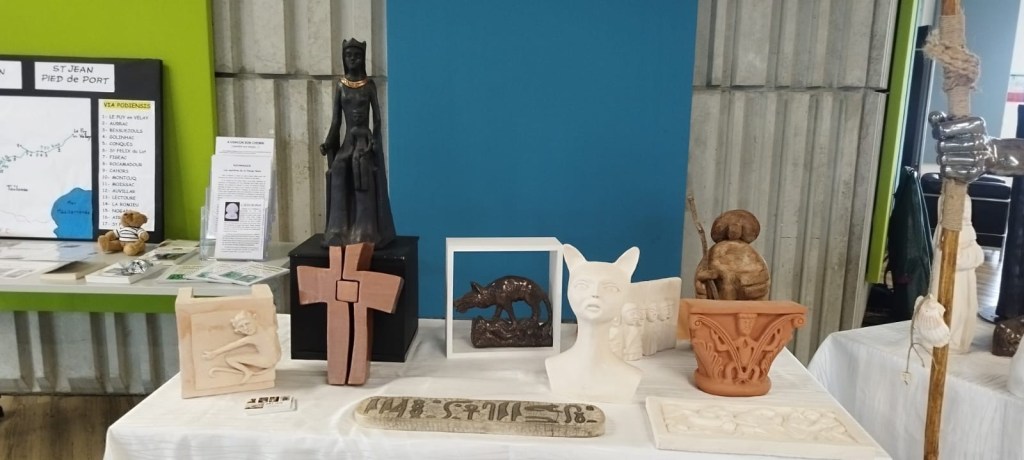
We discovered at breakfast that Gilles is an accomplished artist, working in ceramics and various forms of sculpture. He also performs in local theatre. Below is some of his art work.
We said our goodbyes and our interesting friends from Brittany departed for the next town, Fromista, and after a short wait, we checked in and performed our daily chores.
At 2:00, we had a simple, but filing lunch of chicken soup for Linda and a bean salad for Jim. We both had different styles of chicken breast for second course and dessert was watermelon and ice cream. As also, our meal of the day was accompanied by a nice, no label local red wine.
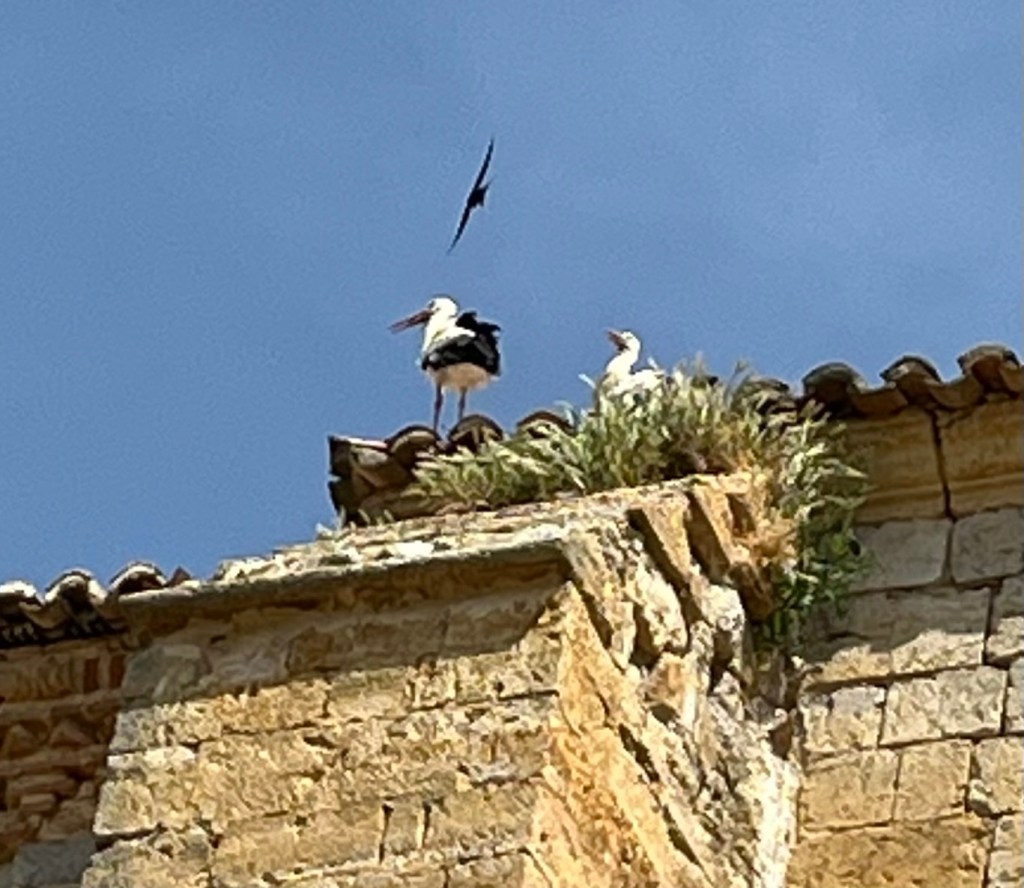
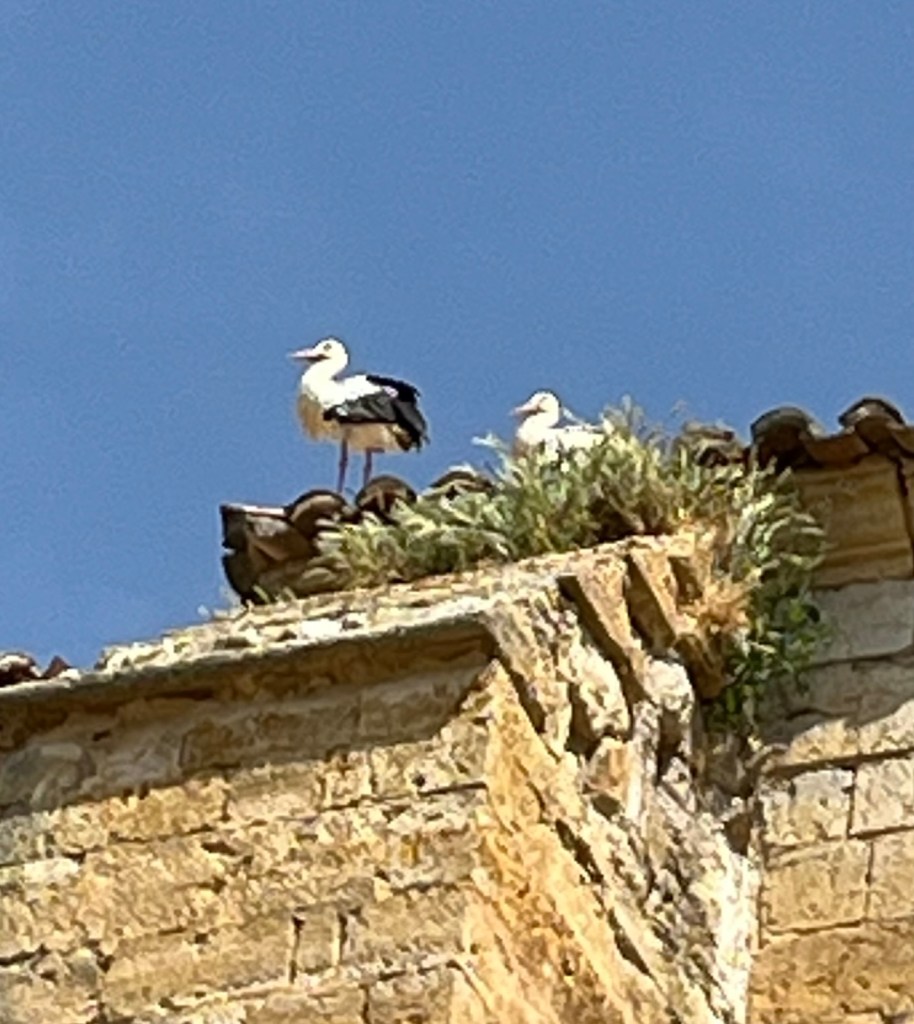
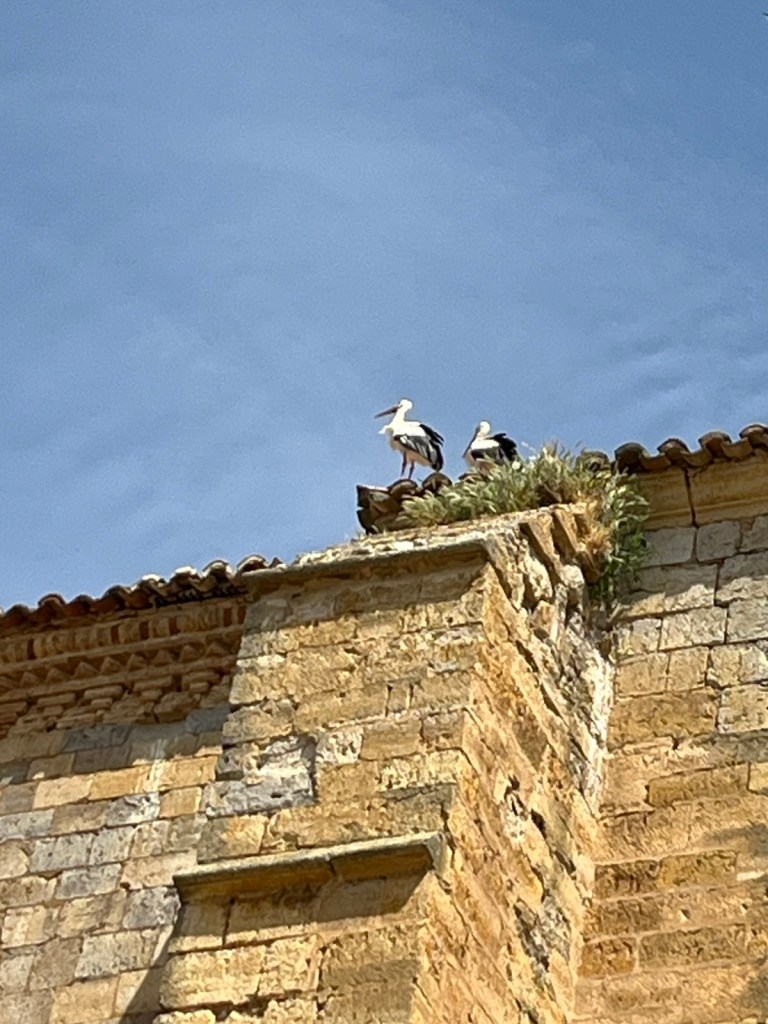
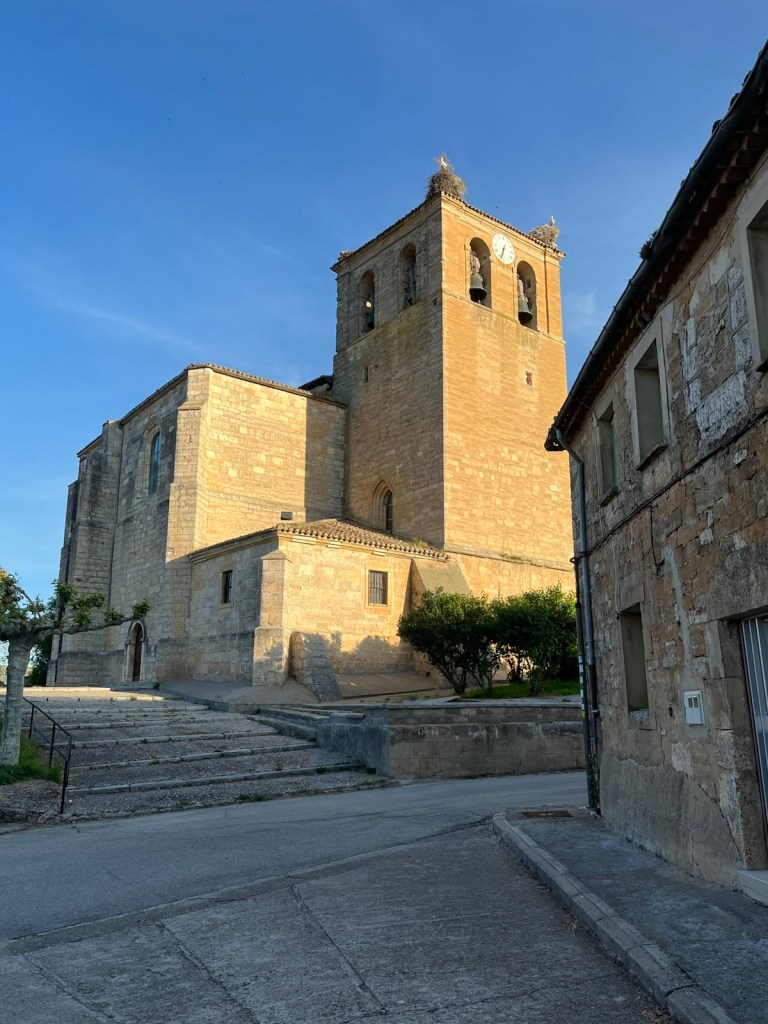
Jim entertained himself for an hour or so watching several stork couples, nesting on the church roofs adjacent to our hostal.
The rest of the day was dedicated to the usual naps, reading and blogging to end another interesting day on the Camino Frances.
It was raining when we woke, so we put on our rain gear and began the mile long walk across Castrojeriz. Within minutes the rain stopped, remaining in Castrojeriz, but not following us as we walked out of town and westbound. The Camino joined the former Roman road leading to a Roman causeway that crossed what was once a lake/swamp.Linda walking on the causeway, hard to see the Roman stone structure today, due to the overgrowth.The causeway revealed as it approached the ruins of the Roman bridge.Linda reaching the end of the 2000 year old Roman structure still functioning today.
When it became apparent that the rain was behind us, we removed the rain-gear.
We continued our walk through the valley until reaching the base of Alto de Mostelares.We began the steep climb up Alto de Mostelares.It was a hard climb. Adding to what was already a difficult task, hoards of mosquitoes began swarming around us, requiring constant swatting and waving our arms to try, unsuccessfully, to drive the little suckers away. This continued all the way to the top.Head down, one foot in front of the other.Zoom (3x) of Castrojeritz left behind as we climbed higher.Linda teaching the top and ready for a brief rest, among still persistent mosquitoes.On our way again on top of Alto de Mostelares.Only a few hundred yards later, we reached the opposite side of Alto de Mostelares and the expansive valley below.The path down was thankfully, paved, but reaching a very steep 18 degree slope. Extreme caution was necessary to avoid a Camino ending knee injury.As we carefully descended an occasional look ahead revealed the path waiting for us once we reached the bottom.The path wove its way through the fields. Thankfully it was still early in the day and a breeze and cloud cover made the lack of trees (shade) a non-problem.Sometimes we forget to look back to get inspiration from the distance already traveled during the walk.At the 6 mile mark we stopped at the San Nicolas Chapel, a primitive albergue run by an Italian Confraternity. It has restroom facilities and has the practice of washing the feet of pilgrims who stay overnight.We next crossed the Rio Pisuerga, originally built in the 11th century to unify Burgos and Palencia provinces.We continued into the province of Palencia and on to our stop in Itero de Vega.Walking along the Rio Pisuerga and on into Itero de Vega.
We left Castrojeritz at 6:30 this morning to miss the forecasted 90F heat. That put us in Itero de Vega at 10:15. Not only did the high temperature not occur, but we arrived 2hr 45 minutes early for our checkin time of 1:00. So much for the best layed plans…
We perched in the Albergue courtyard, first to have breakfast, then patiently until getting an early checkin of 12:30! Jim’s liter of beer (Radler) also helped.A late afternoon hail storm interrupted our naps. Otherwise, we chilled, read and blogged until the 7:00 pilgrim dinner.
Tonight’s pilgrim dinner was served family style and included, mixed salad, pasta carbonara, vegetable soup, wine and yogurt.
We had interesting conversations with pilgrims from France, Quebec, Denmark, Germany and the US.
Another culinary experience to chalk up for Camino2025.
On our first few Caminos, we always left Hontonas in the dark to avoid the summer heat. There are two paths that leave Hontonas, one following the paved road and the other, a dirt path partway up the hill but not all the way to the Meseta, because Hontanas and Castrojeriz are both in the same valley.
Since our first Camino was in the dark, we took the paved road, minimizing our chances of getting lost. Also, as we discovered later, the paved path is lined with trees (shade) while the dirt path is more exposed to the sun. So, until today, we have always walked the paved path, but for Camino2025, we decided to walk the dirt path for the first time.
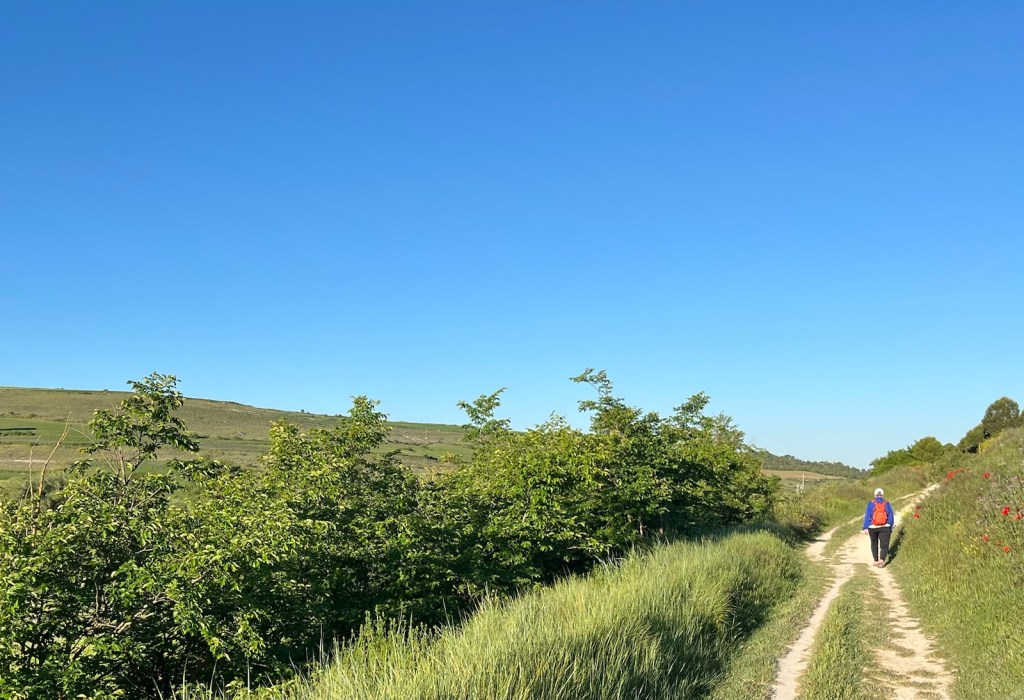
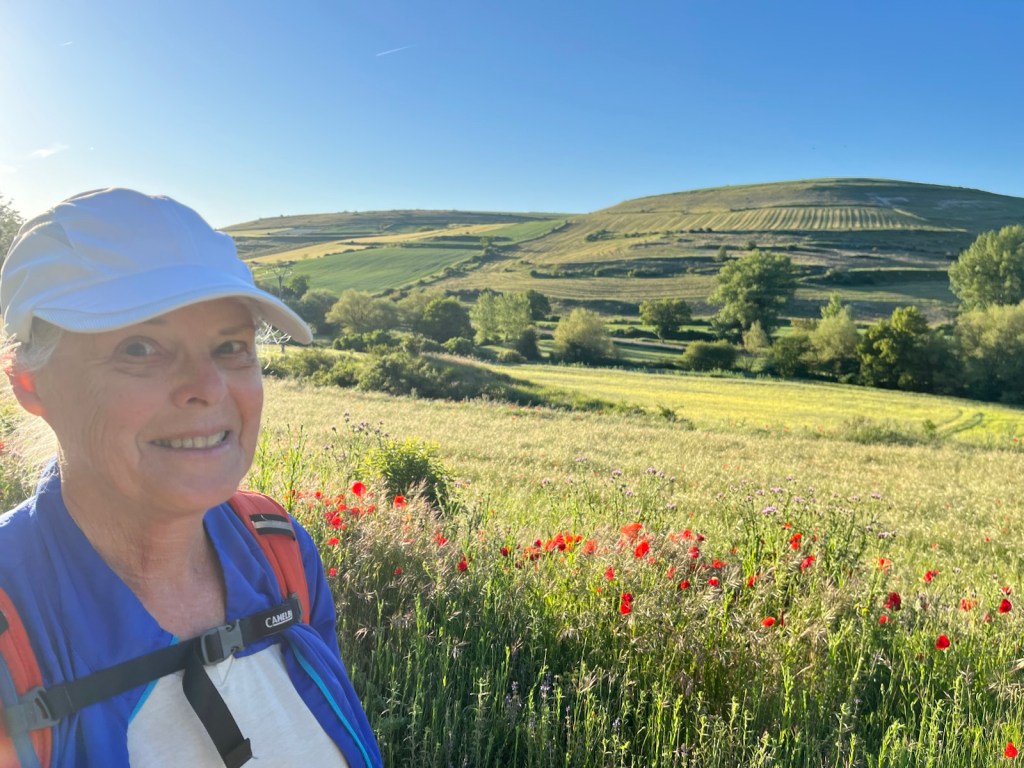
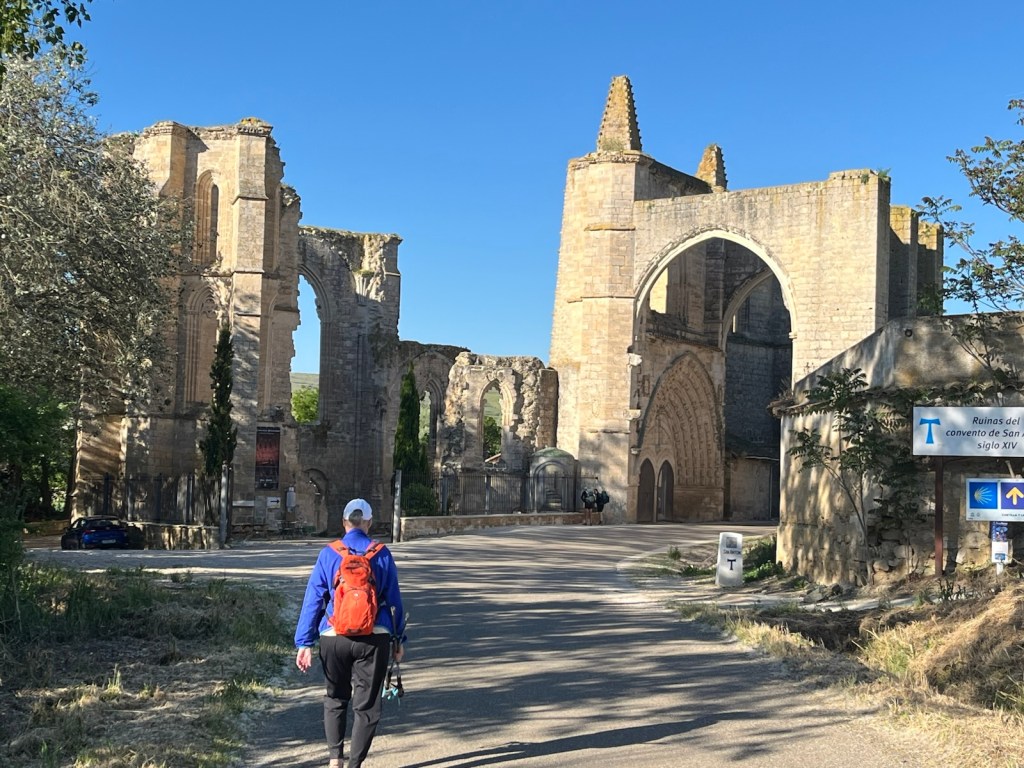
Today we opted for the dirt path.We’re about 30-40 feet above and parallel to the paved road.Blue sky, bright sun, in the 50F’s.The dirt path and paved path converge, almost after 3 miles.Poppies greet us all along the way.San Antón ruins dominate both sides of the road. Among the ruins is a primitive albergue with meals by candlelight, no electricity or hot water. It’s a very basic, special experience for some.
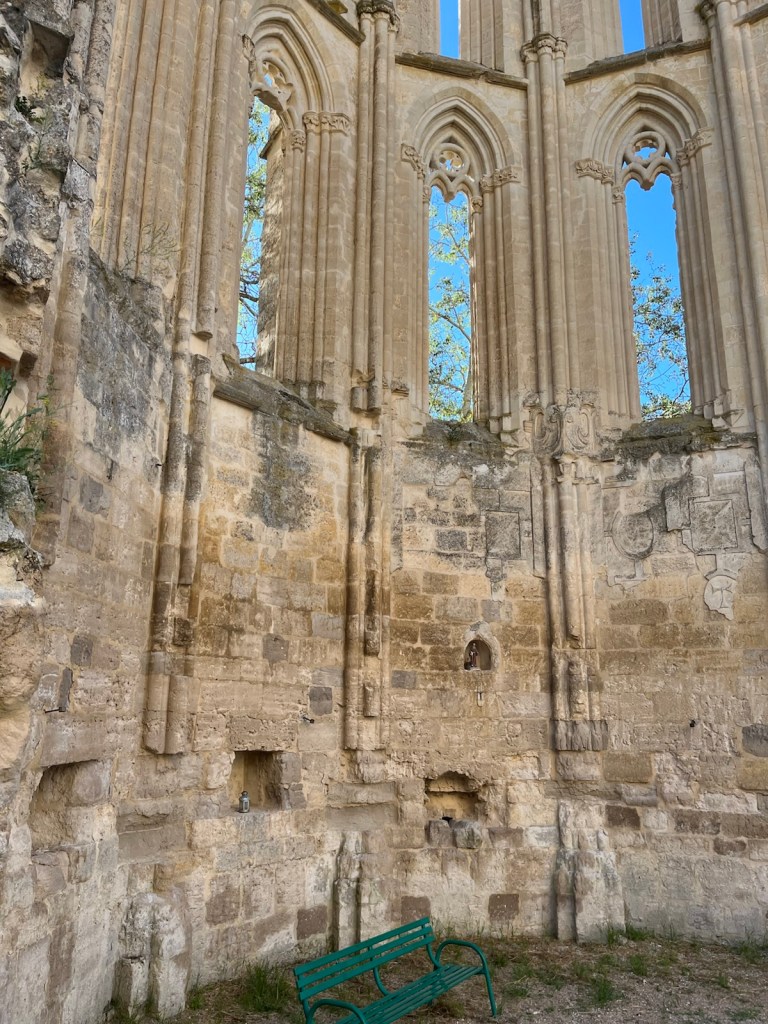
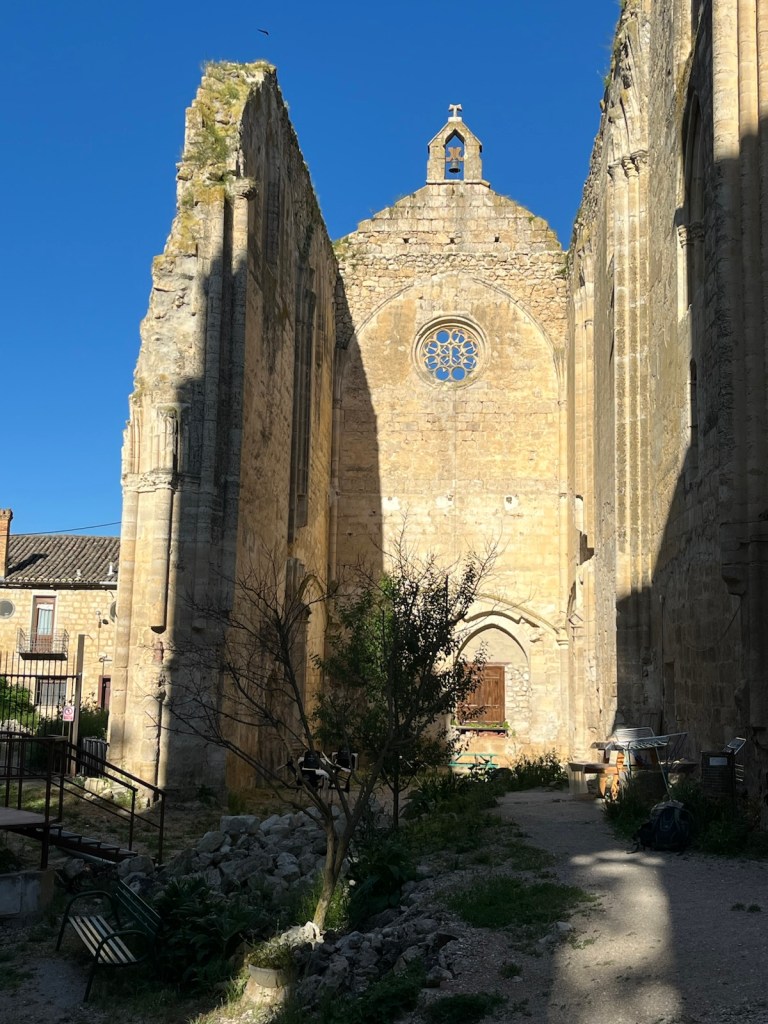
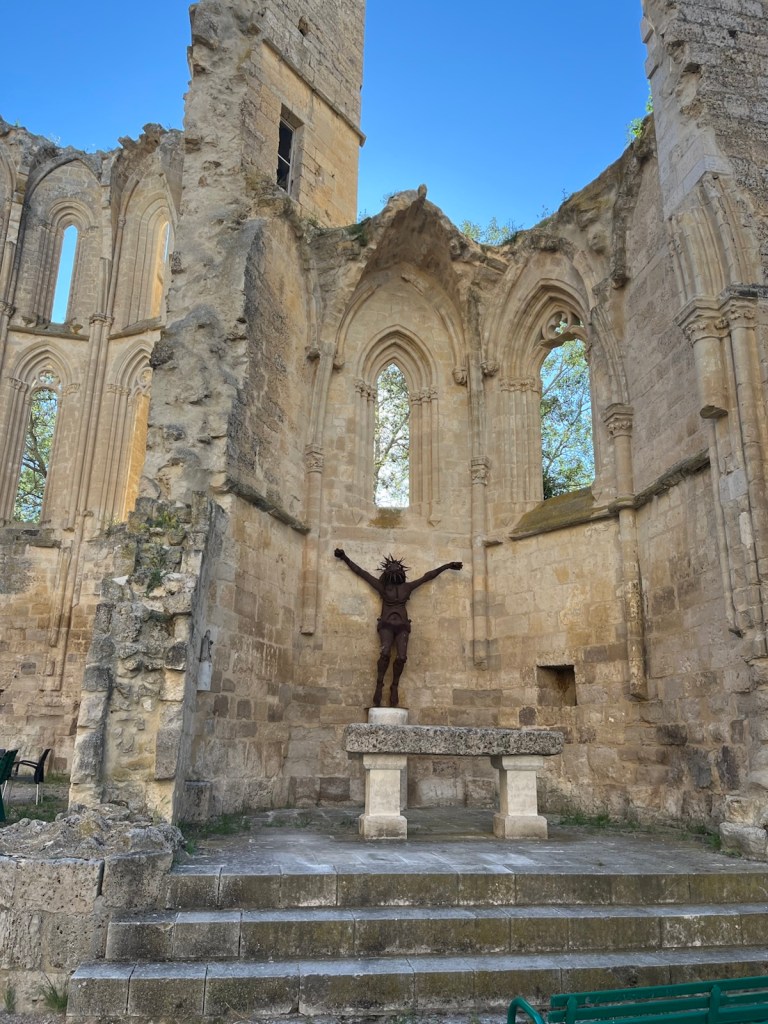
San Antón church complex was started by the Order of St. Anthony, a 11th-century order dedicated to the 3rd-century Egyptian hermit whose relics it held. A man brought his daughter to the relics and she was healed of a particularly pernicious disease reminiscent of leprosy. This disease became known as St. Anthony’s Fire, which caused a terrible burning feeling, loss of circulation and eventually gangrene. This disease was in fact likely ergotism, caused by a fungus that grows on rye bread. The order developed a reputation for healing this disease, though serendipitously, pilgrimage was an excellent antidote to the disease as vigorous exercise and plenty of wine helped to overcome it. The niches outside the church were used to hold food for the poor.
St. Antón is the patron saint of animals, and across Spain people bring their pets to be blessed on his saint’s day.
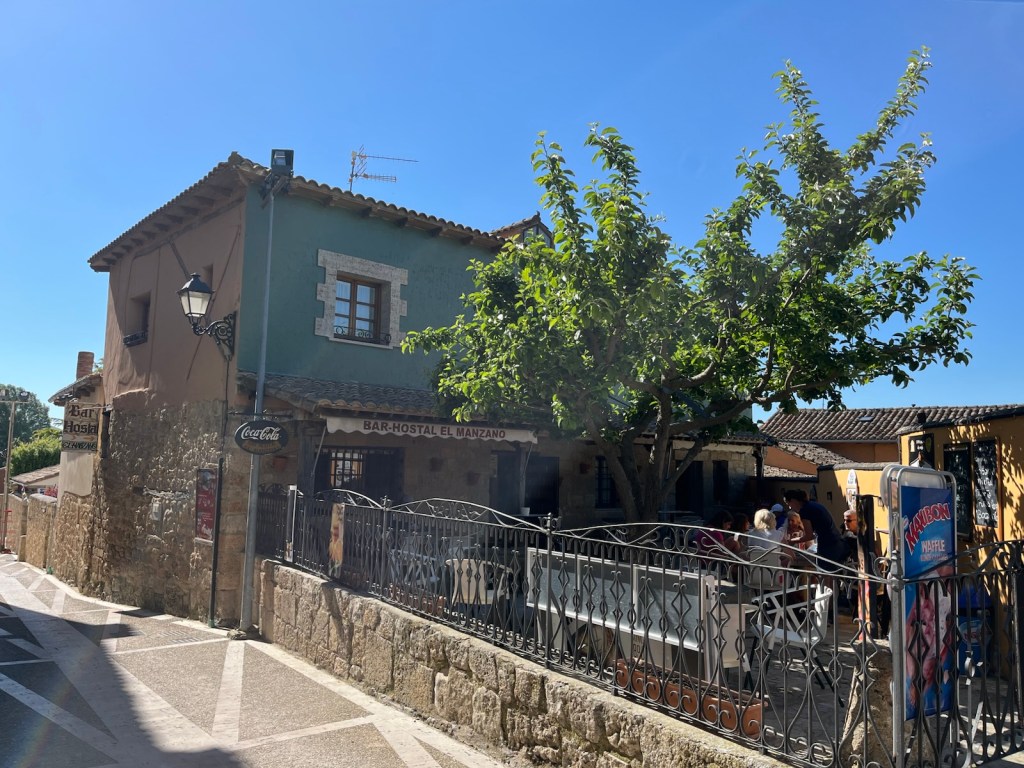
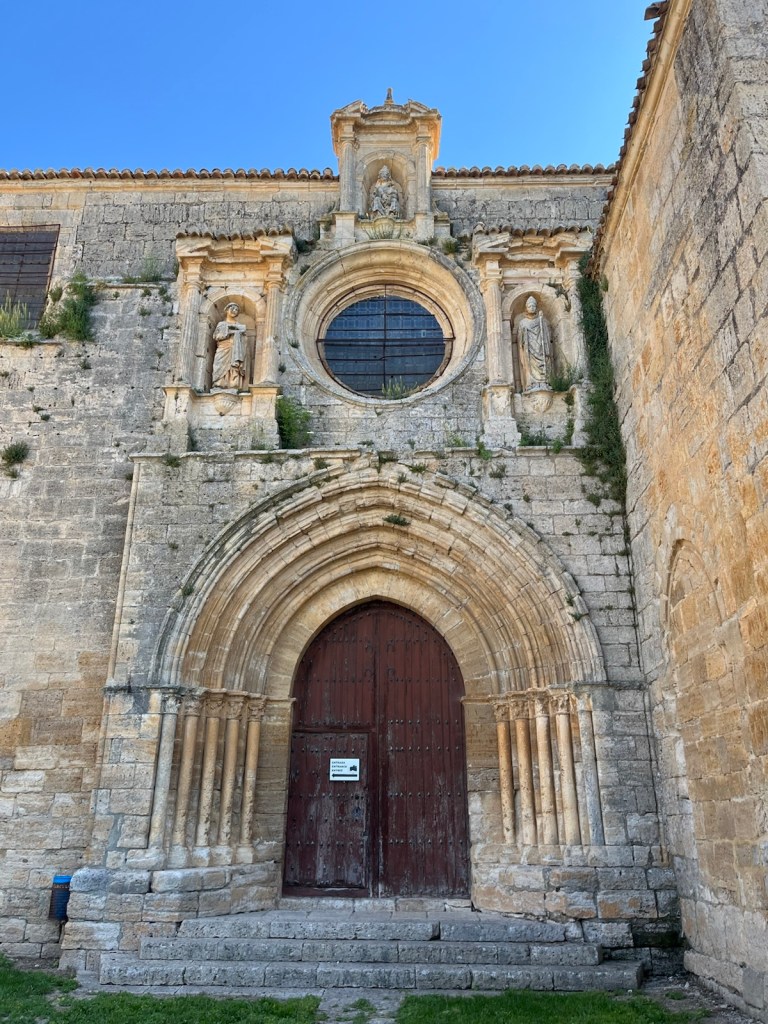
interior of San Antón ruinsmore interior ruins of San Antón the altarLeaving San Antón and walking on, with Castrojeriz castle and town some two miles ahead.… back on the dirt path with Iglesia de la Santa María del Manzano straight ahead.Entering Castrojeriz Bar-Hostal El Manzano. We stayed here on our first Camino in 2014. Currently run by its third owner since then.Our prolonged breakfast stop at Bar El Manzano, before walking to Albergue Orion (not open until noon).the side entrance of Iglesia de la Santa María del Manzano and directly across from our breakfast stop.
Legend has it that Mary appeared to St. James from an apple (manzano) tree and he was so startled that his horse reared up and came down heavily, leaving hoofprints in the stone outside the entrance of the Iglesia.
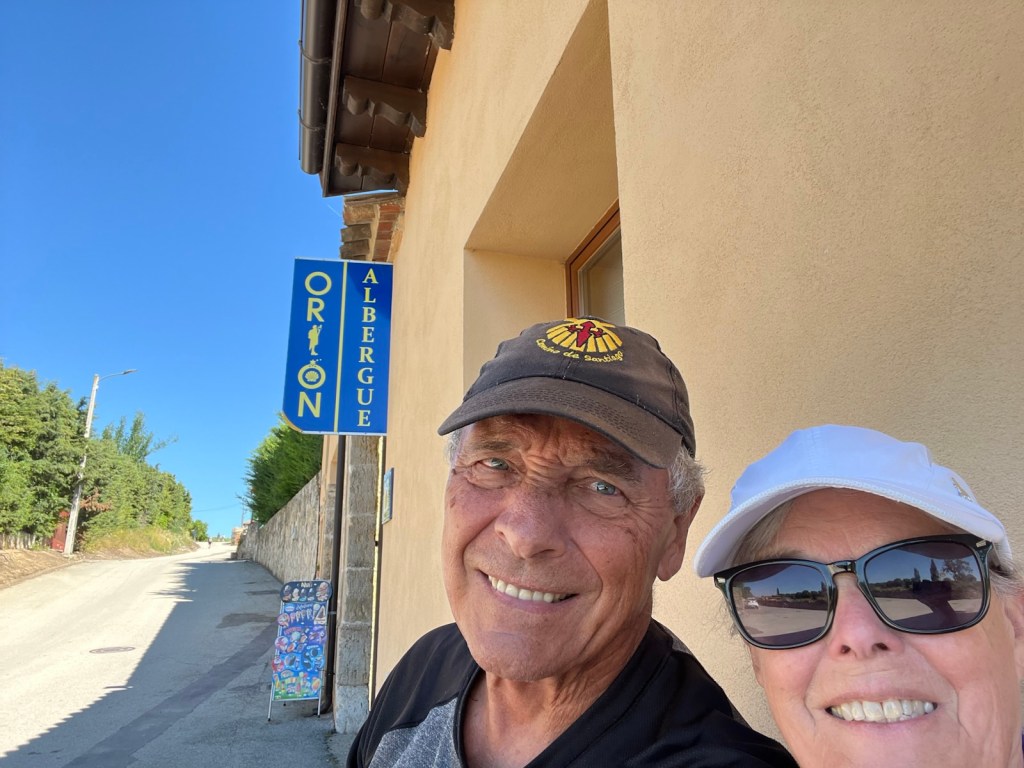
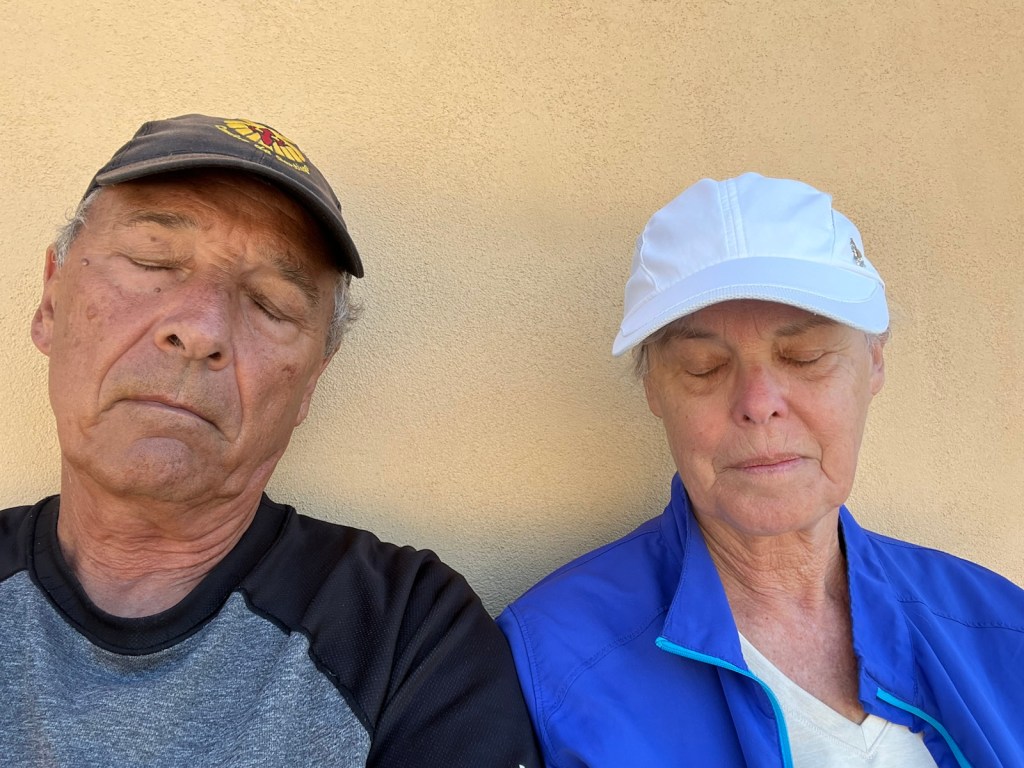
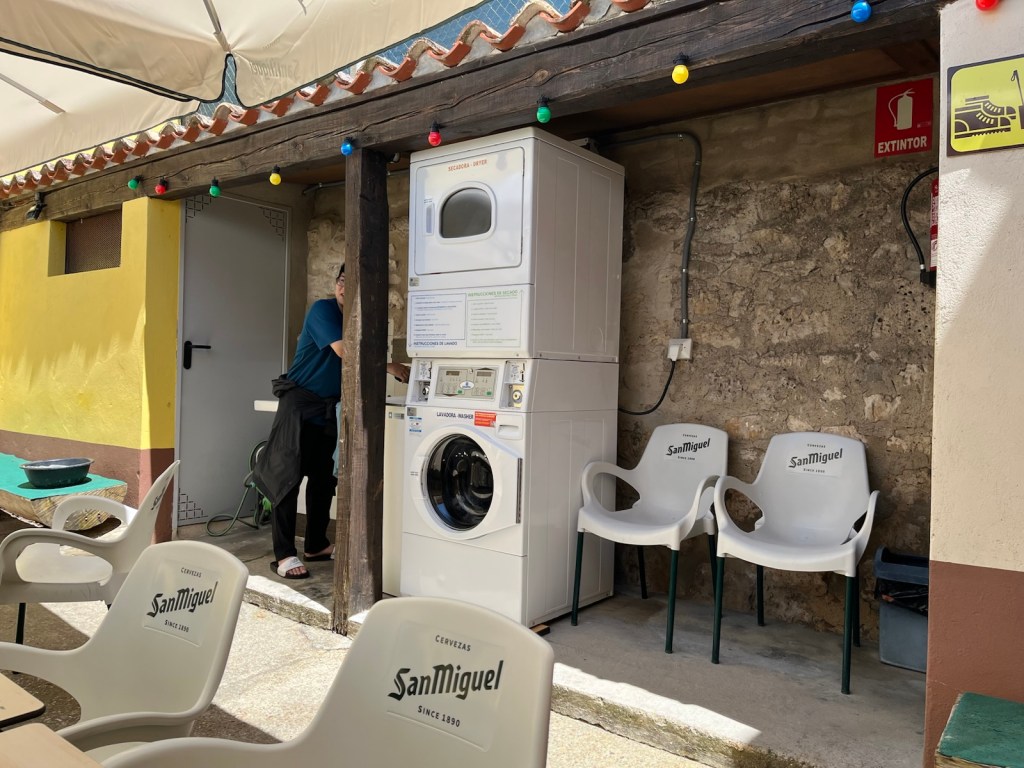
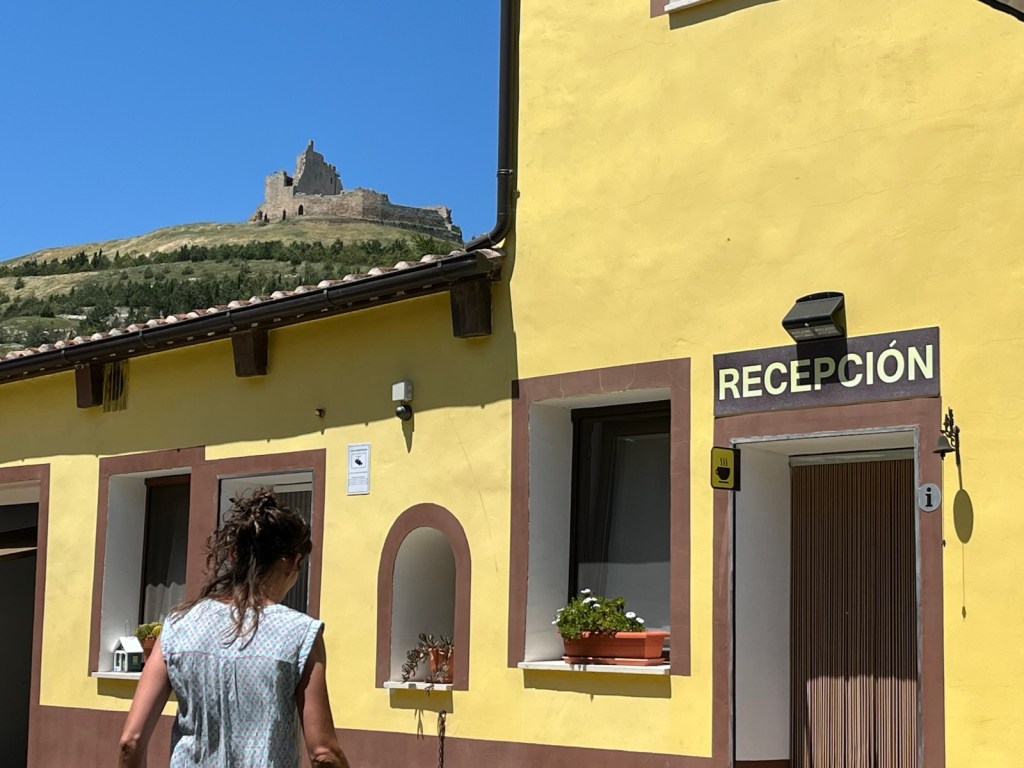
We tired of waiting at Bar El Manzano, so we found a bench in the shade outside the still locked doors of our albergue,Waiting was beginning to get the best of us this morning.The doors opened at 12:00 and we were quickly checked in.Albergue Orion is a favorite of ours. It has excellent facilities for cleaning clothes at nominal cost or you can wash by hand in well placed sinks and plenty of clotheslines and clothes pins for drying for free.Castillo de San Esteban observed from Albergue Orion
Castrojeriz occupies a perfect position for defense along the steep mesa topped by the Castillo de San Esteban. The Romans used the castle, said to be founded by Julius Caesar, to protect the roads to Galicia’s lucrative gold mines. The city changed hands frequently until coming under Christian rule in the 10th century.
We signed up for the 7:00 special evening dinner. But we also split a meal at 1:30 to hold us until dinner time.
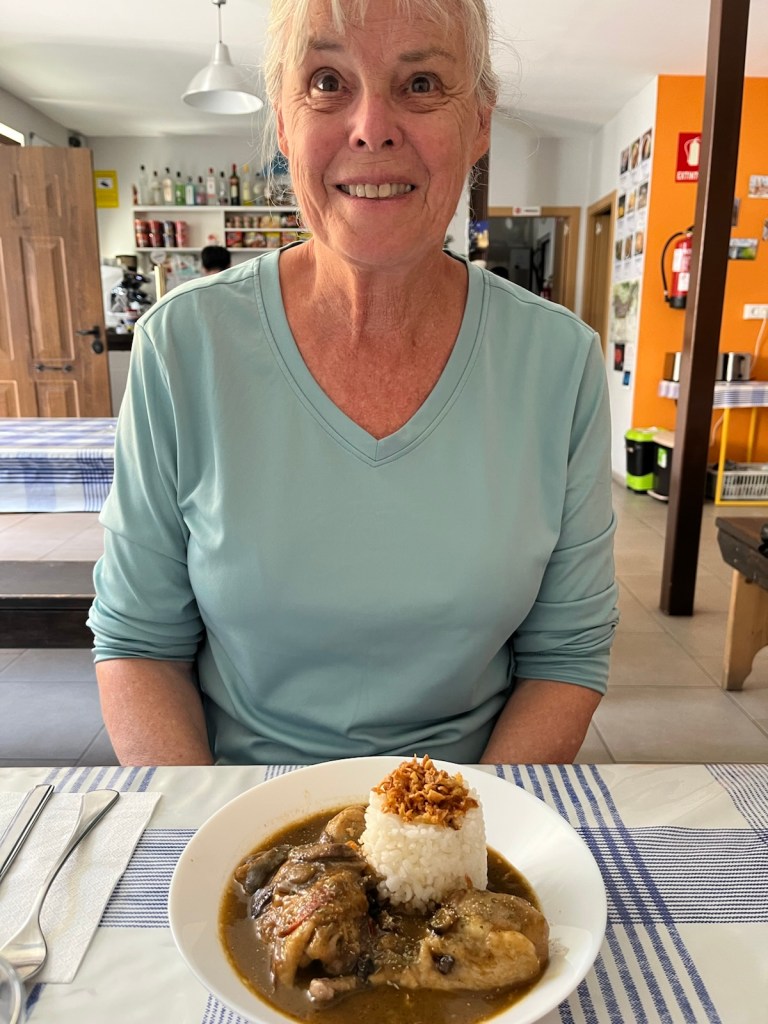
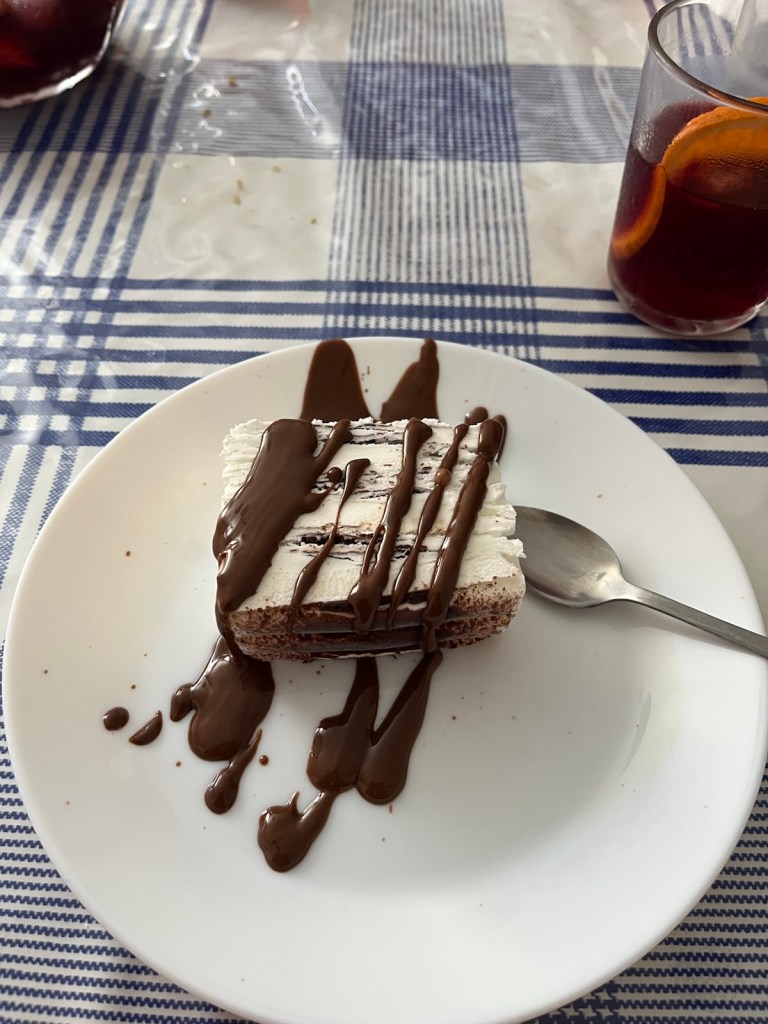
We haven’t had sangria yet, so we figured today was a good time to start.Linda had a delicious bowl of chicken soup, also confirmed delicious by Jim.Jim had an also tasty and filling spaghetti.Dessert also came with the meal so Linda had yoghurt with honey…… and Jim had helado. And we still have dinner to look forward to!
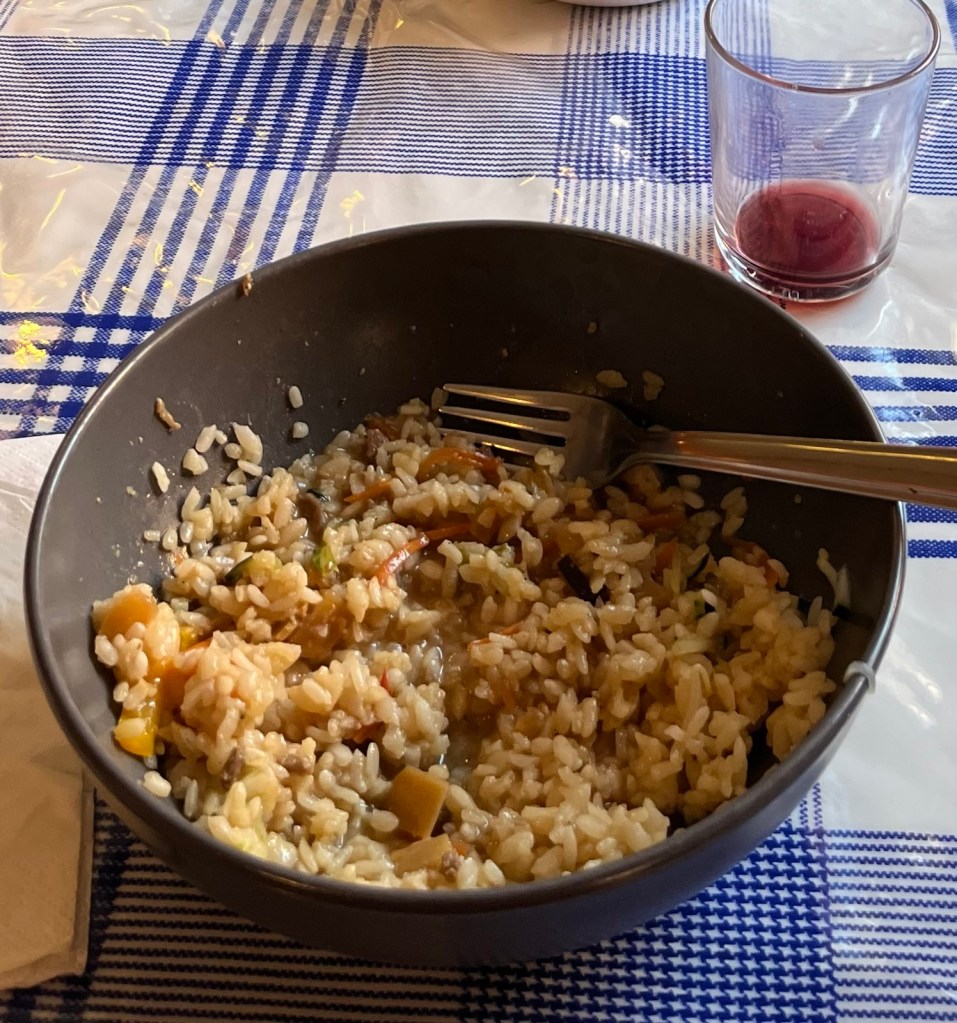
Dinner was enjoyed by 20 pilgrims from Netherlands, Korea, Japan and US. The traditional Korean meal was served and it was as good as we remembered from last year. Unfortunately Jim dived right in and forgot to take a photo. So all we got was the remnants of his meal.
With good food, taking before and after photos requires discipline, which was lacking for tonight’s meal.
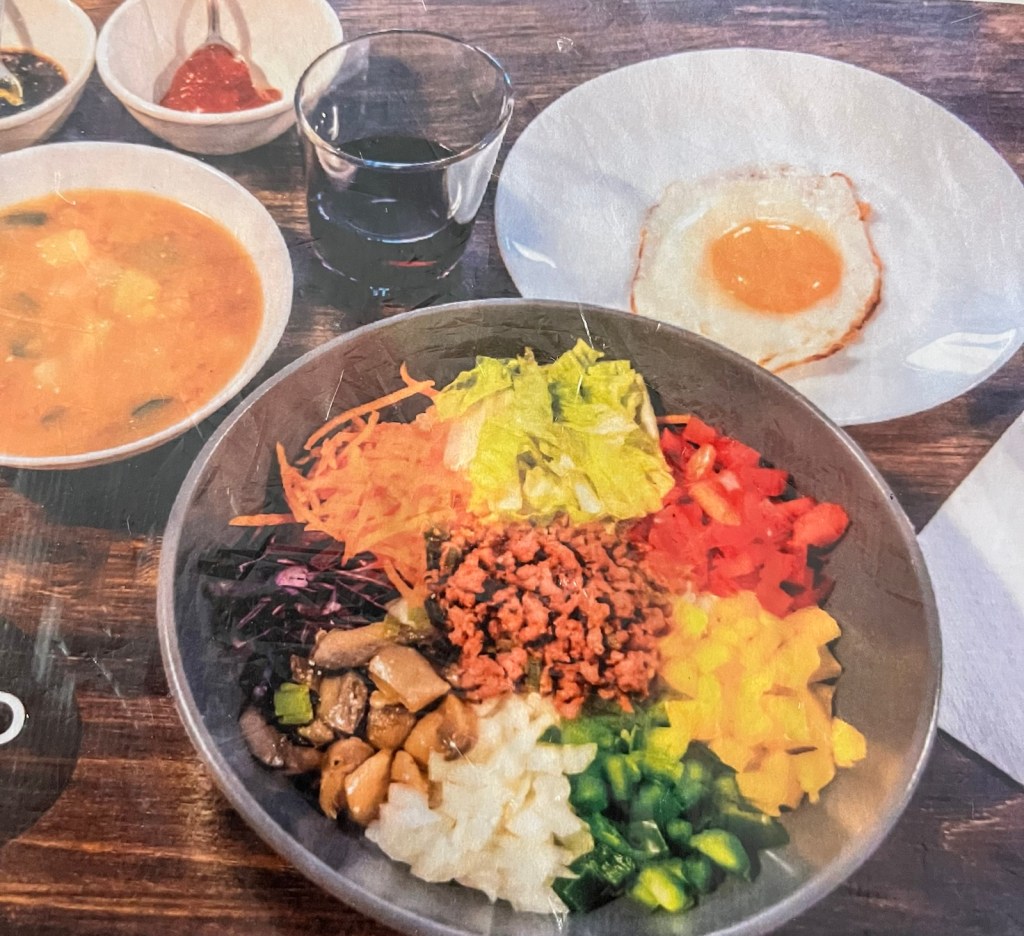
However, the owner graciously shared her photo of the dish before some voracious pilgrim got his hands on it.
The assortment of vegetables and meat covers a bed of white rice. Miso soup is added, an over easy fried egg placed top and seasoned with a spicy soy sauce. Mix it together as you like, or not. It’s very healthy and tasty.
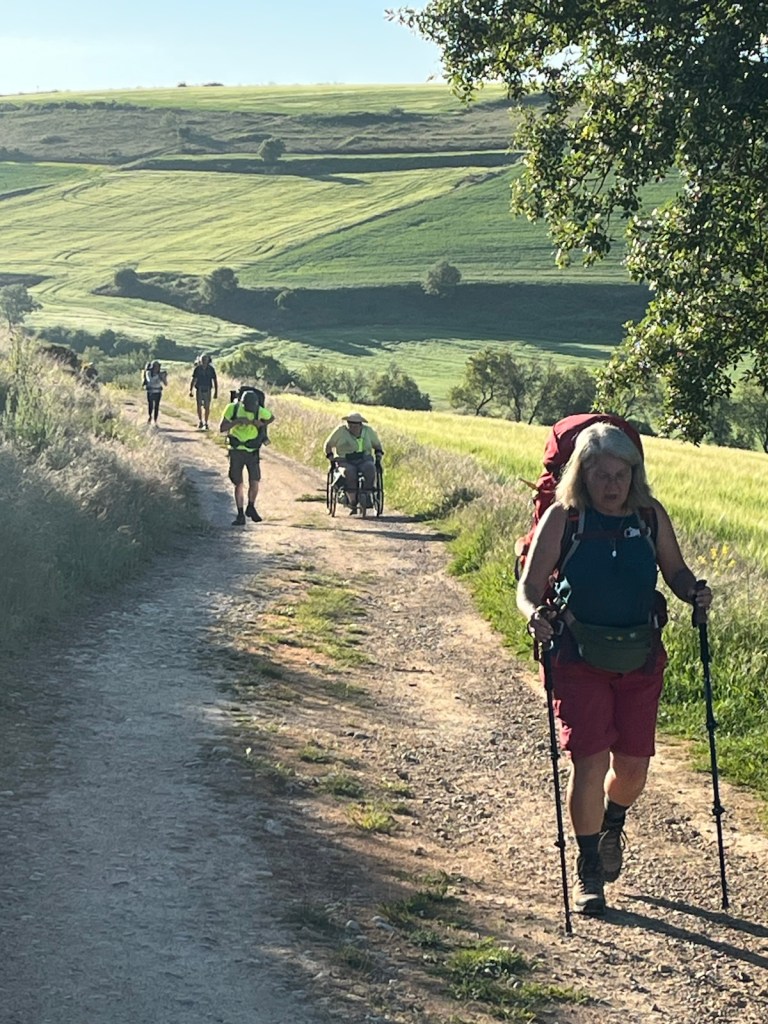
Leaving Hornillos at 7:30.Walking up from the valley towards the Meseta.Near the top… pilgrim in wheelchair gaining on us!Reaching the Meseta after a 2 mile ascent.More MesetaApproaching San Sol and the walk down to the valley, then returning to the Meseta.Back onto the Meseta.The Meseta seemingly endless after 6 miles.At last, our first view of Hontanas and the walk down into the town.Breakfast stop as we entered Hontanas.
Our room was ready at 11:30 and soon after we were checked-in and resting in our room.
Our hostal, Fuentestrella, has only been open since the beginning of the year. Owned/operated by family, son, mother, father.The view from our double room w/ bathroom.
We had a simple meal for lunch, and later, a smoothie and drinks, all conveniently prepared in the hostal.
We walked a few blocks from our hotel and got a taxi to take us to Tardajos, a small village on the outskirts of Burgos, skipping the long walk through urban areas, residential areas and a complex system of expressways. The ride took about 10 minutes.
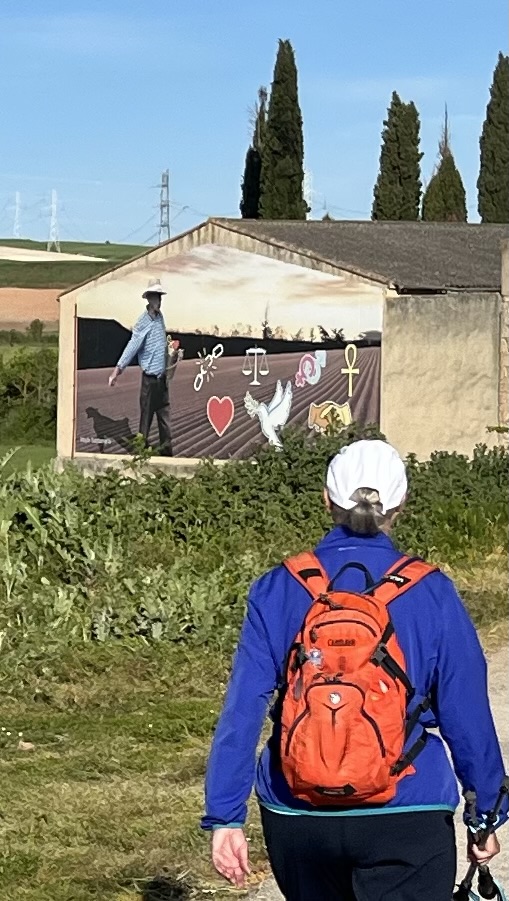
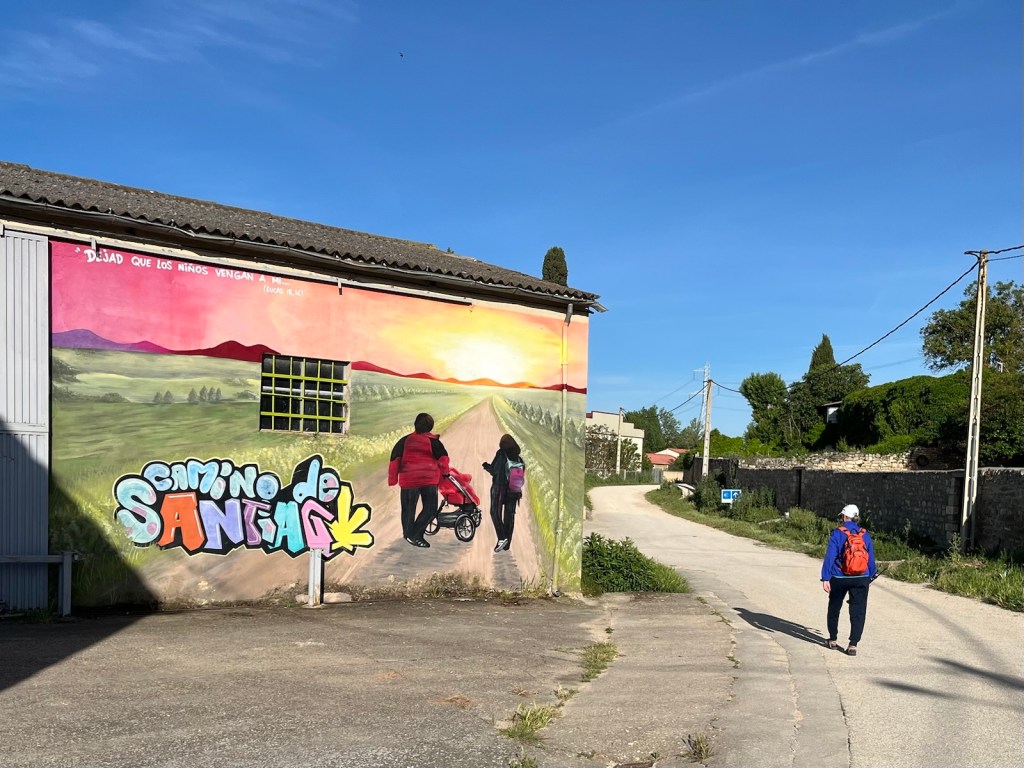
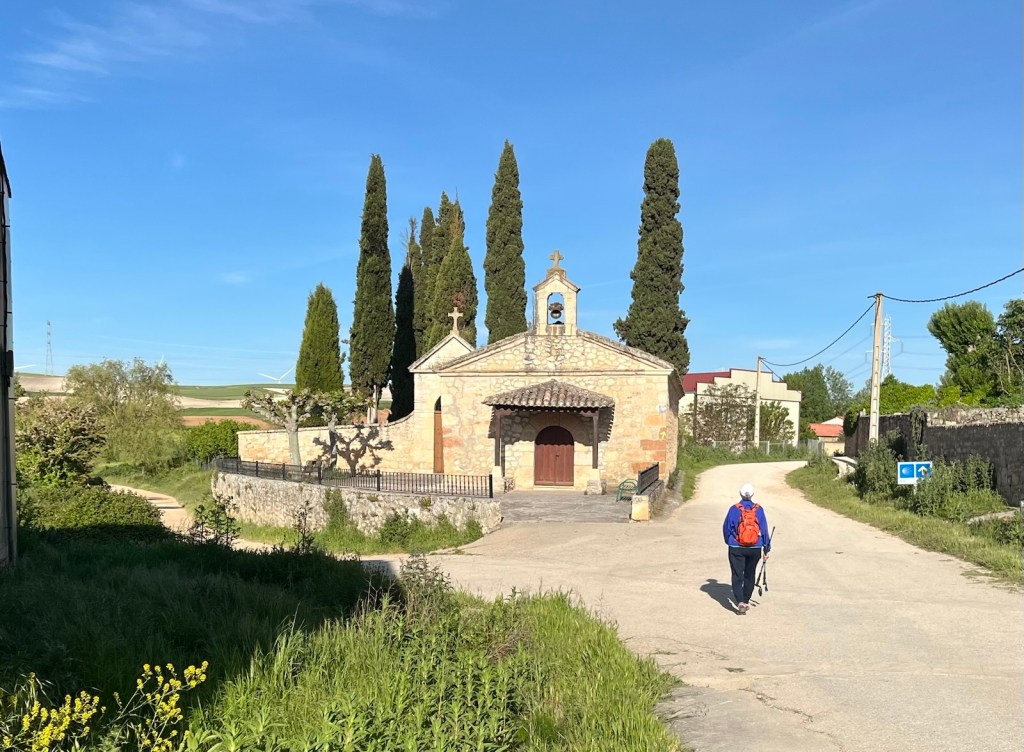
Walking through a very quiet Tardajos this morning.Storks were in their usual hangouts on top of Iglesia de Nuestra Señora de la Asunción.We walked on pavement from Tardajos to Rabe de las Calzadas where we stopped for breakfast.We always stop at the Restaurant-Hostal Fuente de Rabe for breakfast. It’s usually the only place open for food or a reststop for the walk all the way to Hornillos. It also has delicious toastadas. The staff is exceptionally friendly and welcoming.Many of the buildings on the way out of Rabe have beautifully painted murals on them with religious or humanitarian themes.Another colorful mural on the way out of the village.Small hermitage was the final landmark as we began the walk up onto the meseta.It took nearly an hour to walk the gradual slope to the meseta.We finally reached the meseta, with its vast grain fields. For the first time we are seeing this in green, whereas in the past, during our summer and fall Caminos, it was always amber or brown due to mature crops or recently harvested ones.We walked on and on and on…
The Meseta is not an autonomous region, but rather a geographical area within the region of Castilla y León—the largest region in Spain. This central high plateau makes up 40% of Spain, with elevation ranging from 400-1000m.
The Meseta has a reputation for being boring, repetitive and bleak. However, there is a certain beauty and awe in the endless horizon and wide open space.
The lack of trees means little to no shade. Towns are often set down in shallow river valleys, practically invisible along the horizon until a few hundred yards from the entrance.
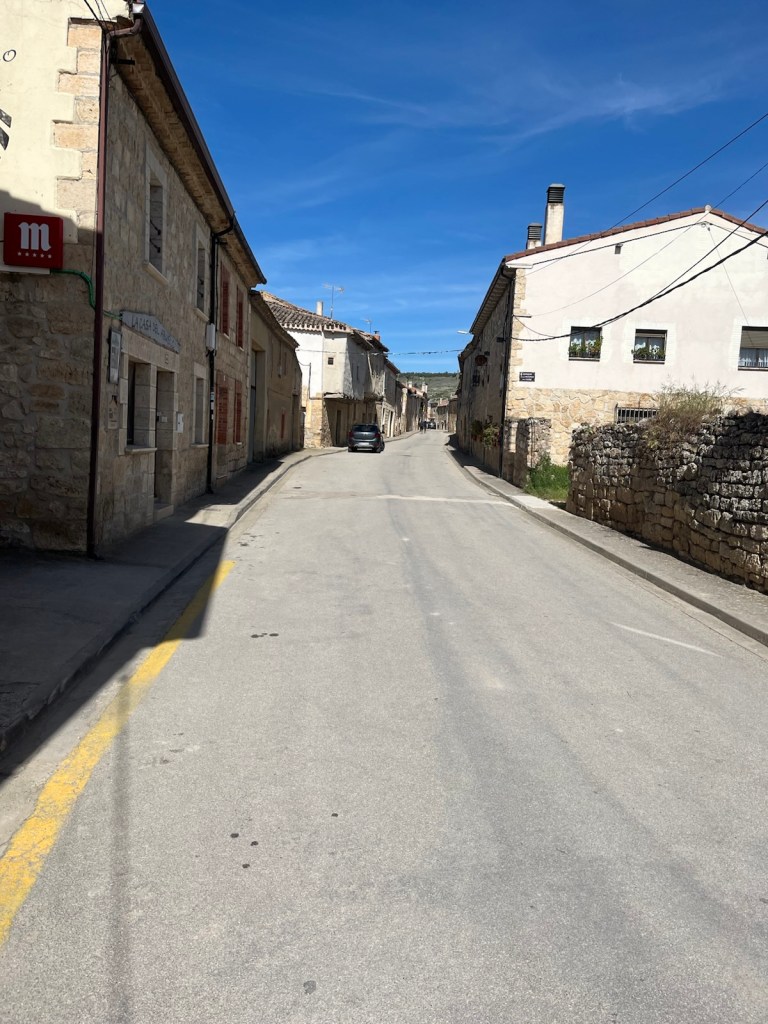
Just before we saw Hornillos, the red Templar cross appeared on the right. This marked the beginning of ” Mule Killer Hill”. Mule Killer is an appropriate name as soon as you experience the path dropping off rapidly before you.The descent is about a mile long.The beaufiful view on the way down is a welcome distraction to the steep descent.Looking back once we got to the bottom. No killed mules were observed today, thankfully.The street (only one) of Hornillos (pop. 61) was relatively quiet when we arrived at 10:30.We found a comfortable seat outside a favorite store, “Km 469” (usually open, food, restroom), to wait for Albergue Meeting Point to open at noon.
We checked in at 12:00 and signed up for the traditional paella dinner, dropped off bags in the room and returned to the store to have the owner prepare us a lunch.
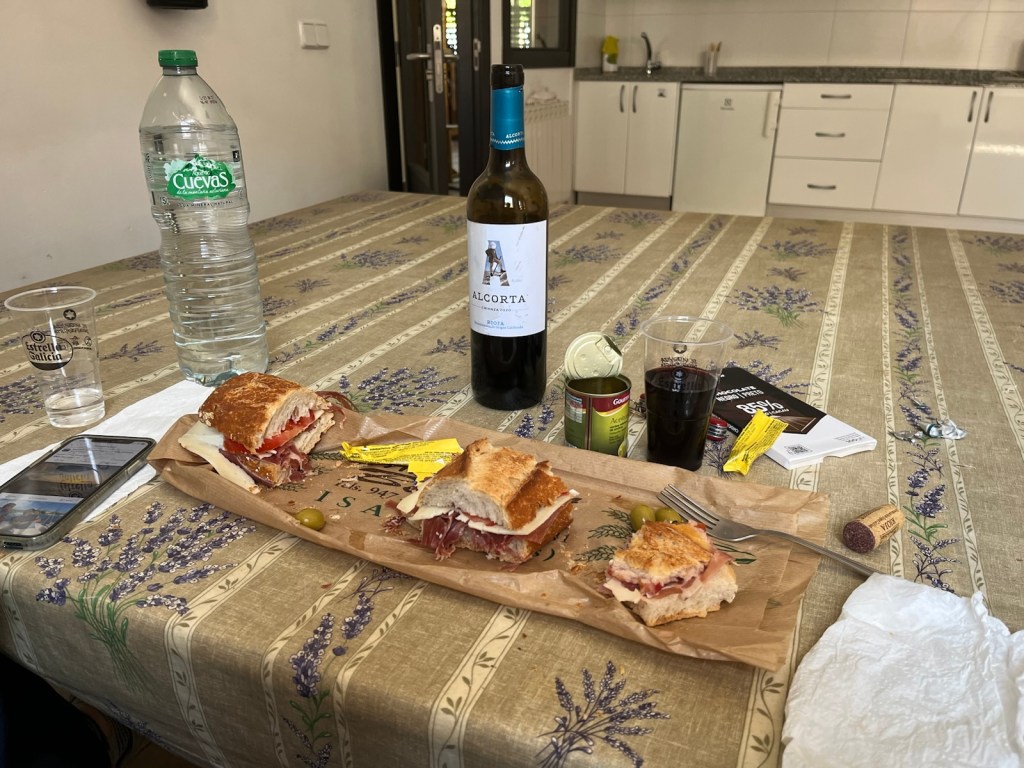
Back at the Meeting Point kitchen, we had our lunch of ham/cheese/tomato sandwich, olives, wine and chocolate for dessert.
After lunch we retired to our room and chilled and chored until dinner time at 7:00.
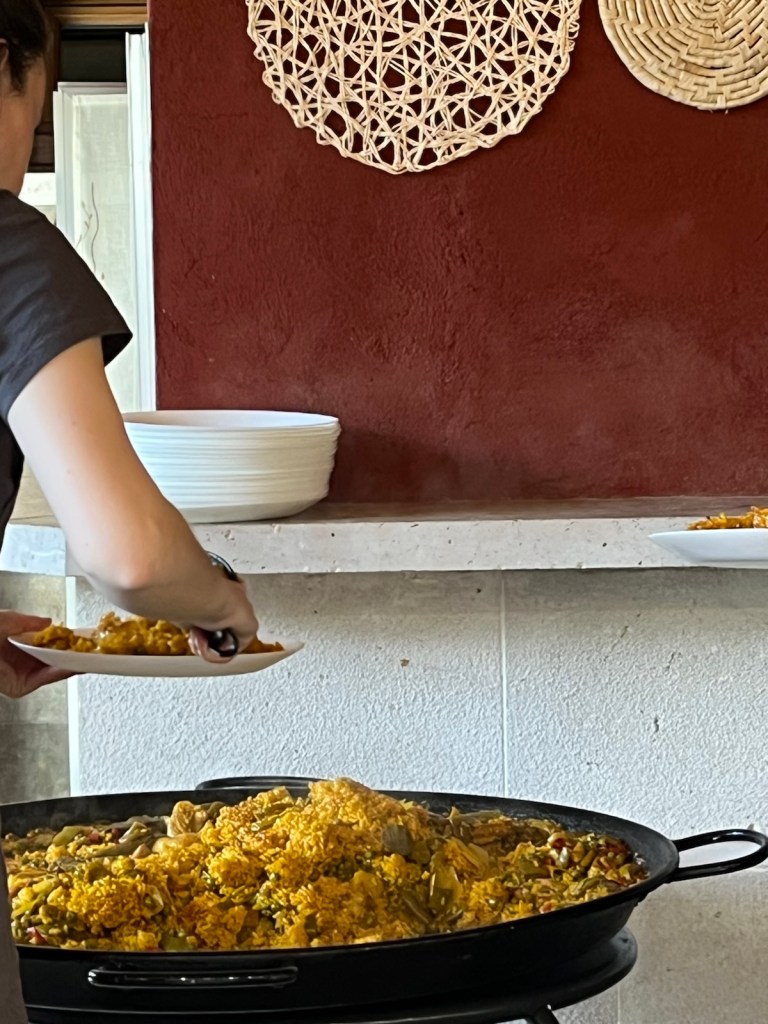
Our host serving from a huge paella pan that has been simmering for several hours working up pilgrim appetites throughout the albergue prior to dinner.
As always we had great conversations with fellow pilgrims during dinner. There were about 30 seated at the table and ironically our conversations were with 6 nearby pilgrims who were all from the US.
Our hostess/owner cleaning up at 8:30 as pilgrims began heading back to their rooms.
Today is a planned rest day. It is also Linda’s 80th birthday!
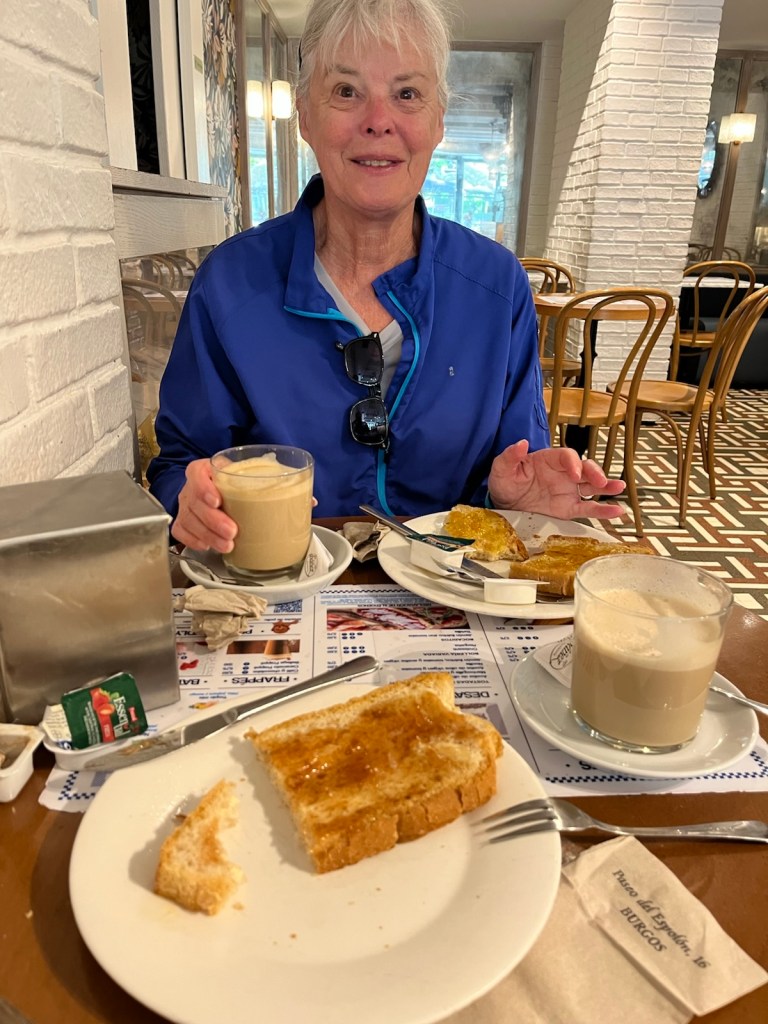
We began the day by sleeping in. Next, we had a leisurely breakfast at one of the few cafes open in this city of 200,000 people on a Monday morning at 9:30!!
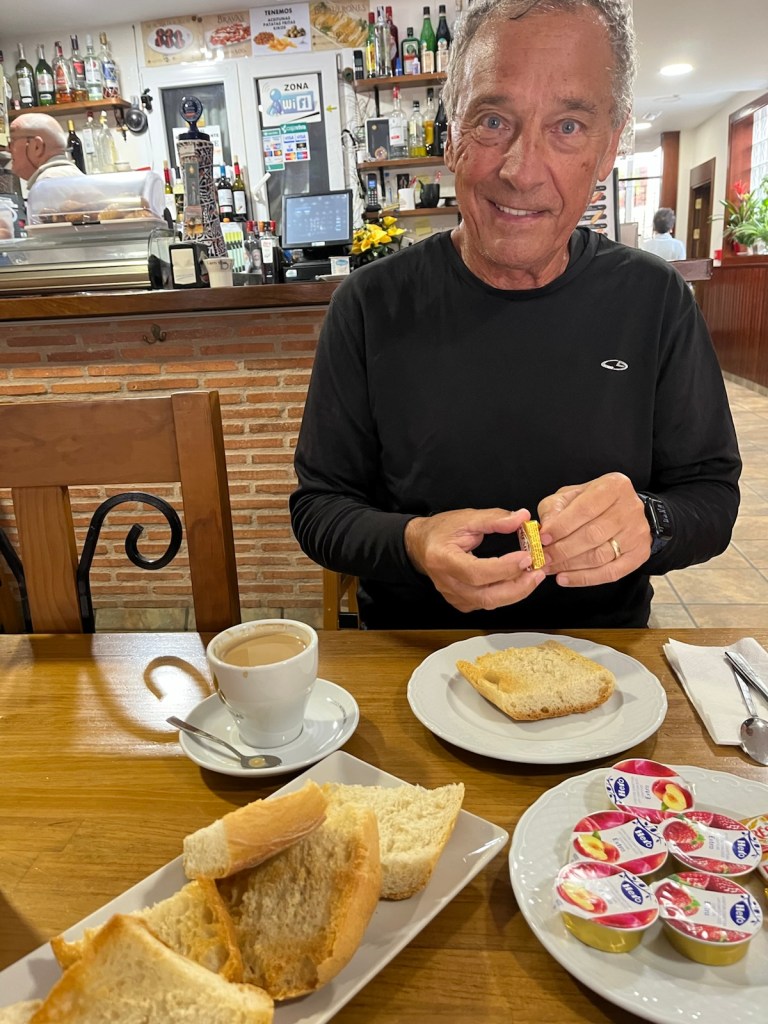
While this cafe specialized in sweets such as churros, we opted for just plain toast, which. was fresh and soft. The large, hot cafe con leche was also welcome on this cool (49F) late May morning.
On the walk back to our room, we stopped by two different ATM’s to replenish our stash of €€€, to carry us through to Leon.
Back at our room, we continued enjoying the day off and leisurely reading, blogging and napping.
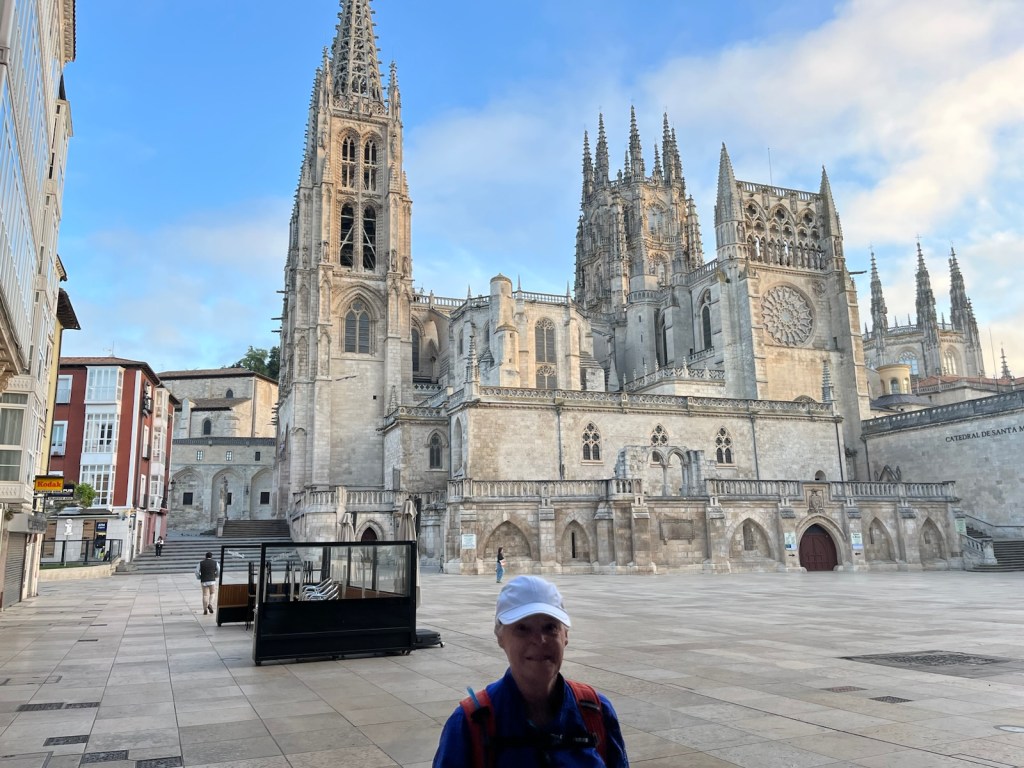
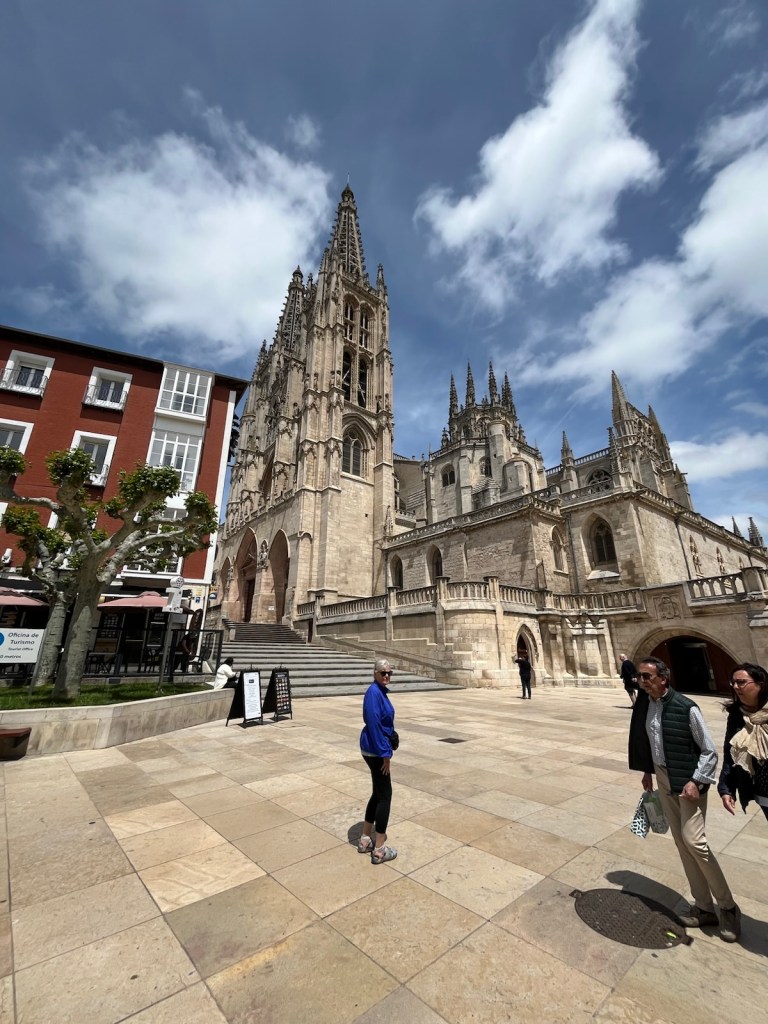
Walking by the Catedral as we scouted out potential lunch spots.
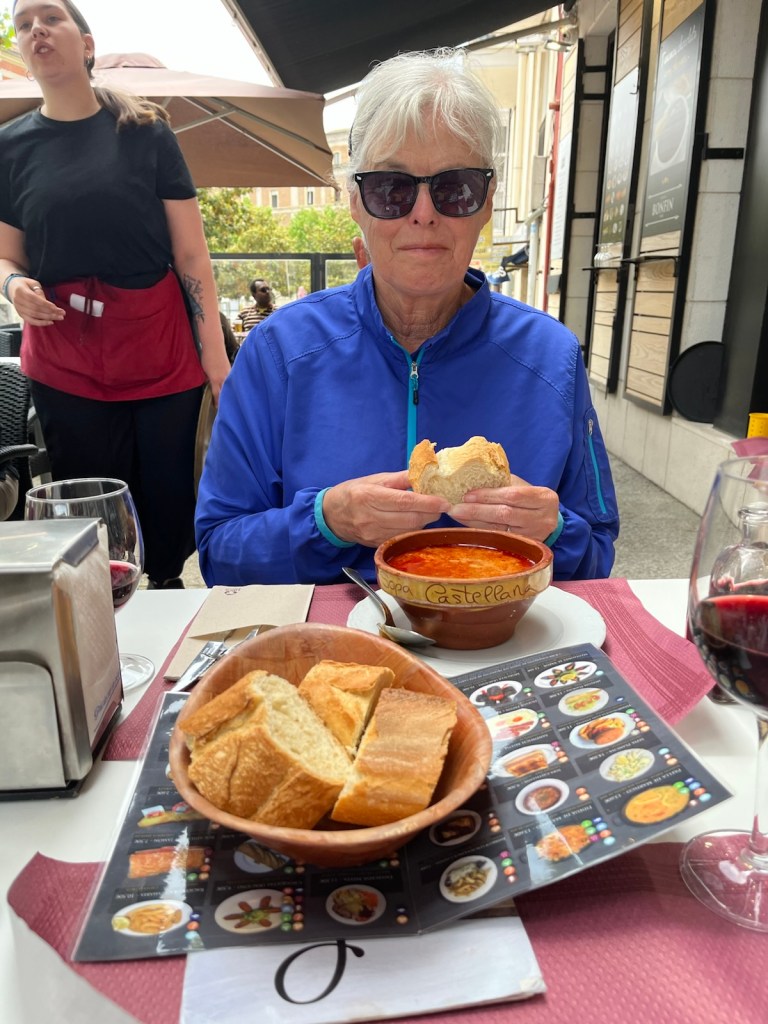
At 2:00 we walked to a nearby restaurant and had our main and probably only meal.
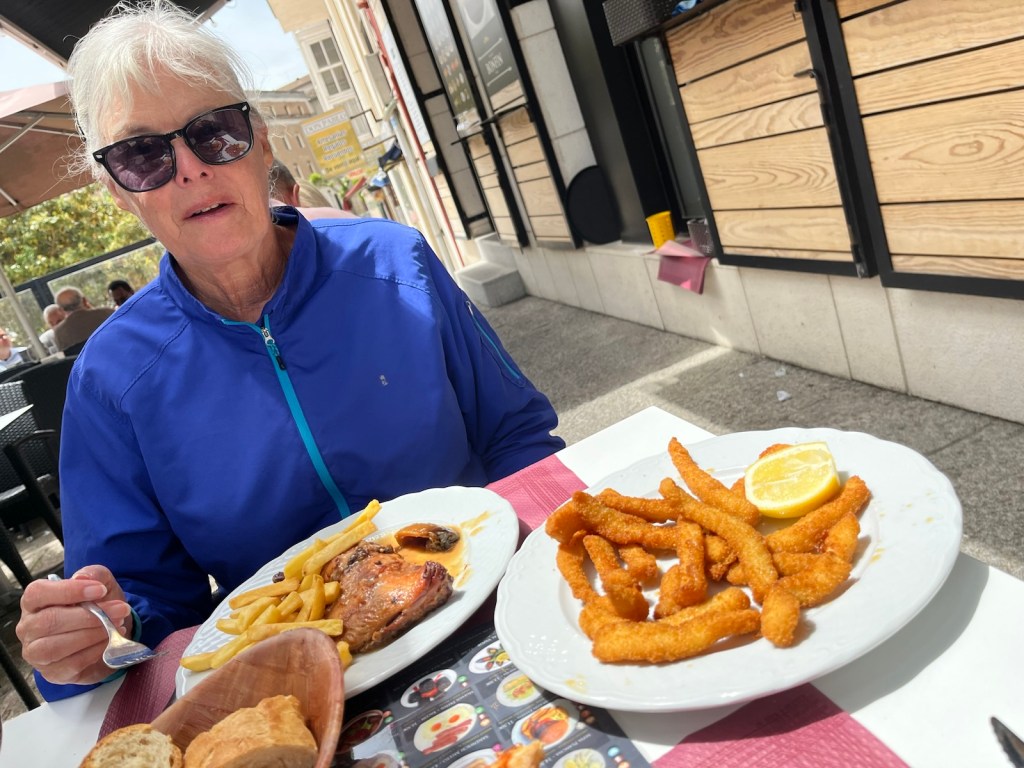
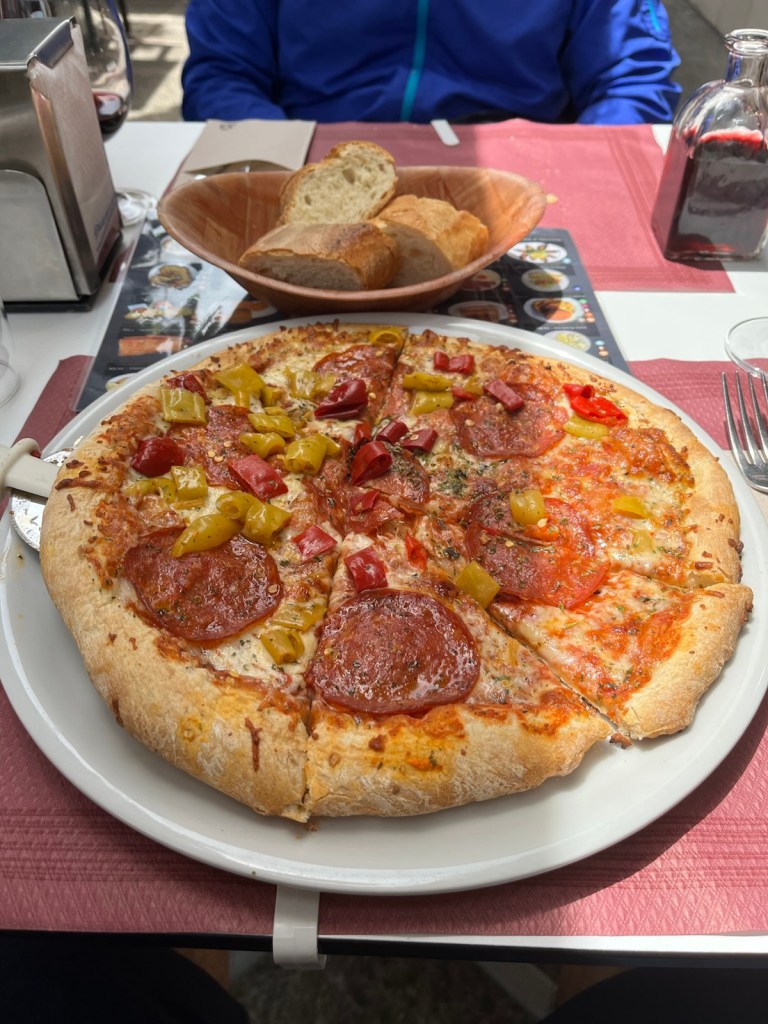
Linda didn’t care for her soup, so she moved on to her next course of chicken with lemon sauce.We also split an order of calamari. The chicken and calamari were good.And Jim had a pepperoni and peppers pizza.
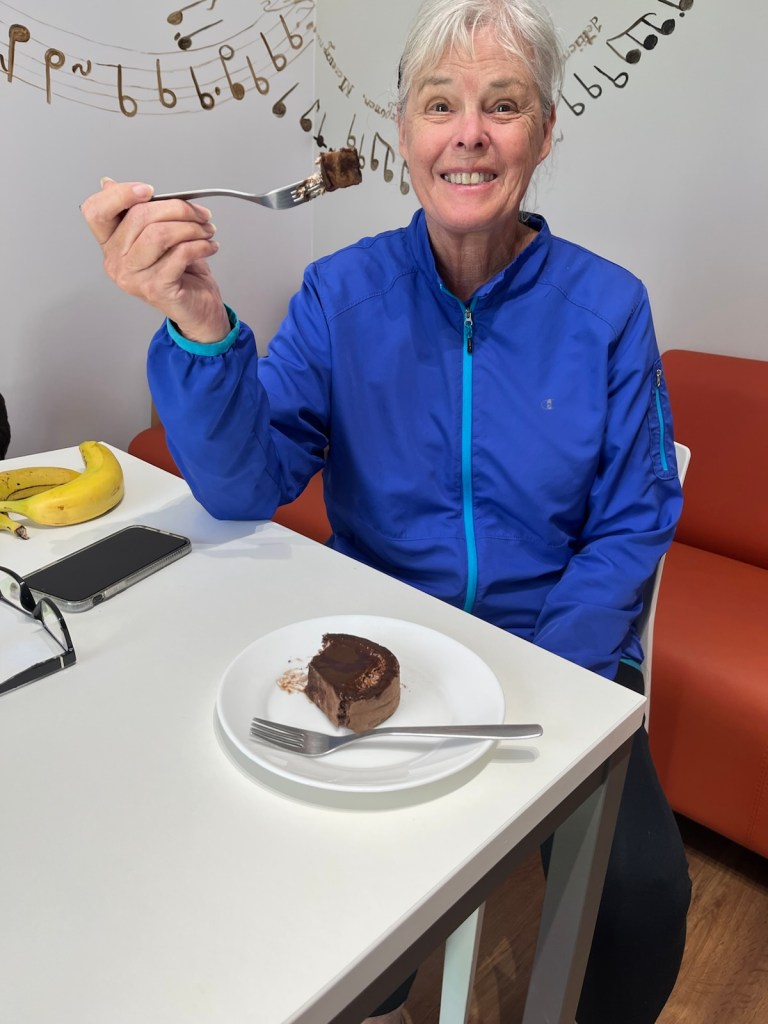
We wrapped up the dessert and carried it back to our room.



























 Jimandi